Homeless at 66, a Widower Hid in an Abandoned Rail Depot to Survive the Ice Storm — What It Held…
Homeless at 66, a Widower Hid in an Abandoned Rail Depot to Survive the Ice Storm — What It Held…
At 66, Amos Whitfield had stopped expecting his son to look him in the eye.
So when Lyle drove him out to the old depot at Cutler Siding and called it a few quiet weeks in the family place, Amos almost believed him. Then Lyle held out his hand for the phone.
He already had the truck keys, the envelope with $2,400 from the sale of Amoss lathe, and the box that held the last of Pegs things. And he drove away without once looking in the mirror.
The nearest town was 19 miles off. That night the ice came.
On the third morning, Amos found one square of platform where the frost would not hold, and under his boot heel the wood rang like steel over a railroad car his son had once dug for and never found. To understand what was down there, you have to start with the afternoon he lost everything.
The road out to Cutler Siding had not been graded in two years, and Lyle drove it like a man who resented every rut. Every few minutes he glanced at the silver watch on his wrist as if the afternoon owed him money.
Denise sat in the backseat with her coat buttoned to the chin and a paper sack on her knees. She had said hello at the curb outside the motel where Amos had been staying for nine days.
She had not said anything since. It was the country Amos had grown up in, and he had not driven this road in 45 years.
Long brown hills, bare cottonwoods, and to the west a hard, low pewter sky.
Its only until January, Lyle said to the windshield.
Maple Terrace has the waiting list.
Soon as a bed opens, they call me and I come get you.
You said that about the motel, Amos said.
The motel was $80 a night, dad. Lyles voice was patient, the careful, reasonable patience of a man explaining a bill to a child.
This place is free. Grandpa left it to the family and nobodys been out here since.
Its got a stove, its got a roof. You grew up here.
Id think youd want to see it. The depot came up over the last rise the way it always had, small and square and yellow against the gray, as if somebody had set it down by hand and forgotten to come back for it.
A little board and batten station with a steep shingled roof and a telegraph bay window over the tracks.
Its paint gone the color of old mustard.
The platform ran 60 ft beside the rails and the rails had rusted to the brown of a dead oak leaf.
At the far end stood the freight shed, its door hanging on one hinge. Lyle parked and did not turn off the engine.
He carried Amoss two bags up the steps himself. Then his phone buzzed in his vest pocket and he said, I have to take this and walked out to the end of the platform with his back turned.
Amos could not hear the words. He could hear the tone.
A man promising he would have it by Friday and that nobody needed to call his wife. When Lyle came back, his face had been put away again, neat as a folded shirt.
He held out his hand, palm up. Im going to need the phone, Dad.
What for? Its on my plan.
Theres no signal out here anyway.
Itll just drain in the cold.
Ill hold on to it for you.
Bellwood is 90 miles, Lyle. Lyle kept his hand out.
It did not waver. Amos looked at the clean pink palm and the gold ring and the watch and he thought about the spring afternoon after his fall when Lyle had pulled a chair up to the hospital bed and laid a stack of papers on the blanket.
Power of attorney.
Just paperwork, Dad.
You shouldnt have to think about the electric bill with a cracked hip. And Amos had signed because he was tired and because it was his son and because Peg had been gone two years by then, and there was nobody else in the room to ask.
By the end of that summer, the house on Locust Street was sold, $187,000 for the care home.
Lyle said, for your future. The truck went in October to cover the deposit, and the keys had gone into Lyles pocket before that.
You shouldnt be driving, Dad.
Its the safe thing.
Everything Lyle had taken from him, he had taken in that same soft voice, the voice of a man doing a hard kindness.
Amos had never once heard him raise it. He put the phone in his sons hand.
Thank you, Lyle said, and meant it, which was the worst part. Then Lyle went to the car and came back with the cardboard box, the one Amos had packed himself on the last morning on Locust Street, Pegs reading glasses, her recipe tin, her hairbrush with a few gray hairs still caught in it that Amos had never been able to pull out.
Everything of hers but one green glove, the left of the pair she had knitted him the winter before she died.
That one he kept in his coat pocket because the right one had gone missing in the move, and he had looked for it three times.
Ill keep this at the house, Lyle said. Its damp out here.
You dont want her things ruined.
Thats mine, Lyle. I know its yours.
Im keeping it safe for you. He shifted the box against his hip.
Dad, we just want you somewhere you cant fall. Thats all this is.
Amos looked past him at the car. Denise was watching through the back window, her face very still.
For a moment, he thought she would open the door and say something, anything at all. She looked at him, then she looked down at the paper sack in her lap.
She did not open the door. Lyle set the box on the backseat beside his sister, then remembered the sack and brought it up the steps.
Something for tonight. Inside were two bruised apples in a bag marked half price, a sleeve of sardines, a jar of peanut butter, and a can of chili with a red clearance sticker on the lid.
Amos looked at the sticker for a long moment. Lyle had never bought anything on sale in his life.
Ill come out in a week or so, Lyle said, check on you. He got in the car.
Amos stood at the top of the steps with the sack in one hand and his other hand closed around the single glove in his coat pocket, and he watched his son back the sedan around in the gravel and start down the long road, the tail lights winking red in the dusk, the dust hanging behind in a pale line across the hills.
It did not stop at the rise.
Neither of them looked back.
He stood there until the sound of the engine was gone, and there was nothing left but the wind in the dead grass and the tick of old boards cooling under his feet.
Then it was just Amos and the depot and the dark coming down.
He was turning to go in when he heard it from the freight shed at the far end of the platform, a long, low, rasping sound, like a saw drawn slowly through green wood, then a thump against boards, then nothing. He took the hatchet from the chopping block by the steps and walked the length of the platform in the last gray light.
Inside the shed it was dim and smelled of old hay, and in the far corner where the wall boards were tightest stood a mule. She was dappled pale gray like a winter sky with the clouds coming apart, and she was thin.
He could count her ribs from the doorway.
Burrs and dried mud had matted into her short mane. A faded red rope halter hung on her head.
She had one white sock on her left hind leg. She turned her long head and looked at him with dark, patient eyes, and she did not shy.
She only looked the way an old woman looks at a stranger on her porch, deciding.
Well, Amos said, his voice came out rough. He had not used it since the car left.
Who left you out here, too?
The mule flicked one long ear.
He had two bruised apples in the sack.
He knew exactly what an apple was worth, 19 miles from town. He cut one in half anyway and held one half out flat on his palm, fingers together, thumb tucked, the way his father had taught him.
Her lips were soft and whiskered and warm. She took it so gently he barely felt it.
Then she took the other half. Then she stepped forward and laid her long gray forehead against his chest and stood there, breathing.
Amos put his hand on her neck. Under the burrs, she was warm.
All right, he said.
All right. He broke the skin of ice on the rain barrel by the back step with the heel of his hand and carried her a bucket of water, and she drank it to the bottom.
He led her down the platform and tied her under the lean-to against the back wall, beside the stovepipe, and she dozed there with one hind hoof cocked, as if she had stood in that exact spot a thousand times before.
The first drops hit the roof an hour after full dark, a light, glassy patter on the shingles, too hard for rain and too soft for hail.
And when he held his flashlight against the bay window glass, he saw each drop freezing where it struck.
Freezing rain. It came down like varnish, coat after coat, on every wire and branch and board until the whole world was locked in glass and the trees began to split under the weight.
He found the pot-bellied stove right where it had always been, its pipe running crooked up through the ceiling.
And in the telegraph bay, on the scarred oak table under the window, he found a kerosene lamp. He picked it up and shook it out of habit.
It sloshed. It was nearly full.
The depot had stood empty two years.
Kerosene does not sit full in a lamp for two years in a building with broken weather stripping. Somebody had filled this lamp, and not long ago.
He did not know what to do with that, so he set it down and went looking for wood. Under a canvas tarp in the lean-to sat a stack of split cottonwood, maybe two weeks of wood if he was careful.
He carried in an armload, then another, the ice already ticking on his shoulders. On the telegraph table, beside the lamp, sat a small tin of kitchen matches.
He counted them out on the oak, 11.
Several heads had gone soft with damp.
He was a machinist.
He had spent 41 years making metal do exactly what he told it to, a thousandth of an inch at a time, and he went at the stove the same way. He cleaned the ash out with his hands.
He tore the saltine sleeve into strips and twisted them, split a cottonwood stick into slivers with his pocket knife and built the kindling into a little cone, the way his father had taught him in this same room 60 years ago, kneeling on this same floor.
The first match broke. The second flared and died.
The third caught the paper and the paper caught the slivers, and he leaned in and breathed on it, slow and steady, the way you would breathe on a cold childs hands, and the flame climbed into the cottonwood and held.
He sat back on his heels.
Eight matches left.
He put the lid on the tin. He lit the lamp from the stove with a twist of paper, and the telegraph bay came up out of the dark in a small circle of yellow light, and he saw his own reflection in the black glass, an old man in a canvas coat with ice melting in his hair, and behind it the freezing rain coming down and down in the lamplight like a curtain of falling beads.
He ate the other apple and half the saltines with his back against the bench and saved the chili. Feed the stove every two hours.
That was as far as he let himself plan. All night the ice came down.
Around two in the morning he woke to a crack like a plank split across a knee and lay still until he understood it was a cottonwood limb giving way out by the creek. More followed.
By dawn he had stopped counting. The morning opened on a world made of glass.
Every blade of grass stood sheathed and bent, and the cottonwoods along the creek stood shattered, their broken tops hanging white.
The mule stood under the lean-to with ice beaded in her mane, warm on the side where the stove pipe ran, and she lifted her head and made a low sound when he came out, as if she had been counting on him. He broke the ice on the barrel with the back of the hatchet and watered her and gave her the last of the saltines one at a time from his palm.
That night the cold came down hard, nine degrees by the rusted thermometer outside the telegraph window.
He fed the stove every two hours and slept in his coat on the bench.
Twice he checked on the mule and both times she was awake, ears pricked toward the freight room. In the morning he understood why.
The sun came up clear and white and the ice on the platform caught it and blazed. Every board was sheathed and shining, every board but one patch.
Near the freight room door lay a square of bare gray wood maybe eight feet across where the ice had not held at all.
The boards there were dry. A thread of vapor, so faint he would not have seen it without the low sun behind it, rose from the cracks and bent away on the air.
The mule had pulled loose before dawn.
She was standing in the middle of the bare square with her head down, and when Amos called her she did not come.
He walked out to her. He set his boot on the bare boards and felt through the sole a warmth that had no business being there, faint as a hand that has just let go of yours.
He lifted his heel and brought it down. The board did not thud, it rang.
A deep, hollow metallic note, like a hammer on the side of an empty tank. Amos stood very still in the white morning light.
He had swept this platform every Saturday as a boy.
Under it there was nothing but dirt and the old cinder bed of the siding. He went into the freight room.
Against the wall that faced the warm square lay a heap of rotted feed sacks. He dragged them away one by one.
Under the last, the floor planks had been cut, a square of them fitted back so cleanly that dust had filled the seams and set flush into a notch.
In one edge was a black iron ring.
He hooked two fingers through it and pulled.
The dust cracked along the seams and the square of planks came up on a hinge with a long, low groan and warm air rolled up out of the dark into his face, warm in nine degrees, and with it the smell of kerosene and oiled wood and old paper. And beneath that, faint and unmistakable, the smell of his fathers pipe tobacco.
For a long moment he only knelt there with his hand on the open hatch, breathing it in.
His father had been dead two years.
His father had not spoken to him in 45 and the smell of his fathers tobacco was coming up out of the ground at Cutler Siding as plain as if the old man had just gone down ahead of him. A wooden ladder ran into the dark.
Amos fetched the lamp and lowered himself one careful rung at a time, the way a man with a mended hip learns to go down anything.
Eight rungs.
At the bottom a short tunnel ran off under the platform, shored with old railroad ties, and 12 stooping steps along it the lamplight found a wall of weathered gray planks with an iron handle set in it. It was the side of a boxcar.
Somebody had buried a whole railroad car under the platform and dug a tunnel to its door. He slid the door.
It rolled on its track as easily as a drawer and he stepped in.
It was a room, long and narrow and dry.
The plank walls rubbed dark with oil.
Two bunks with gray wool blankets folded square, shelves of jarred beans and tomatoes and peaches, tins of crackers, a sack of sweet feed, two red cans of lamp oil, a kerosene heater with a full tank, a thermometer on a nail that read 52° because the ground does not freeze 10 ft down and a man who knew that had built a room where the cold could not follow.
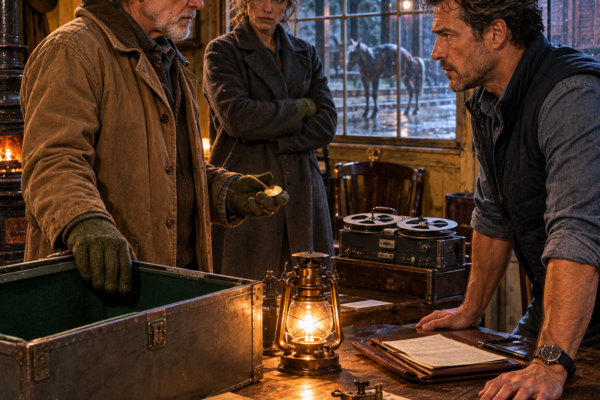
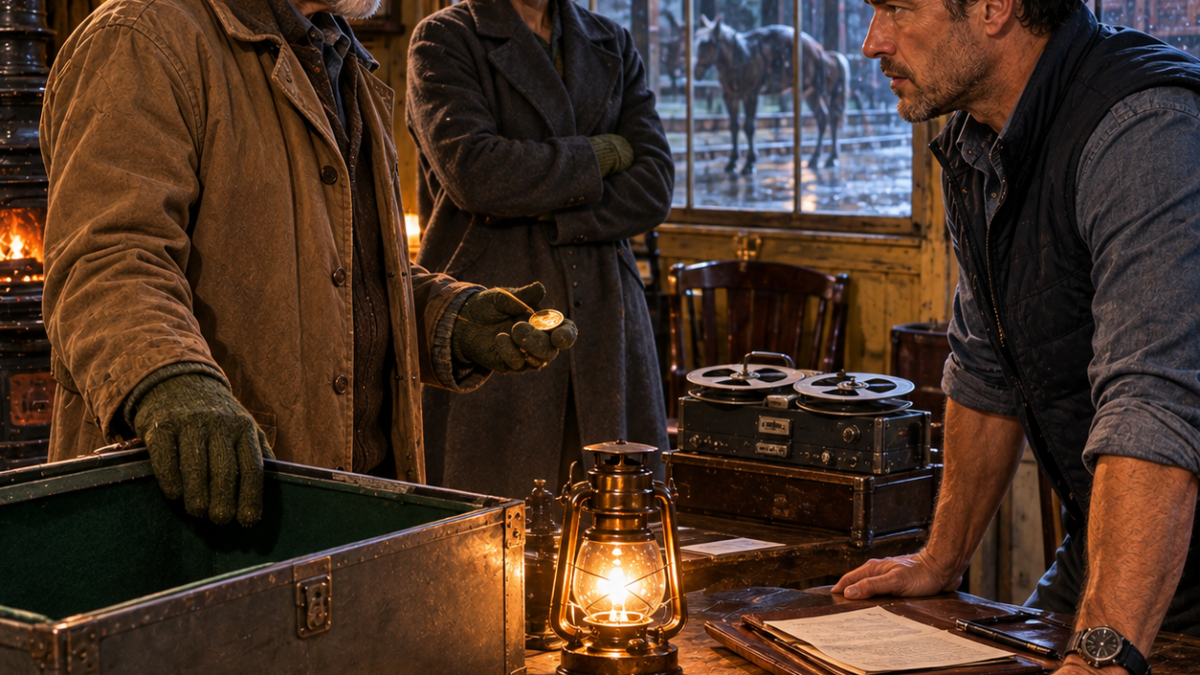
And against the end wall, under a shelf of photographs, a small desk and on it a portable reel-to-reel tape recorder in a scuffed brown case.
Beside the recorder lay five flat cardboard boxes numbered in grease pencil 1 through 5 and a tin of batteries with a strip of tape across the lid. On the tape, in a hand Amos had not seen in 45 years, fresh as of March.
He sat down on the nearest bunk because his legs had decided for him.
The photographs faced the desk. His mother on the depot steps in a flowered apron, Amos at nine with a broom taller than he was, and then pictures he had never given anyone.
Amos and Peg on the courthouse steps on their wedding day. Lyle at four in a cowboy hat.
Denise with a missing front tooth.
School pictures year after year, the kind that come in a paper folder.
He fitted the batteries with fingers that would not quite work, threaded the first reel, and pressed the key. The tape hissed.
A man cleared his throat close to the microphone. Is this thing going all right?
Amos shut his eyes.
Amos, this is your father.
If youre hearing this, Im gone and youre down in the car, and Im glad you found it. I dont know who brought you out here.
I expected wasnt anybodys kindness.
sorry for that part.
You walked out that door in 1981, and I told you not to come back. I was wrong.
I knew it before you reached the road. I didnt go after you because I was proud, and I thought youd be home by Christmas.
Then you were married, and then you had children, and every year it got harder to pick up the telephone because every year there was more to apologize for. Thats how it goes with men like us.
The silence grows interest. So hear this before anything else.
I never once stopped being your father.
You just stopped being in the room.
You were never cut off, son.
You were only out of earshot.
I bought this car off the railroad for $40 the year they closed the line and buried her where the old coal bin was. Storm cellar first.
Now shes yours.
Everything on these reels is for you.
Play them in order.
You always did skip ahead.
A breath, then quieter.
Im glad youre out of the ice.
The reel ran on in hiss for a long time.
Amos sat with his hands over his face and did not stop it.
When he looked up, he saw the door. On the inside of the box car door, carved deep at eye level and blacked in with stove polish were two lines in square capitals, the lettering of a man who had stenciled a great many freight crates.
A door you walk out of is still a door. I kept it oiled.
He ran his hand along the iron track. His fingers came away slick and dark, the heavy grease of a man who had oiled that door every week, whether or not anyone would ever use it because the oiling was the point.
On the desk lay an index card. It was not tender at all.
It was a list.
Stove pipe in the waiting room leans. Wire it to the hook above.
Hand pump under the sink needs priming.
Jug of water under there for it.
Sweet feed is for the mule. Half a coffee can, morning and night, no more.
Keep off the north end of the platform.
The boards are rotten over the old cistern.
Front door hinges are greased.
Keep them that way.
The mule. His father had known there would be a mule.
Amos climbed the ladder with the sack of sweet feed over his shoulder and the oil can from the shelf in his pocket. He measured half a coffee can into a bucket and the gray mule put her whole face into it and blew.
Then he went around to the front of the depot, to the door where he had stood watching his sons tail lights go and knelt on the iced step and worked the spout into each of the three hinges, slow and thorough, until the door swung under his hand without a sound. Some people leave behind money and some leave behind a door that still opens.
He stood on the step a while with the oil can in his hand.
Then he did the rest of the list because it was a list and his father had written it for him. He found the hook in the waiting room ceiling, a bent spike his father must have driven years ago for exactly this and a coil of baling wire hanging from it.
He climbed onto a bench, took two turns of wire around the leaning stove pipe and two around the hook and twisted the ends tight with his pliers until the pipe stood true. He found the jug under the sink, a gallon of water gone cloudy but still water, and poured it slowly down the throat of the old cast iron pump while he worked the handle.
Nothing. Nothing.
Then a gasp and a cough deep in the pipe and a cold, clear stream ran into the basin, and he stood over it with his hands under it until his fingers ached. Water, fire, food, a door that opened.
That morning he had been sure of none of them.
He filled the kettle and set it on the stove, and when it had begun to tick, he went back down the ladder to play the second reel. The second reel was about the depot.
Ezra told it the way he had told everything, in plain order, start to finish. How he had bought the station and its 40 acres from the railroad when the branch closed for less than a good pickup cost.
How the town had laughed at him for buying a building that sat at the end of nothing.
How he had kept the telegraph table because it had been his own fathers.
How he had lit the lamp in the bay window every night, every single night, because a depot with a lamp in the window is a place a man can find in the dark. He did not say who he meant.
He did not have to. The third reel was about Amoss mother.
It was the hardest to hear.
Ezra described the funeral, 20 years back, in the little cemetery outside Bellwood.
He described seeing Amos at the edge of the crowd in a dark suit, with Pegs hand on his arm, and their two grown children beside him. He described walking toward him after the last prayer, with every intention of putting out his hand.
And I got within 10 feet of you, the voice said, and I could not find one word, not one.
40 years of words saved up, and I stood there like a fence post.
You looked at me, then you turned around and walked to your car, and I stood there and let you. I have been finding that word ever since, Amos.
I found it about a week later.
It was sorry. Its a short word.
It took me a week. Amos remembered that day very clearly.
He remembered the long walk to the car.
He remembered thinking that his father had come toward him only to him off.
The fourth reel was shorter.
The voice was older on it, thinner, the breath coming between sentences. Your peg passed.
I read it in the Bellwood paper. Im sorry, son.
She was a good woman.
She wrote me, you know, every Christmas for 30 years, sent pictures of the children.
Never once told you Id guess because she knew youd tell her to stop and she knew I needed them. You married better than you deserved.
So did I. After she passed, I called the boy, Lyle.
I asked him to bring you out here.
I asked him to tell you your father wanted to see you.
I said Id pay for the gas. He said hed ask you.
He called back two days later and said you didnt want to come, said youd said there was nothing out here for you.
I believed him. I shouldnt have.
A man who wouldnt come to the phone himself isnt a man whod send a message back by his son. I knew you better than that.
I just didnt want to know it badly enough to drive to town and find out. The tape went quiet.
Amos sat very still on the bunk.
He remembered the kitchen on Locust Street the week after Pegs funeral.
The casserole still stacked on the counter under foil.
He remembered Lyle leaning in the doorway with his car keys in his hand, saying it in that same reasonable voice.
I called Grandpa, Dad, to let him know about Mom.
I asked if he wanted to see you.
He said theres nothing out there for you.
Im sorry. I thought youd want to know.
He had wanted to know.
He had carried it for three years like a stone in his shoe, and it had never once been true. Lyle had stood in two doorways and told two old men the same lie, each in the others voice, and walked away and left them both to it.
Amos did not shout.
There was no one to shout at, and he had never been a shouting man.
He sat with his hands flat on his knees and let it go all the way down through him until it reached bottom. And when it got there, it was not rage.
It was something colder and more useful.
It was attention.
Why would a son do that? He did not know yet.
But he had spent 41 years at a lathe, and he knew that when a part comes off the machine wrong, you do not curse the part. You find the place in the setup where somebodys hand slipped.
He reached for the fifth box. It was empty.
The cardboard was the same as the others, the number five written on the lid in the same grease pencil.
But there was no reel inside, only a faint ring in the dust on the bottom where a reel had sat for a long time and then had not.
He turned the box over. Nothing.
He checked the shelves, the bunks, under the blankets, behind the jars. He checked the recorders lid.
He lifted the desk blotter, and under the blotter laid flat as if someone had wanted it found only by a man who lifted things.
He found a key. It was brass, long and heavy with a squared bit and a stamped bow, the kind of key a railroad man would know in the dark.
A switch key, the kind that unlocked the padlocks on the track switches so no one could throw a switch who had no business throwing it. A paper tag hung from it on a loop of string, and on the tag, in the same hard capitals as the door, were three words: When Youre Ready.
There had been no switch at Cutlers Siding in 36 years.
The siding track had been pulled up the year the line closed, nine years after Amos left. He had read about it in a newspaper in a city two states away and turned the page.
He turned the key in the lamplight and did not know what it opened.
Above him, faint through the earth and the platform boards, the mule stamped once on the ice, then twice, then stood still as if she were waiting for him to come up and look at something.
He came up out of the car to find the mule standing at the far end of the platform, past the warm square. Her long ears turned toward the county road.
Amos followed her gaze.
Nothing moved out there but the glare.
He stood beside her a long time in the cold with the switch key in his pocket, and then he went in and fed the stove.
And that night, for the first time in weeks, he slept the whole night through on a bunk his father had built.
The truck came the next morning.
He heard it before he saw it. The slow clank of tire chains on ice, and he went out onto the platform in his coat with the hatchet in his hand.
Not because he meant to use it, but because it was what he was holding. An old green pickup crawled over the last rise and down the glazed road at the speed of a walking man and stopped beside the platform, and the engine coughed off.
The door opened. A small woman climbed down in a red plaid coat and a mustard yellow scarf, rubber boots, round wire glasses.
She was very old and very upright, and she looked at the smoke coming out of the depot chimney, and then at the mule, and then at Amos, and she did not look surprised by any of it.
I knew it, she said.
I saw the smoke from the county road and I said, either thats a vagrant or its the boy.
And a vagrant would have eaten the mule by now.
Amos stared at her. Something old shifted in his memory.
A chalkboard, a smell of oranges and floor wax.
Mrs.Pell, he said. Saida, at our ages.
She came up the steps, one hand on the rail and stopped in front of him and looked up into his face the way she had once looked at a long division problem he had gotten wrong. Sixth grade, you cried over remainders.
You were the only boy in the room who cried over remainders instead of fists. I told your mother youd do something careful with your life.
I ran a lathe for 41 years. Well, Saida Pell said, there you are.
She turned to the mule.
And you, you rotten faithful thing. Ive been trying to get out here for three days.
She dug in her coat pocket and came out with a carrot and held it flat and the mule took it and leaned her head against the old womans shoulder.
You know her, Amos said. Her names Pearl.
Your father named her after your mother. Said she was the only female on the place stubborn enough to put up with him.
Ida rubbed the long gray neck. He bought her as a weanling the spring your boy turned 15.
When Ezra passed, my nephew Clay took her over to his place four miles east. She got out 12 times that I know of.
Every time she walked straight back here and stood under that lean-to right by the stove pipe where he used to tie her waiting for somebody to light the stove. She looked at Amos over her glasses.
Somebody finally did. Amos looked at the mule.
Pearl blew softly through her nose. You filled the lamp, he said.
Every month for two years. Your father asked me to the last time I saw him.
He said, Ida, keep it full. If he ever comes, hell come in the dark.
She looked past Amos at the depot door at the hinges gleaming with fresh oil. He was right.
You did.
Then her mouth tightened and somebody else came in the dark too last April. Three holes at the north end of your platform dug and filled back in sloppy right where the old passenger cars used to stop.
I told myself it was boys hunting bottles. She did not say what she had told herself after that.
She did not ask him how he came to be there.
She looked at his coat and his stubble and the two bags on the waiting room floor and she let the rest alone.
That was the first kindness, Amos would think later, the not asking. Get your coat buttoned, she said.
Youre coming to town. Pearls got feed and water and shell keep till dark.
Ive got a ham in the oven that wont eat itself, and you look like a man whos been living on saltines.
I cant pay for a ham. No, youll split my kindling next week.
Thats the price, and I dont haggle.
The road to Bellwood took an hour at the speed she drove, chains clanking, the heater roaring and smelling of hot dust.
The country slid by white and broken.
Ida talked a little about the storm and did not need Amos to talk back.
He felt the miles go by under him, 19 of them, every one a mile he would have walked. Bellwood was one street of low brick storefronts with a white grain elevator standing at the end of it like a church.
A feed store, a diner, a post office, a courthouse no bigger than a house.
Ida parked at the feed store to pick up a sack of sweet feed for Pearl, and while she was inside, Amos stood by the bulletin board on the front wall and read the cards out of habit. Firewood for sale.
Puppies, free to good home.
And a white index card in a hand he knew from 30 years of birthday cards. Bass boat, trailer, all gear, 14,000 firm.
Call Lyle. He read it twice.
Lyle had bought that boat four summers ago and named it after his wife.
The young man behind the feed counter knew the name.
Whitfield. Your son was in here last week, he said, friendly as anything.
Asked if anybodyd been out to the old depot lately. Wanted to know how long the road would stay closed after the storm.
He hefted the sack onto the counter.
I told him nobody goes out there.
Amos paid nothing because Ida had already paid and said nothing because there was nothing in him yet to say, but he carried that sentence out to the truck with the feed.
How long the road would stay closed, as if the length of it mattered to somebody. On the way out of town, Ida took the highway past the edge of Bellwood without being asked, and slowed by a raw lot behind a chain link fence.
Half a building stood there, steel frame and bare block, with a sign wired to the fence, Whitfield Self Storage, coming soon. The concrete had weeds frozen in its cracks.
A bulldozer sat at the back of the lot under a skin of ice with no tracks around it. They stopped work in August, Ida said, looking straight ahead.
The contractor was in the diner, saying he hadnt been paid since June. I dont spread talk.
Im only telling you what the whole town knows, so you dont have to hear it from someone who enjoys it.
Amos said nothing. He looked at his own name on the sign.
 [Tap here for the Next Part ]