Part 3: Homeless at 66, a Widower Hid in an Abandoned Rail Depot to Survive the Ice Storm — What It Held…
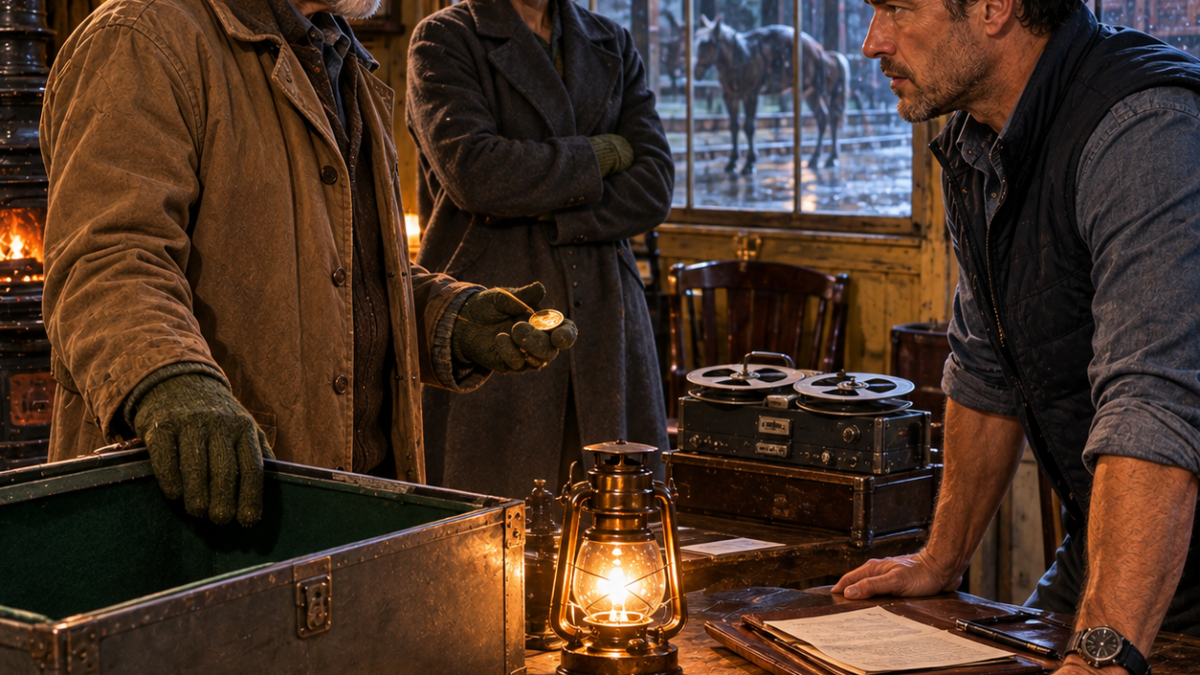
The ice was building on his sleeves, on his cap, on the backs of his hands. He moved two steps nearer the edge where the boards ran out over the cinders and held it higher, and the single bar flickered and held, and Ida answered on the first ring.
The county road was closed at the highway.
A line was down across it near the Hensley place. Clay could bring the tractor at first light, not before.
Was he warm?
Amos told her he would be.
He told her he had company.
There was a short silence on the line, and then Ida said, Well. Then its a good thing he built two bunks and hung up.
The freight room door had glazed shut in its track. He broke it loose with the back of the hatchet, three hard blows, and put Pearls blanket on her and forked her more straw and left her a full bucket.
By the time he came back for the others, the waiting room thermometer read 39 and Denise could not stop shaking. Then he lifted the hatch.
Down there, Denise said. 52 degrees, Amos said.
Mind the ladder.
Its eight rungs.
He went first with the lamp. Denise came after him and then Lyle, last, slowly, as if every rung was a question he did not want to answer.
At the bottom, Lyle stooped through the short tunnel behind the others and stepped into the box car and stopped. Amos lit the heater.
The car filled with its low blue hum and the smell of kerosene.
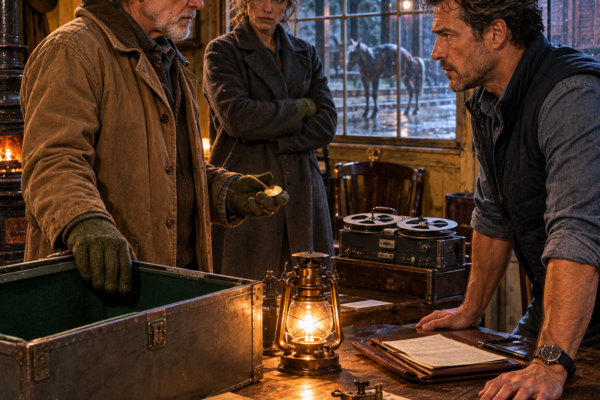
The lamp threw its amber light along the oiled planks, over the bunks and the shelves of jars, over the desk and the recorder, over the carved words on the inside of the door, and over the shelf of photographs where a boy of four in a cowboy hat looked out at the man he had grown into.
Lyle stood in front of that shelf for a long time.
Where did he get these? he said finally.
Your mother sent them every Christmas for 30 years. Amos sat down on the lower bunk.
She never told me.
She never told you either, Id guess. Lyle did not answer.
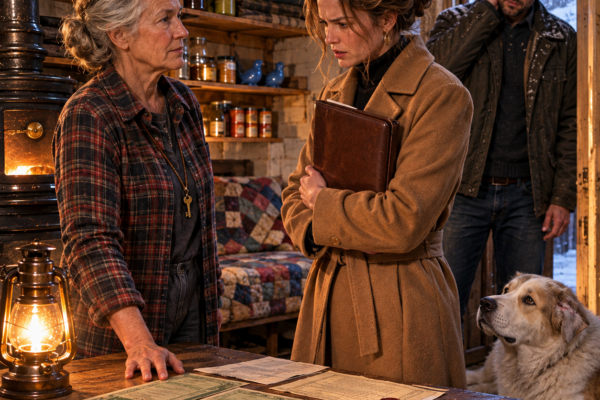
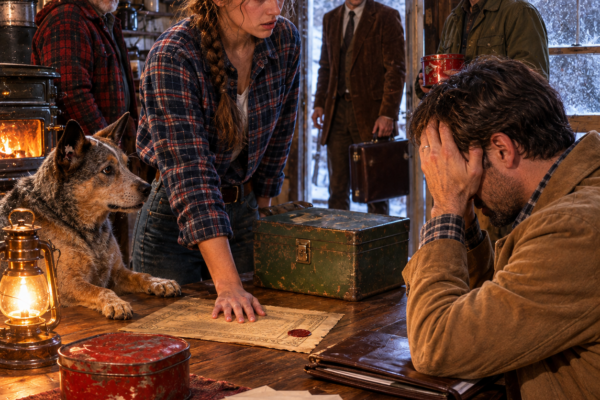
Amos took the folded papers out of his coat and laid them on the desk under the lamp, one at a time, in order, the way he would lay out a drawing for a man who had to understand it the first time. This is the deed recorded 14 months ago in my name.
This is the receipt you signed in Mr.Greers office for the notice that would have told me so and never delivered. This is the revocation of your power of attorney recorded at the courthouse.
This is the will. And this, he set the switch key on top of the pile, is what you were looking for when you asked Greer where the switch was.
It was under a mule.
You walked past it every time you came out here. He looked up at his son.
Im not signing anything, Lyle.
Not tonight, not tomorrow. This depot is not for sale to you at any price.
Youll give Mr.Greer an accounting for every dollar of the house money and youll pay back what you spent that wasnt mine to spend. Thats all Ive got to say about it.
Im not going to shout at you. I never did and Im too old to start.
The heater hummed. Overhead, faint through the earth, the ice ticked on the platform boards.
Lyle sat down on the edge of the other bunk. He put his elbows on his knees and looked at the floor and when he spoke, his voice was not the soft, reasonable voice anymore.
It was smaller and rougher, a voice Amos had not heard since Lyle was a boy.
I signed a personal guarantee on the storage lot, he said. 240,000.
The bank called the note in May. I had until the end of the year or they take the house and Karen doesnt know, Dad.
Nobody knows. I grew up watching you work doubles and then sit at the kitchen table counting quarters for the electric bill and I swore Id never be that scared and then I was more scared than you ever were.
I told myself youd be better off at Maple Terrace.
I told myself Grandpa didnt want you anyway. Id said it so many times I almost believed it.
He rubbed his face with both hands. Thats not a reason.
I know its not.
Its just the why. Amos looked at his son for a long moment.
Its a why, he said.
Its not enough of one. Lyle nodded without looking up.
Amos reached over and threaded the fifth reel and ran it forward to where the old man had stopped talking to him and pressed the key. The voice came into the car, thin and near.
Lyle, its your grandfather.
If youre hearing this, youre down here with your father and that means I was right about you after all and Im glad.
I watched you dig at the north end that night. I dont hold it against you.
A man digs in the wrong place when hes frightened and you were frightened. I could see that from the window.
So heres where it is, son.
The thing worth having at Cutler Siding was never under the platform.
Its the habit of coming back. I didnt have it.
Your father thought he didnt have it either.
Youve got the same blood. Go on and use it.
Start tonight if youre down here.
Hes sitting right there.
The tape ran out into hiss.
Lyle did not move for a while. Then he got up and crossed the narrow car and sat down on the bunk beside his father, not touching him, just sitting the way a boy sits on the cap of a switch stand with his legs hanging down, waiting to see which way the rails will go.
Amos did not put his arm around him, but he did not move away.
It was Denise who broke the silence.
She had been standing by the door the whole time, beside the carved words, with her hands in the pockets of her long charcoal coat.
Now she took one hand out, and in it was something green. She held it out to her father.
It was the right glove, the one Peg had knitted, the one he had looked for three times.
It was under the back seat of Lyles car, Denise said. Her voice was very quiet.
I found it the morning we drove you out here.
When I got in, I had it in my lap the whole way, under that sack.
Ive had it in my pocket for eight days, she swallowed. And the box.
When Lyle got home that night, he put it in a trash bag for the dump.
I took it out of his garage after he went to bed and put it in my trunk.
Everythings there, Dad.
The glasses, the recipe tin, her brush.
I didnt know how to give any of it back without saying what Id let happen. Amos took the glove.
The wool was soft and a little matted, and it still held the shape of his hand.
You called Greer, he said.
I called Greer.
And then I didnt tell you. She did not look away.
I was a coward. Im sorry.
I dont expect that to count for much.
Amos took the left glove out of his coat pocket, where it had ridden every day since the motel, and laid the two of them together on his knee, a pair again. It counts for something, he said.
Well see how much.
They slept in the car that night, the three of them, Amos and Lyle on the two bunks, and Denise in the desk chair wrapped in a gray wool blanket, with her head against the wall beneath the photographs.
The heater hummed, the ice ticked overhead.
Once, deep in the night, Amos woke and saw by the low lamp that Lyle was awake too, lying on his side, looking at the shelf where his mothers Christmas pictures stood in a row.
Neither of them said anything.
After a while, Amos closed his eyes again. Clay Pell came over the rise at first light on a red tractor with chains on every wheel and pulled the sedan out of the ditch like a cork out of a bottle.
The rest took most of a winter.
Lyle brought the accounting to Greers office on the first of the month as he had been told.
He sold the base boat and the half-built lot on the highway and he signed a note to repay his father the rest of the house money over five years and Greer filed it and Amos did not ask anyone in the courthouse to make it more than that. Karen found out.
Lyle told her himself, which Amos had not expected. In March, Amos sat down with the people from Sun Reach in Greers office and leased them 30 of the 40 acres, the low east fields along the substation road for $11,000 a year paid to him.
He kept the depot, the platform, the switch stand, and the hill behind the freight shed where Pearl liked to stand in the evenings. The coins stayed in the vault in Bellwood.
The first one stayed in his shirt pocket.
He put a new stove pipe in the waiting room with Clays help and a new roof on the freight shed and four bunks in the waiting room where the farm wives had once sat with their parcels. Ida brought curtains.
He paid his debt in kindling every week and kept on after she said it was paid. Truckers who slid off the county road in bad weather began to find their way to the lamp in the telegraph window as truckers always had and the bunks did not stay empty long.
Denise came out on Sundays now and then and brought the box of Pegs things one piece at a time as if she understood it was better that way. Lyle came in April to help with the roof.
He did not say much.
He was good with a hammer. He came back in May.
Some doors you do not throw open.
You only keep them oiled and see who comes.
The next November, in the third week, the sky went the color of pewter again in the afternoon, and by dusk the first glassy patter of freezing rain was ticking on the shingles. Amos lit the lamp in the telegraph window.
He fed the stove. He put on the green gloves, both of them, and went out onto the platform to bring Pearl in.
That was when he saw her. A young woman was walking down the old railbed from the east, where the rails had been pulled up 37 years ago, picking her way between the ties in the failing light.
She had a red duffel bag over one shoulder and a thin olive green rain jacket that was no good at all, and canvas sneakers, and a gray knit cap with ice already beating on it. She walked like someone who had stopped expecting anything at the end of the road.
She stopped at the edge of the platform and looked up at him, and at the lamp behind him, and at the gray mule standing in the freight room door. Im sorry, she said.
My car quit on the county road. I saw the light.
She looked down at the duffel.
I dont have anywhere to go tonight.
I can pay a little.
Amos looked at her.
He looked at the jacket and the sneakers and the bag, and he did not ask her where she had come from or who had left her to walk or why.
He would hear it or he would not. It did not change what came next.
No charge, he said.
Theres chili on the stove and four bunks inside, and the stove draws.
Whats your name? Tessa.
Tessa.
Im Amos. Thats Pearl.
Shell want to smell your bag.
He stepped back and held the depot door wide for her, and it swung on its three hinges without a sound. She hesitated on the step, the way he had hesitated once at the top of a ladder.
A door you walk out of is still a door, miss, Amos said. This ones oiled.
Come on in, out of the ice. She went in.
He heard her set the duffel down by the stove and heard the small sound a person makes when warm air reaches them after a long, cold road. Amos stood a moment longer on the platform in his wifes green gloves, under the lamp his father had kept lit for 45 years, in the same place he had stood a year before, watching a pair of tail lights go over the rise.
The ice came down in the lamp light like a curtain of falling beads.
Pearl nosed his elbow once. Then he went inside and closed the door behind him and left the lamp burning in the window for whoever else was still out on the road.