Part 2: Homeless at 66, a Widower Hid in an Abandoned Rail Depot to Survive the Ice Storm — What It Held…
Idas kitchen was white beadboard and lace curtains and an enamel wood range that ran so hot the windows wept. A whole wall was covered in framed class photographs, the years printed along the bottom.
She fed him ham and green beans and cornbread at an oilcloth table and did not watch him eat, which he was grateful for.
While she cut the pie, he found himself on the wall.
Sixth grade, the year his mother cut his hair with the kitchen scissors, second row, third from the left, a skinny boy with his chin up and his ears out, looking at the camera as if it owed him an answer.
He had not seen that face in 55 years.
He could not stop looking at it.
When he had finished, she poured him more coffee and sat across from him.
Everybody in this county knows about your fathers lamp, she said. Truckers used to steer by it on the county road in bad weather.
People called it Ezras lamp.
45 years every night in that telegraph window. The train stopped and he kept on.
Anybody who asked, he said it was for whoever needed to find the place in the dark. She turned her cup on the oilcloth.
He told me the truth once, only once, the night of the big snow when I drove out to make sure he had wood. He said, Ida, its for my boy.
Hell need to see it from the road.
Amos looked at the coffee in his cup for a long time.
He never told me, he said.
He never told anybody anything if he could build it instead. Idas voice was gentle and very dry.
Youd know that better than I would. Then she told him about Thaddeus Greer.
Hes a lawyer. Office over the feed store.
He handled your fathers estate and he has been asking after you for two years.
Every month at the post office hed catch me and say, Ida, any word of the Whitfield boy?
I had none to give him.
She stood and took his plate.
Ill take you to him first thing tomorrow.
Tonight Ill drive you back so you can see to that mule because you wont sleep anywhere else and I can see that from here.
She was right. She drove him back at dusk and he fed Pearl her half can and sat a long time on the bunk in the box car with his father photographs, not playing anything, only sitting.
And in the morning the green pickup clanked over the rise at half past eight.
The office over the feed store was one room with a radiator that knocked and a window that looked out on the grain elevator. Thaddeus Greer was a slight bald man of 70 in a tweed jacket and a green knit tie with half moon glasses and a gold fountain pen.
When Ida brought Amos in he came around the desk and shook Amoss hand with both of his.
Mr.Whitfield, he said, I have been waiting two years for you to walk through that door. He had the file ready.
He had kept it ready for two years. The will was one page, typed, dated 1991, the year after Ezra bought the depot.
It left the Cutler Siding depot, its 40 acres and all its contents to his son, Amos Ezra Whitfield, and to no one else.
He never changed it, Greer said.
He came in every few years to make sure it still said what he meant. It did.
Your father died two years ago, this past September.
The estate went through probate here.
I was his executor. The probate closed 14 months ago, and I recorded the deed in your name at the courthouse across the street.
Mr.Whitfield, you have owned that depot for over a year. Amos sat very still.
Nobody told me.
I tried.
Greer took a single sheet from the back of the file. I had no current address for you.
Your father had one from a long time ago, and the letters came back.
Then, about 22 months ago, your son came into this office.
He said hed heard his grandfather had passed and wanted to know about the estate. I told him I could only discuss it with the heir.
He offered to deliver the notice to you personally. He said you were unwell, and he handled your affairs.
Greer laid the sheet down. This is the receipt he signed for the envelope.
It was a plain receipt, one sealed notice of probate addressed to Amos E.
Whitfield, received for delivery, and under it, in neat blue ink, Lyles signature. The date was the second week of January, nearly two years back.
Amos had seen Lyle that same week. Lyle had driven him to a doctors appointment and talked about the weather the whole way.
Theres more, Greer said quietly.
Six months ago, a company called Sun Reach Grid Partners wrote to me as the attorney of record. Theyre building solar fields near the new substation.
They wanted to buy the depot land.
They offered $410,000.
He set down a second letter, and in August, your son telephoned me.
He said he held your power of attorney and wanted to know how to sell the property.
I told him what Ill tell you.
A power of attorney lets your agent act for you. It does not let him sell your land to cover his own debts, and no title company in this state will close a sale like that on an agents signature.
When the agent stands to gain, theyll want yours in front of a notary.
Amos sat and put it together out loud, slowly, the way he would have walked a new apprentice through a setup.
He did not raise his voice.
He sold my house in August, he said, $187,000. He told me it was for the care home.
He took my truck. He took my phone.
He took my money from the lathe.
His boat is for sale on the board downstairs.
His building out on the highway hasnt had a man on it since summer.
He took a phone call on my platform that he didnt want me to hear.
He looked at the receipt with his sons signature on it.
He knew this depot was mine almost two years ago. He couldnt sell it without me, so he brought me out to the one place he could say was free in the third week of November with no phone and no truck and a can of chili, and he was going to come back in a week with a paper.
Nobody said anything.
A cold old man signs whatever you put in front of him, Amos said, if hes cold enough. Ida Pell closed her eyes for a moment.
What do I do?
Amos said, it was not quite a question.
Two things today, Greer said.
First, you revoke the power of attorney in writing. Ill notarize it and record it before noon and mail notice to your son and your bank.
From the moment he receives it, he cant sign anything in your name.
Second, you ask for an accounting. He was your agent.
He owes you a record of every dollar he handled, and if he spent your house money on his own debts, the law calls that what it is, and hell have to make it right. Greer uncapped the gold pen.
Everything else can wait for you to decide, Amos signed. His hand was steady.
He watched Greer press the notary stamp into the paper and blot it. And something in his chest that had been held clenched since a spring afternoon in a hospital bed, unclenched by a single turn, like a nut backed off a bolt.
Greer walked them to the top of the stairs. At the door he stopped, as if he had remembered something and took off his glasses.
Your father left me one more instruction, he said. It made no sense to me, and I told him so.
He said that if his grandson ever came asking about the switch, I was to say it was right where it always was.
Amos felt the brass key heavy in his coat pocket.
Theres no switch out there, he said.
They pulled the siding 36 years ago. Thats exactly what I told him, Greer said.
And your son did come asking.
Last spring, he asked me where the switch was.
Ida drove him back in the early afternoon with groceries he had not asked for, and an old flip phone she pressed into his hand at the platform.
It gets one bar at the west end of the platform if you hold it up like a torch, she said.
My numbers the only one in it.
Use it. Then she clanked away over the rise, and the quiet came back.
He fed Pearl, he fed the stove, then he went down into the car because he did not know where else to put what Greer had told him.
He had not looked closely at the shelf above the desk the first day. Now he did.
Behind the photographs pushed to the back sat a cigar box. Inside were Christmas cards, 30 of them, maybe more, tied in bundles by decade with kitchen string, and every envelope addressed in the round, upright hand he had read on grocery lists for 40 years.
Peg.
He opened the newest one first.
It was dated the December before she died.
It was short. Dear Ezra, the children are well.
Lyle has a new business and works too hard.
Denise is teaching third grade and is good at it.
Amos is Amos.
He fixed the neighbors furnace for nothing and pretended it was no trouble. He still talks about you when he thinks Im not listening.
He still keeps your old pocket knife in the kitchen drawer. One of these years, one of you will pick up the telephone.
I hope Im alive to see it.
Love, Peg.
Amos sat on the bunk with the card in his hands. He thought of his wife at the kitchen table on Locust Street every December for 30 years, writing two Christmas letters, one to the world and one to an old man at the end of a dead rail line, licking the stamp, never saying a word, carrying the two of them, father and son, like a woman carrying two full buckets across ice, so carefully that neither one ever knew it was being carried.
And he thought how she had been gone three years now and how he had not cried at the funeral because there had been so many people to thank and how he had not cried since because there had been no one to do it in front of. And now there was no one at all, only a buried railroad car and a mule overhead and his fathers voice in a box.
And he put his face down against her handwriting and let it come.
When it was over, he put the card back in its bundle and tied the string the way she had tied it.
Before Amos goes any further, tell me something in the comments.
Who in your family kept a light on for you that you never knew about until it was gone?
Then stay with Amos because the brass key in his pocket was about to fit something his son had been looking for all year. The next day, he split cottonwood for both stoves, his and Idas, and filed the long edges off Pearls hooves with a rasp from the lean-to while she stood for it like a lady at the hairdressers.
He slept in the car again that night. On the morning after that, Pearl would not eat.
She stood under the lean-to with her sweet feed untouched in the bucket, and every few minutes she lifted her near forefoot and struck it down on the frozen cinders beside the wall, the way a horse paws at a gate it wants opened.
Amos watched her from the step.
Then he went and looked at what she was pawing.
He had taken it for a hitching post.
Every depot had one.
A squat cast iron column about waist high, rusted the color of a brick with a flat cap on top and a lever bracket on one side that had long since lost its lever. Pearls lead had been tied to it for years.
The rope had worn a bright groove in the rust, but it was not a hitching post.
He saw it now, the way you suddenly see a face in the grain of a board. It was a switch stand, the hand-thrown kind that stood beside the track at every siding, with a lever that swung the rails over and a target on top that told the engineer which way they were set.
The rails had been pulled up 36 years ago. The stand had never been moved.
His father had left it where it always was and tied a mule to it every day so that nobody would ever look at it twice. He remembered it then, all at once.
He remembered being seven years old and sitting on that flat iron cap in summer with his legs dangling, watching his father throw the lever with one easy pull of his whole body, the rails sliding over with a clank he could feel in his teeth, and his father saying, thats how you send a train where its needed, son. You dont push it.
You set the track ahead of it and let it come. Low on its side, near the sinners, a small iron door no bigger than a mans hand was held shut with a railroad padlock.
Amos took the brass key out of his pocket.
His fingers were cold and he had to try twice.
It went in. It turned, stiff and then smooth, the way a good lock turns that has been oiled when no one was looking, and the shackle dropped open.
Inside the iron base was a cavity the size of a lunch pail, dry as a cupboard.
In it sat a flat tobacco tin, and in the tin was a folded square of heavy paper, a drawing in pencil done with a straight edge, the way a man draws who has drawn a thousand blueprints for a thousand freight crates. It was the floor plan of the boxcar, the bunks, the shelves, the desk, and under the desk the third floor plank from the end wall had been shaded in with an arrow and two words, lift here.
Under the drawing, in the same hard capitals, I said, play them in order.
Youre ready now. Amos stood beside the switch stand in the cold for a long moment with the paper shaking in his fingers, and Pearl reached over and pushed her nose against his elbow once, as if to say she had been telling him for days.
Every morning since he came, she had stood with her lead tied to this iron post and her eyes on him, waiting for him to see what was right in front of him.
He went down the ladder faster than a man with a mended hip ought to, and then he stood at the bottom of it in the lamplight with the drawing in his hand and did not move. He was afraid.
He understood that about himself with some surprise.
He was 66 years old, and he had stood in front of furnaces and lathes and a foreman who wanted his job, and he had buried a wife, and he was afraid of a floorboard because whatever was under it was the last thing.
After it, there would be nothing more of his father to find, only the finding over and done, and the old man truly gone.
He set the lamp on the desk and got to work because work was the only cure he had ever known for that kind of fear. The desk was bolted to the wall, not the floor, and he saw now that it had been built that way on purpose so that it could stand above a plank that needed to come up.
He dragged the chair aside. He knelt.
The third plank from the end wall looked like every other plank in the car, gray and oiled and fitted tight.
But when he wrapped it with his knuckles, it answered him with the same hollow note the platform had given under his boot heel four mornings before.
He got the pry bar from the tool hook by the ladder and worked the flat end into the seam.
The plank did not fight him. It lifted clean along its length, and the plank beside it lifted after it because they had been cut to come out as one.
And under them, laid into the space between the floor and the cars old steel sills, was a box. It was a long, flat, strong box of gray steel, the kind banks once used to ship payroll by rail, with brass corners and a hasp.
The hasp was not locked.
A loop of wire held it shut, twisted once so that a man with nothing but his fingers could open it. Amos lifted it out.
It was heavy, far heavier than its size, the dead, solid heaviness that only one thing in the world has.
He set it on the bunk and untwisted the wire and opened the lid.
The inside was lined with green felt, and on the felt lay envelopes, small manila coin envelopes, the kind with a flap and a little metal clasp, laid in rows the way a careful man lays out parts on a bench before assembly.
Row after row of them. Each one had been written on in pencil.
He picked up the first one at the top left.
April 9th, 1960. It was his birthday, the day he was born.
He undid the clasp with fingers that had forgotten how to be steady and tipped it, and a coin slid into his palm. He knew the weight before he looked.
41 years of handling stock had taught his hand to read metal the way a blind man reads a face, and his hand knew this weight, soft and dense and heavier than its size before his eyes had found the color.
It was gold.
It was heavy and soft-edged and warm-looking even in the cold lamplight, a $20 gold piece with a striding woman on its face holding up a torch and a date from long before his father was born.
On the back of the envelope, in smaller pencil, his father had written, Bought this the day you came.
Paid too much.
Didnt care. He turned over the envelope for the year he was 21.
On the back, in pencil, You left today. Bought it anyway.
The one for 1990 said, Line closed.
Bought the depot. Bought this too.
Still yours.
The one for the year Lyle was born said only, A grandson.
Peg wrote to tell me.
Would have bought two if I could.
Amos turned to the next envelope.
April 9th, 1961. The next, 1962.
His eyes went down the rows faster than his hands could follow.
1970. 1980.
1981, the year he walked out the door and his father had not missed it. 1982.
1990. 2000.
Every April, every single one, through the years of silence, through the years of his own childrens birthdays and Pegs Christmas letters and the funeral where neither of them could find a word.
All the way down the felt to the last envelope in the bottom row, in a hand gone thin and shaky, dated 5 months before his father died.
So this was what the switch had been guarding. Not 40 acres of prairie, not a depot with a lamp in the window, a row of birthdays kept in the dark where no one could send them back.
And somebody had sat in Thaddeus Greers office last spring and asked in a reasonable voice where the switch was.
Amos looked at the felt rose and thought of a clearance sticker on a can of chili, and a phone call taken at the end of a platform with a mans back turned, and for the first time he understood exactly how much his son had needed him to be cold. April 9th, 2024.
He did not count them yet. He could not.
He sat on the bunk with the gold piece in one hand and the empty envelope in the other, and the felt rose blurring in front of him.
And somewhere above, through 10 ft of earth and the platform boards, he heard an engine.
It was faint at first, then not faint. A car coming down the county road too fast for the ice and slowing, and the sound of tires crunching onto the glazed gravel beside the platform.
The engine stopped.
A car door opened and shut, hard. Pearl braided once, loud and harsh, a sound Amos had not heard her make.
And then, through the open hatch, in a voice as soft and reasonable as a hand on a shoulder, his son called his name.
Amos did not answer right away. He closed the lid of the strong box on the felt rose, slid it under the gray blanket on the lower bunk, and put the gold piece from the first envelope in his shirt pocket and buttoned the flap.
Then he climbed the ladder.
Lyle was standing in the freight room doorway in his navy vest with the white sky behind him and a long envelope in his hand.
He looked at the open hatch. He looked at his father coming up out of it.
For one second, before he could put his face away, Amos saw something cross it that was not worry at all.
It was hunger. Dad, Lyle said, what is this?
Whats down there?
Your grandfathers cellar.
Amos stepped off the ladder and stood on the floor beside the hatch. He did not stand in front of it.
He did not need to.
Its mine, same as the rest. Lyle held up the envelope.
Amos could see Thaddeus Greers letterhead from where he stood.
I got this yesterday.
Some country lawyer saying you revoked my power of attorney, saying I owe you an accounting. He laughed a little, softly, as if it embarrassed him on Amoss behalf.
Dad, whos been out here filling your head? Im the one who handles things.
Im the one whos been handling things since your hip. I know you have, Amos said.
Ive seen how.
Lyles mouth stayed in its patient shape, but his eyes went to the hatch again. Did you find something down there?
Grandpa used to say he stopped.
Say what, Lyle?
Nothing.
He was old. He said a lot of things.
Amos waited. He had learned in 41 years at a lathe that most mistakes announce themselves if you stand still long enough.
Lyle did not fill the silence. He was too careful for that, and Amos was almost proud of him for it.
The way you can admire the finish on a part that was cut to the wrong drawing. Mr.Greer wants the accounting by the 1st of the month, Amos said.
Every dollar from Locust Street, every dollar from the truck. Bring it to his office, not to me.
The patience went out of Lyles face then.
Not all at once, but the way air goes out of a tire, slowly. And what was underneath was not anger.
It was fear, plain and gray and old. Ill come back, Lyle said, with Denise.
Well sit down and talk about this like a family. That would be a first, Amos said, and was sorry the moment he said it and did not take it back.
Lyle drove off too fast for the ice.
Pearl brayed after the sedan until it went over the rise.
Then she went back to her bucket and ate every grain of sweet feed in it. That night, Amos counted 65 envelopes, one for every birthday the day he was born to the last one before his father died.
He laid them out on the bunk in their rows and counted them twice, the way he would have counted parts in a lot, and both times it came to 65. Under the felt, when he lifted the tray, there were two more things, a typed copy of the 1991 will, signed and witnessed, the same as the one in Greers file, and a flat cardboard box marked with a five in grease pencil.
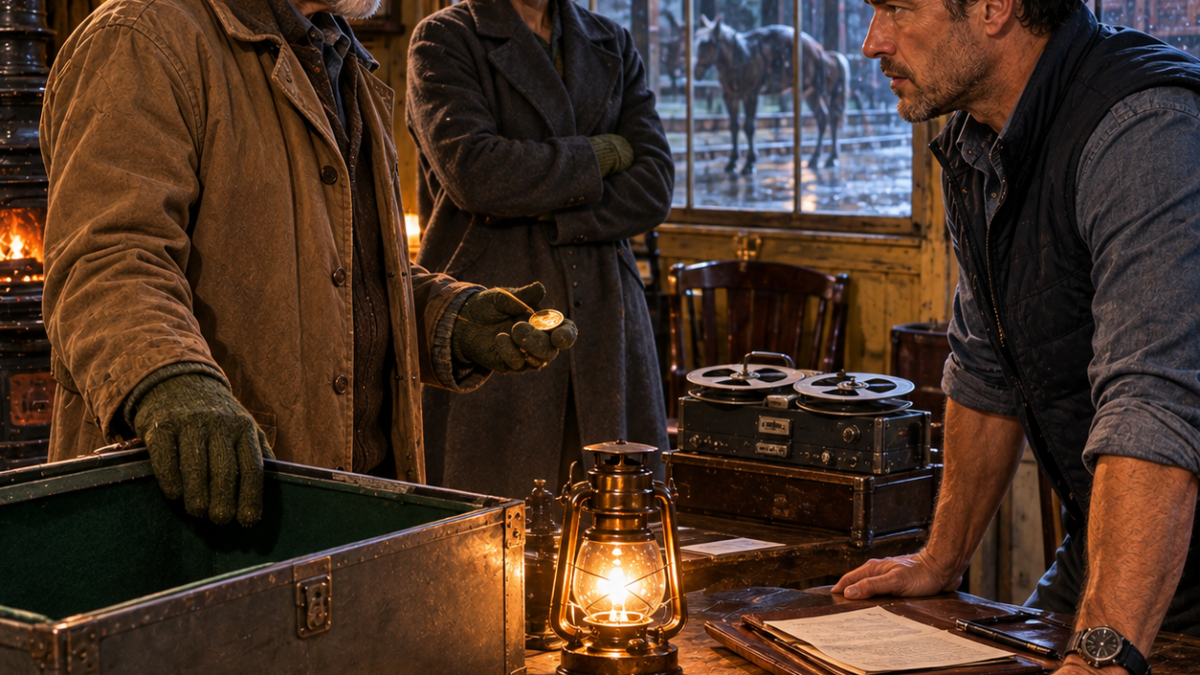
He threaded the last reel. Amos, if youre hearing this one, you found the box and you know whats in it.
Ill tell you why, and then Ill stop talking, because Ive done more talking on these reels than I did in my whole life. I couldnt send you a birthday card youd open.
I tried the first three years. They came back, so I bought you something you couldnt send back, one a year.
Your mother thought Id lost my mind.
She said, Ezra, write the boy a letter.
I said Id rather buy him gold than write him a bad letter.
She said that was the most Whitfield thing shed ever heard. She was right.
Now listen, your boy Lyle came out here twice, the spring after Peg passed.
First time he was polite, asked after my health, asked what the depot was worth. I told him the truth.
I told him whatever I had was under where the train stopped, and it was for his father, and Id be glad if he brought you out to get it. I thought that might be the thing that got you here.
Im an old fool. He came back about a week later, at night, alone.
He had a shovel in his car.
I watched him from the telegraph window with the lamp turned down.
He dug three holes at the north end of the platform where the passenger cars used to stop, because thats what he thought I meant.
He put his foot through the boards over the old cistern and came out mud to the knee and drove off swearing.
He never came to the door.
So I knew. I dont hold it against him the way you might think.
A man digs in the wrong place when hes scared, but I knew he wasnt going to bring you. Id have to get you here some other way.
Thats what Idas for.
And Greer and the lamp. The rest of this reel isnt for you.
Its for Lyle.
If hes ever down here with you, play it for him. If he isnt, leave it be.
The voice stopped. The tape ran on.
Amos reached out and pressed the stop key and sat in the warm car with his hand on the machine for a long time. His son had dug holes in the dark at Cutler Siding while his grandfather watched from the window.
Two years later, he had brought his father to the same platform and left him there with a can of chili. Amos understood finally that Lyle had not chosen the depot because it was free.
He had chosen it because he believed there was something buried there he could not find without his fathers name, and he had meant to get both. In the morning, Ida came for him, and they drove to Bellwood with the strong box on the floor of the pickup under a feed sack and Amoss boots on either side of it.
There was a coin dealer in Bellwood, which surprised him until Ida explained that farmers in a county like this one had been burying gold in coffee cans for a hundred years, and somebody had to know what it was worth when the grandchildren dug it up.
His name was Royal Kimbro.
He worked out of a narrow shop next to the post office with a loop screwed into one eye and a scale under a glass bell.
And he did not say a word for 40 minutes while he went through the envelopes one at a time. When he finished, he took the loop out of his eye and wrote a figure on a pad and turned it around.
65 St.Gaudens double eagles, he said.
Mixed dates, good condition, a few better than good.
Your father paid too much for the first one. He paid fair for the rest.
He tapped the pad.
At todays gold price, a little over $280,000. Id buy them all this afternoon at 90% of that, but I dont think youre selling.
No, Amos said. Im not.
They went from the coin shop to the bank, where a young woman with a name plate rented him a safe deposit box in the vault, and he put 64 envelopes into it and turned the key. The first one, April 9th, 1960, stayed in his shirt pocket.
Then they climbed the stairs over the feed store. Greer listened to all of it with his fingers steepled, and when Amos finished, he nodded once.
The will leaves you the depot, its land, and all its contents. The coins were in the depot.
Theyre yours.
Nobody else has a claim to them, not your son, not anyone. He hesitated and took off his half-moon glasses and polished them on his tie.
There is one more thing I think you should know. I debated whether to tell you.
Tell me. Your daughter called this office about a month ago.
She asked whether her grandfather had left a will.
I told her that I couldnt discuss the terms, but that it named her father and that if she cared about him, she should tell him so. Greer put his glasses back on.
She said she would. Amos sat very still.
Denise in the backseat with the paper sack on her knees, Denise watching through the rear window, Denise looking down. She had known then.
She had known for a month that the depot was his, and she had ridden out with her brother and watched him take the phone and the box and the keys, and she had said nothing at all.
Somehow that was worse than the holes in the dark.
Lyle at least had wanted something.
Amos could not think what Denise had wanted except to be somewhere else. On the drive back, Ida turned the radio up for the weather.
The man on the county station had the careful voice of someone who did not want to frighten anybody and was going to anyway. A second ice storm was building out of the southwest behind the first, wetter and heavier, due by late tomorrow afternoon, up to an inch of glaze, power outages likely, travel strongly discouraged after dark.
Ida turned the radio off. To the west, along the whole edge of the sky, a long gray bank of cloud lay low over the hills like a wall somebody had started building and meant to finish.
Bring Pearl into the freight room tomorrow, she said. Keep the stove pipe wired, keep the lamp lit, and keep that phone in your pocket at the west end of the platform, Amos Whitfield, or Ill come out there through it myself.
Yes, maam. And if your boy comes back tomorrow, she said, make him leave before dark.
Lyle came back the next afternoon at a quarter to three.
The sky had gone the color of wet slate and the air had that stillness that comes before freezing rain, when even the grass seems to be listening. Amos had brought Pearl into the freight room and spread straw for her and stacked cottonwood high beside the stove and filled the lamp.
He was on the platform with the hatchet, splitting kindling, when the gray sedan came over the rise.
Denise was in the passenger seat this time. She got out slowly and stood beside the car with her arms folded inside her long charcoal coat.
Lyle got out with a leather folder under his arm and a pen already clipped to it and came up the steps smiling.
Dad, he said, lets go inside.
Its going to get nasty. Well be quick.
Amos set the hatchet in the chopping block and led them in.
Lyle set the folder on the telegraph table under the lamp and opened it. Two documents.
One was a deed, already typed, transferring the Cutler Siding Depot and its 40 acres from Amos E. Whitfield to Lyle A.
Whitfield with a line at the bottom for a signature and a notary block. The other was a purchase agreement from Sun Reach Grid Partners with Lyles name already signed as seller.
Heres how it works, Lyle said. His voice was warm and practical, the voice of a man walking a customer through financing.
You sign this over to me, I close with Sun Reach.
410,000. That pays for Maple Terrace for as long as you need it, the good wing with the garden.
Everything else gets straightened out.
This lawyer business goes away.
Nobody has to dig up anything ugly. Nobody has to dig, Amos said.
Thats a good word for it, son. Lyles pen stopped halfway out of its clip.
Denise, by the window, turned around.
Outside, the first drops hit the roof, the same light, glassy patter Amos had heard eight nights before, then faster. Then, all at once, a hiss on the shingles like something frying, and the bay window began to blur with ice.
We need to go, Denise said.
It was the first thing Amos had heard her say since hello at the motel curb.
Lyle, now, before the road goes.
Lyle looked at the window. He looked at the deed.
He looked at his father, who had not moved and seemed to make a calculation and snapped the folder shut.
Tomorrow, he said.
Well do this tomorrow. They ran for the car.
Amos stood in the doorway and watched the sedan back around in the glazing gravel and start up the rise too fast, its rear end already loose. Halfway up, the tail swung out.
The car turned a slow, almost graceful half circle on the ice and slid sideways off the road and settled nose down into the ditch with a soft crunch, its headlights pointing at the Nobody was hurt. He could see that from the platform.
He could see Lyle climbing out and then Denise and both of them standing in the ditch in the freezing rain, looking at the car and then looking back down the hill at the only lit window for 19 miles.
Behind Amos, inside the depot, something groaned. He turned.
The stove pipe, wired to its hook, was bowing under the weight of the ice building on the roof above it.
And as he watched, a thin gray finger of smoke curled out of the joint where it met the ceiling and drifted slowly across the waiting room toward the lamp. They came back down the hill on foot, slipping and catching each other, Denise holding the leather folder over her head like an umbrella.
By the time they reached the platform, their coats were stiff with ice and Lyles loafers had stopped being shoes at all. Amos held the door for them.
He did not say anything.
There was nothing that needed saying yet.
Inside, the smoke had thickened along the ceiling.
Amos climbed onto the bench and looked at the joint. The ice load on the roof had pushed the pipe out of true and the old seam where it met the ceiling collar had split along its length.
There was no fixing it tonight.
He climbed down, shut the damper, and shoveled ashes over the fire until it died to a sullen red. What are you doing?
Lyle said. Thats the only heat.
Its the only heat up here. Amos said.
Without the stove, the cold came into the depot like water into a sinking boat. The thermometer by the telegraph window read 61 when he banked the fire.
In half an hour, it read 48. Denise sat on the bench with her soaked coat clutched around her and her teeth had begun to chatter in small, hard bursts she could not stop.
Lyle held his phone up to the ceiling, to the window, to the door. No service.
He looked at it as if it had betrayed him personally.
Amos walked to the west end of the platform in the freezing rain with Idas phone held up like a torch. Nothing.
 [Tap here for the Next Part ]