“Final Warning!” the Single Dad Said—But the Black Belt Still Attacked, Unaware He Was an Ex-Navy SEAL
“Final Warning!” the Single Dad Said—But the Black Belt Still Attacked, Unaware He Was an Ex-Navy SEAL

You really want to do this?
In front of your kid?
Pay for the damage. Walk away.
Ha!
You hear that?
The repair man’s giving orders.
Please, I don’t want any trouble.
NAH!
NOBODY ASKED YOU. YOU GOT THAT JACK JACK AND I TOOK God down.
Final warning.
Or what, old man? Grant Mercer had never walked away from anything.
Not a sparring match, not a failed contract, not a bruised ego in a diner. When the man in the worn work jacket told him to back down, Grant saw exactly what he wanted to see.
A tired repairman playing hero in front of his daughter.
The steady voice didn’t read as experience.
The calm in the man’s eyes looked like fear, not control.
To Grant, a man who built his whole identity around rank and belt color, this night was already decided.
He stepped forward. He chose this.
And somewhere just behind the diner a young woman was watching.
Her phone quietly raised.
The only question was when the truth finally came out how much would Grant have already cost himself? If stories like this about quiet strength, about what it really means to protect someone are the kind of thing you find yourself coming back to consider subscribing.
There are more stories like this one and they’re worth your time.
Nolan Pierce had a system for most things and the system worked because he never let it get complicated. He woke up before Tessa most mornings, made coffee, checked the weather, and packed a lunch that was decent enough to eat and simple enough not to think about.
He drove 12 miles to the rehabilitation center where he worked, fixed whatever was broken power wheelchairs, hydraulic lift systems, motorized beds, and drove 12 miles home.
On the days Tessa had late classes, he waited.
On the days she didn’t, they ate together.
That was more or less the shape of their lives, and it was a shape Nolan had chosen deliberately.
He wasn’t a man who talked much about what he’d done before this.
His co-workers at Riverside Rehab knew he was ex-military.
The posture gave it away before the paperwork ever did, but nobody pressed him for specifics, and he didn’t offer any.
The work suited him.
There was something about spending 8 hours keeping the equipment running that allowed people to move, walk again, regain something they’d lost that felt like enough, not heroic, just useful.
And useful, in Nolan’s private accounting of things, was worth more than heroic most days.
He had three rules he’d set for himself after he left the service, and he held to them the way other men held to religion.
No looking for trouble, no using his hands unless the situation had already taken every other option off the table, and no letting Tessa see what he was capable of.
The last one mattered most.
She was 22 now, sharp and determined. Working toward a nursing certificate while picking up shifts at the community center.
She’d been 13 when her mother died, and she’d grown up watching her father carry everything quietly.
Nolan knew she admired that about him.
He also knew she resented it sometimes, and he understood why.
That Friday evening, he picked her up from a lab session that had run almost 40 minutes over schedule. She came down the steps of the building with her bag over one shoulder, and her hair still tied back from the practical, and she looked tired in the clean way people look tired after doing something that actually mattered.
He didn’t ask about the session.
She’d tell him if she wanted to.
They stopped at Cedar Bend Diner because it was on the way, because neither of them felt like cooking, and because Tessa had mentioned twice that week she’d been craving the soup.
The diner sat at the edge of the main road through town. A low-ceiling place with red vinyl booths and a counter that ran the full length of the back wall.
Darlene Watts had worked there for going on 11 years.
She knew Nolan’s order without asking and she always brought Tessa extra crackers without being told.
They took a booth near the window. The diner was maybe 2/3 full, the usual Friday crowd, a few families, a couple of older men at the counter, a table of college kids near the door.
Normal, quiet.
Nolan sat with his back to the wall out of habit and looked at the menu he’d already memorized because it gave him something to do with his eyes.
Grant Mercer was sitting in the corner booth with two men Nolan didn’t recognize.
They looked to be in their late 20s, built like men who trained seriously, and they were listening to Grant the way people listen when they’re trying to stay in someone’s good graces.
Grant himself was loud in the particular way that some men get loud when they’ve had enough to drink to stop managing themselves.
He was a big man, broader than Nolan, a few years younger, with the kind of physical confidence that came from years of being the most capable person in any room he chose to enter. He wore a polo shirt with the logo of a martial arts gym on the chest and he was talking with his hands.
What most people in that diner didn’t know was how much of Grant’s confidence was load-bearing.
He’d built his gym’s reputation on a string of early successes, a few local law enforcement contracts, some regional press that called him one of the best self-defense instructors in the county, but a dispute over a training contract had gone sideways the previous year.
And with it went a chunk of his enrollment.
He’d moved operations to this town as a quieter restart, telling himself it was a strategic choice rather than a retreat.
The new contract he’d been counting on had also fallen through that afternoon.
By the time he walked into Cedar Bend, he was a man carrying considerably more weight than he looked.
Nolan noticed him the way he noticed most things quickly, without reaction, and looked back at his menu.
The trouble started when Darlene came to take Grant’s table’s order.
Grant wanted something that wasn’t on the menu.
And when Darlene explained they were short-staffed and the kitchen was running limited options, he repeated his request louder, as though volume might change the answer.
Darlene apologized again and offered an alternative.
Grant told her the alternative wasn’t what he wanted, and he said it with a tone that wasn’t really about the food at all.
Then he reached across the table and swept the condiment tray off the edge. Salt shaker, pepper, a small bottle of hot sauce, all of it hit the floor.
The crack of the glass bottle was loud enough to bring the whole diner to a stop.
Pick that up.
Grant said, looking at Darlene in the way a person looks at something they own.
And maybe next time you’ll be ready when a customer sits down.
Darlene stood very still for a moment.
She was 61 years old and had been serving food to people in this county for most of her adult life.
She bent down and began collecting the pieces from the floor.
And her hands were steady, which somehow made the whole thing worse to watch. Tessa was out of the booth before Nolan fully registered she was moving.
She crouched beside Darlene and started helping gather the pieces of the broken bottle.
Her movements quick and deliberate.
She didn’t say anything to Grant.
She just helped.
Grant watched her for a moment with the particular irritation of a man who has decided an audience is paying attention to the wrong thing.
What’s this?
He said, addressing the booth where Nolan still sat.
“Your kid thinks she’s making a point?”
Nolan set down his menu.
He didn’t raise his voice.
He didn’t stand up fast.
He pushed himself out of the booth slowly.
The way a man stands when he’s not in a hurry and wants that fact to be understood.
He walked over to the edge of Grant’s table and stood at a respectful distance and he said evenly that he’d appreciate it if Grant kept his attention on his own table, that Darlene was doing her job and didn’t need the commentary, and that if there was an issue with the service, the right person to speak to about it was the manager, not the woman cleaning
the floor.
Grant looked at him.
He took in the work jacket with the Riverside Rehab logo on the breast pocket.
The boots that had seen better years.
The general appearance of a man who fixed things for a living.
He made a decision about who he was dealing with in about 3 seconds.
“Appreciate it.”
Grant repeated.
And let the words sit there a second.
He leaned back in the booth and smiled at his two students, Derek on his left, and a broader man named Marcus on his right. He looked back at Nolan.
“I got a black belt telling me what to do from a repairman.”
He shook his head.
“You want to step outside and explain how that works?”
“No.”
Nolan said.
He went back to his table, left enough to cover both meals and a tip, and put a hand on Tessa’s arm to let her know it was time to go.
She stood and they walked toward the door. Nolan heard Grant say something to his students that got a short obliging laugh.
Derek’s came easy.
Marcus’s came a half second later, the way laughs come when a person isn’t entirely sure they find something funny.
Nolan didn’t look back.
Outside, the air was cooler than it had been all week and a light rain had started while they were in the diner. The parking lot behind Cedar Bend was small, six or seven vehicles under a long aluminum awning lit by two overhead fluorescents.
Nolan’s truck was near the far end.
He and Tessa walked toward it without rushing across the road.
The Millard’s convenience store was still lit up.
The kind of place that stayed open until midnight regardless of whether anyone came in after 9:00. Nolan noticed the security camera mounted on the corner post near the edge of their lot.
An older model, fixed angle, pointed out toward the road and the shared parking area.
He noticed it the same way he’d notice an exit sign or a fire alarm without meaning to, without filing it away as anything important.
They were almost to the truck when the diner’s rear door opened.
Grant came out first.
Derek and Marcus followed a step behind.
And there was something in the way they followed not quite eager, not quite reluctant that told Nolan they’d been in situations like this before and had learned it was easier to be present than absent.
Marcus kept his hands in his jacket pockets.
Derek’s eyes moved between Grant in the parking lot with the look of someone calculating exit distances.
Grant’s mood had shifted.
The restaurant had been a contained space with other people watching.
Out here, with the rain and the aluminum roof and the sound of the road, the geometry was different. He started talking again.
He said Nolan had embarrassed himself in there.
That walking away was the kind of thing people did when they didn’t have any other options and wasn’t that a shame?
And what was Nolan going to tell his daughter that her father tucked his tail in because some gym instructor raised his voice? He kept his distance for the first 30 seconds.
Circling just outside the range where his presence would require a response. Nolan kept walking.
He stopped at a point between Grant and the truck and turned toward Tessa without looking at Grant at all.
He told her, quietly, to go stand near the diner’s side entrance where the light was better and the camera above the door was angled down at the lot.
He told her to dial 911 if anything happened that required it, not before.
His voice didn’t change the way voices do when people are scared.
It changed the way voices change when something moves from probable to certain.
Tessa didn’t move right away.
She looked at her father, then at Grant, then back at her father.
She’d never seen anyone come after him like this.
Not in a parking lot.
Not anywhere. Her father was always the calmest person in every room.
And that calm had always felt like a kind of protection, something between them and whatever was difficult about the world.
But standing here in the rain with this man circling and talking, the calm looked different.
It looked like preparation. She went to the side entrance.
She stayed close to the wall and she raised her phone.
Grant watched her go and then turned back to Nolan. He said something about how the daughter at least had some sense moving out of the way and that Nolan should take the hint.
Nolan didn’t answer.
He watched Grant the way a man watches a door that he knows will open, waiting to see how fast.
Grant stepped forward and reached out to grab Nolan’s shoulder, not a punch, not yet.
Just a grip meant to establish that he could.
Nolan’s left arm came up and redirected the hand cleanly, nothing dramatic.
Just a small motion that moved Grant’s hand away from the contact point while he stepped back.
Grant pulled his arm back with an expression that had moved past irritation into something colder.
“You’ve done that before.”
Grant said.
“Back up.”
Nolan said.
Grant’s jaw worked for a moment.
He turned his head toward Tessa and pointed an unhurried, deliberate gesture. The kind meant to make sure everyone in the parking lot understood the direction of things.
He said she needed to learn the same lesson her father apparently hadn’t.
That when a person spoke to you, you answered. And when someone with more standing was in the room, you showed it.
Nolan moved.
Not fast.
Not dramatically.
He shifted two steps to the left and forward, putting himself squarely between Grant and the angle to Tessa. And when he stopped, the geometry of the parking lot had changed.
Grant would have to go through him to make that gesture mean anything.
For the first time since they’d come outside, Nolan’s voice dropped.
Not to a whisper.
Lower than that. To the register that people use when they are done being indirect.
“Final warning,” he said.
“Walk away.”
Grant stood there for a breath.
The rain ticked on the aluminum overhead.
Marcus shifted weight from one foot to the other. The fluorescent light above the trucks parking space buzzed softly.
Then Grant smiled, the smile of a man who has made up his mind and is satisfied with the decision, and he said the same thing he’d said in the diner, the same word he’d used when Nolan had first stood up from the booth.
“Or what, old man?”
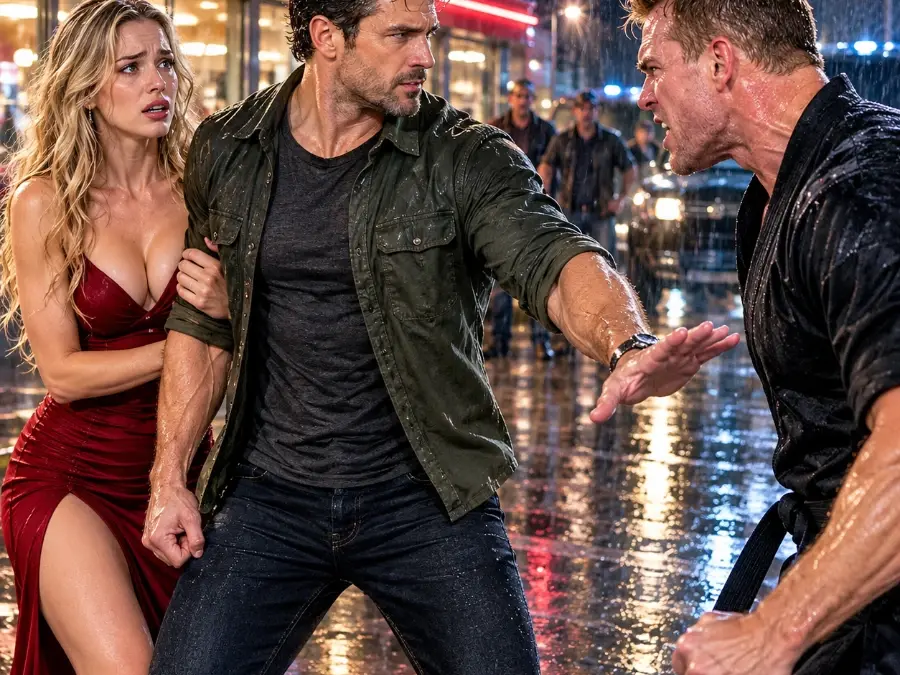
He came forward without any more warning than that. Grant threw his first punch without any setup, no feint, no shift in stance, just raw forward momentum and the conviction that it would be enough.
It wasn’t enough.
Nolan slipped the strike to the outside and stepped back, creating distance the way a man creates distance when he knows the floor is wet and the space between the parked cars is tighter than he’d like.
He wasn’t trying to win anything yet.
He was still trying not to be here at all.
But Grant didn’t register the step back as anything other than retreat, and he came forward again, faster this time, lower, arms out to grab and drive Nolan into the side of the nearest truck.
The wet asphalt changed the math. A takedown on dry ground is one thing.
A takedown in the rain, near parked vehicles, near a concrete curb, was something that could put either of them in a hospital regardless of who started it.
Nolan made the calculation in the half second he had before Grant’s arms closed in, and the calculation came out the same way it always did when the options ran out.
Completely and without hesitation.
He didn’t throw a punch.
He redirected Grant’s weight using the momentum Grant had already committed.
Turning the grab into a lever and brought him down to the asphalt in a controlled fall that was far less gentle than it sounds.
Grant’s right shoulder took most of the impact, and his face caught the edge of it, too.
The kind of contact that leaves marks and requires paperwork. He went down hard and stayed down, breathing through his nose, one arm moving weakly at his side.
Nolan stepped back immediately.
He put both hands up, fingers open, and told Derek and Marcus to stay where they were. His breathing was level.
He wasn’t breathing hard.
Derek had his phone out. Marcus was completely still, watching his instructor on the ground with an expression that was somewhere between disbelief and the particular discomfort of a man reconsidering the choices that had brought him to a rain-soaked parking lot on a Friday night.
Tessa was already moving toward them from the side entrance.
Nolan told her to stop and call for an ambulance, and she did. She stopped and made the call, but she kept her phone raised, still recording.
Darlene had appeared in the doorway behind her. She stood with one hand on the frame and watched.
The police arrived 12 minutes later, which felt both fast and slow, depending on where you were standing.
Nolan stayed exactly where he was, answered every question directly, and pointed the officers toward the camera above the diner’s side entrance, toward Tessa’s phone, and toward the Millers’ camera across the road.
He mentioned the Millard’s camera specifically said he’d noticed it when they were walking to the truck and that it would have had a clear line to the spot where Grant made contact first.
The officer taking notes wrote that down without reacting either way.
Grant was sitting up by then, one hand on his shoulder, his expression reorganized into something more controlled now that there were uniforms present.
He didn’t say much while the paramedics worked.
He listened.
He watched Nolan answer questions and something in the way he watched suggested that whatever came next wasn’t going to be a parking lot conversation.
The ambulance took Grant to County General to check the shoulder and rule out a concussion. Derek and Marcus gave brief statements and left separately Marcus with a quick, relieved stride.
Derek more slowly glancing back once at Nolan before getting in his car.
Nolan and Tessa stayed until the officers finished and by the time they drove home, it was nearly 11:00 and neither of them had eaten the dinner they’d gone to the diner for.
Tessa sat in the passenger seat with her hands in her lap and said nothing for the first several miles.
Not upset silence more.
The silence of a person who is processing something that doesn’t fit into any category they had ready.
She’d grown up knowing her father was former military, knowing the job had been serious, but serious in the way that family stories are serious.
Contained. Distant.
Something that had happened somewhere else to someone slightly different from the man who packed her lunches.
What she’d seen tonight didn’t fit that frame.
The efficiency of it, the absence of anger, the way he’d stepped back immediately after it wasn’t what she’d expected violence to look like up close.
She didn’t ask about it that night and Nolan didn’t explain.
They got home, ate toast and cereal standing in the kitchen and went to bed.
The system held even when the evening hadn’t.
The video appeared online the following morning.
Derek had posted it to a local Facebook group just after 7:00 a.m.A 12-second clip that began with Nolan’s forearm driving Grant’s shoulder toward the asphalt and ended with Grant on the ground.
The caption described a man attacking an unarmed martial arts instructor outside Cedar Bend Diner.
It did not include what happened before.
It did not include the part where Grant threw the first punch or the part where he’d pointed at Tessa or the part where Nolan had said twice that he didn’t want this.
By 10:00 in the morning, the post had over 200 comments. By noon, someone in the thread had identified Nolan by name and mentioned where he worked.
Nolan saw it when a coworker texted him the link.
He read the caption, watched the clip twice, and set his phone face down on the workbench.
He finished the repair he was in the middle of a hydraulic positioning system on a therapy table that had been pulling left and then called his manager. Wade Sutton was a careful man by temperament, which was part of why he was good at running a rehabilitation facility and part of why the conversation was difficult.
He didn’t accuse Nolan of anything.
He said the clip was circulating, that he’d already received two calls from concerned staff members and one from a board member, and that until the situation was clearer, it would be best if Nolan moved to duties that didn’t involve direct patient contact, equipment storage, supply coordination, administrative work.
Just temporarily. Wade used the word temporarily three times in the conversation, which told Nolan exactly how temporary it was likely to be.
Nolan said he understood.
He packed what he needed from his workstation and drove home. And he spent the afternoon looking up the name of a lawyer.
By the end of that week, the shape of Grant’s strategy had become clear.
He’d filed a formal complaint with the county sheriff’s office claiming he had been assaulted without provocation.
In a separate communication through his attorney, he indicated he was exploring a civil claim for medical expenses and lost income.
Grant had canceled two group sessions while his shoulder was being evaluated, and his attorney seemed prepared to argue that this constituted professional damages.
The video kept circulating.
Local parents in the comments expressed concern. Someone started a thread asking whether the rehabilitation center knew one of their employees had a history of violence.
The thread used the phrase history of violence without any evidence that there was one because the internet operates on the assumption that a 12-second clip is sufficient biography. Nolan retained a lawyer named Patricia Morrow, who had a small office above a tax preparation service near the center of town and a manner that was blunt without being unkind.
She told him the first thing he needed was a complete account of everything in order without omission.
He gave it to her.
She listened without interrupting, and when he finished, she said the situation was manageable but not simple.
The key question wasn’t whether Nolan was capable of what the video showed clearly he was, but whether the force was legally justified given the circumstances and whether there was evidence to establish what those circumstances actually were.
The evidence picture was frustrating.
The diner’s rear camera had been partially blocked by a catering van parked close to the building.
It had captured Grant following them outside and some of the verbal exchange, but the angle cut off at the critical moment.
Tessa’s video was better.
It had captured Grant’s final threat and the lunge, but there was a stretch of eight or nine seconds where the image was unstable and the action unclear because she’d moved while dialing, the Millards camera was potentially useful.
But obtaining the footage required cooperation from the store’s owner, and it wasn’t clear yet what the angle would actually show.
Derek and Marcus had each given statements supporting Grant’s version.
Marcus had said in his statement that Grant had simply been trying to talk, that the physical confrontation was initiated by Nolan, and that he hadn’t seen Grant throw a punch.
Derek’s statement was more measured.
He’d confirmed the sequence of events only in general terms, stopping short of the specific claim that Grant hadn’t struck first.
Patricia noted the difference without drawing conclusions yet.
What she did say was that a statement given reluctantly leaves different marks on the page than one given easily.
Meanwhile, the consequences kept accumulating in ways that didn’t wait for the legal process.
The reduced hours at Riverside Rehab meant Nolan was taking home roughly 40% less each week.
He had savings of a modest amount, held back from years of living carefully, and he’d always intended that money for Tessa’s tuition for the next certification cycle.
He started doing the arithmetic on how long it would last if the situation dragged out, and the arithmetic wasn’t reassuring.
He didn’t tell Tessa.
He was aware that this was a decision, and he was aware it was the same decision he’d been making since her mother died, absorbing the difficult parts before they reached her, under the theory that protection looked like removing the threat before she had to see it.
It had worked, more or less, for 9 years.
He was good at managing what she knew.
She found out anyway.
She found the payment receipt from Patricia’s office in the stack of mail on the kitchen counter, and she found the printed schedule that showed his reduced hours, and she put the two things together the way smart people put things together when they’ve been given enough pieces.
She came to the kitchen where he was making dinner and put both documents on the counter between them.
She didn’t raise her voice.
She was too much like him for that.
She told him she’d seen the video, both the clipped one and the fuller version she’d taken herself, which she’d watched maybe a dozen times trying to understand what she’d seen.
She said she wanted to bring her video to Patricia, and she wanted to make a witness statement.
And she had already thought about reaching back out to Darlene to ask if she’d be willing to talk to the attorney.
She said it calmly, the way she presented things when she’d thought them through and wasn’t looking for permission.
Nolan told her no. He said it carefully.
He said Grant had people around him, that the clip had stirred up local attention, and that if Tessa became a visible part of the response, she could become a target for the kind of low-level harassment that social media made effortless.
He said he didn’t want that near her.
He said he had it handled. She looked at him for a long moment.
“Dad,” she said, “you keep saying you did this to protect me, but now you’re shutting me out of my own life.”
He didn’t have an answer for that.
Not a real one. He had reasons, good reasons, he thought, but reasons and answers are different things, and Tessa was old enough to know the difference.
He said he understood why she felt that way, and that he’d think about it, which was the kind of thing people say when they’re not ready to admit that the other person is right.
The situation with Grant came to its clearest point near the end of the second week, when Patricia called to relay the contents of a formal demand letter.
Grant’s attorney was requesting payment for medical expenses, two weeks of canceled sessions at his gym, and an unspecified amount for what the letter called reputational harm.
Patricia’s read on the letter was that it was meant to pressure Nolan into a settlement before the evidence was fully assembled.
She recommended they decline and let the process continue.
That same evening, Wade called to say the board review was taking longer than expected and that Nolan’s return to full duties would need to wait at least another 2 weeks.
Nolan came home and sat at the kitchen table and didn’t do anything for a while.
Tessa came in from her shift at the community center and she could read the kitchen the way she’d always been able to read him.
The posture, the stillness, the two envelopes on the table that he hadn’t opened.
She asked what happened.
He told her about the demand letter.
He told her about Wade’s call.
And then, without meaning to, he said the thing that broke something open between them, that he was going to handle it the same way he’d handled everything since her mother died, on his own, because that was how it got done.
Tessa sat down across from him.
Her eyes were bright in the way they got before she cried, but her voice was steady when she spoke.
She said she knew that was how he’d operated for 9 years and she understood why, but she said being kept safe wasn’t the same thing as being trusted.
She said he’d shielded her from every hard thing since her mother was gone.
And in doing that, he’d also kept himself from ever having to let her stand beside him.
Every time she tried to be part of his life, the real parts, the hard parts, he’d redirected her back behind a door she hadn’t asked to be behind.
The argument that followed was short and honest, which is the worst kind.
When it was over, Tessa said she needed a few days at her friend Kayla’s place, a classmate from her nursing program who lived 20 minutes away.
Not because she was done with him, because she needed space to stop being angry before she said something she didn’t mean.
She packed a bag.
He didn’t stop her.
She was 22 years old and she was right. And the most honest thing he could do was let her go.
After the door closed, he stayed at the table in front of him Patricia’s notes, the printed demand letter, the modified work schedule, and a photograph taken 6 years ago at a rest stop somewhere in North Carolina, Tessa at 16, her mother on one side and Nolan
on the other.
Everyone slightly sunburned and squinting into the light.
He’d kept the photo on the refrigerator for a long time and moved it to a drawer the year he stopped knowing what to do with it.
He’d spent years making sure he was positioned between his daughter and anything that could hurt her.
He was trained for that.
He was good at that.
What he had never been trained for, what no amount of service or discipline or careful living had prepared him for, was the recognition that the very act of standing between her and everything had also placed him between her and him.
He’d survived things that should have ended him.
He’d come home when others hadn’t.
He’d built something small and stable and decent out of the years that came after, and he’d done it mostly alone because alone was the only way he knew how to do anything without risking what mattered.
But the table was quiet and the house was quiet.
And the two things he’d spent the last 9 years trying to hold together, being her protection and being her father, sat in front of him in separate pieces and he didn’t know yet how to make them fit.
He spent 3 days in that quiet house before he admitted to himself that fixing the situation legally wasn’t the same as fixing what had actually broken.
Patricia was doing her job. The process was moving the way processes move slowly with paperwork, with phone calls that ended in more phone calls.
The evidence picture was incomplete but not hopeless.
What Nolan kept coming back to in the early mornings at the kitchen table with his coffee going cold was that every step he’d taken since the parking lot had been another version of the same move.
Get ahead of the problem, contain the damage, handle it before it touched Tessa. And every time, the problem had found a way past him and touched her anyway.
He called her on the third evening.
Not to ask her to come back, just to ask if she was all right, and to tell her that he’d been thinking about what she said.
She told him she was fine, that Kayla’s couch was manageable, and her lab sessions were going well.
There was a version of that conversation that would have stayed at the surface, and for a moment it almost did.
Then Nolan said, “I think you were right about the door.”
She came back the next day. They sat at the kitchen table for a long time.
And what happened between them was neither an argument nor an apology.
Exactly, it was closer to an accounting.
Nolan talked in a way he hadn’t talked since before Tessa could remember.
Not about missions or the specific shape of what his service had looked like, but about what it had done to the wiring underneath everything else.
He’d spent years learning to manage environments, to eliminate variables, to keep the people around him from being exposed to risks they didn’t know existed.
It was the only way he’d known how to keep anyone alive.
And when he came home for good and the environments changed, the wiring stayed.
He told her about the night her mother died.
He’d been home, hadn’t been overseas, hadn’t been unreachable, had been 12 miles away at the hardware store when she called the first time.
By the time he got to the hospital, there was nothing anyone could do.
He’d spent the years after that applying everything he knew about threat assessment to every situation his daughter walked into, because it was the only framework he had for the feeling of almost, the way things can be over before you understand they were in danger.
He didn’t say it as an excuse.
He said it because she’d asked him once a long time ago why he never talked about what it was like.
He was answering, late but answering. Tessa listened without interrupting him.
When he finished, she said something he hadn’t expected, that she hadn’t ever needed him to be invincible, that she’d needed him to be present.
And for a long time those two things had looked the same from her angle.
But they weren’t.
She said she understood why he’d done what he’d done.
And she also needed him to understand that growing up inside someone else’s careful management of risk had its own cost.
She’d learned not to ask certain questions.
She’d learned to read his silences and work around them rather than into them.
That kind of navigation was exhausting in a way she’d never said out loud.
“I don’t need a perfect father,” she told him.
“I need the real one.”
He said, “I know.
I’m sorry it took me this long to hear that.”
It wasn’t a resolution to everything nine years of pattern doesn’t dissolve in a kitchen table conversation, but something shifted.
In the specific way things shift when two people stop performing for each other and just sit in the same room honestly. When they were done talking, Tessa made them both more coffee and they stayed at the table until it was nearly midnight.
And it was the least defended he’d felt in a long time.
The next morning, Tessa did something she hadn’t told Nolan she was going to do.
She drove to Darlene’s house before her afternoon lab session.
She had the address from the diner’s website where Darlene was listed as a long-time employee.
She knocked on the door and Darlene answered in a housecoat and reading glasses and Tessa said, plainly, that she wasn’t there on behalf of a lawyer or to put pressure on anyone.
She was there to ask one question. If it came to it, would Darlene be willing to tell what she saw?
Darlene invited her inside and made tea.
She said she’d been waiting for someone to ask.
She said she’d watched Grant knock that condiment tray to the floor deliberately, watched him make her pick it up, and she’d been thinking about what she’d do if the opportunity came to say so in the right setting.
She wasn’t afraid of Grant Mercer.
She’d been managing men like him across a diner counter for longer than he’d been doing anything.
After she left Darlene’s, Tessa drove to Miller’s.
She thought about what her father had said the night it happened, that he’d noticed the camera on the corner post when they were walking to the truck.
He’d mentioned it once, offhandedly, in one of the early conversations about the evidence, and she’d filed it away without fully knowing why.
She walked into the store and asked the owner, a man named Roy, whether the exterior camera on the north post had been running the Friday night 2 weeks ago.
Roy said it had been running.
He said he’d been meaning to check it, actually, because someone from town had mentioned the parking lot incident, and he’d wondered about it.
He pulled up the archived footage on a laptop he kept behind the counter, and they watched it together.
The angle wasn’t perfect.
It caught the rear lot at a diagonal, across the road and at some distance, but it was clear enough for what mattered.
Grant coming through the diner’s rear door, the slow arc of the confrontation across the parking lot, and without any ambiguity, Grant moving forward and throwing the first strike before Nolan did anything other than step back.
Roy said he’d be glad to share it.
He said he didn’t have any stake in the situation beyond not wanting his parking lot associated with a version of events that wasn’t true.
Tessa called Patricia Morrow from the Miller’s parking lot.
She gave the attorney Roy’s name and contact information, told her what the footage showed, and said Darlene Watts was prepared to give a statement.
Patricia was quiet for a moment on the other end of the line.
Then she said Tessa had done in one morning what might have taken them another 2 weeks through formal channels.
She asked if Nolan knew.
Tessa said she’d tell him when she got home.
He was in the driveway when she pulled in replacing a broken tail light on the truck.
She told him where she’d been.
He set down the screwdriver and listened.
And when she finished he didn’t say anything for a moment.
Then he said “You didn’t have to do that.”
“I know.”
she said.
“I wanted to.”
He nodded once.
It wasn’t a small nod.
What followed was several more weeks of the process working the way the process works slowly undramatically with documents and phone calls and a great deal of waiting.
Patricia assembled the evidence package, Roy’s footage, Tessa’s original video, Darlene’s statement, the partial diner camera footage and presented it to the county sheriff’s office in response to Grant’s complaint.
Derek contacted Patricia’s office voluntarily and said he wanted to amend his account.
He said he’d signed the original statement because Grant had told them both what to say that night and he hadn’t known how to refuse at the time.
He said he was no longer willing to put his name on something he knew was false and that he’d been thinking about it since the night of the incident when he’d sat in his car for a long time before driving home and hadn’t been able to explain to himself what exactly he’d been a part of.
The amended statement aligned with everything else.
It confirmed that Grant had followed Nolan outside deliberately. That the conversation had not been an attempt at de-escalation and that the clip posted online had been recorded starting roughly halfway through the confrontation.
Marcus’s original statement had been vague enough that it required no amendment.
He had described what he saw in general terms that read against the new evidence supported nothing that helped Grant.
The sheriff’s office reviewed the assembled evidence and did not advance Grant’s complaint to a formal charge.
Patricia received the notification and called Nolan the same afternoon.
She told him, in her blunt and not unkind way, that the file was closed on the criminal side and that Grant’s civil demand, without the criminal complaint to anchor it, had considerably less leverage than it had appeared to have 2 weeks ago.
Grant’s attorney sent one more letter.
Patricia’s response was brief.
The civil claim went quiet.
The consequences for Grant accumulated in the way consequences do when behavior finally becomes visible to the right people.
Not all at once, not dramatically, but steadily.
Several of his regular students stopped renewing their memberships in the weeks after the full account started circulating locally.
A regional law enforcement training consortium that had been considering him for a self-defense instruction contract reviewed the incident and decided to continue their search.
Grant’s gym didn’t close immediately, but it contracted and the reputation he’d spent years building on the strength of a belt color and a confident manner had developed a crack that no amount of reframing was going to repair quickly.
He wasn’t arrested.
He wasn’t publicly shamed in any formal sense.
He just had to keep living in a small town where most people now knew more about him than he’d intended them to and where the title on his polo shirt no longer did the work it used to do.
Wade Sutton called Nolan near the end of the third week and said the internal review was complete and his full schedule was reinstated. He said it straightforwardly, without excessive apology or explanation, which Nolan appreciated.
He went back to work the following Monday and spent the morning fixing a motorized tilt mechanism on a therapy chair that had been misaligned for 2 weeks while he was gone.
It took him just under an hour.
Nobody made a speech about it.
The money he’d spent on Patricia’s fees and the weeks of reduced income didn’t come back.
That wasn’t how time worked.
He recalculated his savings, adjusted the timeline on Tessa’s tuition contribution, and found that with some patience and a few extra weekend hours, the gap was manageable.
Not comfortable, but manageable.
He’d lived with manageable before.
What had changed was harder to measure in those terms.
He started leaving the door open to questions he’d previously handled by not answering.
When Tessa asked him, a few weeks after everything settled, what he’d been thinking in the parking lot when Grant came through the diner door, not during the fight, but before, in the moment he understood where things were going, he told her the truth.
He said he’d been thinking about her.
Not in the way he usually thought about her, which was as someone to keep behind him.
He’d been thinking about her standing at the side entrance with her phone, and thinking that she was going to handle whatever came next, whether he controlled it or not, and that maybe the best thing he could do was make sure she didn’t have to do it alone.
“That’s new,” she said.
“I’m working on it,” he said.
She smiled at that.
And it was the particular smile of someone who has been waiting a long time to hear something and is choosing not to make too much of the moment so the other person doesn’t feel observed.
A few months after the parking lot, on a Friday evening that carried the same autumn chill as the one where all of it had started, they stopped at Cedar Bend Diner after Tessa’s lab session.
Darlene was behind the counter when they came through the door, and she crossed the room and embraced Tessa before she’d even reached the booth, and told Nolan that his money was no good tonight, and brought them both hot coffee without asking.
The diner looked exactly the same, same red booths, same buzzing overhead light near the counter, same view of the rear parking lot through the window by their table.
Nolan looked out at the lot for a moment.
The aluminum awning over the parking spaces, the overhead fluorescents, the Millard’s Corner Post visible across the road with its camera still mounted where it had always been.
He held the memory of that night the way you hold something that still has weight but no longer has the power to take you out of the room you’re actually in.
He turned back to the table.
Tessa was telling him about a patient she’d worked with during her first week of clinical rotation, an older man recovering from a hip replacement who had refused to use the walker until Tessa had, in her words, made it logistically unavoidable.
She was doing the thing she did when a story delighted her, which was talking faster and using her hands more than usual, and she was not paying any attention to whether her father was fully following all the details because she’d learned she could trust him to keep up.
He kept
up.
After a while, when they’d both had more coffee than was probably advisable at 8:00 in the evening, she looked at him across the table and asked the question the way she asked things now, directly, without testing the air first.
“Dad,” she said, “do you ever miss being a SEAL?”
He thought about it genuinely, the way the question deserved.
He thought about the men he’d served with, the specific weight of that kind of trust, the way people become essential to each other in conditions that can’t be fully explained to anyone who wasn’t there.
Then he thought about what else came with it and what it had cost.
And what he’d carried home that he’d never quite been able to set down until recently.
“I miss the men I served with,” he said, “but I don’t miss the fighting.”
Tessa looked at him with something that wasn’t quite relief and wasn’t quite satisfaction, something between the two.
The expression of someone who has been hoping for a particular answer for a long time and, having received it, is choosing to treat it gently.
“Good,” she said, “because I still need you here.”
He looked at his daughter, not the 13-year-old he’d been protecting for 9 years in his mind, but the woman across the table who had walked into a convenience store on her own and asked the right question and changed the shape of what came next.
He thought about the fact that she had done that without asking his permission. And that it had been exactly the right thing to do.
And that he was proud of her in a way that required him to also acknowledge he’d underestimated her for longer than was fair.
“I’m not going anywhere,” he said.
Outside the window, the rear lot sat quiet under its fluorescent lights.
Nolan’s truck was parked where it always was, under the aluminum awning at the far end.
Across the road, Millard’s Corner Post held its camera at the same fixed angle it had always held toward the spot where on a rainy Friday 2 months ago, Grant Mercer had made a decision he couldn’t unmake and Nolan Pierce had made a different kind of decision entirely.
The man who had been trained to walk into the most dangerous possible version of any situation sat in a vinyl booth in a small town diner and listened to his daughter talk. Not because there was nothing left to protect her from, but because he had finally understood that being present fully, honestly, without a barrier between them was its own kind of protection.
The kind that didn’t require him to stand in front of everything, just to be on the same side.
He’d spent a long time believing that strength meant carrying things alone.
It turned out that putting them down, carefully and honestly, in front of the one person who’d always deserved to know, that was the harder thing.
It was also, he was beginning to understand, the more important one.
If this story stayed with you, it’s probably because something in it felt true, not just about Nolan, but about the people in your own life who protect by going silent, or the moments when showing up honestly takes more courage than any fight ever could.