The Neighbor Whispered, “Don’t Sell It” — What Was on His $2 Old Farm?
Nate Ketter had never once raised his voice to his father, and on the day he turned 21, he ran out of reasons not to. They took his phone, his truck keys, 3 years of wages, and the pocket watch his grandfather gave him at 9.
In return, a deed to a falling down farm for $2. 13 miles from town, past a creek ford, no power, no neighbor within a mile and a half.
On his second evening there, a stray dog froze in the upstairs bedroom, one paw lifted, staring at a wall that smelled of cedar. Behind it waited a room his father had walked past a hundred times while searching for everything except what stood in front of him.
To understand what Nate found, you have to start with the dinner.
The dinner was set for 6:00 on Saturday, the 29th of May, and by a quarter past, everyone was at the table.
His mother had made the good pot roast.
His aunt Pauline had brought potato salad under a sheet of foil, and Uncle Gil had brought nothing but his appetite, the way he always did. His cousin Brent sat at the far end with his phone face down beside his plate, which was as much manners as Brent had ever shown.
A cake waited on the counter under a plastic dome. Nate noticed because 3 years at his fathers front counter had made him a noticer of prices that someone had peeled a half-price sticker off the box and left a pale square behind.
The good truck had been sold in March.
His father drove a tired tan sedan now and called it a phase.
Nate had turned 21 that morning. He had not expected anything.
He had hoped, in a small way he would have been embarrassed to admit, for a card.
Marvin Ketter waited until the plates were cleared.
Then he stood, tapped a fork against a water glass, and smiled the smile Nate had known all his life, pleasant and tight, the smile of a man at a ribbon cutting.
Before the cake, he said, I want to say something about my son. 21 years old, a man now, and a man needs something of his own.
Marvin reached behind him to the sideboard and came back with a long, cream-colored envelope. He laid it in front of Nate with a small flourish.
Taped to the front was a single, crisp $2 bill. What is it?
Nate asked.
Open it. It was a deed.
Nate read the first paragraph twice. It conveyed to Nathan Emmett Ketter, for the sum of $2 and other good consideration, 38 acres and a dwelling known as the Hollow Farm, lying on Hollow Creek Road in Corbin County.
It had been signed by his father, notarized, and stamped by the county recorder the afternoon before. His grandfathers farm.
He had not set foot on it since he was 14. Two dollars, Marvin said, tapping the bill.
Strictly legal. A man has to pay something or it isnt a sale.
Happy birthday, son. Youre a landowner.
For about a second, the table was silent.
Then Brent snorted and Aunt Pauline laughed so hard she had to set down her fork.
38 acres of poison ivy, she said, and a roof with more holes than a colander. Oh, Marv.
Oh, thats good.
For the length of one breath, Nate smiled with them because a gift like that had to be a joke, the kind his father told badly and expected people to forgive.
Then he looked at the deed again, at the recorders stamp dated the day before, and the smile went out of his face without his permission.
Now I know what youre thinking, Marvin said, and the laughter settled the way it does when a host raises a hand.
Your mother and I have thought it through.
Youre a grown man, and we cant keep carrying you. The house on Linden Street is going on the market.
Your room will be an office.
The store is tightening up, so payroll has to go, and Im sorry, but I cant carry family on it, and that truck belongs to the store, so Ill need the keys. Nate did not move.
Lets keep this simple and fair, son, Marvin said.
Land is just land.
It was the reasonable voice.
Nate had heard it all his life, at the dinner table and behind the register, and until that night it had never once sounded like a door closing. He laid the keys in his fathers palm.
They were on a ring with a feed store tag, and the tag was still warm from his pocket.
The phone, too, Marvin said gently. Its on my account, and Im shutting the line off Monday.
Ill hold on to it for you.
Nate gave him the phone.
And this.
From the sideboard drawer, Marvin took a white envelope that Nate knew by its thickness. $3,640 saved in 10s and 20s over 3 years.
The money he had meant for a used truck of his own.
I found it in your dresser. Cash in a drawer, anybody could walk off with it.
Ill keep it safe in the store.
Safe until youve got a bank out there. Thats my money, and its perfectly safe.
Nobodys taking anything from you, Nate. Then his father held out his hand again, palm up, and looked at Nates shirt pocket.
It was a silver pocket watch, dented on one side, stopped at 10:04. Emmett Ketter had put it in his grandsons hand on the porch of the Hollow Farm when Nate was 9 years old, and it had not run since the funeral, but Nate had carried it every day since.
He had not even wound it. Winding it felt like deciding something.
Thats an heirloom, Marvin said.
Too good for a place like that.
Let me hold it. Nate looked across the table at his mother.
Beth Ketter sat with her hands in her lap, twisting her plain gold wedding band around and around her finger.
She looked at the tablecloth as though something were written there.
She did not look up.
She did not say one word. He put the watch in his fathers hand.
He would think about his mothers silence for a long time, longer than he would think about the laughing, longer than the keys or the money. The laughing was only noise.
The silence was a choice.
Nobody cut the cake. 10 minutes to pack, Marvin said, and Ill run you out there myself while the weather holds.
No sense making a scene of it. Nate packed in his old bedroom with the door open because his father stood in the hall.
Two shirts, one pair of work pants, socks, a toothbrush, the green canvas jacket off the hook. His father said there was no need for the sleeping bag.
There were blankets at the farm.
The cardboard box of his grandfathers odds and ends, which had sat under his bed since the funeral, was gone. I moved it to the garage, his father said, so it doesnt get damp.
From the pantry, Nate took what nobody stopped him from taking.
Half a loaf of bread, a jar of peanut butter, a can of corn, a can opener. He took a box of kitchen matches from the drawer by the stove and put it in his jacket before anyone could see.
The ride took 26 minutes, and Marvin talked the whole way about the new road they were putting in by the highway, about how a young mans first year on his own was the making of him.
Near the end he said, as lightly as if he were remarking on the weather, Youll find folks come around asking about that land now and then. Roads change things.
Once youve had time to see what a burden it is, well sit down and talk about taking it off your hands.
Family handles family business. At 20 minutes to 8:00, he stopped at the gate at the end of 2 mi of gravel and a stone ford where the creek ran brown and loud.
He did not turn off the engine. Youll thank me in a year, he said.
Nate got out with the duffel and the paper sack.
The sedan turned around in the road.
The tail lights went down the lane and over the ford and up the far side, and then there was only the sound of the creek and one bird somewhere in the dusk. It did not stop.
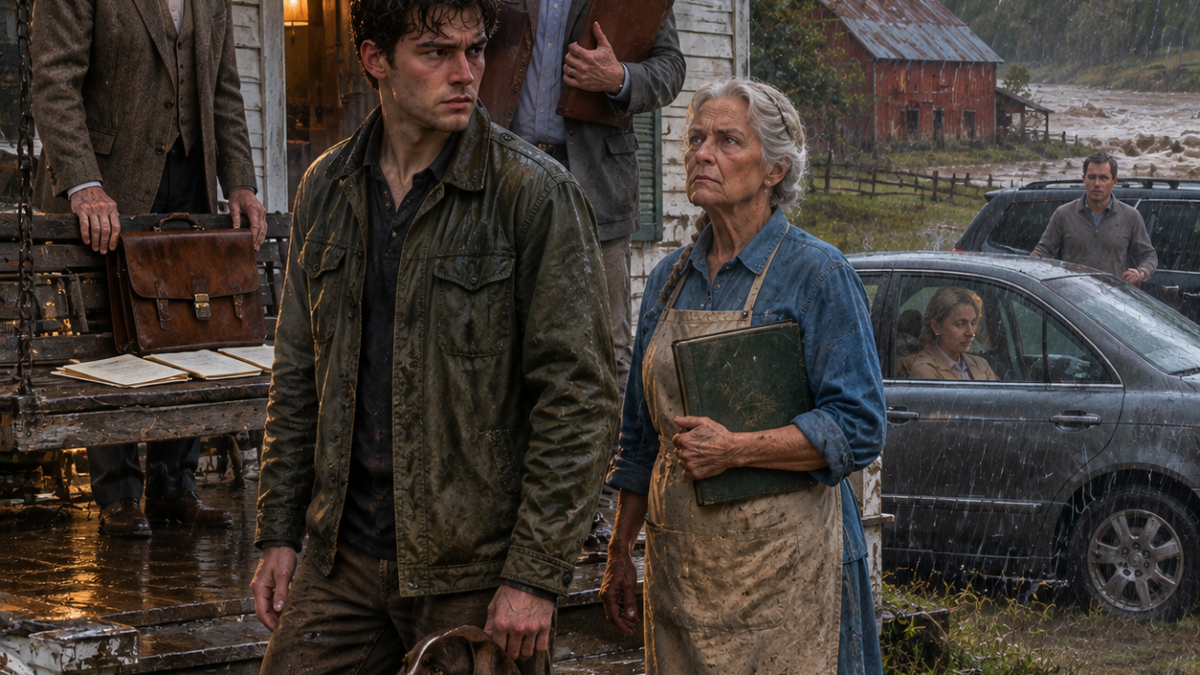
Neither of them looked back. The house stood at the end of a long lane of tall grass, white once, with green shutters gone gray and a tin roof streaked with rust like old tears.
A porch ran around three sides.
The swing hung from one chain. Beyond it, a red barn leaned toward the creek.
And in the yard, a small whitewashed shed squatted over the well. Its door tied shut with a loop of wire.
The back door had never latched properly.
It opened when he leaned on it.
Inside, it smelled of dust and cold stove and mice.
Somebody had taken the good furniture, and he did not have to ask who.
What remained was too heavy or too plain to sell. The black cast iron cook stove, the oilcloth covered table, a few chairs, a calendar on the wall still turned to March of the year before.
In the small square for the ninth, in a hand mate would have known anywhere, someone had written Lenore Pie.
After that, nothing.
The power had been cut in April. When he turned the kitchen tap, nothing came because there was no tap, only an iron pump at the sink with a handle rusted solid.
He stood a long minute in the kitchen with his bags at his feet. Then he did the next thing because the next thing was the only thing there was.
He found a candle stub in the drawer and counted the matches in the box he had taken. 41, enough if he was careful.
He lit the candle with one.
By its light he laid paper from the drawer, splinters from the porch rail, and dry slabs from the kindling box, opened the damper and lit the cook stove with the second. It caught on the third try.
It was not much, but it was a fire, and a fire was a place to stand. He ate two slices of bread with peanut butter, standing, and drank creek water from a coffee can he had dipped at the ford.
It was a little after 9:00 when the scratching started under the porch.
He took the candle out.
The night was cool, 46° by the feel of it, and the porch boards creaked under him. At the edge of the light, low to the ground, two eyes lit green and then pulled back.
A dog, thin enough that her ribs showed like the staves of a barrel, a liver and white pointer with a brown head and a nick in one ear. She wore a faded red collar with no tag.
When he crouched, she showed him the whites of her eyes and backed farther under the porch. Im not going to hurt you, he said.
His voice sounded strange to him. He had half a loaf of bread, one jar, one can of corn, and no idea when he would see a store.
He tore a slice in half, laid it on the bottom step, and went back inside without watching.
In the morning, the bread was gone. The dog was sitting at the foot of the steps with her ears up, waiting, as if she had been there all her life.
They would be tied together tighter than either of them knew at the time.
Sunday came clear and cool.
Nate gave her the heel of the loaf and the corn, cold from the can. She ate it in four swallows and looked at him and then at the empty can.
That left him one slice of bread and a quarter jar of peanut butter.
He went to work. The sink pump took most of the morning.
He carried creek water to prime it, poured a coffee can down the top, worked the handle until his palms stung, and on the 31st stroke, the pipe coughed, shuddered, and spat a rope of rust-brown water that ran slowly clear. He drank a whole can of it.
In the old garden, he found dandelion greens and wild onions among last years dead stalks, and he boiled them with a spoon of salt from the tin on the shelf.
It tasted like a lawn. He ate it all, and Sage ate hers.
He had not named her yet.
He found himself calling her Sage anyway, because she had bedded down in the wild sage by the barn, or because he could not stand to call her nothing.
She followed him from the barn to the creek and back. When he sat down on the porch step, she sat beside him.
By mid-afternoon, the sky in the west had turned the color of a bruise.
The first drops hit the tin roof at 10 minutes past 4:00, big and slow, and then the whole roof began to roar. He had forgotten how loud rain was on tin.
He ran upstairs because he remembered that the roof had always leaked. It did.
There were three dark stains in the plaster of the ceiling and a drip had already started in the middle of the front bedroom.
He fetched the stewpot, the coffee can, and a bucket and set them where the water came in.
Plink, plink, plunk.
He stood in the middle of the room, wet to the knees and almost laughing. It was the first time all weekend he had felt anything but hollow.
Sage had followed him up.
She had not come in.
She stood at the door with her nose working and then she crossed the room, stepped around the iron bedstead that was pushed against the low knee wall under the slope of the ceiling, and stopped. Her whole body went still.
One front paw rose off the floor and hung there.
Her tail stiffened out straight behind her and her nose pointed, like the needle of a compass, at the painted boards behind the bed.
What is it?
Nate said. She did not look at him.
She did not move.
He smelled it then, faint under the wet plaster and mouse smell, cedar, clean dry cedar, the kind that comes from a closet in a house where nothing else had been clean in years. He pulled the bedstead out from the wall by a foot and the iron legs shrieked across the boards.
He rapped the wall with his knuckles, pine, pine, pine. Then, low near the baseboard, a hollow sound, like knocking on a drum.
He knelt.
The paint had been brushed over the seam, but a seam it was, a straight narrow line in the boards, a little too straight for the house around it.
Near the bottom, where a knot should have been, was a knot that was not one. He pressed it with his thumb.
Something behind the wall gave a small, dry click.
Rain drummed on the roof.
Sage did not breathe. Nate set both hands flat against the boards and pushed, and the wall moved.
The wall swung inward on a pair of hinges that had been oiled, and that was the first thing that frightened him.
Nothing else in the house had been oiled in years. It was a low door, no higher than his belt, cut into the knee wall so cleanly that the paint had been brushed right across the join.
Beyond it, there was only black, and a breath of air that came out against his wet face, dry and cool, smelling of cedar and lamp oil, and something faintly sweet, like fruit in a cellar. Rain ran down the roof over his head.
In there, no drop fell.
Sage did not go in. She stood at his knee, trembling along her whole length, and looked up at him as if the next part were his.
Hold on, he said. I need a light.
He went down the stairs in the near dark and came back with the candle stub from the kitchen, cupping the flame in his palm the whole way. When he stooped through the low door, with the dog pressed against his leg, the light shook across a room.
It was a room.
That was what he could not get past.
Not a crawl space, not a hole to hide a box in, but a real room, windowless, about 8 ft by 10, lined from floor to rafters in cedar boards gone the color of honey.
Three cots stood along one wall, each made up tight with a gray wool blanket. Quilts sat stacked on a plank bench.
Hurricane lanterns hung from nails along a beam, and beside them hung a flat tin of kitchen matches, dry as bone. In one corner stood six glass jugs of water with corks in their necks.
In another, a lidded pail of rice, a sack of dried beans, and a gallon of lamp oil.
On the floor shelf, 10 quart jars of peaches sat shoulder to shoulder, each lid marked in black marker, August 2025. Nate took a match from the tin, lifted the glass of the nearest lantern, and lit the wick.
He turned it up until the flame stood steady, and the whole room went the warm gold of the inside of a pear. Above the bench ran a single plank shelf, and on the shelf stood 12 pint jars in a row.
Each had a strip of masking tape across the lid, and on each strip, in pencil, in big square capitals he would have known anywhere, a number, 1 through 12. He did not touch them yet.
Somebody had built this on purpose, with a carpenters patience.
He looked up. The rafters over the room were laid with newer boards than the rest of the roof.
The tar paper between them tight and black.
Somebody had patched this one corner, and left every other part of the house to leak.
He thought of the rooms downstairs. He had noticed it Saturday night, without noticing.
Every drawer pulled out an inch, closet doors standing open, the way a house looks after somebody has gone through it fast, and not found what he wanted. His father had stood within 10 ft of this wall.
Nate sat down on the nearest cot, because his knees decided it for him.
The wool smelled of cedar. Sage came in then, one careful paw at a time, and lay down against his boot with a long breath that was almost a groan.
You knew, he said to her, didnt you? She thumped her tail once on the cedar floor.
He reached up and took down the first jar.
Under the lid, folded in thirds, was a sheet of lined paper, and wrapped in a scrap of faded flannel was something small and heavy. He set the flannel on his knee and unfolded the paper.
It was written in pencil in the same square hand as the calendar and the numbers, and it was not long.
Nate, if youre reading this, then you ran out of options, and the house did what I built it to do.
Im sorry for whatever it cost you to get here. I am not sorry you came.
I am not a man who says things well, so Ill say this one plain.
I wanted you. I wanted you at my table every Thanksgiving and on my porch every summer.
And when you stopped coming, I did not stop leaving the light on.
Whatever you were told about why, hold it loosely until you have read the rest of these. Some practical matters.
The roof leaks over the north end of this house, but not over this room. I patched it myself twice.
Sleep on the cot by the door.
The peaches are on the floor.
The matches are in the tin. The oil is in the can, and the water is in the jugs.
Whats in the flannel is for groceries.
It is worth more than that, but groceries is how you will want to think of it for now.
Open the jars in order.
They are not long.
Here is the only thing I know that nobody had to teach me. Keep one dry corner for whoevers roof gives out.
Your grandfather, Emmett Keter.
He read it once, and then he read it again, slower. With his thumb under the line where it said he had not stopped leaving the light on.
Then he unwrapped the flannel. It was a gold coin, a little bigger than a quarter, and so heavy that his hand dipped when it landed in his palm.
On one side, a mans face in a feathered headdress. On the other, an eagle.
And under the eagle, a date, 1926. He did not know what it was worth.
He knew only that his grandfather had called it groceries. What a person leaves behind for someone they love is rarely what anyone expects to find.
He did the next thing. He took down a quart of peaches, twisted the lid until the seal gave with a small sigh, and ate five halves straight from the jar with his fingers.
So sweet and cold he could hardly swallow.
He fed Sage three, one at a time from his palm, and she took each as though it might be taken back. Inside the blanket, he found a dry pair of wool socks.
He pulled off his wet boots and put them on. He shut the little door and found a loop of cord on the inside that worked the catch, so the room could be closed from within.
Then he sat with his back against the cedar, the lantern turned low, and the dogs head on his foot, and listened to the rain on a roof that could not touch him. He wiped his fingers on his jeans and reached for the second jar.
This one was thicker. Inside, the paper was folded around something stiff, and he pulled out the paper first.
Nate, I will tell you now what I could not tell you any other way, because I tried every other way.
I wrote to you at Christmas six years running, and on your birthday five.
I called on Sunday evenings. I stopped counting the calls somewhere past 200.
Your father told me, politely, every time, that you were out, or busy, or that you had said you did not care to come.
I did not believe it.
I could not prove it. A man cannot walk into another mans house and take his grandson by the hand.
So, I am telling you plainly instead. I asked.
I asked every time.
There is a key at the bottom of this jar.
You will know the lock when you see it.
He tipped the jar.
A small brass key slid into his palm, tied through its eye with a loop of gray string, the coarse woven kind that comes off a feed sack. It had a notch worn smooth by a thumb.
He turned it over.
There was nothing written on it anywhere. He tried to hold on to what he had just read and could not because something else had already come up through the floor of him, a kitchen, a smell of pot roast, his fathers voice, pleasant and reasonable, saying words he had carried ever since.
It had started the summer he was 14. His father and grandfather had gone out to the Hollow Farm barn to talk, and the talk had gone on a long time, and when Marvin Ketter came out of the barn, his face had been the color of putty.
He had not said goodbye.
He had put Nate in the car and driven the 13 mi home without turning on the radio.
Nate had watched his grand father standing at the edge of the porch, one hand lifted as they pulled out, and had not understood why the hand was not waving, but only staying up as if to stop something. Then Thanksgiving had come and no one had mentioned the farm.
In the end, he had asked, Dad, are we going to Grandpas? His father had been at the stove.
He had not turned around right away. Your grandfather and I talked, he had said.
He thinks its better if you dont come for a while.
Why?
He didnt say.
Hes an old man, Nate. Set in his ways, a boy underfoot wears on him.
His father had turned then with that tight kind smile and laid a hand on his shoulder.
It isnt about you. Old men get like that.
Well give him some room.
Across the kitchen, his mother had been scrubbing a pot that was already clean. She had not turned around, either.
No card had come that Christmas or the next.
He had run out to the mailbox every afternoon that December and every afternoon his fathers hand had been there first. His father always brought in the mail.
Nate had decided, somewhere in the second year, to stop asking and start not caring because not caring cost less. Sage shifted against his boot.
The lantern ticked. Nate looked at the little brass key in his palm and at the gold coin on the blanket beside him and he did something he had not done since the funeral.
He put the heel of his hand against his mouth, hard, and held it there until the shaking stopped.
He did not read any more that night, not at first. He sat with the key.
He tried it in his head on every lock he knew. The back door had no lock to speak of.
The barn had a hasp and a stick. The well house door was tied shut with wire.
He would try them all in daylight. It was nearly 9:00 when he got up to put out the lantern and that was when he saw it.
He had been looking at the shelf for 2 hours without really seeing it. 11 of the pint jars stood in their row with ordinary lids and ordinary tape.
The 12th, at the far end, had a lid punched through with two small holes and through the holes ran a loop of wire and through the loop hung a padlock about the size of a walnut.
He stood very still.
Then he took the key and turned it over once in his fingers and a small cold thought went through him that had nothing to do with the rain.
He lifted the 12th jar down.
Behind the tape on the lid in pencil in the square hand were two lines.
Last. Not before youve been to town.
He held the key a handsbreadth from the padlock.
He could feel in his own thumb how neatly the one would fit the other. A jar that would not open until he had done something and a man who had known he would be tempted.
All right, he said to the lantern or the jar or the dog.
All right, Ill go. He set the 12th jar back in its place and slid the key into his shirt pocket where the watch had been and buttoned the flap over it.
Then he read the rest one by one and he did not close his eyes until the 11th. They were what his grandfather had promised not long.
How to bank the cookstove for the night. Which stone in the ford stayed solid when the creek came up.
Where the spring ran under the barn.
Which of the neighbors to trust and which to walk past with a nod. Who to see in town and in what order.
The sixth in a hand that pressed harder into the paper said that when a front stalled over the hills the creek came up faster than anyone believed that the ford would be under in an hour and that when it was the lane was shut and a man should stay where he was and not try it. Stay dry, it said, and wait it out.
Not one of them said a word about money.
He fell asleep near midnight with the quilt over his shoulders and one hand on the dogs back in the one dry room for 13 miles while the rain went on and on over his head and could not reach him.
The rain quit a little before dawn and the silence woke him. Nate lay a minute in a room with no window and no clock and knew the hour by the dog who was up and at the little door with her nose to the crack.
He worked the cord. Gray light lay across the bedroom floor and out past the cracked front window, the whole hollow smelled of wet clover.
He cooked rice with two halves of peaches stirred in and Sage got her share on a pie tin.
At the ford, the creek ran the color of coffee with milk in it, a foot higher than Saturday and loud over the stones.
He stood reading it the way the sixth jar had told him to. Third stone from the near bank still showing.
On the way back, he stopped at the well house.
He had put it off and he knew why.
A thing you have not looked at is still possible. He lifted the loop of wire and the door swung in on a small room that smelled of wet stone.
A plank floor, a hand pump on a platform of heavy boards, a coil of rope, a tin bucket.
Nothing else. He knelt and pressed the boards with the flat of his hand.
Solid.
The brass key belonged to nothing in that room. He re-tied the wire the way he had found it because the old man had tied it that way.
At 10:00, Sages head came up from her paws.
She looked down the lane and then she did a thing he had not seen her do. She ran hard and low down through the wet grass toward the ford whining.
A small figure was coming up the lane on foot. A woman narrow and wiry as a fence post with a basket on one arm and a green cloth-bound book under the other, walking the way people walk who have walked a road for 50 years and mean to keep on.
She stopped at the foot of the steps with the dog wagging against her knees.
Well, Dot, she said in a voice like a screen door. You look better than you did.
Her names Sage, Nate said. At least thats what Ive been calling her.
The woman gave him a long, plain, gray-eyed look from under a pinned-up braid of white hair. She wore a rolled-sleeve denim shirt, a canvas apron, rubber barn boots, and reading glasses on a cord.
Emmett called her Dot, she said.
Sage is a fine name. She seems to have taken it.
She set the basket on the rail.
Im Lenore Tibbs.
I farm the place a mile and a half up the hollow. Youre Nate.
Id have known without being told.
Youve got his jaw and youre standing like him, like a man who expects the next thing to be a bill. Under the checked cloth sat a cherry pie, still warm enough to fog it, and beside it a thermos, a dozen eggs, a loaf of bread, and a jar of pickled beets.
Its Memorial Day, she said. A person ought to eat pie on Memorial Day.
I brought one up here on the second Monday of every month for 11 years and Im not about to quit because the customer changed.
On the kitchen calendar, in the square for the 9th of March, in the old mans hand, it said Lenore pie. He went on the 9th of March, Lenore said, as if she had followed his eyes.
In the morning, in his chair on this porch. Thats all Ill say about that.
It was quiet and he wasnt alone because Dot was with him.
They ate on the porch steps, the three of them, pie out of the pan with two forks and a spoon. The dog had stayed on that porch 3 weeks after the funeral.
Then she had walked the mile and a half to Lenores back door and laying down on the step. And for a time, she lived on two porches.
In the third week of April, she stopped coming. That was when your fathers car started coming up the lane, Lenore said.
Nate set down his fork.
Twice. Once in daylight, most of an afternoon.
Once at night and the headlights stayed on until nearly midnight.
I saw them from my kitchen.
She shrugged. He had a right to go through his own fathers house.
But a man who has a right to a thing doesnt generally do it at night.
She turned the thermos lid in her hands. Did you find it?
The room? He looked at her.
The dog looked at him. Its all right, Lenore said.
Ive known about it since 2011.
A storm that June had taken the whole roof off the Gerlach place across the creek in about a minute and a half.
The Gerlachs, a father and mother and three little ones, had come across the field at midnight carrying a baby in a pillowcase and slept on Emmett Ketters kitchen floor. He had not said a word.
He had made cocoa and found blankets.
In the morning, he had gone upstairs and stood in the front bedroom a long time. And the next week he started.
He built it that summer, alone, evenings and weekends. A room that would stay dry whatever the roof did.
Cedar. Because he said it smelled like the closet your mother kept.
She smiled at the lane. In 15 years, I know of eight times somebody slept in it.
A hay crew caught in a flood. A hunter off the ridge with a bad ankle.
A woman whose car died in the ford at two in the morning.
Me once in a tornado watch.
He never charged anybody or asked a single question.
Hed say, Theres coffee.
And go on out to the barn.
And my father? He never told Marvin.
She said it without heat. He said a place like that stays a refuge only so long as it stays quiet.
He said Marvin quit asking about the farm unless it was about money. She looked at the dog.
He had a line he said, the way other men say grace, Keep one dry corner for whoevers roof gives out. It was in the first jar.
For the first time that morning, her face moved. Then youve started.
She said softly. He surprised himself.
He reached into his pocket and held out the coin. She did not take it.
She looked at it a long moment and when she spoke, her voice had changed.
1926.
$10. Thats an Indian head eagle, son.
Real gold and a good deal more than groceries. Emmett bought one on the first of March every year as long as I knew him.
Sometimes too, in a lean year, which I never understood.
Hed ask for the cash and I kept my mouth shut and my pencil sharp because it was none of my business. Your pencil?
31 years keeping books at the grain co-op.
She patted the green ledger. I keep them still.
Habit.
She put a rough finger on the coin and pushed it gently back toward his chest. Id put that away.
Id not carry it to town in a shirt pocket and Id not say a word about it to a soul until youve seen somebody Id trust.
Tomorrow, Im in town anyhow. Ill be here at 9:00 with the truck.
She went back up the lane at noon. At 20 minutes to 9:00 the next morning, a tan SUV came up the lane.
It was clean and new with a rental sticker in the corner of the windshield and it crossed the ford with the care of a vehicle that expected to be billed for scratches. The man who got out wore a gray quarter-zip pullover, pressed khakis, and white leather sneakers that he looked at once and then ignored.
 [Tap here for the Next Part ]