All She Got Was the Old Lake Cabin — Then Came a Knock: “Grandpa Sent Me…”
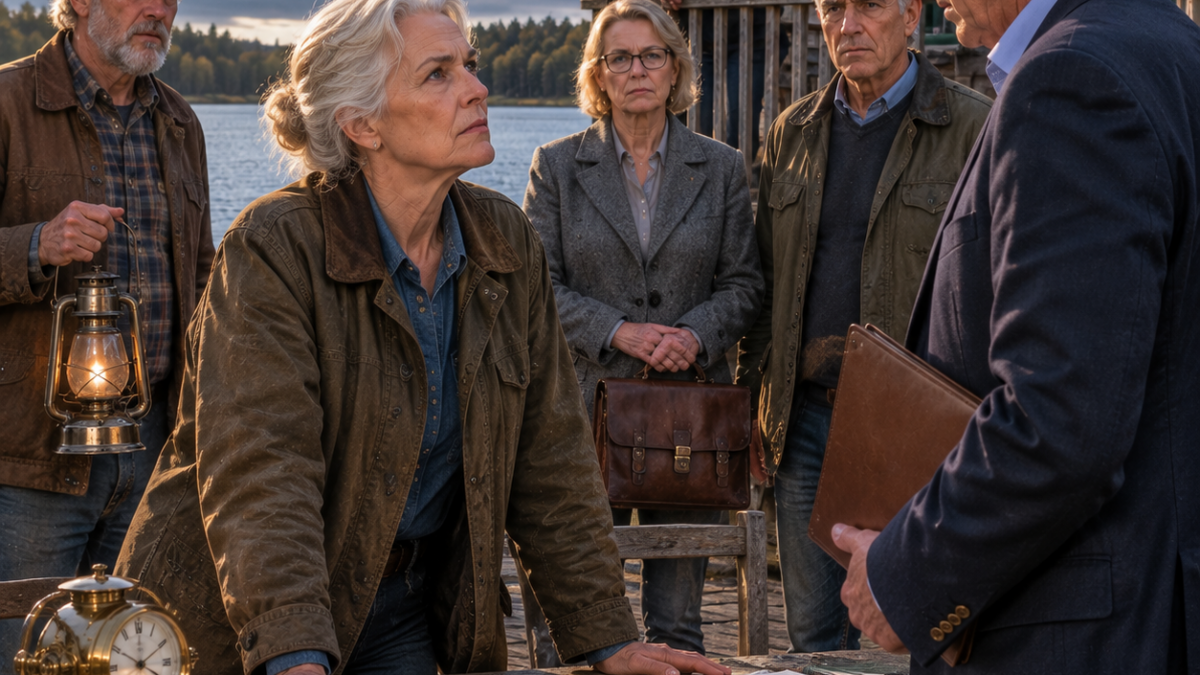
All She Got Was the Old Lake Cabin — Then Came a Knock: “Grandpa Sent Me…”
Its only fair, Corey, her brother said, and pushed the cabin key across the table the way a man leaves a tip. For 7 years, Corin Ashb, 63, had nursed their mother in that house.
In one afternoon, Ry took it all. The house, her husbands tools, a folder containing receipts for $38,400 in repairs, and the brass ships clock from the mantle.
What he left her was a fishing cabin on Turn Lake, 14 miles from town. On their first night there, her husband Art heard a note rising out of the water, and by the second he was kneeling at a hatch beneath the fish cleaning table at the end of the pier, a hatch her brother had stood over all his boyhood without wondering why it sounded hollow.
To understand what they found, you have to start with the afternoon.
He slid that key across the table.
It was the 11th of September, a Saturday, and the kitchen at 214 Orchard Street smelled of coffee that nobody had touched.
Her mother had been gone 5 weeks and 6 days, and the good tablecloth was still on the table because Karen had not yet found the heart to wash it.
Rey had brought a folder. He had always been a man who brought a folder.
He sat in the chair their father used to take in a navy blazer that hung looser than it had at the funeral and laid out their mothers will like a man dealing cards he already knew the order of. Beside him his son Tyler sat with his cap in his lap and his eyes on his boots.
Art stood behind Karins chair with one hand on the back of it and the other the left tucked into his jacket pocket where he kept it when other people were looking. Mom left the house to me, Ray said.
And the landing to you?
I think thats about as fair as anyone could ask.
The landing? Karin said.
Turn Lake, Grandpas place. He smiled his large, warm smile.
You always loved it up there. And Ive paid the taxes through the end of the year, so you wont owe a dime.
Thats me looking after you, Corey. I want you to know I thought about it.
She had not been to the landing in 9 years. Rey knew that.
It was Rey who had told her the spring after their grandfather died that the septic had failed and the county had condemned the place.
She had believed him.
She had never had a reason not to.
Weve put $38,400 into this house, Art said quietly. The roof was 16,200, the furnace 9,800, plumbing 7,400, and the porch 5,000.
I kept every receipt. Im sure you did, Art.
Youre a careful man.
Rey held out his hand, palm up, and after a moment, Art took the folder from the sideboard and put it in it. Ill keep these with the estate file so nothing gets lost.
You understand? Those were improvements to a house you lived in rent-free.
Id call that a gift, and Id never throw it back in your face. It was the voice that did it, not the words.
It was the voice he used on customers at the storage yard.
Patient and sorrowful.
the voice of a man who was only taking the thing out of your hands because he could see how heavy it was.
Karen had known that voice since she was six when he took the last cookie off her plate to spare her the stomach ache.
Arts workshop, Ry went on. The garage is estate property, so the tools stay until after the appraisal.
October, probably. The cedar chest the same, and the clock stays with the house.
Grandpas clock, Karin said. Its a clock, Corey.
He glanced at it as he said it.
The heavy brass ships clock on the mantle that their grandfather had wound every Sunday of his life, and she saw his eyes go over it the way a mans eyes go over a price tag.
Ill need the keys by noon tomorrow. The contractors start Monday.
His phone buzzed against the table.
He turned it face down without looking, and it buzzed again, and he laid his hand flat on top of it as if it were a small animal that might get away.
Tyler had not lifted his eyes since he sat down. Karen looked at her nephew, 29 years old, the boy she had taught to bait a hook at that same lake, and waited for him to say her name.
He studied the toe of his boot.
In the front room, the clock went on ticking, and she thought with a clarity that surprised her, that she could forgive a great deal of what happened in this kitchen before she could ever forgive that quiet. Did mom know?
she asked. That it would be like this.
Mom signed what mom signed, said Rey, and slid the key across the cloth.
They loaded Arts pickup on Sunday morning, and it took less than an hour, which was the worst of it. two suitcases, the mattress off their bed, a box of kitchen things, a sack of rice, six cans of soup, two quilts, Arts small toolbox from behind the truck seat, all of his tools he had been allowed to keep, her mothers reading glasses in their cracked case, which nobody had thought to count.
At 10 minutes to noon, she laid the house keys on the kitchen table. The mantle was bare where the clock had been, and a pale ring marked the wood.
Two doors down, a curtain in Rays car window moved and was still.
Dont look back, Art said.
Its a rule I made up on the way.
Im looking back. I know.
Id think less of you if you didnt. It was 14 miles.
The road went from two lanes to one, and the one went to gravel at a green sign riddled with old holes, and the bars on Arts phone went from three to none, gently, like lights going out in a house.
They crossed a low gravel causeway over a neck of water that Art called the Narrows, and after that there was nothing but spruce and sky, and the trucks one dusty rattle, until the trees opened, and there was the lake.
It lay long and flat in the late light, the color of slate, with a rind of dark stones showing along the shore where the water had been let down for the autumn. The cabin sat above it on a rise, gray shingled and low, with a green door and a porch whose steps had gone soft in the middle.
It looked like something that had been waiting politely. Beside it ran the pier, 60 ft of weathered timber, built like a letter L.
It was 10 minutes to 7 and at the very end of the pier, a single yellow light was burning. Art put the truck in park and sat with his hand on the wheel.
Cy, he said, nobodys been in here in 9 years. I know.
Theres a light on.
They walked out to it together over boards that gave a little underfoot and then held. It was a hurricane lamp, an old one, hung on an iron hook on the last post, its glass clean and its wick trimmed square.
Art put the back of his fingers to the chimney and drew them away.
Warm, he said.
Somebody filled this today.
She looked down the long shore.
There was no boat on the water, no smoke, no figure on the road. Across the cove, a mile and a half off, a few windows glowed among the trees, and that was all.
The lamp burned on, steady in the windless air.
It did not feel like a trap.
It felt like being expected.
That night, Art primed the pump on the porch with a pint of water from the thermos, working the iron handle with his right hand, slow, listening to it until it coughed and gasped, and gave them a gush of brown water, and then a thin, clear stream so cold it made her teeth ache. She rolled a newspaper into a brush and cleaned the stove pipe until the soot came down in black sheets, and she struck one match from the box in the kitchen drawer and counted 25 left.
The fire caught on the second try. They ate soup out of the can, standing up, and then they lay down on the mattress with both quilts over them, and listened to the lake move against the shore.
Im sorry about the house, Art said into the dark. It was never ours.
It was ours for 7 years. His voice was rough.
I wanted it to be anyway. She found his bad hand under the quilt and held it and felt the faint steady tremor in it, the small wrong thing that had stayed with him since the spell he had two winters back.
And she thought of nothing for a long time.
She did not know what woke him.
It was past 11.
The wind had come up from the northwest, a soft one, and under it, so low she felt it in the floor before she heard it.
There was a note, one long hollow tone, rising and falling, like a breath drawn across the lip of a jug.
Art was already sitting up.
He went out in his socks with the flashlight, and she watched from the porch rail as the beam went down the pier and stopped.
He crouched at the end.
He laid his whole palm against the last post, the way a man lays a hand on a horse and stayed there so long she called his name. Its under us, he called back.
The whole end. The winds going through something.
Through what?
I dont know yet.
The note faded as the gust died.
But it isnt water.
In daylight, the pier looked different.
The lake had been drawn down about 20 in, and along the shore ran a band of dark, wet cribstones, stacked in a way no one stacks stones by accident.
Art walked the board slowly, tapping with a knuckle, and Karen walked behind him with her coffee. The planks rang dull and dull.
Then at the end, where the pier widened into a platform 16 ft square with a great oak slab bolted down on it for cleaning fish, the sound changed.
He knocked again three times, and each time the answer came back deeper than it should have. Hollow, he said.
Thats a rooms worth of air under there, Corey.
12 feet by nine maybe. He crouched and she saw the private pleased look come onto his face that she had last seen when he fixed the water man at the church.
Eight bolts and everyone capped in brass.
Somebody wanted this slab to stay put. He tried every cap.
He tried a pry bar and then put it down because the old oak did not so much as creek. By noon they gave up and went to split wood because the stove still wanted feeding and the day still wanted doing.
At dusk she went round the back for an armload of kindling.
When she came around the corner again the lamp at the end of the pier was lit.
She hadnt heard a thing.
No step on the boards.
Only far out across the water so faint she might have imagined it. the small stuttering note of a motor going away.
Art, I saw he was standing. Didnt see who.
They were still standing there with the dark coming down when someone knocked on the cabin door. It was a slow, deliberate knock three times, the way youd knock if you had practiced the sound for a long while.
Art took the flashlight. Karen opened the door.
A short, barrel-chested man stood on the porch, 67 or 68, with a bushy gray beard and a faded green cap in his hands, and grease worked into the creases of his knuckles. He wore navy coveralls and wire rimmed bifocals, and a carpenterss pencil lay behind one ear.
He looked, she thought, like a man who had rehearsed this for a very long time and lost every word. Mrs.Ashb, he said.
He cleared his throat. Im hap done, Levy.
I fix boats in Wellers Crossing. The cap turned once in his hands.
Your grandpa sent me.
Nobody spoke. The stove ticked behind them.
Out on the water.
The lamp went on burning.
My grandfather died 9 years ago.
Karin said. Yes, maam.
March 14th. He nodded slowly as if the date were one he carried in a pocket.
He sent me before, said Id know the day when a Hartigan woman slept under that roof with the deed in her name.
Not a night before, in case she changed her mind.
He glanced past her at the lamp. 9 years Ive been lighting that thing.
Every dusk, 1st of May to the last of October.
He paid for the oil in advance.
Why? Because it isnt a favor, Mrs.Ashb.
Its a debt.
For the first time, he smiled. a short sideways one that did not go very far, and it gets paid in lamp oil.
He reached into the bib of his coveralls and drew out a small brass key tied through its eye with a loop of green string and held it out on his open palm. It had a notch worn smooth by a thumb.
I dont know the lock it fits, he said.
I do know the door that goes down to it.
Would you like me to show you? They went out onto the pier in the dark.
the three of them with the flashlight and the lamp and the lake moving against the timbers. At the end of the platform, Hap stopped and looked down at the oak slab and then at Art who was already looking at the bolts.
Seven brass caps, Hap said.
One lead. I saw it, Art said.
Third from the south corner. The only one thats dull.
Youd have worked it out by Thursday. Id have worked it out by Wednesday.
Anton said you would. The old mechanic pushed his bifocals up onto his forehead.
Reverse thread.
Quarter turned to the right, which feels wrong, and then lean on the south end.
Art knelt.
His left hand shook as it came out of his pocket, and he looked at it a moment and put it back and used the right. The lead cap turned the wrong way with a small dry click.
He set his shoulder to the slab, and Hap set his to the other end, and the whole great oak table, swung away on a hidden pivot, easy as a gate. Beneath it, set flush in the timbers, and ringed with a black rubber gasket, lay a hatch of oak 3 in thick, with an iron ring sunk in its face.
Art and Hap lifted it between them. A breath came up out of the dark, cool and dry and strange, smelling of cedar and lamp oil and old paper, and nothing at all like the lake.
Karin put the flashlight into the opening. Nine rungs went down.
At the bottom, the beam found a plank floor and the edge of a cot made up tight with a gray wool blanket and something that gleamed, a glass chimney, a lantern hanging from a nail waiting.
Ladies first, said Hapdun Levy gently. Its yours.
She went down the ladder with her heart going like a girls. The room was dry.
That was the first thing before she had even let go of the ladder. After a night of lake wind and a day of damp boards, the air at the bottom was as dry and still as the inside of a cedar chest, and it smelled of tar and lamp oil and clean wool.
Karen stood in the middle of the floor and turned slowly around. It was a room 12 ft by 9 with a ceiling she could have touched on tiptoe panled from the planks to the beams in cedar gone the color of strong tea.
Four cotss stood along the walls, each made up tight under a gray wool blanket.
A barrel of water with a tin dipper. A shelf of canned goods.
Every can stamped with the same month.
August 2027, a flat tin of kitchen matches beside two hurricane lamps, and in the back wall set into the cedar like the door of a ships cabin, a narrow door banded with iron and fitted with a brass lock.
On a plank table in the middle of the room, lay a thick leather ledger, and on top of the ledger lay an envelope held down by a lump of lake polished brass. It said one word on the front in square upright capitals.
Karin Art came down behind her slow, favoring the left hand, and Hap came last and stood with his back against the ladder, not looking at anything.
Ive been down here every August since he passed, he said after a while. Stalked the cans, aired the blankets, signed the book.
He nodded toward the iron banded door.
never turned that lock, though.
He had me swear on it, and Im not a swearing man.
Karen sat down on the nearest cot and broke the seal.
The paper was heavy and cream colored, folded in thirds, written in blue black ink, in a hand she had last seen on the back of a birthday card in 1981. Karin, if Hap has done as he was told, you are sitting in the room I built in the summer of 1952.
It is dry and the lamp over your head has been trimmed by a better man than I am.
I did not leave you a cabin.
I left you the lamp. The cabin is only where it hangs.
I am not a man who says things well. So I will say one thing plainly.
You were never the one I forgot to tell.
You were never the one I forgot to tell.
You were never the one I forgot to tell.
You were never the one I forgot to tell.
You were never the one I forgot to tell. You were never the one I forgot to tell.
You were never the one I forgot to tell. You were never the one I forgot to tell.
Once in the kitchen and once at the hospice.
I have thought on it for a year.
A man who asks for the key before he asks after the lake is not a man I hand a lamp to. I do not say this to turn you from your own blood.
I say it so you will check what he tells you.
If Raymond ever says this place is condemned, go and look for yourself. The stores are rotated every August by Hap Dun Levy, who is paid.
Matches in the tin, water in the barrel.
The ledger on the table is the record of everyone this room has kept dry since 1952, and you will want to read it before you decide anything.
The door in the back wall is not to be opened until Margarite Pool of Wellers Crossing is standing beside you. She is a careful woman, and I want it done so that no one can ever say a thing was taken that was not given.
Hap has the key.
Do not go to that door alone. Read the beam over your head.
It is the only advice I ever carved.
Anton. P.
S. Your husband will have heard the pier before he found the hatch.
He has the ears for it.
She read it twice.
The second time she read it aloud because she wanted to hear whether it sounded like him, and it did, dry and brief and not quite able to hide what was under it. When she finished, no one spoke.
Art had sat down on the cot opposite and put his good hand over his mouth. Hap had taken his cap off again and was looking at the inside of it.
Condemned, Karen said at last.
Yes.
Rey told me the county had condemned it.
In the spring of 2018, he showed me a letter.
Did you read the letter?
Art said gently.
I read the top of it. It had the seal.
She laughed. One dry sound.
I was nursing mother.
I had a basket of laundry on my hip.
I read the top of it.
She stood and found the matches and took down the nearer lamp because her hands needed something to do.
The chimney lifted off with a squeak.
The wick had been trimmed square and lay in its brass collar like a small white tongue, and she turned the thumb wheel up a/4 in, and struck a match, and held it to the wick until it caught and bloomed and climbed.
She lowered the glass. The cedar went from tea to honey, all at once, all the way up the walls.
Over her head, on the great squared beam that ran the length of the room, a line of letters stood cut deep into the wood, each one an inch tall, black, with a lifetime of lamp smoke.
Keep a lamp lit on the water side.
Every family has a door it never opens.
It was a ledger of lined pages ruled by hand in columns, date, names, boat or none, weather, hours. In the last column, a single initial ah and later on from a certain year, a second one and a third.
The first entry was dated August the 9th, 1952. Two men and a boy.
Outboard dead off the point, wind northwest, stayed till light.
She turned another page and another, page after page, in two hands, then three, down the decades.
A woman and a baby in a rowboat, a man who had lost his oars, a church picnic of 14, caught out by hail.
Whole families with their names set down in a column and their weather beside them. She read for a long time, and the wind came up, and the note came down through the hatch, and settled in the room, low and clear, and she understood it now.
It was a lamps breath.
It was the pier saying its one word. 1100 and some nights by my count.
Hap said maybe more. He quit counting around the time I started.
He nodded at the page.
Thats my name there. Bottom of the one youve got.
Dun Levy 4. July of 1968.
I was 9 years old. She looked.
There it was. Four names in a childish column and a line of ink running across in her grandfathers hand.
Squall off the Northshore.
Boat lost.
All saved. She turned back one page more and found a night in the autumn of 1956 when the weather column had only one word in it, white caps, and 11 names ran down the page and the top one read e.
Thornquist skiff Marta went through.
She did not know the name. She read it and passed on.
I knew him a little.
Hap said, Your grandfather. People thought he was hard.
He turned the cap over.
He was the least hard man I ever worked for.
He simply didnt care to be thanked. Hap, Art said.
What did Rey know?
The mechanic was quiet a long moment.
He knew there was something.
He said, I dont know how much.
He came out here twice in June of 2018 and again in May of the next year, both times after dark with a flashlight. I was out in my skiff fishing, you understand?
Because thats what I told myself. His mouth moved.
He walked the whole pier.
He stood on that slab and stamped on it twice to hear what it said.
He didnt know what he was listening for.
He went home.
Karen put the ledger down.
She didnt remember deciding to. It had been the middle of March, 2018, a Wednesday, and the phone had rung before 6:00 in the morning.
Grandpa passed in the night.
Ry said it was peaceful. There was nothing to do, nothing needed from her, no need to come out to the hospice.
He had already seen to everything, and the funeral would be Saturday, and he had seen to everything.
By Saturday, he had the keys to the landing and the papers from the lawyers office, and a way of saying we in a sentence that left her out of it. In April, at their mothers kitchen table, he had slid the letter across to her with the county seal at the top.
Septic failure, unfit for habitation. The county would not permit anyone to sleep there.
A shame, he said, but there it was. He would handle the notices, and she shouldnt spend a thought on it.
In May, he had come with a second paper and a pen, a disclaimer of interest, he called it, in the contents of the lake property, just a formality, so that mothers estate would stay clean.
She had signed it on the table beside the sugar bowl without reading it because he was her brother and she was tired and because the pen was already in her hand.
I signed away something.
She said now I dont know what.
Maybe nothing.
Art said you cant give up what isnt yours to give.
Is that the law? Its plumbing.
He said its the same.
She nearly smiled. She looked up at the beam, at the lamp, at the narrow ironbanded door in the back wall with its patient brass lock, and she felt for the first time in 9 years the strange quiet that comes when something you have always half known is finally said aloud by someone else.
He said I wasnt to open that door, she said.
Without Margarite Pool.
Yes, maam.
Then we wont.
Hap nodded.
It looked as if a very old weight had gone out of his shoulders and left him a little taller. He put the key in her hand and closed her fingers over it.
Tuesday, he said. Come to the shop.
Ill tell you what I can, and Ill take you to her. Shes a good woman, and shes been waiting nearly as long as I have.
They climbed out into the night. The lake was black and still.
The stars were out in their thousands, and the lamp at the end of the pier burned on, and Karen stood looking at it for a long time.
Hap swung down into a small aluminum skiff that was tied up in the shadow of the pier, and she realized she hadnt once heard it arrive.
He pulled the cord.
The motor caught on the second pull, and began to mutter, and the small light of his stern lantern drew away across the cove. They closed the hatch and swung the slab back into place, and Art put the lead cap on with his right hand and stood looking at it.
A man who spent 40 years learning which valves closed the wrong way, he said.
And the one that matters was in my own front yard. It was never your yard.
It was in front of me then. She slept badly.
It was the first night in 6 weeks that she had not dreamed of her mothers house, and in its place came a long, clean dark with a note in it and a flame.
Art woke her a little after, too.
He was standing at the window in his undershirt, with his hand flat against the glass.
Dont turn on the light, he said quietly. Down at the foot of the lane, where the gravel met the county road, a pair of headlights sat motionless in the trees.
The engine was running. She could hear it.
A rough, heavy diesel with something rattling loose underneath. A heat shield, maybe.
It sat there idling for what felt like a very long time.
2 minutes, three, pointing at the pier and the small, steady light at the end of it. Then the headlight swung away.
The rattle faded up the road toward town, and in the silence that came after it, she heard the lake settle back against the stones, and understood that whoever had been watching them had seen the lamp.
Dunlevy Marine Repair stood at the foot of Water Street in Wellers Crossing, a long tin roofed shed with a handpainted sign and a gravel yard full of boats in various stages of being forgiven. Over the open bay door, a row of outboard motors hung by their cowlings from a beam like hams in a smokehouse.
It was Tuesday morning, a little after 9.
They had driven the 14 mi with the windows down, and as the bars on Arts phone came back one by one, he had looked at the screen, turned it face down on the seat, and said nothing.
Karin had known without asking that there would be messages from Rey and that there would be more of them before the day was out.
Hap was waiting in the doorway with two mugs. He had washed his hands which on him looked like a formal occasion.
You slept, he said. Not much.
Nobody sleeps the first night.
He led them to a cramped office at the back with a stove and a calendar from a gasket company and sat himself on an upturned bucket as though it were the only seat in the world he trusted. Art took the chair and then stood up again and went to the bench by the window where an outboard lay open on a stand and looked at it with his good hand behind his back.
Go ahead, Hap said without turning. Its been running rough since June.
I wouldnt presume.
Its a motor, Art.
It doesnt have feelings.
Art took up a screwdriver in his right hand and bent over the carburetor, and there was only the small clicking sound of a man listening to metal. The tremor in his left hand, which hung loose at his side, quieted as it did when his whole mind was somewhere else.
I want to hear it, Karin said. From the beginning, Hap, not from the part youre comfortable with, he let out a long breath.
I was nine, July of 1968.
My father had a 12-oot Johnboat and a head full of ideas about walleye.
He took my mother and my little sister and me out past the North Point after supper, and the sky in the northwest went the color of a bruise, and by the time he got the motor started, the wind had it by the throat.
That lake stacks its water at one end in a northwest wind and then it comes back. We were in the water and then we were clinging to the boat and the boat was going.
Neither of them moved.
And there was a light, Hap said, out on the southshore, just a yellow point.
My mother saw it first.
She said, Hold on, children. Somebodys lit a lamp.
And your grandfather came out of the dark in a 19 ft flatbottomed patched up rowboat, and he pulled my sister over the side like a sack of flour, and then me and then my mother and my father last, never said a word, rode us in, filled us with coffee.
In the morning, he drove us home. The bucket creaked under him.
He wrote it down in the book, four names, and what the weather was doing.
He said that was how a thing like that became real. And thats why you light the lamp.
Thats why I light it now. Its not why I started.
He spread his hands. I quit school at 16 to work on boats.
In 1989, your grandfather put an envelope on my workbench, enough to buy this lot and this shed.
I tried to give it back.
He said, Its not a gift, Hap.
Im not that sentimental.
Its a loan.
You can pay me back in lamp oil. The short sideways smile came and went.
Ive been paying him for 38 years and I havent made a dent.
Karen laughed and it turned into something else halfway through and she set the mug down and pressed her wrist to her eyes.
Art did not come to her.
He knew better. He turned another screw and kept his back to her, and the small shop held its silence around her like a hand.
He thought if you knew youd tell Raymond, Hap said gently, because youd think it was a gift for the whole family.
He wasnt wrong, was he?
She had no answer.
Theres a story, Hap said more slowly. The old people call it white cap night, September 1956.
A squall came down the lake out of nowhere, and a hermit sort of fellow who carved ducks, Elias Thornquist, was out in a skiff after dark.
Hed have been gone, but there was a light on the Southshore and he made for it.
Your grandfather kept him on a cot in that room till morning. I saw that name in the register.
Then youve seen part of it.
Thornquist wouldnt sell his best birds.
He said they werent for sale.
They were promised.
He died the next spring and nobody ever found one of them.
People say the dump or a nephew in Ohio. He met her eyes.
I never asked your grandfather.
I figured that was the point of the lock.
The motor on the stand caught, coughed once, and settled into a long smooth purr that filled the shop with the smell of warm oil. Art stood with his head tilted, listening, and she saw the slow private pleasure come over his face that she remembered from the church water mane.
Vacuum leak, he said, in the fuel line. 6 months, said Hap.
Ive been looking at that. You were looking.
I was listening. Hap took a call in the yard and came back decided.
Margarite will see you tomorrow, 9:00, above Larssons hardware.
Shes in court till dark today. Bring your photograph identification and dont sign anything between now and then.
I have nothing to sign.
No, he said, but Id lay a months pay. Somebodys about to bring you something.
On the sidewalk outside Larssons, Karin took out her phone.
14 messages, six from Rey, three from his wife, Patrice, and four that were only her brothers name.
She did not open them. She was surprised how little it cost her.
Highway 12 is on the way, Art said. Id like to see his lot.
Hes been to our lake twice with a flashlight. Hartigan boat storage lay three mi out of town on a road that had seemed prosperous when she was a girl.
Three long metal sheds, Hartigan painted green along each roof, and rows of winter boats shrink wrapped like loaves.
Three of the bays stood empty. On the fence by the gate, somebody had stapled a laminated notice, pale with weather, with the name of Lakeshore Mutual Bank at the top, and a word in the first line that began with D.
A heavy green diesel pickup was parked beside the office, 9 or 10 years old, with a strip of heat shield hanging off its underside by a loop of bailing wire. It swayed in the wind and rattled a thin metallic shiver that Karen had last heard at 2:00 in the morning at the foot of her own lane.
Thats your night visitor, Art said very quietly. Or Rey lent it.
Ry doesnt lend things.
On the far side of the lot, a figure in a gray sweatshirt was easing a forklift down a row with a boat on its forks.
He turned the corner, raised his head, and saw the car. It was Tyler.
He stopped the machine and sat looking at his aunt across a hundred yards of gravel and white plastic and she looked back and it was her mothers kitchen again. She thought he lifted a hand.
If he did, it fell.
He turned the forklift around and drove the boat back the way it had come.
He wanted to want to, Karin said.
They were back at the landing before 4. Art walked out to the pier the way another man would check on a sleeping child.
 [Tap here for the Next Part ]