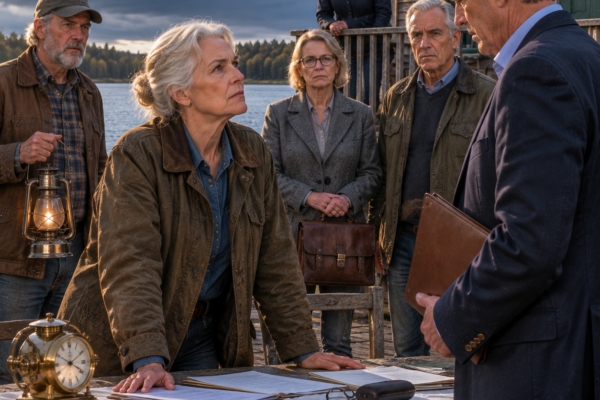
Part 3: All She Got Was the Old Lake Cabin — Then Came a Knock: “Grandpa Sent Me…”
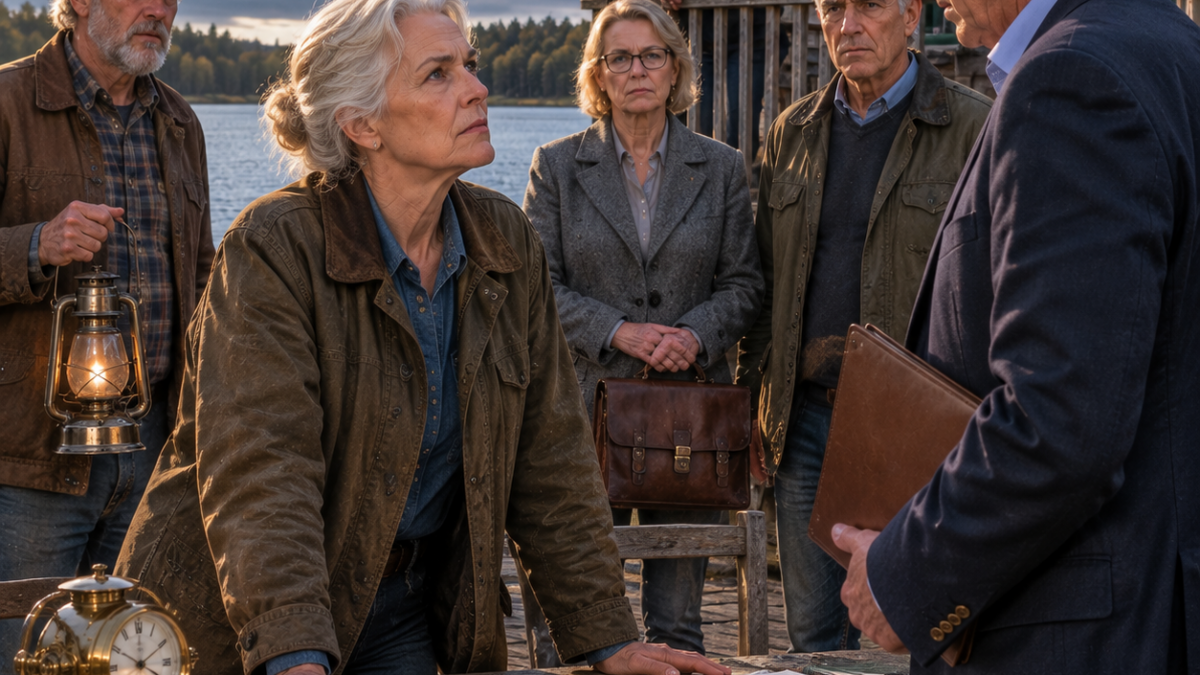
Ive got something in the truck, he said in a voice scarcely above the water. I should have said it Saturday in the kitchen.
I should have said it every hour. Say it now, said Karen.
Dad was going to sell the clock to a dealer in the city Monday morning.
I took it off the mantle Sunday night when the house was empty, and I put it in my closet, wrapped in a towel. He swallowed.
I told him it had been taken. And in the small hours of Tuesday, I drove out here to give it to you, and I sat at the end of the lane for 10 minutes, and I couldnt.
And on Tuesday, I brought Grandmas chest because that I could carry. His face was wet.
I didnt say your name in the kitchen.
Ive heard myself not say it every night since.
He went back to the truck and came out again with something wrapped in a blue bath towel held in both arms the way you carry something alive.
He unwrapped it on the oak slab among the papers and it was the brass ships clock, the 8th day, with its cracked glass door and its small worn key tied on a thread ticking. He had been winding it.
She could see by the hands that it was right to the minute. Karin put her palm on the cool brass.
It was the first thing of her grandfathers she had touched since the day shed last wound it with him at 9 years old on a Sunday.
You wound it, she said. Sundays, Tyler said.
I didnt know what else to do.
She did not embrace him. She was not ready and she would not pretend.
But she took his hand in both of hers hard and held it.
Come back when youre ready to say the rest, she said.
The doors open.
Thats all it is. It isnt wide.
Yes, maam, said Tyler.
At 3, Margarite P took her satchel and said she would be driving out ahead of the weather. The Narrows will be under by 5.
She shook Karins hand once hard. You did that very well.
The wind came at 20 4.
It arrived all at once.
A long cold roar out of the northwest that laid every spruce on the shore over like grass, and the lake went from put to white in the time it takes to draw a breath.
The tablecloth tore off the slab and sailed away across the water like a gull, and Art caught the clock against his chest, and the papers against the clock. Hap was already running for the hook at the end of the pier.
The lamp, he shouted.
Get it lit and get it shielded.
Ray had risen.
Tyler, the truck, were leaving. Mr.Hartigan, Clareire Renick called, youll not cross the narrows.
Tyler had already gone and was back in 4 minutes. Wet to the thighs, white to the lips.
Its gone, he said.
The waters over the causeway. Its 2 feet and rising.
He looked at his father. Were not going anywhere, Dad.
A limb the size of a mans waist came down on the cabin roof at that moment with a sound like a dropped piano, and the stove pipe leaned over and fell, and smoke rolled in at every seam of the little house. The room, Hap said, Now all of you.
They went down one at a time into the honeyccoled dark.
Clare first, then Tyler, then Rey, who stood for a long moment at the top of the ladder, with the wind tearing at his blazer, and his face turned up to the sky, and then went down with the stiffness of a man who has just been told the name of a feeling.
Hap lit the second lamp.
Karen came after with the clock in her arms. Art stayed on the platform.
He had gone out to the iron hook. The hurricane lamp swung there.
guttering the gale trying to take the flame off the wick like a hand taking a coin.
He had a wire hood from the kitchen and a strip of tin, and the patient, stubborn competence of a man who has spent 40 years convincing water to go where it was told.
She watched him from the hatch, bent double against the wind, with the left hand, the bad hand, steadying the glass, while the right worked the wire.
She saw the tremor go out of the hand. It simply left.
It left the way a bird leaves a branch. The flame bloomed and took hold under its little tin roof and held.
He came down the ladder drenched and grinning and pulled the hatch shut behind him, and the roar stopped as if a door had been closed on it.
There was a silence in the room.
The lamp ticked over their heads on the beam. keep a lamp lit on the water side, stood black and patient in the honey light, and from the wall the vent breathed out its one low note, a long soft tone that rose and fell with the wind, and was not like any sound she had ever heard a house make.
It was a long night.
The crib shuddered under the waves, and from time to time a sea went over the platform, with a boom they felt in the soles of their feet.
Hap passed round tins of peaches. Clare Renick fell asleep on the endcot with her windbreaker over her face.
Tyler sat on the floor by the ladder with his knees drawn up. Art sat beside Karen with the clock on his lap and their shoulders touching.
Rey did not sleep.
After midnight, he took the ledger from the table and opened it on his knee under the lamp and turned the pages for a long time without speaking.
Karen watched him read. He stopped and went back and read the same line twice and then a third time.
October of 1963, he said at last horsely to nobody.
Jay Hartigan alone, skiff swamped, stayed till light.
His thumb moved on the page.
Dad was here in this room and grandpa wrote it down.
He lifted his eyes and in the lamplight they were very young. He never told me he was ever afraid of anything.
Maybe it wasnt a thing to be told, Karin said. Maybe it was a thing to do.
He shut the book.
He sat holding it against his chest for a good while, and the wind went on overhead, and no one said anything more.
By 8 on Sunday morning, the lake had gone back to a clean, mild blue, as if it had never done anything in its life.
The hatch swung up on a morning so still they could hear a loon.
Two boards on the pier had gone, and a post leaned, but the great oak slab had not moved an inch, and at the end of it, under Arts tin roof, the lamp was still burning, pale and small in the sun. An hour later, she laid it out at the table on the porch with Pool, who had come in by Hapsk with a thermos of coffee.
Ry did not argue when Margarite Pool explained in her dry voice what a court does with an executive who has lied about a condemnation. He nodded once as though agreeing with a bill.
Karen asked for four things, and she asked in the plain voice. the tools and the receipts folder back in Arts hands by Thursday.
The $38,400, repaid in full out of the sale of the storage lot, which Blue Water would buy for $280,000, and nothing more, as Clare Renick said she would put in writing. That would clear the bank and leave Rey his house and his name.
He would tell Patrice the whole of it himself, and he would not come to the landing again unless he was asked.
And the fourth, P said. The fourth is for later, said Karen.
It isnt a thing I can ask yet.
Hell know when.
Ry looked up at her.
His eyes were red, and he looked 10 years older than he had a week before, and also strangely lighter, like a man who has set down something hed been carrying so long he thought it was his own arm. Yes, he said.
In October, the state museum sent a man and a crate of glass.
And 20 of the birds went into a long case in the front room of the Wellers Crossing Library under a brass plate that said in small letters given to the lamp kept by a Hartigan. Corin kept three at home, the swan, the pinttail, and a small teal in a cedar cabinet art built with a vent and the white gloves folded on top.
She did not sell a single one.
She offered Hap Dun Levy a salary which he refused and then a pension which he accepted on the condition that she never call it one. Art went to the shop on Thursdays and by spring half the outboards in the county came to him to be listened to.
The pier was rebuilt board by board in the old pattern. P drew up a small new trust to pay for lamp oil and canned stores and a fresh ledger and signed it in front of the register.
The brass ships clock went back on the cabin mantle over a stove with a new pipe and Karin wound it every Sunday afternoon. Tyler drove out the first weekend in November with a pair of work gloves and a hammer and did not say a word and worked until dark.
He was there the following Sunday as well.
On the 10th of September, 2028, a Sunday at dusk, she was at the end of the pier with the oil can and a rag when she saw a man come down the lane on foot. He was perhaps 70, tall and stooped, in a wool coat too heavy for the day, with a canvas bag on one shoulder and no car behind him.
He stopped at the foot of the pier. He looked at the cabin with the green door and at the lamp and at her, and he did not seem able to decide whether to speak.
Im sorry to trouble you, he said.
I was told there was a pier.
A man at the cafe said the lady out at the landing might know of work or a barn.
Or, Im sorry.
His hand tightened on the strap. My name is Ambrose Keen.
Im 71.
My daughter-in-law has sold the farm. Karin put down the rag.
She came up the pier and took the bag from his shoulder, which was lighter than it should have been, and set it on the porch.
Theres soup, she said, and a stove and a bed. Nobodys going to ask you anything.
She looked up at him and found to her faint surprise that she was smiling. It isnt charity, Mr.Keen.
Its a loan. You can pay it back in lamp oil.
He did not understand her.
He would, she thought. It had taken her a week.
Behind them in the cabin, the brass clock ticked on the mantle. Art called something from the kitchen, and the smell of onions came out through the door.
She took the match from her apron pocket and struck it and held it to the wick on the iron hook at the end of the pier, and the flame caught and climbed and steadied, and she stood a moment with her hand cupped round it as someone had once done for her. Keep a lamp lit on the wateride, she thought.
Somebody has to.
Out on the dark lake, a long way off, a single light was moving toward the shore.