What Was Behind the Hatch in the $1 Carousel?
9 mi past the last street light, the carousel at Starlight Park had stood silent for 8 years. Its painted horses frozen mid-gallop under a roof that leaked.
At 66, Harold Pennock had just been handed its deed by his own son, and by noon, he and his wife had lost the house, the pickup, their phones, their savings, and a box of his dead mothers photographs. What was left to them was a half-mile walk, two suitcases, and an empty pillow.
At dusk that first evening, they heard an organ playing somewhere beneath the floor. By the next morning, Harold had lifted a plank in the operators cage and found a hatch that his son had walked over for 40 years without once looking down.
To understand what lay beneath it, you have to start with the morning their son came to the house with a folder.
It was a Monday, the 20th of September, and the kitchen of the yellow caretakers house smelled of coffee and toast. Harold sat at the table in his old green cap with the newspaper folded to the crossword, and Bea stood at the stove with her back to him frying two eggs.
She was 64, small and round, with silver curls she cut herself.
They had eaten breakfast in this kitchen for almost 40 years. Through the window, the old entrance arch stood in the early light, its white paint flaking like birch bark.
A clean, quiet sedan came up the drive at half past 10.
Their son, Garrett, got out first in a navy pullover and pressed khakis with a folder under his arm. His wife, Tamara, followed, thin and bright, her phone already in her hand.
Their daughter, Dana, 37, came last, a little apart in a gray sweatshirt carrying an empty cardboard box.
She did not look at the window. Mom, Dad.
Garrett came in without knocking as he had since he was nine and put a hand on his fathers shoulder.
It was warm and sure. Can we sit?
Id like us all to sit.
They sat. Dana stayed by the sink turning the strap of her canvas bag around her fingers.
Garrett opened the folder.
The closing was Friday. He said gently.
I told you it was coming.
The new owners took possession at 9:00 this morning and theyll have a crew on the grounds by noon. Possession of what?
Harold said.
Of the park, Dad. The grounds, the arch, this house.
He said it the way a doctor says a hard word. 138 acres, 5.
2 million.
It was the only way.
You know what the roof alone would have cost?
Bea turned from the stove with the pan still in her hand.
You sold our house? I sold the park.
The house is on the park.
His eyes were wet and Harold remembered a small boy with the same wet eyes holding a broken kite in the picnic grove.
You signed the power of attorney in May of 2024, both of you. It was all done properly.
Ive carried this place for 8 years and Im tired and so are you.
Let me carry it the rest of the way. We signed care plan paperwork.
Harold said slowly.
It was care, Dad. Garrett smiled, a small patient smile and Bea knew it.
She had seen it once on a 9-year-old with a baseball in his hand and a shattered window behind him.
Paragraph 12.
Its all there. He did not show them.
He went on in the kind voice, a voice that took things out of your arms one at a time and called each one a kindness.
The pickup was titled to the park.
He said.
So it went with the fleet.
The The were on his family plan and would be shut off by noon. Because a phone nobody paid for was only a trap.
Their savings, $61,400, had been moved last Thursday into a management account where he would hold it for them until they were settled.
Ediths photograph albums were in a storage unit in town.
Garrett had the key.
Harolds fathers brass key ring belonged to the park and Bees sewing machine was too heavy to carry.
Garrett, Bee said. Im only trying to take the weight off you, said Garrett.
He turned the page. Now, the good part.
He slid a sheet across the table.
It was a deed with a county stamp and across the top it said quitclaim.
The pavilion lot isnt part of the sale.
Meadowgate didnt want it.
Its 1. 2 acres with the carousel and the old tool room and Ive deeded it to the two of you outright.
Its recorded for $1. Thats just how the county does a family transfer.
He spread his hand.
You always loved that merry-go-round.
Its yours. No one can take it from you.
Harold did not need his glasses to see that it was a very short deed.
He turned it over in his mind the way he would have turned a bolt to find the flaw in the thread.
Youre putting us out. Im giving you something.
Theres a cot out there and a stove.
Its a roof, Dad. Its more than most people your age get.
On the sill above the sink stood a small wooden horse, no longer than a mans hand, carved from pine and worn smooth as soap.
Harold had made it in the winter of 1983 from a scrap of the old carousels trim and given it to the girl from the ticket booth on the night she first rode beside him.
Bee had kept it 44 years. Tamara picked it up and held it out with two fingers.
Donation pile? Thats not a knickknack, said B.
Its a toy horse, Mom, said Garrett, not unkindly, and he dropped it into the cardboard box that Dana held. It made a very small sound.
Danas hands tightened on the box. She said nothing at all.
Within the hour, it was done.
Two suitcases, the quilt from the bed, a thermos, half a loaf of bread, a wedge of cheese, and a paper bag of five apples B packed before anyone could tell her not to. Harold stood in the doorway of the house where his children had learned to walk and the whole world seemed to tilt a little, like a boat.
He did not argue.
He had never argued with anyone in his life. He only said, Your grandfather built this porch, and his son said, I know, Dad, in a voice full of love.
They rode in the back of the sedan down the gravel track behind the picnic grove, a half mile through the quiet grounds past the shuttered arcade. Garretts phone lay face down on the dashboard.
Twice it lit, and twice he turned it over without looking.
He had sold the good truck in the spring, Harold remembered, saying he wanted something sensible.
He had been drinking instant coffee in the park office all summer. Harold noticed these things now, the way a man notices stones in a field he has already walked across.
The pavilion stood at the end of the track under its old maples, a 12-sided building of wood with tall arched openings and a green copper cupola, the cream paint gone gray.
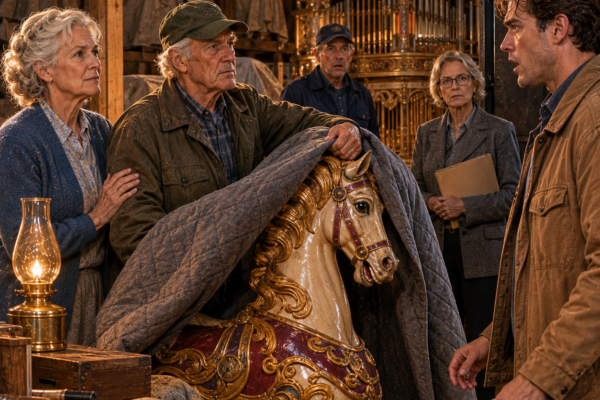
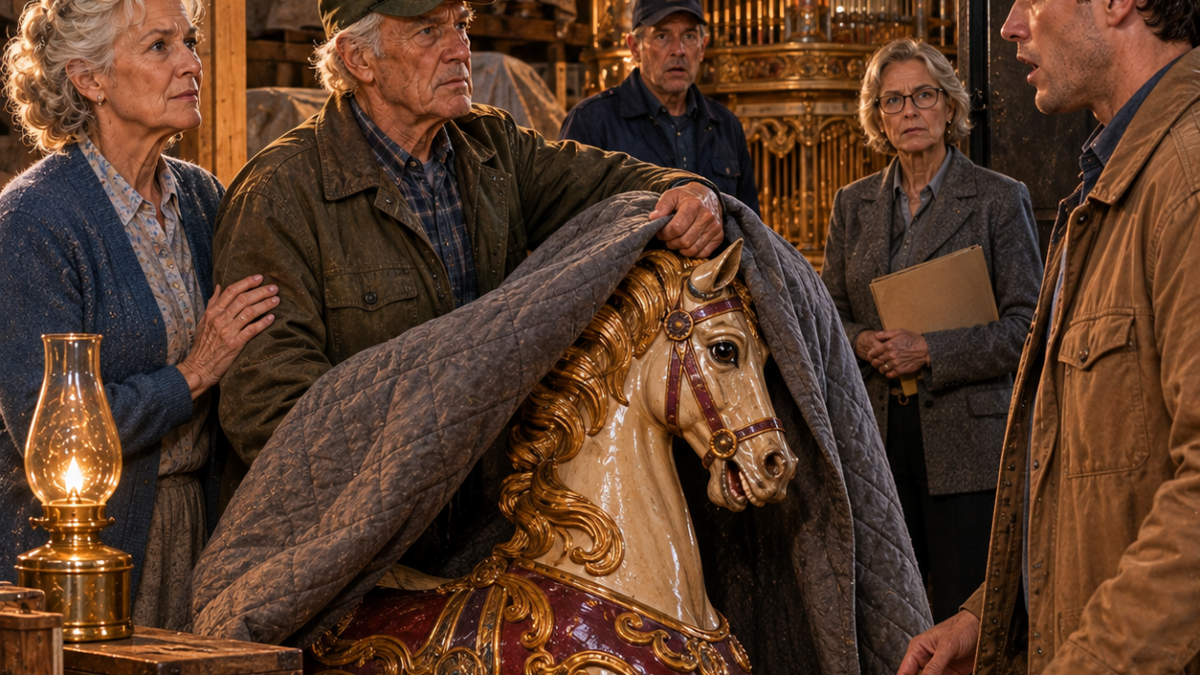
Inside, in the dim light, the carousel waited, a 36-foot platform, a center pole wrapped in clouded mirrors, 34 plain wooden horses on brass poles, two bench chariots, and a stained canvas ceiling hanging in scallops like a wet tent.
At the platforms edge, stood a little cage of dark wood with brass levers and a leather stool where the operator sat. Garrett set the suitcases in the tool room, a lean-to against the east wall with a concrete floor, a workbench, a potbelly stove, and a cot with a gray blanket.
There, youre all set.
Dana stood a few steps off in the grass with the box against her hip looking at the pavilion as though she had something to say to it.
Dana, said Bea. Her daughter lifted her eyes.
Her mouth worked. Then Garrett said, Dana, the car.
And she turned and went, and the three of them drove away along the track in the quiet noon without looking back.
It was 9 mi to Wenlock, the last mile and a half on gravel, and there was no signal on the grounds. No one was coming.
Well, said Bea at last, taking off her cardigan, that stove wont light itself. That was what she had always done.
When a day was too big to look at, she looked at the next small thing, and Harold, who had spent 40 years keeping rides alive with a wrench and a pocket full of cotter pins, followed her lead. He cleared a birds nest from the stove pipe with fence wire while she swept the concrete.
In his shirt pocket, he found a matchbook with four paper matches. The first broke, the second lit the kindling, and the stove coughed, and a thread of smoke rose into the cupola.
He carried water up from the creek in a rusted bucket, three trips, and set it to boil. They ate the bread and cheese standing up.
Bea counted the apples twice, the way she once counted ticket stubs at closing.
The pony came at 5:00. Harold was on the platform, running his hand along a brass pole when he saw the gray shape among the maples, a shaggy animal no taller than a mans belt, standing perfectly still with its head low.
Its coat was dappled the color of old ash with a white blaze down the face. It was very thin, its back sagged, and its mane hung in matted ropes over cloudy, patient eyes.
A frayed red halter hung on it loose as a shirt on a scarecrow, and a little brass plate glinted under its jaw.
Hello, old girl.
Bee said.
The pony took two stiff steps like a rusted gate swinging.
Bee walked toward it with her palm out, and the pony pushed its muzzle into her hand with a long sigh.
Harold bent to read the nameplate.
The brass was so worn he had to trace the letters with his thumb.
Dapple. It cant be.
He said. Dads pony was named Dapple.
Shed be 26.
He sold her to a farm outside Wenlock the spring he died, 19 years ago.
His voice sounded far away to him. Somebodys named her after the old one.
Thats all. They had five apples.
Harold cut one in quarters with his pocketknife, and the pony took each piece from his palm with enormous delicacy. She ate the heel of the bread.
She drank a whole bucket of creek water with her eyes half shut.
Then she did not leave. She stood in the tool room doorway with her head against the frame as though someone had told her to wait there, and she was not sure she was allowed to stop.
We cant afford to feed her. said Harold.
No. Bee agreed, and put another quarter of apple into the soft gray mouth.
We cant afford a lot of things. The evening came in slowly with the light long and amber across the boards and the shadows of the horses stretching out, they sat on the edge of the cot with the stove ticking beside them and a candle stub on the bench.
Bee had her hand in her cardigan pocket where the little horse used to be.
He saw her fingers close on nothing and open. It was 20 past 7:00 by Harolds watch when she lifted her head.
Harold, I hear it. It was very faint.
At first, he thought it was the creek or the wind in the maples. Then the notes came clear.
A waltz played on pipes and a bell, swinging and slow with a drum somewhere beneath it and an old sweetness in the tune that he knew in his bones. It seemed to be coming from the floor and the walls and the dark under the platform all at once.
Thats over the waves, Bee whispered.
Thats your fathers waltz. He was on his feet.
He went out onto the platform among the horses in the amber dusk and the music hung around him as faint as breath on a window.
Every hair on his arm stood up.
He had been a mechanic all his life and mechanics do not believe in ghosts. They believe in belts and bearings and springs.
He tilted his head and tried to find where the sound began and could not. The pony had come in behind him.
She walked past his knee without hurry, her hooves loud on the old boards, and went straight to the operator cage. She stopped there with her ears forward and her muzzle low, close to the floor.
The waltz played about 4 minutes, then it slowed as a music box slows, and the last note hung in the air and dissolved, and the pavilion was only a pavilion again with a creek running somewhere in the dark. Harold went into the cage.
He ran his hands over the levers and the leather stool and the worn rail and knelt and put his ear to the planks.
Dust. Nothing.
Its a draft in the pipes, he said, in a voice that was almost steady, or something in the cupola.
Itll have a reason, Bee. They always do.
Of course it will, she said.
Neither of them believed it.
They slept in their clothes under the quilt on a cot built for one, with the pony dozing in the doorway.
It was a mild night, with the creek speaking, and an owl calling twice from the maples.
Harold lay awake long after Bees breathing had slowed.
He thought of his sons face in the kitchen. He thought of the small sound a wooden horse made when it was dropped into a box.
And under all of it, like a thread of silver, he heard the waltz, though it was not playing. At first light he got up without waking her, and went out to the platform to look at the cage by daylight.
The morning was gray and still, with dew on the boards.
He crouched where the pony had stood, and looked along the floor with the eye of a man who has spent his life looking for the one thing out of place. The planks were all dark with age and dust, all but one.
The third board from the leather stool was clean, a lighter wood, as though feet had passed over it many times.
Along its edge ran a seam of lamp black no wider than a pencil line, where a blade had been drawn along it carefully a hundred times. He had stood in that cage at seven years old, at his fathers elbow.
He had never once seen this.
He took out his pocketknife. The blade went into the seam as if it had been waiting, and the board rose with a small dry creak.
Under it lay a second board, and under that, set flush in the floor, an iron ring the size of of Harold Pennock put his hand through it and pulled.
The hatch rose on a counterweight with hardly a sound. Beneath it, a brick shaft dropped into the dark, nine steps of worn stone going down, and out of it came a breath of air so cool and dry and still that it seemed to belong to another century.
It smelled of machine oil and old leather and beeswax, like a workshop where someone had put down their tools for a moment and would be back directly.
Harold struck the third match.
The flame bent toward the stairs. He went down slowly, one hand on the brick.
At the bottom, the shaft opened into a room, and he held the match up and saw a wall of gold. It was a band organ, as wide as a barn door and as tall as the ceiling, with a front of carved wood and gilded figures.
Two wooden drummers stood at the corners with their sticks raised, and between them rose rank on rank of brass pipes, each wearing a thin bloom of dust that glowed in the match light.
He had seen such organs in books.
He had never seen one so whole. The match burned down to his fingers, and he did not feel it.
In the dark, he found a table, and on the table a brass lamp with a clean glass chimney, and beside it a flat tin of lamp oil.
He filled the lamp, trimmed the wick with his thumbnail, and lit it.
The room came out of the dark all at once.
It was 18 ft by 14, lined in red brick with a low vaulted ceiling, and the floor was swept. It was the floor that made the skin crawl on the back of his neck.
There was dust on the organ, and not a speck on the boards. Someone had been here lately, and often.
On the far wall stood a tall machine of iron and brass that he took at first for a clock.
A heavy iron weight hung on a chain beside it with a long pendulum and a gear train as fine as a watchs, and a thin brass lever stood cocked above a dial. He walked all the way round it with the lamp.
Then he laughed once out loud in the room under the hill. What is it?
Bee called down the shaft. Behind her at the top, a gray shape blocked the daylight.
The ponys head hung down into the hole, ears pricked.
Come and see.
Mind the steps. She came down with her hand on the wall, and at the bottom her breath went out of her slowly.
Its not a ghost, Bee.
He was smiling like a boy. Its a trip clock.
A weight falls, the gears turn, and at a set hour this lever lets go.
He touched the thin brass arm.
It starts the organ, plays one roll, and stops. Thats all.
Somebody set it to play at dusk.
Somebody?
said Bee.
Somebody who winds it, Harold said, and the smile went. He looked at the weight.
It hung nearly at the top of its drop, which meant the chain had been hauled up that very day. A machine like this runs a day, 2 days at most.
Someones been coming down here and winding it every day for I dont know how long.
Neither of them was afraid, exactly.
It was more the feeling of walking into a house where the table has been laid for you.
He saw the carving when he turned to go back up for the second lamp. The hatch lid stood open above the stairs, and on its underside, cut into the oak with a chisel in deep square letters worn smooth by years of lamp smoke, were the words Round and round and room for everyone.
Harold traced them with his thumb.
Your father, said Bee softly.
Thats what he used to say at the ticket window, Harold said, No not quite steadily. When a child had no money, Dad would wave them through.
I thought it was only a thing he said. On the worktable, under the lamp, lay a ledger bound in dark green cloth, about the size of a family Bible.
Harold had not touched it, but the cover was clean, like the floor, and on it, in white ink, in a square hand he knew better than his own, were four words: Roll book for Harold.
He sat down on the stool, slowly. B set her hand on his shoulder.
Inside the cover, folded once, lay a sheet of ruled paper. He opened it and held it to the lamp and read it aloud in the stone room, so she could hear it, too.
Harold, if you are reading this, you needed somewhere to go, and I am sorry that you did. I never said the plain things to you, son.
I was brought up not to, so I will say them here, on paper, where I cant lose my nerve.
You were the best thing I ever made, and you never knew it because you were too busy keeping everybody elses rides running. You were never the man left holding what nobody wanted.
You were the man I trusted with what mattered. The waltz plays every dusk.
I built the clock myself in the winter of 1972.
It keeps the leather alive, and it tells whoever is listening that somebody in this family still keeps a light on. Your mother loved that tune.
She said it sounded like somebody being glad you had come home. I wound the weight every noon for 36 years.
Duncan Orr will wind it now.
He gave me his word, and he has never broken it. Ask him.
Garrett is a good-hearted boy with my pride and none of my patience, and I did not dare tell him what I have told you. What sleeps behind the iron door is not for sale.
It is for whoever needs it.
Oil the bearings in March. Keep a lamp trimmed.
Be warm. Dad Harold folded the paper along its crease.
His hands were quite steady and the tears ran down his face anyway. Bea knelt on the swept floor beside him and for a long time neither of them said anything.
At last he drew a long breath and did the next small thing.
He found a rag and a can of oil under the table and began, because his hands needed something to do, to oil the iron hinges on the back panel of the organ. Some people leave money behind and some leave a song running for whoever comes home.
He wiped his hands and opened the roll book. It was a ledger of 36 pages.
One for each paper roll in the rack behind the organ and every page was ruled in the same careful hand.
A number, a title, a date and a line or two of notes. Roll one, a march to open the season of 1972.
Roll seven, a polka.
The children like it fast. Roll 14 was over the waves and beside it, in the margin, Alvin had written for Edith.
Plays at dusk.
Do not change.
He turned the leaves. In the notes ran a long quiet history of a man who had kept a small thing going when nobody was looking.
Reeds replaced in 1984.
A leather bellows reglued. A mouse in the pipes in 1991.
And in the margin of page after page, the same small phrase appeared like a stitch in a hem.
Duncan wound it today. Duncan says the damp is bad.
Duncan says, Tell the boy.
Tell the boy what?
he murmured.
I dont know. He turned another leaf and his hand stopped.
Between roll 22 and roll 23, a page had been cut out of the ledger. Not torn, but cut cleanly close to the binding with a razor.
Only a narrow stub remained and on the stub, in pencil, in very small letters, the date October 14th, 1971. He knew that date.
He had known it all his life.
He was 10 years old and it was a Thursday and a flatbed truck with a Pennsylvania plate stood in front of the pavilion in the rain.
Men in coveralls were carrying out long crates one after another and his father stood on the pavilion step in his flat cap with a clipboard in his hand not speaking, not moving with a face like a man at a graveside.
When the last crate was loaded, the truck pulled away down the gravel road and Alvin Pennock stood a long time looking after it. That night he sat in the kitchen with his big hands flat on the table and told his wife and his son that the horses were gone.
The company was bankrupt, he said, and a dealer from Philadelphia had bought the original Ferrode carving at auction, all 32 of them, for a price that would not have covered the roof. Harold remembered his mothers hand going to her mouth.
He remembered his father saying in a flat voice, Theyre gone, Edie. Theres nothing to be done.
And the following spring his father had carved 34 plain pine horses in the shop with Duncan Orrs help and painted them and set them on the poles. Everyone in the family had grown up believing it.
He sat now with the pages empty stub under his thumb. I watched them load the crates, he said slowly.
I saw them.
The truck went down the road.
What was in them?
said B.
He didnt answer. He sat there while the pony shifted her weight overhead and the lamp ticked and the ghost of the waltz turned in his mind.
He was thinking about the family, about how a story told once by someone you trust becomes the floor you stand on about his son who had been told it, too.
It came to him then how long Garrett had been taking things. Not the farm.
That was only the last piece.
It had begun in the spring of 2019 on a Tuesday in the pavilion when Harold had felt a tightness in his chest and sat down on the platform and Garrett had knelt beside him and said, Dad, let me let me take the books. Let me handle the insurance.
Let me do the contracts.
A little at a time with love in every word until the day his father looked up and found he owned nothing but a signature. In May of 2024, there had been a kitchen table and a stack of papers with yellow flags and a pen in his hand and Garrett saying gently, Its only care plan paperwork, Dad.
Its so you dont have to worry. He had not worried.
That was the whole of it.
He had trusted his son the way he trusted the floor.
The ledger had one more page worth looking at.
On the last leaf under roll 36 was a drawing in pencil, a plan of the room they sat in, very exact, in Alvins hand.
The organ stood in the middle of it with the clock opposite. And behind the organ at the back, a heavy black rectangle was marked with two words underlined, iron door.
Harold took the lamp and went around behind the organ.
The back panel swung open on the hinge he had just oiled, and behind it, in the narrow space between the organ and the wall, stood a door. It was black iron, riveted, taller than a man, set deep in the brick.
It had no handle and no keyhole.
On the right, a rusted chain hung straight down from a pulley, ending in a stub of broken links, and beside it, the teeth of a bronze sprocket wheel were worn to nubs.
Someone had stenciled two words across the door in white paint, and the paint had hardly faded.
Not yet. He put his palm against the cold metal.
There was no sound behind it, nothing at all. Duncan Orr, B said from the foot of the stairs.
She had the roll book open in her hands.
Your father says to ask him. Duncan Orr moved to Florida in 2009.
Harold stood very straight in the lamplight, with his hand flat on the iron.
He sent us a Christmas card for years.
Hes dead, B.
Or hes 80 and sitting in the sun in a place called Sarasota.
Overhead, on the platform, a hoof struck the boards, once sharply, and then again. He climbed the stairs.
The light at the top had changed, and he saw that it was almost noon. The pony had left the cage.
She was standing on the grass outside the pavilion, tall for her size, with her head high and her ears fixed, looking down the slope toward the creek.
And as he watched, she began to walk, steadily, like an animal who has been walking the same road at the same hour every day of her life.
He followed her. The creek ran 200 yd below the pavilion, under a low stone bridge where the old park road crossed it, and the pony went straight to the bridge without once looking back.
Harold followed her down the slope through the wet grass with Bees footsteps behind him.
In the bank under the bridge there was a culvert, a small arch of fitted stone where the water ran beneath the road. He had played near it as a boy, but he had never seen what he saw now, a rusted iron door set into the stone beside the creek no taller than a mans chest standing a handsbreadth open.
The pony stopped in front of it and blew softly through her nose.
The door swung wide on old hinges and out of the dark backed a small old man in blue coveralls bent double dragging a canvas tool roll after him. He had a bald head with a white fringe and a white mustache stained yellow at the edges and a hitch in his left leg as he straightened up.
He turned and saw the pony and his whole face changed.
Theres my girl. he said.
Youre early today.
He dug in his chest pocket and brought out half an apple and she took it from his palm with her lips. Then he looked up and saw the two of them on the bank and the apple stopped halfway.
Nobody spoke.
Water ran under the bridge. The old man slowly wiped his palm on his coveralls.
Alvins boy. he said.
His voice was dry and light and not quite steady.
Well, I wondered how long it would take you. Duncan Orr.
Harold said.
Youre in Florida.
So I let people think. He bent and picked up his tool roll.
Your fathers idea.
He said, Dunk, if you stay in Wenlock the town will wonder why youre forever at the park. So I told everyone Id gone to Sarasota to be near my daughter and she mailed my Christmas cards from there for years.
A glint of humor crossed his face.
I rented a trailer on Birch Road, 11 miles off.
Its very restful being dead. 19 years, Bea said slowly.
Youve been winding that weight for 19 years.
Every noon but two. Once for my hip and once for my wifes funeral.
He nodded.
I made your father a promise in the hospital, he said. Duncan, keep the organ playing until a Penik needs it.
I thought it might be 40 years. He looked at Harold.
It was 19. Harold tried to thank him and found he could not.
Dont, said the old man, raising a hand. I owed your father more than 19 years, and youre only the first payment.
Have you eaten? You havent.
I can tell by your faces. I brought soup.
He had brought it in a dented steel thermos on the seat of a pickup truck older than Garrett, parked in a lay-by past the bridge with half a loaf of rye and four pears. They sat on the tailgate in the thin noon sun and ate from paper cups while the pony nosed at the pears.
It was barley and beef.
Harold thought he had never tasted anything so good.
I saw the sedan Monday, Duncan said.
I was in the tunnel, winding.
I came up the bank and saw your boy unloading two suitcases at the tool room. He turned the cup in his hands.
I stood in the culvert an hour. I wanted to come out and say something, but Ive only the one promise to keep, and I thought if I show my face too soon, Ill frighten you off the one thing that can help.
So I waited for the music. It plays itself.
Alvin built it so that whoever slept in that pavilion would hear it and look.
Its a porch light, Bea said softly. Thats what he called it.
Harold set down his cup.
Why did he hide it all?
The organ, the room, the iron door. Duncan looked out through the maples to where the green roof of the pavilion showed.
He seemed to be gathering up a long time.
Because of 1971, he said.
You were 10.
Do you remember the truck?
I watched them load the crates. You were on the fence rail in a yellow slicker.
Duncan almost smiled. Harold, the truck was real, and so was the auction.
The company had gone under, and the bank was taking everything. A dealer named Gannett meant to cart the Ferrad horses off to Pennsylvania and sell them one at a time to collectors.
Your father couldnt stand it. They had been turning on that platform since 1924, carved by an Italian who came over on a boat with his tools in a sack.
He drew a breath.
So, the night before the auction, Alvin went to the trustee with $9,000 from a bank loan he never told a soul about. The trustee didnt know a Ferrad from a fence post, and he wrote a bill of sale for 32 wooden horses, and your father and I carried every one of them down through the culvert in the dark.
Harold sat very still, holding the cup in both hands. The crates on that truck were the kiddie train and the shooting gallery, said Duncan.
Gannett got his lot and cursed and left. And your father stood on the step and told the town the horses were gone because the minute anyone knew they existed, somebody would come for them.
The bank, a collector, the county, or a pennock with a debt.
His eyes rested on Harold. He told your mother in bed that night, not you, because you were 10.
And then, he never found the day. I was 47 when he died, Harold said, and his voice cracked.
Why not then?
Because of Garrett. The pony shifted her weight.
Wind moved through the maples, and the leaves, which had begun to turn, hissed softly. He was 22 in 2008, said Duncan.
Alvin watched him sell the familys old Airstream for a down payment on a boat, he said to me. The boy has my pride and none of my patience.
If he learns whats down there, hell have them on a flatbed in a month. Ill hold the door shut until Harold needs it.
He rubbed his mustache. I think he was right.
I think it hurt him to be right.
It isnt that he was greedy, Harold said.
He had not known he would say it.
He was always so kind to us. Thats what I cant His chin shook, and Bee put her hand over his.
Kind and greedy arent opposite, son, said Duncan gently. They live in the same house.
He drove them back up the road in the truck with the pony walking behind like a dog and showed them the tunnel inside the culvert. It was 40 ft of dry stone running up the slope to a small iron door into the back of the organ room.
Thats how I come and go. The hatch is your fathers front door.
This is the back.
And the iron door behind the organ? Harold said.
Duncans eyes went careful. Whats the matter with it?
The chains broken.
The sprockets worn through. Nobody was ever meant to open it by hand.
Its a counterweight door.
You pull the chain and the weight takes it. He folded his arms.
Ive a bronze sprocket on my bench at home.
I cast it myself the winter of 2008. Your father told me not to fit it.
Give it to Harold, he said, the day he asks the right question. Whats the right question?
I expect you know after what I told you.
Harold looked down at his scarred hands. The words came out very quietly.
What did he save? The old man let out a breath as if he had been holding it since 2008.
You heard it by the bridge, he said, and his voice roughened.
I wont describe the rest. Id only spoil it.
Ill tell you that your father went down on Sundays and sat round and round and room for everyone. He said the horses said it first.
When can we open it?
Saturday. He lifted a finger, not before.
The pivots havent moved in 19 years and force would crack the casting.
 [Tap here for the Next Part ]