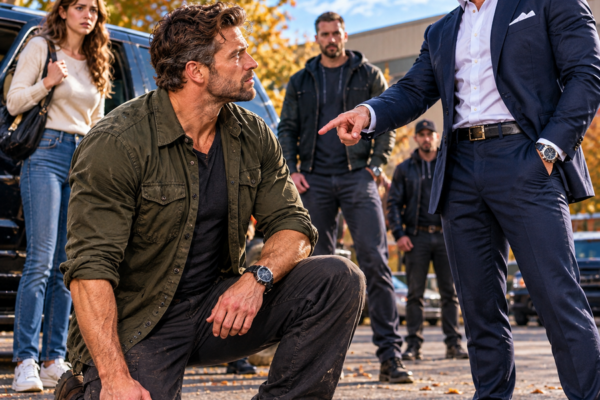
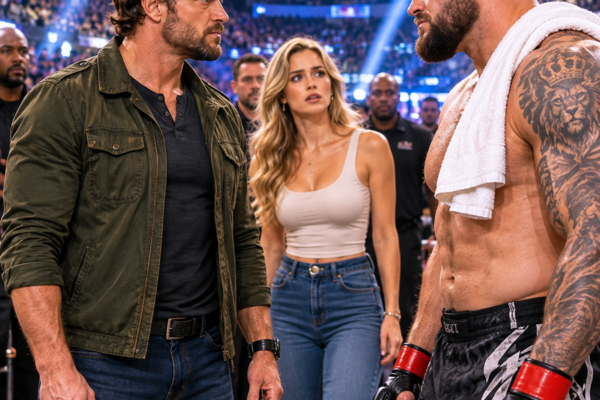
They Laughed at the Single Dad Trucker—Until His Fighting Past Left the Black Belt Speechless
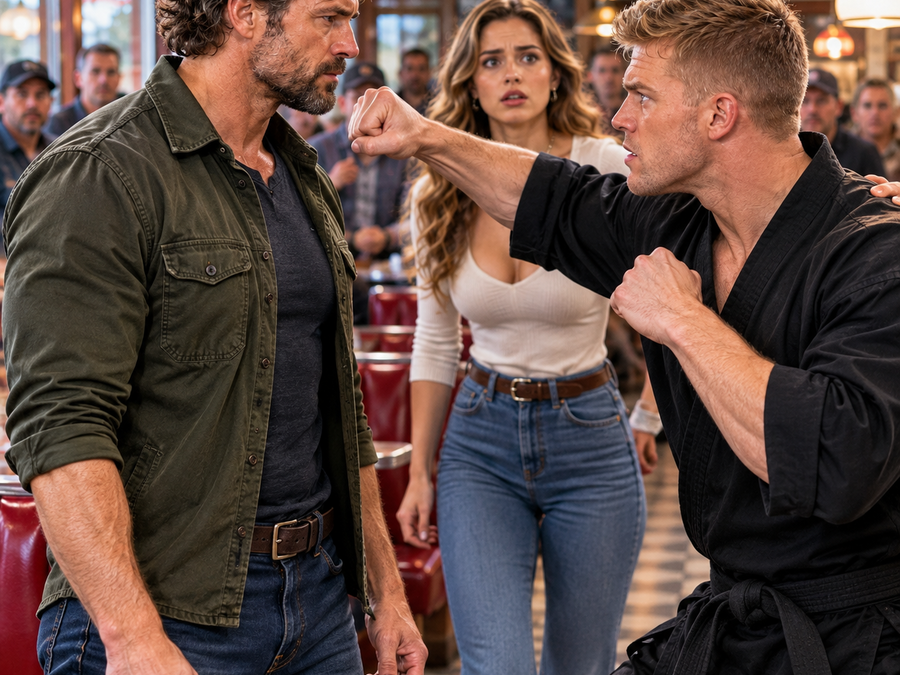
They Laughed at the Single Dad Trucker—Until His Fighting Past Left the Black Belt Speechless
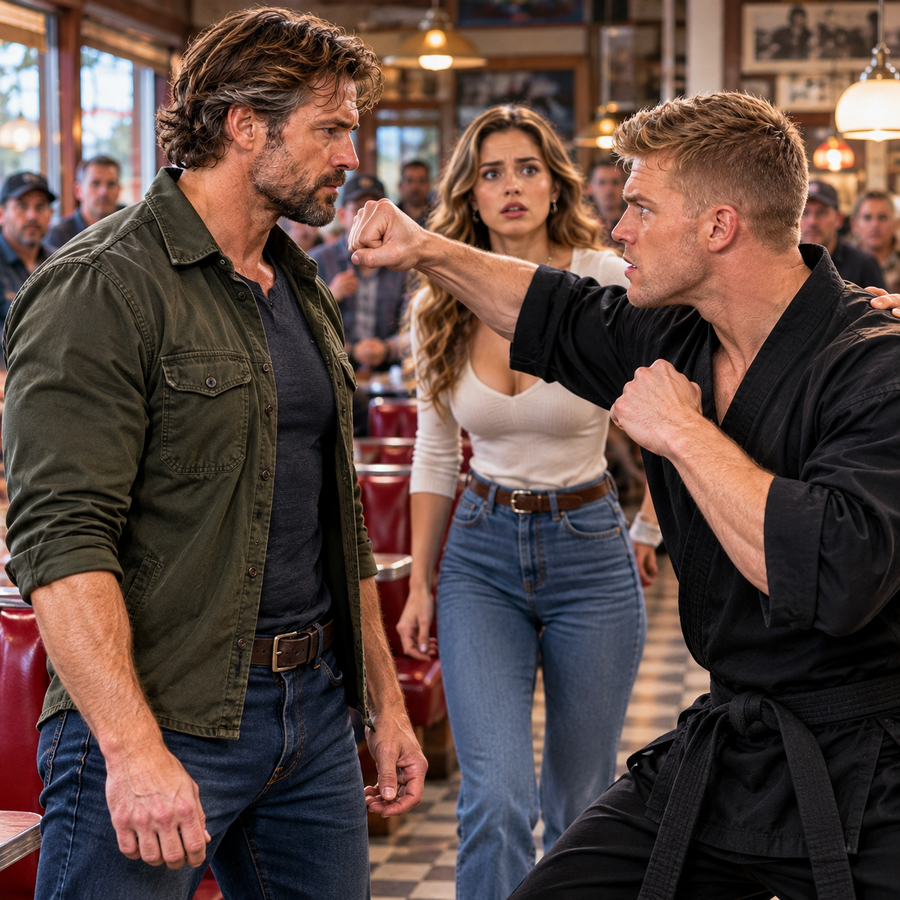
Hauling boxes doesn’t make you tough, old man.
Never said it did. Pick that up.
I’m leaving.
You’re not going anywhere, trucker.
The trucker didn’t argue.
He didn’t raise his voice.
He didn’t even look at the younger man when the hat hit the floor.
That was the first thing Colton Vance got wrong, mistaking stillness for weakness.
Colton had spent years training to read opponents.
He knew what fear looked like. He knew what surrender looked like.
But the quiet way Darren Pike retrieved that hat, the way his jaw stayed level and his breathing never changed, that wasn’t either of those things.
Nobody in the diner caught it.
Colton certainly didn’t.
But what was it about the way that trucker stood back up that made the old man at the far end of the counter slowly set down his coffee?
If you’re new here, this channel tells stories about quiet strength, real dignity, and the kind of people the world underestimates.
Hit subscribe so you don’t miss the next one.
The parking lot of Red Creek Travel Stop sat off Interstate 43 in the kind of geography that existed purely as a place to stop before somewhere better. Two fuel islands, a row of diesel pumps sized for rigs, a convenience store lit up like a surgery theater, and a diner attached to the main building that had probably been remodeled sometime in the late 1990s and left entirely alone since.
The booths were the color of old mustard. The menus were laminated and slightly sticky at the corners.
The coffee was always hot, not because anyone particularly cared about quality, but because the people who stopped here at this hour needed it to be.
Darren Pike pulled his rig into the far end of the lot just past 9:30, cut the engine, and sat for a moment with both hands still resting on the wheel. nearly 10 hours since his last real break.
His shoulders had locked somewhere around the 200- mile mark and hadn’t loosened since.
He rolled them once heard the familiar creek and reached for his jacket on the passenger seat.
Through the windshield, the diner’s sign threw an orange glow across the asphalt.
He could already smell the grease from the exhaust vent on the side of the building.
Getting down from the cab was the part he’d learned not to rush.
He swung the door open, gripped the handle above the frame, and stepped down to the bottom rung. And on the last step, his left knee caught wrong.
A quick bright spike of heat ran from just below the kneecap up through his thigh and was gone in under a second. He stood still on the asphalt for a moment, shifting his weight, testing the joint.
It held.
It always held. He pulled his cap on, zipped the jacket halfway, and walked toward the entrance without giving it another thought.
Nobody looking at Darren would have called him remarkable.
He was broad through the shoulders in a way that had more to do with years of physical work, than with any kind of deliberate training, the accumulated result of loading docks and hand trucks and cargo that didn’t always cooperate.
His jacket
was the faded canvas kind that only got that color from genuine use.
And his hands, even at rest, looked like they’d been weathered by something rougher than a desk.
He walked with a slight favoring of his right side that he hadn’t consciously noticed in years.
At 42, he looked like exactly what he was.
A man who worked long hours, did hard things, and had long since made his peace with the evidence of both. He took a booth near the window where he could see his rig in the lot.
Old habit.
He’d had equipment tampered with often enough over the years that the sighteline had become automatic.
Not anxiety, just preference.
He set his cap on the table and picked up the laminated menu without really reading it.
He already knew he was going to order the patty melt.
The waitress appeared within a couple of minutes, a woman named Tessa, who moved with the compact efficiency of someone who had worked the same floor for a long time, and quietly decided that anything slower was a personal affront.
She was somewhere around 50 with dark circles that no amount of anything was going to fix by this point in her shift, and she wrote down his order without asking him to repeat a word of it.
“How much longer on your shift?”
Darren asked.
She didn’t stop writing.
3 hours. Know that feeling, he said.
Tessa looked at him for a half second longer than the transaction required, the way a person sometimes does when something lands the right way, and they can’t immediately explain why.
Then she turned and headed back toward the kitchen, and Darren unfolded a paper napkin and spread it across his knee. At the far end of the counter, a man was sitting alone with a cup of coffee and a newspaper turning pages with the unhurried patience of someone who had nowhere particular to be.
He was somewhere north of 60, heavy set, with a broad face that had settled into something like permanent thoughtful neutrality.
He glanced toward Darren’s booth in the unfocused way that people in late night diners sometimes glance at each other out of habit rather than interest and then returned to his paper.
Darren’s phone lit up on the table.
He picked it up before the second buzz.
The face on the screen was 12 years old and had inherited her mother’s eyes and his stubbornness, which was a combination that gave him equal parts concern and a quiet, involuntary pride he didn’t always know what to do with.
Sadie had clearly been waiting because she was already talking when the video finished connecting something about the spring showcase at her school.
How her class had been rehearsing for 6 weeks.
How her teacher had asked parents to confirm attendance and she had already told the teacher that her dad was 100% going to be there. So, he needed to be there because she had already committed to that on his behalf and she wanted him to know that.
Darren watched her talk and felt the tiredness that had nothing to do with the road or the hours or the stiffness in his shoulders.
He was 230 mi from home.
The delivery window in Harwick opened at 7 the next morning. He did the arithmetic in the time it took her to finish her sentence.
Drive time sleep turnaround distance back and the numbers were tight, but they worked if nothing went wrong.
I’ll be there,” he said.
Sadi’s expression held about 30% skepticism and 70% wanting to believe him.
“Promise, promise,” he said.
After she hung up, he set the phone face down on the table and looked out at the lot.
His rig sat under the sodium lights, trailer sealed and logged. He ran the route back through his head one more time, finished the delivery drive back through the night.
four hours of sleep at most, be seated in that auditorium before noon on Saturday.
He’d done harder things on less sleep.
He was still holding the outline of it in his mind when Tessa came back with his food and he thanked her and started eating. He was halfway through the patty melt when the front door opened.
The two of them came in loud in the way people do after a hard workout, still running on the energy of wherever they’d just been.
voices calibrated for a larger room.
The one in front was wearing a gym jacket with the name of a martial arts academy printed across the back in block letters still flushed from training, moving through the diner entrance like he expected the room to rearrange itself around his arrival. He was mid20s, maybe with the physical confidence of someone who had spent enough years being told he was exceptional at something, that he had stopped distinguishing between the arena where that was true and everywhere else.
His friend trailed a step behind
him, broader, quieter, with an expression that suggested he had learned to read rooms a little earlier in his life than his companion had.
They took a table near the center of the diner. For a few minutes, they were just two guys coming down from a late session, ordering drinks and talking at a volume that drifted into the surrounding booths, whether those booths wanted it or not.
Darren noted them the way he noted most things in a new space, registered, categorized, returned to his food.
Then the one in the gym jacket started talking about the parking lot. He framed it as a complaint, but the volume was pitched for performance.
something about a truck taking up the spaces near the entrance, making it harder for regular people to park.
He put a small deliberate weight on the words regular people. His friend Bryce made a sound that might have been a laugh and went back to his drink.
Colton looked over at Darren’s booth.
He took in the jacket, the cap on the table, the hands wrapped around the coffee mug, and something in that inventory satisfied a conclusion. He appeared to have already reached because his posture shifted the subtle loosening of a person who has decided the room is safe.
“Driving a truck,” Colton said loudly enough for the surrounding tables to hear him clearly doesn’t make you tough.
Darren didn’t look up.
He took a sip of his coffee. The silence that followed was not the kind Colton had been anticipating.
He had expected a defensive comeback, maybe embarrassment, something he could grab onto.
What he got was a man finishing a bite of his sandwich as though nothing had been said at all.
That kind of quiet required a response. Colton leaned back in his chair and kept going, working through a routine about men who spent their lives doing manual labor, and somewhere along the way decided that calluses were the same thing as capability.
Bryce had stopped watching Colton.
He was watching Darren. Darren looked up from his plate, not at Colton at the clock on the wall briefly, the reflexive check of a man calculating time.
Then he looked at Colton with an expression that carried no visible charge.
“I never said I was tough,” Darren said.
“The sound that came from two or three nearby tables was somewhere between amusement and recognition.
” Colton heard it and read it as people responding to him.
What he didn’t see was the man at the end of the counter, Gordon, though no one in the room knew his name yet, who had folded his newspaper in half, and was studying Darren with a slight crease between his brows.
Not amused, doing something else, trying to locate a memory, Darren laid a few bills on the table for the check, picked up his cap, and started to stand. Colton was out of his seat before Darren finished standing up.
He crossed the diner in a few easy strides and positioned himself squarely in front of the booth, cutting off the direct path to the door.
It was done smoothly, casual enough to pass as spontaneous, deliberate enough that it wasn’t.
Darren looked at the gap between Coloulton and the nearest table, measured it, and stayed where he was.
What happened next took about 4 seconds.
Colton reached up and knocked the cap off Darren’s head.
It hit the floor and Colton stepped on it one measured grind of his heel against the brim without breaking eye contact. Darren looked at the cap on the floor.
He crouched to pick it up and as he did, his left knee delivered the same sharp message it had given him getting out of the cab there and gone faster than thought. He straightened up, brushed the brim with the back of his hand, and held the cap without putting it back on.
His face didn’t change.
Colton watched all of this and let it confirm exactly what he’d already decided.
“Come on, trucker,” he said, and there was real enjoyment in it.
“Show me what you’ve got.”
Darren checked his watch.
The delivery window in Harwick opened at 7.
Any formal involvement tonight, any waiting in a parking lot, any paperwork, any drawn out explanations to anyone holding a clipboard? And that window was gone.
Gone meant the contract.
Gone meant the company flagging his record. Gone meant Saturday.
He ran the chain from one end to the other in approximately the time it took to exhale.
Move, Darren said. I have somewhere to be.
He stepped to the left.
Colton put a hand flat against his chest and pushed not hard enough to knock him back, but hard enough to stop him. the kind of push that announced itself.
Darren looked at the hand, then at the face behind it.
His expression held the same flat neutrality it had held since Colton first opened his mouth. In the booth closest to them, a woman in her 40s had gone completely still over her takeout bag.
Tessa had come out of the kitchen with a tray and reading the geometry of the situation from across the room, set the tray down on the nearest counter without breaking stride.
At the center table, Bryce had both hands flat on the surface in front of him, and the vague alertness in his face had sharpened into something more focused.
Not alarm exactly, but the expression of a person who has started noticing details that don’t fit the model he came in with.
Colton pushed Darren again, this time with both hands.
This time with real weight behind it, designed to make a man take a step back to force a reaction to produce visible evidence of the dynamic Colton needed the room to see.
Darren absorbed it and stayed where he was.
He didn’t stumble.
He didn’t reach out to brace himself.
He just took the impact and remained exactly as he’d been, which was not the response the push was built for.
The diner had gone quiet. Not the polite quiet of people pretending not to watch.
The actual kind.
Darren’s gaze moved to the door, then back to Colton.
His left knee achd in the background a low, persistent heat was used to managing.
The promise he’d made 40 minutes ago sat somewhere behind his sternum, like a compass needle pointing in a fixed direction.
He looked at the younger man standing in front of him, flushed, certain performing, for a room that had stopped performing along with him, and something older and much quieter took stock of exactly how much space they were standing in, where the tables were, where the other people were, and what
the next few seconds were likely to require.
He was still deciding how little that would have to be.
Tessa had worked the night shift at Red Creek long enough to recognize the moment when a situation inside a diner stopped being a situation and started being something she would have to write in an incident report. She came around the end of the counter with no particular announcement and positioned herself about 4 ft from where Colton was standing.
“That’s enough,” she said.
Her voice was the same one she used to tell the kitchen she needed an order refired.
No heat in it, just absolute certainty about being heard. Take your table or take the door.
Those are the two options. Colton turned toward her with an expression that belonged to a person who had never once adjusted his behavior because a middle-aged woman in an apron asked him to.
He looked at her the way someone looks at a speed bump they’ve decided not to respect.
“You going to call the cops?”
he said.
“Because this guy can’t stand up for himself.”
Whatever Tessa was about to say, she didn’t get to say it.
Darren stepped between them, not fast, not in a way that announced itself as anything.
He simply moved so that he was between Colton and the counter where Tessa was standing, and the geometry of the room shifted accordingly.
He still hadn’t raised his hands.
He was just present and present in a way that quietly changed what was possible.
“Leave her out of it,” Darren said.
Tessa looked at the back of Darren’s jacket for a moment.
She had seen men step between people before, and she had learned to sort the ones who did it from panic from the ones who did it from somewhere steadier.
Darren had moved like a man crossing a room to retrieve something he’d left on the table, purposeful, even without urgency.
She stepped back behind the counter, but didn’t go back to the kitchen.
Colton looked at the new positioning and recalibrated.
He wasn’t out of moves.
He spread his hands slightly and offered something framed as generosity, but built entirely out of contempt. A friendly match right here in the space near the service counter.
Nothing serious, just the trucker needing to land one clean hit and Colton would walk away, apologized the whole thing would be settled. He said it like he was doing Darren a favor.
Darren said nothing.
He picked his cap up off the table where he’d set it and straightened the brim.
Colton stepped in and snapped a punch at Darren’s face short fast.
Stopped 2 in short of contact.
a faint throne to produce a reaction.
The move was something Colton had done in the gym hundreds of times, designed to make a man flinch, blink, step back, give away the automatic response that lived below conscious control, and told you everything you needed to know about what you were dealing with.
Darren didn’t blink.
He didn’t lean back.
He didn’t shift his weight.
His eyes didn’t move to track the incoming hand.
He simply stood where he was and the punch stopped in front of his face and he remained exactly as he’d been a half second before.
Colton pulled his hand back slowly and something in his expression changed.
Not much, not in a way he would have acknowledged, but enough.
Bryce had his elbows on the table.
He wasn’t watching Colton anymore.
He was watching Darren, the way a person watches something that has started behaving outside the model they arrived with.
In the gym, Bryce had seen plenty of people flinch at a faint. He had flinched plenty himself in the early days.
A faint that fast at unexpected range you blinked.
You pulled back.
Something in your body answered before your brain could intervene.
Darren had produced none of those answers, and Bryce found himself sitting very still, running his eyes from Darren’s feet to his hands to his face, doing the kind of inventory that Colton hadn’t bothered with.
He reached over and put a hand on Colton’s forearm.
Let’s go, he said quietly.
Come on. Colton shook him off without looking at him.
What happened next moved faster than it had any right to, given how slowly the preceding minutes had accumulated.
Colton threw a real punch, not a demonstration, not a statement, but an actual committed strike directed at the side of Darren’s head.
And Darren wasn’t there when it arrived.
He’d moved maybe 6 in, maybe less, a small lateral shift that took him entirely out of the path of the punch without turning, without retreating, without giving ground in any meaningful sense.
The punch went past him and found nothing.
Colton threw again.
Darren moved again.
The same economy, the same sufficiency of exactly the required distance and no more.
A kick came next, and Darren stepped back once measured, so the heel passed an inch in front of his shin.
He still hadn’t lifted his hands.
He was watching Colton’s shoulders or his hips, or some point that wasn’t his face, and whatever he was reading there, he was reading it early enough that he was never where the strikes were going.
The diner was completely silent now. Not uncomfortable silence, something older than that.
The kind that settles when something is happening that people don’t quite have the vocabulary for yet.
The woman with the takeout bag had set it on the floor and turned fully in her seat. A trucker at the back booth had stopped eating midbite.
Tessa behind the counter had her arms folded and was watching Darren with an expression that had moved somewhere past trying to categorize what she was seeing.
At the end of the counter, Gordon set his coffee cup down.
He stood up from his stool slowly, the way a heavy man in his 60s stands, when his knees require a conversation with the rest of his body first, and he looked at Darren with the expression of a person trying to hold a half-remembered face against the one in front of him.
He took a few steps along the counter, getting a better angle, and his eyes moved from Darren’s feet to the way he carried his shoulders to the absolutely controlled quality of stillness he maintained between Colton’s attempts.
Then something landed in Gordon’s memory.
Not gradually, all at once.
“Darren Pike,” Gordon said.
It wasn’t a question, but it carried enough uncertainty that it came out balanced somewhere between statement and disbelief.
Darren turned his head.
Gordon was staring at him from across the room with the look of a man watching something return from a distance he’d thought was permanent.
The regional finals, Gordon said, speaking more to himself than the room. 13 years ago, the Witmore Arena.
You went three rounds with Marcus Delroy and put him down in the fourth. His voice had found its footing now.
I had seats seven rows back. My brother-in-law still talks about that fight.
The room processed this on a brief delay. What Gordon laid out for the diner concisely, the way a man recites something he has stored with care, was that the trucker, standing in the middle of the room with the battered canvas jacket and the worn cap, had won 31 professional bouts in 35 starts.
That he had held a national kickboxing title and defended it three times before he walked away from the sport.
that the last time Gordon had seen him, Darren Pike had been standing in the center of a lit canvas ring with a belt around his waist, and the kind of reputation that takes years to build, and a deliberate decision to leave behind.
Colton had gone still. Not the trained stillness that Darren had been demonstrating for the past several minutes, the involuntary kind, the kind that comes when the ground beneath a certainty shifts and the body needs a moment to catch up.
He looked at Darren, at the jacket, at the hands, at the left knee, that Darren was subtly waiting slightly less than the right.
The kind of micro adjustment invisible unless you were looking for the right things, which Colton hadn’t been until now.
Darren looked at Gordon across the room. That was a long time ago, he said.
He said it without heaviness, without performance, without any of the things someone says a sentence like that for.
He said it the way he might note that he’d once lived in a different city.
Then he turned and looked at the clock on the wall, and his face held the look of a man quietly computing the cost of the minutes he had already spent, and deciding what he could afford to lose from what remained.
Bryce was on his feet.
He had his hand on Colton’s shoulder, the real grip this time, fingers wrapped, not the light redirection from earlier.
Colton, he said, and the single word carried everything he’d been building toward for the past 10 minutes.
All the accumulated small wrongnesses, the faint that didn’t land a reaction, the punches that hit air.
The way Darren moved like someone who had logged more hours than Colton had been alive in training.
We’re done here.
Let’s walk out.
For a moment, it seemed possible.
Colton’s jaw was tight.
His eyes were doing the work of recalibrating, going back over the last several minutes, and finding new explanations for things he’d been reading as fear.
The man he’d decided to perform for had turned out to be the wrong audience in the worst possible way, and the room had already understood that before he had.
There was a version of the next 5 seconds where Colton absorbed this and let Bryce steer him toward the door.
He shook Bryce’s hand off his shoulder.
“Champions get old,” he said.
He looked at Darren when he said it, and there was something in his expression that had moved beyond posturing something closer to actual need.
Needing the next thing he said or did to land to count to restore something the evening had taken apart.
“Everybody does,” Darren said.
It wasn’t delivered as a comeback.
It was delivered as a fact flat and indifferent.
The kind of thing you say when the conversation has already concluded and you’re simply noting the closing point.
That quality, the absence of any relish in it made it worse for Coloulton than any sharp response would have.
Colton came in swinging.
Not the technical combinations from earlier.
Those had required a belief in a particular contest and that belief had been revised. This was something more primitive coming out of a place that had been embarrassed in front of an audience and needed to produce a result.
He threw hard and he threw fast.
And Darren retreated four steps and gave him the room.
And the strikes still found nothing because Darren kept moving in the educated way that wasn’t available to a man in Colton’s current state of mind to replicate or predict.
Darren kept offering him space. Left a gap on the right side, then shifted to close it before Coloulton could capitalize.
Turned to face him every time Colton tried to circle.
He was containing the thing rather than ending it, which Colton understood on some level before he could articulate why it mattered. And when he understood it, it was worse than anything physical.
Darren wasn’t fighting him.
He was managing him the way you manage something you are trying not to damage.
And the realization of that pushed Colton past a threshold he didn’t consciously decide to cross.
His hand went sideways and found the back of a chair.
It was a metal chair, the old diner kind heavy gauge tubular frame. His hand closed around the top rail, and he pulled it off the floor in one motion, and the sound of the legs clearing the tile was loud enough that every person in the diner heard it like a starting gun.
Two people in the back booths were already moving toward the exits.
The woman with the takeout bag had pressed herself against the far wall.
There was a man standing 3 ft directly behind Darren, a heavy set trucker who had been finishing his meal at the adjacent table and was now suddenly directly in the center of whatever was about to happen with no clear route away from it. Darren assessed this in the time it took Colton to draw the chair back.
What happened in the next 4 seconds was not the continuation of what had been happening before.
What had been happening before was avoidance, the consistent, deliberate withholding of force from a situation that hadn’t yet required it.
What happened next was the end of avoidance.
Darren stepped inside Colton’s reach as the chair came forward, absorbed the redirected force of it across his forearm rather than his face stripped the chair from Colton’s grip in a motion completely without excess, and then had Colton off balance and going down before the chair had finished clattering away across the tile.
He brought him to the floor and held him there, one knee against Colton’s back, one hand on his wrist, not hurting him, not punishing him, just removing the possibility of further movement with the minimum necessary application of control.
Colton was still struggling, and in the effort of holding him down, the torquing pressure of keeping a resisting man on the floor while he twisted against it.
Darren’s left knee took the weight from the wrong direction.
The pain that came was not the brief spike from the parking lot or the quick flash from the booth. It was deep and architectural, the kind that came from a structure that had been asking for less for a long time and had finally decided to stop asking.
Darren’s face tightened.
He shifted his weight, found a different brace held the position, but one of his legs buckled an inch before he could stop it. Colton felt it and redoubled.
Darren kept him down, but the effort of it now showed in ways it hadn’t before.
Someone in the diner had called 911. Darren could hear the voice reporting the address somewhere to his right, and he understood what that meant for the rest of the night.
the time, the explanations, the paperwork that had no end point he could calculate from here.
The delivery window ticking toward a margin he couldn’t recover.
He stayed focused on the man under his hands and the people around him.
But in a corner of his mind, the arithmetic had already started doing what arithmetic does when you give it enough real numbers.
His phone lit up on the table he’d never made it back to, the screen faced up.
From behind the counter, Tessa had a clear sighteline to it.
She could read the name on the screen from where she stood. Sadi in large bright letters against the dark background, buzzing once, twice, then holding on the notification.
She looked at the phone, then at Darren on the floor with his knee at a bad angle and Colton still struggling beneath him, and the two images arrived in her mind at the same time and connected in a way that had nothing to do with the incident report.
Darren
couldn’t reach the phone.
He didn’t try.
He held the position and waited for the situation to stabilize and let the call go unanswered. Outside somewhere on the highway, the red and blue was already moving.
The cruiser pulled into the Red Creek lot without the siren.
Just the lights cycling blue and white across the fuel pumps and the side of Darren’s rig.
Two officers came through the front door in the way officers enter rooms where something has already happened, reading the space before anyone opened their mouth. The diner had not rearranged itself.
Colton was on his feet again, breathing hard, his jacket pulled sideways.
Darren was on a chair near his original booth with a cold ice pack pressed against his left knee, which Tessa had produced from behind the counter without being asked.
The metal chair was still lying on its side near the service counter where it had come to rest after Darren stripped it out of Colton’s hands.
Colton got to the officers first, which he had clearly intended to do.
He framed the story the way a man frames a story when he has very little time and a strong incentive quickly with confidence in a voice calibrated to sound like the kind of person you believed by default. He described a former professional fighter who had been provoked into losing his temper.
He used the word unprovoked twice in the first 30 seconds. He pointed out as if this were the operative fact of the entire evening that the man sitting against the wall with the wrapped knee had a documented history of professional combat and had applied a level of force that no reasonable person would consider proportionate.
One of the officers was writing.
The other was watching Darren, then Colton, then the room.
Darren didn’t interject.
He held the ice pack against his knee and looked at the floor in front of him with the expression of a man waiting for something to run its course.
He had his phone in his other hand. The missed call from Sadi was still on the screen.
He cleared it and dialed her back. She picked up on the second ring, which meant she had been waiting.
“Hey,” he said.
His voice came out level, not the false calm of a man hiding something, but the genuine steadiness of one who had already decided that whatever was happening in this room was not going to reach her through the phone. I just wanted to call back.
I’m still at a stop.
There’s a thing I need to sort out, but I’m fine.
Don’t wait up.
Sadi said she hadn’t been waiting up in the tone she used when she absolutely had been.
Then she asked if he was still going to make it Saturday.
“I’m working on it,” he said.
“Go to sleep.”
He set the phone down.
Across the room, Tessa was already talking to the second officer, delivering what she knew in the same tone she used for everything else, flat and direct with no ornamentation. She described the parking lot complaint that was never about a parking lot.
She described the cap being knocked off.
She described both shves the direction the aggression had moved in from the beginning and then she told them about the camera. Red Creek Travel Stop had four security cameras covering the interior.
The footage was stored on a local system in the manager’s office and ran on a continuous 48 hour loop.
Tessa had already knocked on the manager’s door before the cruiser was fully stopped in the parking lot.
And the manager, a tired man in his 50s, who had the look of someone who deeply regretted not leaving earlier, had confirmed the system was running, and the footage from the last 45 minutes was intact. They watched it in the back office on a monitor the size of a laptop.
The angle from the main dining floor camera was good, not perfect, but sufficient.
It showed Colton approaching Darren’s booth while Darren was seated.
It showed the parking complaint delivered to a man who hadn’t looked up from his food.
It showed the cap being taken off someone’s head and the heel coming down on the brim.
It showed the first push.
It showed the second.
It showed the moment Colton threw the first real strike at a man who had raised neither hand nor voice in the preceding several minutes.
And it showed clearly enough that no verbal explanation was required that when Darren finally put Colton on the floor, there was a man standing directly behind him and a piece of furniture already in motion.
By the time they came back out into the diner, something had shifted in how the officers were distributing their attention.
Bryce was still at the center table, sitting with both hands wrapped around a glass of water he hadn’t touched.
He had watched Colton give his account to the first officer, and he had sat with it for several minutes while the internal arithmetic that precedes a decision ran its course.
When the second officer Sam went to take his statement, Bryce told him what happened, not a version of it.
He described the sequence in the order it occurred, including what he had tried to do at two separate points in the evening to stop Colton before it reached where it reached. He said it without looking over at Coloulton.
Colton, who had heard enough of it from across the room, turned away and stared at the window.
The officers consulted in the small corridor near the restrooms for a few minutes. When they came back, one of them told Darren he was free to go.
The phrasing was polite and efficient, and carried within it the understanding that the footage had made the accounting fairly uncomplicated.
Colton was given a different kind of conversation conducted in lower voices near the door. Darren pulled the ice pack away from his knee and looked at the joint.
It was swollen in a way that hadn’t been true at the start of the evening enough that he could feel the pressure of it against the inside of his jeans when he bent the leg.
He straightened it slowly, tested weight, and it held.
He picked up his cap from the table.
Gordon had not left.
He was back on his stool at the end of the counter with his phone in his hand, still working through something. Colton came back across the room.
The conversation by the door was over, and whatever had been said there had taken something out of his posture.
Not his pride exactly, because there was still too much tension in his jaw and shoulders for that, but his certainty. He stopped a few feet from where Gordon was sitting and looked at Darren who was buttoning his jacket and not particularly looking at anything.
I want to see, Colton said. Gordon turned his phone around without comment.
The video on the screen was old enough that the resolution showed it the slight grain of recording technology from over a decade ago.
The color a little warmer than modern cameras produced, but what it showed was legible in every way that mattered. a younger version of the man currently standing in the diner somewhere in his late 20s wearing the white canvas shorts and hand wraps of a professional boat.
He was at the center of a full ring under event lighting and there was a belt being fastened around his waist and the sound from the phone’s small speaker was the sustained roar of an arena crowd at the end of something they’d watched with their whole attention.
Colton watched the whole short clip.
Nobody rushed him.
Then he looked at this man in the jacket, at the worn cap, at the knee Darren was standing on with the same deliberate evenness he’d been managing since he first came through the door.
Colton’s face was doing the work of holding several incompatible things at once.
the image on the phone, the memory of his own punches passing through empty air, the knowledge that he had been kept from causing harm by someone who could have ended the conversation at any of a dozen different points in the last hour and had simply chosen not to.
“If you were that good,” Colton said, and his voice came out lower than he intended, with a roughness in it that wasn’t there when he was performing for the room.
Why didn’t you just destroy me?
Darren looked at him, not with anger, not with the satisfaction of a man who has been waiting all evening to have this exchange. Just directly the way he had looked at most things tonight because I stopped needing strangers to know how strong I was years ago, Darren said.
The diner was very quiet.
Bryce looked at the middle distance and didn’t say anything.
Tessa had both hands on the counter and was looking at Darren, and whatever she had thought she was seeing when he first sat down in her section had reorganized itself into something that fit better with the man she’d watched manage the last hour.
Colton had no answer for it, not because the sentence was complex, but because what it described was genuinely outside his current frame of reference. The idea that strength and the demonstration of strength were separable things that a person could carry, a capability for decades, and find eventually that the carrying of it was sufficient, and the showing of it had become beside the point.
He had spent years making them identical.
He didn’t know yet what it cost to do that.
He walked back to his table.
Bryce was already standing, jacket on, and they left without further conversation.
Darren stood by the booth for a moment, and looked at his phone. He did the math on the rest of the night.
Harwick, the delivery window, the drive back, the miles between here and Bellidge, the hours until an auditorium filled up, and a 12-year-old girl started looking toward a specific seat. The answer had not improved.
His knee had added a variable he couldn’t fully account for.
He walked to the door. Tessa came around the counter and fell into step behind him.
She pushed through the door a half step after he did and stopped him in the small windbreak corridor between the interior door and the exterior one. Hold on a second, she said.
Darren turned. I talked to the manager, she said.
And I talked to a driver who’s been sitting at pump 3 for the last hour, waiting out a weather advisory on the 43 North corridor.
He’s running a similar line to yours.
He can pick up the tail end of your delivery if you call your dispatcher and arrange the transfer. Manager is going to make the call to your company as a courtesy if you want him to, given the circumstances.
She said it in the same tone she used for everything. No excess, no theater, just information efficiently delivered.
Darren looked at her.
Why?
Tessa pulled her jacket collar up against the cold coming through the outer door. I saw her name on your phone, she said.
Sadi came up while you were on the floor.
She didn’t elaborate further and didn’t look like she intended to.
It was the full explanation.
The transfer took 20 minutes to arrange a call to his dispatcher, a call to the other driver, a brief documentation exchange that Darren handled sitting in the cab of his rig with the engine running and the heat on and his left leg stretched out to keep the knee from stiffening in the cold.
The other driver was a man named Rey, who accepted the handoff with the complete lack of drama that characterized most professional conversations between people who worked nights and understood what they shook hands in the lot.
Ray pulled out ahead of him and turned north toward Harwick.
Darren pointed his rig south toward Bellidge.
He drove with the windows up and the radio off. The highway at this hour was mostly his.
The occasional cluster of headlights in the oncoming lanes, the sparse red tail lights of other rigs holding their lanes ahead. His knee achd with the consistent lowgrade persistence of something that was going to require attention in the coming days, and he shifted in the seat until he found the position that kept it tolerable.
He didn’t think about Colton.
He didn’t think about the camera or the officers or Gordon’s phone and the video from 13 years ago.
Those things had happened and they were behind him and they required nothing further from him.
He thought about the arithmetic because the arithmetic was still running.
He drove at exactly the speed limit and let the miles resolve themselves into something workable. He arrived in Belridge a few minutes past 7 in the morning, parked the rig in the company lot, and drove his personal truck to his apartment.
He slept for 4 hours with the alarm set and his knee elevated on a folded blanket and the phone on the nightstand where he would hear it.
When the alarm went off, he sat up in the way that required negotiation with the left leg taped the knee himself from a roll of athletic tape he kept in the bathroom cabinet, changed his shirt, and drove to the school.
The auditorium was filling up when he arrived.
He found the entrance that led to the backstage corridor, and asked a woman at the door whether he could get a message to one of the students. And the woman looked at the jacket and the taped knee visible below his rolled up cuff, and something in the combination made her gesture him through without requiring him to explain further.
Sadi was behind the stage curtain with six other kids in matching costumes, and she turned when she heard his voice, and her face went through three expressions in approximately 1 second.
The relief that meant she’d been checking the look at the knee that meant she’d noticed, and then the collision with him as she crossed the four feet between them faster than he could fully brace for.
He got his arms around her and held on.
“What happened?”
she said into the shoulder of his jacket.
She was looking at the knee.
“Long night,” Darren said.
She pulled back and looked up at him with the expression she’d inherited from her mother, the one that was not satisfied with that answer, but was willing to accept it temporarily, given the circumstances, reserving the right to return to the subject at a time of her choosing.
He straightened up and looked at her in the costume, the serious face of a kid preparing to do something she had practiced for 6 weeks in front of her teacher and her classmates and presumably the mirror in her room.
And now finally an actual audience. He had not seen this look before, and he recognized it completely.
Go, he said.
I’ll be in my seat.
He found the row and took the chair that had been empty and walked to it with the measured step of a man who had gotten where he was going and had no remaining argument with the cost of it.
The lights went down, the curtain moved, and in the dark of that auditorium, surrounded by parents and siblings, and the ordinary Saturday morning commotion of a middle school spring showcase, Darren Pike sat with his taped knee stretched out in front of him and watched his daughter walk out onto the stage.
He had not told her
about the diner. He had not told her about the cap or the shves or the man who had come at him with a metal chair and found out late in the evening that there were things about the trucker in the worn jacket he had failed to account for.
He had not told her about the belt or the 31 winds or the name that Gordon had pulled out of 13 years of memory and said out loud in a room full of strangers. None of that was hers to carry.
What was hers was the seat that hadn’t been empty.
What was his was the promise that had stayed intact through the whole long night it had taken to keep it. Sadi found him in the audience the practiced scan of a kid who had been looking for one specific face since the moment she stepped into the lights.
And something in her settled when she located the right seat and found it occupied.
She looked at her father.
He gave a single nod.
She looked back at her teacher at the side of the stage, waiting for the count.
He had fought 35 professional bouts.
He had stood in lit rings in front of crowds and defended something that took years to earn.
But the thing he had spent the whole of last night protecting wasn’t a record or a reputation.
It was this a Saturday morning, a middle school stage, a girl who’d made a teacher write his name on the attendance list because she hadn’t doubted for a second that he would show up.
He had never needed strangers to know how strong he was. He only ever needed one person to know that he kept his word.
If this story stayed with you, the idea that the strongest thing in the room isn’t always the loudest, then you probably know someone who lives that way.