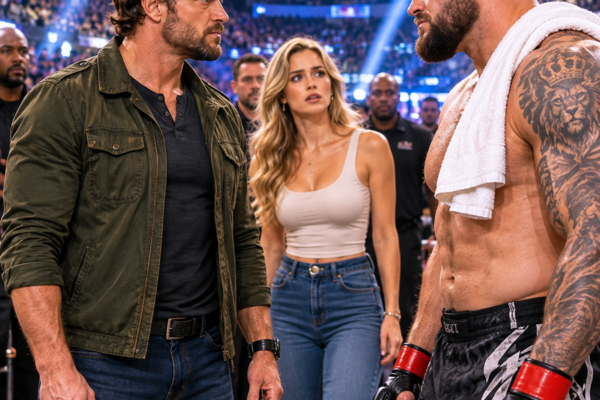
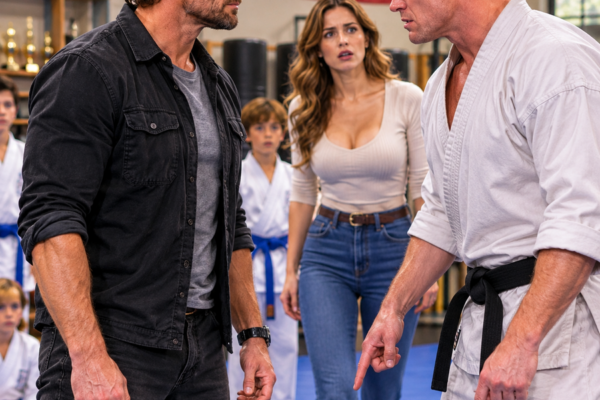
Thugs Targeted a Helpless Single Dad—Unaware He Was Once an Elite U.S. Navy SEAL Operative
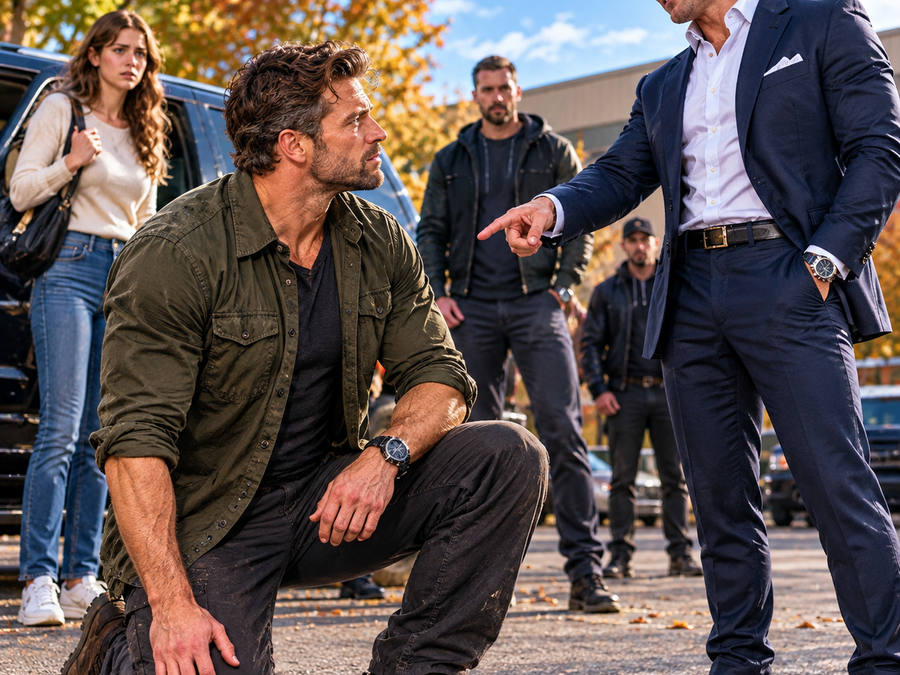
Thugs Targeted a Helpless Single Dad—Unaware He Was Once an Elite U.S. Navy SEAL Operative
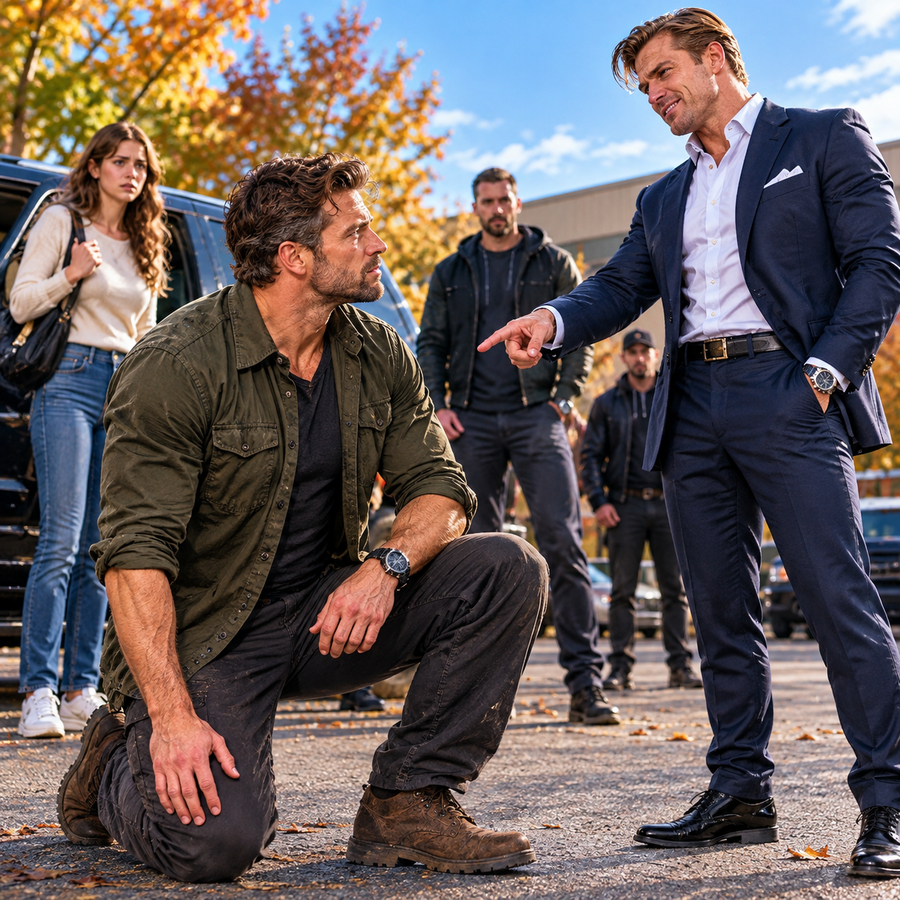
On your knees.
Pick it up.
Every piece.
Let her go.
You’re a broke grease monkey with no spine.
Get his face.
Every second of this. Last chance.
Post it. Caption it.
Helpless dad. The boot connected with his spine before he could exhale.
Four of them positioned deliberately.
And his daughter 6 ft away with someone’s hand on her wrist.
Gavin Roark had run threat assessments in conditions far worse than a grocery store parking lot in Marlow Creek, but Brett didn’t know that.
Brett saw a grease-stained mechanic on his knees picking up the broken pieces of his daughter’s laptop saying nothing.
What Brett was too busy filming to consider was this.
A man who records himself assaulting someone doesn’t get to call it a misunderstanding later.
He had just turned his own phone into a witness.
Gavin picked up every piece of that laptop without raising his voice. Brett was certain he had nothing left to fight with.
He had no idea what he just handed him.
If you want to see how this ends, and the ending is worth it, hit subscribe and follow along.
Now, let’s go back to where this all started.
Gavin Roark had lived in Marlow Creek for just under 2 years, and in that time he had learned which conversations to avoid and which silences to hold on to.
The town wasn’t hostile, exactly.
But it had a way of measuring a man by what he drove, what he owned, and whether his name appeared on a deed somewhere.
By those standards, Gavin didn’t register.
He rented a two-bedroom house on Caldwell Street from a landlord he’d never met in person, drove a Ford pickup that had gone 230,000 mi before he bought it, and wore the same four rotation of work shirts from Monday through Saturday without apology.
He worked at Marta’s shop on Route 11, a diesel and industrial repair outfit that smelled permanently of grease and burnt metal.
The work suited him.
Engines were honest.
They either ran or they didn’t and the reasons were never personal.
He was good at it. Fast enough to stay productive and precise enough that Martha never had to check his work twice.
The pay was modest.
Enough to cover rent and keep Sadie’s school lunches funded a month in advance.
And there was never much left over. He had stopped expecting there would be.
His daughter Sadie was 15.
Sharp in ways that sometimes startled him.
She had her mother’s eyes and her mother’s habit of asking questions that had no comfortable answers.
Four years had passed since Lauren’s accident and the absence had settled into their routines.
Not like a wound but like a weight.
Always present, distributed unevenly, felt most on quiet evenings when neither of them had anything left to say and the house seemed larger than it had any right to be.
Gavin managed it the way he managed most things.
By keeping his hands occupied and letting the hours stack up until the day was done. He had received calls twice in the years since leaving the Navy.
From private security firms offering positions that paid three times what he earned at Martha’s.
He declined both without much deliberation. The work would have meant irregular hours and extended stretches away from home.
And he had watched enough of his former teammates raise families at a distance to know how that story ended. Sadie had already lost one parent.
He wasn’t going to be the second one who disappeared.
So the box in the closet, the one containing his discharge papers, his service record, and a photograph taken somewhere outside Kandahar that he hadn’t looked at in over a year, stayed closed.
There was no version of his current life that required it to be opened. The first time he saw Dylan Price was on a Tuesday in late October.
The kid came by the shop to deliver a parts order 17.
Maybe slight-framed, with the practiced stillness of someone who had learned that being invisible was safer than being noticed.
Gavin signed the receipt and handed back the clipboard without drawing it out, but he watched the kid walk back to his car and filed the observation away.
He knew that expression.
He had seen it on younger men in circumstances that had nothing to do with a parts delivery in a small county town, and it stayed with him the way certain things did without explanation, without urgency, filed under a category that didn’t yet have a label.
The Colton Vance job came in the following week.
A flatbed tow truck from Vance’s roadside assistance fleet needed a full diagnostic and brake certification before its next county inspection.
Marta assigned it to Gavin because he was fastest with the diagnostic equipment and because certifications had a cost to get wrong.
It should have been a 2-hour job.
It took nearly four because what the onboard computer showed didn’t match the vehicle’s maintenance log.
The GPS unit recorded operational periods that didn’t align with any dispatch entry, late-night runs, routes that went nowhere near the listed service corridors.
The brake wear was inconsistent with the stated mileage.
Gavin documented everything accurately and flagged the discrepancies for Marta’s review before signing off.
He didn’t speculate about what the irregularities meant.
That wasn’t his job.
And he had no reason at that point to think the answer would matter to him personally.
Brett Vance arrived at the shop 3 days later and walked through the bay without waiting to be invited.
He was Colton’s younger brother, broad-shouldered, with the specific confidence of someone accustomed to occupying space that hadn’t been offered to him.
He told Gavin the work order notes were creating a problem and that he wanted the flagged discrepancies removed and the file updated to to a clean inspection.
He delivered request as though it were a formality, something a reasonable employee would process without friction.
Gavin listened to the full explanation before responding.
Then told him clearly that altering accurate maintenance records would expose Marta to liability and that he wasn’t going to do it.
Brett looked at him for a moment with an expression that suggested the answer was in a language he wasn’t accustomed to hearing.
He said Gavin would regret making things difficult and then he left.
Gavin didn’t tell Sadie about the visit that evening.
She sat at the kitchen table working through a history assignment, chewing the end of her pen the way she always did when something wasn’t resolving cleanly and he thought about mentioning it and decided against it.
He had already flagged the situation through the work order and Brett Vance was the kind of man who made threats and sometimes followed through on them, but Gavin had dealt with worse and he wasn’t going to bring that particular weight into the kitchen on a Wednesday night.
He was wrong to leave it there.
Four days later, Brett came back with three other men and they didn’t come to the shop.
Gavin and Sadie had stopped at the grocery store on Route 11 after school pick up, a routine run.
Nothing in the cart that wouldn’t fit in two bags.
The parking lot was nearly empty.
He was carrying the bags toward the truck when Brett stepped out from between parked cars and Gavin registered within the first two seconds exactly what he was dealing with. Four men positioned deliberately, one with a folding knife clipped to his front pocket and visible enough that it was meant to be seen.
Another had moved to stand between Sadie and the store entrance. A third had his phone raised and filming before a word had been spoken.
Brett said things designed to humiliate in front of a camera. He told Gavin to get on his knees.
He told Gavin what he was a broke, spineless grease monkey who had forgotten his place.
One of the crew knocked the bag from Sadie’s hands, and her laptop hit the asphalt and broke open at the hinge.
Gavin looked at Sadie’s face.
He looked at the man blocking her exit.
He looked at the knife.
He ran the geometry in the time it took Brett to say the next sentence, and he understood that any reaction that resembled what he was capable of in that parking lot with his daughter 6 ft away and four men positioned to respond would end with Sadie getting hurt.
So, he knelt down.
He picked up the pieces of the laptop slowly while Brett delivered his performance for whoever was watching on the other end of the phone. When Brett drew his foot back and connected with his spine, Gavin absorbed it without moving from his knees.
He told Brett once that he was giving him a chance to walk away.
Brett laughed for the camera and told the man filming to caption it when he posted.
The drive home was mostly silence. Sadie stared out the passenger window and let three traffic lights go by before she said anything.
When she spoke, her voice had a flatness that was worse than anger.
The particular quiet of someone who has been disappointed by something they were still trying to believe in.
She said she wished her father could stand up for both of them.
She didn’t say it to wound him.
She said it because it was true.
From where she was standing, with everything she could see, Gavin kept his hands on the wheel and said nothing that would sound like an excuse.
He filed a report with the sheriff’s department the next morning and submitted the video as evidence.
Owen Mercer had held the county law enforcement position for 11 years and had the particular skill of a man long in that role, the ability to acknowledge a problem without ever committing to addressing it.
He reviewed the video and called it unfortunate.
He suggested a cooling-off period, said that formal complaint processes were slow and often inconclusive, and said he’d keep the report on file.
When Gavin mentioned the diagnostic discrepancies in Colton’s fleet records, Owen said that kind of claim would require substantially more documentation before his office could act.
Two days after that visit, Owen called Gavin directly. He said he was calling off the record as a courtesy.
He mentioned Colton Vance’s contributions to several county organizations and said that formal proceedings in situations like this tended to drag on and produce limited results.
He suggested that Gavin might want to consider his daughter’s stability before escalating.
The tone was measured, almost paternal. But underneath every syllable, the message was clear.
This office is not your resource. Gavin thanked him and ended the call.
He sat with the phone in his hand for a minute afterward and understood that Owen Mercer was not going to be a neutral party in whatever came next. The job loss came at the end of the week.
Marta called him into her office after the last shift and told him with a face that was unhappy in the specific way of someone who has made a decision they know is wrong but have run out of alternatives.
Colton’s fleet contracts were a significant share of monthly revenue, and Colton had communicated that those contracts would relocate if Gavin remained on staff.
She said she’d tried to find another arrangement.
Gavin told her he understood, collected his tools, and walked out without making it harder for her than it already was.
She had treated him fairly for 2 years, and the situation she was in was not one she had built.
He applied at three shops within the region over the following 10 days.
Two declined before he’d finished the application.
The third offered an interview date and canceled it the morning before. The pattern required no interpretation.
Colton Vance had made calls, and the calls had been received.
The brake line discovery happened on a Thursday morning. Gavin noticed the pedal response was off when he pulled out of the driveway for a short errand and immediately returned.
He worked through the system component by component.
unhurried going through the sequence the way he’d been trained to approach any diagnostic methodically without rushing toward a conclusion before the evidence was complete.
The rear line had been cut, not frayed, not worn through, but severed cleanly at a point that required knowing where to look.
Someone had understood enough about vehicles to place the cut where the damage would appear consistent with deterioration to most mechanics. To Gavin, it was not consistent with deterioration.
He photographed every angle of the cut, bagged the component, and had a neighbor drive Sadie to school before taking the truck to an independent shop two towns over for a written assessment. That evening with Sadie asleep, he sat at the kitchen table with the photographs and the assessment report and thought carefully about what kind of decision he was looking at.
The employment pressure and the public humiliation were one language, social and economic, designed to isolate. The brake line was another language entirely.
It said that someone had considered whether he might die on a county road in a way that would look accidental and had decided to leave the outcome partially to chance. Men who spoke that language did not typically stop when their target left town.
They stopped when they were stopped. He called Russell Keen at half past 10.
Russell had been his teammate for the better part of 6 years, one of a small number of people who knew the full, accurate version of what Gavin had been before Marlow Creek, before Lauren, before the long, deliberate effort to
become someone his daughter could grow up around without fear. Russell answered on the second ring.
Gavin briefed him the way they’d both been trained to report.
Compressed.
Sequential. No editorializing.
The diagnostic records, Brett’s visit, the parking lot, Owen’s phone call, the job loss, the brake line.
When he finished, Russell said he’d drive up in the morning.
Gavin said he didn’t need someone coming to start something.
Russell said he understood the difference. And Gavin knew he did.
Because Russell had always understood the difference. After the call, Gavin went into the closet and carried the box to the kitchen table.
He set it down and looked at it for a long time before opening the lid. The photograph was there.
And the discharge papers.
And a folded piece of paper with contact numbers he hadn’t dialed in years.
He didn’t remove anything.
He just looked at it the way a person looks at something they’ve been successfully ignoring when ignoring it is no longer an available option.
He closed the lid, left the box on the table where he could see it in the morning, and went to check that the front door was locked.
He was not going to leave. He had considered it the clean exit, a new county, another version of starting over.
But Sadie had 1 year left before she could choose her own version of that.
And she deserved to finish it without watching her father decide that what was being done to them wasn’t worth the trouble of standing still.
Russell Keen arrived the next morning in a gray Tacoma with a duffel bag and a thermos of coffee, and he walked through the front door with the easy efficiency of someone who had shown up in worse places under worse circumstances.
He was a few years older than Gavin.
Heavier in the shoulders.
With close-cropped hair going gray at the temples.
He sat at the kitchen table, looked at the box of service documents still sitting where Gavin had left it the night before, and didn’t mention it.
They spent the first hour going over everything Gavin had documented, the brake component, the photographs, the work order discrepancies, the timeline of Brett’s escalation.
Russell listened without interrupting, and when Gavin finished, he said they needed a file, and they needed it built the right way, because anything assembled carelessly would fall apart before it reached anyone who could act on it. They worked the documentation in the evenings after Sadie went to her room.
Russell brought a laptop and knew how to organize what they had, the diagnostic printout from Colton’s fleet vehicle, the independent assessment of the sabotaged brake line, timestamped photographs, screenshots of the social media posts that Brett’s crew
had uploaded before apparently reconsidering and taking down.
Though not before Russell had preserved a copy. What they had was accurate and well documented.
What it didn’t yet do was connect Colton Vance to any of it by name in a way that a district attorney would treat as actionable rather than circumstantial.
That was the gap they needed to close.
Tessa Burn reached out to Gavin through a note sent home with Sadie, which was a careful choice, not a call, not a text, nothing electronic. She taught sophomore English at Marlow Creek High and had noticed what the last several weeks had done to Sadie.
The flinching when cars slowed near the school entrance, the way she sat with her back to walls in the classroom. Tessa wrote that she thought there was something larger happening, and that she might know a student who was part of it.
Gavin drove to the school on a Saturday morning and met her in her classroom, and she told him about Dylan Price.
She said Dylan had stopped attending two of his afternoon classes, and that when she’d kept him after one day, he’d stood near the door the entire time, positioned to leave quickly, watching the hallway.
She hadn’t been able to get much out of him directly, but she knew he was making deliveries for someone.
And she knew that whatever arrangement he was part of had started with a debt his family couldn’t pay.
She said she was telling Gavin because she didn’t trust Owen Mercer’s office and because Sadie had told her without elaborating that her father was the kind of person who would actually do something with the information.
The first time Gavin encountered Dylan outside of the shop context was not arranged.
He was picking up a replacement part at a hardware supply store two towns over and saw Dylan loading boxes into a car in the back lot, the same car he’d driven to Marta’s shop, same practice stillness in the way he moved.
Gavin walked over and
didn’t introduce himself formally.
He said he used to work at Marta’s on Route 11 and that he remembered signing for his deliveries.
Nothing else. Dylan looked at him for a moment with the specific weariness of someone who had been approached by too many adults with agendas, then went back to loading the boxes.
Gavin let him. Dylan came to the house the following evening without being asked.
He rang the doorbell at 7:30, stood on the porch with his hands in his jacket pockets, and told Gavin he knew who he was. Then he said he needed to know something before he said anything else, whether Gavin was going to put him in a position where his mother would pay for it.
Gavin told him directly that he wasn’t going to ask Dylan to do anything until there was a way to make sure his mother was protected first and that he would not move on any information Dylan gave him without doing that groundwork.
Dylan looked at him in a way that suggested he was deciding whether the answer was something a person could actually be held to. Then he came inside and sat down.
What Dylan described over the next hour answered most of the structural questions Gavin and Russell had been working around.
Brett’s crew used teenagers with limited options, kids carrying family debt, kids without jobs.
Kids who needed money fast enough that they didn’t ask too many questions about where the work came from.
They drove vehicles from one location to another between parking structures and storage lots in a cluster of properties outside the county line.
Dylan had figured out the cars were stolen 3 months in. By that point, Brett had made clear what the alternative to continued cooperation looked like.
People had been sent to idle outside the house where his mother lived alone, and the message had been received without anyone needing to say it out loud.
Gavin submitted a second set of documents to the sheriff’s department a few days after the independent break assessment.
Additional GPS data that Russell had corroborated through public records and a formal written request for the original diagnostic printout to be entered into evidence.
He hand-delivered the envelope to the front desk rather than Owen’s office, and he kept a time-stamped copy.
The following morning, Owen called him in for what the message described as a clarification meeting. Gavin brought the copy of the submission and said very little.
Owen spread several pages across his desk and told Gavin that the incident at the abandoned vehicle yard in which Gavin had physically engaged Brett and two other men could be interpreted in more than one way under county statutes.
He said that a civilian
with documented special operations training who initiated contact in an unsanctioned environment and physically restrained multiple individuals was not automatically protected by self-defense framing.
He said the words slowly without raising his voice, and Gavin understood that this was not a legal briefing. It was a blueprint.
Owen was telling him how the file was going to be built, and he was doing it early enough that Gavin would know resistance was the expensive option.
Gavin left the sheriff’s office and called Russell from the parking lot.
He told him not to submit anything further through local channels, then explained what Owen had said and what it meant.
Russell said they needed to route everything through the state level and that he knew a contact in the state attorney’s office who had handled a similar case in another county 2 years prior.
Gavin told him to make the call.
Two nights later, Brett’s people went through the storage unit where Russell was keeping duplicates of the assembled file.
Dylan hadn’t offered the location.
He didn’t know it, but someone had tracked Russell’s car from the motel to the unit and put it together from there.
Three men arrived after midnight with a bolt cutter and a reliable sense of timing. Russell was there working late, which none of them had anticipated.
He was struck hard enough to put him on the floor and bruise two ribs, and by the time he recovered his footing, the men were gone with two binders of printed records and an external drive. He drove himself to the county hospital and called Gavin from the waiting room.
Gavin drove to Dylan’s house before 7:00 the following morning, knowing the kid would likely be somewhere between guilt and panic, and found him sitting on the front steps already dressed.
They drove to the hospital without discussing it, and sat in the plastic chairs outside Russell’s room for 40 minutes without Gavin raising the subject of the missing files.
He asked Dylan where his mother was staying.
Dylan said she was at his aunt’s place in the next county.
He’d gotten her out the day before when he’d realized the situation was accelerating.
Gavin nodded and said that was the right call.
Dylan stared at the hallway floor for a long time, and when he looked up, his expression had shifted from guilt to something more resolved.
He said he was ready to give a formal statement.
Gavin told him they would do it through the state office, not the county, and that they would arrange protection for his mother before Dylan signed anything.
The damage to the file was serious, but not complete.
Russell had maintained digital backups on a server that the men in the storage unit hadn’t known about, and the original diagnostic printout from Colton’s fleet vehicle was still with the attorney Gavin had retained.
What was lost had been recoverable in one form or another.
What couldn’t be recovered was time, and the gap in momentum gave Colton room to work.
Sadie found the box on a Saturday afternoon while Gavin was at the attorney’s office.
She hadn’t gone looking for it.
It was still on the kitchen table where it had been sitting for almost 2 weeks.
And when she lifted the lid, she found the discharge papers, the service photograph, and a commendation letter she had never seen before.
She had the photograph in her hand when Gavin came home.
He knew from the way she was standing in the kitchen doorway that the conversation was going to cost something. She asked him directly why he had let Brett kick him to the ground in a parking lot if he was what that photograph said he was.
He told her the honest answer.
That four armed men and a daughter with no exit route meant that any response he was capable of could have put her in the middle of a situation with consequences that outweighed any amount of pride. She heard the words.
She turned them over.
And then she told him that it sounded like the kind of logic a person could use to justify never doing anything, and that she didn’t know anymore whether he was protecting her or protecting himself from something he was afraid to let out.
She put the photograph on the table and went to her room.
And Gavin stood in the kitchen and understood that the truth, delivered fully, had not closed the distance between them. It had widened it.
The social media campaign started the following week.
Someone paid, coordinated, operating across multiple accounts, began posting accounts of Gavin’s history that were technically accurate in their facts and systematically wrong in their framing.
The confrontation at the abandoned vehicle yard was described as an unprovoked attack on two young men.
The video circulated again, this time with the 40 seconds before Brett raised the metal bar removed.
What remained showed Gavin moving with the kind of precise, unhurried efficiency that looked, absent context, exactly like what Colton needed it to look like.
A man with professional training applying disproportionate force to someone smaller than him.
Three parent accounts posted to the school community page asking whether the environment was safe for students connected to the situation.
The child services inquiry came on a Wednesday.
A case worker named Patricia Walsh knocked on the door of the Caldwell Street house, introduced herself with practiced neutrality, and explained that an anonymous report had raised questions about the home environment. She was courteous and thorough and made clear that she was not there to accuse anyone of anything.
Gavin showed her the house, answered every question directly, and made sure Sadie was present and able to speak freely.
The assessment produced no findings that supported the complaint. But the inquiry was in a file now, and Gavin knew that a file was the kind of thing that could be reopened with enough pressure from the right direction.
Owen moved within 10 days of the warehouse confrontation.
Martha’s shop on Route 11 burned on a Thursday night.
She had gone back after closing to finish a billing cycle and was in her car in the lot when she smelled smoke from the bay. She got out before the structure was fully involved.
The shop was gone by the time the county engine company arrived. Not salvageable, not insurable in any timeline that helped her in the immediate term.
The equipment, the records, the client files, the work orders going back 6 years, all of it gone.
Martha called Gavin from the lot while the fire crew was still working the perimeter, and he heard in her voice something beyond distress.
The particular exhaustion of a person watching something they built with specific, sustained effort be removed in under an hour. Owen brought Gavin to the county building the next morning for a formal interview.
There was a recording device on the table, a deputy in the corner, and a thick folder that Owen opened deliberately in front of him. He said the investigation was looking at all individuals with a documented grievance against the property and its owner, and that Gavin had been terminated under contentious circumstances.
Gavin sat with his attorney present, answered only the questions that required answering, and said nothing that would be useful to anyone building a case in the wrong direction.
He recognized the structure of what Owen was doing.
It was the same blueprint from the earlier meeting, now with a crime attached to it. The goal was not to charge Gavin today.
The goal was to have the folder, so that when the next thing happened, the pattern would already be in the file. Russell was released from the hospital that same afternoon.
Dylan was gone.
His aunt had taken him further out of county after Brett’s people had been seen in the neighborhood twice in 3 days.
Gavin’s lease termination notice was sitting on the kitchen table when he got home.
The notice gave 30 days. Sadie found him there that evening, reading it for the third time.
She had heard about the fire from someone at school.
She sat down across from him and said that she understood he was trying to fix something, but that everything around them kept getting worse, and that every person who had tried to help them had ended up hurt because of it.
She said she wasn’t asking him to give up, she was asking him to consider that fighting from inside a corner that kept getting smaller wasn’t the same thing as fighting smart.
She was 15 and she was right.
And Gavin didn’t try to argue the point.
He told her he heard her. He said he was going to figure it out.
The words sounded thin even to him, and they both knew it.
Two days later, while Gavin was at his attorney’s office reviewing what remained of the compiled file, his phone showed a notification from an unknown number.
He opened it.
The video showed Sadie sitting on a concrete floor, her wrists bound with zip ties, crying quietly. Behind her was a cinder block wall with a single light source.
Brett’s voice came from off screen, steady and entirely confident, saying that Gavin had until the following morning to deliver every copy of every document he was holding, and to sign a written statement accepting responsibility for the confrontations that had occurred.
In exchange, Sadie would be returned to the parking lot of the Caldwell Street house.
If Gavin contacted the sheriff’s department, Colton’s attorney would file the assault documentation within the hour, and Owen would process it himself.
Gavin watched the video twice.
Then he forwarded it, along with the time stamp and the number it had arrived from, to Russell and to his attorney with a single instruction.
Reach the state attorney’s office tonight, not tomorrow.
He looked at Lauren’s photograph on his phone afterward, the one he kept in a separate folder, the one from the week before Sadie was born.
He had made a specific promise at Lauren’s graveside.
Not out loud. Not in front of anyone.
But made in the way promises matter most, that Sadie would grow up safe. The man who had made that promise had certain skills and a certain history, and he had spent four years keeping both of them in a locked box because he had wanted Sadie to have a father rather than a soldier.
But his daughter was in
a cinder block room with zip ties on her wrists, and he was running out of ways to keep those two things separate.
Gavin’s attorney made the call to the state attorney’s office at 9:47 that evening.
By 11:00, two investigators from the state bureau had confirmed receipt of the ransom video, the timeline of documented harassment, and the full file that Russell’s server backup had preserved.
They asked Gavin to do nothing until they had a plan in place.
He sat in his attorney’s office until nearly 1:00 in the morning while the coordination happened in rooms he wasn’t in, through channels that Owen Mercer had no visibility into, and when he finally drove back to the Caldwell Street house, it was to an empty kitchen and a silence that had a specific quality to it.
The kind that exists when someone who is usually in the house is not. The state investigators called him back before 6:00 the next morning.
They had located the property from the address metadata embedded in the ransom video.
An industrial storage building on the edge of a township two counties over, registered to a holding company with documented ties to Colton Vance’s secondary business interests.
A coordinated entry was being planned. They needed Gavin to make contact with Colton.
Accept the meeting on the terms Brett had set, and keep both men engaged long enough for the operation to position.
They also confirmed that Russell had notified them.
Dylan and his mother were secured at a protected location out of county, one less variable for Gavin to carry into what came next.
They were explicit about what they needed from him, and equally explicit about what they did not want. He was not to enter the building independently, not to provoke a physical confrontation before their teams were in place, and not to bring anything that could be categorized as a weapon.
He agreed to all of it before they finished the sentence.
He called Colton’s number from his own phone at 7:15.
Colton answered on the first ring, which told Gavin that Colton had been awake and waiting. The conversation was brief.
Gavin said he would bring everything, and that he wanted his daughter returned unharmed at the point of exchange. Colton named the location and said he expected Gavin to arrive alone.
The call lasted under 3 minutes. Gavin kept his voice flat and unremarkable, the tone of a man who had run out of options and was accepting a bad deal because there was no better one available.
Colton heard what he expected to hear. The drive to the property took 40 minutes.
The state investigators had delivered a wireless transmitter, a compact audio and GPS device separate from his phone through his attorney the previous evening, fitted into the inner lining of his jacket. The device gave the team outside both his location and live audio from the moment he stepped out of the truck.
He was aware of the positions the team was taking up in the surrounding area.
Not because he could see them, but because he knew how a perimeter of that kind was structured and he trusted the people running it. The same way he had once trusted specific teammates in specific situations.
Not because trust came easily, but because the alternative to trust in those moments was paralysis.
Brett was waiting near the building’s entrance with two of his crew.
Colton stood further back near a vehicle. With the particular posture of a man who considers himself above the operational details of his own operation.
When Gavin got out of the truck, Brett crossed the distance between them at a pace designed to establish dominance from the first second and told him to empty his pockets and turn around. Gavin complied without comment.
One of Brett’s crew patted him down and found the phone, which Brett pocketed.
And nothing else, the transmitter in the jacket lining went undetected.
Then Brett told him to get on his knees. Gavin recognized what this was.
It wasn’t security protocol, it was the parking lot again.
Rerun on a larger stage with a higher value audience.
Brett wanted the image.
The man who had caused trouble for his brother kneeling in the dirt a second time in a place with no witnesses except the ones Brett controlled.
Gavin held Brett’s gaze for one full second, then knelt down.
He was not doing it for Brett. He was buying time and every second the team outside used to get into position was a second that mattered.
Sadie was brought out by one of Brett’s crew, hands bound in front of her with zip ties, eyes red, but expression set in a way that reminded Gavin sharply of her mother under pressure.
She saw him kneeling in the dirt, and her face did something complicated and painful that he filed away to address later. Brett walked a slow circle around Gavin, telling him in a conversational tone how things were going to go from here, the signed statement, the permanent departure from Marlowe Creek, the understanding that if any of this resurfaced, there were people in the county building who would respond accordingly.
He said it with the ease of someone narrating an outcome that had already been decided. Gavin kept his eyes on Sadie and kept counting.
Then Sadie looked directly at Brett and told him clearly, clearly enough for everyone in the yard to hear that the police already had copies of everything.
She said it not as a plea or a bluff, but as a flat statement of fact delivered to a person she had decided to stop being afraid of.
Brett’s posture changed immediately.
He covered the distance between himself and Sadie in four steps, grabbed her by the arm, and produced a handgun from his waistband, not pointing it at her directly, but holding it in a way that made the implication complete and unmistakable.
Gavin was moving before the gun finished clearing Brett’s waistband.
The calculation involved no deliberation.
Sadie was the variable. Brett was the threat.
And the space between them needed to be closed before Brett made a decision with the weapon that couldn’t be undone.
Gavin came off his knees at a lateral angle that cut off Brett’s field of movement towards Sadie, rather than coming at him straight on.
He got a hand on Brett’s weapon arm at the elbow and drove it upward and outward.
Brett fired once.
The discharge went into the corrugated metal wall 6 ft above the ground, and Gavin rotated Brett’s wrist against the joint and felt the gun drop.
Brett swung with his free elbow and connected with Gavin’s left shoulder, and the impact landed on something that tore.
Gavin felt it go and kept moving anyway.
He drove Brett’s weapon arm down and back and put him on the ground, and the gun was 3 ft away in the dirt, and Sadie was running.
The entry team came through two points simultaneously in the following seconds.
The sound of vehicles and commands filled the yard and the building entrance, and Brett’s crew made the calculations that people with limited options typically make when faced with organized force, to drop to their knees.
One attempted to run toward the tree line. One went back inside the building and was met there.
Colton at the vehicle turned to get in and drive and found someone already standing behind his car. Gavin released Brett the moment he heard the team come through and stepped back and let him stay on the ground.
His left shoulder had a specific quality of wrongness he recognized from previous experience, a through wound. Judging by the burning and the immediate loss of reliable strength in the arm, he applied pressure with his right hand and stayed on his feet and looked for Sadie.
She was 20 ft away at the perimeter of the yard being guided toward a vehicle on the access track.
She looked back at him from that distance.
He was sitting on the ground by then, not because he’d made a decision to sit, but because his legs had registered what his attention hadn’t.
Leaning against the exterior wall with his right hand pressed hard against his left shoulder, he held her gaze until he was sure she had been handed off to someone who would take her somewhere safe. Then he let his head drop back against the corrugated metal and concentrated on staying conscious.
He was in surgery inside of 2 hours.
The bullet had passed through the muscle and soft tissue of the upper left shoulder without hitting bone, a clean path through the wrong place, which was the best version of a bad outcome. He was told he would recover full function with appropriate rehabilitation, but that the process would take several months, and that certain categories of mechanical work would be limited for the first 6 to 8 weeks.
When the assessment was finished, his first question to the attending physician was whether his daughter had been at the hospital. The physician said a teenage girl matching that description had been in the waiting room for the last 2 hours and had refused to go home.
Sadie came in when they let her.
She sat in the chair next to the bed and looked at him with an expression that had moved past the complicated thing he’d seen in the yard and arrived at something quieter and less defended.
She said she was sorry for what she’d said the week before about him protecting himself rather than her.
He told her she hadn’t been wrong to ask the question.
She said she thought she’d been at least partially wrong about the answer.
They didn’t resolve the full weight of the last several months in that conversation, and neither of them tried to.
What happened instead was simpler and more durable.
She reached over and took his right hand, the one that wasn’t wrapped and immobilized, and they sat there in the light from the corridor window while the hospital ran its quiet nighttime routines around them.
Dylan returned to Marlow Creek 3 weeks after the arrest. He came with his mother, who had been housed in a protected location during the final phase of the state investigation, and he gave his formal statement to the state investigators in a recorded session that lasted nearly 4 hours.
What Dylan described the full operational structure of Colton’s theft and transport network, the names of intermediate buyers, the properties used as temporary storage, the specific roles assigned to the teenagers Brett had recruited, matched, and extended the documentation that Gavin and Russell had assembled.
The investigators had enough to seek warrants for multiple locations.
The searches produced what the warrants anticipated.
Colton Vance was taken into custody on a Tuesday morning outside his primary office with his attorney present and was charged with organized theft, receiving stolen property, kidnapping, witness coercion, and directing acts of violence. The business assets connected to the criminal operation were frozen the same day and his partners in various county ventures began issuing statements distancing themselves within hours of the charges being made public.
Brett was charged separately for the kidnapping, the assault across multiple incidents, and the discharge of a firearm.
The charge sheet was long enough that his own attorney’s expression, captured by a local news photographer outside the county building, communicated something between resignation and professional discomfort.
The video from the grocery store parking lot, which Brett had originally posted as evidence of his dominance, was entered as part of the harassment and organized intimidation evidence. The moment that had been intended to follow Gavin through the community as proof of his helplessness became, in the context of the full case, a documented record of Brett conducting a premeditated act of public intimidation against a man who had refused to falsify maintenance records.
Owen Mercer was placed on administrative leave two days after Colton’s arrest when the investigators’ review of internal communications showed that Owen had forwarded information from Gavin’s formal complaints directly to Colton on three separate occasions, including the
content of the brake line submission that had prompted the storage unit break-in.
He was suspended pending further review and subsequently charged with misconduct in office and obstruction.
The community response had the slow-burning quality that comes from people realizing the mechanism they had trusted to protect them had been pointed the other direction for a long time.
Marta’s situation resolved more slowly, as these things do.
The arson investigation produced a witness statement from one of Brett’s crew who had accepted a cooperation agreement, and the connection between the fire and Colton’s operation was formally established.
Marta filed her insurance claim with the documentation Gavin had helped her prepare during his recovery period working with one functional arm at her kitchen table, going through the equipment inventory list item by item, making sure nothing was undervalued or
omitted.
Several of the mechanics she had employed over the years organized a collection of used tools and helped her identify a smaller commercial space available at a reduced lease rate. The new shop was a fraction of the size of the original.
It opened on a Wednesday morning in early spring with a small group of people who had known Marta long enough to understand what it cost her to start over, and Gavin drove her there that morning and stayed for the first hour before she told him to go home and rest his shoulder. Dylan came by the new shop
one afternoon in late August before the school year started.
Tessa Byrne had connected him with a nonprofit that helped students in difficult circumstances maintain enrollment.
And they had worked out a schedule that let him contribute to his household without abandoning his coursework.
Tessa had also stopped by herself the week prior not to discuss anything in particular, just to drop off a casserole for Marta and to tell Gavin that Sadie was doing well in her classes and that the flinching at doorways had stopped. When Dylan arrived, he found Gavin helping Marta recalibrate a piece of diagnostic equipment, his right hand doing most of the work, and his left arm doing what it could.
They didn’t talk about the warehouse or the statement or any of the things that had cost both of them something real.
Gavin put his right hand out and Dylan shook it.
Then Dylan said he needed to get home for dinner.
And Gavin said that sounded about right. The new house on Birch Lane was smaller than Caldwell Street.
One less room. A narrower yard.
A landlord who hadn’t heard of Gavin Roark before the lease was signed.
He and Sadie moved in on a Saturday with Russell’s help and an arrangement of second-hand furniture that filled the space without overwhelming it.
The left shoulder was at about 60% by then, improving steadily.
The physical therapist had told him he’d likely never notice the difference in another year.
Gavin thought that was probably true and that the scar itself didn’t bother him.
He had others from other situations and they had all become unremarkable in time.
Sadie had a career day presentation at school in October. Teachers had asked students to introduce a family member or adult they admired, explain what that person did, and say what it had taught them.
Gavin sat in the third row of the gymnasium and listened to her speak without notes.
She didn’t mention Navy SEALs or classified operations, or the parking lot, or the warehouse.
She described a man who had walked away from higher-paying work to be home for dinner, who had fixed other people’s broken engines for 6 days a week without complaining about the gap between what he earned and what he deserved, and who had tried, consistently, to protect people around him without requiring them to be hurt in the process.
She said the thing that had taken her the longest to understand about her father was that the restraint was not weakness.
Then she said clearly, without hesitation, “My dad was never helpless.
He was just strong enough not to hurt people when he didn’t have to.”
She said it plainly, not for effect, and sat down.
Gavin drove them home after the presentation through the early dark of an October evening. At the kitchen table he went to the closet and came back with the box, the one that had been sitting in various locations throughout the last several months, opened and closed and opened again.
He set it on the table between them and took out the photograph from Kandahar, the discharge papers, and the commendation letter Sadie had found on the afternoon that had gone wrong between them. He told her what she was looking at.
He answered the questions she asked.
He told her about the teammate he hadn’t brought home and about the specific weight of that and about how long he had carried it in the wrong direction before understanding that carrying it at all was not the same as being crushed by it.
Sadie listened in the way she had learned to listen completely without interrupting with her mother’s eyes.
He put everything back in the box when they were done.
He didn’t lock it.
He left it on the kitchen shelf where it was visible from the table because there was no longer any reason to keep it somewhere he couldn’t see it.
The life he was living and the life he had lived were both his. They had always been both his and the work of keeping them separate had cost more than it had ever been worth.
His left arm ached in the cold mornings.
He had learned to treat that as information rather than complaint, a reliable reminder of a specific night when the things he had spent four years trying to keep in a box had turned out to be exactly what his daughter needed him to have.
He didn’t celebrate that.
He made breakfast, drove Sadie to school, and went to work in the quiet company of engines that either ran or they didn’t while the town of Marlow Creek continued its ordinary business in the ordinary light of a morning that nobody had to be afraid of anymore.
Gavin Rourke never threw a single punch to prove he was strong.
He took a boot to the spine in a parking lot, lost his job, watched his truck get sabotaged, and sat in a sheriff’s office while a corrupt cop built a case against him.
And through all of it, he never stopped thinking about the one person who needed him to come home.
That’s not weakness.
That’s the hardest kind of strength there is.
The kind that knows exactly what it’s capable of and chooses every single day not to use it carelessly.
The real lesson here isn’t about fighting back.
It’s about what a person holds on to when everything else is being stripped away.
Gavin held on to his daughter.
He held on to the people who were willing to stand beside him.
And he held on to the belief that doing things the right way, even the slow, costly, unglamorous way, was worth it.
Not because it always wins quickly, but because it’s the only kind of winning that actually lasts.