Billionaire Woman Vanished and No One Could Find Her—Only a Single Dad Found Her Alive and Saved Her – PART 4
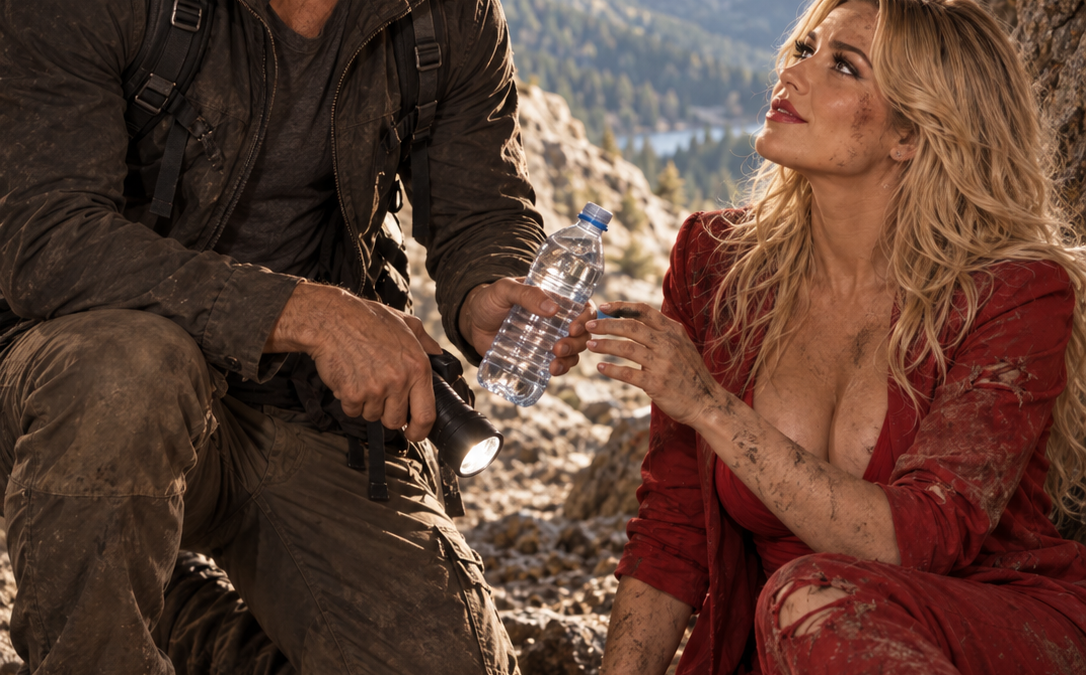
PART 4
The news cycle peaked that afternoon and then kept going.
Victoria Langford’s survival story was everywhere.
By evening, every major network, every news website, every social media platform cycling the same photographs. Victoria being helped from a helicopter.
Victoria in a hospital bed, looking even there, even after all of it composed and direct and exactly herself.
The story of the fraud of Whitmore’s arrest of the shell companies and the land parcels spread alongside the survival story until the two were inseparable.
A single narrative about a woman who had gone into a mountain to find evidence and come out the other side with it intact. The volunteer rescuer was described in every account only as a local watershed specialist who had continued searching after the official operation terminated. No name, no photograph, no interview.
Daniel watched the coverage for about 20 minutes that evening, sitting on the couch next to Sophie, who had questions.
“Why was she there in secret?”
Sophie asked.
because she was investigating something inside her own company and she didn’t know who she could trust.
Daniel said, “That sounds really lonely,” Sophie said.
He looked at her.
“Why lonely?”
“Because she couldn’t ask anyone for help,” Sophie said.
“If you can’t trust the people around you, you have to do everything alone.”
She thought about it.
“That’s the loneliest kind of alone, not being by yourself, being around people you can’t be honest with.”
Daniel stared at his 10-year-old daughter.
“Yeah,” he said.
“That’s exactly right.”
Sophie looked at the television.
“Is she going to be okay now?
Like really okay, not just the leg.”
“I think so.”
Daniel said, “She’s tough and she’s got people now, lawyers, federal investigators, her company.
It’s going to be complicated for a while, but she’s going to be okay.
” “Good,” Sophie said and went back to her book.
Three weeks passed. Daniel gave his formal statement to Carrasco.
Two hours in a federal building in Durango. A woman typing everything he said. Carrasco across the table asking careful specific questions in the way of someone assembling a structure that needs to hold weight.
Daniel answered everything directly. He described the map gap, the fabric on the branch, the stone markers, the communicator with its battery removed, the bootprint, the chamber, the slab.
He described Victoria’s account of what happened the meeting, the man, the communicator, the storm.
He described finding her stabilizing her climbing to the ridge, the text to Reyes. He did not editorialize. He did not speculate beyond what he directly observed.
He answered what was asked and volunteered nothing beyond it. Carrasco walked him out at the end.
“You’re a good witness,” Carrasco said.
“I just told you what happened,” Daniel said.
“That’s what makes someone a good witness,” Carrasco said.
They shook hands in the parking lot. Daniel drove home.
He stopped at the gas station and bought two blueberry muffins because it was a Thursday and Thursdays had become muffin days without anyone formally deciding that.
The second week and week, his phone rang with a number he didn’t recognize, but that had a Denver area code.
He almost declined it. Something made him answer.
Daniel.
Victoria’s voice.
Clear and steady, only slightly different from the voice he remembered from the chamber. A fraction less raw, a fraction more rested, but the same precise quality, the same economy of words.
Victoria, he said. A brief pause.
How’s the leg?
he asked. Physical therapy three times a week, she said.
I’m walking without the brace as of 2 days ago.
The therapist says I’m ahead of schedule, which I think means she says that to everyone, but I’m choosing to believe her.
Good. Another pause. Shorter.
I want to come to Silver Creek, she said. Not with a security team, not with cameras.
Just me and my attorney, and we’ll stay at the inn on Main Street, and I’d like to take you and Sophie to dinner if that’s all right.
He thought about it for exactly one second.
That’s all right, he said.
Saturday. Saturday works.
Good. She paused again.
Then how is she Sophie?
She’s reading four books at once.
He said she lost another tooth.
She’s been asking me every 3 days whether the lady from the mountain is really okay.
He heard Victoria’s breath catch just slightly.
Tell her yes, Victoria said. Tell her yes from me. I will.
Saturday came clear and cool. The early edge of autumn fully arrived in Silver Creek. Now the aspens along the ridge gone gold.
Victoria arrived in a rented sedan, just her and Ruth Cabrera, and checked into the inn with no ceremony and no announcement. Daniel met them at the diner on Main Street at 6:00.
Sophie shook Victoria’s hand very seriously when they were introduced the way she did when she decided someone was important and wanted them to know she understood that.
Victoria shook it back with equal seriousness.
You’re the lady from the mountain.
Sophie said, “I am.
” Victoria said, “Dad said you were really brave.”
Sophie said, “Your dad found me.”
Victoria said, “I don’t know how brave I was.
I was mostly just stubborn.”
Sophie considered this. Dad says stubborn and brave are the same thing when it counts.
Victoria looked at Daniel. He shrugged.
She’s not wrong.
They ate dinner. Real dinner.
The diner’s pot roast, which was the best thing on the menu and the thing every Silver Creek local ordered without looking at the menu.
Victoria ate the whole thing. Daniel noticed that she ate the whole plate without looking at her phone once without a single motion toward the device in her jacket pocket.
She talked to Sophie about the book Sophie was reading. She asked questions and listened to the answers genuinely listened the way Daniel had noticed she listened in the chamber, the full attention kind that most adults stopped doing sometime in their 30s when the world got loud enough to require constant filtering.
After dinner, Sophie went to talk to Elaine, who had come to meet them, and Daniel and Victoria sat across from each other with coffee and the particular quiet of two people who have been through something together and don’t need to fill the silence.
I want to do something for the rescue service, Victoria said.
The volunteer operation, the equipment they’re using is 10 years out of date.
I looked into it.
Victoria, I’m not offering you money, she said.
I already know how that conversation ends.
I’m talking about the service, the radios, the weather stations, the technical climbing equipment, the things that would have found me on day two if the team had them.
She held his gaze.
And a permanent endowment for operational costs so the funding doesn’t run out when the county budget gets tight.
Daniel was quiet.
It’s not charity, she said.
It’s the correct response to a gap in regional emergency infrastructure that I experienced personally and that I have the resources to close.
Ruthlessly logical, Daniel said. Always, she said, one condition on my end.
What’s that?
You work with the county to develop the poststorm reassessment protocol formally as a consultant. Get paid for it, not as a favor as actual professional work.
He opened his mouth. That one is not negotiable.
She said, “The protocol saves lives.
It deserves to be properly developed and properly attributed.
Even if your name is off everything else, the professional work should be compensated.”
He looked at her for a long moment.
Then he said, “One condition on my end.
Name it.
My name stays off the building, off the equipment, off everything.”
“Done,” she said without hesitation.
And the endowment is administered through the county, not through your company. Also done.
And Daniel, she said, “How many conditions do you have?”
“Just those two.”
She smiled.
It was the first time he’d seen her smile fully.
Not the controlled, measured version, but the real one, the one that reached her eyes and changed her whole face. It looked like relief, like someone who had been holding herself at a careful distance from the world and had just for a moment let the distance close.
“Deal,” she said.
He put out his hand. She shook it. Ruth Cabrera across the restaurant made a small note on her legal pad.
Later, walking back through Silver Creek’s main street.
Sophie between them. The three of them passed the volunteer rescue station on the corner, a small building with aging equipment visible through the window and a radio mast on the roof that had been there since before Daniel moved to town. Sophie stopped and looked at it.
“Is that where the rescue people are?”
she asked.
“That’s where their stuff is,” Daniel said.
“They don’t live there.”
“It looks kind of old,” Sophie said.
“It is kind of old,” Daniel said.
Sophie looked at Victoria. Are you going to fix it? Victoria looked at Daniel.
Daniel said, “Nothing.”
“Yes,” Victoria said.
“I am.”
Sophie nodded satisfied and kept walking. Daniel looked at Victoria.
Victoria looked at him and in the particular way of two people who have already said the important things in harder circumstances, they didn’t say anything at all.
They just walked.
The protocol went live in January, not with a press release, not with a ceremony, with a 14-page document distributed to 17 regional search and rescue operations across southwestern Colorado attached to a cover letter from the San Juan County Sheriff’s Office describing a new mandatory reassessment procedure for terrain altered search zones following
extreme weather events.
The document was technical precise and almost entirely unreadable to anyone who didn’t spend their professional life thinking about how mountains behaved after storms.
Daniel had written most of it at the kitchen table after Sophie went to bed over the course of 3 weeks with two cups of coffee and a set of topographic maps spread across the chairs. He had written it the way he wrote watershed reports without drama, without narrative, just the logic of the land and what it required of the people trying to read it.
His name appeared on the document as contributing technical consultant. That was all. No biography, no backstory, no reference to the night in October when the protocol had proven itself in real conditions before it was even written down.
Reyes called the morning it went out. You see the distribution list?
Reyes asked. I saw it.
Daniel said 17 operations.
By summer it’ll be 25.
The state emergency management office wants to adopt it statewide. Daniel poured his second coffee.
Does it work?
That’s the question.
It worked in October, Reyes said.
That’s a pretty strong data point.
One data point, Daniel said. Hayes.
Reyes’s voice shifted.
The professional tone dropped a register into something more direct. Stop doing that. Doing what?
Minimizing it. You know what this document is.
You know what it does. Stop being modest about it and let it be what it is. Daniel was quiet for a moment.
It’s a search protocol, he said.
It’s a search protocol that will find people who would otherwise die, Reyes said.
That’s what it is.
Let it be that. He let it be that.
Spring came to Silver Creek the way it always did. slowly, then all at once, the snow retreating up the ridge lines while the valley floor turned green ahead of it.
The flood gauges needed recalibrating after the winter melt, and Daniel spent 3 weeks in the field doing the work he’d been doing for 15 years, the ordinary systematic work of a man who understood that water needed watching.
Sophie finished fourth grade. She lost two more teeth.
She started reading five books at once instead of four, which Daniel considered an escalation he hadn’t anticipated and wasn’t sure how to address.
Life, in other words, returned to its shape. And then in April, the protocol found its first person.
Daniel heard about it from Reyes, not from the news. A slide in the Simmeron Range had redirected a creek bed and buried a section of trail that two hikers had been on when the storm hit.
The initial search assumed they’d moved south toward the trail head.
The new protocol required a posttorm terrain reassessment before committing to that assumption. The reassessment identified two alternative drainage paths created by the slide. A ground team was sent into the secondary drainage.
They found both hikers in 4 hours. Both alive.
Reyes texted him three words. Protocol found them. Daniel read it standing in a field next to a flood gauge muddy to the knees, the spring sky huge and blue above him.
He read it twice. Then he put his phone in his pocket and went back to work.
He didn’t tell Sophie that night.
He didn’t tell Elaine.
He didn’t call anyone.
He just sat with it across from his daughter at dinner and felt the weight of it and thought about the gap in the map and the stone markers and the bootprint and Victoria’s palm flat on the notebook and the way all of it had led here to two hikers alive in a drainage.
Nobody would have checked without the document sitting on 17 search coordinators desks.
You’re quiet, Sophie said.
Just thinking, he said about what? He looked at her about how things connect.
he said how one thing leads to another thing and you don’t always see the line between them while it’s happening.
Sophie considered this with the gravity she brought to most things like dominoes.
Kind of like dominoes, he said, “Except you don’t knock them over on purpose.
They just fall in the right direction and you can’t always see where they’re going to land,” she said.
“No,” he said.
“You can’t.”
She nodded satisfied and went back to her pot roast. He called Victoria the next morning.
He hadn’t spoken to her since February when she’d called to tell him that the grand jury had returned indictments on Whitmore and four co-conspirators and that the federal case was proceeding with the kind of momentum that Carrasco had described at a press conference.
Daniel watched from his living room as the most comprehensive insider trading and corporate fraud case his office had prosecuted in a decade.
“The protocol worked,” he said when she answered.
A pause. Then tell me, he told her.
Two hikers, the Simmeron slide, the secondary drainage, 4 hours. When he finished, Victoria was quiet for a long moment.
Not the calculated quiet of someone choosing words. The quiet of someone who needed a second to absorb something that landed harder than they expected.
“Both alive,” she said.
“Both alive,” he said.
Another silence.
“Daniel,” she said.
Her voice had something in it he hadn’t heard before.
Not from the chamber, not from the hospital, not from the diner in Silver Creek. Something unguarded. I think about that week every day.
Not the bad parts. The part where you came back.
He didn’t say anything.
I’ve spent 15 years building things.
She said, “Projects, companies, infrastructure deals.
I know how to build things. And I always thought I knew what mattered, the scale of it, the reach, the number of people affected.








