“Sir, I Can Try.” Thirteen Elite SEAL Snipers Failed the 4,000-Meter Shot—Until a Quiet Logistics Officer Stepped Up to the Line and Exposed a Nineteen-Year Military Cover-Up.
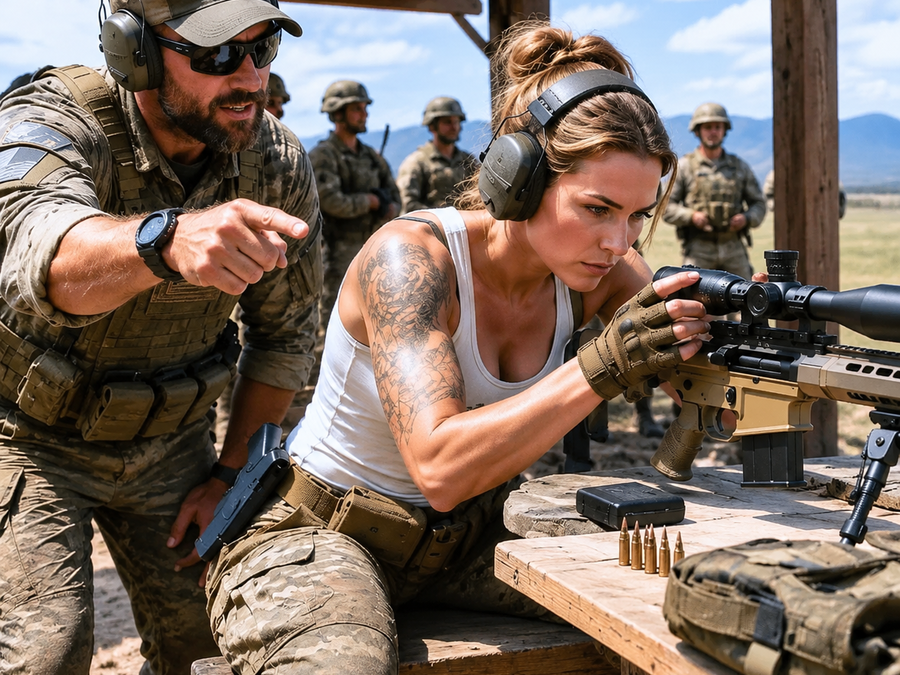
“Sir, I Can Try.” Thirteen Elite SEAL Snipers Failed the 4,000-Meter Shot—Until a Quiet Logistics Officer Stepped Up to the Line and Exposed a Nineteen-Year Military Cover-Up.
Colonel Richard Hayes looked Captain Emily Walker up and down, laughed once, loud and ugly, and said the words that made every man on the firing line go cold: “Sweetheart, the supply room is that way.
Go count your boxes and let the real soldiers work.”
He said it in front of thirteen elite snipers who had just missed the same target thirteen times, and not one of them corrected him.
That was the moment. That was the insult that started everything.
The heat over Fort Harrison was the kind that made the air itself look like water. It shimmered and bent above the sand, and out there, four thousand meters away, sat a target so small that even the finest optics turned it into a trembling gray dot.
General William Carter stood behind the firing line with his hands folded behind his back, and he watched another one of his best men lower his rifle in defeat.
“That’s thirteen,” Carter said quietly.
He did not raise his voice.
He never had to.
“Thirteen of the finest long-range shooters this country has ever produced, and that target is still sitting out there laughing at us.”
Colonel Hayes stepped closer.
“General, with respect, that shot isn’t humanly possible today.
The wind is switching every forty seconds. The mirage is eating the target.
Nobody makes that shot.
Not in these conditions.
Not at that distance.
It’s not a question of skill anymore.
It’s physics.”
“Physics?”
Carter repeated. He turned the word over in his mouth like it tasted wrong.
“You know what I hate about that word, Colonel?
People use it to explain why they gave up.”
Hayes’s jaw tightened, but he said nothing.
He knew better than to argue with the old man when his voice went flat like that. Behind them, the thirteen snipers stood in a loose line, sweat soaking through the backs of their shirts, faces tight with the particular shame of men who were never supposed to fail.
These were Navy SEALs. These were the ones other soldiers whispered about with something close to worship.
They had made shots that ended up in training manuals.
They had done things at fifteen hundred meters, at two thousand meters, that ordinary people would call miracles.
But four thousand was a different animal.
Four thousand was the edge of the map. And today, the edge of the map had won thirteen times.
“Do we have anyone else who can make this shot?”
Carter asked. He did not ask it hopefully.
He asked it the way a man asks a question he already knows the answer to.
“Anyone?
I don’t care about rank.
I don’t care about unit.
Is there a single person on this range who can put a round on that target?”
Nobody answered. The wind hissed across the sand.
A radio crackled somewhere with static and nothing else. Thirteen of the best marksmen in the United States military looked at their boots, and the silence stretched out until it became its own kind of humiliation.
And then a voice came from behind the observation area. A calm voice.
A woman’s voice.
“Sir, I can try.”
Every head turned. She was standing near the back, half in the shade of the equipment tent, and if you had walked past her a hundred times, you would never have looked twice.
Captain Emily Walker, thirty-nine years old, logistics officer—the woman who signed the paperwork when a crate of ammunition went missing, the woman who approved the fuel requests and tracked the spare parts and made sure the coffee machine in the command tent actually had coffee in it. She was not a warrior.
She was the person who counted the warriors’ bullets.
At least, that was what everyone believed.
Colonel Hayes was the first to react, and he reacted exactly the way you would expect a man like Hayes to react. He laughed—not a small laugh, a big one from the belly, the kind of laugh designed to be heard by everyone.
“Captain Walker,” he said, wiping his eye, “this is not a demonstration.
This is not a place for volunteers who want a story to tell their friends.
Go back to your desk.”
A few of the younger SEALs smiled. One of them looked away and shook his head, embarrassed for her.
Emily did not smile.
She did not flinch. She simply kept her eyes on the general.
“Sir,” she said again.
“If I miss, you lose two minutes.
If I hit, you gain an answer.
That seems like a fair trade to me.”
General Carter did not laugh.
That was the first strange thing. He was a man who had spent forty years in uniform, in war zones most of these young men could not find on a map, and he had learned a long time ago that the loudest person in the room is almost never the most dangerous one.
He looked at the quiet woman standing at the back, and something in the way she held herself made him pause.
“You’re a logistics officer,” Carter said.
It was not a question; it was a test.
“Yes, sir.
That’s what my file says.”
“That’s what your file says.”
Carter caught the phrase, the way she had put it, the small space she had left inside it.
“And what does your file not say, Captain?”
Emily was quiet for a moment. When she answered, her voice did not rise, but it did not waver either.
“It doesn’t say everything, sir.
Files rarely do.”
Hayes threw up his hands.
“General, you cannot be serious.
We have thirteen of the finest snipers in the world standing right here—men who have earned their place at this line through years of qualification, through blood.
And you want to hand the rifle to a supply clerk because she’s feeling brave today?
Do you understand what that says to these men?”
“I understand exactly what it says, Colonel.”
Carter’s voice dropped, and the temperature of the whole range seemed to drop with it.
“It says that in this military, we care more about what a person can do than about what their business card says they do.
Now, are you afraid she’ll miss, or are you afraid she won’t?”
Hayes’s face went red.
He opened his mouth and closed it. That was the first crack.
That was the moment when a few of the SEALs stopped smiling and started paying attention, because they had just watched a full colonel get put in his place over a woman they had already written off.
“Captain Walker,” Carter said, turning back to her.
“Step up to the line.”
The distance from the shade of the equipment tent to the firing platform was maybe forty feet. Emily walked it slowly, and every step of that walk was watched by thirteen men who did not believe she belonged.
She could feel their eyes.
She had felt eyes like that her entire career.
One of the snipers, a broad-shouldered kid named Petty Officer Danny Ror, muttered to the man beside him, loud enough to carry, “This is a joke, right?
Somebody’s going to jump out and tell us this is a joke.”
Emily stopped walking.
She turned her head and looked directly at him. She did not glare.
She did not snap.
She just looked at him calmly, the way a schoolteacher looks at a boy who has said something foolish.
“Petty Officer,” she said.
“What was your last group at two thousand meters before today?
I mean, on a good day.”
Ror blinked, thrown off.
“Four inches,” he said, almost defensively.
“Sub-four.”
“That’s good work,” Emily said, and she meant it.
“That’s real work.
Nobody’s taking that from you.”
She paused.
“But you’re standing here treating four thousand like it’s just two thousand twice over.
It isn’t.
And that’s why you missed.”
The line went dead silent, because she was right, and every one of them knew she was right, and a supply clerk was not supposed to know that.
Ror’s mouth opened, but nothing came out.
The man beside him, an older sniper named Chief Marcus Bell, put a hand on Ror’s chest without looking at him—a small gesture that said stand down.
And Ror stood down. Chief Bell was watching Emily now with a different expression than the others.
He was maybe the most experienced shooter on that line—twenty-two years in, quiet, gray at the temples—and he had noticed something the young ones had missed.
He had noticed how she walked: not nervous, not showing off.
She walked like a person moving toward a job she had done a thousand times before.
“General,” Bell said quietly, stepping forward.
“I’d like to lend the captain my rifle.
It’s dialed.
It’s ready.
She can be shooting in thirty seconds.”
Emily looked at him, and for just a moment something passed between them—a small nod of respect from one professional to another.
But she shook her head.
“Thank you, Chief,” she said.
“But no.
I’ll use my own.”
Hayes let out a bark of disbelief.
“Your own rifle?
You have your own rifle?
A logistics officer just happens to carry a four-thousand-meter-capable weapon system in her personal vehicle?”
Emily was already walking back toward the equipment tent.
“I’ll be two minutes, sir.”
When she returned, she was carrying an old, scuffed rifle case, the kind you might find at a gun show in some small town, the kind that had clearly been opened and closed ten thousand times.
She set it down on the platform and unlatched it.
And what came out of it made three of the SEALs actually laugh out loud.
It was not new. It was not sleek.
It was not the eighty-thousand-dollar precision system half of these men had strapped to their shoulders. It was a rifle that had been rebuilt piece by piece over years.
The stock had been sanded and reshaped by hand.
The barrel had been swapped.
The optic was mounted on a base that had clearly been machined in somebody’s garage.
It looked like something a grandfather might keep in a closet.
“That thing?”
Ror said, and this time the laugh was back, mean and easy.
“That’s what she’s going to use?
My grandpa had a rifle like that.
He used it to shoot squirrels.”
A couple of the others chuckled.
Emily did not react. She lifted the rifle out of the case and cradled it in her hands with a gentleness that stopped the laughter faster than any words could have.
She handled it the way a mother handles a sleeping child. And there was something in that gentleness that made even the loud ones go quiet, because you cannot fake that.
You cannot fake twenty years of hands on a thing.
“You can laugh at the rifle,” Emily said without looking up.
“The rifle doesn’t care.
And in about ten minutes, neither will you.”
She lay down on the platform.
She settled the rifle. And then she did something none of them expected: she did nothing.
The seconds ticked by. One minute.
The SEALs shifted their weight, glanced at each other.
Two minutes.
Somebody coughed. Colonel Hayes checked his watch with theatrical impatience.
Three minutes passed, and Emily Walker had not moved a muscle, had not touched the trigger, had barely seemed to breathe.
“General,” Hayes said, “this is exactly what I was talking about.
She’s frozen.
She doesn’t know what she’s doing.
She got up here on nerve, and now she’s realizing she’s in over her head.
Let’s end this before it gets embarrassing for everyone.”
“She’s not frozen, Colonel,” Chief Bell said quietly.
“How would you know?”
“Because I’ve seen frozen, and I’ve seen this.”
Bell nodded toward Emily.
“This is a shooter reading wind.
She’s counting cycles.
Look at the flags.
Watch what she’s watching.”
Out along the range, small marker flags were mounted at intervals—at five hundred meters, at a thousand, at two thousand, all the way out.
And they were not all moving the same direction. The wind near the firing line was pushing left to right.
Halfway out, it curled back.
Near the target, the mirage boiled straight up, meaning the wind out there had almost died. It was three different wind conditions layered on top of each other across four thousand meters of desert, and it was changing.
And that was why thirteen of the best men in the world had put thirteen rounds into the sand.
Emily was not frozen.
Emily was solving it.
She watched the cycle. The wind at the thousand-meter flag would swing, hold for a few seconds, then curl.
It had a rhythm. Everything in nature has a rhythm if you are patient enough to hear it.
And Emily Walker had spent nearly two decades learning to be that patient.
In her mind, she was running numbers: the temperature, the barometric pressure she had checked before she ever walked to the line, the angle of the sun, the rotation of the Earth itself—because at four thousand meters, the Earth moves under the bullet during its flight, and if you do not account for it, you will miss by feet.
She was calculating spin drift. She was calculating the loss of velocity as the round went transonic, that violent moment where the bullet slows below the speed of sound and gets kicked sideways by its own shock wave.
She was calculating the drop, which at this distance was not measured in inches, but in stories—the round arcing up into the sky and falling back down like an artillery shell. To the men watching, she was a woman lying still.
Inside her head, she was doing mathematics that would have broken most people.
“Four minutes,” Hayes announced.
“General, I have to insist—”
“You can insist all you want, Colonel,” Carter said.
“She fires when she’s ready, not when your patience runs out.”
And then, so quietly that only Chief Bell heard it, Carter added, “Look at her hands, Marcus.
Tell me what you see.”
Bell looked.
Emily’s hands were completely still—not the forced stillness of a nervous person holding themselves rigid, but the natural, easy stillness of someone whose heartbeat had slowed down on purpose.
“She’s got a low pulse,” Bell murmured.
“Real low.
She’s taking it down between beats.”
He shook his head slowly.
“General, I’ve been doing this twenty-two years, and I’ve only met a handful of people who can drop their heart rate like that on command.
Every one of them was a killer.
Not a clerk—a killer.”
Carter said nothing, but his eyes narrowed, because now he was thinking the same thing Bell was thinking, and both of them were beginning to understand that they did not actually know who Captain Emily Walker was. Five minutes.
And then Emily’s finger moved to the trigger.
The whole line felt it before it happened, the way the air changes right before lightning. Even Ror, who had been laughing two minutes earlier, found himself holding his breath.
Emily exhaled half a breath, held it, and squeezed.
The rifle cracked—a hard, flat sound that rolled out across the desert and came bouncing back off the distant hills.
The recoil rocked her shoulder, and the barrel settled, and Emily immediately went back onto the scope to spot her own shot, tracking the trace—that faint distortion in the air where the bullet tore through the mirage. Nobody breathed.
Because here is the thing about four thousand meters that the movies never tell you: the bullet does not arrive when you pull the trigger. At that distance, the round is in the air for six full seconds.
Six seconds.
You fire, and then you wait, and the target sits out there completely unaware that death has already been launched at it and is now falling out of the sky toward it.
One second. The trace climbed.
Two seconds.
Hayes had stopped breathing. He would have denied it later, but he had.
Three seconds.
Chief Bell was mouthing something—a prayer or a count, nobody could tell.
Four seconds.
Ror’s hands had curled into fists at his sides.
Five seconds.
Emily did not move. She stayed on the scope, calm as still water, watching her round fall.
Six. For a moment, nothing.
A terrible, endless moment of nothing. And then the radio crackled, and a voice from the downrange observation post said the two words that changed everything.
“Impact confirmed.”
The line did not erupt.
It did the opposite.
It went absolutely, completely silent—the silence of thirteen men who could not believe what they had just seen.
Then the radio spoke again.
“Center mass.
I say again, center mass hit confirmed.
That’s a first-round impact.
Dead center.”
First round.
Thirteen of the best snipers alive had fired thirty, forty rounds between them across two hours and put nothing on that target.
And a logistics officer had lain down, waited five minutes, fired one shot, and put it through the middle. Emily Walker did not celebrate.
She did not smile. She simply worked the bolt, ejected the spent brass, caught it in her palm out of pure old habit, and set the rifle down as gently as she had picked it up.
Then she stood, brushed the sand off the front of her uniform, and looked at General Carter, waiting.
Nobody spoke.
Ror was staring at her like she had walked through a wall.
Chief Bell had taken his cap off unconsciously, the way a man does at a funeral or in a church—a gesture of pure, involuntary respect.
And Colonel Hayes, the man who had called her sweetheart and told her to go count boxes, stood there with his mouth slightly open and no words coming out of it at all.
“Unbelievable,” one of the SEALs finally whispered.
General Carter walked toward Emily slowly.
He stopped a few feet in front of her, and for a long moment he just studied her face the way you study a photograph you have seen before, but cannot place.
“Captain Walker,” he said, “I’ve been in this army for forty years.
I have watched the best of the best do things I couldn’t explain, and I have never—not once—seen a first-round, cold-bore hit at four thousand meters.”
He paused.
“So I’m going to ask you a question, and I want the truth.”
“Yes, sir.”
“Who are you?”
Emily held his gaze.
And for the first time, something moved behind her calm expression—something old and heavy and carefully guarded.
“I’m a logistics officer, sir,” she said.
But she said it slowly, and everyone heard the thing underneath it: the thing she was choosing not to say yet.
“No,” Carter said softly.
“You were a logistics officer ten minutes ago.
Right now, you’re the best shooter I have ever seen, and I want to know how a person becomes that good and then hides it in a supply room for years.
That doesn’t happen by accident, Captain.
Nobody trains to that level for fun.
PART 2
Somebody made you, somewhere, under conditions I probably don’t have the clearance to know about.”
The wind hissed across the sand, and Chief Bell, who had been quiet, spoke up in a voice that was strangely tight.
“General, may I ask the captain something?”
Carter nodded.
Bell stepped forward.
He was looking at Emily very carefully now.
In his hands, those steady sniper’s hands were not quite steady anymore.
“Captain Walker…
were you ever in the Korengal Valley in Afghanistan?
’06, ’07?
A relief operation.
A convoy that got pinned in a riverbed for two hours?”
Emily’s face did not change, but she went very, very still.
And that stillness was an answer all by itself.
Bell’s voice dropped almost to a whisper.
“There were twelve of us.
We were dead.
We were absolutely dead, pinned from three sides in that riverbed.
And we had called for air, and air was forty minutes out, and we did not have forty minutes.”
He swallowed.
“And then something started happening to the enemy positions on the high ground.
One at a time. Impossible shots from somewhere so far out we never even heard the reports over our own gunfire.
We never found the shooter.
Command never acknowledged there was a shooter.
For nineteen years, I’ve told that story, and people have looked at me like I made it up, like I imagined an angel because I was about to die.”
His voice broke just slightly.
“That was you, wasn’t it?
That was you.”
The entire range was frozen.
Emily looked at him for a long moment, and then quietly she said, “How many of you made it home, Chief?”
Bell’s eyes filled.
“All twelve,” he said.
“All twelve of us.
Every man.”
“Then it doesn’t matter who the shooter was,” Emily said.
“It only matters that you all made it home.”
And Chief Marcus Bell, a twenty-two-year veteran, a man made of leather and iron, put his hand over his mouth and turned away because he could not hold it in. The other SEALs were staring now, and the whole story was rearranging itself in their heads in real time.
The woman they had laughed at—the supply clerk, the one Hayes had called sweetheart—she was the ghost.
She was the legend they had all heard some version of, the one nobody believed: the impossible shooter who saved a dead squad from the far side of a valley and vanished without a trace. Ror took a step forward.
His face had gone pale.
“Ma’am,” he started, and then stopped because he did not know how to say what he needed to say.
“Ma’am, ten minutes ago I said something about my grandfather’s rifle and squirrels.
I said your rifle looked like something my grandpa used to shoot squirrels with.”
Emily looked at him, and for the first time all day, the corner of her mouth turned up just slightly.
“I heard you, Petty Officer.”
“I’m sorry,” Ror said.
“I’m real sorry.
I didn’t—I didn’t know.”
“That’s the whole point, son,” Emily said gently.
“You didn’t know.
Nobody knew.
That was the arrangement.”
“What arrangement?”
Carter cut in sharply.
“Captain, what are you talking about?
You saved a SEAL team’s lives in the Korengal, and there’s no record of it, and you’ve been carrying supply requisitions for the last nineteen years?
Who did this to you?
Who buried you?”
And this was the moment the mood on the range changed again, because the story was no longer just a miracle. It was becoming a question.
And the question had an ugly shape to it. Emily was quiet for a long time, long enough that the wind cycled twice.
When she finally spoke, her voice was steady, but there was something underneath it now—something that had been pressed down and locked away for a very long time.
“When I came into this army,” she said, “there was a program—small, quiet.
You won’t find it in any recruiting brochure.
They pulled people who scored a certain way on certain tests, people who could do the math and hold the stillness.
Most of them washed out.
A few of us didn’t.”
She paused.
“I didn’t.”
“Go on,” Carter said.
“They trained us for a role that officially did not exist.
And when the missions were over, the men who ran that program made a decision.”
Her jaw tightened.
“They decided that the story of what we could do was more valuable to them if it stayed a story—a rumor, a ghost.
And they decided that certain people, people like me, were more useful invisible than they were visible.”
“Meaning what?”
Hayes said.
It was the first thing the colonel had said in ten minutes, and his voice had lost every ounce of its earlier arrogance. Emily turned and looked at him directly.
“Meaning, Colonel, that when the shooting was done and the medals were being handed out, somebody decided I would be a logistics officer on paper forever—because a hero they couldn’t explain was an inconvenience, and a supply clerk was easy to file away.”
She let that sit.
“I’ve spent nineteen years signing for other people’s equipment while the men whose lives I was allowed to save were told I never existed.”
The silence that followed was not the silence of disbelief anymore. It was the silence of thirteen professional warriors realizing that one of their own had been robbed of everything she had earned—quietly, on purpose, by the very institution they had all sworn to serve.
Chief Bell turned back around, his eyes red.
“Nineteen years,” he said.
“You kept this for nineteen years.
You saved my life, and you couldn’t even tell me it was you.”
“I wasn’t allowed to, Chief,” Emily said.
“There were rules.
There were people watching. And the truth is, after a while, I stopped fighting it.
It’s easier to be invisible than to keep losing the same battle over and over.”
She looked down at her hands.
“I told myself the shot was the only thing that mattered, that the men made it home, that the rest was noise.
And most days, I believed it.”
“And today?”
Carter asked.
“What changed today?”
Emily looked out at the target four thousand meters away—a tiny dot that thirteen of the best men in the world could not touch.
“Today you asked if anybody could make the shot,” she said.
“And I got tired of pretending I couldn’t.”
General Carter stood there in the desert heat and felt something he had not felt in a very long time: not surprise, but anger—a cold, clean, righteous anger, the kind that comes when a man of principle discovers that a great wrong has been done quietly in the dark under his own flag.
“Captain Walker,” he said, “I want you to understand something.
What was done to you was not a filing decision. It was a theft.
Somebody stole your career.
Somebody stole your name, and they did it because it was convenient.”
He turned and looked at the thirteen snipers, then back at her.
“That ends today.
In front of these men, it ends today.”
Hayes shifted uncomfortably.
“General, we don’t—we don’t actually know the full circumstances.
There may have been operational reasons. Classification.
It’s not always as simple as—”
“Colonel.”
Carter did not raise his voice, but every man on that line went still.
“Two hours ago, you called this officer sweetheart and told her to go count boxes.
So before you stand there and lecture me about circumstances, I would think very carefully about which side of this you want to be remembered on.”
Hayes shut his mouth. And that was a mini-victory that none of the men would ever forget—watching the arrogant colonel fold in half in front of the woman he had humiliated.
But Emily, strangely, did not look triumphant.
She looked tired, because she knew something the general did not know yet. She knew that the people who had buried her career nineteen years ago were not gone.
She knew that some of them were still in uniform, still powerful, still very interested in making sure that certain ghosts stayed ghosts. And she knew that by lying down on that platform and firing that one shot, she had just done the one thing she had spent nineteen years being careful never to do: she had made herself visible.
“General,” she said quietly, “I appreciate what you’re saying.
I do.
But you need to understand what you’re stepping into.
The men who did this to me didn’t do it by accident.
They did it deliberately.
And they’re not going to be happy that I’m suddenly standing on a firing line in front of a two-star general and thirteen witnesses.”
Carter frowned.
“Are you telling me you’re afraid of them?”
“No, sir,” Emily said.
“I’m telling you that you should be careful, because you just watched them fail to keep me buried, and people like that don’t take failure well.”
She paused.
“And there’s something else.
Something I haven’t told anyone—not in nineteen years.”
The whole line leaned in.
“That mission in the Korengal,” Emily said slowly, “the one where I saved the chief’s team.
That wasn’t the mission I was actually sent there to do.”
Chief Bell’s head snapped up.
“What?”
“My orders that day were not about your convoy, Chief,” Emily said.
“Your convoy getting pinned down was not in anybody’s plan.
I made a choice in the field to break my assigned mission and save you and your men instead.”
She took a breath.
“And that choice—the choice to save twelve American lives—is the real reason they buried me.
Not because I was an inconvenient hero. Because I disobeyed the order I was actually given.
And the order I was given, and what I saw when I refused to follow it, is something that certain people have spent nineteen years making sure never came to light.”
You could have heard a grain of sand drop. General Carter stared at her.
“Captain, what exactly were you ordered to do that day?”
Emily met his eyes, and in that moment every man on that firing line understood that the impossible shot they had just witnessed—the miracle at four thousand meters—was not the story at all.
It was only the beginning of the story.
“That, sir,” Emily said quietly, “is a conversation we should not have standing out in the open.
Not here. Not with radios on.
Not until you understand exactly who you’d be going up against, and exactly what it cost twelve men to come home, and exactly what it’s going to cost me to finally say it out loud.”
Carter held her gaze for a long moment.
Then he nodded once, slowly—the nod of a man who has just realized he has walked into something far larger than a shooting demonstration.
“Then we’ll have that conversation,” he said.
“Somewhere secure.
And Captain…”
He glanced at the target, then back at her.
“Whatever it is you’ve been carrying all these years, you’re not carrying it alone anymore.
Not after what I just watched.”
Emily said nothing, but something in her shoulders shifted just slightly—the smallest loosening of a weight she had held so long she had forgotten it was there.
Chief Bell stepped forward and did something no one expected.
He came to attention, and he saluted her—a full, sharp, formal salute from the most senior enlisted man on that range to a woman everyone had spent the morning laughing at.
“Ma’am,” he said, his voice thick.
“On behalf of twelve men who made it home to their families—twelve men who never knew your name—thank you.”
And one by one, down the entire line, the SEALs came to attention. Ror, the man beside him, the next—thirteen of the finest snipers in the United States military, standing at attention, saluting a logistics officer.
Colonel Hayes was the last.
He hesitated. His pride fought him, and then slowly he raised his hand and saluted, too, because there was nothing else a man could do in the face of what they had all just seen.
Emily Walker looked down that line of saluting warriors—men who two hours ago would not have given her a second glance—and for the first time in nineteen years, her eyes stung. But she did not cry.
She had been invisible too long for that.
Instead, she brought her own hand up, crisp and clean, and returned their salute. And in the silence of that desert, with the target still marked four thousand meters away and thirteen legends standing at attention, General William Carter made himself a quiet promise.
He was going to find out who had buried this woman. He was going to find out what she had refused to do in that valley nineteen years ago.
And whoever they were, however powerful they were, he was going to drag the whole thing into the light.
He did not yet know that the answer would reach higher than he could imagine. He did not yet know that some of the men responsible were closer than he thought, and he did not yet know that by making Emily Walker take that shot, he had not ended her long silence.
He had started a war.
But Emily knew.
Emily had known the moment she said the words, Sir, I can try.
She had known that once she picked up that rifle, there would be no going back to the safe, small, invisible life she had built in the supply room. She had traded her hiding place for the truth.
And the truth, she understood better than anyone, was the most dangerous target of all. She latched her old rifle back into its scuffed case—the case they had all laughed at—and she stood.
She looked out one more time at the impossible shot she had just made.
“Nineteen years,” she said softly, to no one and to everyone.
“Nineteen years I told myself the shot was the hard part.”
She closed the case.
“It never was.”
The secure conference room at Fort Harrison had no windows, no radios, and no room for lies.
General Carter had cleared it himself.
Only four people were allowed inside: Carter, Emily, Chief Bell—who had refused to leave her side—and Colonel Hayes, whom Carter kept in the room for one specific reason, though he had not said the reason out loud yet. Emily sat with her hands folded on the table, calm as still water, the same calm she had carried onto the firing line.
But Carter had learned something about that calm in the last hour.
It was not peace.
It was control.
It was the surface of a very deep and very cold lake, and somewhere down at the bottom of it were things that had been sinking for nineteen years.
“All right, Captain,” Carter said, taking the seat across from her.
“No radios, no open doors, just us.
Now I want you to tell me what you were ordered to do in the Korengal Valley in 2007.
And I want you to tell me why saving twelve American lives got you buried in a supply room.”
Emily did not answer right away.
She looked at Chief Bell.
“Chief, what I’m about to say is going to change how you remember the best day of your life—the day you survived.
Are you sure you want to hear it?”
Bell’s jaw tightened.
“I’ve spent nineteen years wondering who saved us.
You think I’m going to walk out now?”
“No,” Emily said softly.
“I didn’t think you would.”
She took a breath, and then she began.
“In 2007, I wasn’t attached to any unit anyone would recognize.
I belonged to a program with no name.
On paper, I didn’t exist as a shooter.
I existed as an administrative attachment to a support battalion.
That was the whole point of me: I could go anywhere, and if anything went wrong, there was no thread to pull—no unit, no record, no blame.”
She paused.
“That day, I was inserted into a position overlooking a specific compound.
My orders were very simple, very clear.
I was to observe that compound, confirm the presence of a specific individual, and eliminate him the moment he appeared.
One target, one shot, nothing else.”
“Who was the target?”
Carter asked.
“They gave me a name and a photograph,” Emily said.
“They told me he was a high-value enemy facilitator, a man moving money and weapons to fighters in the valley.
They told me his death would save American lives.”
Her voice went flat.
“I believed them.
I had no reason not to.
That was my job. I set up.
I waited.
And I watched that compound for eleven hours.”
Chief Bell leaned forward.
“And our convoy?”
“Your convoy wasn’t part of my mission at all,” Emily said.
“You were three kilometers to my south.
I could see the dust of your vehicles.
I could hear it start on the radio net when you got hit—the ambush in the riverbed, the call for air, the call that air was forty minutes out.”
She looked at him.
“I was lying there watching a compound, waiting for one man.
And three kilometers away, twelve Americans were being cut to pieces, and I could hear every second of it.”
The room was silent.
“So here’s the choice they built into me without ever telling me they’d built it,” Emily continued.
“My orders were absolute: do not compromise the position, do not fire on any target other than the primary, do not reveal capability—because the moment I took a shot at your ambushers, I gave away that there was a shooter on that ridge, and I lost the primary target forever.”
She swallowed.
“The men who sent me had decided in advance that the one man in that compound was worth more than a squad of Americans in a riverbed.
They just never expected me to be in a position to have to choose.”
“But you did choose,” Bell said quietly.
“I did.”
Emily’s eyes met his.
“I watched you and your men for about ninety seconds.
Ninety seconds is a long time when people are dying. And I made a decision that I was going to be a soldier before I was a tool.
I broke position.
I took the first enemy shooter on the high ground, then the second. Then I worked my way through every fighting position I could see.
I gave up the primary target the instant I pulled that first trigger.
He was gone—melted back into that compound, and I never saw him again.”
“You saved twelve men,” Carter said.
“I disobeyed a direct order and compromised a classified operation to save twelve men,” Emily corrected.
“Those are the same events, sir.
It just depends on who’s telling it.”
And here Carter felt the first cold finger of understanding crawl up his spine.
“They punished you,” he said, “for saving American soldiers.”
“They didn’t call it punishment,” Emily said.
“That’s the part people never understand.
Nobody ever stood up and said, ‘Captain Walker, you’re being disciplined for saving lives.’
PART 3
That would have been a scandal.
That would have left a mark.”
She shook her head slowly.
“What they did was quieter than that, and smarter.
When I came out of that valley, I was told the primary target had escaped due to a compromise on the ground. I was told an operation that people above me had spent years building had collapsed in a single afternoon.
And I was told, in a room a lot like this one, that it would be best for everyone if my particular set of skills was—and I remember the exact word he used—retired.”
“Who said that to you?”
Carter asked.
“I want a name.”
Emily was quiet for a long moment.
“That’s where this gets dangerous, General,” she said.
“Because the man who said it to me is not a nobody.
He wasn’t a nobody then, and he is a great deal more than a nobody now.”
Colonel Hayes, who had been sitting silent and pale in the corner, finally spoke.
“Captain, before you say a name in this room, you should understand that accusations of this kind against senior people without documentation can end careers.
Yours included—maybe especially yours.”
Emily turned and looked at him, and for the first time there was a flicker of something sharp under the calm.
“Colonel, I lost my career nineteen years ago in a windowless room from a man who smiled while he did it.
There is nothing left of it for anyone to end.”
She looked back at Carter.
“But he’s right about one thing.
Once I say this name, there’s no unsaying it.
And the people around him are very good at making problems disappear.
I’ve been one of their disappeared problems for nineteen years.
I know how it works.”
Carter leaned forward and put both hands flat on the table.
“Captain Walker, I have spent forty years watching good soldiers get chewed up so that comfortable men could stay comfortable.
I am two years from retirement. I have nothing left to protect and nothing left to fear.
So I am asking you, one soldier to another: give me the name.”
The room held its breath.
Emily looked at the old general across the table, and something in his eyes—something steady and unafraid—made her decide.
“The man who buried me,” she said, “was a lieutenant colonel at the time.
He ran the program. He designed the mission that day.
He was the one who decided that one facilitator was worth more than a squad of Americans.”
She took a breath.
“His name is Gregory Vance.
And today, he is not a lieutenant colonel.”
Carter went very still.
“Today,” Emily said, “he is a three-star general—Lieutenant General Gregory Vance—and he sits on the committee that oversees exactly the kind of special programs that made me and unmade me.
He is, right now, one of the most powerful men in the entire special operations community.”
The name landed in the room like a live grenade.
Carter sat back slowly, because he knew that name.
Everyone at his level knew that name.
Gregory Vance was a rising star, a man spoken of in the same breath as future four-star commands, a man whose reputation for ruthless efficiency was treated as a virtue by everyone above him. And Carter had shaken his hand twice.
“You’re telling me,” Carter said slowly, “that Lieutenant General Vance—three stars, sitting on the oversight committee—personally destroyed your career nineteen years ago to cover up the fact that he would have let twelve Americans die in a riverbed to protect one target?”
“He didn’t let them die,” Emily said.
“That’s the thing, General.
That’s the thing that has kept me awake for nineteen years.”
Her voice dropped.
“I did save them.
The twelve men lived, so on paper, nothing bad happened.
There’s no dead squad.
There’s no massacre.
There’s no scandal—because I fixed the scandal before it happened, with my own hands, from a ridge three kilometers away.”
She looked at Bell.
“That’s the cruelty of it, Chief.
If I had followed orders, twelve of you would have died, and it would have been a tragedy, and there would have been an investigation, and the truth would have come out. Because I disobeyed and saved you, everyone lived and there was nothing to investigate.
My good deed erased the evidence of the crime.”
Chief Bell put his head in his hands.
“So Vance got to have it both ways,” Carter said, the anger building in his voice now, cold and steady.
“His men lived, so there’s no dead squad on his conscience or his record.
But his precious operation got compromised, so he needed someone to blame and someone to silence.
And you were the perfect scapegoat—no unit, no record, a ghost he could just erase.”
“Now you understand,” Emily said quietly.
But she was not finished. And what came next was the thing she had never told a single living soul.
“There’s more, General,” she said.
“And this is the part that changes everything.
When I broke position and started shooting, I didn’t just save Chief Bell’s convoy.
I saw something through my scope in that compound, in the ninety seconds before I gave up the primary target.”
She paused, and her hands—so steady all day—were not quite steady now.
“I saw who the primary target was actually meeting with.”
“Who?”
Carter breathed.
“Two men,” Emily said.
“One was the facilitator I’d been sent to kill—the enemy, the bad guy, exactly who they told me he’d be.”
She looked up.
“But the other man in that compound, the man he was meeting with, the man he was shaking hands with and taking a package from, was not an enemy fighter, sir.
He was wearing civilian clothes, but he moved like one of ours.
And I recognized him.”
The room was dead silent.
“I’ve spent nineteen years telling myself I imagined it,” Emily said.
“That the heat did it, that the distance did it, that I was wrong.
Because if I was right, then the operation I compromised wasn’t about killing an enemy facilitator at all.
It was about protecting a meeting between one of theirs and one of ours.
And the target I was sent to eliminate the moment he appeared—the man they were so desperate to kill—wasn’t a target at all.
He was a witness.
They didn’t send me to that ridge to take out an enemy.
They sent me to clean up a loose end.
And I was too good at reading a scene, and I saw one second too much.”
Carter’s mouth was dry.
“Who was the American, Captain?
The man in the compound—who did you recognize?”
Emily looked at him for a long, long moment.
“I only ever saw him twice in my life,” she said.
“Once through my scope in that valley, and once three days earlier in the briefing room where they gave me my orders.”
She swallowed.
“The man in that compound meeting with the enemy, taking a package—the man I was really sent to protect by killing the only person who could identify him…
it was Gregory Vance.”
The grenade did not just go off. The whole room caved in.
Carter stared at her, and for the first time in the entire day, the old general looked genuinely shaken, because the story had just transformed from a tragedy into something else entirely. This was not a career buried over a compromised operation.
This was not even a cover-up of cowardice.
This was treason—and a witness.
A witness who had spent nineteen years being kept alive only because she’d never spoken, filed away in a supply room where she could do no harm, watched, controlled, invisible.
“You’re saying,” Carter said slowly, and he had to force the words out, “that Lieutenant General Gregory Vance, in 2007, met personally with an enemy facilitator in a compound in the Korengal Valley and took a package from him, and that he sent you to that ridge specifically to eliminate the one man who could ever identify him—and that you failed to do it not because you were incompetent, but because you chose to save twelve Americans instead, and that in the ninety seconds you spent doing that, you saw his face?”
“Yes, sir,” Emily said.
“That is exactly what I’m saying.”
Colonel Hayes had gone white as paper.
“Captain, that’s not a career being ruined.
That’s not politics.
That’s—”
“That’s why I’m still alive,” Emily said, cutting him off, and her voice had gone hard and clear.
“Think about it, Colonel.
If all I’d done was compromise an operation, they’d have court-martialed me, made an example.
But they didn’t.
They buried me quietly, kept me close, kept me watched, and kept me silent.
Why? Because a court-martial has testimony.
A court-martial has a record.
A court-martial gives a person a chance to say, in an official proceeding, on the record, exactly what she saw through her scope that day.”
She let that sink in.
“They couldn’t afford to give me a stage, so they gave me a filing cabinet instead.
As long as I stayed quiet and small and invisible, I got to keep breathing. That was the deal.
Nobody ever wrote it down, but I understood it.
And for nineteen years, I kept my end.”
“And today you broke it,” Bell said, lifting his head, understanding dawning on his face in horror.
“Today on that range, in front of thirteen witnesses and a two-star general, you made yourself visible.”
“I did,” Emily said quietly.
“Captain,” Bell said, and his voice was urgent now, “if what you’re saying is true, then the moment word gets back to Vance that you fired that shot, that you stood up, that people are asking questions about who you really are—” He couldn’t finish.
“Then the deal is off,” Emily said.
“Yes, Chief.
I know.”
Carter stood up abruptly.
He walked to the far wall and stood there with his back to them. For a long moment, nobody said anything.
When he turned around, his face had changed.
The shock was gone.
What replaced it was harder, colder, and far more dangerous.
“Captain Walker,” he said, “I’m going to ask you one question, and I need you to understand that everything—everything—depends on your answer.
Do you have any proof?
Anything at all?
A photograph, a document, a witness—anything besides your own memory of something you saw through a scope at three kilometers nineteen years ago?”
Emily was quiet.
And in that quiet, Carter’s heart sank, because he already knew.
“No, sir,” Emily said finally.
“I have nothing but my own two eyes and my own word.
There is no photograph.
There is no document. The mission that put me on that ridge officially never happened.
My orders were verbal. The program that ran me has been dissolved and reformed under three different names since then.
Every thread that could ever connect me to that valley has been cut.”
She met his eyes.
“That is precisely why they let me live.
A witness with no evidence isn’t a threat.
She’s just a crazy woman with a story nobody has to believe.
As long as she stays quiet, she’s harmless.
And I was very, very quiet.”
Hayes exhaled shakily.
“Then it’s your word against a three-star general with a spotless record.
Captain, with respect, that’s not a fight.
That’s suicide.”
“I know exactly what it is, Colonel,” Emily said.
“I’ve known for nineteen years, which is why I never opened my mouth.
It’s not courage that kept me quiet—it was math.
I ran the numbers, same as I run them on the range, and the numbers said I couldn’t win, so I didn’t play.”
Carter came back to the table and sat down heavily.
“Then why?”
he asked.
“Why today?
You had it all figured out.
You had survived. You had made peace with the filing cabinet.
Why, after nineteen years of doing the math and coming up short, did you stand up today and pick up that rifle?”
Emily was quiet for a long time.
“Because of the target,” she said finally.
Carter frowned.
“The target?”
“The four-thousand-meter shot, sir.
The one thirteen SEALs couldn’t make.”
She looked at him.
“Do you know what that shot was for?
What it was actually testing?”
“It was a demonstration of advanced precision capability,” Hayes said.
“A proof of concept for the new long-range program.”
“Whose program, Colonel?”
Emily asked softly.
Hayes opened his mouth, and then he stopped, and the color drained from his face all over again.
“The new Advanced Precision Initiative,” Emily said.
“The one that shot was demonstrating for, the one everyone at Fort Harrison has been so excited about—it is funded and overseen by the Special Operations Oversight Committee.”
She paused.
“It’s Vance’s program, General.
That shot today was a demonstration for a program built by the same man who buried me nineteen years ago.
When I heard about it—when I realized that Gregory Vance was building a whole new generation of exactly what I used to be, exactly what he used and then threw away—something in me finally broke.”
“So you weren’t just taking a shot,” Carter said slowly.
“I was sending a message,” Emily said.
“To him.
I knew he’d hear about it.
A logistics officer making a shot his golden new program couldn’t make, in front of a general and thirteen SEALs.
I knew it would get back to him, and I knew he’d understand exactly what it meant.”
Her voice was very quiet now.
“It meant the ghost he buried is done being buried.
It meant I’m still here.
And it meant I’m not afraid of him anymore.”
“Captain,” Bell said, “that’s not a message.
That’s a declaration of war against a man who has already proven he’ll destroy anyone who threatens him.
And you just did it with no proof and no protection.”
“I had no proof and no protection nineteen years ago either, Chief,” Emily said.
“The difference is, back then I chose to hide.
Today I chose not to.
That’s the whole difference.
That’s the only thing that’s changed.
But it changes everything.”
Carter was watching her with a new expression, something between admiration and fear.
“You planned this,” he said.
“This morning, when I asked if anybody could make the shot, you didn’t step forward on impulse.
You’d been waiting for a reason.
You’d been waiting for exactly this.”
“I’ve been waiting a long time, sir,” Emily admitted.
“I didn’t know it would be today.
But when you asked the question and nobody answered, and I realized whose program that shot was really for…”
She stopped.
“Sometimes you wait nineteen years for a door to open.
And when it finally opens, you don’t stop to think.
You just walk through it.”
The room was silent for a long moment. Then Carter did something that surprised all of them: he laughed.
Not a bitter laugh—a low, grim, almost admiring laugh.
“You know what, Captain?”
he said.
“In forty years, I have never met a single soldier with the nerve to do what you just did.
Nineteen years of silence, and you break it with a four-thousand-meter shot as a message to a three-star general who thinks you’re already dead and buried.
That is either the bravest thing I’ve ever heard or the most reckless, and I honestly can’t tell which.”
“They’re usually the same thing, sir,” Emily said.
“They usually are,” Carter agreed.
He stood up again, and this time when he spoke, his voice had the flat, final quality of a man who has made a decision he will not unmake.
“All right, here’s where we are.
We have a three-star general who, if you’re telling the truth, committed treason nineteen years ago and has spent every day since covering it up.
We have one witness with no evidence whose entire credibility rests on her own memory.
And we have, as of about two hours ago, a general who now knows his ghost is walking around.”
He looked at each of them.
“The clock started the second that round hit the target this morning.
Vance is either already hearing about it or he will within the day, which means we do not have the luxury of time.”
“What are you going to do, sir?”
Bell asked.
“I’m going to do the one thing Vance has spent nineteen years making sure never happened,” Carter said.
“I’m going to give this woman a stage—a record, a proceeding, something official, something with witnesses, something that can’t be quietly filed away in a cabinet.”
He turned to Emily.
“You said they buried you because they couldn’t afford to give you a court-martial, because a court-martial has testimony.
Fine.
Then we give them a proceeding—not a court-martial, something better, something they can’t control.”
“Sir,” Hayes said carefully, “any proceeding you convene, any formal inquiry, goes up the chain.
And the chain, at a certain level, includes the oversight committee—which includes Vance.
You would be handing him the investigation into himself.”
Carter smiled thinly.
“I know, Colonel, which is why we’re not going to do it that way.”
He paused.
“There is exactly one kind of proceeding that a three-star general on an oversight committee cannot quietly control or make disappear, and I’ve spent forty years in this army learning where the pressure points are.”
He looked at Emily.
“But it means going outside the chain.
It means going to people I’ve been careful never to owe favors to.
And it means that the second we start, we’re all in it together, and there’s no getting out.
Not you, Captain.
Not you, Chief.
And not me.”
He turned to Hayes.
“And not you either, Colonel.
You’ve heard everything now.
You’re a witness, which means you’re already in it, whether you like it or not.”
Hayes was quiet for a long moment.
He looked at Emily, and something worked behind his eyes—some private war between the comfortable man he’d always been and the soldier he’d once meant to become.
“This morning,” Hayes said slowly, “I called you sweetheart.
I told you to go count your boxes.”
He shook his head.
“I’ve been in this army for twenty-six years, Captain, and I have spent every one of them being exactly the kind of officer who does what’s comfortable and calls it what’s smart.
I looked at you and I saw a supply clerk because it was easier than looking harder.”
He swallowed.
“I don’t know if I’ve got the spine for what the general’s talking about.
I really don’t.
But I know that if I walk out of this room and go back to pretending I didn’t hear it, then I’m no better than Vance.
I’m just a smaller version of the same thing.”
He looked up.
“I’m in.
God help me, I’m in.”
And that, more than anything, was the moment Emily allowed herself to believe this might actually be real.
PART 4
Because if a man like Richard Hayes—a man built entirely out of caution and self-interest—could be moved to stand up, then maybe the thing she’d buried for nineteen years was not as impossible to prove as she’d told herself.
“There’s one more thing you all need to understand,” Emily said.
“One more piece I haven’t said.”
They looked at her.
“I said I have no proof.
That’s true.
There’s no photograph, no document, no witness to what I saw.”
She paused.
“But Vance doesn’t know that.”
Carter’s eyes narrowed.
“Say that again.”
“For nineteen years,” Emily said slowly, “Vance has kept me alive and quiet because it was easier than the risk of killing me.
Think about what that means.
It means he’s been afraid of me.
Not of me talking, because he knows my word alone means nothing.
He’s been afraid that somewhere, somehow, I kept something—a photograph, a copy of something, some insurance—because that’s what a smart operator would do.
And he knows I was a smart operator.
He trained me to be one.”
She looked at Carter.
“He has spent nineteen years assuming I have proof, because the alternative—that I have nothing—is too dangerous for him to bet on.
That’s the real reason I’m alive, General.
Not because I’m harmless.
Because he can’t be sure I’m harmless.”
The implication hung in the air, and slowly Carter began to smile again—that same grim, admiring smile.
“So he thinks you’re holding a loaded gun,” he said.
“He’s spent nineteen years thinking I’m holding a loaded gun,” Emily said.
“And this morning, I stood up and fired a shot heard by a two-star general and thirteen SEALs.
To a man like Vance, that doesn’t look like a demonstration.
That looks like the first move.
That looks like a person who’s finally decided to use the insurance she’s been holding all these years.”
Her voice was very steady.
“He’s going to react.
And frightened men who think they’re cornered make mistakes.
That’s the only edge I have.
He’ll never believe I’m bluffing, because believing it costs him everything if he’s wrong.”
Carter stared at her, and then he let out a low whistle.
“Captain Walker, you have been playing a nineteen-year game of poker with a treasonous three-star general holding absolutely nothing, and you’ve won every hand by never showing your cards.”
“I’ve been surviving, sir,” Emily corrected quietly.
“There’s a difference.
Surviving isn’t winning.
It’s just not losing yet.”
She looked down at her folded hands.
“But I’m tired of surviving.
I’ve been not losing for nineteen years, and it’s cost me everything a person can lose except my life.
I want it to end, one way or the other.
I want it to finally end.
And this morning, I decided that if I have to bet everything on a bluff, I’d rather do it standing up than spend another nineteen years hiding in a supply room, waiting for the day he finally decides I’m not worth the risk anymore.”
The room fell silent.
And in that silence, a phone buzzed.
It was Hayes’s phone.
He pulled it out, glanced at the screen, and the color that had been slowly returning to his face drained right back out of it.
“General,” he said, and his voice had gone thin.
“It’s an email from the oversight committee’s office.”
He looked up.
“It’s a notification.
Effective immediately, there’s going to be an unscheduled command inspection of Fort Harrison’s special programs.
Full review—personnel records, everything.”
He swallowed hard.
“Led personally by the committee’s senior member.”
Nobody had to ask who the committee’s senior member was.
“That was fast,” Bell said quietly.
“That was very fast,” Carter said, his eyes narrowing.
“Captain, you said he’d react.
You said it might take a day.”
“I underestimated him,” Emily said, and for the first time all day there was the faintest tremor of something in her voice—not fear, exactly, but the recognition of a worthy and deadly opponent.
“He didn’t wait to hear the details.
He heard I fired a shot, and he was already moving.
That’s not a man responding to a rumor, General.
That’s a man who’s been waiting nineteen years for exactly this, with a plan already loaded—just like I have.”
Carter and Emily looked at each other across the table.
“He’s coming here,” Carter said.
“Personally.
To Fort Harrison, to conduct an inspection that will give him access to every record, every person, and every corner of this base.”
“He’s coming to finish it,” Emily said.
“The deal’s off, General.
He knows it’s off, and he’s not coming to talk.”
She drew a slow breath.
“He’s coming to make sure the ghost he buried nineteen years ago goes back in the ground for good this time.
And he’s bringing all the authority of a three-star general and a federal oversight committee to do it—completely legally, completely quietly, right in front of everyone.”
The four of them sat in the windowless room, and the weight of it settled over them like a physical thing.
This morning, it had been an impossible shot in the desert. Now it was a three-star general with a private army of authority en route to the base, with nineteen years of buried treason on the line and every reason to make one inconvenient captain disappear once and for all.
Carter placed both hands flat on the table again.
When he spoke, his voice was low and absolutely steady.
“Then we don’t have days,” he said.
“We have hours—however long it takes Gregory Vance to get here.”
He looked around the table at the three of them: an old general, a haunted chief, a colonel who’d finally found his spine, and a woman who’d been invisible for nineteen years.
“So I’m going to ask each of you one time, and then I never want to hear a word of doubt again.
Are we doing this? Because once he walks onto this base, there is no undoing it, and there is no middle ground.
We stop him, or he stops us.
Those are the only two ways this ends.”
Bell answered first.
“Twelve men made it home because of her,” he said.
“I’ve owed a debt for nineteen years and never knew to whom.
I’m paying it now.
I’m in.”
Hayes was next. His hands were shaking, but his voice was not.
“I’m in.”
And then all eyes turned to Emily.
She sat very still, the way she’d sat on the firing line—the deep, cold lake with everything sunk down at the bottom of it.
And then slowly she looked up, and there was something in her face that none of them had seen all day: not calm, not control, but something that had been buried nineteen years finally surfacing.
“I stopped being a soldier the day they put me behind a desk,” Emily said quietly.
“I told myself I was still one, but I wasn’t.
I was just a person who used to be a soldier, keeping her head down, waiting to be forgotten.”
She stood up from the table, and she stood the way she’d walked to the firing line that morning—like a person moving toward a job she’d been born to do.
“This morning, when I picked up that rifle, I remembered what it felt like to be exactly what you are, out loud, in front of everyone, and not apologize for it.”
Her jaw set.
“Gregory Vance made me a ghost.
He spent nineteen years counting on the fact that ghosts don’t fight back.”
She looked around the table at the three men who had chosen to stand with her.
“He’s about to find out he was wrong.”
Lieutenant General Gregory Vance arrived at Fort Harrison eleven hours later, and he did not come alone.
He came with a staff of six, a full inspection team with federal authority, and a smile that Emily recognized the second she saw it from across the parade ground. It was the same smile from nineteen years ago—the smile of a man who had already decided how the story ended and was simply here to walk everyone else through it.
He was older now, silver at the temples, three stars on each shoulder, but the smile had not aged a day. Carter met him at the front of the headquarters building, because that was what protocol demanded and because Carter wanted the first look.
He wanted to see Vance’s eyes when they landed on him.
“General Carter,” Vance said warmly, extending a hand.
“Bill, good to see you.
Sorry to descend on you like this with no warning.
You know how the committee is—something flags in the system and suddenly we all have to move like the building’s on fire.”
Carter shook the hand.
“General Vance.
Always a pleasure.
Though I have to admit, I’m curious what flagged.
Fort Harrison runs a clean shop.”
“Oh, I’m sure it does,” Vance said easily.
“Probably nothing.
A records discrepancy, an unusual expenditure—something a young analyst got excited about.
We’ll poke around for a day or two, confirm everything’s in order, and be out of your hair.”
He smiled.
“You know how it is.
Better to look and find nothing than to not look and find out later you should have.”
And there it was: the performance. Smooth, relaxed, reasonable—a man with nothing to hide, inconvenienced by the machinery of oversight.
Carter had spent forty years around men who lied for a living, and he knew good work when he saw it. Vance was very, very good.
But Carter had noticed something, too. In the half-second before Vance said Fort Harrison runs a clean shop, his eyes had swept the parade ground—fast, searching, looking for one specific face.
And when he hadn’t found it, something behind the smile had tightened just slightly.
He was looking for Emily.
And Emily wasn’t there, because Carter had made sure of it.
“Let’s get you settled,” Carter said.
“I’ve cleared a conference room for your team.
Full access to whatever you need.”
“Appreciate it, Bill,” Vance said.
“Truly.”
The performance held all the way inside.
But as they walked, Vance leaned in slightly and lowered his voice to something almost friendly, almost conspiratorial.
“Say, Bill, funny thing.
I heard the strangest story on the way over.
Somebody on my staff was reading a summary of range activity, and there was a note about a demonstration shot—four thousand meters, first-round hit.”
He chuckled.
“Now, I know that’s impossible, so somebody clearly fat-fingered the report.
But I got curious.
You wouldn’t happen to know who the shooter was, would you?”
And there it was.
Eleven hours, and he couldn’t even wait until he sat down.
Carter kept his face perfectly neutral.
“We ran a precision demonstration yesterday, yeah.
Testing conditions for the new initiative—your initiative, actually.”
He paused, letting that land.
“Conditions were rough.
Wind was all over the place.”
“But somebody made the shot,” Vance pressed—lightly, casually, so casually.
“Somebody got lucky,” Carter said with a shrug.
“You know how it goes.
Four thousand meters, you throw enough rounds, eventually one finds the target.
Doesn’t mean much.”
He watched Vance’s face as he said it, and he saw the flicker—because Vance knew that was a lie.
Vance knew better than almost anyone alive that you do not get lucky at four thousand meters.
There is no lucky at four thousand meters.
A first-round, cold-bore hit at that distance was not luck.
It was a specific human being with a specific and very rare set of skills. And there was exactly one person Gregory Vance associated with that particular impossibility.
“Right,” Vance said slowly.
“Of course.
Lucky.”
The smile stayed; the eyes did not.
“Still, I’d love to meet the lucky shooter while I’m here.
Shake their hand.
Always good to encourage talent, even the accidental kind.”
“I’ll see if I can arrange it,” Carter said.
And that was the first move of the real game: both men smiling, both men lying, both men knowing the other was lying, and underneath the pleasantries a clock ticking down—because they both understood that this polite dance could only last so long before somebody had to reach for the knife. Two floors below, in a locked storage room that Chief Bell had personally swept for anything that might listen, Emily sat with Bell and Hayes and waited.
“He’s here,” Hayes said, looking at his phone.
“Carter just texted.
Vance is here, and he’s already asking about the shooter.”
“Of course he is,” Emily said.
“That’s why he came.
Everything else is theater.”
She was calm again, the deep, cold lake back in place.
“How’s the general handling him?”
“Playing dumb,” Hayes said.
“Telling him you got lucky.”
Emily actually smiled a little.
“Vance won’t buy that for a second, but it’s the right move.
It forces him to keep pretending, too.
As long as they’re both pretending, nobody has to make the first real move.
It buys us time.”
“Time for what, exactly?”
Bell asked.
He’d been quiet, tense—a warrior with no clear target.
“Ma’am, I’ll follow you anywhere, you know that.
But I don’t understand the plan.
We’ve got no proof.
He’s got federal authority and three stars’ weight.
He’s going to spend two days tearing this base apart looking for you.
And when he finds you, what stops him from just filing you away again?
Or worse?”
Emily was quiet for a moment.
“You’re right, Chief.
That’s exactly what he’ll try to do.
He’ll conduct his inspection, he’ll find some records irregularity, some administrative pretext, and he’ll use it to pull me out of Fort Harrison and reassign me somewhere quiet and remote where I can be watched even more closely than before.
Or he’ll find grounds to have me evaluated—declared unfit, unstable, a logistics officer with delusions about a decorated general.”
She looked at Bell.
“That’s the elegant version, where nobody gets hurt and I just disappear again, legally, on paper, and everybody moves on.”
“And the not-elegant version?”
Hayes asked quietly.
“The not-elegant version is that accidents happen to people who become inconvenient,” Emily said.
“But he won’t reach for that first.
It’s too risky, too visible.
Too many people already know I exist now.
He’ll try the elegant version first—which is exactly what I’m counting on.”
Hayes frowned.
“You’re counting on him trying to erase you legally?
Why?”
“Because the elegant version requires him to use the system,” Emily said.
“It requires paperwork.
It requires him to open my file, examine my history, request my records, initiate a reassignment or an evaluation.
It requires him to put his hands officially on my case.
And every one of those actions is a document.
Every one of them is a thread.”
She leaned forward.
“For nineteen years, Vance has kept me buried by never touching me—by keeping his distance, by making sure there was no connection between Lieutenant General Gregory Vance and Captain Emily Walker, logistics officer.
That distance is his protection.
It’s what lets him say, Who?
I’ve never heard of this woman.”
Her eyes sharpened.
“But now I forced him to come here personally.
And if I can force him to actually reach into my file, to act on my case with his own hands, then for the first time in nineteen years, there will be a documented connection between him and me—a reason for a three-star general on an oversight committee to take a personal interest in one anonymous logistics captain.”
She sat back.
“And a man like Vance—an innocent man—would have no reason to do that.
The only reason he’d touch my file with his own hands is if he was afraid of what’s in it, or what I know.”
Hayes stared at her.
“You’re trying to make him incriminate himself.
Not with proof of the treason—with proof of the cover-up.
With the very act of trying to bury you.”
“The treason happened nineteen years ago in a valley with no witnesses and no records,” Emily said.
“I can’t prove it.
I’ve made my peace with that.
But the cover-up is happening right now, today, in this building.
And if I can make him overreach—if I can make him act like a man with something to hide instead of a man with nothing to fear—then I don’t need to prove what happened in the Korengal.
I just need to prove that a three-star general moved heaven and earth to silence a logistics officer who fired one lucky shot.
And a jury of his peers, or a congressional committee, or a room full of journalists can draw their own conclusions about why a man like that would be so very afraid of a woman like me.”
The room was silent.
“That,” Bell said slowly, “is the most dangerous thing I’ve ever heard.
You’re not trying to win.
You’re trying to make him lose control.”
“Frightened men make mistakes,” Emily said.
“I told you that yesterday.
I’ve spent nineteen years watching Gregory Vance from the bottom of a filing cabinet, and I know exactly one thing about him for certain: he cannot stand not being in control.
It’s the thing that makes him powerful.
It’s also the crack in him.
And I’m going to press on that crack until it breaks.”
Upstairs, the pressing had already begun, though not the way Emily had planned. Vance had settled into the conference room, spread out his team, and requested the first batch of records—standard stuff: expenditures, personnel rosters, range logs.
His people worked with quiet efficiency.
And Vance himself, after about an hour, stood, stretched, and announced that he’d like to take a walk, get a feel for the base, stretch his legs.
Carter, who had not left his side, said he’d be happy to escort him.
“No need, Bill,” Vance said easily.
“You’ve got a base to run.
I’ll just wander.
I promise not to get into trouble.”
The smile.
“I do this at every base.
Helps me get the real picture.
You learn more from a ten-minute walk than from a hundred pages of records.”
Carter’s stomach tightened, because he understood exactly what the walk was for.
Vance wasn’t stretching his legs.
Vance was hunting.
He was going to walk this base, casually chatting with soldiers, and somewhere in that casual walk he was going to find someone who’d mention the shooter’s name—because on a base this size, after a shot like that, everybody was talking about it.
“Tell you what,” Carter said, thinking fast.
“Let me at least walk you to the range.
You’ll want to see where the demonstration happened.
Get the lay of it.”
It was the only move he had: steer the walk, control the terrain, keep Vance away from the wrong mouths.
“That would be great,” Vance said.
And so the two generals walked, and it was a duel disguised as a stroll.
Vance would drift toward a group of soldiers, and Carter would find a reason to steer him elsewhere. Vance would ask a passing sergeant a friendly question, and Carter would answer it first.
PART 5
For twenty minutes, they moved across the base like two chess players fighting over invisible squares, and neither one ever dropped the smile. But Carter was one man, and Fort Harrison was a big base, and eventually the math caught up with him.
They rounded a corner near the vehicle bay, and there was Petty Officer Danny Ror—the young SEAL who’d laughed at Emily’s rifle—standing with two other shooters.
And Ror, who had no idea who Vance was, who saw only three stars and a friendly smile, snapped to attention.
“At ease, at ease,” Vance said warmly.
“You boys were on the range yesterday for the demonstration?”
“Yes, sir,” Ror said.
Carter opened his mouth to intercept, but Vance had already turned his full, warm, disarming attention on the young man, and there was no clean way to cut it off without it looking exactly like what it was.
“I heard it was really something,” Vance said.
“Four thousand meters.
I’ve been in this business thirty years, and I’ve never seen a first-round hit at that distance.
Must have been one hell of a shooter.”
He chuckled, man to man, just two guys admiring a great shot.
“Who was it?
Some legend you boys keep hidden away?”
And Carter watched, helpless, as Ror’s face did something complicated.
Because Ror had been there. Ror had laughed at her, and then watched her make the impossible real, and then stood at attention and saluted her.
And the memory of that was written all over his young face.
“It was, uh…”
Ror hesitated.
And in that hesitation, Vance’s eyes sharpened like a hawk spotting movement in the grass.
“Go on, son,” Vance said gently.
“No trouble.
I just like to know who the talent is.”
And here was the moment—the whole thing balanced on a nineteen-year-old’s split-second decision.
Carter could not speak; any interruption now would scream that there was something to hide.
Ror glanced at Carter, just a flick of the eyes, and whatever he saw in the old general’s face—some warning, some plea—he was too young and too honest to fully read it.
But he was also, Carter would realize later, not a fool.
“It was one of the instructors, sir,” Ror said.
“Visiting instructor.
Ran the demo, made the shot, shipped out this morning.
Didn’t catch the name.
We just called him the Old Man.”
He shrugged, easy as anything.
“Made us all look like garbage, and then left.
Typical.”
The other two SEALs—who had been there, who knew perfectly well the shooter had been Captain Emily Walker and had not shipped out anywhere—kept their faces absolutely still, because they were SEALs, and SEALs know how to lie to protect one of their own.
And somewhere between yesterday’s salute and this moment, Emily Walker had become one of their own.
Vance studied Ror for a long, long second.
“A visiting instructor,” he repeated.
“An old man who shipped out this morning.”
“Yes, sir.”
“Huh.”
Vance smiled.
“Well, shame I missed him.
Would have liked to shake his hand.”
He clapped Ror on the shoulder.
“As you were, gentlemen.”
He turned and walked on, Carter beside him, and neither general said a word for a full minute. But Carter had seen it.
He had seen the exact moment Vance stopped believing.
Because Vance was not stupid. A visiting instructor who conveniently arrived, made an impossible shot, and shipped out before anyone could ask questions was a story so clean it was obviously a story.
Ror had lied well enough for a nineteen-year-old, but he’d lied to a man who’d spent his whole career detecting exactly that kind of lie.
Vance now knew two things for certain: one, the shooter was real and was someone people on this base were actively protecting; and two, Carter was in on it.
The old general steering him around the base all afternoon, the visiting-instructor cover story—it all clicked into place.
Carter wasn’t a bystander.
Carter was running interference.
Which meant Carter knew who the shooter was.
Which meant Carter knew.
The temperature of the entire game changed in that silent minute, and both men felt it change.
“Beautiful base, Bill,” Vance said finally, pleasantly.
“Really, you’ve done good work here.”
He paused.
“I think I’ve got what I need from the walk.
Let’s head back.
I want to dig into those personnel records tonight.
Efficiency, you know—the sooner I confirm everything’s clean, the sooner I’m out of your hair.”
“Of course,” Carter said.
But they both knew he wasn’t going to be looking for anything clean.
He was going to be looking for a name.
He was going to go through every personnel record on Fort Harrison until he found the one person capable of that shot.
And Emily Walker’s file—buried as it was, scrubbed as it was—still existed, still had her assignment history, still, if you knew how to read between the lines, held the faint fingerprints of a ghost.
Carter texted Emily the moment he was alone: He knows the shooter is real and protected.
He knows I’m involved.
He’s going into personnel records tonight looking for a name.
How long before he finds you?
The reply came back fast: He won’t find my name tonight.
My file is buried under three reorganizations.
But he doesn’t need my name.
He just needs to find the one file that’s been scrubbed too clean.
A ghost leaves a hole shaped exactly like a person. He knows how to look for the hole.
Give him till morning. Carter read it twice, and then he texted back the question that mattered: And when he finds the hole?
The reply took longer this time: Then he’ll know it’s me, and he’ll stop pretending.
And that’s when the real thing starts.
Get some sleep, General.
Tomorrow’s going to be a long day.
Carter did not sleep. Neither did Vance two floors up, working through personnel files past midnight with a focus that his staff found unusual for a routine inspection.
And neither did Emily in the locked storage room, running the numbers on a bluff that had to hold for one more day.
But somebody else wasn’t sleeping either.
And that was the thing none of them had counted on.
At two in the morning, Colonel Hayes got a phone call.
He almost didn’t answer it.
It was an unknown number, and Hayes had learned long ago to let unknown numbers go to voicemail.
But something made him pick up—maybe it was the hour, maybe it was the tension of the day, maybe it was just fate.
“Colonel Hayes,” a voice said, a voice he didn’t recognize—male, older, careful.
“You don’t know me, but I know what’s happening at Fort Harrison right now.
And I know who Gregory Vance is looking for.”
Hayes sat up in the dark.
“Who is this?”
“My name doesn’t matter yet,” the voice said.
“What matters is that nineteen years ago I was in a briefing room, and three days later twelve men who should have died in a riverbed came home alive.
And for nineteen years I’ve wondered why.”
A pause.
“And now I hear a general flew across the country to Fort Harrison because somebody made a shot that only one person in the world could make.
And I think I finally understand what happened in that valley.
And I think you’re standing next to the only person who can prove it.”
Hayes’s mouth had gone dry.
“What are you talking about?
Who are you?”
“I was Vance’s communications officer in 2007,” the voice said quietly.
“I ran the radio net for the operation in the Korengal.
I heard everything that came across that day—every transmission, including the ones that were never supposed to exist.”
A long breath.
“I’ve kept quiet for nineteen years because I was afraid, and because I told myself I didn’t have enough to matter.
But I have the logs, Colonel. I kept copies—the communications logs from that day.
And there’s a transmission on them that Gregory Vance would kill to erase, because it proves he ordered a shooter to stand down and let those twelve men die, on the record, in his own voice.”
The room seemed to tilt. Hayes gripped the edge of the bed.
“You have proof,” Hayes whispered.
“You have actual proof.”
“I have a piece of it,” the voice said.
“Not everything.
Not what happened in that compound—I don’t know anything about that.
But I have the stand-down order.
I have Vance’s voice on the net telling an unnamed shooter to hold fire and maintain position while a distress call was screaming across every channel.
I have him choosing the operation over those men, in his own words.”
A pause.
“For nineteen years, that recording has been the most dangerous thing I own.
And I think it’s time somebody used it before he finds your shooter and buries this all over again.”
Hayes was on his feet now, heart hammering.
“Why now?”
he managed.
“Why call me?
Why tonight?”
And the voice on the other end was quiet for a long moment.
“Because I’ve been watching Vance’s career for nineteen years, Colonel,” the man said.
“I watched him get promoted on the backs of things I know he did.
I watched him become untouchable, and I made peace with it because I was a coward, and I wanted to keep my pension and my family and my quiet little life.”
A bitter laugh.
“But then I heard about the shot—four thousand meters, first round.
And I knew the second I heard it exactly who made it, because I heard her once before on the radio nineteen years ago: a voice I was never supposed to hear, breaking every rule, refusing a direct order to save twelve men she’d never met.”
His voice cracked.
“She’s alive.
She’s still out there.
And after everything she gave up, everything they took from her, she’s finally standing up.
And I’ll be damned if I’m going to sit in the dark one more day and let her do it alone with nothing in her hands.”
A breath.
“Tell her, Colonel.
Tell her the man on the radio that day never forgot her voice.
And tell her she’s not holding nothing anymore.”
The line went dead. Hayes stood in the dark, the phone pressed to his ear, listening to silence.
And then he ran. He ran down two flights of stairs, past the sentries, to the locked storage room, and he pounded on the door until Bell yanked it open with a weapon already half-drawn.
Hayes pushed past him into the room where Emily sat—still awake, still calm, still waiting.
“Captain!”
Hayes gasped, breathless.
“Emily—it’s not a bluff anymore!”
Emily was on her feet instantly.
“What are you talking about?”
“There’s a man,” Hayes said.
“He just called me—two in the morning, an unknown number, and I almost didn’t answer.
He said he was Vance’s communications officer in 2007.
He said he ran the radio net in the Korengal that day.”
Hayes could barely get the words out.
“He has the logs, Emily.
He kept copies.
He has a recording of Vance ordering a shooter to stand down and let Bell’s convoy die—Vance’s own voice, on the record.
And he heard you that day on the radio, refusing the order.
He never forgot your voice.”
Hayes’s own voice broke.
“He said to tell you, you’re not holding nothing anymore.”
The room went absolutely silent. Emily stood very still.
The deep, cold lake—the surface that had held for nineteen years—and for the first time, Bell and Hayes watched something break through that surface.
Her hand rose slowly to her mouth. Her eyes—those steady, calculating eyes that had read wind at four thousand meters without a flicker—filled with tears she could not stop.
“He heard me,” she whispered.
“Nineteen years…
I thought I was completely alone up on that ridge. I thought no one heard.
No one knew.”
A tear slid down her face.
“Someone heard me.”
“Not just heard you,” Bell said, his own voice thick.
“He’s got the proof, ma’am.
He’s got the actual proof—Vance’s voice ordering the stand-down.
That’s not your word against a three-star anymore.
That’s a recording.”
And then Emily did something none of them had ever seen her do. She sat back down slowly, and she put her face in her hands.
And this woman who had survived nineteen years of silence, who had made an impossible shot without a flicker of nerve, who had bluffed a treasonous general with an empty hand, finally, quietly wept.
But it lasted only a moment, because Emily Walker had not survived nineteen years by staying down.
She lifted her head, she wiped her face, and when she looked up, the tears were gone and something else was in their place—something cold and clear and absolutely lethal.
“He recorded the stand-down order,” she said slowly, the strategist waking back up, the mind that read wind now reading the whole board at once.
“The stand-down order proves Vance tried to let those men die.
It proves cowardice.
It proves he chose an operation over American lives.”
Her eyes narrowed.
“But it doesn’t prove the treason.
It doesn’t prove what I saw in that compound.
It doesn’t prove the meeting, the package, Vance’s own face on the wrong side of that handshake.”
“Does that matter?”
Hayes asked.
“Emily, we have him.
The stand-down order alone ends his career—ends him.”
“It matters,” Emily said, standing again, pacing now, her mind moving faster than her feet, “because it changes everything about how Vance will react tomorrow.
Think about it.
Right now, Vance is afraid I have proof, but he’s guessing.
He doesn’t know what I have.
He spent nineteen years afraid of a bluff.”
She stopped pacing.
“But the moment that recording surfaces—the moment Vance learns his communications officer kept the logs—he stops guessing.
He knows exactly how much danger he’s in.
And a man who knows he’s cornered doesn’t play the elegant game anymore.”
She turned to them, and her voice dropped.
“The elegant version—the reassignment, the quiet burial—that’s over the second that recording exists, because you can’t quietly reassign your way out of a recording of you ordering American soldiers left to die.”
Bell understood first, and the color drained from his face.
“You’re saying the recording makes it more dangerous, not less.”
“I’m saying the moment Vance knows that recording exists,” Emily said quietly, “he stops being a man protecting a career.
He becomes a man fighting for his freedom.
And there is nothing on this earth more dangerous than a powerful man who suddenly realizes he might actually go to prison.”
She looked at Hayes.
“This communications officer—did he say where he is?
How to reach him?
How to get the recording?”
Hayes’s face fell.
“No.
He called from an unknown number. He hung up before I could ask anything.
I don’t even know his name.”
And the temperature in the room dropped ten degrees.
“So we know the proof exists,” Emily said slowly.
“We know it’s out there.
We know it can end Vance.”
She closed her eyes.
“But we can’t reach it.
We can’t produce it.
We have no way to contact the one man who can save us.”
She opened her eyes.
“And in a few hours, when Vance finds the hole in the personnel records shaped exactly like me, he’s going to know it’s me, and the game is going to start, and we’ll be sitting here knowing there’s a recording that could win the whole thing that we cannot get our hands on.”
The three of them stood in the locked room in the middle of the night, and the enormity of it settled over them.
So close.
The proof was real. The proof existed.
And it was floating somewhere out in the dark in the hands of a frightened man with no name and no number—a man who could vanish back into his quiet life at any moment and take the only recording in the world with him.
“He’ll call back,” Hayes said without much conviction.
“He has to call back.
He wouldn’t have called at all if he wasn’t ready to help.”
“Maybe,” Emily said.
“Or maybe he made his one brave phone call at two in the morning, and by sunrise the fear will win again, and we’ll never hear from him.”
She sat back down slowly.
“That’s the thing about carrying something dangerous for nineteen years, Colonel.
I know it better than anyone.
Some days you’re ready to finally put it down, and some days the weight of it is the only thing you know how to hold.
He called tonight because he was brave tonight.”
She stared at the wall.
“The question is whether he’ll still be brave when the sun comes up.
Because I promise you, Gregory Vance will be.”
Two floors above them, in the conference room lit only by the glow of a laptop screen, Lieutenant General Gregory Vance turned to the next personnel file, and the next, and the next—working backward through nineteen years of Fort Harrison’s records, patient as a man defusing a bomb, looking for the one file that had been scrubbed a little too clean, looking for the hole shaped exactly like a woman he thought he’d buried forever.
And at four a.m., his finger stopped scrolling.
He leaned toward the screen.
He read a single line in a personnel roster: an assignment gap, a career that made no sense, a logistics officer with nineteen years of impeccable, invisible, utterly unremarkable service, and a single administrative notation from 2007 that had been redacted so thoroughly it left a scar. Gregory Vance looked at the name attached to that scar: Captain Emily Walker.
And Gregory Vance, three-star general, sat alone in the dark and slowly, very slowly, smiled—not the warm smile, not the performance, the other one.
“There you are,” he said softly to the screen, to the ghost, to the woman who had haunted him for nineteen years.
“Hello, Emily.
I’ve been wondering when you’d surface.”
And he reached for his phone.
The phone Vance reached for at four a.m.was not his official line.
It was a second phone, small and old, the kind a man keeps when he has business he does not want appearing on any record.
He dialed a number from memory, and it rang twice before a voice answered, thick with sleep.
“It’s me,” Vance said quietly.
“I need something handled quietly tonight.”
Two floors below, Emily did not know about the call, but she felt something anyway. She had spent nineteen years developing an instinct for the exact moment a hunter stops searching and starts closing.
And at four in the morning, sitting in that locked storage room, she suddenly went very still.
“He found me,” she said.
Bell looked up from the corner where he’d been half dozing.
“What?”
“I don’t know how I know,” Emily said, “but I know he found the file.
He knows it’s me.”
She was already moving, checking her watch, running the clock.
“We’re out of time.
PART 6
The polite part is over.”
She was right. Twenty minutes later, at 4:23 a.m., there was a knock on the storage room door.
Not a pound—a knock. Calm, unhurried, almost courteous.
And that courtesy was more frightening than any amount of force, because it meant the man on the other side was completely in control. Bell was up with his weapon before the second knock.
Hayes went pale.
Emily put a hand on Bell’s arm.
“Don’t,” she said quietly.
“Whoever that is, they’re not here to do it the ugly way.
Not yet.
Not with this many witnesses awake.”
She stood, straightened her uniform, and walked to the door herself.
“Let me.”
She opened it. It was not Vance.
It was two of his staff officers—a major and a captain—standing in the corridor with the flat, official expressions of men delivering orders they’ve been told not to think about.
“Captain Emily Walker?”
the major said.
“That’s me.”
“Ma’am, you’re to come with us.
General Vance has requested your presence for a personnel matter connected to the ongoing inspection.”
The major’s eyes flicked past her to Bell’s weapon, to Hayes, to the locked room full of people at four in the morning.
Something registered in his face—some understanding that this was not a routine summons—but he was a soldier following orders, and he kept his voice level.
“Now, ma’am, if you’d come with us.”
And here was the first test.
Because if Emily walked out that door alone with Vance’s men, she vanished into the general’s control.
And if she refused, she became a captain resisting a lawful order from a three-star general, which was exactly the kind of instability Vance needed to declare her unfit. Emily understood the trap instantly.
It was elegant.
It was a box with no good side.
So she didn’t pick a side.
She rewrote the box.
“Of course,” she said pleasantly.
“I’d be happy to speak with the general about any personnel matter.”
She turned to Carter, whom Hayes had woken and who had just arrived, breathless, at the end of the corridor.
“General Carter, since this concerns my personnel file, and since you’re my base commander, I’d like you to accompany me.
And Colonel Hayes, as the officer of record for yesterday’s range activity, which I understand is what flagged the inspection.”
She smiled at Vance’s major.
“I assume the general won’t mind.
He did say he wanted everything transparent.”
The major hesitated, because there was no clean way to refuse. Vance had built his whole approach around the appearance of a routine, transparent inspection.
He could not very well have his staff bar a base commander from a personnel discussion without the whole performance collapsing.
“I’ll need to confirm with the general,” the major said.
“Please do,” Emily said warmly.
The major stepped away and made a call—a short one—and when he came back, his jaw was tight.
“The general says everyone’s welcome,” he said.
“The more the merrier.”
And Emily heard, in that forced pleasantry relayed secondhand, the exact sound of Gregory Vance adjusting to a move he hadn’t planned for.
She’d taken his private ambush and turned it into a public meeting.
It wouldn’t save her, but it changed the terrain.
And on unfamiliar terrain, even a master makes mistakes. They walked to the conference room together: Emily, Carter, Hayes, and Bell—whom nobody had invited, but whom nobody was going to stop.
Four of them walking into a room that Vance had arranged to be his. Gregory Vance was waiting.
He’d cleared his staff out.
It was just him now, sitting at the head of the long table, a single laptop open in front of him, three stars catching the light, and that smile. He rose as they entered—gracious, warm, the very picture of a senior officer graciously making time in the middle of the night.
“Emily Walker,” he said, and he said her name the way you’d greet an old friend.
“My goodness, look at you.”
His eyes moved over her face, taking in nineteen years.
“You’ve held up well.
Better than I have, clearly.”
He touched his silver hair—self-deprecating, charming.
“Please, everyone, sit.”
Nobody sat.
“Suit yourselves,” Vance said easily, and settled back into his own chair.
“Bill, I have to apologize.
I wasn’t entirely straight with you earlier, and you deserve better than that.
The truth is, this inspection was never really about records.”
He spread his hands.
“It was about her.
Captain Walker and I have a history—a complicated one, from a long time ago.
And when I heard about that shot yesterday, I knew it had to be her, because there’s only one person alive who shoots like that, and I trained her.”
He looked at Emily with something that almost looked like fondness.
“Didn’t I, Emily?
I made you.
Everything you are, I made.”
“You made me a liar,” Emily said quietly.
“And then you made me disappear.
Let’s not dress it up, Gregory.”
The smile flickered just slightly at the sound of his first name in her mouth, but he recovered.
“You’re angry,” he said gently.
“You have every right to be.
What happened to you was—I won’t pretend it was fair.
You were a casualty of a very difficult set of decisions in a very difficult time, and I’ve carried that.”
He put a hand on his chest.
“I have carried what happened to you for nineteen years, Emily.
You may not believe that, but it’s true.”
And Carter, watching, felt a chill, because Vance was good.
He wasn’t denying; he was reframing.
He was taking the whole story and gently bending it into a tragedy of circumstance—a hard decision in a hard war, a good man who’d had to sacrifice a good soldier for the greater good.
It was masterful.
And to anyone who didn’t know the truth, it would have been completely convincing.
“You carried it,” Emily repeated.
“Is that why you flew across the country the moment you heard I’d surfaced?
Because you’ve been carrying it?”
“I came,” Vance said, “because I was worried about you.
Truly.
A shot like that out of nowhere after nineteen years of silence—Emily, that’s not the behavior of someone who’s at peace.
That’s the behavior of someone in distress.
And given our history, given what you went through, I felt a responsibility.
I still feel that responsibility.”
He leaned forward, his voice dropping into something warm and concerned.
“I want to help you.
I do.
I think you’ve been carrying a terrible weight for a very long time, and I think it’s affected how you remember certain things.
Trauma does that.
It rewrites memory—especially the memory of combat, especially at a distance through a scope under the worst stress a human being can experience.”
And there it was: the knife sliding in so gently you almost didn’t feel it.
He wasn’t calling her a liar.
He was calling her damaged.
He was, right in front of witnesses, laying the groundwork to have her declared unfit, unstable—a traumatized soldier with false memories.
And he was doing it with so much apparent compassion that anyone watching would think he was the kindest man alive.
Bell’s hands curled into fists.
Hayes went rigid. But Carter, who understood exactly what he was watching, laid a subtle hand on each of their arms.
Not yet. Let it play.
Emily, though, did not react at all.
She just looked at Vance with those calm, calm eyes. And when she spoke, her voice was almost gentle.
“You’re very good at this, Gregory.
You always were.
I used to watch you do it to other people and think, Thank God he’s on my side.”
She tilted her head.
“It took me years to understand you were never on anyone’s side but your own.”
“Emily—” Vance said, wounded.
“You want to talk about memory?”
she continued, ignoring him.
“Let’s talk about memory.
Let’s talk about what I remember from the Korengal Valley on the fourteenth of that month in 2007.”
Her voice was steady and clear, and she was not speaking to Vance anymore. She was speaking to the room, to the witnesses.
“I remember lying on a ridge for eleven hours watching a compound.
I remember my orders: observe, confirm, eliminate one specific individual on sight.
I remember being told he was an enemy facilitator.”
She paused.
“And I remember hearing, three kilometers to my south, twelve American soldiers get ambushed in a riverbed and call for help that was forty minutes away.”
Vance’s face had gone very still.
“I remember the order I received on the net,” Emily said.
“Clear as anything: Hold position.
Maintain the primary mission. Do not engage.
Do not compromise.
I remember a voice telling me, while American soldiers screamed for help on every channel, to let them go rather than reveal my position.”
Her eyes locked onto Vance’s.
“I remember whose voice it was, Gregory.”
The room was silent.
“That’s a very vivid memory,” Vance said softly, “for something that happened nineteen years ago under extreme stress at extreme distance.”
He shook his head sadly.
“Do you hear how detailed it is?
That’s not how real memory works, Emily.
Real memory of combat is fragmented, chaotic.
When someone remembers a traumatic event with a clean narrative and a clear villain, that’s not memory—that’s a story the mind builds to make sense of pain.
I’ve seen it a hundred times in soldiers who’ve been through what you’ve been through.”
He looked around the room, at Carter, at Hayes, appealing to them—reasonable, concerned.
“She believes what she’s saying.
I don’t doubt that for a moment.
But belief isn’t truth.
And a traumatized soldier’s belief, however sincere, is not a foundation for an accusation against—”
“There’s a recording.”
It was Hayes who said it.
The words came out before Carter could stop him, before Emily could signal him, before anyone could weigh whether it was the right move.
Hayes had spent twenty-six years being cautious, and he had watched this smooth, monstrous man calmly try to erase a woman’s truth by calling her broken, and something in him simply could not stand it one second longer.
“There’s a recording, General Vance,” Hayes said again, louder, his voice shaking with fury.
“Of you on the net that day, ordering a shooter to stand down and let those men die.
Your voice.
So you can stop with the trauma routine, because it’s not her word against yours anymore.”
The effect on Vance was instant and total. The warmth vanished.
The concerned, fatherly compassion evaporated like it had never existed.
For one unguarded second before he could stop it, Gregory Vance’s face showed exactly what was underneath.
And it was not a good man who’d made hard choices.
It was a predator who had just heard a sound in the dark. And Emily, watching, closed her eyes for the briefest moment, because Hayes had just made a terrible mistake—and a brilliant one.
She wasn’t sure yet which.
Vance recovered faster than any of them expected. In the space of a breath, the mask slid back into place, but it was a different mask now.
The compassion was gone. What replaced it was cold and precise and utterly focused.
“A recording,” Vance said slowly.
“Interesting.
Colonel Hayes, is that?
I don’t believe we’ve met.”
He studied Hayes with new, sharp attention.
“You seem very confident about the existence of this recording, which tells me you haven’t actually heard it—because if you had, you’d know how careful to be about what it does and doesn’t contain.”
He leaned back.
“Let me guess.
Someone contacted you recently, told you a story, claimed to have logs, a recording, proof.
Am I close?”
Hayes said nothing, but his face said everything.
“I thought so,” Vance said softly.
And now, horribly, he smiled again—the cold smile, the real one.
“Let me tell you something about that recording, Colonel, since you seem to have staked so much on it.
Assuming it even exists.
Assuming your midnight caller was telling the truth.”
He spread his hands.
“A voice on a radio net, nineteen years old, ordering a shooter to hold position.
Do you know what that proves?
It proves that a commander made a tactical decision under fire to protect a classified operation.
That’s not a crime.
That’s command.
Officers make that exact call in every war that’s ever been fought.
Sometimes you cannot save everyone.
Sometimes the mission has to come first.
It’s the worst part of the job, and every commander who’s ever lived has had to do it.”
He looked around the room.
“So even if this recording exists—even if it’s authentic, even if you could produce it—all it proves is that I was a commander who made a hard, lawful tactical decision.
It proves nothing about treason.
It proves nothing about a compound.
It proves nothing about anything Captain Walker imagined she saw.”
His eyes returned to Emily, and they glittered.
“Because the compound is the real story, isn’t it, Emily?
That’s what you’ve never told anyone.
That’s the thing you think you saw through your scope, and that we both know you cannot prove—not with a radio log, not with anything, because there’s nothing to find, because it never happened.”
And Carter, listening, felt the floor drop out from under the whole plan, because Vance was right.
The recording, if it existed, proved the stand-down order.
It proved Vance chose the mission over the men.
But Vance had just calmly, in real time, defused it.
He’d reframed the most damning piece of evidence they had into a mundane, defensible, even honorable command decision.
And in doing so, he’d revealed that he’d thought about this exact scenario before.
He’d wargamed it.
He had a nineteen-year-old answer ready for a nineteen-year-old recording, because he’d always known it might exist, and he’d always known exactly how he’d handle it.
The recording wasn’t the checkmate they’d thought.
And worse, Hayes had just told Vance it existed, which meant Vance now knew there was a communications officer out there with copies—which meant the nameless man who’d called at two in the morning, the frightened man who’d finally found his courage, was now the most hunted person in the country, and Vance had every resource to find him.
Emily understood all of it in an instant. She saw the whole board collapse.
And in that collapse, she made a decision that changed everything.
“You’re right,” she said.
The room turned to her.
“You’re right, Gregory,” Emily said calmly.
“The recording only proves the stand-down order.
And you’ve got a defense for that ready to go, don’t you?
You’ve had it ready for nineteen years.
A hard tactical call.
Command under fire.
Very noble.”
She nodded slowly.
“And you’re right that I can’t prove what I saw in the compound.
No photograph, no witness, nothing but my own two eyes nineteen years ago through a scope under stress.
You’ve reframed the whole thing beautifully: a traumatized woman with false memories and a radio log that proves nothing.”
She took a step toward the table.
“There’s just one problem with your defense, Gregory.
One thing you got wrong—and you got it wrong because you’ve spent nineteen years so afraid of what I might have that you never once stopped to ask yourself the right question.”
Vance’s smile stayed fixed, but his eyes narrowed.
“The right question,” Emily continued, “isn’t whether I can prove what I saw.
You’re correct—I can’t.
The right question is this.”
She placed her hands flat on the table and leaned toward him.
“If I truly had nothing, Gregory—if it really was just a traumatized woman with false memories and no evidence—then why did you fly across the entire country the second you heard I’d surfaced?
Why did you personally conduct an inspection?
Why did you spend all night in this room going through personnel files with your own hands until four in the morning to find one anonymous logistics captain?”
Her voice dropped.
“An innocent man doesn’t do that.
A man with a clean conscience hears that a traumatized soldier fired a lucky shot and thinks how sad and goes back to bed.
He doesn’t drop everything and travel two thousand miles to personally hunt her down.”
She straightened.
“Your defense against the recording is perfect.
But your behavior over the last twenty-four hours is the confession.
You’ve been acting like a guilty man since the moment you heard my name, and everyone in this room has watched you do it.”
The silence that followed was absolute.
Because she’d done it: she’d found the crack and pressed on it.
Vance’s entire strategy depended on appearing to be an innocent man responding reasonably to a false accusation.
And Emily had just held up a mirror and shown the whole room that innocent men do not behave the way Gregory Vance had behaved. His presence here, his urgency, his all-night hunt, the very thoroughness of his response—all of it screamed of a man terrified of exposure.
He had spent so much energy trying to bury her that the burying itself had become the evidence.
Carter saw Vance understand it—saw the exact moment the general realized he’d walked into a trap of his own making, that every single thing he’d done to control the situation had, in front of four witnesses, painted the portrait of a guilty man.
And that was when Gregory Vance stopped being careful.
“You clever, clever woman,” Vance said softly.
And the last of the mask fell away entirely.
What sat at the head of the table now was not a compassionate general or a reasonable commander. It was something colder and older and far more honest.
“Nineteen years.
You know, I almost admired it—how quiet you stayed, how small you made yourself.
I’d check on you every so often, pull your file, make sure the logistics officer was still filing her supply requests and keeping her mouth shut.”
He shook his head slowly.
“And every year I’d think, This is the year she breaks.
This is the year she can’t stand it anymore and does something stupid.
And every year you didn’t.
You just kept your head down and survived.”
His eyes were flat and cold.
“I really thought you’d learned.
I thought I’d finally taught you the one lesson that mattered: that some things are bigger than you.
That some fights you simply cannot win.”
“You did teach me that,” Emily said quietly.
“For nineteen years, I believed it.”
“Then why?”
And for the first time, there was something almost genuine in Vance’s voice—something like real bafflement.
“You had a life.
You were safe. You were breathing.
I let you breathe, Emily. Do you understand that?
For nineteen years, I chose every single day not to solve the problem you represented because you stayed quiet, and the quiet was enough.”
His voice hardened.
“And you threw it all away for a shot.
A single shot on a range to send me a message. Why?
Why now?
What was worth it?”
PART 7
And Emily looked at him for a long moment. When she answered, her voice was not angry.
It was tired, and it was true, and it was the realest thing anyone had said in that room all night.
“Because I found out you were building it again,” she said.
Vance went still.
“The new precision initiative,” Emily said.
“The program that shot was demonstrating.
It’s yours.
And when I understood that—when I understood you were out there recruiting a whole new generation of kids, training them to be exactly what I was, promising them they’d be heroes…”
Her voice caught just slightly.
“I couldn’t do it, Gregory.
I couldn’t sit in my supply room one more day knowing you were going to do to them what you did to me—use them up, and when one of them saw one second too much, when one of them made the wrong choice for the right reason, bury them alive the way you buried me.”
She lifted her chin.
“I stayed quiet for nineteen years to protect myself.
I stood up because I couldn’t stay quiet and protect them.
That’s the difference.
That’s the only thing that changed.
I finally found something worth more than surviving.”
And in the silence after those words, something shifted in the room. Because Carter had heard it.
Hayes had heard it. Bell had heard it.
And even Vance’s own major, standing forgotten by the door, had heard it.
They had all just watched a woman explain, simply and without drama, that she had knowingly traded her own safety to protect strangers she’d never met.
You cannot fake that, and you cannot argue with it. And every person in that room knew in their bones which of the two people at that table was telling the truth.
Vance felt it too—felt the room turn, felt nineteen years of careful control slipping through his fingers in the space of a single honest sentence.
And a cornered predator, when it feels the trap close, does the only thing left to it: it attacks.
“You want to protect them,” Vance said, and his voice had gone very quiet and very dangerous.
“How touching.
How noble.”
He stood slowly, three stars rising.
“Let me tell you what’s actually going to happen, Captain Walker.
Tonight, you’re going to be relieved of duty pending a medical and psychological evaluation—standard procedure for an officer displaying signs of severe combat-related stress and paranoid ideation directed at a senior commander.
That evaluation will find you unfit, and you’ll be quietly, honorably, compassionately separated from service with full benefits and a diagnosis in your file.
That means that anything you ever say about me, about a valley, about a compound, about a recording, will be the ramblings of a sick woman.”
He smiled coldly.
“I won’t even have to bury you this time, Emily.
You’ve done it to yourself.
You surfaced. And a ghost that surfaces just becomes a documented case of a disturbed veteran.
I’ll make sure you’re comfortable.
I’ll make sure you’re cared for.
And I’ll make sure no one ever believes a single word you say again.”
He turned to Carter.
“General Carter, as the senior officer on the oversight committee present, I’m formally directing you to relieve Captain Walker of duty and place her under medical hold, effective immediately.
This is a lawful order.
I trust you will comply.”
And there it was: the final trap, the most elegant one of all. Vance had turned the whole confrontation into a lawful order and had handed the dirty work to Carter himself.
If Carter complied, he destroyed Emily with his own hands.
If he refused, he was a two-star general disobeying a lawful order from a three-star on the oversight committee, and Vance could relieve him, too, and take Emily anyway. The room held its breath.
Carter looked at Vance. He looked at Emily.
He looked at the trap, and he saw every wall of it. And he understood that there was no clever way out—Vance had built it too well.
Any move Carter made, Vance had an answer for. Except one.
Because Vance had built his entire trap on the assumption that he was the highest-ranking authority in the room and that a lawful order from him could not be refused.
And Carter had spent the last eleven hours making a phone call Vance knew nothing about.
“General Vance,” Carter said slowly, “that’s a lawful order.
You’re right.
And under normal circumstances, I’d have no choice but to comply.”
Vance smiled.
“But these aren’t normal circumstances,” Carter continued.
“Because about nine hours ago, before you even landed, I made a call to someone I’ve been very careful never to owe a favor to—for exactly a moment like this.
I told them I had a situation at Fort Harrison involving a member of the oversight committee, a nineteen-year-old operation in the Korengal Valley, and a decorated officer who’d been buried to cover it up.”
He paused.
“And they told me to hold everyone in place, and to touch nothing, and to wait.”
Vance’s smile faltered.
“Your order to relieve Captain Walker,” Carter said, “is countermanded.
Not by me—by the Office of the Inspector General of the Department of Defense, who as of about six hours ago has opened a formal inquiry into the events in the Korengal Valley in 2007, and who has instructed me that no personnel action of any kind is to be taken against Captain Emily Walker, and that all parties—including you, General—are to remain available for questioning.”
He let that land.
“There’s a team en route.
They should be landing within the hour.”
For the first time all night, Gregory Vance had nothing to say.
“So no,” Carter said quietly.
“I won’t be relieving Captain Walker.
And you won’t be leaving.
And that recording the colonel mentioned—the one you so cleverly explained away as a lawful tactical decision…”
He almost smiled.
“You can make that argument to the Inspector General, along with an explanation of why an innocent man flew two thousand miles in the middle of the night to personally hunt down a logistics clerk he claims to barely remember.”
Carter’s voice went hard as iron.
“You spent nineteen years believing she couldn’t win because she had no proof.
You never once considered that she wouldn’t need proof—that all she’d ever need was to make you show everyone who you really are.”
He glanced at Emily.
“And you just did.
In front of all of us.”
Vance looked around the room: at Carter, immovable; at Hayes, who had found his spine; at Bell, who had never lost his; and at Emily Walker, the ghost he’d buried, standing calm and steady and finally, after nineteen years, completely unafraid.
And Gregory Vance realized that the trap he’d walked into had not been sprung in the last five minutes.
It had been closing around him slowly, patiently, for exactly nineteen years—set by a woman he’d thought he’d broken, baited with a single impossible shot, and triggered by nothing more than his own inability to leave her buried.
“You planned this,” Vance breathed.
“All of it.
The shot, everything.
You wanted me to come.”
Emily looked at him, and for the first time she allowed herself the smallest, quietest smile.
“I told you, Gregory,” she said.
“The shot was never the hard part.”
Outside in the dark over Fort Harrison, the sound of an aircraft on approach began to grow—low and steady, coming in from the east.
The aircraft touched down at 5:47 in the morning, and Gregory Vance watched it through the window with the face of a man watching his own life come in for a landing.
He did not run.
There was nowhere to run to, and Vance was too intelligent to pretend otherwise.
Instead, he did the last thing a cornered predator does when it realizes the trap is truly closed: he sat back down at the head of the table, folded his hands, and began, very quietly, to negotiate.
“Bill,” he said, and the warmth was back, but it was thin now, stretched over something desperate.
“Before those people walk in here, let’s be reasonable.
You and I are old soldiers. We understand how these things work.
There are ways to make this manageable for everyone—ways that don’t destroy careers, that don’t drag the entire special operations community through the mud, that don’t hand our enemies a gift-wrapped scandal.”
He looked around the table.
“I can make each of you very comfortable.
Colonel Hayes—a full command of your own.
Chief Bell—whatever posting you want, wherever you want it.
Emily…”
He turned to her, and his voice softened into something almost pleading.
“Emily, I can give you everything back.
Your record, your rank, recognition for the Korengal—real recognition, medals, a citation, everything they took.
You’d be a hero, officially, finally.
And all you have to do is let this be what I said it was: a hard tactical decision in a hard war.
Nothing more.”
The room was silent.
Emily looked at the man who had stolen nineteen years of her life, offering to give them back—and she felt something she had not expected to feel: nothing. No temptation, no anger even, just a vast, quiet stillness.
The same stillness she’d found lying on that firing platform two days ago, the stillness that comes right before you finally take the shot you’ve been preparing for your whole life.
“You still don’t understand,” she said softly.
“After all these years, you think this is about my record, my rank, my recognition.”
She shook her head slowly.
“Gregory, I don’t want anything back.
I made my peace with what you took a long time ago.
I stopped grieving my career somewhere around year seven.”
She leaned forward.
“This was never about getting my life back.
This was about making sure you couldn’t take anyone else’s.
There are kids in your new program right now, tonight, asleep in barracks somewhere, dreaming about being heroes, trusting the men who train them.
And one of those kids someday is going to see something they weren’t supposed to see, and do the right thing when the right thing costs everything.
And you are going to be there to bury them the way you buried me.”
Her voice was steady and absolute.
“I’m not letting that happen.
Not for a medal, not for my record, not for anything you could offer me.
So no, Gregory.
This doesn’t get to be a hard tactical decision.
This gets to be exactly what it was.”
And that was the moment Gregory Vance stopped negotiating, because he finally understood that he was not dealing with a person who wanted something. He was dealing with a person who wanted nothing.
And there is no one on earth you cannot buy except the person who wants nothing at all. The door opened at 5:52.
The Inspector General’s team was smaller than any of them expected: four people, quiet, unhurried, carrying nothing but tablets and the crushing weight of federal authority.
The one in charge was a woman about Emily’s age, a civilian with the flat, calm eyes of someone who had spent a career taking powerful men apart one careful question at a time.
She introduced herself as Deputy Inspector General Sarah Reyes, and she did not smile, and she did not waste time.
“General Vance,” she said, “you’re not under arrest.
I want to be clear about that. This is an inquiry, not an arrest.
But you are now the subject of a formal investigation into events in the Korengal Valley in October of 2007, and into your conduct over the past thirty-six hours. You have the right to counsel.
I’d strongly advise you to use it.”
She turned.
“Captain Walker, you are the reason we’re here.
I’ve read the preliminary brief General Carter provided.
I’d like to hear the rest from you directly.
But first…”
She looked around the room.
“There’s someone who insisted on coming, against my recommendation.
He said he wouldn’t give us the materials otherwise.”
She stepped aside, and a man walked into the room.
He was older than Emily, gray, ordinary-looking, the kind of man you’d pass on the street a thousand times and never notice.
He wore a civilian jacket that didn’t quite fit, and he held in both hands an old hard case, the kind that protects something fragile.
His eyes went straight to Emily, and they filled instantly with tears.
“Captain Walker,” he said, and his voice shook.
“You don’t know me.
My name is David Okafor.
Nineteen years ago, I was a staff sergeant running the communications net for an operation in the Korengal Valley.”
He swallowed hard.
“I was the man on the other end of the radio that day.
I was the one who relayed the stand-down order to you.”
His voice broke completely.
“I’ve spent nineteen years hearing your voice in my sleep—you refusing that order, you breaking every rule to save twelve men you’d never met, while I sat in a command post and did nothing but pass along the words of a coward.”
The room was frozen.
“I called Colonel Hayes last night,” Okafor said.
“I almost didn’t.
I’ve been afraid for nineteen years, and the fear had gotten to be like a second skin—you stop even noticing it’s there.”
He lifted the case slightly.
“But I kept everything.
Every log, every recording.
I told myself I kept them for insurance, to protect myself. That was a lie.
I kept them because I knew someday, somewhere, you were going to stand up.
And when you did, I didn’t want you to be standing there alone with empty hands, the way I imagined you standing on that ridge.”
A tear ran down his face.
“I heard about the shot—four thousand meters.
And I knew it was you. And I thought, David, you coward.
She’s doing it.
After nineteen years, she’s finally doing it, and you’re going to sit in the dark one more time and let her?”
He shook his head.
“Not this time.
Not again.”
He set the case on the table. He opened it, and inside, nestled in foam, was old equipment: drives, a recorder, nineteen years of carefully preserved evidence.
“It’s all here,” Okafor said to Deputy Inspector General Reyes, though his eyes never left Emily.
“The complete communications logs from that day, authenticated, timestamped, including the stand-down order in General Vance’s voice.”
He paused.
“And one more thing—something even Captain Walker doesn’t know about, because it happened on a channel she couldn’t hear.”
Emily went very still. Vance went whiter than the paper on the table.
“After you broke position and started shooting,” Okafor said, turning to Emily now, “after you gave up the primary target to save those men, there was traffic on a secure channel between General Vance and someone I could never identify.
Vance was furious.
He was screaming that the shooter had compromised everything, that the meeting was blown, that the package was exposed.”
Okafor’s voice dropped.
“And then he said something I’ve never been able to forget.
He said—and I have it recorded in his own voice—he said, Find out who the shooter was and make sure they never talk.
I don’t care how.
That witness cannot exist.”
The words landed in the room like a body falling from a great height.
Because that changed everything.
That was not a hard tactical decision. That was not command under fire.
That was a general, in his own voice, ordering the elimination of an American soldier to protect a meeting with the enemy. That was the confession—the real one, the one Emily had been told for nineteen years that she would never, ever be able to prove.
“You have that,” Emily whispered.
“You have him ordering my—”
“He ordered them to make you disappear, Captain,” Okafor said quietly.
“And when they couldn’t find you—when your file was too buried even for them—someone made a different call.
They decided it was safer to keep you alive and controlled than to keep hunting a ghost and risk exposure.”
His jaw tightened.
“That’s the only reason you’re alive, Captain Walker.
Not mercy—logistics.
And I’ve carried the recording of the man who ordered your death for nineteen years, too afraid to use it.”
He looked at her with an anguish that came from somewhere very deep.
“I am so sorry.
I am so sorry it took me nineteen years to become the man you were on the very first day.”
And Emily Walker—who had not broken when Vance called her damaged, who had not broken when the trap seemed to close, who had held the deep, cold lake steady through every impossible moment—finally broke.
She crossed the room and took David Okafor’s hands in hers.
And this man who had carried her voice in his nightmares for nineteen years, and this woman who had thought no one had ever heard her at all, held onto each other and wept in front of a general and an inspector in a room full of witnesses. And neither one of them cared who saw.
“You heard me,” Emily said, over and over.
“All this time, someone heard me.”
“I heard you,” Okafor said.
“The whole world’s about to hear you.”
Deputy Inspector General Reyes let the moment breathe. She was not a cruel woman, and she understood that some things are bigger than procedure.
But after a moment, gently, she stepped forward.
“Mr.Okafor,” she said, “that recording—the one where General Vance orders the shooter eliminated—do you understand what you’ve just handed me?”
“Yes, ma’am,” Okafor said, wiping his face.
“I understand exactly.”
Reyes turned, and she looked at Gregory Vance, three stars still on his shoulders, sitting frozen at the head of the table.
“General Vance,” she said, and her voice had changed.
It was no longer the voice of an investigator conducting an inquiry.
It was the voice of someone reading the first line of the end of a man’s life.
“A moment ago, I told you that you were not under arrest—that this was an inquiry, not an arrest.”
She nodded toward the case.
“That was true a moment ago.
It is no longer true.”
Vance did not move.
“I would very strongly advise you to remain silent,” Reyes said, “and to remain seated.
There are federal agents outside that door, and there will be no comfortable exits from this room. Not for you.
Not anymore.”
And Gregory Vance—Lieutenant General, rising star, future four-star, the man who had ruled Emily Walker’s life from a distance for nineteen years—finally spoke his last words as a free man.
He looked at Emily, and whatever was left of the mask—the warmth, the reason, the compassion—all of it was gone, and what remained was small and hollow and afraid.
“I could have killed you,” he said quietly.
“Nineteen years ago, I could have solved it.
I chose not to.
I let you live.”
His voice cracked.
“Why does it feel like that was the mistake?”
PART 8
And Emily looked at him for a long moment. When she answered, there was no triumph in it, no cruelty—just the truth, delivered as cleanly and as gently as a round arriving from four thousand meters away.
“Because it was, Gregory,” she said.
“You made a lot of mistakes, but that was the one that mattered.
You should have been afraid of me from the very first day.”
She held his gaze.
“I told you the shot was never the hard part.
The hard part was everything before it—nineteen years of everything before it.
And I did the hard part every single day while you slept fine.”
The agents came in at 6:04.
They took Gregory Vance out of that room in handcuffs, three stars and all, and it was done without drama, without a struggle, without a single word from the man himself.
He walked out with his head up, because pride was the only thing he had left. And then the door closed behind him, and nineteen years ended in the space of a single quiet click.
For a long moment, nobody in the room said anything. Then Chief Marcus Bell—who had stood silent through the whole thing, who had waited nineteen years to learn the name of the person who saved his life—walked over to David Okafor, came to attention, and saluted the communications sergeant who had, in his own broken way, finally found the courage to matter.
“I was in that riverbed,” Bell said.
“I was one of the twelve.”
His voice was thick.
“You relayed the order that day, and I know that’s haunted you.
But you also kept the recording that just ended the man who gave it.
So I need you to hear this, Sergeant, from one of the men whose life hung on that day.”
He held the salute.
“You did right.
In the end, you did right.
And that’s what a man gets judged on—not his worst day, his last one.”
Okafor returned the salute with a shaking hand and could not speak.
And Emily watched the two of them—the survivor and the radio man, two men connected across nineteen years by her single choice on a ridge—and she understood something she had never let herself understand before.
That the shot she’d taken that day had never really ended.
It had kept traveling through nineteen years, through David Okafor’s guilt and Marcus Bell’s gratitude and twelve families who got to keep their sons and husbands and fathers—one round fired in defiance of an unjust order, still landing, still saving people two decades later.
She had spent nineteen years believing she’d sacrificed everything for nothing, that her one good choice had cost her a life and changed nothing.
She had been wrong. It had changed everything.
She just hadn’t been allowed to see it until now.
The days that followed moved fast, the way they do when a dam finally breaks after holding back nineteen years of water.
The recordings were authenticated—every one of them: the stand-down order, the furious secure-channel traffic, and the confession, the order to eliminate the shooter in Gregory Vance’s own unmistakable voice.
Against that, there was no reframing, no clever tactical defense, no compassionate story about a hard call in a hard war.
There was only a general who had met with the enemy, taken a package, and then ordered the death of the one soldier who saw it. The investigation widened.
Okafor’s recordings pointed to others, and those others, faced with federal charges, began to talk.
The full shape of what had happened in the Korengal in 2007 slowly came into the light, and it was worse than even Emily had known.
The man in that compound, the one Vance had met with, the package that changed hands—it connected to things that reached far beyond one general and one valley.
Emily’s single choice on that ridge, it turned out, had not just saved twelve men; it had accidentally torn a hole in something that powerful people had spent two decades keeping sewn shut.
But that belonged to the investigators now, and to the courts.
Emily’s part in it was finished.
She had done the one thing she’d set out to do: she had made herself visible.
And in making herself visible, she had made it impossible for the truth to stay buried.
General William Carter came to see her a week later. They sat together, two soldiers in the quiet after the storm.
“They’re going to want to make you a hero,” Carter said.
“The real thing this time, publicly.
There’s talk of the Korengal action being formally recognized.
Decorations.
A commendation nineteen years overdue.”
He studied her face.
“How do you feel about that?”
Emily was quiet for a moment.
“I feel like it’s not for me,” she said finally.
“It’s for them.
For Bell and his eleven men.
For Okafor, who needed nineteen years to become brave.
For the kids in that program who’ll never know how close they came to being used the way I was.”
She looked at Carter.
“If a medal helps make sure this never happens again, then fine—pin it on.
But I didn’t do it for that, sir, and I won’t pretend I did.”
“I know,” Carter said.
“That’s exactly why they should give it to you.”
He paused.
“There’s something else.
The new precision initiative—Vance’s program.
It’s being restructured top to bottom.
New oversight, new leadership, new safeguards—real ones this time, built by people who understand what happens when you train someone to be exceptional and then treat them as disposable.”
He looked at her carefully.
“They want you to run it, Emily.
Not as a token, not as an apology—because there is no one alive who understands both sides of it the way you do: what it takes to make a shooter that good, and what it costs when the institution betrays them.”
Emily was silent for a long time.
“You’d be teaching the next generation,” Carter said gently.
“The kids you stood up to protect.
You’d be the one making sure that what happened to you never happens to them—that when one of them makes the hard, right choice someday, there’s someone at the top who has their back instead of a knife.”
He leaned forward.
“You’ve spent nineteen years invisible, Captain.
I’m offering you a chance to spend the next nineteen making sure no good soldier ever gets buried the way you were.”
And Emily Walker, who had wanted nothing, who could not be bought with rank or medals or recognition, found that there was, after all, one thing she wanted.
“Yes,” she said.
“For that—yes.”
The first day she walked into that training program as its commander, the students did not know what to make of her: a woman in her forties, quiet, unassuming, who moved through the world without demanding to be seen. Some of them—the young and the arrogant—made the same mistake everyone always made.
They looked at her calm and mistook it for softness. They looked at her stillness and mistook it for weakness.
There was a young man among them, gifted, cocky, the best shooter in the class, who reminded Emily so much of a young Danny Ror that she nearly smiled.
On the third day, during a session at extreme range, he grew frustrated with a shot he could not make, and he said, loud enough for her to hear, that maybe the whole thing was impossible and they should just accept it and move on. Emily walked over.
She looked at the target a thousand meters out, small and shimmering in the heat.
She looked at the young man’s rifle, at the wind flags, at the conditions he’d already given up on.
“May I?”
she asked. The young man, embarrassed, half amused, stepped aside.
And Emily Walker lay down, and she went still—the deep, cold lake, the surface no one could read—and she read the wind that a whole class of gifted young shooters had failed to read.
She waited, the way she had waited nineteen years, until the moment was exactly right.
And she fired one shot.
A thousand meters away, the target rang. The young man stared.
The whole class stared.
Emily stood, brushed the sand from her uniform, and handed the rifle back to him. And she said the only thing she had ever needed to say—the thing that was the whole truth of her life, distilled into a single sentence.
“Nothing worth doing is impossible,” she said.
“It’s just hard.
And the hard part is never the shot.”
She looked at each of them—these young soldiers who would someday face their own ridges, their own impossible orders, their own moments where doing right would cost everything.
“The hard part is who you decide to be on the day it costs you everything to do the right thing.
That’s the only shot that ever really matters, and nobody can make it for you.”
She walked away, and behind her a whole class of young shooters watched her go with the beginning of understanding in their eyes.
Years later, they would still talk about her—the students who trained under her, the soldiers whose lives she shaped.
They would talk about the quiet woman who had once been buried alive by the very institution she served, who had spent nineteen years invisible, and who had walked out of that darkness not with bitterness, but with a mission.
They would talk about how she taught them that greatness is not loud, that the strongest people are often the ones the world walks past without noticing, that the person counting the bullets might be the one who fires the shot that changes everything. And on the day Emily Walker finally retired—for real this time, with her record restored and her name known and her rightful rank on her shoulders—General William Carter stood at the ceremony and told the story one last time: the desert, the impossible target, the thirteen SEALs who missed, and the woman nobody expected who stepped forward from the shadows and said four words that changed everything: Sir, I can try.
He told them how she’d been buried and how she’d risen, and how one shot fired in defiance nineteen years earlier had traveled all that way through all that darkness and finally landed exactly where it was always meant to land—on the truth.
And when he finished, the entire assembly rose to their feet, and they did not applaud. They came to attention, every one of them, and they saluted a woman who had spent most of her life being overlooked and who had turned out to be the bravest soldier any of them had ever known.
Emily Walker stood before them, and for the first time in her life, she let herself be fully, completely seen. And she returned their salute, crisp and clean and steady as still water.
She had been the woman nobody expected—the person everyone decided did not belong, the logistics officer they walked past without noticing—and she had been, all along, the one carrying the solution the whole world had been waiting for. Nineteen years they had tried to keep her invisible.
Nineteen years they had told her that some fights cannot be won. Nineteen years she had believed the shot was the hardest part.
They were wrong about all of it.
And Emily Walker proved it the way she had always proved everything: with patience, with courage, and in the end, with the truth. Some ghosts do not stay buried.
Some truths cannot be silenced.
And some soldiers, no matter how deep you bury them, will always, always find their way back to the light. Emily Walker was all three.
And that is why, at Fort Harrison and far beyond it, they still tell her story to this very day. Yet stories told in barracks and ceremonies have a habit of smoothing out the edges, turning real people into bronze statues—and Emily Walker had never wanted to be a statue.
Three years after her retirement ceremony, she lived in a low timber house six miles outside Bozeman, Montana, where the wind came off the Bridger Range clean and cold and didn’t carry a single radio frequency she had to answer to.
Out back stood a converted barn with a wood stove, a lathe, a set of precision gauges, and two long workbenches smelling of linseed oil and walnut shavings.
She spent her mornings bedding rifle stocks by hand for local hunters and disabled veterans who couldn’t afford custom gunsmithing, and her afternoons walking the ridge behind her property with an aging black Labrador named Gauge who had washed out of a bomb-detection course for being too friendly.
It was a quiet life—not the quiet of a supply room, not the quiet of hiding, but the earned quiet of a woman who had finally put her pack down on ground she owned.
On a crisp Thursday afternoon in October, the gravel down her driveway crunched under tires she didn’t recognize.
Gauge lifted his head from his rug beside the wood stove and gave one polite, half-hearted bark.
Emily set down her wood chisel, wiped her hands on a shop rag, and stepped out onto the porch. A dusty silver rental sedan pulled to a stop beside her pickup.
The driver’s door opened, and a young man in civilian jeans and a dark flannel jacket stepped out.
He stood there for a second, taking in the mountains, the barn, and the woman watching him from the porch, looking strangely uncertain for someone who moved with the unmistakable, economical posture of an active-duty operator.
Emily recognized him before he reached the bottom step. He was older than the cocky kid who had stood on her range during her first week as commander of the restructured Precision Initiative—broader in the shoulders, a thin pale scar slicing through his left eyebrow—but his eyes were the same.
“Sergeant Cole Mercer,” Emily said evenly.
“You’re a long way from Fort Harrison.”
Cole stopped at the foot of the wooden steps and managed a faint, tired smile.
“Staff Sergeant now, ma’am.
And it’s good to see you, Colonel.”
“Just Emily,” she corrected gently, gesturing toward the barn.
“Coffee’s hot on the stove.
Come on in before you freeze out here.”
He followed her inside.
Gauge trotted over, sniffed Cole’s boots, and leaned heavily against his knee until Cole reached down and scratched behind the dog’s ears.
Emily poured two mugs of dark, stout coffee and handed him one, leaning back against her workbench while he took a seat on an overturned crate.
“You didn’t drive out to Montana to talk about barrel harmonics,” Emily said, watching him over the rim of her mug.
Cole stared down into his coffee.
For a long moment, the only sound in the barn was the crackle of pine logs in the stove.
“No, ma’am,” he said finally.
“I came because I remembered what you told us on day three.
After you hit that thousand-meter steel with my rifle.”
“What part?”
“You said the hard part isn’t the shot.
You said the hard part is who you decide to be on the day it costs you everything to do the right thing.”
He looked up, and Emily saw the weight behind his eyes—the exact, cold exhaustion she had carried for nineteen years.
“My day came three weeks ago.”
Emily set her mug down on the bench.
“Tell me.”
“I was attached to a joint reconnaissance evaluation team overseas,” Cole said, keeping his voice low and careful, the way a man speaks when he isn’t sure who might be listening.
“Testing the new long-range optical guidance units—the ones the defense contractor, Vesper Dynamics, sold to the Precision Initiative last year.
Four million dollars a batch.”
Emily frowned slightly.
“I signed off on the prototype specs before I retired.
The glass was solid.”
“The prototypes were solid,” Cole said grimly.
“The production units aren’t.
Half of them lose zero after twenty rounds in high heat—internal housing warps by two mils.
On our final field test, my spotter caught the drift before we engaged a live training target near a civilian road.
If I hadn’t aborted the shot, that round would have landed forty meters off into a village market.”
Emily went very still.
“You logged the failure.”
“I logged it, photographed the housing warp, pulled the ballistic telemetry, and submitted a red-flag safety stop to the program office.”
Cole let out a short, bitter breath.
“Forty-eight hours later, Vesper Dynamics’s regional liaison—a civilian named Arthur Penn—flies out to our staging base.
Tells my detachment commander that the drift was ‘operator error under thermal fatigue.’
Tells me to sign an amended after-action report blaming myself so the procurement contract doesn’t get stalled before the Senate budget vote next month.”
“And you refused.”
“I refused,” Cole said.
“And two days after I got back to Fort Harrison, my security clearance was placed on temporary administrative hold.
Yesterday morning, the deputy program director told me I’m being pulled off the firing line pending a ‘combat stress and judgment evaluation.’
”
The barn went dead silent.
Even the fire in the stove seemed to hush.
Combat stress evaluation.
The exact same words Gregory Vance had used in that windowless conference room at four in the morning.
The elegant version. The quiet burial.
“Who is Arthur Penn?”
Emily asked, her voice dropping into the flat, calm register that used to make senior officers sit up straight.
“Former procurement deputy under the old Special Operations Oversight Committee,” Cole said.
“Retired from the Pentagon six years ago, walked straight onto Vesper Dynamics’s executive board.
Everybody knows he used to play golf with Vance before Vance went to Leavenworth—they just never had enough on Penn during the Korengal trials to indict him.”
Emily stared out the barn window at the pine trees swaying in the autumn wind. When Gregory Vance had been sentenced to thirty-five years at Fort Leavenworth, the federal prosecutors had dismantled the core of his network—three colonels, two defense contractors, a corrupt logistics director.
She had known then that you never get every root on the first pull.
Now one of those roots was trying to strangle one of her kids.
“Why didn’t you trigger Protocol Four?”
Emily asked, turning back to him. Cole blinked.
“Ma’am?”
“When General Carter and I restructured the Precision Initiative,” Emily said, “we wrote an independent oversight clause directly into the program’s charter.
Protocol Four.
Any operator who witnesses an unsafe equipment failure or faces retaliatory administrative action can bypass the program office entirely and file a sealed evidentiary packet directly with the DoD Inspector General and the chair of the Special Operations Oversight Committee.”
Cole’s shoulders sagged slightly.
“I tried, Colonel.
I went to the program legal officer to request the Protocol Four routing forms.
He told me the clause was ‘under administrative review’ and temporarily suspended pending the new budget cycle.”
“He lied to you,” Emily said flatly.
“Nobody in a program office has the authority to suspend a charter protocol approved by the Inspector General.
PART 9
They’re banking on the fact that you’re a staff sergeant who doesn’t know the federal code well enough to call their bluff.”
“Maybe,” Cole said quietly.
“Or maybe the people at the top don’t care anymore now that you’re retired and General Carter is fishing in Florida.
Maybe the old system just grew back the second you walked out the door.”
He looked at her, and for the first time his composure slipped, revealing the twenty-four-year-old underneath the uniform.
“I don’t know what to do, Emily.
If I push this and lose, I get discharged with a psych flag and a ruined name.
If I sign Penn’s amended report, some nineteen-year-old shooter takes those warped optics into a real valley next year and misses a shot that gets somebody killed.”
Emily walked over and rested a hand briefly on his shoulder.
“You already know what you’re going to do, Cole.
You wouldn’t have driven a thousand miles to Montana if you were planning to sign that paper.”
“Then tell me how to survive it,” he said softly.
“You survived nineteen years.
How do I survive next Tuesday?”
“You’re not going to survive nineteen years,” Emily said, walking over to the wall where her jacket hung on a brass peg.
“Because we’re not playing that game anymore.
You kept copies of the ballistic telemetry and the warped-housing photos?”
Cole tapped his chest pocket.
“Encrypted thumb drive.
Never left my person.”
“Good.”
Emily reached into her desk drawer and pulled out a small, battered notebook—not a phone contact list, just handwritten numbers in blue ink.
“The reason I stayed quiet for nineteen years, Cole, is that I had nobody to call.
You do.”
She picked up her phone and dialed the first number.
It rang twice.
“Reyes,” a crisp, familiar voice answered.
“Sarah,” Emily said.
“It’s Emily Walker.”
A brief pause, then a genuine warmth cut through the professional tone.
“Emily.
Don’t tell me you’re calling to invite me trout fishing.
You hate trout fishing.”
“I’m calling because a Staff Sergeant named Cole Mercer is sitting in my barn in Montana with photographic and telemetry proof that Vesper Dynamics shipped defective long-range optics to Fort Harrison—and Arthur Penn is using a fake psych evaluation to bury him before next month’s budget vote.”
Silence on the line for three full seconds. Then Emily heard the sharp click of a pen.
“Arthur Penn,” Sarah Reyes repeated softly.
“We tried to tie him to Vance’s procurement kickbacks four years ago and came up one document short.
Tell me Sergeant Mercer didn’t sign anything.”
“He didn’t sign a word,” Emily said.
“And when he tried to invoke Protocol Four, the program legal officer told him it was suspended.”
“It is not suspended,” Reyes said, her voice turning to cold steel.
“In fact, obstructing a Protocol Four whistleblower filing is a federal offense under the revised Defense Oversight Act.
Where is the annual Precision Initiative review board convening this week?”
“Fort Harrison,” Cole supplied quickly.
“Monday morning.
Nine hundred hours.
Arthur Penn is giving the keynote presentation on the Vesper contract.”
Emily relayed it into the phone.
“Stay put until I call you back,” Reyes said.
“I’m going to call one other person who owes you a favor—and then I’m going to book a flight.”
Emily hung up and dialed the second number in her notebook.
It rang four times before a deep, gruff voice answered.
“Hayes.”
“Hello, Richard,” Emily said.
“Emily?”
Brigadier General Richard Hayes—who had earned his first star two years earlier after stepping up during the Vance inquiry, and who now sat in the exact oversight committee seat Gregory Vance had once disgraced—sounded genuinely surprised.
“What’s wrong?
You never call unless something’s on fire.”
“Something’s on fire at Fort Harrison,” Emily said calmly.
“And someone in your oversight office is holding the match.”
She told him everything—clean, unadorned, fact by fact.
Hayes didn’t interrupt once.
When she finished, he let out a long, low breath.
“Arthur Penn,” Hayes muttered.
“He’s been lobbying my committee for six months to fast-track the second phase of the Vesper contract.
Told me the field tests were flawless.”
“He lied to you, Richard,” Emily said.
“And he’s trying to use Vance’s old playbook on one of my students to cover it up.”
“Not on my watch,” Hayes said, and there was none of the old, cautious colonel left in his voice—only the steady iron of a man who had learned, late in life, what a uniform was actually supposed to mean.
“Tell Sergeant Mercer his administrative hold is frozen as of this minute.
I’m convening an emergency executive session of the review board at Fort Harrison Monday morning at nine.
And Emily?”
“Yes, Richard?”
“Bring your old rifle case.
Not to shoot—just so Arthur Penn remembers whose house he’s walking into.”
On Sunday afternoon, Emily locked her barn, left Gauge with her neighbor down the road with strict instructions about his evening biscuits, and drove south with Cole Mercer through the high passes of Wyoming toward Fort Harrison.
They didn’t talk much for the first three hours.
Eventually, as the sun began to drop behind the red ridges, Cole broke the silence.
“Colonel,” he said, eyes on the highway, “can I ask you something?
When you were standing in that room with Vance—before Mr.Okafor walked in with the recordings—weren’t you terrified?”
Emily watched the desert scrub roll past the passenger window.
“Yes,” she said honestly.
“You didn’t look it.
Chief Bell told our class you looked like you were reading a grocery list.”
“That’s because fear is just wind, Cole,” Emily said softly.
“You don’t get mad at the wind.
You don’t pretend it isn’t blowing.
You measure it, you account for it, and you don’t let it pull your trigger for you.”
Cole nodded slowly, absorbing that.
“What happens if Penn pulls strings before tomorrow morning?
He’s got senators on speed dial.”
“Then he pulls strings,” Emily said.
“And we watch where they lead.
You’re not standing on a ridge alone this time, Sergeant.
You’ve got an entire structure behind you.”
They pulled through the main gate of Fort Harrison just after dark.
Waiting in the parking lot of the visitor’s quarters were three people who made Cole’s shoulders drop two full inches the moment he stepped out of the truck.
Chief Marcus Bell—retired now, wearing a faded flannel shirt and his old range cap—was leaning against a pickup truck beside David Okafor, who had traded his ill-fitting civilian jacket for a neat tweed coat and now worked as a senior advisor for the DoD Whistleblower Protection Office.
And standing between them, in crisp Navy service khakis with a Senior Chief’s anchors gleaming on his collar, was Danny Ror.
“Look what the wind blew in,” Bell grinned, pulling Emily into a brief, fierce hug.
“Heard somebody was trying to mess with one of our kids.”
“Hello, Marcus,” Emily smiled.
“David.
Senior Chief Ror.”
Danny Ror stepped forward and shook Cole’s hand firmly.
“Saw your telemetry logs an hour ago, Mercer,” Ror said.
“Bell called me as soon as Hayes froze your hold.
I pulled three of those Vesper optics out of the armory rack myself this afternoon and ran them through the thermal chamber. Every single one of them drifted nearly two mils at a hundred and ten degrees.
You didn’t just save that village market—you probably saved half my next graduating class.”
Cole let out a breath he looked like he’d been holding for three weeks.
“Thank you, Senior Chief.”
“Don’t thank me,” Ror said, glancing at Emily with quiet respect.
“Thank the woman who taught us to check the glass before we blame the shooter.”
Monday morning at 8:55 a.m., the main briefing auditorium at Fort Harrison was packed.
This wasn’t a windowless storage room in the middle of the night.
This was daylight, with overhead lights bright, court stenographers seated at the front table, and five members of the Special Operations Oversight Committee seated along the raised dais—with Brigadier General Richard Hayes sitting dead center. In the front row sat Arthur Penn, immaculate in a bespoke charcoal suit, flanked by two corporate attorneys from Vesper Dynamics.
When Emily walked through the double doors beside Cole Mercer—with Deputy Inspector General Sarah Reyes, David Okafor, Chief Bell, and Senior Chief Ror walking right behind them—Penn’s polished smile vanished for a half-second before snapping back into place.
“General Hayes,” Penn said smoothly, rising as Hayes called the session to order, “I believe there’s been a scheduling error.
My presentation on the Phase Two Vesper contract is set for nine hundred hours.
And I’m not sure why a retired logistics officer and a suspended staff sergeant are sitting in a restricted procurement review.”
Hayes didn’t even look up from his gavel.
“Sit down, Mr.Penn.
You’re not giving a presentation today.
You’re answering questions.”
Penn’s jaw tightened.
“General, I have a scheduled call with the Senate Armed Services vice chair at noon—”
“I already spoke to the vice chair at seven this morning,” Sarah Reyes interjected calmly, stepping forward to place a thick blue binder on the witness table.
“He sends his regards, and he requested a full copy of today’s transcript by five p.m.Deputy Inspector General Sarah Reyes, Department of Defense.
And before you ask, Mr.Penn, Staff Sergeant Mercer is not suspended.
He is a protected federal whistleblower under Protocol Four of the Precision Initiative Charter.”
A murmur rippled through the uniformed officers seated in the gallery.
Penn’s face lost a shade of its tan.
“Protocol Four was under administrative review—”
“No, it wasn’t,” Hayes said flatly.
“And the program legal officer who told Sergeant Mercer that it was has already been relieved of duty pending an ethics inquiry.
Now sit down, Mr.Penn.
Staff Sergeant Mercer, please step up to the podium.”
For the next forty minutes, Cole Mercer did not flinch, did not raise his voice, and did not guess. He put his encrypted thumb drive on the projector.
He walked the board through the exact thermal-drift graphs, the photographs of the warped optical housings, the aborted shot near the village market, and the exact wording of the amended after-action report Arthur Penn had ordered him to sign. Then Senior Chief Danny Ror took the podium and laid three actual Vesper Dynamics optics from the Fort Harrison armory directly onto the table—alongside the certified thermal-chamber test sheets he had run the afternoon before.
“Three out of three failed, gentlemen,” Ror said clearly.
“Not operator error.
Cheap aluminum alloy substituted for the titanium housing specified in the contract.”
One of Penn’s corporate attorneys stood quickly.
“General, this is clearly a manufacturing variance from a single subcontractor lot—Mr.Penn had no personal knowledge of—”
“Actually, he did,” David Okafor said quietly from the Inspector General’s table.
He tapped his tablet, projecting an internal email dated eight months earlier onto the large screen behind the dais—obtained via an emergency IG subpoena signed at midnight.
It was from Vesper Dynamics’s chief engineer to Arthur Penn: Switching to the 6061 aluminum housing saves $1.
4M on the Fort Harrison lot, but thermal expansion above 105°F will push zero past spec.
Recommend holding shipment.
Below it was Penn’s six-word reply: Ship it.
Nobody shoots past 2,000.
The auditorium went utterly, devastatingly silent.
Arthur Penn sat frozen in his bespoke suit, staring up at his own six words glowing in twelve-foot letters on the screen.
He had spent years thinking like Gregory Vance—thinking that the people holding the rifles were just interchangeable parts, and that nobody at the bottom would ever have the nerve or the leverage to make the truth stick.
“Mr.Penn,” Sarah Reyes said, her voice cool and final, “the Inspector General’s office is referring Vesper Dynamics and your personal conduct to the Department of Justice for federal procurement fraud, false claims, and witness intimidation.
The Phase Two contract is suspended effective immediately.”
Hayes looked down from the dais, his eyes hard.
“General Carter once asked me which side of history I wanted to be remembered on,” Hayes said quietly.
“I made my choice four years ago, Mr.Penn.
Looks like you just made yours.
Clear the room—except for the investigators and the witness.”
As federal agents stepped quietly into the aisle to escort Penn and his attorneys out for formal processing, Emily did not watch them leave. She was watching Cole Mercer.
He stood beside the podium, his hands resting lightly on his laptop case, breathing slow and even.
He didn’t look triumphant.
He didn’t look angry.
He looked steady—like a man who had just stepped off a ridge and found solid ground waiting for him.
An hour later, the desert sun was climbing high over Fort Harrison. The heat was beginning to build, turning the distant air above the sand into shimmering water.
Emily walked out onto the firing line—the exact same concrete platform where she had stood four years earlier in a logistics captain’s uniform, carrying an old, scuffed rifle case.
Beside her walked Cole Mercer, Senior Chief Danny Ror, and Chief Marcus Bell.
Behind them, leaning lightly on a wooden walking stick, came retired General William Carter, who had flown in from Florida that morning just in time to catch the tail end of the hearing.
“Well,” Carter said, squinting out into the desert haze.
“Looks like the safeguards held.”
“They held because the people inside them chose to use them,” Emily said quietly.
“Paper doesn’t protect anybody, Bill.
People do.”
“Speaking of people,” Ror said, grinning slightly as he set a custom long-range rifle—fitted with a verified, non-Vesper optic—onto the shooting mat.
“The wind’s switching every thirty-five seconds today.
Mirage is boiling straight up past two thousand.
Target’s sitting out there at four thousand meters.”
He looked at Emily.
“Want to show the new kids how it’s done one last time, Colonel?”
Emily looked out across the four kilometers of shifting desert, at the marker flags snapping in three different directions, at the tiny gray dot trembling at the edge of the map. She felt the old math stir effortlessly in the back of her mind—barometric pressure, spin drift, Coriolis effect, the quiet rhythm of the wind.
Then she smiled and shook her head.
“No, Danny.
I already took my shot.”
She turned and looked at Cole Mercer.
“Your turn, Staff Sergeant.”
Cole hesitated for half a second, then nodded. He stepped up to the mat, lay down behind the rifle, and settled his cheek against the stock.
He didn’t rush.
He didn’t touch the trigger.
One minute passed.
Two minutes.
Three.
Beside Emily, Chief Bell watched Cole’s hands and murmured softly, “Look at his pulse.”
Emily watched.
Cole’s breathing slowed.
His shoulders dropped.
He wasn’t fighting the wind; he was listening to it—counting the cycles, waiting for the exact seam between gusts where the desert held its breath.
At four minutes and twenty seconds, Cole exhaled half a breath and squeezed. The rifle cracked, rolling out across the sand and echoing off the distant hills.
Nobody spoke. Nobody moved.
Six long seconds stretched across the desert heat—one, two, three, four, five, six.
The range radio crackled to life.
“Impact confirmed,” the spotter’s voice called out, sharp and clear.
“Dead center mass.”
Cole worked the bolt, caught the warm brass in his palm without looking, and stood up, brushing sand off his trousers.
He looked at Emily, and for the first time since he’d pulled up her gravel driveway in Montana, he smiled—a real, unburdened smile.
“Not bad, Staff Sergeant,” Emily said softly.
“Had a good teacher, ma’am,” Cole replied.
Later that evening, as the desert sky bruised into deep violet and the first stars appeared above Fort Harrison, Emily loaded her overnight bag into the bed of her pickup truck.
General Carter shook her hand; Bell clapped her shoulder; Ror and Cole stood together by the gate, watching her pull out onto the highway heading north.
She drove into the dark with the window cracked an inch, the cool night air rushing across her face.
Tomorrow she would be back in Bozeman. Gauge would be waiting by the porch steps.
There was a walnut rifle stock half-finished on her workbench and a whole quiet autumn waiting on the other side of the mountains. For nineteen years, she had lived in the shadows because someone had decided her voice was too dangerous to hear.
Now, four thousand meters behind her and miles ahead of her, the light was finally on—and a whole new generation of soldiers knew exactly how to keep it burning.