My Neighbor Needed a Wedding Dance Partner. She Moved My Hand: “It Goes Lower Than That.”
My Neighbor Needed a Wedding Dance Partner. She Moved My Hand: “It Goes Lower Than That.”
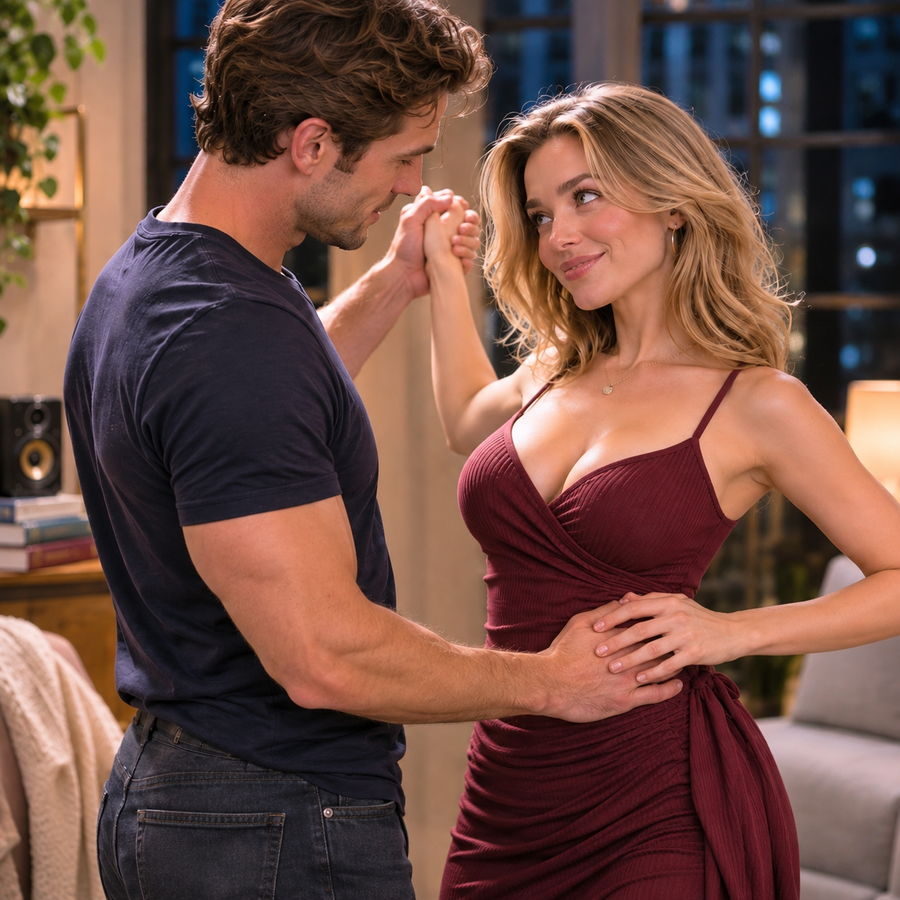
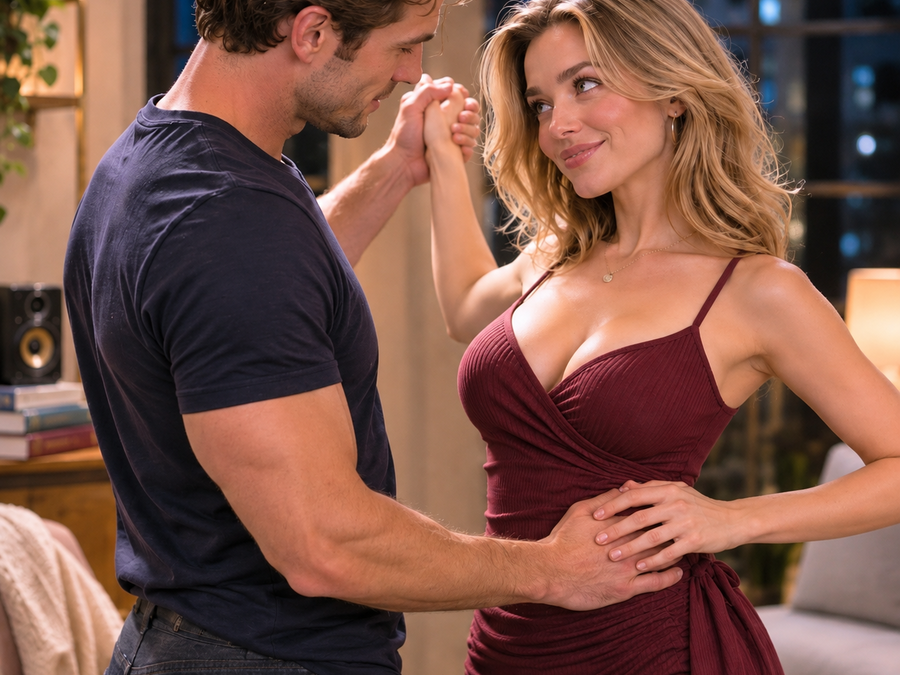
I had one hand on Lucille Fontaine’s shoulder, the other holding her fingers out at a respectful angle and about nine inches of her living room air between her body and mine when she looked down at the gap as if it were a defect she intended to write up.
Dominic, this is a handshake with extra steps, she said. She took my right wrist, slid my hand down off her shoulder and past her ribs and settled it at the curve of her waist, pressing my fingers flat under hers for exactly one second.
It goes lower than that, she said, and the corner of her mouth did something that had nothing to do with instruction. My name is Dominic Ivers.
I inspect buildings for the city of Columbus and I have spent most of my career telling people where things are not up to code.
Standing in my neighbor’s living room with my palm warming against her sweater, I could not find a single thing wrong.
My ears went first and the back of my neck followed and I managed to ask whether that was the technical answer or the other kind. Technically both, Lucille said, so pick whichever one you can handle and keep your elbow up.
She smelled like orange peel and laundry soap, which I noticed against my will, and I decided a man holding a woman at the waist should at least pretend to be thinking about footwork. 20 minutes earlier she had knocked on my door in wool socks, holding her laptop open against her hip like a tray.
Lucille lived directly across the hall from me, apartment 3B to my 3A, and in the year since she moved in, our longest conversations had happened in that corridor, mostly about the elevator that never worked and the package thief on the second floor. I had never been past her welcome mat. She told me her younger sister Margot was getting married in two weeks, that the wedding party had a choreographed dance for the reception, and that the groomsman assigned to her had just accepted a job in Denver and could not
back before the morning of the wedding.
She needed someone who could learn 45 seconds of waltz, turns, and a change of direction near the end in 14 days, and she had run out of people she trusted to say yes. I told her I had two left feet, which was accurate, since the only wedding dance of my adult life had been spent holding a plate of cake by the wall. She said two left feet she could work with and two absent feet she could not.
And I agreed faster than a man who inspects load-bearing walls should ever agree to anything. Her apartment looked like a place where someone lived on purpose, with the rug pushed against the wall, a resistance band hanging from a doorknob, and a speaker balanced on a stack of anatomy textbooks.
Lucille was a physical therapist, which meant she gave instructions about the human body the way other people read a grocery list without a flicker of embarrassment. She told me my knees were locked, my shoulders were up around my ears, and I was standing as if I expected the floor to file a complaint. The basic step was a box, she explained, three counts to a side, with me leading forward while she mirrored me back.
I started on the wrong foot, rushed the second count, and put my full weight on her toes before I had finished apologizing. She winced, laughed, and said, Wait for the three, Dominic.
You keep arriving early and nobody is giving out awards for it. We ran the box until I stopped staring at my shoes, which took about 15 minutes and one near collision with a floor lamp. Every time I rushed, she counted the missing beat out loud, low and patient, and every time I laughed at myself, her shoulders loosened a little under my hand.
I am a man who likes to get things right, and being bad at something in front of her turned out to be oddly easy. What I did notice, because noticing is the job, was what happened whenever a pass ended. I stepped back out of habit, the way you step away from a finished inspection, and Lucille stayed exactly where she was, her fingers resting on my arm, until I realized I was the one who had left.
She did it again on the next pass and the one after that, and each time she looked at me with a perfectly level expression. On the fourth pass I stopped and asked her as plainly as I could manage whether the hand business earlier was part of the dance or part of something else, because I would rather ask than guess wrong.
Lucille tilted her head and I watched her decide how honest to be. Ask me again when you can get through a full box without looking at your feet, she said.
That’s the only deal I’m offering, and it comes with a sticky note.
She peeled one from the pad on her bookshelf, wrote the schedule in small, neat capitals, 7 o’clock every night except Sunday, and pressed it flat against the center of my chest with two fingers.
The note would have stayed there on its own, but her fingers stayed a moment longer than the adhesive needed. At the door she told me not to practice alone, since I would only learn my mistakes more efficiently.
I said that in my line of work I never did anything unsupervised, and she laughed harder than the joke deserved. In the hallway we ended the way we always ended, with one of us saying good night and the other saying something about the elevator, except that tonight neither of us could find the usual place to stop. Her door closed and the latch clicked, and I stood on my side of the corridor with my right hand still curled around the shape of her waist, as if it had been issued to me on loan.
Inside my apartment I peeled the note off my shirt and read the schedule twice, as though it might have changed.
I knew exactly where the dance wanted my hand, and I had learned it in 20 minutes, but I had no idea whether Lucille Fontaine wanted a better dance partner or a closer neighbor, and the note on my counter said 7 o’clock
tomorrow.
I knocked on 3B at 7 o’clock sharp the next evening, and for five nights after that, with her sticky note stuck to my refrigerator like a permit I was afraid to let expire.
Lucille opened the door each time in her wool socks, the speaker already warm, and the rug already pushed against the wall. We built the 45 seconds in pieces, the box first, then the turn that sent her under my arm, then the change of direction near the end where the whole wedding party would swing the opposite way at once. Whenever I rushed a count, she said the missing number under her breath without looking up, and I began to hear it in my head at the grocery store and in the stairwells I was supposed to be inspecting.
By the third night I could finish a full box with my eyes on her face instead of my shoes, so I held her to her own deal and asked again in the middle of a turn whether her corrections were about my feet or about something she was avoiding saying. Lucille adjusted my elbow by a quarter inch and told me it was about my elbow, which was true, and answered nothing. By the end of that first week I had stopped needing most of her corrections, which created a problem I had not planned for because she kept making them anyway.
She would press my shoulder down an inch it did not need to go, or rotate my wrist to a position it already occupied, and she did it with the same clinical face she wore for everything else. I tracked it the way I track hairline cracks in a foundation, noting where it happened, how often, and whether it was getting worse.
It happened mostly at the ends of passes when the music had nothing left to count, and each night it happened a little closer to my collar, until one evening she checked my posture with her whole palm flat against my sternum and kept it there while she thought about something else. I was learning her too.
I had started leaning into the turn half a second before her weight shifted, and she noticed and said, Look at you, listening. In a tone I decided to treat as praise.
On the sixth night while she retied her hair, I told her I had an idea and that it was not a correction. Practicing every evening meant the only Lucille I ever saw was the one holding a clipboard in her head. And I wanted to know what she was like when nobody was counting.
I suggested dinner at the Ethiopian place on High Street before practice, 6 o’clock, my treat.
She looked at me over her raised elbow with the hair tie in her teeth, took it out and asked, Is this a scheduling improvement or a date? I told her it could be whichever she could handle, and she narrowed her eyes at hearing her own line come back to her and then laughed in spite of herself.
6:15, she said, because I’m not leaving a clinic early for a man who still steps on me during the pivot.
It was a yes, and I could not tell what exactly she had said yes to. The restaurant was a 10-minute walk from our building, and Lucille tore her in Gera with quick, efficient motions like she was demonstrating a stretch for a patient. She told me about Margot, who at 9 had staged a full funeral for a goldfish and had gone on to build a life out of deciding things loudly and being right more often than anyone found fair.
I told her about the stairwell I had condemned that week and the landlord who took it personally as if I had insulted his mother. She listened with her chin in her hand, the way people listen when they actually want the answer. And somewhere between the second round of bread and the coffee, I understood that nothing needed counting for this to go well.
Without the music, the talk was easier and more exposed at the same time. When I asked what she did on Sundays since her schedule skipped them, she said laundry and meal prep, picked at the edge of the last piece of bread and came right up to the edge of saying something else before swerving into a story about the dryer in our basement.
It struck me that a woman who could tell me to come over, wear socks, and keep my elbow up without blinking could not ask me for a single unclaimed Sunday. Back in her living room that night, I did something I had not planned to do.
When she pressed play and turned to face me, I stepped in on my own and took the hold without waiting for a word. My right hand settled at her waist where it belonged and my left holding hers at the height she preferred. I left no gap at all between us and my elbow was up before she could mention it.
Lucille looked down at the place where 9 in of air had once been, looked up at me and said nothing, which was the first time in a week she had passed up a correction. The music started and we ran the whole 45 seconds, the box and the turn and the long middle where I used to drift.
And when we reached the change of direction, I stopped thinking about my feet entirely. I let go of her hand on seven, sent her out on the spin and drew her back on eight into the closed hold facing the opposite wall in time with the beat and without a single step landing on her toes.
The last chord faded and the speaker went quiet and neither of us moved. She was breathing a little harder than the dance should have required and her hand had slid from my shoulder to the back of my neck at some point during the spin. That was the pivot, she said.
And I said I knew. And she said I had not looked at my feet. I told her I had been busy.
Lucille laughed softly, close enough that I felt it against my collarbone and she stayed right where she was for what I counted as 11 seconds, long after any lesson could have explained it. When she finally stepped back, she did it slowly and her fingers left my sleeve last.
She walked to the bookshelf, peeled a fresh note off the pad and wrote tomorrow’s date and time in her small neat capitals.
The pen stayed over the next line for a while without writing anything and I understood that the schedule had run out of things to teach me before it had run out of days. I could do the dance now and so could she. So whatever brought me back to her door from here on would have to be a reason that belonged to one of us.
By the ninth night I could do the whole dance in my sleep, and I know that for a fact because I woke at three in the morning with one arm lifted around nobody. When I knocked at seven, Lucille opened the door already holding the remote for the speaker, and she ran the routine once without saying a word of correction. The box was clean, and the turn was clean, and the change of direction near the end landed on its count with both of us facing the far wall like we had been born that way.
I waited for her to tell me my wrist was off or my shoulders were creeping up, but she only looked at the speaker as if it had given her a diagnosis she did not like. Again, she said, and she pressed play before I could point out that there was nothing left to fix. We ran it a second time and a third, and somewhere in the long middle of the fourth, I understood that she had stopped watching my feet.
She was watching my face, and she was counting only out of habit because the numbers came out of her mouth a half second after my body had already found them. At the change of direction, I let go of her hand on seven, the way I had a hundred times by then, and Lucille did not go.
She kept her fingers closed around mine through eight, right through the place where she should have spun out and come back, and the music carried on past us with nobody following it. For the first time all week, I did not know the next count. Everything I had rehearsed said to send her toward the opposite wall, while everything in front of me said she had left that beat empty on purpose to see which one I would obey.
I stayed with her, stepping in instead of out, and my free hand returned to her waist while the speaker played its last bars to a rug and two people standing very still. The song ended, and the room went quiet enough that I could hear the refrigerator humming in her kitchen.
Her face was tilted up, close enough that I could see the small freckle beside her left eyebrow, and I knew exactly what came next if this were dance. It was not, and I did not kiss her, though I wanted to with the kind of clarity I usually save for load calculations.
She had spent nine nights moving my hand wherever she liked, and I was not willing to treat any of it as an answer she had never given out loud.
I’m not counting anymore, I said, and my voice came out lower than I expected.
So, I’m going to ask, and you can tell me it’s none of my business.
What do you want from this, Lucille?
I don’t mean the dance.
I watched her open her mouth, and I watched the joke load behind her eyes. I want you to keep your frame, she said, and stop being so polite with your hands. She heard it as it left her, and a flush climbed up from her collar, but she did not look away.
I kept my hands exactly where they were, neither tightening nor retreating, and I let the silence go on long enough that she could have filled it with anything. Then I told her the simplest true thing I had.
I’d like to come over when we’re not practicing, I said, on a Sunday or a Tuesday with nothing scheduled, or just to sit on your couch and be bad at a conversation instead of a waltz.
I’m not asking for a step.
I’m asking for the knock.
I suppose I could clear a chair for you, Lucille said, and I recognized it for what it was, a kind of cover she had been using on me for a month. I did not answer the joke, and I did not need to because she heard how small it sounded in the quiet.
She exhaled through her nose, shook her head at herself, and slid her hand up from my shoulder to rest flat against my chest, the way she had the night she checked my posture. That came out as furniture, she said.
I mean, I want that, Dominic.
I’ve wanted it since February, when the elevator broke and you carried my groceries up four flights and wouldn’t come in for a glass of water because you didn’t want to presume.
I had forgotten the groceries completely, which told me how little I had known about what I was being forgiven for.
She said she had stood on her side of the door that night, listening to my footsteps cross the hall and had decided to wait for a reason, and then her sister’s groomsman had accepted a job in Denver.
We were still standing in the middle of the rug, which struck both of us as funny at the same moment, and the laughing let us finally say the practical part. Lucille told me her aunt Renata had been sending her photographs of venues with the caption just in case, and that if the family saw us hold the final pose, the engagement would be announced before the cake was cut.
I said that on Saturday I would be her partner for 45 seconds and that I was not auditioning for anything.
She agreed that nobody would get a show and that whatever this was, it was not for the benefit of her relatives or her sister’s photographer.
I did not ask her to decide what it was, not in the same breath as everything she had just told me, and she noticed that I didn’t.
You can take your hand off my waist now, she said, and when I started to, she added that she had not said I had to. Then she looked down and informed me I was standing on her foot, which I was. On Sunday, the one day her schedule skipped, I knocked at 10:00 with two coffees from the place on High Street and no sticky note in my pocket.
Lucille opened the door in her wool socks, saw the cups, and looked past me at the empty hallway as though checking for a catch. She had a laundry basket on her hip and I carried it down to the basement for her, where the dryer she had once used to dodge an honest answer ate three of my quarters and gave back nothing. We sat on the folding table beside the machines and compared sibling horror stories, mine involving a brother who still owed me for a transmission.
At some point she bumped her shoulder against mine and left it there, and neither of us pretended it was a posture check. Climbing the stairs afterward, she took my with no count and no hold, only the plain fact of fingers. And we reached the third floor landing still joined.
Either of us could have let go there, and the fact that letting go remained possible was what made it mean something that we didn’t.
Over the next two evenings, we practiced only as much as the dance deserved, which was twice through, and then the couch, where she put her feet in my lap and told me which of the people in her life were allowed to be wrong about her. It was warmer than it had ever been in that apartment and harder to disguise, and I caught myself doing the arithmetic anyway.
A paper calendar hung from a magnet on her refrigerator, and on Tuesday night I watched her cross off the square without looking at it. Thursday was circled in red marker with the words final run in her small, neat capitals, and Saturday carried a drawing of a tiny wedding cake with a smudged candle on top. Past Saturday, there was nothing, only the white squares of an ordinary month.
I understood that once Thursday had been crossed off, the wedding would be the last thing on the calendar that gave me a reason to stand in her living room, and that I had no idea what either of us would do with the days after it. On Thursday night, Lucille opened her door wearing the heels she planned to wear on Saturday, and I had polished my one pair of dress shoes for the occasion.
Neither of us mentioned the shoes, though I noticed that the red marker on her refrigerator calendar had gone over the words final run a second time. She pushed the rug to the wall, set the speaker on its stack of anatomy textbooks, and said we would run the dance twice, all the way through, as if the wedding were already happening in her living room. The first pass was clean enough that I forgot to be nervous, and the second was better.
We came out of the long middle together, swung the opposite way at the change of direction without so much as a stutter, and landed the pose with her hand curled at my shoulder and mine at her waist. She stayed in the pose for a few seconds and studied me with her professional eyes, hunting for a flaw in my posture, my timing, or the angle of my wrist. When she could not find one, she let out a long breath through her nose, and I told her what neither of us had wanted to say all week.
We’re ready, Lucille.
I can’t think of another thing you could fix.
Nobody’s ever ready, she said, but she was already reaching for the remote.
Her thumb hovered over the button, and I watched her decide whether to run it a third time on the grounds that no one had told her not to. She pressed the other button instead, the one that shut the speaker off, and the apartment went quiet, except for the refrigerator humming in the kitchen.
I let go of her hand and stepped back. One clear step with no count attached, because I wanted her to see me leave the dance on purpose. She looked at the space I had made, and I could tell she understood that I had made it for her to answer into.
A year of hallway conversations had taught me to say good night at about this point, but I had a question that did not belong to the choreography, so I stayed where I was and asked it. I told her the dance had been the best excuse I had ever been handed, and that I was grateful for every night of it.
But the excuse was finished.
I’d like to take you out after the wedding, I said.
Not as a way of extending the favor, and not because we’re good at standing near each other.
I ‘m asking for myself, and I’d like you to pick the night, whichever one you want, or none of them if that’s the real answer.
I had a place in mind, a restaurant on the river with a patio and a band I had heard through the wall once, but I did not offer it as a condition. I wanted the invitation to stay small enough for her to turn down. Lucille crossed her arms, and the eyes that had spent two weeks measuring my elbow went straight to my shoulders.
You’re letting your shoulders creep up again, she said.
So before you do anything else, you need to drop them and let me. Her hand had already started toward my collar, and I watched it stop halfway there, as if it had run into a closed door.
She looked at her own fingers, then at me, and laughed once, a short and rueful sound that seemed to surprise her.
“That was a correction,” she said, “and your shoulders are perfectly fine.”
I’m a coward with a clipboard.
She lowered the hand and then raised it again, deliberately this time, and set it flat against my chest without a single instruction attached.
“Yes,” she said.
“I’d like that very much.
And I’m saying it in plain words because you’re the only man I know who would wait for them.
I want to see you when neither of us has a place to stand or any steps to remember.”
I had prepared for a joke about the river or a scheduling counter offer, and for a moment I did not trust that she had actually answered. The warmth that moved through me was nothing like the glow of getting a dance step right, and it took me a second to find a response that was not just an enormous grin.
I told her Friday was open since I had been planning to spend it ironing a shirt, but that Saturday and Sunday and every evening after belonged to her to assign.
“Sunday,” Lucille said.
“Sunday because I’d rather not be hung over from dancing in champagne while you’re deciding what to order.”
She said it quickly as though the answer had been waiting for a door, and I understood that she had thought about the day before I asked. We sat on her couch with her feet in my lap and settled the wedding the way we had settled most things lately by talking until the strange part sounded practical.
Her aunt Renata would be at the head table with a cousin in tow who was single and a photographer on retainer, and Lucille said that any hint of us as a couple would turn the evening into a campaign. I said I would be her dance partner for 45 seconds and that I would be pleased to be introduced as her neighbor for the rest of the night. My neighbor Dominic, she tried out loud and tilted her head at how it sounded.
It’s accurate, and it’s also the least interesting thing about you, which is going to make them crazy.
What the two of us might become, she said, was our business first, and nobody owed her sister’s guests an announcement before we ourselves had finished deciding.
I agreed that a wedding was Margot’s day and that I had no intention of borrowing it.
Around 9 I stood up to leave, and I realized it was the first night all month that I had no reason to say when I would see her next. Lucille walked me to the door in her wool socks, having kicked the heels across the floor, and neither of us reached for the usual line about tomorrow. The sticky note she wrote on the first night was still on my refrigerator across the hall, and I thought about mentioning it, then decided it was better as a private joke.
She leaned against the frame with the hallway light in her hair, and I said good night, and she said it back with no remark about the elevator and no mention of account. When I crossed to 3A and turned my key, she was still watching me from her doorway, and she lifted two fingers in a small wave that made me feel like I had solved something. The latch of 3B clicked on her side a second after mine, and I stood in my dark kitchen without turning on the lights.
For two weeks every knock on her door had come with a justification, a time written in her tidy capitals and a step to learn. Now I had a Sunday with no instruction attached to it, and a Saturday that would put us in a hotel ballroom in front of 200 relatives, a photographer, and the one aunt who sized people up by their posture. The dance would be easy because we had made it so, and the music would carry us through every count.
What happened when it ended, with all of those eyes still on us, was the one part of the evening neither of us had rehearsed. The ballroom of the downtown hotel held 200 guests, a string of warm bulbs across the ceiling and a photographer who moved through the crowd like a man hunting for evidence. When the DJ called the wedding party to the floor, I walked out in my polished dress shoes with Lucille on my arm, and I realized I had gone formal on her.
My hand rested at her shoulder at a respectful angle. My other hand held her fingers out at a polite height, and a clean 9 in of air had come back between us. Lucille noticed it at once, the way she noticed everything about a body, and I saw her eyes drop to the gap and rise again.
She had every right to move my hand, and 200 relatives would have taken it for part of the dance. She only lifted one eyebrow a 16th of an inch and let me stand there in my own caution, which was more mercy than I deserved.
The music started and the whole line of couples moved together, six pairs of bridesmaids and groomsmen in a ballroom built for 45 seconds of waltz. Margot was at the front with her new husband, laughing so hard she nearly lost her count.
Behind them, our box came out clean, then the turn that sent Lucille under my arm, and by the long middle I had stopped worrying about the cameras. I could feel the distance closing on its own, a little each bar, because my body remembered what the last two weeks had taught it. Her hand slid up to my shoulder and my palm settled at her waist, and neither of us had to correct the other.
At the change of direction, a cousin’s partner, two couples down, lost her footing and the line bunched, which sent the swing toward the opposite wall a beat too early.
Lucille squeezed my fingers on six, a signal we had never rehearsed, and I followed her into the early turn instead of the written one. She did not look back to check on me, and I understood she was trusting me to finish the sequence. So I did.
We landed the closing pose a half second ahead of the music, with her hand curled at my shoulder and mine low at her waist, her breath warm against my collar.
The room applauded and somebody whistled, probably the groom’s brother, and Aunt Renata rose halfway from the head table to assess our posture with a face of grave approval.
In the choreography, the couples were supposed to break apart on the final chord and spread out to the edges of the floor, and that was exactly what we did.
Lucille let go of my hand first, and the stretch of floor between us widened while her sister’s friends moved in to hug the bridal party.
I stood at the edge of the parquet, a man in rented-looking cufflinks who had just fulfilled his obligation in front of everybody she loved. The dance was done, and so was the favor.
And every reason I had ever been handed to stand next to Lucille Fontaine had just gone quiet. The DJ let the applause fade, and a slow song came on, something with a brushed drum and a trumpet far back in the mix.
Nobody had assigned this one to anyone, and the floor was filling with couples who had never learned a step. I crossed the room to where Lucille stood by a table of centerpieces, her heels in one hand because she had already given up on them, and I stopped at a respectful distance.
This time, the distance was a choice, not a habit, and I wanted her to see me make it.
There’s no count for this one, I said.
No assigned partner, no pose, and nobody to disappoint if you say no. Will you dance with me, Lucille? I held out my hand, palm up, and left it there where she could take it or leave it.
She looked at my hand and then at the dance floor, and then at the head table, where Aunt Renata had stopped mid-sentence to watch us. For the span of a breath, I saw the cost of it cross her face, the cousin and the photographer, the The she had warned me about on her couch.
Then she set the heels down on a chair and put her fingers in mine, in full view of 200 people and the one aunt who sized up everyone by their posture. Yes, she said, loud enough for the table behind us to hear.
Obviously, yes. Where else would I be?
We walked out together past her sister, who mouthed something I could not read and then gave me a thumbs up with both hands. On the floor, I took her hand at the height she liked and settled my other hand at her waist, closing the gap without a word, and my elbow was up by instinct. We swayed more than we danced because the song wanted nothing more than that.
Her cheek came to rest near my jaw and I could smell the orange peel under the hotel perfume.
That’s the correct frame, she murmured close to my ear, but it still goes lower than that.
She had said it as a joke the first night and as a challenge in a hundred small corrections since, and now it landed somewhere warmer than either. I asked whether she was giving me an instruction or an invitation because I had learned to ask. Ask me properly, Lucille said, and I did.
And when she nodded, my hand moved to the small of her back and stayed there. Nobody in the room needed an explanation and I could not have given one if they had.
We left a little before midnight after Margot had hugged us both twice and told Lucille that she looked unbearably happy, which Lucille denied. In the cab, she took off her earrings and put them in my coat pocket without comment and the driver kept his eyes on the road with great discipline.
The elevator in our building was broken as it had been since the day she moved in, so we climbed three flights with her shoes dangling from my fingers and her arm through mine. On the third floor landing, she stopped in front of 3B and did not reach for her key.
I asked what time on Sunday she wanted me to knock and she said six because the patio on the river would have the evening light, and she had apparently looked it up. I told her six was perfect, that I had a shirt already ironed and that I would bring a sweater in case the river was cold.
I’ll come over, she said, which was not what I had expected her to say.
She followed me across the corridor toward the door she had never once crossed in a year of hallway talk, and I turned my key with hands that were not entirely steady.
Inside my apartment looked the way a bachelor’s place looks to a physical therapist, a little bare and a little ergonomically hopeless.
She went straight to the refrigerator where the sticky note from the first night still hung beside a takeout menu, her tidy capitals faded at the corners. Lucille peeled it off, flipped it over, and wrote on the back with a pen from my counter, and I watched the pen move across the paper with no clipboard in her face.
She stuck it to the center of my shirt with two fingers, exactly where she had pressed the first one, and her fingers stayed longer than the adhesive needed. The note said Sunday six, no steps to learn.
And underneath, smaller, knock first anyway. Placing a hand where a dance tells you to put it takes nothing but practice, and I was good at it by the end.
Asking someone to stay close when the music is off and no one has told you to is a different skill, and I only learned it because a woman once moved my hand and said it goes lower than that. I think about how often I almost stayed polite and called it respect.
I am glad I asked and gladder that she answered in front of everyone who mattered to her.
THE END.