“You’re Not Tired, Sir—You’ve Been Drugged,” the Maid’s Little Girl Whispered Calmly—Then the Billionaire CEO Realized Someone Inside His Own Home Wanted Him Dead
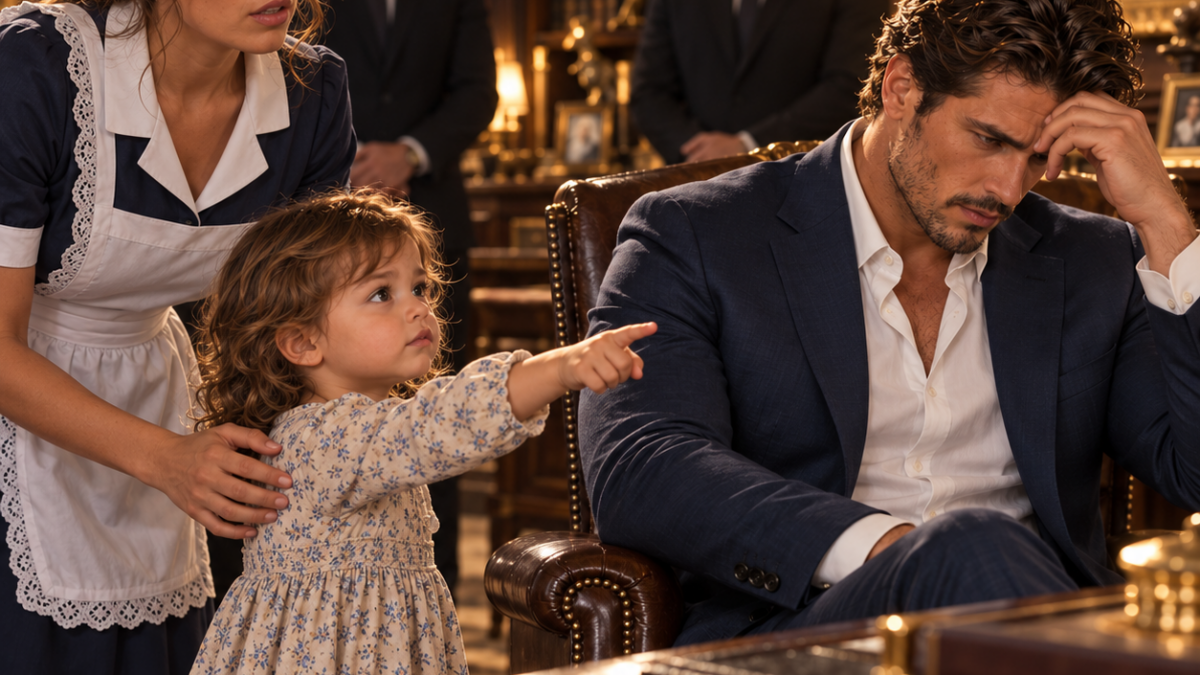
“You’re Not Tired, Sir—You’ve Been Drugged,” the Maid’s Little Girl Whispered Calmly—Then the Billionaire CEO Realized Someone Inside His Own Home Wanted Him Dead

PART 1
Don’t drink that, sir.
Sophia Bellini’s small hand closed around Alessandro Moretti’s sleeve just as the black crystal glass reached his mouth.
No one moved. The lawyer seated across from him stopped breathing mid-sentence.
Aleandro<unk’s assistant froze with a folder halfopen in his hands.
Near the window, Victoria Romano turned from the afternoon light, her expression registering surprise, but nothing more. Alisandre looked first at the child gripping his sleeve, then at the glass.
In his house, people did not touch him without permission. They certainly did not interrupt him in front of his inner circle.
Sophia seemed to remember that a second too late. Her fingers released the expensive fabric immediately, but she did not step away. She was 9 years old, small even for her age, wearing the navy cardigan her mother made her put on whenever she helped carry linens through the mansion.
Her dark hair was clipped behind one ear with a faded blue barret. She looked terrified now, but not of Aleandro. Her eyes stayed fixed on the drink.
You’re not tired, sir,” she whispered.
“Someone’s been making you tired.”
The room became so quiet that Alisandro could hear the faint hum of the air conditioner behind the bookcase. His gaze shifted to Victoria.
She had been part of his life long enough to recognize the danger in silence. But she did not rush to fill it.
That was one of the things he trusted about her. She knew when speaking too quickly made innocent people look guilty.
Sophia, Elena Bellini said from the doorway, her face draining of color. She had been carrying folded towels when she saw where her daughter had gone.
Come here right now. Sophia did not move.
Aleandro lowered the glass but kept it in his hand. Why did you say that?
Elena stepped into the room.
Mr.Moretti, I’m so sorry.
She doesn’t understand what she’s saying.
Victoria raised a hand gently.
Elena, it’s all right.
She’s frightened.
Let her explain.
The kindness in Victoria’s voice made Sophia look at her, confused, perhaps because she had expected to be removed immediately.
Alessandro noticed that, too. Tell me, he said. Sophia swallowed.
It happens after that drink. One of the attorneys shifted in his chair. Aleandro<unks eyes hardened.
What happens? You change.
A faint crease appeared between Victoria’s brows.
Change how, sweetheart? Sophia looked back at Aleandro.
You forget things you don’t usually forget.
You get angry at things that didn’t make you angry before.
Sometimes you ask the same question twice.
Aleandro<unk’s grip tightened slightly around the glass.
And you know what I usually forget? No, sir.
I know what you usually remember. Something in the answer landed differently than an accusation would have.
Aleandro set the glass down. He had built his life around people who claimed certainty. Men came into his office every week, certain they knew who was loyal, certain they knew where money had gone, certain they knew which threat mattered.
Children rarely had the luxury of certainty. They noticed what happened and hoped an adult would care.
“How long have you been watching me?”
he asked.
Sophia’s cheeks colored.
I wasn’t watching you like spying.
I help mom in the hall after school. Your afternoon meetings are usually at the same time. Usually, Aleandro repeated 3:10 or 3:15.
Unless your car comes back late. His assistant looked up sharply.
The attorneys exchanged a glance. Aleandro did not. And the drink?
Usually before 3:30. Victoria stepped closer, but her tone remained calm.
Allesandro. Children are very good at patterns, but patterns can mean many things.
You’ve been exhausted for months.
Everyone here knows that. I know, Sophia said quickly.
That’s why I wrote it down instead of guessing.
She reached into the pocket of her cardigan and pulled out a small spiral notebook, the kind sold in packs for school children. Elena closed her eyes for half a second as though she had just realized exactly how far this had gone. Allesandro held out his hand.
Sophia gave him the notebook.
The first pages contained ordinary things, a spelling list, a reminder about a library book, a crude sketch of what looked like one of the mansion’s garden statues.
Then the entries changed. dates, times, short observations written in uneven pencil.
Monday, Mr.Moretti asked Mr.Russo twice if the shipment had arrived. Wednesday, he dropped his pen after the black glass and stared at it before picking it up.
Friday, he yelled at the man with the gray tie, then asked mom later why the man had left early. Aleandro turned another page.
Tuesday, after the afternoon drink, Mr.Moretti asked who put his father’s watch on his wrist.
His thumb stopped against the paper. The watch was there now, beneath the cuff of his shirt, gold, heavy, old-fashioned. His father had worn it until the day he died.
Alessandro had taken it from the bedside table at the hospital and put it on his own wrist before leaving. He had worn it every day for almost two decades.
He remembered Tuesday, not the whole afternoon. That was the problem. He remembered standing beside the windows.
He remembered Victoria telling him to cancel dinner. He remembered feeling irritated because someone had moved papers on his desk.
And he remembered looking down at the watch and experiencing for one strange second the sensation that it belonged to somebody else. He had told himself he was tired.
Everyone had told him he was tired.
This doesn’t prove someone put anything in your drink, Victoria said.
She did not sound defensive.
If anything, she sounded protective, but it does prove she’s been worried about you longer than any of us realized.
She turned to Sophia. You should have told your mother.
I did. Elena looked at her daughter.
She said Mr.Moretti didn’t seem like himself.
I told her adults get tired. There was shame in her voice now.
And Alessandro disliked it. She had no reason to be ashamed for choosing the most ordinary explanation. Ordinary explanations were how life worked until suddenly they were not.
He looked again at Sophia’s notes.
Why today? He asked.
Why stop me today instead of yesterday? Sophia glanced at the black glass. because it was wrong.
What was wrong? She pointed but did not touch it.
The scratch. Aleandro looked at the gold rim. A hairline mark was visible near one side.
The result of the glass being dropped years earlier. He had never noticed it.
Mom polishes that one. Sophia said.
The scratch usually faces your chair when it’s put down because the tray comes from that side.
Today it was facing the window. One of the attorneys exhaled through his nose. Not quite a laugh, more like disbelief.
Aleandro turned his attention to him until the man looked away.
“Anything else?”
Aleandro asked. Sophia hesitated. The water bottle was already open.
His assistant frowned.
“They’re open before service sometimes.”
“I know,” Sophia said.
“But this one was wet under the cap.”
Alisandre looked at the bottle beside the glass. A small ring of moisture darkened the wooden coaster beneath it. Nothing about that proved anything either.
That was what made the moment unsettling. There was no dramatic piece of evidence, no powder floating in the drink, no stranger running from the room, only a child listing ordinary details until the ordinary began to feel unfamiliar.
3 hours earlier, the Moretti mansion had been running exactly the way Aleandro preferred, quietly, efficiently, predictably. Predictability had kept him alive longer than Charm ever could. At 48, he trusted systems more than promises.
The front gates opened only after two checks. Visitors were logged twice.
Staff moved through restricted floors with individual cards. His office had its own access record and cameras covering both approaches.
People called that paranoia when they lived in houses where betrayal caused embarrassment instead of blood. Alessandro called it maintenance. Yet over the previous two months, he had begun encountering small failures in the one system he could not replace himself.
A name disappeared halfway through a sentence. A meeting he was certain had been moved turned out never to have changed. He once accused his assistant of withholding a document only to find it in the locked drawer where Aleandro himself kept confidential papers.
The moments never lasted long. That almost made them worse. If he had collapsed, someone would have called a hospital.
If he had forgotten entire days, even he would have been forced to admit something was wrong. Instead, he suffered little fractures that healed before anyone could examine them. His private physician, Dr.Alio Rinaldi, had performed routine tests and found nothing alarming.
stress, he said. Sleep deprivation, too much caffeine, too much responsibility.
Victoria had agreed, though she never pushed Alessandro hard enough to provoke him. She simply began arranging fewer evening meetings and having meals brought upstairs when he worked late.
Sometimes she replaced his whiskey with water without mentioning it.
Once after he forgot the same appointment twice, she sat across from him in his bedroom and said, “You are allowed to be human, Alejandro.
” He had nearly laughed.
In his experience, powerful men were allowed to be human only in private and usually for less than 5 minutes. Still, he trusted her.
Victoria had known him before the mansion, before the tailored suits, before men lowered their voices when he entered restaurants. She knew where his anger came from and which memories not to touch.
If someone had told him that morning that a 9-year-old housekeeper’s daughter would make him question the people closest to him before dinner, he would have dismissed the idea without finishing his coffee.
Sophia had been easier to overlook. She came to the mansion after school because Elena could not always arrange child care. She sat in the kitchen doing homework, occasionally helping fold towels or carry light supplies.
Allesandro knew her name because she once corrected him when he called her Sophia instead of Sophia. She had done it politely without smiling, and he remembered thinking she possessed the strange courage of children who had not yet learned which adults they were supposed to fear. Over time, Sophia learned the mansion the way children learn any place where they spend enough afternoons.
She knew the west stair squeaked on the fourth step. She knew the old service bell near the second floor made two dull chimes when the side door opened.
She knew the chef hummed when nervous.
She knew Aleandro<unk’s assistant walked faster when lawyers were waiting.
She knew her mother used lavender soap before taking clean glasses upstairs. And she knew that shortly after Alisandro drank from the black crystal glass in the afternoon, something often changed. At first, she noticed because he became louder.
Then because he became quieter. One day, he stood outside his own office holding a key in his hand and stared at the lock as though he had forgotten why he was there.
Another afternoon, he asked Elena whether his father was coming for dinner. Elena assumed he meant one of the older family advisers and answered carefully. Allesandro corrected himself a few seconds later and walked away.
Sophia knew his father was dead because she had seen the portrait with the dates underneath. She wrote the incident down, not because she thought someone was poisoning him. That idea came later.
She wrote because things that changed bothered her and writing them down stopped her from wondering whether she had imagined them. Now back in the office, Aleandro closed the notebook and looked around the room. Nothing had changed physically.
His attorneys were still seated. Victoria was still near the windows.
Elena stood behind Sophia with both hands clenched around the folded towel she had forgotten she was carrying. The glass remained on the desk, black crystal catching a thin line of sunlight.
Yet the room no longer felt like the same room. Aleandro pressed the intercom.
Marco, his security chief answered immediately. Yes, sir. Come to my office.
Bring an evidence bag.
Don’t send anyone else.
Victoria looked at him.
You’re taking this seriously.
I take unexplained changes seriously. Good.
Her answer came without hesitation. Then test it properly. Not here.
Not through anyone who has handled your medical care. Use an outside laboratory. Aleandro studied her face.
There was concern there. Maybe fear, but fear for whom was impossible to read.
That was my intention. Victoria gave Sophia a small, reassuring smile.
You did the right thing, telling him what you saw. Sophia looked surprised.
Elena looked even more so. Aleandro noticed both reactions and stored them away without interpretation. Marco arrived carrying a sealed evidence kit.
Allesandre watched him photograph the glass, bottle, coaster, and the position of everything on the desk before touching any of it. He ordered the office locked after the items were removed and told everyone present that the matter was not to be discussed.
Then he gave Sophia back her notebook. Keep it with you.
Am I in trouble? She asked. No.
Is my mom? The question came faster.
Aleandro glanced at Elena. No one is in trouble because of what you told me. He meant it when he said it.
At that moment at least, Sophia nodded and followed her mother toward the door. Before leaving, she turned back.
“Sir, what?”
“If the test says there’s nothing in it, that doesn’t mean I lied.”
Aleandro held her gaze.
“No, it means the test says there’s nothing in it.”
Sophia seemed satisfied by the distinction. She left.
Victoria stayed long enough to tell Alessandro she would cancel his evening dinner if he wanted, then thought better of it when she saw his expression. Or perhaps I should stop trying to manage your schedule.
For the first time that afternoon, the corner of his mouth almost moved. Perhaps.
When she left, Allesandre waited until the door closed, then called Marco back. Access records. This room today start 2 hours before I arrived.
Marco returned several minutes later with a tablet.
There’s one entry that doesn’t make sense.
Aleandro took it. The office had been open 12 minutes before his arrival. The card belonged to a household employee.
For a second, the name meant nothing. Then Aleandro remembered the woman standing behind Sophia with towels pressed against her chest.
He read the line again. Elena Bellini. Access granted.
Allesandro looked toward the doorway through which mother and daughter had just disappeared. The first useful fact in the investigation did not point toward Victoria, the doctor, or an unknown enemy. It pointed toward the mother of the little girl who had stopped him from drinking.
Aleandro did not call Elena back into the office. He did not send security to the kitchen, and he did not tell Sophia that the first record they checked had placed her mother near the very glass she had warned him about. Instead, he stared at the access log until the letters stopped looking like a name and became what they actually were, a piece of data that could be true, false, incomplete, or deliberately misleading.
Years ago, he would have treated the record as certainty.
Someone’s card opened a restricted door.
Therefore, that person had opened it. experience had taught him that systems were only as honest as the people who understood how they worked.
“Where is Elena now?”
he asked. Marco checked his phone.
“Kitchen level.
She hasn’t left the property.”
“Don’t approach her.
” Marco looked surprised.
“Sir, you heard me.
I want her movements from 2:30 until 3:15.
Cameras, staff, witnesses, laundry logs, deliveries.”
Quietly, Marco hesitated. if she used her card.
A card used her name. That is all we know.
Allesandro handed the tablet back and Marco. Nobody asked Sophia anything without her mother present. The security chief nodded and left.
Allesandro remained alone for several minutes, looking at the empty place where the glass had been. Suspicion was easy. Evidence was harder.
He had watched men destroy families, partnerships, even themselves because they confused those two things. He was not going to make the same mistake simply because the person under suspicion worked in his house. When Victoria returned 20 minutes later, she found him reviewing the mansion staffing records.
“I thought everyone had been dismissed,” she said.
“They were.”
“Then why do you look like someone just handed you another problem?”
Alesandro turned the tablet toward him before remembering she could not read it from where she stood. He did not correct the movement.
Someone entered my office before I arrived.
Victoria’s face changed, but only with concentration.
Who?
Elena’s card.
The answer hit her more visibly than Sophia’s accusation had.
Elena.
That’s what the system says.
Victoria shook her head almost immediately.
That doesn’t make sense.
Why? Because she knows the rules. Because she has worked here for years.
Because if she wanted to put something in your drink, using her own access card would be an absurd way to do it. Allesandre leaned back. People do absurd things.
Yes, usually when they panic.
Elena doesn’t strike me as someone who panics.
You defended Sophia earlier.
Now you’re defending her mother.
I’m defending the idea that an access log is not a confession.
Victoria moved closer to the desk. You told Marco to test the glass independently.
Give Elena the same courtesy. Verify before you decide what the record means.
Alisandre watched her. If she was part of whatever was happening, she was making a dangerous choice by arguing for the person the evidence currently implicated. If she was innocent, her reaction was exactly what he would expect from someone thinking clearly.
That was the problem with reasonable behavior. It rarely revealed which side a person was on. I am verifying, he said.
Good. Victoria turned to leave, then stopped.
And Allesandro, what? Do not let Sophia see her mother questioned like a criminal, unless you have something stronger than a card number.
He said nothing. Victoria left without waiting for an answer.
Alisandre looked at the closed door and wondered whether the advice had been compassion, calculation, or both. The first contradiction appeared less than an hour later.
At 2:46, the exact minute Elena’s access credential opened the second floor office corridor.
Elena Bellini appeared on a camera outside the basement laundry room carrying a basket of pressed sheets. The image was grainy but unmistakable. Her face was visible.
Her uniform was visible. She entered the laundry room and did not come out for 9 minutes.
Two other employees independently remembered her there because a dryer had jammed and Elena helped remove a twisted sheet from the drum.
Marco placed the still image beside the access record on Aleandro<unk’s desk.
She couldn’t have been upstairs, he said.
Not unless she learned to be in two places at once. Who can duplicate these cards?
Aleandro asked. In theory, security administration.
In practice, they’re encrypted.
You can’t copy one with a cheap reader.
That wasn’t my question.
Marco’s jaw tightened.
Three people have administrative access. Me, my deputy, and the systems contractor.
Aleandro looked toward him. And old cards destroyed when replacements are issued. Always.
That’s the procedure.
Procedures are descriptions of what people are supposed to do. Allesandro tapped the log.
I’m interested in what happened.
Marco opened the credential history. Elena had reported a damaged card 4 months earlier after the plastic casing split near the chip.
A replacement had been issued the same afternoon. The database listed the first card as deactivated, but the disposal field was blank. No destruction date, no employee initials, no confirmation.
Marco stared at the missing entry longer than Aleandro did. That should be there.
Yet it isn’t.
I’ll find out who handled it.
Quietly, Allesandre looked again at the time stamp.
Someone had either cloned Elena’s credential or found an old card that should no longer have worked.
Both possibilities were bad. The second was worse because it meant the weakness had existed inside the mansion for months.
When Elena was finally brought in, it was not to an interrogation room, but to the smaller sitting room beside the kitchen, where Sophia was doing homework under the watch of one of Elena’s friends.
Aleandro came alone. Elena stood as soon as he entered.
Sir, sit. She remained standing until he did. Sophia watched both adults, pencil motionless above a worksheet.
Alessandro did not mention the access log immediately. Did you enter my office corridor this afternoon?
No, sir. Did you lend anyone your access card?
Never. Have you lost one? Elena frowned.
My old one broke months ago. Security replaced it.
Sophia looked up. The one with tape on it? Elena turned toward her.
Yes. You kept it in the drawer near the pantry before you gave it back.
Elena’s expression tightened.
For one day, then I returned it. Allesandre looked at Sophia.
Do you remember to whom? She shook her head. A man from security.
Not Mr.Marco. That narrowed little.
Several employees fit the description. Aleandro changed direction.
Sophia, yesterday you wrote that someone bringing water smelled different. Elena closed her eyes briefly.
Sophia, it’s all right.
Aleandro said. Tell me exactly what you noticed.
Sophia shifted in her chair. Mom smells like lavender after she washes the glasses.
The person upstairs smelled like roses. Elena stared at her. You never told me that.
I didn’t know it mattered.
Aleandro asked. Did you see the person? Not their face.
I was coming around the corner and they went into the office hall. Woman.
I think so. Because of the perfume. Because of the shoes.
What shoes? Heels?
Not very high.
Aleandro thought of Victoria’s heels crossing his office floor, then immediately rejected the leap.
Half the women who worked upstairs wore them. He looked at Elena who uses rose perfume in the house.
Elena considered the question. Several people. Mrs.Romano sometimes.
Clara in guest services. Marta used to but she changed brands because the chef complained.
Maybe others. Sophia added quietly.
It wasn’t Mrs.Romano’s normal perfume.
Alisandro looked at her. You know that? She hugs mom on holidays.
Elena gave her daughter a look that might have been embarrassment if the situation were different. Aleandro almost asked whether Sophia cataloged the smell of every adult she met but stopped himself. The observation was not proof.
It was not even necessarily useful. That made it safer. Was there anything else?
Sophia shook her head. Just the smell in the shoes.
Good. He stood.
Elena rose too. Mr.Moretti, am I suspected of something? Alisandro could have avoided the question.
Instead, he said, “Your access credential was used near my office.”
The blood left her face.
Sophia’s pencil dropped, but I wasn’t there.
I know. Elena stared at him. You know, we checked before we came to you.
The fear in her expression did not disappear. It changed shape. Then someone used my card.
Someone used your identity. Aleandro corrected.
Sophia looked from him to her mother. Because of me? No.
But if I hadn’t said anything, then I would still have a problem.
I simply wouldn’t know about it.
He looked at Elena. Until we understand how your old credential remained usable, neither of you discusses this with anyone.
Elena nodded. Sophia did not.
What if the person asks, “Then you know nothing.”
Sophia frowned. But I do know something.
Allesandro studied her for a moment, then practiced the most difficult skill in this house. What? Knowing something and not proving it to everybody, she seemed unconvinced, but Elena placed a hand gently over hers before she could answer.
By evening, the investigation had gained facts, but lost certainty. The rose perfume pointed nowhere specific.
Elena’s credential implicated a card rather than Elena.
The missing destruction record could indicate negligence or intentional theft.
Marco’s deputy remembered processing several damaged cards the week Elena’s was replaced, but could not recall hers individually.
The outside contractor insisted deactivated credentials should never have opened a secured door. Yet, a systems report revealed something Marco had not known. During a software migration 3 months earlier, a batch of old credential identifiers had temporarily been restored from backup.
Most were automatically blocked again. A handful had remained active until the next audit.
Elena’s original card was among them.
“So, someone didn’t need to hack anything,” Allesandro said.
Marco looked furious. They only needed the physical card, which was supposed to be destroyed. Yes.
And wasn’t apparently not.
Alessandro closed the report. This was the first meaningful shape the threat had taken.
Whoever had used Elena’s credential did not require extraordinary technical skill.
They required familiarity with the house, access to discarded security materials, and confidence that a domestic employees name on a log would either be ignored or blamed on her. It was clever precisely because it was ordinary. Later, when Aleandro passed the kitchen, he saw Sophia sitting alone with her notebook closed beside her homework.
“Why aren’t you writing?”
he asked. She looked at the cover.
“I thought maybe I shouldn’t anymore because of your mother’s card.”
“Because every time I notice something, somebody gets in trouble.”
Alisandro leaned against the doorway.
Your mother didn’t get in trouble.
She looked scared. He had no useful answer to that.
Elena had been scared. A person could be innocent and still understand how easily a system could decide otherwise.
Sophia picked at the edge of her eraser.
What if I’m wrong about the drink?
Then you’re wrong.
Would you be angry? No, really. I have people around me who are paid very well and are wrong all the time.
Sophia considered that. Do you tell them frequently?
For the first time since the office incident, she smiled. It lasted only a second.
Then footsteps approached and one of Aleandro<unk’s assistants appeared carrying a secure envelope.
The preliminary lab report came in. Aleandro took it upstairs before opening it. The analysis had been performed by a laboratory with no connection to Dr.Raldi or the Moretti household.
He read the first page once, then again more slowly. No unexpected sedatives, no common tranquilizers, no detectable concentration of the substances the lab had screened for. Nothing in the remaining liquid established that Alessandro had been drugged.
Marco stood across the desk waiting.
Victoria, summoned because she had been present when the glass was sealed, read the conclusion over Aleandro<unk’s shoulder.
She did not look relieved in a triumphant way. She simply exhaled.
That’s good, she said.
Aleandro did not answer. Downstairs, Sophia waited because Elena had told her the results were coming.
When Allesandro finally entered the kitchen, she searched his face before he spoke.
They didn’t find anything, he said.
Sophia looked at the floor. Oh, that does not mean you lied.
She looked up quickly, remembering his promise.
It means the test didn’t find anything.
So maybe I was wrong. Maybe. He refused to rescue her from the possibility.
That mattered, too. Sophia nodded slowly and closed the notebook with both hands.
Upstairs, the black crystal glass sat sealed inside an evidence locker, clean enough to make every suspicion look foolish. For the first time since Sophia had stopped his hand, Aleandro had something more dangerous than proof.
He had a reasonable explanation for almost everything. The clean laboratory report should have ended the matter.
That was what any reasonable person in Aleandro Moretti’s position was supposed to conclude.
A child had noticed changes in an exhausted man, connected them to a glass he used every afternoon, and frightened herself into believing the drink was responsible. The glass had been sealed. The remaining liquid had been analyzed by an independent laboratory.
Nothing unexpected had been found.
Elena’s old access credential had turned out to be part of a flawed security migration rather than proof that she had entered the office.
Even the rose perfume led nowhere. By breakfast the following morning, the mansion had almost returned to its normal rhythm. Staff crossed polished floors with trays and laundry baskets.
Security shifts changed at the gates. Phones rang inside administrative offices.
The machinery of Alessandro’s life kept moving, and normality began doing what normality did best, making yesterday’s fear look embarrassing.
Sophia sat in the kitchen with her notebook buried beneath a mathematics workbook. She had not written in it since hearing the test result. Elena did not tell her to stop, but she did not encourage her either.
Her daughter had been carrying a kind of responsibility no 9-year-old should have carried, and part of Elena clearly hoped a negative test would let Sophia put it down. Upstairs, Allesandro tried to do the same. He had three calls before noon, two contract reviews, and a meeting concerning the port expansion.
Halfway through the second call, he paused while looking at a familiar name on a page and could not remember why it mattered. The blankness lasted perhaps 3 seconds, four at most.
Then the memory returned. The man owned warehouses near the eastern docks. Aleandro continued speaking without allowing anyone on the call to hear what had happened.
Afterward, he remained at his desk with the receiver still in his hand. Stress, he thought.
Sleep deprivation, too much caffeine, too much responsibility.
Dr.Raldi’s explanations sounded more persuasive now that a laboratory had failed to find anything in the glass.
They also made Aleandro angry, though he was no longer certain whether the anger came from pride or fear. At 11:30, Victoria entered carrying coffee in a folder.
She had abandoned the habit of bringing him water without asking.
“I assume this is still permitted,” she said, holding up the coffee.
“Depends.
Did you personally interrogate the beans?”
Twice. They refused legal representation.
“It was the first joke either of them had made since Sophia interrupted the meeting, and for a moment, the tension in the room loosened.
Victoria placed the cup on the far side of the desk and sat down.
How do you feel?”
Like everyone keeps asking me how I feel.
That is usually what happens when someone thinks he may have been drugged and wasn’t.
Victoria watched him carefully.
We don’t know that.
Allesandre looked at her. The test was negative.
The test showed nothing unusual in that sample. That is not the same sentence.
He said nothing. Victoria rested one hand on the folder.
I don’t want you frightening yourself and I don’t want a child frightened either, but I also don’t want us becoming stupid because one test gave us permission to relax.
It was exactly the kind of thing Alessandro himself might have said. That bothered him more than reassurance would have.
What do you suggest? He asked.
You already had Dr.Raldi examine you. Have another physician review his findings independently.
If they agree you are exhausted, then perhaps we accept the boring answer.
And if they don’t, then we stopped calling it exhaustion.
Her logic gave Aleandro no obvious reason to distrust her. He almost wished it did. Suspicion was easier when people behaved badly.
That afternoon, Aleandro asked his attorney, Daniel Russo, to bring him every medical record generated during the previous 6 months.
Russo arrived carrying a secure digital archive and two paper folders from Dr.Raldi’s office.
“You’re reopening the medical question?”
he asked.
“I’m changing it.
” Allesandro set the laboratory report aside.
We keep asking what was in the glass? Russo waited.
Wrong question. Maybe. If nothing was in that glass, then what explains everything else?
They began with dates rather than diagnosis.
Alessandro’s calendar was one of the most carefully maintained documents in the house.
Meetings, calls, departures, arrivals, even private appointments were logged because people around him needed to know where he was without asking him every 10 minutes.
Dr.Rinaldi’s reports looked ordinary at first.
Blood pressure, complaints of poor sleep, irritability, short-term memory disruption, recommendations to reduce workload. On paper, the progression seemed almost embarrassingly straightforward. A powerful middle-aged man under chronic stress began showing signs of fatigue and cognitive strain.
Russo read two reports and leaned back. This is what he told you. Yes, and some of it happened.
Yes. Aleandro did not need to pretend otherwise.
He had forgotten things. He had become angry without understanding why.
He had experienced moments when familiar objects seemed oddly distant. If there was a conspiracy, it was parasitic on something real enough to be convincing.
Russo opened a report dated 6 weeks earlier. Private examination. 3:00 in the afternoon.
Allesandro looked at the page. Something in him tightened. Read the date.
Russo did. Alessandro turned toward his computer and opened his calendar.
At 3 that afternoon, he had been in the downstairs conference room reviewing environmental documents with Russo and two outside attorneys. The meeting had lasted from shortly after 2 until nearly 5.
Russo stared at the screen. I was there.
So was I. Could Raldi have seen you before the meeting and entered the wrong time? Possible.
Russo picked up his phone. I can ask his office for the appointment log.
Aleandro stopped him. Not yet. He read the report again.
It described him as unusually fatigued, confused about the date, and unable to recall the names of two scheduled visitors. Do you remember me being confused that day?
Russo hesitated. You were irritated. That is not unusual.
No. Did I forget who you were? Not unless you hit it exceptionally well.
Aleandro opened more records. Another examination supposedly occurred on a Thursday morning. His calendar showed no medical appointment, but that meant little.
Rinaldi frequently stopped by the mansion without being formally scheduled. A third report matched an actual visit.
A fourth was vague enough to have occurred almost any time. Nothing yet proved fraud. It proved paperwork was imperfect, which was hardly a revelation.
When Raldi finally received Alessandro<unk’s call, his explanation came easily.
My assistant enters final reports in blocks.
He said, “Sometimes the electronic system records the documentation time rather than the examination time.
If you are asking whether every time stamp reflects the precise minute I was sitting in front of you, probably not. The report says 3:00 in the afternoon, then I likely saw you earlier.
When silence lasted only long enough for Raldi to search his memory without appearing evasive, I would need the raw schedule. Alessandro, I see dozens of patients with you especially.
Some visits are informal. 10 minutes in your office, a conversation after dinner. You call me at night.
I document what matters medically. Did you examine me that day?
If there is a report, yes. Rinaldi sounded more offended than frightened. You asked me to keep an accurate record because you were concerned about your symptoms.
That was true. Aleandro had asked for documentation after forgetting an important meeting.
Then send Daniel the raw appointment logs.
Aleandro said, “Of course.”
Rinaldi lowered his voice.
“Is this because of the child?”
“This is because I’m checking my own records.”
“Good.
Check them. But be careful about turning clerical mistakes into explanations simply because the real explanation frightens you.
Alessandro<unk’s expression hardened.
And what is the real explanation? You are under stress severe enough to affect sleep, judgment, and memory. I told you that before anyone mentioned poisoning.
The doctor did not retreat. You may dislike that answer. Disliking it does not make it false.
When the call ended, Russo looked at Aleandro. He has a point.
I know that was becoming the most irritating phrase in the entire investigation. By evening, certainty had moved farther away instead of closer. The glass had tested clean.
Elena had an alibi. The access card anomaly had a technical explanation.
Dr.Raldi’s inconsistent time stamp had a plausible administrative explanation.
Aleandro began to understand how dangerous a weak suspicion could become once a man with power decided to feed it. He could investigate anyone in the house. He could search accounts, phones, rooms, histories.
Given enough scrutiny, everyone would eventually look suspicious. That did not mean everyone was guilty.

