A Plane Crash Left Her Alone With a Cold Mafia Boss — Then He Refused to Let Her Go (Part 1)
A Plane Crash Left Her Alone With a Cold Mafia Boss — Then He Refused to Let Her Go (Part 1)
PART 1
My name is Elena Vale, and I was 30,000 feet above the Atlantic Ocean when the man I hated most saved my life. His name was Luca Romano, a powerful Italian mafia boss wrapped in silence, money, black suits, and the kind of calm that made armed men lower their eyes before he even spoke.
I worked for him at Romano Maritime, the legal face of an empire everyone pretended was clean. On paper, I was his accounts coordinator. In reality, I was the woman who fixed his numbers, carried his files, answered his calls, and watched powerful men fear him from across polished tables.
I knew his ships, his private ports, his sealed contracts, his quiet threats. I also knew one thing with complete certainty. Luca Romano had no heart.
I learned that one year earlier when my mother was lying in a hospital bed waiting for emergency surgery and I stood in his office with my pride broken between my hands. I had asked him for one day off and an advance on my salary.
I had not begged loudly. I had not cried in front of him. I simply said, “Please, Mr. Romano, my mother may not survive the night.” He looked at me in front of three men who worked for him and replied, “Personal tragedy does not pause business.”
That sentence did not just hurt me. It froze something inside me. My mother survived because an anonymous payment reached the hospital before midnight. But I never connected that miracle to him. Why would I? Luca Romano had already shown me what kind of man he was.
From that day, I stopped expecting softness from him. I gave him perfect work, cold respect, and a hatred so controlled it almost looked like obedience.
Now, one year later, I sat across from him inside his private jet because he had ordered me to attend a coastal business meeting with him. Outside the window, there was nothing but ocean. Inside the cabin, there was cream leather, dark wood, gold-rimmed glasses, two silent guards, one pilot behind a closed cockpit door, and Luca Romano reading a file as if the sky itself belonged to him.
He wore a black shirt open at the throat, a dark tailored coat folded beside him, an expensive watch on his wrist, his dark hair pushed back neatly, his trimmed beard making his face look sharper than it already was. He was handsome in the cruelest way, the kind of man a woman noticed even when every sensible part of her warned her not to.
I kept my eyes on my laptop. “You keep looking at me like you want to say something,” he said without lifting his gaze. I closed the laptop halfway. “I was wondering if men like you ever feel guilt.”
The guard near the cockpit looked at me as if I had stepped too close to a loaded gun. Luca turned one page slowly. “Guilt is useless.” “Of course you would say that.” His eyes rose to mine, gray, cold, and steady enough to make my pulse trip. “Elena, do not start a conversation you are not ready to finish.”
Hearing my name in his voice always annoyed me. It sounded too controlled, too intimate, too much like he knew something about me I had not allowed him to know. I leaned forward, anger giving me more courage than wisdom. “I finished it the day my mother almost died while you talked about business.”
The cabin sharpened into silence. Luca’s face did not change in the obvious way. He did not flinch. He did not apologize. Yet, something moved behind his eyes, a shadow crossing deep water.
Before I could understand it, the jet shook hard enough to throw my laptop off my knees. It hit the floor with a crack. A glass shattered near the bar. One guard grabbed the wall. The ocean outside the window tilted.
The pilot’s voice came through the cabin speaker, clipped and tense. “Sir, we have a pressure warning.” Luca stood at once. That was when the right engine exploded.
Orange fire flashed outside my window. The whole jet dropped. Not like turbulence, not like a rough flight, but like the sky had opened beneath us. My stomach flew into my throat. The lights flickered red. Smoke pushed through the ceiling vents in thin black lines.
One guard shouted in Italian. The other crossed himself. The cockpit door flew open and the pilot yelled, “Brace! Impact in less than one minute.”
Less than one minute. The words emptied my body. My hands went numb. My seat belt was loose because I had been too angry. Too proud. Too distracted to tighten it properly.
I tried to lock the buckle, but my fingers slipped. The cabin pitched sideways. My shoulder slammed into the seat. Across the aisle, Luca saw me. He unbuckled himself.
“Sir, sit down!” a guard shouted. Luca ignored him. He crossed the falling cabin with one hand gripping seatbacks, moving through chaos as if panic had no authority over him. A suitcase tore free and hit his ribs. Broken glass sliced across his hand. He did not stop.
He reached my seat, dropped to one knee in front of me, and grabbed my belt. “Don’t touch me,” I screamed. His eyes snapped to mine. “This is not the time to hate me.” “It is the only thing I have left.”
Pain touched his face so quickly I almost missed it. Then he pulled the belt tight across my waist and locked it. The buckle clicked. The sound was small, final, terrifying.
The jet dropped again. Metal screamed behind us. The wing outside my window burned brighter. Luca gripped both sides of my seat and placed his body in front of mine. “What are you doing?” My voice came out thin and broken. “Keeping you alive.” “You’ll die.”
His mouth moved like he almost smiled, but there was no happiness in it. “Then at least you can hate me safely.” I stared at him because I did not understand this version of him.
The Luca I knew dismissed pain, turned need into weakness, and made compassion look like bad business. This Luca had blood sliding from his temple, and one arm braced above my head while the ocean rushed closer outside the glass.
His hand came to the side of my face, firm and warm, forcing me to look at him instead of the water. “When we hit, keep your mouth open. Protect your head, and do not fight the belt.” My throat closed. When we hit, he did not lie. That scared me more than the fire.
In that final second, with the cabin tearing itself apart and death rising blue and bright below us, I wanted him to know the truth. “I hate you,” I whispered. His thumb moved once against my cheek, gentle enough to break something in me. “Good,” he said. “Hate is strong. Use it.”
The ocean swallowed the jet. The impact broke the world. Metal shrieked. Glass exploded. Water punched through the cabin with brutal force.
Luca’s body slammed over mine, his arm locking around my head, my face crushed against his chest against smoke, salt, blood, and the faint expensive scent I had always hated noticing. For one impossible second, I heard his heartbeat. Then the plane split open, sunlight vanished, and everything went black.
I woke with sand in my mouth and blood on my tongue. At first, I thought I was dead. But dead people do not taste salt, cough sea water, or feel their ribs scream when they try to breathe.
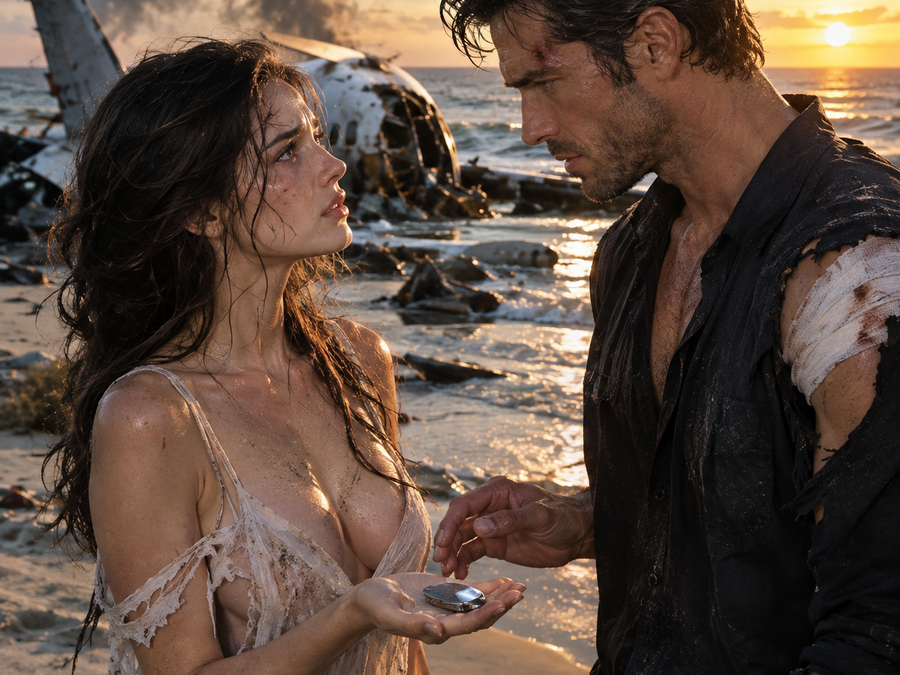
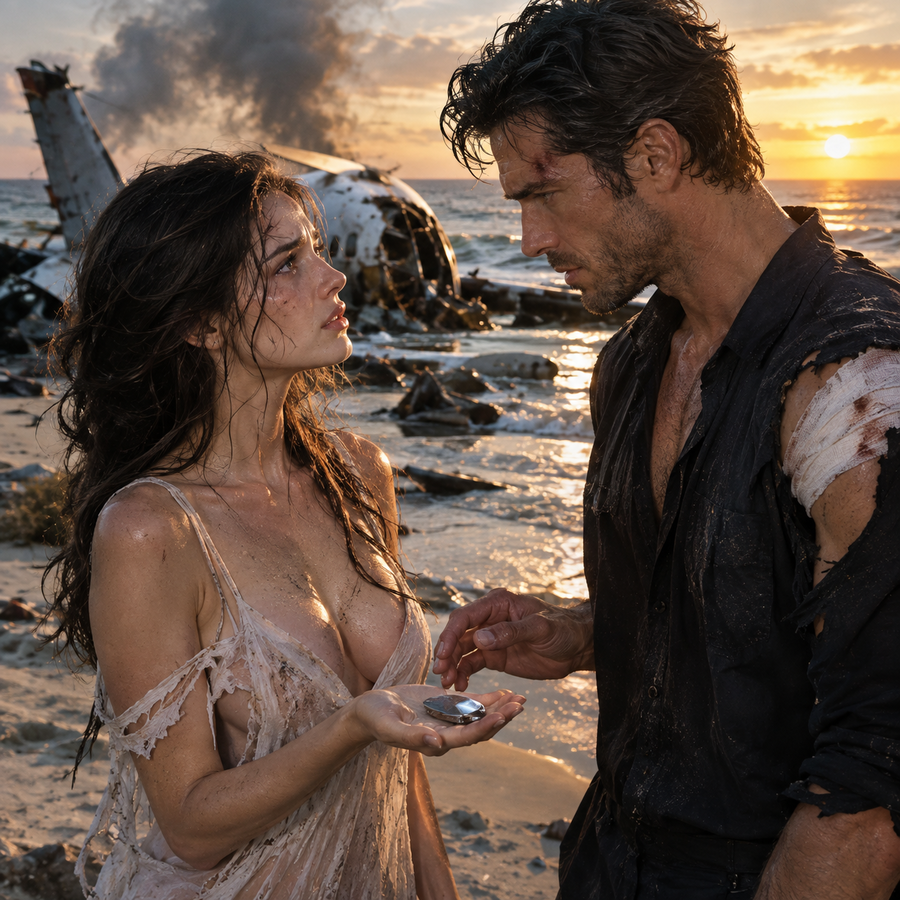
I opened my eyes to violent daylight. Waves hissed a few feet away, palm leaves bent over me. Heat pressed against my skin. Pieces of silver metal lay scattered across the beach like bones. Luca Romano’s private jet had been torn in half. One wing rested in shallow water. The tail was buried in sand, and smoke curled from the broken cabin.
There was no runway, no city, no rescue team, no road leading anywhere. Only ocean in every direction and a thin line of jungle behind the beach.
I pushed myself up on shaking hands and nearly collapsed from pain. “Help!” I shouted. My voice cracked. “Is anyone alive?” No answer came from the wreckage. No guard called back. No pilot cursed. No footsteps rushed toward me.
The silence after a crash is not peaceful. It is cruel. It makes every missing voice feel like a body. Then I heard a groan.
I turned toward the sound and saw Luca trapped near the broken fuselage, pinned under a bent sheet of metal with sand and smoke around him. Blood ran down the side of his face. His black shirt was torn open at the collar. One arm was trapped beneath the panel, his free hand digging into the sand as he tried to push himself loose. His eyes found mine.
“Elena,” he rasped. Relief hit me so hard it scared me. “Luca.” His gaze moved past me toward the wreckage. “Run.”
I turned my head and saw the fire. A thin orange line crawled across the sand, slow and hungry, following a dark trail of leaking fuel toward the broken wing. Toward him.
My body froze. The man I hated was trapped beside a burning plane. And for one terrible second, I had exactly what I once thought I wanted. A world without Luca Romano.
I could step back. I could tell myself he deserved it. I could let the fire reach him and carry my hatred home like proof that justice sometimes had flames. His voice came again, weaker. “Elena, go.”
I looked at the blood on his face. The hand that had locked my belt. The body that had shielded mine when the ocean hit. I hated him for making me choose.
I grabbed a broken metal rod from the sand and ran toward the fire. Heat slapped my face before I reached him. Smoke burned my throat. Luca’s eyes sharpened. “I told you to run.” “And I told you not to touch me. We both ignored orders.”
I jammed the metal rod under the edge of the panel and pushed. It barely moved. Pain tore through my ribs, but I pushed again, screaming through clenched teeth. Luca used his free hand to help, his face going pale with effort.
The fire crept closer. A small pocket of fuel caught near the wing, flaring bright enough to make me flinch. “Elena, leave it.” “Shut up.” “The tank may blow.” “Then stop talking and move.”
He stared at me, something almost like disbelief cutting through the blood and smoke. I pushed the rod down with every piece of strength I had left. The panel lifted an inch. Luca dragged his trapped arm free with a brutal sound that made my stomach twist.
I reached for him and he grabbed my wrist. Together, we stumbled backward across the sand. We had barely made it twenty feet when the broken wing erupted. The blast threw us down.
Luca twisted mid-fall and took the impact on his shoulder, pulling me beneath him before fire and sand rained over us. For a second, I could not hear anything except a high ringing in my ears. His weight pinned me. His breath hit my cheek. His heart hammered against mine.
He was alive. I was alive. I hated that my first feeling was gratitude. “Are you hurt?” he asked. His voice was rough, close, almost angry with concern. I shoved weakly at his chest. “Get off me!”
He rolled away at once, then pressed a hand to his ribs and sucked in a breath. His left forearm was badly bruised, scraped raw where the metal had trapped it. Blood dripped from his cut hand. The blast had thrown sand into his hair, ruined his shirt, stripped him of every polished inch of power.
Yet his eyes still searched my face before checking his own injuries. “Your temple is bleeding,” he said. “So is half your body. Answer the question.” “I’m alive.”
He looked toward the burning wreckage. “That is the only answer that matters right now.” I followed his gaze. The fire was spreading through part of the cabin, eating what little remained of luxury.
Somewhere in that smoke were the men who had boarded with us. I knew they were dead before Luca said it. His jaw hardened. He stood too fast and swayed. I grabbed his arm without thinking. He looked down at my hand. I let go as if burned.
“Don’t get sentimental,” I said. “I saved you because you saved me. A fair transaction.” “Exactly.” He stared at me for a moment, then looked away. “Then we are even.”
The word should have satisfied me. It did not.
We moved what we could before the fire took more of the wreckage. Luca gave orders because that was his instinct, and I argued because that was mine.
Water bottles. A first aid kit. Two emergency blankets. A cracked mirror from the cabin wall. A small knife from the galley. Three sealed packets of dry food. A length of rope. A half-melted flare case with no working flare inside. A metal container we could use for collecting rain water if rain ever came.
No radio. No phone signal. No emergency beacon we could trust after a water crash. The sea had swallowed one section of the fuselage, and the cockpit was unreachable without crossing fire and twisted metal.
Luca stood in the sand, counting supplies with the cold focus of a man building a kingdom from wreckage. I hated how useful he was. “We need shade first,” he said. “Then water, fire, injury care, and a signal marker large enough to be seen from above.”
“Still giving orders.” “Still alive because of them.” “You mean because of me?” His eyes met mine. “Yes.” The simple answer caught me off guard.
Luca Romano did not hand out praise. He barely handed out oxygen. I turned away before he could see my face change. “Fine. What do you want me to do?” “Sit down.” “That is not useful.” “You have a head wound and possible bruised ribs. Sit down before you fall down.”
“I don’t take orders from you here.” “Then take advice from the man you dragged out of a fire.” He reached for the first aid kit. I stepped back. “I can clean it myself.” “You cannot even see it.” “I can feel it.” “Feeling blood run down your face is not medical training.”
I glared at him. He waited, patient in the most irritating way. At last, I sat on a piece of broken cabin lining. Luca knelt in front of me with the first aid kit open between us.
His hands were dirty, cut, and steady. He poured water onto a cloth, then paused. “This will sting.” “I’ve survived your management style. I’ll survive antiseptic.” A faint breath left him. Not quite a laugh, but close enough to unsettle me.
He touched the cloth to my temple. Pain flashed white. I hissed and grabbed his wrist. His skin was warm under my fingers. He did not pull away. “Easy,” he said. The word was low, not soft, yet nothing in it was cruel.
He cleaned the blood with careful strokes. His face close enough for me to see tiny lines of exhaustion around his eyes, and a small scar near his eyebrow I had never noticed in the office.
Without his black desk, his guards, his perfect lighting, and the distance he kept around himself like armor, he looked younger. Not harmless, never that, but human. That bothered me more than the wound.
“Why are you looking at me like that?” he asked. “I’m trying to decide if the crash damaged your personality.” “And?” “Too early to tell.”
He placed a small bandage at my temple. “Your sarcasm survived impact.” “Lucky me.” “Very.” He said it without irony, and the word stayed between us longer than it should have. I looked away first.
He cleaned his own hand next, quickly and badly. I watched blood keep sliding from the cut across his knuckles. “You missed a piece of glass.” “It is fine.” “It is inside your hand.” “I said it is fine.”
I took the cloth from him. “And I said you missed glass.” His eyes narrowed. “Elena, this is not the time to be a mafia statue.” I grabbed his wrist and pulled his hand toward me. He let me, which surprised both of us.
His palm was rougher than I expected, marked with old scars that did not belong to a man who only signed documents. I used tweezers from the kit to remove the glass shard. He did not flinch, though I felt the tendons in his wrist tighten under my fingers.
“Do you feel pain?” I asked. “Only when it is useful.” “That makes no sense.” “Most truths don’t at first.”
I cleaned the cut and wrapped it with gauze, making the bandage tighter than necessary because I was angry at how careful I wanted to be. When I finished, he looked at his hand, then at me. “Thank you.”
The words sounded unfamiliar coming from him. I almost told him not to say them, but the beach was too quiet, the dead too close, and my heart too tired for another sharp answer.
By late afternoon, the sun had become brutal. Heat shimmered above the sand. The wreckage smoked less, but the smell of fuel still poisoned the air.
Luca chose a place near the edge of the palms, far enough from the broken plane, close enough to the beach for visibility. We dragged fabric, cushions, and palm branches into a crude shelter. He worked with ruthless efficiency despite his injuries. I worked because stopping meant thinking. And thinking meant remembering the pilot’s voice, the guard’s silence, the ocean swallowing metal.
At one point, Luca lifted a heavy piece of cabin lining and his face went gray. I caught the edge before it fell. “You are not fine,” I said. “I am functional.” “That is not the same.” “Today it is.”
“You always talk like you’re negotiating with your own body.” “My body usually loses.” “That is not strength.” He looked at me. “No.” I held his gaze. “No, it is arrogance with bruises.”
For the first time, Luca Romano had no immediate reply. We finished the shelter as the sun lowered. It was ugly, uneven, and probably useless against real weather, but it cast shade.
On the open sand, we arranged reflective pieces of metal and pale fabric into a large X. Luca said aircraft might see it if anyone searched the area. I did not ask whether anyone would. Hope felt fragile, and I was afraid my voice would break it.
As evening came, the island changed. The bright beach softened into gold. The ocean turned darker, endless and indifferent. Birds screamed from the trees. The jungle behind us rustled with life we could not see. Without the heat, fear found room to breathe.
We ate half of one dry food packet and shared a small amount of water. Luca insisted I drink more. I refused. He stared at me. I stared back. “If you order me to drink,” I said, “I will pour it on the sand.” He handed me the bottle. “Please.”
That one word defeated me. I drank. Not much, but enough to make him stop watching my mouth like my survival was a problem he needed to solve.
“How far do you think we are from land?” I asked. He looked toward the horizon. “Far enough.” “That is not an answer.” “It is the only one I trust.”
The honesty scared me. In the office, Luca’s certainty had been unbearable. Here, his uncertainty felt worse.
“Do you think they’ll come?” I asked. He did not answer quickly. I appreciated that, though I wished I didn’t. “They will search,” he said. “My people will not accept silence.” “Your people?” “Yes.” “Because they care about you.” His expression closed. “Because I am necessary.”
The words were clean, bitter, and almost invisible under his control. I heard them anyway. Necessary was not the same as loved. I knew that difference better than I wanted to.
He stood before I could respond and gathered dry palm fibers, broken wood, and scraps from the wreckage. “We need fire.” “Do mafia bosses usually know how to make fire?” “Only the charming ones.”
I looked at him sharply. “Was that a joke?” “A small one. Do not make it emotional.” I almost smiled. Almost.
He tried the damaged lighter first. It sparked twice, failed, sparked again, then died completely. Luca stared at it with the same cold disappointment he usually reserved for incompetent men. “Are you going to intimidate it into working?” I asked. “I am considering it.” “Let me know if it apologizes.”
This time the corner of his mouth actually moved. It was quick and controlled, but I saw it. The island did something strange to the air between us.
He switched methods, using the knife, dry fiber, and a piece of metal from the wreckage to strike sparks. It took longer than I expected. His injured hand reopened. Sweat slid down his neck. He did not complain, curse, or ask me to take over. He worked with quiet focus until a tiny ember caught in the fibers.
He leaned in and blew gently, protecting it with both hands. A small flame lifted out of the dusk. I watched it grow, stunned by how much relief one fragile fire could bring.
Luca fed it slowly, patient now that patience mattered. Orange light touched his face, cutting warmth into the hard lines. He looked tired. Not bored, not cold, not untouchable. Tired.
“How do you know how to do that?” I asked. His eyes stayed on the flame. “My father believed power should survive comfort.” “That sounds like something carved over a prison door.” “It felt like one.”
The answer was too honest. I did not know what to do with it.
Night settled fast. The island went black beyond the fire. The ocean kept moving. A steady breath in the dark. Every rustle from the palms made my shoulders tense. My wet clothes clung to my skin, and when the wind shifted, cold slid through me.
I wrapped my arms around myself and tried not to shiver. Luca noticed immediately. Of course he did. The man noticed everything except how much damage his own words caused.
He removed his dark coat from where it had been drying over a branch and held it out. “Take it.” “No.” “Elena, you’re injured.” “You are smaller. That is not an argument. It is physics.” “I don’t want your coat.”
His eyes held mine across the fire. “I am not asking you to like me. I am asking you to stay warm.” I hated the quiet concern in his voice. I hated that my body wanted the coat more than my pride wanted distance.
I took it with stiff fingers and pulled it around my shoulders. The fabric was torn, smoky, and still carrying his warmth. It smelled like salt, ash, blood, and him. I looked into the fire so I would not have to look at his face.
“Thank you,” I said. He sat across from me, arms bare beneath his rolled sleeves, bandaged hand resting on his knee. “A fair transaction.” I should have accepted that. I should have let the words build the wall again. Instead, I watched him hide a shiver when the wind crossed the beach.
He turned his face toward the dark ocean, jaw tight, pretending the cold did not reach him. The old Luca would have made that look like strength. The island made it look lonely.
For a long time, neither of us spoke. The fire cracked. The wreckage cooled behind us with soft metal ticks. Somewhere in the jungle, something moved through leaves. I pulled his coat tighter.
“Why did you save me?” I asked. Luca did not look at me. “Because you were going to die.” “That is not an answer.” “It is the only one that matters.” “No. Men like you always have reasons.”
His gaze moved from the ocean to the fire. “Men like me. Powerful men. Cold men. Men who count everything before they move.” “And what did you count when you ran toward the fire for me?”
The question hit too close. I looked down. “You had saved me first. A transaction.” “Yes.” His eyes lifted. In the firelight, they looked less gray, almost silver. “Then why did you scream my name?”
My throat tightened. I remembered it then. Not as sound, but as a feeling torn out of me when I saw him trapped. Luca. Not Mr. Romano. Not boss. Luca.
I hated that he remembered. “Shock,” I said. “Of course.” “Don’t sound amused.” “I would never.”
The silence returned, but it had changed. Something had entered it. Not forgiveness, not trust, something smaller and more dangerous. Awareness.
I shifted under his coat and looked toward the black line where ocean met sky. “Do you think we’ll survive?” Luca leaned forward, elbows on his knees, the fire cutting shadows under his cheekbones. “Yes.” “You don’t know that.” “No.” “Then why say it?”
His eyes met mine, steady again, but no longer empty. “Because if I sound uncertain, you will stop fighting. If you stop fighting, this island wins. I do not intend to lose you to sand, water, or fear.”
My breath caught. He seemed to realize what he had said only after the words left him. His face closed, but too late. I had heard the crack.
I looked away before he could punish himself for it. “I’m not yours to lose,” I said quietly. “No,” he replied. “You are not.”
The fire burned between us, small and stubborn against the dark. My body ached. My head throbbed. My hatred remained, but it no longer felt simple.
The man across from me had broken my heart with one sentence a year ago. Shielded me with his body an hour before impact. Let me pull him from fire, cleaned blood from my face, thanked me, joked badly, built a shelter, made a flame from wreckage, and gave me his coat while he shivered in silence.
None of that erased what he had done. None of it explained him. That was the problem. Monsters were easier when they stayed monsters.
Luca Romano looked into the fire as if it held answers he would never ask for aloud. Beyond him, the destroyed jet lay under moonlight, proof that everything powerful could fall.
I rested my bandaged temple against the torn edge of his coat and listened to the ocean. For the first time since the crash, I felt the truth settle over me. We were alone on a deserted island with no signal, no rescue, no food beyond scraps, and no one to trust except each other.
The worst part was not the ocean around us or the darkness behind us. The worst part was that after one impossible day, I was no longer sure I knew how to hate him.
I woke to the sound of the ocean and the terrifying absence of Luca Romano. For a few seconds, I did not remember where I was. My body reached for the small apartment I had left behind, the street noise below my window, the cheap curtains moving in morning light, the smell of my mother’s tea when she stayed with me after surgery.
Then pain dragged me back. My ribs hurt. My head throbbed. Sand stuck to my skin. The coat around my shoulders was too large, too smoky, too unmistakably his.
I sat up too fast and the island tilted. The fire had burned down to gray ash. The wrecked jet lay in pieces under the morning sun. The beach was empty. Luca was gone.
A cold panic opened inside my chest. It was stupid, immediate, and humiliating. Of course he had left. Powerful men survived by choosing themselves first. Maybe he had found a better part of the island, a signal point, water, anything useful, and decided I would slow him down. Maybe the kindness of last night had been nothing more than crisis behavior, a temporary accident caused by blood loss and smoke.
I pushed myself to my feet, gripping his coat with one hand and a broken piece of metal with the other. “Luca.” My voice cracked over the beach. No answer.
I hated the fear that rushed through me. I hated it more than I had hated him because it sounded too much like need. “Luca.”
Something moved near the trees. I raised the metal shard, heart slamming against my ribs. Luca stepped out from the green shade with two coconuts tucked under one arm, a strip of torn fabric tied around his injured hand, and his black shirt clinging damply to his chest.
His face was still cut, his jaw shadowed by exhaustion, but his eyes sharpened the moment he saw me standing. “Why are you holding that like you plan to murder the island?”
I lowered the metal shard before he noticed my hand shaking. “I thought you left.” The words escaped before pride could stop them. His expression changed. Not much, but enough.
He crossed the sand slowly, as if sudden movement might scare me. “I went to find water.” “You could have said something.” “You were sleeping.” “So you just disappeared.” He set the coconuts near the dead fire. “I do not leave people behind, Elena.”
That sentence hit a bruise I had not shown him. I looked away. “Funny. I remember being left behind very clearly.”
He knew what I meant. I saw it in the way his mouth tightened. The hospital, my mother, his office, that one sentence he had used like a door slammed in my face. He did not defend himself. He only picked up one coconut and struck it against a rock until it cracked.
“Drink.” “I’m not thirsty.” “You are dehydrated.” “You don’t know that.” “Your lips are cracked. Your skin is flushed, and you almost fell when you stood. Drink.”
I took it because arguing required energy I did not have. The coconut water tasted warm and sweet. Better than pride.
He watched until I swallowed, then looked away before his concern became too visible. That was Luca’s pattern. Care, then retreat. Give warmth, then make it look like strategy.
We spent the morning turning survival into work. Luca found a narrow freshwater trickle deeper past the palms where rain collected in rocks before running toward the sea. He marked the path with strips of white cabin fabric tied to branches. I collected leaves wide enough to reinforce the shelter while he cut palm ribs with the small knife.
He moved with pain hidden under discipline. Every time he reached too high, his jaw locked. I pretended not to notice until pretending became cruelty. “Your shoulder is worse.” “It is usable.” “You keep saying things like usable and functional as if your body is rented equipment.” “Today it is.” “No, today it is the only body you have.”
He glanced at me. “That almost sounded like concern.” “Do not make it emotional.” A faint smile touched his mouth and vanished before it could become dangerous. “You are learning my language.” “Unfortunately.”
By noon, the sun turned the beach white and vicious. We worked in the shade, dragging salvaged fabric over the shelter, tying rope between two palms, building a low wall of broken cabin panels to block the wind.
Luca showed me how to twist palm fiber into rough cord. His hands moved around mine, guiding without taking over. In the office, he gave instructions like verdicts. On the island, his voice lowered into patience.
“Loop it under, pull through, then tighten. Not with your fingers. Use your wrist.” “I know how to tie things.” “This knot says otherwise.” “This knot is under pressure.” “So are we.”
I looked at him. He looked back, calm, but not cold. The air between us shifted again, subtle and unwelcome. I pulled the cord too hard. It snapped.
“Wonderful,” I muttered. Luca handed me another strip. “Again.” “You enjoy watching people fail?” “No, I respect people who try again.”
The answer silenced me. I expected cruelty and kept finding discipline. I expected arrogance and kept finding restraint. None of it made him innocent, but it made my hatred work harder.
Later, while carrying dry branches from the treeline, I stepped on a sharp shell hidden under sand. Pain shot through my foot. I dropped the branches and cursed.
Luca turned so fast the knife was in his hand before I could blink. “What happened?” “Nothing. It’s a cut.” He came toward me. “Sit.” “I can walk.” I took one step and nearly folded. He caught my elbow. Steady but careful. “You can argue while sitting.” “You enjoy bossing injured women?” “Only stubborn ones who bleed on the beach.”
He helped me down onto a flat piece of wreckage. I tried to keep my foot away from him, but he took my ankle gently, as if I might break. The cut was deep enough to bleed but not dangerous. Still, when his thumb brushed the sand from my skin, my breath caught.
He noticed and paused. “Did that hurt?” “No.” “Then why did you stop breathing?” “Because your hands are cold.” “My hands are not cold.” “Your soul is.” “Maybe it spreads.”
He looked at me for a moment, then cleaned the cut without answering. His focus made the world shrink to his fingers. The sting of water, the warmth of his palm under my heel.
A mafia boss kneeling in sand, wrapping my foot with a strip of his own torn shirt, should have felt absurd. Instead, it felt intimate in a way I did not know how to fight.
“You should not waste your shirt,” I said quietly. “I have survived worse losses.” “Like what?” His fingers stilled for half a second. “Childhood.”
I waited, but the door closed in his face before another word came through. He tied the bandage and released my foot. “Do not step without watching.” “Yes, sir.” “Careful. I may start enjoying your obedience.” “Do that, and I’ll walk into the ocean.”
This time he did laugh. Not much, not freely, but enough to change his face. It startled me so badly I forgot to look away. Luca Romano had a beautiful smile because it looked like something he had not allowed himself in years.
He seemed to realize it, too. The smile disappeared. Silence returned. I missed it immediately and hated myself for that.
The second night came colder than the first. The island looked warm in daylight, all blue water and golden sand. But after sunset, the wind turned sharp and wet.
We had a stronger fire now, a better shelter, a small pile of coconuts, two food packets left, and water stored in the metal container. Luca insisted we ration everything. I accused him of being dramatic. Then hunger woke inside me, and I stopped joking.
He gave me the larger half of the food. I noticed because hunger makes fairness visible. “Switch,” I said. “No.” “Luca. Eat. You need strength, too.” “I have more reserves.” “That is the polite mafia way of calling me smaller again.” “It is the accurate way.” “Accuracy is annoying.”
He leaned back against a palm trunk, the firelight cutting bronze along his cheekbones. “So is dying.” I broke the food and placed part of it in his hand. “Then don’t.”
He stared at the piece resting on his palm. “You do not need to take care of me.” “I’m not. I’m protecting my investment. If you collapse, I have to drag you, and you are heavy.”
He accepted the food. “A fair transaction.” The same words from yesterday, but softer now.
Wind moved across the beach. I pulled his coat around me, then looked at his bare forearms. He was shivering. Not obviously. Luca would rather bleed publicly than shiver honestly. The tremor came in small betrayals, fingers tightening, shoulders locking, jaw clenching.
I watched for almost a minute before anger rose. “You’re cold.” “I’m fine.” “You are shaking.” “The wind is strong.” “Your pride is stronger, but not smarter.”
I stood, walked around the fire, and sat beside him with the coat still around my shoulders. He turned his head slowly. “What are you doing?” “Surviving in your language.” I opened one side of the coat and pushed it over his arm.
His body went still. Too still. “Elena.” “Do not start a conversation you are not ready to finish,” I said, throwing his own line back at him.
For a second, neither of us moved. Then he allowed the coat to cover both of us. Our shoulders touched. Heat moved between us, immediate and shocking.
The fire cracked. The ocean breathed. I stared straight ahead, pretending my heart had not changed its rhythm. Luca’s voice came low beside me. “You do not have to do this.” “I know.” “Then why?” I looked at the flames. “Because you would do it for me.”
His silence became heavy. “That is a dangerous assumption.” “No, it is an inconvenient truth.” He leaned his head back against the palm and closed his eyes. The line of his throat moved as he swallowed. “You should hate me.” “I do. Not very efficiently.” “I’m tired. That explains many mistakes.”
I should have moved away. Instead, I stayed. His arm slowly relaxed beside mine. I felt the exact moment he stopped resisting the warmth. It was not trust. Not yet. More like surrender forced by exhaustion. Still, it made my chest ache.
“That day in your office,” I said before I could lose courage, “when I asked for help. Did you even think about my mother after I left?” His eyes opened. The fire reflected in them. “Yes.” I waited. He offered nothing else. “That’s it? For now.” “Why?” “Because some answers require more than a campfire and a cracked skull.” “That sounds like another way to avoid guilt.” “Maybe.”
The honesty cut deeper than denial. I turned toward him. “You humiliated me.” His face tightened. “I know.” “You made me feel like asking for help was shameful.” “I know.” “And you let me hate you.”
His gaze lowered to the fire. “Yes.” I wanted an excuse. A cruel answer would have restored the old shape of him. Instead, he gave me quiet responsibility, and I did not know where to put it.
“Why,” I whispered. Luca’s jaw worked once. “Because kindness with my name attached to it can become a target.” “That makes no sense.” “It does in my world.” “Your world is sick.” “Yes.”
The word was so simple it stopped me. A gust of wind pushed sparks toward the ocean. Luca shifted slightly, angling his body to block it from me without seeming to. I noticed everything now. His small protections, his hidden pain, his refusal to let need become visible.
“Who taught you to live like that?” I asked. His eyes stayed on the dark water. “Everyone who survived around me.”
The next morning, clouds gathered over the sea. Luca noticed first. He stood on the beach for a long time, studying the horizon, one hand pressed against his injured ribs.
“The sky has turned white-gray,” he said. “The ocean darker. Restless. Storm.” “How bad?” “Bad enough that our shelter may not hold.” “Comforting?” “I was not trying to comfort you.” “You rarely are.”
He looked at me then. “That is not true.” The answer landed too softly. I turned away and started collecting more palm branches.
We spent hours reinforcing the shelter, dragging heavier panels from the wreck, tying everything down with rope and twisted fiber. My bandaged foot burned. Luca’s shoulder worsened. Neither of us stopped.
By late afternoon, the wind had teeth. The palms bent hard. Waves struck the shore with heavy, angry force. We moved our supplies higher toward the trees. Luca checked the shelter again, then looked toward the wreckage.
“If the wind turns, we may need the fuselage section.” “The broken plane? The part that is not burned?” “Metal holds better than palm leaves.” “Unless it slices us in half.” “Every option has personality flaws.”
I stared at him. “You become funnier when dehydrated.” “I will try not to enjoy that.”
The first rain hit like thrown stones. Within minutes, the beach disappeared behind sheets of water. Wind ripped at the shelter. The fire hissed and died. Darkness arrived early, thick and loud.
Luca grabbed my hand and pulled me toward the reinforced side as the roof snapped above us. A palm branch tore loose and flew past my face. “Move!” he shouted.
We ran for the partial fuselage, heads down, sand and rain stinging our skin. My injured foot slipped. Luca caught me around the waist, but the motion cost him. A piece of loose metal swung in the wind and slammed into his shoulder. He made no sound, which frightened me more than a cry would have.
We reached the wreckage and crawled into a torn section tilted against rocks. It smelled of smoke and salt, but it blocked the worst of the wind. Luca braced a loose panel at the entrance while rain hammered the metal above us.
“Your shoulder,” I said. “Later.” “No, now.” “Elena, hold that panel.” “I am holding it.” “You’re bleeding,” I said. “Later.”
Lightning flashed, white and violent. For one second, his face looked carved from pain. Then the thunder hit, and the panel shook hard enough to tear free. Luca shoved his body against it, shielding me from the open rain. “Get behind me.” “Stop doing that.” “Doing what?” “Putting yourself between me and everything.” “It keeps working.” “It will kill you.”
His eyes found mine through the dark. “Not tonight.”
The storm lasted forever. Maybe ours. Maybe a lifetime. We crouched inside the broken plane while rain turned the world outside into noise. Water leaked through gaps and ran down our backs. Cold sank deep. I could not stop shivering.
Luca’s body heat became the only solid thing in the dark. At first, we stayed apart. Pride drew a line between us. Hypothermia erased it. He pulled me against him with one arm, his back to the opening, his body taking the wind.
I should have resisted. I did not. My cheek rested against his chest. His heartbeat was slower than mine, but not calm. Nothing about him was calm now. He was holding control together with both hands.
“You’re burning,” I whispered. “I am cold.” “No fever.” He did not answer. I touched his forehead. Heat. Too much heat. “Luca—” “It is nothing.” “If you say usable or functional, I will hit you.”
A weak breath left him. “Noted.” His injured shoulder had swollen badly. The skin around the impact was dark, and the cut near his collarbone had reopened.
I tore a clean strip from the emergency blanket lining and used the last antiseptic wipe from the kit. He sat with his back against the fuselage wall, jaw locked, while I cleaned the wound. His eyes closed once, hard.
“Does it hurt?” I asked. “Yes.” The answer startled me. “You admitted that. Storm must be worse than I thought.” I pressed the bandage into place, then held it there because there was no tape left. His skin burned under my palm. Rain roared overhead.
In the tiny metal shelter, the world had shrunk to his breathing and my hand over his wound. “Who takes care of you when you’re like this?” I asked. “No one sees me like this.” “That is not what I asked.” His eyes opened. Fever made them brighter, less guarded. “No one.”
The word slipped under my ribs. I thought of his office, his guards, his wealth, his reputation. All that power circling him like walls. Necessary, he had said. Not loved. I looked down at my hand on his chest. “That sounds lonely.” “It is safe.” “No, Luca. It is lonely.”
His gaze moved over my face, slower than usual, as if fever had taken away the distance he kept. “You say my name differently now.” I stilled. “How?” “Like you are no longer throwing it.”
I wanted to deny it. I could not. The storm gave us nowhere to hide. His head tipped back against the metal. For a while, he drifted in and out, not fully asleep, not fully awake. Fever loosened words he would never have offered in daylight.
“Do not let them see softness,” he murmured. I leaned closer. “Who?” “Men who smell weakness.” “You’re safe.” “Bosses are never safe.” His brows pulled together. “A boss does not beg. Does not need. Does not love in places where enemies can count it.”
My throat tightened. “Who told you that?” “Everyone.” His voice broke on the last syllable. I pressed the wet hair back from his forehead. “They were wrong.” His eyes opened. “No, they survived. That is not the same as living.”
He stared at me as if I had spoken in a language he once knew but had forgotten. I kept my hand on his forehead, cooling the fever with a damp cloth, and felt something inside me fold open despite every warning.
This was not forgiveness. Not yet. The wound he had left in me still existed. But hate requires distance. And Luca was too close, too human, too painfully alone.