CEO Was Surrounded by Thugs —Then the Single Dad Janitor Saved Her From The Thugs (Part 1)
CEO Was Surrounded by Thugs —Then the Single Dad Janitor Saved Her From The Thugs (Part 1)
PART 1
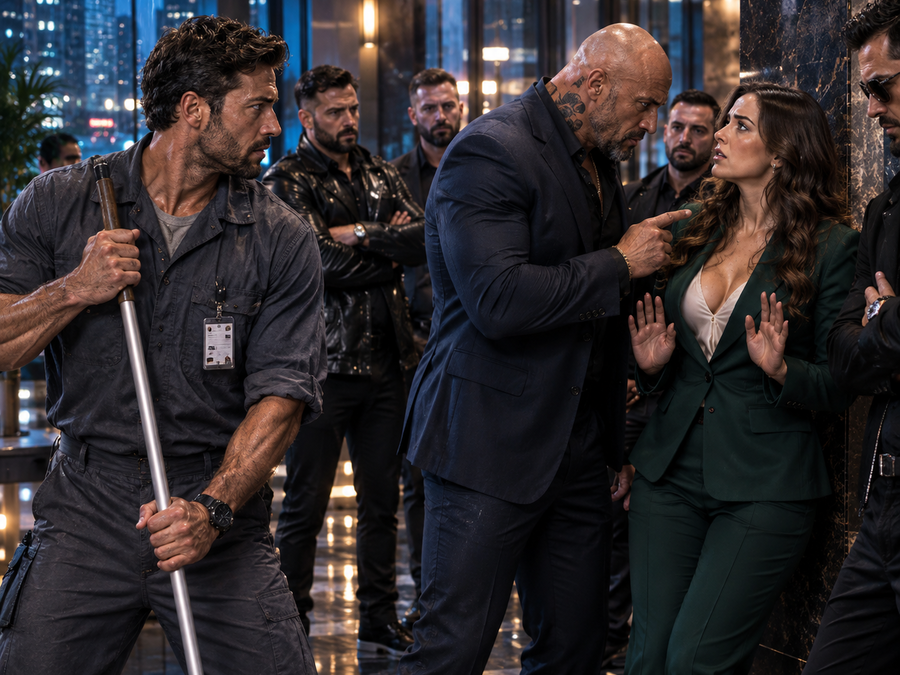
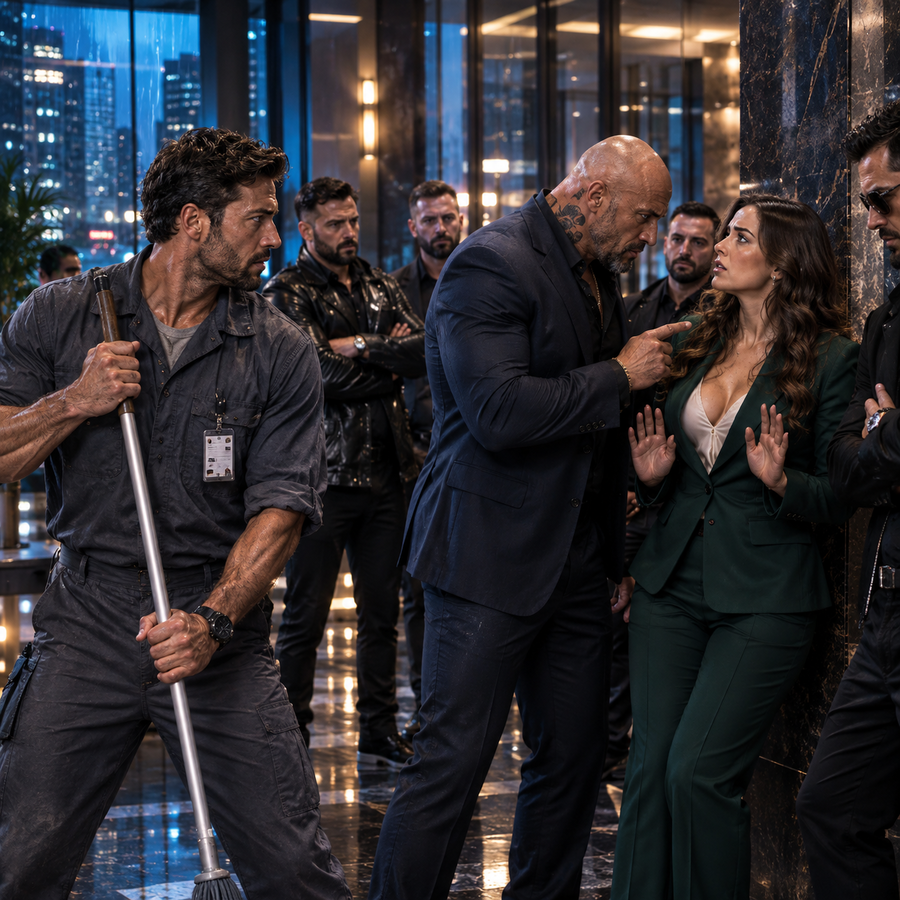
The man grabbed Clare Whitmore by the collar and slammed her against the marble wall of her own lobby. “Sign it,” he said, “or we carry you out in pieces.” Nobody moved. Forty employees watched through glass walls and locked doors, and not one of them stepped forward.
Nobody except the janitor at the end of the hall, who set down his mop, cracked his knuckles once, and walked straight into the middle of five armed men without saying a single word. What happened next changed everything.
They thought they knew about the quiet man who cleaned their floors every night. And what came after that shook Apex Horizon Corporation to its foundation.
The first thing Michael Hayes did every morning was make his daughter’s lunch. Not because Emma couldn’t do it herself. She was nine years old and perfectly capable of slapping peanut butter on bread. He did it because it was the only thirty minutes of his day that belonged entirely to the two of them.
Her sitting on the kitchen counter in her pajamas, kicking her feet against the cabinet doors while she talked about whatever was taking up space in her mind that morning, and him standing at the counter, listening like every word she said was the most important thing he’d heard in years.
Most mornings it was. “Dad,” Emma said, watching him slice the crusts off her sandwich with the focus of a man diffusing something dangerous. “Do you ever get bored?” “Bored of what?” “Work? Do you ever get bored of work?”
Michael thought about that for a moment. He folded the sandwich into a neat triangle the way she liked it, tucked it into the container, and snapped the lid shut before he answered. “No,” he said. “Why not? You do the same thing every day.”
“So do surgeons,” he said. “Doesn’t mean it doesn’t matter.” Emma considered this. She had her mother’s eyes—dark and serious and always working something out just beneath the surface. Most of the time when she looked at him like that, he had to look away first.
“Surgeons save lives, Dad.” “So do clean floors,” he said. “You ever slip on a dirty floor?” She laughed. It was the best sound in the world, and he never got used to it.
He kissed the top of her head, handed her the lunch bag, and got her out the door in time for the school bus. Then he stood in the kitchen alone for a minute, listening to the sound the bus made as it pulled away. And he poured himself a second cup of coffee and sat down at the table where her cereal bowl was still sitting with a thin ring of milk drying around the rim.
He didn’t move it right away. He just sat there and let himself have that minute. Then he washed it, dried it, put it back in the cabinet, and got ready for work.
Michael Hayes had been a night janitor at Apex Horizon Corporation for three years. The building was in the heart of Chicago, forty-two floors of glass and steel that looked like someone had tried to build a monument to the idea that money was the most important thing in the world. The lobby alone could have swallowed his entire apartment building.
The floors were Italian marble. The lighting was the kind of soft, deliberate, expensive that most people never noticed because they assumed all nice places looked like that. Michael noticed. He noticed everything. It was something he couldn’t turn off even when he wanted to.
His brain had been trained for years to map every room he walked into, to register exits, entry points, the position of every person, their body language, the way they held themselves when they were comfortable versus when they were afraid. Three years of pushing a cleaning cart through corporate hallways hadn’t changed that wiring one bit. He’d just learned to ignore most of what it told him.
He had a simple routine. He clocked in at six in the evening, collected his cart from the supply room, and worked his way up from the lobby floor by floor until the building was quiet. He knew which offices would be empty by seven and which executives regularly burned past midnight.
He knew the security desk schedule, the elevator maintenance windows, which vending machine on the fourteenth floor made a grinding noise when you pressed B7, and which bathroom on the twenty-third floor had a sink faucet that needed a specific counterclockwise pressure to stop dripping. He knew the building the way a man knows a place he’s been paying attention to for three years. He did not know it the way a man knows a place he cares about deeply.
That distinction mattered. This was a job. A good job with reliable hours and a supervisor who left him alone and a schedule that had him home before Emma woke up for school. He was not there because he loved Apex Horizon Corporation or felt any loyalty to the people who worked there. He was there because it paid his rent and protected his daughter’s routine, and those were the only two things he needed from it.
Most of the people in that building didn’t know his name. The ones who did know his name didn’t use it. He was the janitor guy. He was the person you stepped around in the hallway without making eye contact. He was the person whose presence in the breakroom made people suddenly remember something they had to do elsewhere.
Three years of that and he had stopped noticing it the way you stop noticing background noise. It was just the texture of the job. The only person in the entire building who regularly spoke to him like he was a human being was Clare Whitmore herself.
The first time she’d spoken to him had been about eight months into his employment. He’d been cleaning the executive floor late on a Thursday night, somewhere around eleven, and he’d heard someone in the CEO’s office still moving around. He’d rolled his cart to a stop outside the door, trying to decide whether to come back, when the door opened, and Clare Whitmore walked out carrying three empty coffee cups and a stack of papers under her arm.
She nearly walked straight into his cart. “Oh, sorry,” she said immediately, stepping back, juggling the cups. “No harm,” he said, reaching out to steady one of the cups before it fell. She got everything reorganized and then looked at him properly for the first time.
She had a way of looking at people that Michael noticed most executives, in his experience, did a quick social sweep of a person and then moved on. Clare actually looked. It lasted maybe three seconds, but it was real attention.
“You’re here late,” she said. “I’m here late most nights,” he said. “This floor usually runs behind the others.” She almost smiled. “That’s probably my fault.” “Probably,” he agreed. She did smile then. A real one. Quick and a little surprised, like she hadn’t expected someone to agree with her that directly.
She handed him the three empty cups without being asked because she’d noticed that’s where they needed to go, and she said, “I appreciate what you do. This place would fall apart without people like you.” He didn’t say anything to that. He’d heard versions of it before from people who meant nothing by it, but the way she said it was different. She wasn’t performing gratitude. She was just stating something she’d thought about.
“Good night,” she said, and went back into her office. He finished cleaning the floor and left. After that, whenever their paths crossed, which was more often than people might expect because Clare Whitmore was one of those executives who regularly worked until ten or eleven at night, she spoke to him.
Not long conversations, just the kind of brief, genuine exchanges that people manage when they share a space and have decided to be decent to each other. She asked about his daughter once after spotting the small photo of Emma that he kept folded inside his wallet when he dropped it in the hallway. After that, she would occasionally ask how Emma was doing, and he would tell her, and she would listen in a way that wasn’t polite performance.
That was the whole of it. He didn’t know much about her life. She didn’t know much about his. Neither of them knew that in three years, that small, quiet thing between them would turn out to matter enormously.
Clare Whitmore had built Apex Horizon Corporation from a two-room startup with four employees and no floor space to a billion-dollar technology company that had changed the way midsize enterprises managed their data infrastructure. She had done it in eleven years. She had done it as a woman in an industry that spent most of its energy pretending women weren’t in the room.
She had done it by being smarter than the people who underestimated her, more patient than the people who tried to rush her, and more stubborn than the people who tried to push her out. Now she was forty-one years old and standing on the edge of the biggest decision of her professional life.
Stratus Systems was a cloud infrastructure company worth roughly three hundred million dollars on paper and considerably more in strategic value. If Apex Horizon acquired Stratus, it would permanently change their market position. It would take them from being a successful company to being an industry-defining one. Competitors would spend years trying to catch up.
The deal had been in negotiation for five months. Clare had driven every aspect of it personally. Her CFO, her general counsel, her VP of corporate strategy—all of them had played their roles, but the vision behind the acquisition was hers. And everyone in the room knew it, including the people who wanted to stop it.
His name was Richard Callaway, and he had been Clare’s chief operating officer for six years. On the surface, Richard Callaway was exactly what his business card claimed he was. He was fifty-three, silver-haired, and effortlessly convincing. He had an MBA from Wharton, a record of operational performance that looked impressive until you understood whose ideas he’d been implementing, and a social ease that made everyone in the room feel like they were talking to someone who’d already solved whatever problem they were discussing.
He had been with Apex Horizon since year four, and for most of that time, the arrangement had worked. But six months ago, everything had changed. A private equity firm called Vestara Capital had made contact with Richard Callaway through an intermediary.
What they proposed wasn’t unusual in concept in the world of corporate maneuvering. Hostile approaches to senior leadership weren’t rare. What was unusual was the scale of what they were offering and what they needed in return. They wanted to acquire Apex Horizon—not through a market offer, not through Clare, through Richard.
If he could force a leadership change, force Clare out, and bring the board into alignment with a pre-structured acquisition deal, Vestara Capital was prepared to offer Richard Callaway a personal payment of nineteen million dollars plus an executive position in the restructured company plus equity that would make him a wealthy man for the rest of his life.
Richard had spent a week telling himself he wasn’t going to do it. Then he’d spent another week telling himself that Clare would understand if she ever found out, that this was just business, that the company would survive it, that he deserved this after six years of executing someone else’s vision. Then he’d made the call.
The plan was elegant in its basics and monstrous in its particulars. The Stratus acquisition, if it closed, would make Apex Horizon functionally unacquirable for at least three years. The integration alone would absorb all available capital and management bandwidth. The deal had to be stopped, and the only way to stop it was to stop Clare.
Vestara’s people had connections, resources, and a very specific idea about how this was going to work. Richard had told himself it would be a controlled situation. Professionals. A boardroom-level confrontation. Some legal pressure, documents signed under duress that would be sorted out afterward by lawyers who understood how these things worked. He had told himself nobody was going to get hurt. He had been lying to himself, and some part of him had known it from the beginning.
The night it happened was a Wednesday in November. The storm had been building since afternoon—the kind of Chicago weather that announces itself hours in advance and then delivers exactly what it threatened. By seven, the wind off the lake had turned the rain sideways, and the streets outside Apex Horizon’s lobby were empty except for cab lights reflecting off the wet pavement.
Michael clocked in at 6:02, traded a few words with the dayshift security supervisor, a heavyset man named Pete, who was always eating something from the vending machine when Michael arrived, and collected his cart from the supply room. Pete left at 6:30. The overnight security man was supposed to arrive at 6:45. He never showed up.
Michael noticed this at 7:15 when he came back through the lobby on his first full pass of the building and the security desk was empty. He noticed it the way he noticed most things in the building—cataloged it, filed it, set it aside. People called in sick. Coverage got thin. It wasn’t his department. He took his cart to the elevator and went up to start on the third floor.
At 7:30, he came back to the lobby for supplies. That was when he saw the vehicle. It was a black SUV—the kind of anonymous, expensive vehicle that exists specifically to not be remembered. It had pulled up directly in front of the main entrance, which was a loading zone, not a parking space. The vehicle sat there with the engine running, hazards off, nobody visible through the tinted glass.
Michael watched it for thirty seconds. His brain, which had never actually stopped doing the thing it was trained to do, started talking. Wrong vehicle for a client pickup. Wrong time. Wrong positioning. You park here when you want to be able to move fast, not when you’re waiting for an executive to get their coat. Engine running in that weather means somebody inside is keeping warm or keeping ready or both.
He wheeled his cart behind the reception desk, keeping his body angled so he could watch the entrance without appearing to watch it. Three minutes later, five men walked in.
They were dressed well—business casual, the kind of clothing that says I belong in an office building without saying I work here. They moved through the lobby doors in a loose formation that they probably thought looked natural and didn’t. The spacing was too deliberate. Each man subconsciously leaving room for the others to react.
They weren’t drunk. They weren’t in a hurry. They were controlled. Michael had spent years around controlled men who moved like that. He knew exactly what it meant.
The one in front was tall, late forties, with close-cropped gray hair and the kind of jaw that people described as strong in novels. He moved like someone who had been in charge of other people for a long time and had stopped noticing that he was doing it.
His name—Michael would learn this later—was Vincent Harlo. He had a history in private security work that had ended badly and a more recent history in contract enforcement that was considerably worse. Vincent Harlo scanned the lobby in the same way Michael scanned rooms. His eyes went to exits first, then positions, then the desk.
He found the security desk, and his posture changed slightly. A small relaxation. A half-second where the plan just got easier. Then he found Michael. He looked at Michael the way men like that always looked at Michael in that uniform. A fraction of a second. A file categorized and closed. Janitor. No factor.
He looked away and started toward the elevator bank. Michael watched them go. His hand had stopped moving. He was holding a cleaning rag against the side of his cart, and he had not moved it in ninety seconds, and he was telling himself to keep thinking this through before he did anything at all.
Five men dressed to pass. Security desk empty. The main entrance security camera—he checked it casually, tilting his eyes up to the corner of the lobby. Its red recording light was off. The red light on the security camera had been on every night for three years.
He left his cart behind the desk and walked to the house phone. He picked it up and dialed the building’s internal emergency number. It rang twice and then gave him a tone that meant the line was broken or redirected. He reached for his personal cell phone. No signal.
He stood with the phone in his hand for exactly three seconds, staring at the zero bars, understanding what that meant. And then he made a decision about what he was going to do next.
Clare was in the small conference room on the thirty-first floor. She was there alone because she’d sent her assistant home at six because the final document review for the Stratus acquisition was the kind of thing she preferred to do in silence.
Four hundred pages of due diligence, merger terms, regulatory filings, and liability disclosures. She’d been through it twice already. This was the third pass—the slow one, where she read every line of the financial representations the way she’d learned to read them in the early years, word by word, with no assumptions about what it was supposed to say.
She had her jacket off, her shoes off, a cold cup of coffee on the table, and she was on page 212 when she heard the elevator. She looked up. The elevator doors opened.
Vincent Harlo stepped out first, and then four men came out behind him. And Clare understood immediately—not intellectually, not after thinking about it, but in the deep animal part of her brain that handled threat recognition—that this was not a late business meeting.
She stood up. “Ms. Whitmore.” Vincent’s voice was professional. The kind of professional that is specifically designed to prevent you from screaming. Calm. Even. Reasonable-sounding. “Please sit down.”
“Who are you?” Her own voice came out steadier than she expected. “People who need about twenty minutes of your time.” He moved to the head of the conference table, three of his men fanning out to cover the room’s exits in a formation so practiced it was almost casual. One man stood by the elevator. One moved to the window side.
“Please sit down.” Clare didn’t sit down. That was the first thing. She stood there in her bare feet on the conference room carpet, and she looked at this man with his five-against-one arrangement and the exits covered and the phones cut. She could see her cell phone on the table showing no signal, and she looked at him and said, “Whatever this is, you’ve made a serious mistake.”
“Ms. Whitmore—” “I don’t know who sent you,” she said. “But I’m going to find out. And when I do—” Vincent put a document on the table. A single page, dense with legal language, with a signature line at the bottom.
“All we need,” he said, “is your signature. Then we leave. Then this is over.” She looked at the document. She recognized the structure of it immediately. It was a transfer of authority document—the kind that could be used to initiate an emergency board action if paired with the right legal filings. Signed under the right circumstances, it would give someone else temporary operational control of Apex Horizon’s executive decision-making while Clare was indisposed.
It was the Stratus deal. This was about the Stratus deal. Her mind moved fast. She understood who had access to this kind of document. She understood who had the corporate authority to make use of it. She understood that whoever had sent these men had been planning this for some time because the security desk was empty and the cameras were down and the phones were cut and all five of them were here.
And then the elevator opened again. One of Harlo’s men stepped forward immediately, reaching for whatever was under his jacket. And then he stopped because the person who stepped out of the elevator was a man in a gray janitor’s uniform with a radio clipped to his belt and a slightly torn right knee on his work pants.
Michael Hayes walked into the conference room, looked at the situation in front of him, and said nothing. “You’re lost, pal,” said the man nearest to him, younger than the others, with the impatient energy of someone who wanted something to happen. “Lobby’s forty floors down.”
Michael didn’t look at him. He looked at Clare. She was standing at the table, barefoot, one hand flat on the document they’d put in front of her, and she was looking back at him with an expression that was trying very hard to be composed and wasn’t quite making it.
Michael moved the expression in his face aside the way you move furniture to check the floor. She was afraid, which was the correct response. She was still upright, and she hadn’t signed anything, which told him something important about who he was dealing with.
“Ma’am,” he said, “you doing okay?” Clare blinked. “Sir—” Vincent Harlo said, stepping forward. His voice had changed. The professional calm was still there, but now it had an edge underneath it. “This is a private meeting. I’m going to need you to go back to whatever you were doing and give us the room.”
Michael looked at him. Then he made the look last long enough to be deliberate. “I heard raised voices,” Michael said. “I’m responsible for this building after hours.” “You’re the janitor,” Vincent said. “You clean floors.” “Tonight,” Michael said. “I’m also the only other person on this floor.” “So—” Vincent took a step toward him.
He was taller than Michael by three inches, and he was using all of it, leaning the weight of his presence forward. Most people backed up when Vincent Harlo moved toward them like that. It was a highly developed skill, and it worked reliably.
Michael didn’t move. He stood there and let Vincent fill up the space between them. And he looked up at the man with an expression so level it took Vincent a half-second longer than usual to decide what to do next. And in that half-second, Michael clocked everything he needed.
Vincent was the threat. The man to Michael’s left—heavier, wider, hands already below his jacket line—was the second priority. The one near the window was staying back, which meant he either had range capability or he was there to prevent exit. The one by the elevator was the youngest and the one most likely to move without a signal. The fifth man was between Clare and the door, and that was the immediate problem.
“Last chance,” Vincent said. “Walk away.” “Can’t do that,” Michael said. Vincent grabbed the front of Michael’s uniform. He grabbed it hard, the way men do when they want to establish that the conversation is now physical and the outcome has already been decided. He pulled Michael forward and spoke quietly and directly into his face—the way a man speaks when he wants someone to understand exactly what the alternative looks like.
Michael let himself be pulled. He let it happen, and he kept his hands low and his breathing even. And he listened to what Vincent said. And when Vincent finished, Michael looked at him very quietly and said, “I heard you.” Then he said, “Let go of my shirt.”
Vincent didn’t let go. The second man moved. It was the second man who made the decision because Vincent had expected Michael to flinch and Michael hadn’t. And the second man was the kind of professional who didn’t wait when the math didn’t add up the way it was supposed to.
He came off the wall toward Clare. Michael moved—not fast in the way that movies mean fast. Not a flash of dramatic motion, not a blur. He moved with the precise economy of a man who had spent years learning that the shortest distance between two points was the one that used the least effort and ended the problem first.
He pivoted out of Vincent’s grip in a way that used Vincent’s own forward pressure against itself, and Vincent stumbled one step sideways. And then Michael was already past him, between the second man and Clare. The second man reached for him. Michael redirected the reach, used the motion, and put the man down on the conference table hard enough to scatter the papers and knock the cold coffee onto the floor.
The room went silent for exactly one second. Then everything moved at once. The younger man by the elevator came forward, and Michael was ready for it. He’d watched the young ones in situations like this for long enough to know they led with momentum and forgot their feet. And he let the momentum come and took the feet. And the young man hit the ground and stayed down because the floor at that angle was extremely convincing.
The window man made his move. He was the patient one. The one who waited. And he was good. He came in tight and low and controlled, and Michael had to actually work for it. Thirty seconds of real effort that left his shoulder complaining and his right hand bleeding from a ring the man was wearing. But he took him down, and he made sure he stayed down.
Two men still standing. Vincent, who had recovered and was watching with an expression that was no longer professional calm but something harder and more careful. And the fifth man, the one between Clare and the door.
Clare had not moved. She was watching Michael with an expression he couldn’t fully read because he wasn’t looking at her directly. He was watching Vincent and the fifth man simultaneously. But he could hear her breathing, which was fast and controlled. And that told him she wasn’t in shock, which was important.
“Who are you?” Vincent said. Not a rhetorical question. He was actually asking. Michael didn’t answer. He was focused on the fifth man, who was making a calculation. His eyes going from Michael to the door to Clare and back.
“The fifth man moves,” Michael said without raising his voice, “and I stop being careful about it.” The fifth man didn’t move. Vincent looked at Michael the way a man looks when he’s reformulating everything he thought he understood about a situation. His jaw worked slightly. Something behind his eyes was running very fast.
“Who are you?” he said again. And then one of the men on the floor—the second one, the one Michael had put on the conference table—looked up from the floor with blood on his face and said it.
“Vincent.” His voice was low and strange. “Vincent. That’s Michael Hayes.” The room changed. Vincent’s expression changed. He looked at Michael. Looked at him properly, with full attention, the way he had failed to look at him downstairs in the lobby. And something crossed his face that was uncomfortably close to fear.
“The Guardian,” Vincent said. Michael didn’t confirm it. He didn’t need to.
What followed happened quickly and without drama. Vincent Harlo was a professional, and professionals understand when the situation has moved past the point where further action produces better outcomes. He looked at his men—two on the floor, one against the wall, one frozen in position—and he made the calculation that professionals make when the math turns against them.
He took a step back. “This isn’t over,” he said. “Yes, it is,” Michael said. “You’re going to leave this building, and you’re going to think very carefully about where you go next, because the moment you walk out those doors, the next call that gets made is to the FBI, and they are going to be very interested in everything that happened in this room tonight.”
Vincent looked at him for a long moment. Then he looked at the document still sitting on the conference table. “Pick that up,” Michael said to Clare without turning around. Clare picked up the document. Vincent’s jaw tightened.
“Take your men,” Michael said. “Walk out.” They walked out. The room was very quiet after the elevator doors closed.
Clare stood at the end of the conference table with the document in her hand and her bare feet on the carpet, and Michael stood near the window, and they both listened to the silence of a building that had just gone through something neither of them had words for yet.
Then Clare sat down—not because she was weak, because her knees had been doing a job for the last fifteen minutes that they were now refusing to continue doing. And she sat down in the conference room chair and put the document on the table and put both hands flat on the surface and breathed.
Michael gave her a moment. Then he sat down across from her. Not something a janitor typically did with the CEO of the company. He sat down anyway because the situation had moved past the categories of janitor and CEO, and because she needed a person in front of her right now more than she needed professional distance.
“Are you hurt?” he said. “No.” She looked at her hands. “No, I’m—” She stopped. She looked at him. “Your hand is bleeding.” “It’s fine.” “It’s not fine. It’s—” She started to stand up. “It’s fine,” he said again, gently. “Sit.”
She sat. They were quiet for another moment. “Michael,” she said finally. “Yeah.” “Who are you?” He looked at her across the conference table in the quiet of the thirty-first floor, with the rain still moving sideways past the windows and his hand bleeding slowly onto his gray uniform sleeve. And he thought about all the ways that question had been asked and answered over the years and all the versions of the answer he’d given.
Then he told her the truth. “I’m Emma’s dad,” he said. “That’s the important part. The rest we’ll get to. The rest can wait.” Clare looked at him for a long time. Then she nodded. “Okay,” she said. “Okay.”
She pulled out her phone to discover the signal had come back. Whatever had been blocking it was gone now. And she started making calls. Michael sat across from her and watched the door because five men had left the building, but the person who’d sent them was still out there, and he intended to still be in that room when the police arrived.
He pressed his sleeve against his hand and watched the door. Down on the lobby floor, his cleaning cart was still sitting behind the reception desk where he’d left it. He’d get back to it eventually.
The police arrived at 8:47. Michael knew the exact time because he’d been watching the clock on the conference room wall since Clare made her first call, counting the minutes the way he used to count them in situations where time was the variable that determined outcomes. Twenty-two minutes from call to arrival.
Reasonable for a non-emergency corporate address on a Wednesday night in a storm. Not fast enough if the men in the elevator had decided to come back, but they hadn’t, and so twenty-two minutes was fine.
Four officers came up first. Then a detective named Ruiz—late thirties, dark eyes, the kind of permanently tired expression that came from too many years of seeing too much—who walked into the conference room, looked at the scattered papers and the overturned coffee cup and Michael’s bleeding hand, and said, “Everybody okay?”
“Yes,” Clare said. “No,” Michael said at the same time. Clare looked at him. “She’s shaken,” he said to Ruiz. “She needs to be checked out before you start.” “I’m fine,” Clare said. “You were grabbed and threatened by five armed men,” Michael said. “Let them check you out.”
Detective Ruiz looked between them with the expression of a man who had walked into a dynamic he didn’t fully understand yet and had decided to let it play out. He nodded at one of the officers, who guided Clare toward the hallway with a quiet professionalism that Clare accepted more readily than she would have admitted.
Ruiz turned to Michael. His eyes went to the uniform first, then to Michael’s hand, then back up to his face with a small recalibration. “You’re the janitor,” Ruiz said. “I work nights,” Michael said. “And you’re the one who cleared the room.” “I helped deescalate the situation.”
Ruiz looked at the conference table. The dent in the surface where Michael had put the second man down was clearly visible. The chair that had ended up on its side. The specific pattern of the papers on the floor. “Deescalate,” Ruiz said. “Yes.” Ruiz pulled out his notebook. “Okay, tell me what happened.”
Michael told him. He told it in the order it happened, clearly, and without editorializing, the way he’d been trained to give situation reports a long time ago. He described the vehicle first, then the five men, then the security desk, then the cameras. He described Vincent Harlo and the four others in enough physical detail that Ruiz’s pen moved steadily across the page.
He described what he’d seen in the conference room and what he’d done about it. When he finished, Ruiz looked at his notes for a moment. “You’re a janitor,” he said again. Not a challenge. More like a man rereading a sentence that doesn’t parse correctly.
“Tonight I was,” Michael said. “Before that, I did other things.” “What other things?” Michael looked at him steadily. “The kind that aren’t on a resume.” Ruiz held the look for a moment. Then he wrote something in his notebook, capped his pen, and said, “We’re going to need a full statement. Official.”
“I know,” Michael said. “I’m not going anywhere.” “Your hand needs attention.” “After the statement.” Ruiz almost smiled. “You always this stubborn?” “Ask my daughter,” Michael said.
The next three hours were a specific kind of exhausting that Michael recognized—the post-situation grind, the administrative machinery that ground up your adrenaline and replaced it with fluorescent lighting and repeated questions. He gave his statement twice. He sat in a conference room while Ruiz and two other detectives cross-referenced what he’d told them with what Clare had told them, looking for gaps and inconsistencies the way investigators always did—not because they doubted him, but because that was how truth got confirmed.
There were no gaps. Somewhere around eleven, a paramedic cleaned and bandaged Michael’s hand in the hallway while he sat on a folding chair and answered Ruiz’s follow-up questions simultaneously. The cut from the ring was deep but clean. Four butterfly closures, no stitches needed.
Clare came back at 11:15. She’d changed from her conference room posture into something harder. Whatever the paramedic and the quiet time in the other room had given her, she’d used it to put herself back together in a way that was not performance. It was genuine reconstitution.
She sat down across from Michael at the small table they’d moved to in the hallway, and she looked at him directly. “They’re asking me about Richard,” she said. Michael kept his expression neutral. “What about him?”
“His name came up. The transfer document they put in front of me—Detective Ruiz says it originated from an internal filing system that only three people have access to. One of them is my general counsel. One is my assistant.” She paused. “And one is Richard Callaway.”
Michael said nothing. “Richard has been my COO for six years,” Clare said. “He was at my company when we were eleven people in a building that smelled like somebody else’s cooking. He was there when we almost ran out of money in year two. He was my—” She stopped. “He was someone I trusted.”
“I know,” Michael said. “Do you?” She looked at him. “Because you don’t look surprised.” “I wasn’t surprised.” He’d thought about it while he was watching the door, turning the shape of the thing over in his mind. The organization of it. The timing of it. The specific nature of the document they’d wanted signed. You didn’t put something like that together from the outside. Someone inside had architected this. And whoever it was had both the access and the motivation to stop the Stratus acquisition.
“I don’t have information you don’t have,” Michael said carefully. “But I’ve been in this building a long time. You watch people long enough, you start to understand how they work.” “And how did Richard work?” Michael thought about the right way to say it.
“He worked hard,” Michael said. “But he worked toward something. You could see it if you paid attention. He never looked satisfied. Even when things were going well for the company, he looked like a man who was always calculating whether he was in the right place.”
Clare absorbed this. “I should have seen it.” “People miss it in the ones they trust. That’s not a flaw. That’s just how trust works.” She looked at him. The hallway was quiet now, except for the murmur of police radio from the conference room. The rain had stopped at some point while they were in statements, and the building had settled into its late-night silence.
“Michael,” she said. “Yeah.” “The name that man said. The Guardian.” He held the silence for a moment. “That was a long time ago,” he said. “How long?” “Long enough that it shouldn’t have mattered tonight,” he said. “But apparently some things don’t expire.”
His full name in those years had been Michael Allen Hayes, and the people who knew what he did for a living—which was never many, and was always exactly the right ones—had called him by various operational designations over the years that he’d never cared about particularly.
The Guardian had been the last one, given to him by a team he’d worked with in the final two years before everything changed, and it had come from a specific incident in a federal witness protection situation that he was not permitted to discuss and had no interest in discussing anyway.
What he was willing to say, sitting in that hallway with his bandaged hand resting on the table and a detective still visible through the glass of the conference room, was this. He had spent eleven years in private security operations. Not corporate security. Operational security. The kind that existed in the thin space between law enforcement authority and the situations that law enforcement couldn’t officially touch.
He had worked witness extraction. He had worked executive threat response. He had worked twice with federal agencies on asset protection in circumstances that had no official name. He was good at it because he was patient and precise and because he had the particular mental architecture that the work required—the ability to read threat before it materialized, to make fast decisions without the adrenaline compromising the math, and to stay completely calm at moments when other people’s nervous systems were overriding their judgment.
He had also been, for eleven of those years, a husband to a woman named Diane who taught middle school history and made excellent chili and had never once asked him to be different than he was, which was the kind of love that was easy to take for granted until it was gone.
Diane died on a Tuesday in March. Aneurysm. Here and then not here in the space of a few hours while Michael was three states away on an assignment that seemed important right up until the moment it became the least important thing in his life. Emma was six years old.
Michael quit within the month. Not because the work itself had broken him. The work had never broken him. He quit because he looked at Emma—six years old, newly motherless, needing a father who was actually present—and he understood with complete clarity that the life he’d built around an identity that kept him away was over.
He couldn’t be the Guardian and be Emma’s dad. He’d tried to be both for six years and lost the only thing that made either of them worth being. So he chose. He chose her.
A janitor’s job paid less than a tenth of what he’d made. The hours were nights, which meant he was home when Emma woke up and home before she went to sleep, which was the only schedule that mattered. He moved them into a two-bedroom apartment in a neighborhood that was safe and affordable and had a good elementary school four blocks away.
He learned to cook seven meals reliably. He read to Emma every night until she decided she was too old for it, and then he left a light on in the hallway and listened to her read to herself through the door.
He was not unhappy. That was the thing he needed people to understand about it on the rare occasions it came up. He was not a man who had given up something precious and was secretly suffering. He had made the right choice, and he knew it. Every morning when Emma sat on that kitchen counter and kicked her feet against the cabinet doors and talked to him about whatever was filling up her mind that day, he was certain of it.
The past was the past. He wasn’t carrying it. Tonight, apparently, it had come to find him anyway.
Clare listened to all of this without interrupting. She was a good listener. He’d noticed that about her before. The quality of her attention. The way she didn’t fill silences with noise while she was still processing. When he finished, she was quiet for a moment. Then she said, “Emma. Is she—”
“She’s at my neighbors’.” He said, “Mrs. Petraus watches her when my shift runs late. She doesn’t know anything’s happened.” “You should call her.” “I already did. She’s asleep.” He paused. “Emma, I mean. Mrs. Petraus is awake.”
Something crossed Clare’s face that was almost a smile, or would have been if the night hadn’t been what it was. “She sounds like a good kid.” “She’s the best person I know,” Michael said. “And I’ve met some people.”
Detective Ruiz came back at 11:50 with news that changed the shape of the night. He sat down across from both of them, put a folder on the table, and spoke in the direct, no-ramp-up manner of a man who had learned that people in crisis processed information better when you stopped trying to manage how they received it.
“Richard Callaway,” Ruiz said. “We reached him at home forty minutes ago. He denied everything, which was expected. But here’s where it gets interesting.” He opened the folder. “One of the five men you encountered tonight—the one you identified as Vincent Harlo—has a file with us. Not federal. Local. He was brought in two years ago in connection with a corporate espionage case that went sideways. That case was closed without charges, but there’s a name in the associated contact list that belongs to a holding company called Meridian Advisory Group.”
He looked at Clare. “Does that name mean anything to you?” Clare stared at him. “Meridian Advisory Group,” she said slowly. “Yes. That’s Richard’s consulting entity. He set it up when he joined Apex Horizon. It’s in his contract—a prior existing business interest, disclosed at hiring. He’s supposed to use it for outside board advisory work only.”
Ruiz nodded. He was watching her face carefully. “The holding company associated with Harlo transferred funds to Meridian Advisory Group fourteen days ago. The amount was not large—twenty-two thousand dollars—but it establishes a financial connection between your COO and the man who coordinated tonight’s action.”
The hallway went very quiet. Clare’s hand was flat on the table. Michael could see the line of her jaw working slightly. “Fourteen days ago,” she said. “Yes.” “Fourteen days ago is when I confirmed the Stratus closing date internally,” she said. “The exact date went to my senior leadership team in a memo.”
Ruiz wrote something down. “Ms. Whitmore,” he said, “I need to ask you a question, and I need you to answer it carefully. Does Richard Callaway have access to any ongoing financial documentation related to the Stratus acquisition that hasn’t been filed externally yet?”
Clare was already standing up. “He has access to the full deal room,” she said. “All the pre-closing documentation. The final terms, the liability structure, the earn-out provisions that haven’t been disclosed publicly.” She looked at Michael. “If someone with that documentation wanted to short Apex Horizon stock before a deal collapse, then the deal collapsing tonight would have been worth considerably more to them than nineteen million.”
“That’s a market manipulation operation,” Michael said quietly. Ruiz looked at him. “In a situation like this,” Michael said, “the coerced signature is almost never the primary play. It’s the predicate. You get the signature, you use it to trigger a board emergency action. The deal falls apart publicly. The stock moves, and whoever positioned correctly against it before tonight makes a very large amount of money in a very short window.”
Ruiz stared at him. “You’re saying—” “I’m saying it has all the structural characteristics of one,” Michael said. “The people who coordinated this weren’t doing it for twenty-two thousand dollars.”
The silence in the hallway was a different quality now. Heavier. Ruiz closed the folder and stood up. “I need to make some calls,” he said. He looked at Clare. “Don’t access the deal room. Don’t contact Callaway. Don’t do anything with the Stratus documentation until I get back to you.”
“Understood,” Clare said. He left. His footsteps were faster than they’d been before.
Clare stood in the hallway and looked at the wall for a moment. “Six years,” she said. Michael didn’t say anything. “I gave that man six years,” she said. “I gave him trust. I gave him access. I gave him—” She stopped. Her voice had gone flat in the specific way that people’s voices went flat when the emotion behind them was too large to be carried normally.
“I built him a position that I thought was earned.” “It might have been earned,” Michael said. “People don’t usually start out deciding to do things like this. They work up to it.” “That’s supposed to make me feel better?” “No,” he said. “Nothing makes you feel better about this tonight. I’m just telling you that it doesn’t mean you were wrong about the person he was. It means you didn’t know what he was becoming.”
She looked at him. “How do you stay that calm?” she said. Genuinely. “How do you do that?” He thought about it. “I had a lot of practice being in situations where calm was the only option that worked. Eventually it stops being a choice and just becomes the setting you’re running on, and nothing breaks through it.” He thought about Emma, about that kitchen in the morning, about the sound the school bus made pulling away from the curb. “Some things,” he said, “break through it.”
At 12:43 in the morning, Richard Callaway’s attorney called Ruiz to inform him that his client wished to make a statement. Ruiz told Michael this with the satisfied brevity of a man whose instincts had been confirmed.
“He wants to talk before we get there first,” Ruiz said. “That means he knows we’re close to something he can’t talk his way out of.” “Who’s Vestara Capital?” Michael said. Ruiz looked at him. “Where did you hear that name?” “I’ve been in this building three years,” Michael said. “I hear things.”
Ruiz made a face that was not quite a refusal and not quite a confirmation. “Vestara Capital is an aggressive PE firm that’s been making moves in the data infrastructure space for eighteen months. They’ve acquired four companies in that space using variations of the same playbook. Find someone inside the target company who’s dissatisfied. Give them a financial incentive. Create a forced event that destabilizes leadership. Then arrive as the solution.”
“And none of the previous targets ended up the way this one did,” Michael said. “No,” Ruiz said. “Because in the previous cases, nobody on the inside of those buildings at eleven at night had your particular background.” Michael said nothing to that. Ruiz looked at him for a moment. “What you did up there—that was not standard civilian behavior.”
“No,” Michael agreed. “I’m going to need your full background for the official record. Not the summary you gave me. The real one.” “I know,” Michael said. “I’ll give it to you. Can I ask you something first? Off the record?” “You can ask.” “Why are you still a janitor?”
Michael looked at him steadily. “Same reason most people do what they do,” he said. “It’s what my family needed.” Ruiz held the look for a moment. Then he nodded slowly and wrote something in his notebook.

