“I Never Loved You” My Mafia Husband Said, So I Took Revenge—And Became His Enemy’s Obsession (Part 1)
“I Never Loved You” My Mafia Husband Said, So I Took Revenge—And Became His Enemy’s Obsession (Part 1)
PART 1
I was forced to marry a cold, dangerous man, incapable of showing any feeling. At first, I thought it would just be an arrangement, but then Escanio started looking at me differently. He took care of me in silence, lost control whenever another man came near, and made me believe that maybe he was developing feelings for me. Until the night when, in front of the entire mafia elite, he looked into my eyes and said he had never loved me.
Humiliated, I pulled away. Then his greatest enemy showed up, determined to turn me into the most dangerous trophy in the mafia. The cathedral smelled of old incense and damp magnolia. I stood at the back of the nave, the white dress weighing on my shoulders as if my family’s entire surname had been stitched into the organza.
My father held my arm with the firmness of a man delivering expensive merchandise. And I couldn’t decide what hurt more: the thin heel sinking into the red carpet, or his silence, which spoke for every word he had never said. “Chin up, Fiorenza.” Tomaso Sanvital’s voice came out hoarse and low. “A Sanvital doesn’t cry at the altar.”
I wasn’t crying. It was worse. I smiled with the corners of my mouth held in place from the inside, the way my mother had taught me when I was still seven and she was still alive. I smiled at the guests, at the men in dark suits in the pews, at the women with lace veils over their faces. I smiled at the colored light pouring through the stained glass and falling to the floor like diluted blood.
And I smiled at the end of the aisle at Escanio Malatesta. He waited at the altar the way a man waits for a signature on a contract. Black suit, dark gray silk tie, an onyx ring engraved with a silver M on his pinky finger. Not a single muscle in his face was out of place. His eyes, dark and impossible to measure, met mine from twenty steps away and didn’t waver an inch until I drew close.
There was no tenderness there. There was no desire. There was the patience of a man who had already decided everything before I crossed the door. My father placed my hand in his. Escanio’s hand was dry, warm, firm, strange. I felt the onyx ring pressing against my finger like a small, icy threat, and I had to breathe deep to keep from pulling my hand back. “Take care of her,” my father murmured. “I’ll take care of her,” Escanio answered.
The low voice turned three heads in the front row. “My way,” the priest began. I barely heard. I caught fragments. Protection, fidelity, loyalty between families. But the word love never came. Not once. When the time for the vows arrived, Escanio lifted his eyes to me and said in the tone of a man signing a document in front of a notary, “I promise protection. I promise that no harm I could prevent will fall upon you. I promise you my name.”
And that was all. Nothing more. I heard a murmur from the back pews. Someone coughed to cover a comment, and my father clenched his fists in the front row. It was my turn. It was the moment a decent woman promised obedience, fidelity, devotion. I looked at the man in front of me, at the onyx ring, at the crest embroidered on his pocket square. Two swords crossed over a black rose. And I opened my mouth. “I promise respect.”
The priest blinked. Escanio didn’t. His eyes flickered for half a second, just half a second, and went back to their earlier coldness. But I saw it, and he knew I had seen it. The wedding band slid onto my finger like a cold loop. His onto his with the same calculated coldness. The priest said something about husband and wife, and Escanio leaned in and brushed his lips against my cheek. Not my mouth. My cheek.
And I caught his scent for the first time. Cedar, something citrusy, a metallic layer underneath, like clean gunpowder. A scent I would learn to recognize in the dark. The guests applauded. Empty smiles. Glances calculating how much each one of those rounds of applause cost in political alliances and old debts. I walked down the aisle arm-in-arm with my mafia husband and swore silently that I would not cry.
The armored car waited for us on the steps. Bastiano Chervy opened the door. I had seen him twice in my life, and both times had had the same impression. A wardrobe in a dark suit with eyes too alert for a man who spoke so little. “Ma’am,” he greeted. “Don’t call me ma’am,” I asked. Bastiano looked at Escanio. Escanio looked at me. He said nothing. Bastiano repeated in the same low voice. “Ma’am.” I got into the car.
Escanio sat beside me, and the leather seat absorbed the silence between us as if it were already used to it. The engine started. The French Quarter paraded past the window in patches of raw iron and balconies with pots of ferns. I saw a couple on the corner laughing at some joke, and the envy was so quick and so dirty that I closed my eyes. “You didn’t eat anything at the reception,” Escanio said out of nowhere.
I opened my eyes. He looked straight ahead, his profile cut by the yellow light of the street lamp. “I wasn’t hungry.” “Bastiano will have something brought when we get there.” “I didn’t say I wanted to eat.” “You didn’t,” he agreed. “But you didn’t eat. And I don’t bring a wife into my house to let her go hungry on her first night.”
Wife? He had said the word with the coldness of someone listing an item in an inventory. I looked at the band on my finger and felt the urge to laugh. An ugly laugh devoid of humor. I swallowed it. “How thoughtful,” I said quietly. “Should I thank you now or only when the bread arrives?” He turned his face toward me. For the first time since the cathedral, I saw a muscle of his move.
One corner of his mouth went up half a millimeter. It wasn’t a smile. It was recognition. His gaze dropped from my mouth to my hand on my knee, lingered a moment longer than it should have, and went back to the window. “When the bread arrives,” he answered, “it’ll save us both time.” I turned my face to the glass. I felt the heat rise up my neck and hated my own body for it.
The Malatesta mansion appeared at the edge of the neighborhood like a fortress pretending to be a colonial house. Iron gates with the crest of the two swords, a garden with old magnolia leaning over the stone path, double balconies in dark wrought iron, and tall windows that let you see nothing inside. Bastiano drove up to the front, opened the door, and Escanio got out first. He held out his hand to me. I hesitated for half a second. I accepted.
“Welcome,” Bastiano said, standing beside the frame of the main door, which was made of dark solid wood with an aged brass lock. “Kitchens to the left, library to the right. The staircase leads to the bedrooms. Don’t go into the east wing at night. Ask first.” I blinked. “That’s the tour?” “It is,” he confirmed. “Are you always this eloquent?” “I am.” I almost laughed. I swallowed the laugh because laughing on the first night would have looked like defeat.
The main staircase was white marble veined with gray, with a wrought iron banister that must have cost someone’s great-great-grandparents a fortune. I climbed with my hand sliding lightly along the cold metal, feeling my heel strike each step like a clock counting down my surrender. Escanio came up behind me. I felt his gaze on my back like physical weight, constant and deliberate.
At the top of the stairs, he pointed down a hallway with walls covered in dark wallpaper and two paintings of Neapolitan landscapes framed in gold. “Your room is the second on the right. Mine is at the end of the hall.” I stopped. I looked at him. “Separate rooms.” “Separate rooms.” “For now or forever?” He held my gaze. He didn’t answer right away.
When he did, it was in the same low voice that had silenced an entire hall during the vows. “For now, Fiorenza. I promised protection. I didn’t promise a bed.” I should have felt relief. I felt something else. I won’t name it because naming it would have been dangerous. “Good night, then,” I said. “Good night.”
I went into the room. I closed the door. I leaned my forehead against the cold wood. I breathed deep and slowly until I felt my chest loosen. The room was enormous. A canopy bed with raw linen curtains and discrete embroidery along the hem. Tall windows looking out over the magnolia garden. A bronze-framed mirror that gave back a bride with her hair pinned up, the dress wrinkled at the back, and dry eyes. Dry eyes. At least that.
I took off my shoes. My feet cried out with relief at the cold floor. I walked barefoot across the thick rug, thick enough to muffle any step, to the window and looked out at the dark garden. Down below, a figure crossed the stone path with the calm of someone on patrol. Bastiano, probably, or someone like him, with the same economy of movement, the same way of measuring the space around him without turning his head. The mansion breathed like an organism. I was not part of the organism. Not yet.
The tray arrived half an hour later. Bread, cheese, a cup of hot tea smelling of fennel, an apple cut into four equal pieces with surgical precision. Whoever cut that apple had a steady hand and a sense of order that went beyond duty. I ate half the apple, two pieces of bread, and drank the whole cup of tea. I thought of Escanio, saying, “It’ll save us both time,” and hated the heat that rose again.
I traded the dress for a silk nightgown that someone, some invisible housekeeper, had laid out on the bed. The silk was cream-colored, cold at first touch, warm right after. I let my hair down. I turned off the bedside lamp, not the bathroom light. I lay down. I looked at the ceiling. The ceiling had a plaster rosette at the center with petals worked in layers. I counted the petals. I reached twenty-two and lost count. I didn’t close my eyes. I couldn’t.
The house made the little noises of an old house. A pipe groaning in the walls. A footstep on the floor below. A window settling against the warm New Orleans wind. I heard everything. My heart was beating too fast for a bride who had not promised love. That was when the doorknob turned. No knock, no warning. The door opened.
Escanio came in with a leather folder under his arm, still in his dress pants and white shirt, no tie, the top button of his shirt undone. His chest rose and fell slowly, as if calm were a garment he wore out of habit. His eyes swept the room with the speed of someone checking a perimeter. Found the bed, found me awake with the silk nightgown clinging to my shoulders, my hair loose across the pillow, my eyes open.
For half a second, the calm failed. I saw it. I saw his eyes drop to the neckline of the nightgown. Saw his jaw lock. Saw his breathing stop for a quarter of a beat. It was fast. So fast that anyone else in the world would have missed it. I didn’t miss it. I had been trained my whole life to read dangerous men by the corners of their faces. He recomposed himself in the span of a blink.
“You’re awake,” he said. “I am.” “I came to bring you this.” He held out the leather folder. “Your schedule for the week. Appointments, times, security. You’ll read it in the morning.” “You don’t knock.” “This house is mine,” he answered, and he added after a pause that lasted too long, “This house is ours. Next time I’ll knock.”
He took a step, just one. He set the folder on the dresser near the door without coming any closer. He didn’t get anywhere near the bed, but the air between us grew thick, heavy with something neither of us named. I sat up in bed. The nightgown slid off my left shoulder. He looked. He brought his eyes back to my face with an effort he probably thought I couldn’t see.
“Good night, Fiorenza.” “Good night, Escanio.” He turned. He walked to the door. He put his hand on the knob. He stopped. He stood there. Hand on the knob, broad back, shoulders tense beneath the thin fabric of the shirt. I held my breath. I didn’t know what I was waiting for. Maybe he would say something. Maybe he would turn around. Maybe he would cross the room in three steps and show me that all the vows were a lie.
He did none of it. He opened the door. He went out. He shut it behind him with the care of a man who knew that a louder sound would have been a confession. I sat there on the bed. The nightgown slipped off my shoulder. My heart beating at a speed no bride in the world should feel on her first night. Not from fear, not from fright, from something else. The thing I would not name because naming it would have been dangerous.
I looked at the leather folder on the dresser. I looked at the new, strange band on my finger. And I thought with the cold clarity that only comes in the hours when no one sees. This man promised protection. He didn’t promise desire. But desire, he just confessed to me without saying a word. I turned off the bathroom light. I lay down. I closed my eyes. I didn’t sleep.
Four days dragged through the Malatesta mansion with the slowness of waiting for news that never comes. Every morning, breakfast in the glass-walled garden room. Every morning, Escanio had already left. Every night, he came back after ten. We crossed paths in the hallway once a day, twice at most. He greeted me with a nod. I greeted him with a nod. Bastiano made silence into a craft.
By Wednesday, I couldn’t take it anymore. I put on linen pants, a white blouse, the silver brooch that had been my mother’s. I went downstairs. I asked for a car. “The foundation,” I said to Bastiano, who appeared in the foyer as if he’d been summoned. “I’ll go with you, ma’am.” “I don’t need that.” “You do.” It wasn’t a question.
I looked at him. He looked at me, and I quickly understood that arguing with Bastiano Chervy was arguing with a granite pillar. I sighed. “Do you have opinions on teenage art?” “No.” “Then the drive will be productive.” A muscle at the corner of his mouth moved. I swear it was a smile.
The foundation’s warehouse sat at the end of a quiet street. Its facade painted a worn yellow that I always promised to repaint and never did. Delfino Brock waited for me at the door with her arms crossed in a cotton dress printed with flowers too large and a black pencil stuck in her undone bun. “Look who’s back,” she said, opening her arms. “The hottest and coldest bride in Mississippi.” “Don’t start.” “Already started.”
She hugged me, squeezed, let go, looked at Bastiano, standing three steps behind. “Hello, wardrobe.” “Ma’am,” Bastiano greeted. “Ma’am,” Delphine repeated, giving him a sidelong look. “Ma’am is my mother’s title, honey. I’m not there yet.” Bastiano didn’t answer. Delphine turned to me, raised an eyebrow as if to say, “This is going to be fun,” and pulled me inside.
The foundation was in its usual productive disarray. Easels leaning against the wall, cloth spattered with paint, three teenagers finishing a mural on the back wall, one of them humming something I didn’t recognize. The smell was oil paint, cheap turpentine, and reheated coffee. The coffee Delphine had left in the thermos since early morning, and that was already bitter enough to bite back. The smell of home.
I felt something that had been loose in my chest since Saturday settle back into its right place. “You vanished,” Delphine said quietly while we crossed the warehouse. “Four days. Marriage takes over.” “Marriage or the husband?” “Both.” “Did he touch you?” I stopped. I looked at her. Delphine held my gaze with the patience of a curator appraising a canvas. “No,” I said. “What? I wanted to ask you that another way, but you’re too blunt for flourishes.” I laughed without meaning to. It was the first real laugh since the cathedral.
I stayed at the foundation until late afternoon. I talked with three teenagers about an exhibit we had scheduled for October. I approved the list of new supplies. I met with the curator of a small gallery who wanted to set up a partnership. By the time I noticed, it was almost six. Bastiano stood near the door with the patience of a man who did this professionally. “He sends word that dinner is at eight.” “He sends word.” “He does,” Bastiano confirmed.
I sighed. I kissed Delphine on the forehead. I left. The drive back was silent. The car glided through the French Quarter as the street lamps began to flicker on between the wrought iron balconies, the orange light blurring the shadows on the stone sidewalks. Bastiano drove with steady hands on the wheel and eyes too alert to the rearview mirror. I noticed that. I noticed he looked behind us more often than an ordinary driver would need to.
“Is someone following us?” “No.” “You look like there is.” “Habit.” I didn’t push, but I filed it away. Dinner was served in the formal dining room, a long dark mahogany table, silver candelabras, two places set at one end only. Escanio was already there when I came down with his usual calm. No tie, the sleeve of his white shirt folded up to the elbow. I had never seen his forearm before. There was a thin scar near his wrist, the size of a comma, pale against the tanned skin. I looked too long.
“Good evening,” I said. “Good evening, Fiorenza.” He stood, a small automatic gesture, and pulled out my chair. I sat. He went back to his. The maid poured red wine into a cut crystal glass that probably had more family history than I did. “Bastiano said you spent the afternoon at the foundation,” he remarked. “Bastiano ratted me out.” “Bastiano informed me. Do you want the report?” “I want to know if you ate.”
I looked at him. He cut his meat with a surgeon’s precision without lifting his face. It was the second time this week he’d brought up food as if it were a contract. “I ate.” “I lied.” “I know you didn’t eat, but I’ll let it slide because you’re sitting here.” I picked up the glass and took a long sip just so he wouldn’t see the corner of my mouth.
We ate almost in silence. We exchanged three sentences about the October exhibit, two about the weather, one about an art auction. The Malatesta Gallery was organizing the following month. Each time I brought the glass to my lips, I felt his eyes follow me for half a second before going back to his plate. Each time he cut his meat with that large hand, the onyx ring glinting in the candlelight. I turned my eyes to the branch of magnolias at the center of the table and pretended I was still hungry.
That was how I lost track of my arm. My elbow knocked the glass. One second. That was all it lasted. The glass tipped, slid across the tablecloth, and the crystal exploded on the floor in a sound that hurt down to the bone. Red wine spread across the dark wood like slow blood. “I’m sorry,” I said, already bending down. “I’m sorry. I’m a disaster. Let me—” “Fiorenza. No.” His voice came out hard.
Too late. My fingers were already gripping a shard of crystal, and the shard was already opening a thin, hot line on my index finger. The blood came before the pain. A fat dark drop dripping onto the pale floor. Then came the pain. “Shit,” I whispered.
Before the maid could arrive, before Bastiano appeared at the door, before I even processed it, Escanio was kneeling beside me. He didn’t look at my face. He looked at my hand. He took my wrist with a firmness that was not violence. Turned my palm up, exposed the cut. “Don’t move.” “I can—” “Fiorenza, don’t move.” I stopped.
He pulled out his pocket square. White with the small crest embroidered in the corner. Two swords crossed over the black rose. And pressed it to my finger with a palm that didn’t match the speed his heart was beating in his neck. I could see it. His pulse jumped under the skin below his jaw, running down to the collarbone, showing because of the undone button on his shirt. “It’s not deep,” he said. “It just bleeds a lot.” “I know. Do you feel dizzy?” “I feel embarrassed.”
His eyes rose. They met mine for the first time since the crystal shattered. They were too close. I had forgotten what it was like to have a man kneeling in front of me holding my hand. “Embarrassed about what?” he asked low. “About breaking your grandmother’s glass in the first week.” “It wasn’t my grandmother’s.” “It was expensive.” “It was.” His mouth made a beginning of a smile and went back to the straight line. “You’re more expensive.”
I froze. It was a simple sentence, said dryly, without flourish, without emphasis. But the sentence entered my chest like a shard, smaller than the crystal one, and lodged there, driven in, sharp, refusing to come out. He kept pressing the pocket square to my finger. I kept not breathing.
The maid appeared at the door. Bastiano appeared behind her. Escanio lifted his head half a centimeter. “Out. I’ll handle it.” The two of them left. The door closed. The formal dining room was left with just us. The spilled wine, the scattered crystal, two candelabras, and the smell of my own blood mixing with the citrus cedar I had already learned to associate with him.
He loosened the pocket square. He looked at the cut. “It’ll need gauze. There’s a kit in the sideboard.” “I know where the kit is.” He stood. He walked to the sideboard in the corner of the room. Three steps, the calm of a man who knew every millimeter of that house, opened the top drawer, came back with gauze, antiseptic, surgical tape. He knelt again in front of me.
I should have said I would sit in the chair and he could tend to me from above. I didn’t. I didn’t want to. I let him. The first drop of antiseptic stung. I held my breath. “Sorry,” he murmured, for the antiseptic, for it being cold. I laughed. It was a short laugh caught in my throat, and he heard it. He noticed. The corner of his mouth went up half a millimeter and came down again.
His hands were large. I had known that since the cathedral. What I hadn’t known was that these same hands wrapped gauze around a woman’s finger with the delicacy of someone diffusing a bomb. Each turn tight enough to stop the bleeding, loose enough not to hurt, every gesture deliberate. When he cut the tape with his teeth, because the scissors were on the other side of the table, I looked at his mouth and lost a second of my life I would never get back.
He noticed. He lifted his eyes in the middle of the knot. We stayed like that. Me sitting in the chair with my bandaged finger in his lap. Him kneeling between my knees with the tape between his teeth. Our faces at a distance that should not exist between two people who had signed a contract. He took the tape out of his mouth slowly. “Done,” he said. “Thank you.” “It was nothing.” “It was something.”
The sentence escaped. I wished I had bitten my tongue first. “Too late.” His eyes dropped from my mouth to my lap. Came back to my face. His pulse kept beating in his neck at a speed he would never confess out loud. He moved half a centimeter closer. I didn’t pull away. I caught his scent again. Cedar, citrus, the metallic layer underneath, stronger now, almost dense, as if the air between us had grown too thick to breathe normally.
I felt the warmth of his breath hit my chin. His eyes were fixed on my mouth as if it had just said something quietly that he needed to decipher. I closed my eyes. That was the mistake. The instant my lashes brushed my cheeks, I felt him pull back, not abruptly, in slow motion, like a man forcing himself, muscle by muscle, to undo a closeness that was already done.
I opened my eyes. He was standing half a meter away, his hands in the pockets of his dress pants, shoulders tense, jaw locked. “Be careful with your finger tomorrow,” he said, his voice clean as if we hadn’t just failed to kiss forty centimeters off the floor. “Change the gauze in the morning. Bastiano will take you wherever you need to go.” “Escanio.” “Good night, Fiorenza.”
He turned his back. He left the room. The door closed behind him with the same calculated care as the first night. No slam, no sound, with the precision of a man who knew exactly how much force was too much. I sat there with my bandaged finger, my heart beating in the wrong place, the smell of wine rising from the floor, and the frightening certainty, frightening as a knife held to the throat, that this man desired me. This man desired me, and he would rather swallow shards of crystal than admit it.
I stood. I walked to the hallway dresser where the maid left the day’s mail because I needed to distract myself with anything at all. And that was exactly where I found it. The silver tray. On top of the tray, a cream-colored envelope sealed with dark wax. The crest in the wax was not the two swords of the Malatesta. It was another. A stylized flower with pointed petals. I recognized it before I even turned the envelope over. Franipani.
I picked it up. I opened it. An invitation engraved in gold letters. The annual Franipani family party. Friday, ten o’clock. Formal attire. No RSVP required. I lifted my face, and Escanio was at the end of the hallway, leaning against the frame of the office door, a glass of whiskey in his hand, looking at me. He had seen me read it. He had waited. “You’re going,” he said. “Is that an order?” “It’s a necessity. Not the same thing.”
“Today it is.” He turned his back and went inside the office. I saw Bastiano and Renato Pellerini standing near the desk. Renato, the gray-haired consilier I had met at the wedding, had a face shut tight as a wall. Bastiano looked at Renato. Renato looked at Escanio. Bastiano lowered his eyes. I didn’t understand the look, but I saw it. And for the first time that week, with my bandaged finger and the invitation in my hand, I felt something that wasn’t desire, wasn’t anger, wasn’t embarrassment. I felt fear.
The Franipani invitation sat on top of my vanity for three days before Friday came. I looked at it every morning while I pinned up my hair. Every night before I turned off the light. The paper was ivory-colored, thick, with a crest of two intertwined serpents on the red wax seal. Everything about Gualtiero Franipani seemed to want to tell me something before I had even met him.
When Friday finally appeared, I woke with a knot in my stomach that had nothing to do with the party itself. It had to do with what would come after. It had to do with the man who had been sleeping across the hall for less than two weeks and who looked at me like someone holding a knife against his own chest. I took a slow shower, let the water run through my hair until the ends dripped down my back. The steam fogged the entire mirror, and I stood in the center of the bathroom longer than I needed to, as if the damp heat could prepare me for something.
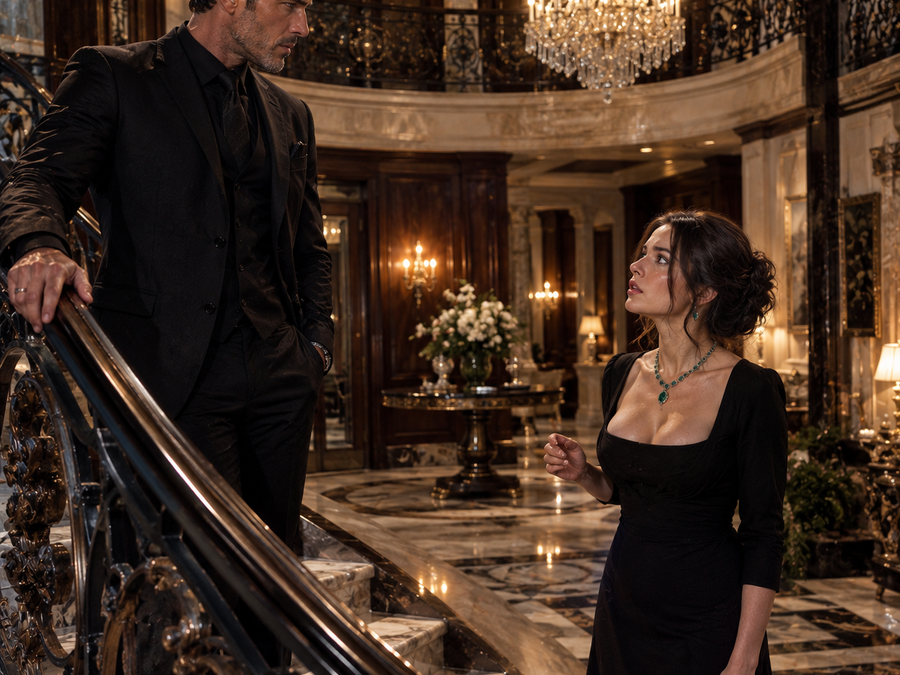
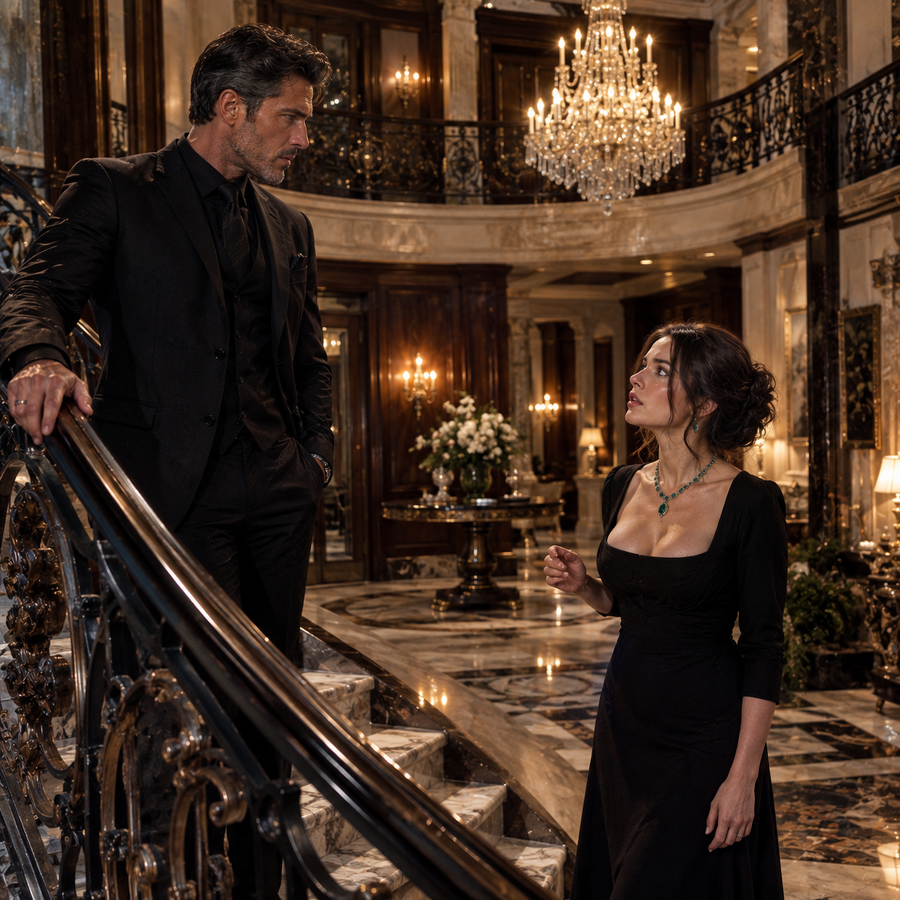
The maid had laid the black dress out on the bed. Long, long-sleeved, a modest neckline in front and cut low in the back. Chosen by Escanio himself. I had learned in just over twenty days of marriage that every gesture of his carried calculation. He dressed me in black not to erase me. He dressed me in black so that no one would doubt to whom I belonged. And even so, he didn’t touch me.
I put the silk robe over my slip, pinned my hair into a low bun, and crossed the second-floor hallway to the jeweler’s room, the chamber where the family kept necklaces, brooches, earrings from generations. Renato had said the night before that I needed to choose a piece from the safe. “Show up with something Malatesta. The women at the party will read that before they read your face.”
I didn’t expect to cross paths with Escanio in the hallway. He came out of the office in a dark robe over his open white shirt. No tie, his hair still wet from the shower. He stopped the instant he saw me. I stopped, too. Between us lay maybe four meters of Persian rug and a hundred years of tension that did not belong to me. “Sorry,” I said, and I don’t even know why I apologized. “I need a necklace.”
Escanio didn’t answer right away. His gaze dropped once over my shoulders, over the curve of silk at my waist, and came back to my face with a coldness so deliberate that it hurt. It was a rehearsed coldness. It was the coldness of a man who must not look twice in order not to fall. “Wear the emerald one,” he said. “It goes with the dress.” “The dress is black.” “That’s why it goes with it.”
He turned his gaze to the hallway window, to anything that wasn’t me, and walked straight past. When his robe brushed against mine, I felt the heat of his body beneath the fabric. Just one second of contact, just the edge of the cloth touching my arm, and even so, my breathing stopped as if someone had pulled a thread. I kept walking as if nothing had happened. But in the mirror of the jeweler’s room, fastening the emerald around my neck, I saw that my hands were trembling.
The necklace was cold against my heated skin. The green of the stone looked almost sarcastic in the reflection, too elegant for a marriage that had never been more than an arrangement. I learned in that instant that the worst kind of desire is the one the other person tries to hide with a stone in your face.
The Franipani mansion sat at the end of a tree-lined street in the Garden District, separated from the world by a wrought iron gate covered in jasmine. The driver stopped before the white stone staircase. Bastiano opened my door before I even touched the handle. Escanio got out from the other side, adjusting his shirt cuff with two precise gestures like a man closing his armor before battle.
“Ma’am,” Bastiano said quietly, offering his arm so I could get out of the limousine without tripping on the length of the dress. “Anything happens, I’ll be three steps away.” “Three steps doesn’t save me from a bullet, Bastiano.” “Saves you from a comment, which hurts more.” I almost smiled. Almost.
Escanio came to my side and offered me his arm without saying anything. I rested my hand on the curve of the black jacket and felt beneath the fabric the tension in the muscles of his arm. Everything about him was on alert. Everything about him was reading the night the way you read a map of war.
We climbed the staircase together. Footmen in white gloves opened the double doors. The main hall swallowed me in a wave of light. Perfume and champagne. The kind of heat that comes from too many people in a closed space. From too many conversations happening at once at a volume too low to seem natural. I had been to New Orleans elite parties before. My father took me on his arm when he still thought I would marry some banker’s son from Atlanta. But the Franipani party was different.
The women wore dresses that looked like armor. The men talked low with glasses held still in the air as if every word were counted and charged. The waiters circulated in absolute silence with trays too heavy for ordinary carriers. It was a party that dressed itself up as a party. Underneath it was something else.
Escanio introduced me to three men whose names I couldn’t keep, kissed the hands of two matriarchs, and led me to the corner where Renato waited with a glass of whiskey in his hand. The consilier greeted me with a bow so small that only I saw it. “Mrs. Malatesta,” he said. “Welcome.” I still hadn’t gotten used to that surname, even less to the way Renato pronounced it, like a man checking a knife before she stepped away to greet someone else.
I stayed with Renato for a while talking about nothing, watching the hall. That was when I saw Gualtiero Franipani for the first time. He stood on the other side of the hall near the main staircase with a glass of champagne in his hand. Thirty-nine years old, tall, broad-shouldered, in a sand-colored suit no one else would dare wear to a formal party. And yet, he looked like the most elegant man in the room. His dark hair combed back, a small smile, eyes that seemed to find the whole world amusing. Eyes that were fixed on me.
