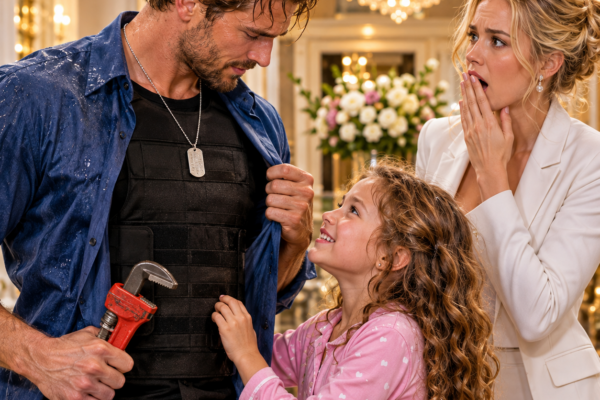
Part 1| Former Navy SEAL Single Dad Took a Bullet for a Little Girl—Then Her Billonaire Mom Changed His Life

Part 1| Former Navy SEAL Single Dad Took a Bullet for a Little Girl—Then Her Billonaire Mom Changed His Life

A single gunshot, then screaming, then 300 people running for their lives.
But Bennett Strad stopped because in the middle of that panicking crowd, he saw a little girl standing completely alone, frozen, 7 years old, staring at a man with a gun pointed in her direction.
He didn’t know her name.
He didn’t know her mother.
He had 17 items on a grocery list and a son waiting at home. None of that mattered.
Bennett ran toward her and the bullet that should have killed that child tore through his shoulder instead. If this is your first time here, welcome.
Hit that subscribe button and follow this channel so you never miss a story like this one. Drop a like and tell me in the comments what city and country are you watching from.
I want to see how far these stories travel. Now, stay with me because what happens next will change everything.
The grocery list had 17 items on it. Bennett Strad had written it at the kitchen table that morning in his particular way organized by section of the store.
Produce first, dairy last.
Nothing left a chance. Because if there was one thing six years of civilian life had taught him, it was that small habits were the architecture of a day.
You planned what you could plan. You controlled what you could control.
And you did not let a Saturday morning turn into a wasted hour wandering between aisles trying to remember whether Milo had finished the orange juice.
He was fairly sure Milo had finished the orange juice.
He wrote it down anyway.
Bennett folded the list into his jacket pocket, checked that the stove was off twice old habit, meaningless, couldn’t stop doing it, and glanced through the kitchen doorway toward the living room where his 8-year-old son was lying on the floor with the book propped against a sofa cushion, reading with the kind of total absorption that Bennett both admired and slightly envied.
“Milo,” the boy didn’t look up.
Milo, I heard you the first time.
Then why didn’t you answer?
Milo turned a page. Cuz I was finishing the paragraph.
Bennett looked at him for a moment. There was something in the way the boy read the slight furrow between his brows.
The way his lips moved just barely on the complicated words that his mother used to do.
Sarah had read the same way, like the story was something she might lose if she stopped concentrating.
I’m going to Cresmont, Bennett said.
Hour and a half, maybe two. Mrs.Zaldara is next door if you need anything.
Milo looked up then finally.
Can you get the cereal with the blue box?
Not the other kind.
The other kind has less sugar.
The other kind tastes like cardboard.
It tastes like grain. Same thing.
Bennett almost smiled.
I’ll get both.
You can alternate.
Milo groaned and dropped his head back toward the book with the theatrical suffering of a child being asked to eat nutritional food.
And Bennett grabbed his keys from the hook by the door and went out into the kind of late October morning that bellweather did well cool without being cold. The sky an honest gray that might clear by noon.
Leaves coming down in the park across the street in slow spiraling arcs. He drove the 12 minutes to Cresmont Galleria without the radio on.
He did most things without the radio on these days. The mall on a Saturday morning had a specific character to it.
Not quite the full chaos of an afternoon that belonged to teenagers and families with strollers, but busy enough that the corridors had movement and sound, the anchor stores already open, the smell of cinnamon from the bakery near the east
entrance, threading through everything.
Bennett tucked his jacket pocket to confirm the list was still there. It was, it always was, and started with the grocery section at the north end.
He found the orange juice, found Milo’s cereal, put it in the basket, found the other cereal, too.
put it in the basket, prepared himself for the theatrical suffering when he got home.
He was standing in the spice aisle, checking whether they had the particular paprika that he’d been using since his neighbor Mrs.Aldara had given him the recipe for her red pepper chicken when the sound came.
A single crack, sharp high, unmistakable to anyone who had heard one before.
The grocery section was on the east side of the mall.
The shot came from the central corridor maybe 200 ft away through the glass partition that separated the grocery from the open galleria.
The sound bounced off tile and concrete and steel, so it was difficult to pin precisely, but Bennett didn’t need precision.
He needed direction and distance, and he had both in the first half second.
He put down the paprika around him. The immediate reaction was the kind of stunned stillness that always preceded the panic.
That gap of two or 3 seconds where everyone in earshot turns toward the sound and tries to make it into something innocent.
A car backfiring, a display falling.
Construction. Then a woman screamed.
The first scream triggering the next, and the grocery section turned into running people. Bennett moved against the current, not sprinting, not yet.
moving fast and purposefully through the surge of bodies, shouldering through the gap between a display stand and a refrigerated case, pushing through the glass partition door as someone else shoved it open from the other side, and nearly took him in the face with it. He absorbed it off his forearm and kept moving.
The central corridor of Cresmont Galleria was wide, maybe 40 ft across, two levels, open ceiling with skylights that brought the gray morning light down onto the polished floors. On any other Saturday, it held the casual geometry of a shopping crowd.
People moving in every direction, kids on the benches, someone pushing a stroller, teenagers grouped outside a phone case kiosk. Now it held 300 people running in one direction.
Their faces the particular white of genuine fear, bags dropped, phones dropped, someone’s coffee cup rolling in a slow arc across the floor.
Bennett took in the corridor in sections the way he’d been trained to, the way he’d never entirely stopped doing.
North end clear. People running.
No shooter.
South end.
More people running.
Someone fallen.
Getting back up.
Middle of the corridor.
A man.
Mid30s. Dark jacket moving erratically near the fountain.
The decorative fountain that sat at the corridor’s center.
Currently dry for winter maintenance.
He had a handgun.
He was shouting something that the noise of the crowd made incomprehensible. His movement was agitated, but not tactical.
someone in crisis rather than someone with a plan, which in some ways made him more dangerous because his trajectory was unpredictable.
And between Bennett and the man with the gun, maybe 15 ft from the shooter, a child, small, 7 years old, maybe less, dark hair and two braids, a purple jacket, a stuffed fox clutched against her chest with both arms.
She was standing completely still in the middle of the corridor while everyone ran around and passed her. And she was looking at the man with the gun with the total frozen stillness of a small animal that has been so frightened its body has simply stopped accepting instructions.
The man swung in her direction. Bennett was already moving.
He covered the distance at a dead run, calculating angles without thinking about it.
He’d have to come from the girl’s left to put his body between her and the shooter.
The pillar at the corridor’s edge was maybe 6 ft past her.
Concrete loadbearing real cover rather than the decorative displays that would stop nothing.
He needed to reach her, move her, get them both behind that pillar before the man’s attention fully locked.
He was close.
He was almost there.
The gun came up. Bennett threw himself the last four feet, hit the floor on his right side, wrapped his arm around the girl, and pulled her with him into the roll.
The shot came simultaneously.
He heard it, felt the impact through his left shoulder, like someone had hit him with a bat, swung with both hands, but the floor was coming up, and he tucked his head and kept the girl against his chest and absorbed the landing with his right side instead.
They slid two feet on the polished floor and came up hard against the concrete pillar. His shoulder was wrong.
He knew it immediately, not just pain, which was considerable, but the specific wrongness of a wound that was using his body’s blood in ways he needed it not to.
He’d been hit before.
He knew the difference between bad and worse.
And this was bad. But the girl was unheard.
She was pressed against his chest, not making a sound, which alarmed him briefly until he heard her exhale. She was breathing, just too frightened to make noise.
Hey. He kept his voice below the level of the continuing chaos.
You’re okay.
You’re going to be okay.
What’s your name?
She stared at him.
It’s all right.
My name’s Bennett.
What’s yours?
Tessa, she whispered.
Tessa. Good.
I need you to stay right here behind this pillar. Okay.
Right here.
You don’t move no matter what you hear.
Can you do that? Her eyes were enormous.
She looked at his shoulder.
You’re bleeding, she said.
I know.
It’s fine.
It was not fine. Will you stay here?
She nodded barely. He pressed her back against the pillar, checked that she was fully behind the concrete, then turned his attention back to the corridor.
The shooter had moved southwest toward the fountain, which he was now partially behind. Not tactical instinct, Bennett assessed, reactive.
He’d fired at movement, missed or near missed evidently, and retreated out of reflex.
The corridor was mostly cleared now.
There were still people pressed into storefronts, behind kiosks, crouched behind planters. The shooter was scanning, agitated, the gun swinging in irregular arcs.
Bennett could hear him shouting now something fragmented and not entirely coherent.
The language of someone in psychological crisis rather than someone executing a plan.
which meant this ended one of two ways.
Bennett waited, reading the man’s movement.
3 seconds, five.
The shooter turned northeast, attention pulled by a noise from that direction. Someone who had panicked and knocked over a display.
Bennett moved. He came out from behind the pillar in a low path, moving southwest, using the concrete planter that sat 8 ft from the fountain as intermediate cover.
His shoulder was affecting his left arm more than he’d like.
The arm wasn’t useless, but it was not entirely reliable, and he adjusted for that.
Preparing to work primarily right-handed, he covered the ground in 7 seconds, reached the maintenance cart that sat near the fountain, one of the mall’s cleaning carts, left by an employee who had rightly evacuated, and grabbed the fire extinguisher, clipped to its side.
The shooter turned.
He saw Bennett. The gun came around.
Bennett threw the fire extinguisher, not like a weapon, like a distraction, a moving object at chest level that required the shooter to react.
And reacting meant the gun arm went up instead of staying trained.
He was already moving when it left his hand, closing the distance in three steps.
Right hand reaching for the shooter’s gun arm.
The extinguisher hit the man in the forearm. Not hard enough to injure.
Hard enough.
The gun discharged into the ceiling.
Bennett got his right hand on the shooter’s wrist, applied the specific leverage he needed, and the gun clattered to the floor.
The man swung with his free arm, caught Bennett across his wounded shoulder, and the world went white for approximately 1 second.
Bennett went down on one knee. The shooter grabbed for the gun.
Bennett kicked it away from both of them, a reflex, nothing elegant about it, and came back up, drove his elbow into the man’s solar plexus with his right arm, and as the shooter folded, Bennett wrapped his right arm around the man’s neck from behind, and held him until the tension went out of his body.
He lowered the shooter to the floor.
His shoulder was very bad now. He became aware of it suddenly and comprehensively, the way pain sometimes waited for the emergency to be over before presenting itself in full.
Bennett sat down on the floor of the Cresmont Galleria because his legs had made a decision he didn’t entirely argue with.
The sound of the space had changed.
The screaming had pulled back.
The running had stopped.
Someone nearby was crying in a way that suggested relief rather than injury. And from somewhere far away, Bennett could hear sirens building.
He looked toward the pillar.
Tessa was already there.
She had come out from behind the concrete, crossed the corridor, and now she stood in front of him, 7 years old, stuffed fox, still clutched against her chest, braids, slightly disheveled, and looked at him with the particular calm that sometimes appeared in children who had
gone past the edge of fear and come out somewhere quieter on the other side.
“You came back for me,” she said.
“You were supposed to stay behind the pillar.
You were sitting on the floor.”
“I’m fine,” he said.
He was very clearly not fine.
Tessa sat down next to him directly on the polished mall floor and pressed her shoulder against his right side the way a small animal might press itself against something solid for warmth.
“I’ll stay here until your bleeding stops,” she said, as though that were a reasonable medical plan.
Bennett looked at this child he had never met in his life.
“Where’s your mom?”
he asked.
Tessa’s composure cracked for the first time just a hairline fracture, a slight wobble in her chin.
“She was at the store at the other end,” she said.
I wasn’t supposed to walk ahead.
A pause, I walked ahead.
She’ll find you, Bennett said.
He leaned his head back against the pillar and closed his eyes for a moment, listening to the sirens getting closer.
His shoulder was informing him of its opinions loudly and continuously. He made a mental note to call Mrs.Aldara and have her stay with Milo if he ended up in the hospital, which was beginning to look likely.
He also made a note to return to this particular grocery store on a different Saturday when the probability of getting shot was presumably lower. Tessa stayed pressed against his right side, not speaking.
The stuffed fox’s glass eyes staring at the ceiling.
He didn’t ask her to move.
The sirens arrived and then there was the sound of running footsteps.
Not the panicked running of before, but the focused searching running of a mother who has not found her child and is covering ground as fast as her legs will carry her.
Tessa. Tessa.
The voice came from his left and Tessa’s head lifted sharply and she was on her feet before he could do anything, running toward a woman who had just burst around the corner of an evacuated kiosk and who dropped to her knees when she saw her daughter coming.
They collided.
The woman, dark coat, dark hair, pulled back from a face that was currently doing the thing that faces do when terror and relief arrive at the same time, and the body doesn’t know which to show, held her daughter with both arms.
And for a long moment, neither of them said anything at all. Bennett watched from the floor.
He watched the woman pull back slightly and run her hands over her daughter’s arms, her face, her hair checking, cataloging, doing the inventory of a parent who needs to know with her hands that everything is present and undamaged.
He had done that exact thing with Milo once after a bicycle accident two years ago that had been less serious than it looked, but which had required him to physically confirm with his own hands that his son’s arms and legs were all accounted for.
He understood the compulsion entirely.
Then Tessa turned.
She pointed at Bennett sitting against the pillar, left arm useless, jacket dark and wet on the shoulder, and said something that her mother couldn’t quite hear from across the space.
The woman looked up.
She met Bennett’s eyes across 15 ft of empty mall corridor.
He could see the moment she processed what she was looking at, who was sitting there, why the floor around him was darker than it should be, what her daughter was trying to tell her. Tessa pulled away from her mother and walked back across the corridor.
and Bennett watched her do it.
She crouched down in front of him and held out the stuffed fox, the one she’d been clutching since the moment he’d first seen her.
“You can borrow Felix,” she said seriously.
“Until your shoulder stops hurting.
I can’t take your fox,” he said.
“I’m not giving him to you.
I’m lending him.
There’s a difference.”
He looked at the fox.
It was soft, clearly well-loved, one ear slightly flattened from years of being held.
“Okay,” he said.
He took the fox.
Tessa went back to her mother.
The paramedics arrived 40 seconds later and found a 37-year-old man with a gunshot wound to the left shoulder sitting on the floor of a shopping mall holding a child’s stuffed animal, looking at nothing in particular, bleeding steadily and apparently in no hurry to be concerned about any of it.
One of the paramedics asked if he could tell them his name. Bennett Strad, he said.
Are you in pain, Mr.Strad?
Some.
What’s your pain level on a scale of 1 to 10?
He thought about it. Six.
It was an eight, but he’d always called things lower than they were.
They got him onto a stretcher, and as they wheeled him toward the north entrance and the waiting ambulances, he tilted his head back and caught one last glimpse of the corridor, the abandoned coffee cups, the dropped bags, the crack in the tile where the fire extinguisher had landed, the fountain sitting dry at
the corridor’s center, the pillar with the small scuff mark on its base, where a seven-year-old girl had pressed her pressed herself against the concrete and waited for a stranger to come back.
The doors opened.
Cold October air.
Bennett closed his eyes against the white sky and held a stuffed fox against his chest like it was something that mattered. Somewhere behind him, among the gathering emergency vehicles and the mall security personnel and the arriving federal agents and the small crowd of people who had emerged from their cover now that the sirens had come, a woman stood with her arms around her daughter and watched the stretcher disappear through the doors.
She didn’t know his name yet.
She didn’t know anything about him yet, what he had done before he became a man with a grocery list, what he had lost, who was waiting for him at home.
She only knew what she had seen.
A man who had absolutely nothing to gain from running toward that child, who ran anyway, who sat bleeding on a shopping mall floor and let her daughter lend him a stuffed fox as though that were the most natural arrangement in the world.
Marceline Voss held Tessa tighter, and she didn’t look away from those doors until long after the ambulance had gone.
The hospital room at Bellweather Regional had a window that faced a parking structure, which meant the view was concrete and fluorescent light and the occasional pigeon navigating the gap between levels. Bennett had been looking at it for 2 days.
He had cataloged every crack in the visible facade, every vehicle that came and went from the third level, every pigeon that landed on the ledge across the way, and then thought better of it. There was not much else to do when your left arm was immobilized.
Your shoulder had been surgically repaired and the nursing staff had confiscated the one book he’d asked Mrs.Aldara to bring because the surgeon had said no reading for 48 hours which Bennett suspected was a policies invented by someone who had never been confined to a bed facing a parking structure.
Milo had visited the first evening brought in by Mrs.Aldara, who was a 63-year-old retired school teacher from Two Doors Down, who had been filling the role of emergency grandmother since Bennett moved into the neighborhood four years ago. Milo had walked into the room, seen his father in the hospital bed with the IV line and the shoulder dressing, and stood completely still in the doorway for a long moment.
“You got shot,” Milo said.
“I did on purpose.”
The being shot part wasn’t on purpose.
The reason I was where I was, that was a choice.
Milo came in and sat in the chair beside the bed.
He was 8 years old, and he looked at his father with the particular expression he had inherited from Sarah, the one that meant he was processing something and would not be rushed through it.
“Were you scared?”
he asked finally.
“Yes,” Bennett said.
“Because he didn’t lie to his son about things that mattered.
Milo considered this. But you did it anyway.
There was a little girl.
She couldn’t get out of the way herself.”
“Oh, another pause.
Is she okay?”
She’s fine.
Milo nodded slowly.
Then he reached into his jacket pocket and produced a folded piece of paper, which he set on the bed next to Bennett’s right hand.
It was a drawing Milo’s drawings were always recognizable, if not technically accomplished accomplished, of what appeared to be a man with a bandage on his shoulder standing in front of something that might have been a building or might have been a large sandwich.
“That’s you,” Milo said,
pointing to the figure.
“And that’s our house.
I drew it so you know what you’re coming home to.”
Bennett looked at the drawing for a moment.
“That’s good,” he said.
“That’s really good, Milo.”
“It was not technically a good drawing, but it was the right drawing at the right time, and Bennett folded it carefully and held it in his right hand, and Milo seemed satisfied with this, and they talked about the cereal both kinds had made it home in the grocery bag, which Mrs.Aldara had retrieved from the mall after the scene was cleared until visiting hours ended.
The second day was quieter.
A federal agent came and took his statement, which was straightforward and took 40 minutes.
The surgeon came and told him what he already knew.
The bullet had passed through the outer edge of the deltoid and the upper trapezius, missing the joint itself by what the surgeon called an uncomfortable margin, and gave him a recovery timeline that Bennett noted, and then privately discounted by about 30%.
because recovery timelines given to people who had not previously spent a decade in naval special warfare were calibrated for a different population.
He was thinking about the warehouse.
Specifically, he was thinking about the fact that his warehouse supervisor, a practical man named Gentry, who Bennett genuinely respected, had called that morning to say that the company’s disability policy covered six at partial pay and that they’d hold the position.
But that 6 weeks was 6 weeks and there wasn’t much flexibility beyond it.
Bennett had thanked him and said he understood because he did understand. Business had its arithmetic.
He was not the center of anyone else’s equation.
He did the math in his head while he stared at the parking structure. 6 weeks at partial pay, then returned to full shifts or the position was filled.
His shoulder would need 12 weeks minimum of serious rehabilitation before it could handle the lifting requirements of the warehouse floor, which meant either he was back before he was ready or he was out of a job. He had savings 4 months, maybe five if he was careful.
After that, the calculation got uncomfortable.
This was where his mind was when the knock came on the open door.
He turned.
Marceline Voss was standing in the doorway of his hospital room in a dark gray coat and Tessa was beside her holding her mother’s hand with one hand and Felix the stuffed fox with the other.
The fox he’d apparently returned.
At some point he had a vague memory of handing it back in the corridor before the paramedics loaded him, though the details of that particular minute were not entirely clear.
“We called ahead,” Marceline said.
The nurse said it was all right to come.
“It’s fine,” Bennett said.
He made an automatic and feudal attempt to sit up straighter with one arm immobilized, abandoned it.
Come in, they came in.
Tessa went immediately to the chair beside the bed, the same one Milo had occupied the night before, and climbed up into it and set Felix on the bed rail with the particular careful ceremony of a child placing something important.
He’s for you, she said.
Until you’re better, Tessa Marceline said, “We talked about this.
We can’t.
I’m lending him.”
Tessa said firmly.
I told him at the mall.
It’s already decided.
Bennett looked at the fox on the bed rail.
He looked at Tessa, who had the expression of someone who had said everything relevant to the subject and saw no need to continue the negotiation. Thank you, he said.
I’ll take good care of him.
Tessa nodded, satisfied, and leaned back in the chair.
Marceline pulled the second chair closer to the bed and sat in it. And for a moment she simply looked at him, not the searching way.
She’d looked at him across the corridor, but steadier, more deliberate, the look of someone who has had 48 hours to decide what they want to say and has arrived at the room still not entirely certain.
I don’t know where to start, she said.
You don’t have to start anywhere.
My daughter would have been, she stopped, reset.
I had one job that morning.
One job which was to keep track of a 7-year-old in a shopping mall, and I failed at it.
And a stranger, she stopped again, and Bennett watched the control in her face, which was considerable, but not absolute.
A stranger who had no obligation whatsoever, decided to fill the gap I left. She walked ahead, Bennett said.
Kids do that.
Don’t be gracious about it.
I’m trying to thank you, and it’s hard enough as it is.
He looked at her.
Okay, thank you, she said.
I mean it in a way I don’t have adequate language for.
I’ve been composing this conversation in my head for 2 days, and every version of it sounds like a Hallmark card.
And that’s not that’s not what I’m trying to say.
What I’m trying to say is that you saw a child in danger and you put your body between her and a bullet without knowing who she was and there is no amount of money or she caught herself.
I’m sorry I had a whole speech.
I could tell.
He said it’s a good speech.
Something shifted in her face.
Not quite a smile but adjacent. What would you have done?
She asked.
If you’d let yourself think about it for a second.
If you’d stopped and waited.
Bennett thought about it honestly.
I don’t know, he said.
I didn’t stop and weigh it, so I can’t tell you what would have happened if I did.
I just saw her standing there. Marceline was quiet for a moment.
My name is Marceline Voss, she said. I know.
The news ran with it.
She made a small sound of mild resignation.
Of course they did. She folded her hands in her lap.
And you’re Bennett Strad.
The news ran with you, too, for what it’s worth, though they had less to work with.
Good. Can I ask you something?
Sure. The way you moved, she said.
the way you assessed the space and moved through it and handled that man.
That’s not just a warehouse worker.
He didn’t answer immediately.
He looked at the parking structure through the window at the pigeons.
No, he said it’s not.
She waited.
Maybe he said seal 11 years roughly. Roughly 11 years, 2 months and some change.
I stopped keeping track of the change at some point. He shifted his right hand on the blanket.
My wife died 6 years ago.
Milo was two. I left the teams and came home to be his parent.
I’m sorry, she said.
About your wife. Thank you.
The room was quiet.
Tessa had fallen asleep in the chair, which seemed impressive given the stiffness of hospital chairs, but which Bennett had observed was a skill that children possessed, and adults gradually lost the ability to sleep anywhere in any position without warning or apparent
effort.
“What do you want to do?”
Marceline asked.
“When you’re out of here.”
I’m asking because I need to be clear about something.
I’m not here to write you a check and consider the matter closed.
I’ve been thinking about that and I won’t insult you that way, but I am going to offer you something and I want you to hear me out before you say no.
He looked at her.
What kind of something?
I run a company Voss Meridian Systems Cyber Security. We design and manage security infrastructure for federal contractors, financial institutions, defense adjacent.
About 400 employees headquarters on the north side of Bellweather.
satellite offices in three other cities.
She paused.
Our head of physical security retired 8 months ago.
I’ve been using a contract firm to fill the gap.
They’re acceptable.
They’re not good.
You want to hire me, Bennett said.
I want to hire you to tell me why my security is failing and fix it. Not as charity.
As a contractor initially with a path to permanent if it makes sense for both of us, she held his gaze.
I’ve done enough background research in the last 48 hours to know that you ran asset protection for three different operations in the Gulf that your unit success rate was minus.
Where did you get that? I told you I run a cyber security company.
Finding information is what we do.
A pause.
I’ll pay you three times what the warehouse pays.
And I can accommodate your recovery timeline.
The first month is mostly assessment and consultation.
Nothing physical.
He looked at her for a long time. Why is your security failing?
He asked.
That’s what I need you to find out.
Do you have a guess?
She was quiet for a beat too long. I have a concern.
What kind of concern?
The kind you don’t put in an email.
She glanced at her sleeping daughter, then back at Bennett.
I’ve had two separate incidents in the last 3 months that our current security firm classified as equipment malfunctions.
A server room camera going offline during a maintenance window.
an access log that wasn’t logging for 6 hours on a day when I know people were moving through that area.
She kept her voice even.
Both incidents were isolated. Both were explained.
Both were plausible. I found myself thinking about them more than I should if I actually believed those explanations.
Bennett said nothing listening.
I have something valuable.
She said, “A platform we’ve been developing for 4 years.
An encryption system.
I won’t go into technical specifics because it would take 2 hours and most of it would mean nothing without context, but if it works the way our development team believes it will, it changes how a certain class of federal security infrastructure operates.
Fundamentally changes it. She paused.
There are people who would benefit considerably from having that system before we’re ready to bring it to market or from having it instead of us.
You think someone inside your company is helping someone outside get access to it?
I think I have two equipment malfunctions that I can’t stop thinking about.
It wasn’t a yes, but it wasn’t a no.
And Bennett had spent enough years reading the gap between what people said and what they actually knew to understand what she was telling him.
I’ll need full access, he said.
Every system, every log, every camera placement.
I’ll need personnel files for anyone with access to the relevant infrastructure, including your senior leadership team.
Marceline nodded.
Done.
And if I find something, you don’t get to decide how much of it I tell you.
Whatever I find, you hear all of it.
Agreed.
Even if it’s someone you trust.
She held his gaze without flinching.
Especially then.
He looked at the parking structure at the sleeping child in the chair beside his bed, her small mouth slightly open, one hand still loosely holding the stuffed fox.
“When do I start?”
he said.
He was out of the hospital in 4 days, which was 2 days ahead of the surgical team’s recommendation, and which the discharging nurse communicated her opinion of without using any particular words, mainly through the way she handed him the aftercare paperwork.
Bennett thanked her, meant it, and went home to the house on Carver Lane, where Milo had rearranged the living room slightly to make a path from the front door to the couch that didn’t require his father to raise his left arm.
“Mrs.Aldara
helped,” Milo said.
said, “But it was my idea.
It was a good idea.
You’re not supposed to lift stuff.”
The nurse called Mrs.Aldara and told her. The nurse was thorough.
She said, “You checked yourself out early.
I was ready to come home.”
Milo looked at him the way he’d been looking at him since the hospital.
That same careful measuring looked that 8 years old shouldn’t have but which his son had carried since the age of five, when he had apparently decided that the world contained a specific and notable category of things that could take your father away without warning.
and that he was responsible for monitoring those things.
You’re not going back to the warehouse.
Milo said it wasn’t a question.
No, I have something else, something better.
Better how? Better pay, better hours, better match for He stopped, tried again.
I’m going to be doing what I used to know how to do at a company that needs someone who knows how to do it.
Milo processed this.
The woman from the hospital?
Her company? Yes.
Her daughter is the girl you?
Yes.
Milo was quiet for a moment.
Tessa, he said.
That’s her name.
She told me when I visited her mom brought her to meet me.
A pause.
She’s weird.
Bennett looked at his son. Weird how?
She asked me if I knew how to play chess.
And when I said no, she told me that was unfortunate. Milo appeared to be replaying this conversation with some lingering confusion.
Who says that?
A 7-year-old who’s been around too many adults probably.
She said she’d teach me if I wanted.
She said chess was better than video games because in chess you have to think about what the other person is thinking about.
That’s actually accurate.
I know.
That’s why it was weird.
Bennett almost smiled.
He spent the first week at home doing the recovery work, the physical therapy exercises that were less dramatic than they sounded, the twice daily dressing changes, the tedious business of relearning what his shoulder could and couldn’t support.
He checked in with Marceline by phone three times, getting basic information about the company’s infrastructure layout, number of access controlled areas, camera system vendor.
What she told him matched what he’d expected from the outside, solid but not exceptional, the kind of security that was adequate until it wasn’t.
On the eighth day, he drove himself to Voss Meridian headquarters. The building was a 12story glass and steel structure on Bellham Avenue, 10 minutes from the waterfront with underground parking and a lobby that had two security desks and a badge system that looked a modern until you looked at it carefully and noticed that two of the four readers at the main entrance had indicator lights
that were slightly the wrong color amber when they should have been green, which meant they were running on auxiliary power, which meant something in the primary circuit had failed and been routed around rather than repaired.
He noted it and went in.
Marceline met him in the lobby herself, which he hadn’t expected.
She looked different here than she had in the hospital, not warmer or colder, exactly, but more precise.
This was her terrain. She moved through the lobby with the particular ease of someone who had built the space and knew every function of every system in it.
And the staff they passed responded to her with the specific attentiveness that came from genuine respect rather than the performance of it.
I’ll take you through the main floor first, she said.
Then the server infrastructure on suble 2, then the development wing on floors 8 and 9, which is where our encryption work is housed.
Before that, Bennett said, “Your two front readers on the main entrance are running Amber.”
She stopped walking.
“I was told those were updated last month.”
She said they were updated.
They’re running on auxiliary.
Whatever the primary issue was, it got routed around, not fixed.
That means you have a gap in the power redundancy for your primary access control, which means if someone wanted to create a gap in your access logging, they’d have a significantly easier time with these readers than with the ones running on full primary.
She looked at the readers, then at him.
We’ve been in the building 30 seconds, she said.
I’ve been looking since the parking structure.
She said nothing for a moment, then took out her phone and typed something.
I’ll have facilities pull the maintenance records this afternoon.
I’ll want to see them, obviously.
She put the phone away. Come on.
They spent 4 hours walking the building. Bennett moved slowly and thoroughly, not because of his shoulder, which was an inconvenience rather than a limitation at this level of activity, but because the building needed slow and thorough.
He cataloged camera placements and identified six blind spots that weren’t in the system documentation.
He pulled up the access log interface and found two instances where the timestamp sequencing had minor irregularities that suggested the logging software had been paused and restarted rather than continuously running. He checked the service corridors on the suble and found a maintenance hatch that the current documentation listed as welded shut but which opened with a standard key.
Marceline walked beside him through all of it and she didn’t interrupt.
She asked questions, occasionally good ones, practical ones, the questions of someone who understood infrastructure, even if she h hadn’t been trained in the specific language of security assessment.
But mostly she watched him work, and he was aware of being watched in a way that was not uncomfortable, just present on the eighth floor in the corridor outside the development wing. They stopped.
“How bad is it?”
she asked.
“It’s not the worst I’ve seen,” he said honestly.
“It’s also not okay.
You’ve got coverage gaps that are systematic enough to feel patterned.
That’s what concerns me more than any individual failure.
Patterned.
When things fail randomly, they fail randomly.
When failures cluster around specific functions, access logging, camera coverage, power redundancy at entry points, that pattern means something.
He kept his voice level.
I’m not telling you I know what it means yet.
I’m telling you the pattern is there, and I’m going to find out where it leads.
She was quiet for a moment, looking at the closed door of the development wing.
I have 37 people behind that door.
She said, “People who have been with me for years.
People I She stopped.
I don’t want to believe any of them.
I know.
But you’re going to look at all of them.
Yes, including me.”
She said, “You should look at me, too.
I’m giving you that permission explicitly because you should have it.
and because if you find anything that points in my direction, even if I’ve orchestrated this whole thing to mislead you, I want you to follow it.
” He looked at her.
Why are you telling me that? Because I need you to actually trust me, and the only way to actually trust me is to verify me.
So verify me. She held his gaze.
I haven’t done anything wrong.
But I need you to know that through your own investigation, not through my telling you. He nodded once.
All right. She pushed the wing door open and the sound of 37 people working filled the corridor.
He went through personnel files at night after Milo was asleep sitting at the kitchen table with his laptop and the coffee going cold beside him. He built his own spreadsheet, not sophisticated, just organized cross-referencing access credentials against log timestamps, noting who had authorization to what systems, who had accessed what when, and which access events coincided with the window of the camera outage and the logging gap that
Marceline had flagged.
It took him 9 days. On the ninth day, he had two names.
The first was a systems engineer named Drew Callaway, 34 years old, 7 years with the company, whose access card had swiped into the sub-level server room at 11:47 p.m.On the night the camera went offline, which was notable because Callaway’s badge records showed he was logged out of the building by 6:30 p.m.that same evening.
Someone had used his credentials after he’d physically left.
Either someone had cloned his card or Callaway had come back through an entrance that wasn’t logging.
Given the maintenance hatch on sublevel, it could be either. The second name was worse.
Richard Soain, 51 years old, head of company security for 9 years, the man whose departure had created the vacancy Marceline was now trying to fill with Bennett.
So had technically retired 4 months ago, but his master override credentials, the security chief’s full system access that should have been deactivated on his last day, were still active, and they had been used twice in the last 6 weeks in access events so brief they might have been logged as system errors if Bennett hadn’t been looking for exactly this pattern.
So hadn’t retired, or rather, he had retired from the role, but not from the access it gave him.
Bennett sat at his kitchen table at 11:30 at night and looked at both names for a long time. Then he picked up his phone and called Marceline.
She answered on the second ring, which meant she was awake, which meant he wasn’t the only one losing sleep over this.
I have something, he said. A beat of quiet on her end.
How bad it’s contained.
I know who and I know how.
I don’t yet know the full scope of what they’ve taken or who’s on the outside receiving it.
He paused. One of the names is Soane.
The silence that followed was longer.
He waited through it.
“How sure are you?”
she said finally.
“Sure enough that I’m calling you at 11:30 instead of waiting until morning.”
Another silence.
He heard her exhale a controlled breath, the kind you took when something you’d been afraid was true turned out to be true, and you’d spent enough energy on the fear that the confirmation almost felt like relief.
“Swain hired three of the people on our current floor security,” she said quietly.
“I know that’s the next layer I need to look at.
What do we do?
We don’t move yet, Bennett said.
If Callaway and Soain know they’re being watched, whatever they haven’t already transferred to the outside gets moved immediately or destroyed.
We need to know what’s been accessed, what’s been copied, and who’s waiting on the other end of this thing before we bring federal investigators in.
How long? Two weeks, maybe three.
The encryption project has a government demonstration in 6 weeks, she said.
If someone on the outside already has working access to the system, I know we’ll move before it becomes a problem.
He paused.
I need you to act normally.
Both of you, you and Callaway specifically. I need him to believe nothing has changed.
I can do that.
She said he didn’t doubt it.
Marceline.
He said her name carefully.
The way you said something when the word itself carried weight. One more thing.
When I was doing the log analysis, I found something that wasn’t in the security documentation.
He waited a beat.
Someone has been pulling your personal schedule data.
Not the company calendar your private appointment system and Tessa’s school routing.
The pickup schedule, the route your driver takes.
The silence this time was different in quality, shorter and harder. How long?
She said.
The earliest flag I can trace is 8 weeks ago. He heard something shift on her end of the line.
A sound that might have been her sitting down or standing up. something changing position because the body needed to move when the mind received certain information.
They’re not just after the system, she said.
No, he said they’re not.
Outside the kitchen window, Carver Lane was empty and quiet. The street light at the corner put a yellow circle on the wet pavement and a car moved through it slowly and was gone.
Everything looked the same as it always did at this hour, the neighborhood settling into its night sounds, ordinary and still.
But Bennett looked at it differently now than he had three weeks ago when he’d driven to a shopping mall with a grocery list and nothing more dangerous on his mind than which brand of orange juice his son preferred.
I’ll find out who’s on the other end, he said.
I’ll close it before they can use what they have.
And if you can’t, she said not desperate, just straight.
Then we call in federal support earlier than I’d like and deal with the gaps.
Okay, she said.
Bennett. Yeah, thank you again.
A pause.
I keep ending up thanking you.
You hired me, he said.
That’s different, is it?
He thought about this honestly about whether there was a clean line between a man who ran toward a stranger’s child because he couldn’t do otherwise and a man now sitting at his kitchen table at 11:30 at night running access logs to make sure that same child’s school.
Route wasn’t being used as leverage against her mother.
Probably not, he said.
She was quiet for a moment, and in the quiet, there was something he didn’t try to name or reach toward.
Just acknowledge the way you acknowledged whether something present and real that you weren’t going to pretend wasn’t there.
Good night, she said.
Good night. He put the phone down and looked at the spreadsheet.
Then he looked at the drawing Milo had made him in the hospital, which he taped to the cabinet above the stove, the bandaged figure, the house that might have been a large sandwich.
He thought about Milo’s description of Tessa.
That chess comment who says that the logic of it that to understand the game, you had to understand what the other player was thinking about. That the point was not the pieces in front of you, but the person across from you.
He pulled the laptop closer. He had two names and a pattern and the beginning of a shape in his mind of what was coming.
He needed to understand what the other player was thinking about. He went back to work.
Part three. The call came at 7:43 in the morning.
Bennett was in the sub-level corridor beneath Voss Meridian headquarters, standing in front of an open electrical panel with a flashlight and a tablet tracing the secondary power routing that fed the server rooms auxiliary systems.
He had been there since 6:15 before most of the building staff arrived because the work that mattered most was the work done before people started moving through spaces and leaving the particular noise of their presence in the data.
He’d learned that in the teams and never unlearned it.
The early hours had a clarity that the rest of the day couldn’t replicate.
His phone buzzed in his jacket pocket.
He didn’t recognize the number.
He answered it anyway because in the last 3 weeks he had developed the habit of answering numbers he didn’t recognize.
Mr.Straoud.
The voice was male flat, professionally neutral in the way that voices were when the person on the other end had rehearsed their tone.
We have your son.
The electrical panel ceased to exist.
The sub-level corridor ceased to exist.
Everything reduced to three words and the specific quality of silence that followed them.
Milo Bennett said.
His voice came out leveled, which was a physiological response he did not choose and did not feel.
The interior of his chest was doing something that had no accurate name in any language he spoke.
He was picked up on Avery Street at 7:18.
He’s unheard.
Whether he stays that way depends on what happens in the next 40 minutes. Let me talk to him.
A pause.
a sound of movement.
Then Milo’s voice tight, trying to hold itself steady, the way his father held things steady, mimicking a composure he’d learned from watching Bennett, without ever being taught it explicitly.
Dad, I’m here.
Bennett pressed his back against the corridor wall, not because he needed the support, but because he needed to know where the wall was.
Are you hurt?
No, there’s two men.
I’m in a car.
I can’t.
A sound on the other end. Brief, not violent, just the sound of the phone being moved.
The flat voice returned.
Marceline Voss comes alone to the Delmore parking structure on 9th Avenue in 40 minutes. She brings the biometric key and the authentication token for the Meridian encryption system.
She comes without security, without a phone. If we see anyone else, any police presence, any surveillance, we execute the boy.
She doesn’t have the full authentication.
Bennett said she needs both the physical token and a secondary confirmation from a locked terminal.
You can’t.
40 minutes, the voice said.
If she’s not there in 40 minutes, you’ll receive proof that time has run out.
The line went dead.
For exactly 2 seconds, Bennett stood against the wall and let the information settle in his body, because panic was a luxury, and he had never been able to afford it.
Not in the water off the coast of somewhere he couldn’t name.
Not in the dark corridors of buildings that wanted to kill him, and not now in a sub-level corridor under a glass office tower in Bellweather, Virginia, with 40 minutes on a clock that had already been running for 11 of them. Then he moved.
He was calling Marceline before he reached the stairwell.
She answered on the first ring, and he could tell from her voice that she’d already heard something, not the call, but the shape of something wrong.
The way the building’s atmosphere had shifted in some way she hadn’t been able to name yet.
They have Milo, he said.
Delmore structure on 9th 40 minutes. They want you with the biometric key and the authentication token.
No security, no phone.
They said they he didn’t finish the sentence.
He didn’t need to.
Silence from her end.
3 seconds of it, which was an eternity.
Bennett, don’t listen to me.
They’re not planning an exchange.
If you walk into that structure alone with the credentials, you don’t come out of it.
They want the authentication and they want to remove both witnesses who can testify to the conspiracy. He was moving up the stairwell now, taking the steps fast without letting his shoulder dictate the pace.
This is a termination event wrapped inside a ransom demand. The ransom is the cover.
Where is he?
Do you know where? 9inth in Delmour is 12 blocks northeast.
The structure is eight levels. Open face on the north side.
He was through the stairwell door now onto the ground floor, crossing the lobby toward the parking exit. The vehicle they used was on Avery Street at 7:18.
That’s near his school, which means they picked him up on the walk.
His driver, he walks Tuesdays and Thursdays.
He told me, “Bennett pushed through the parking exit door into the cold morning air.
I need you to listen to me very carefully.
They’re focused on you, your arrival, your credentials, your physical presence.
That’s where their attention is going to be, which means they’re not going to be fully focused on the perimeter.
He heard her breathing on the other end, controlled, measured, the breathing of someone holding themselves together by force of will. What do you need me to do?
She said, he was already at his car. He got in, put the phone on speaker on the passenger seat, started the engine.
I need you to be visible.
You agree?
You’re compliant.
You’re scared.
All of that is fine because it’s honest.
They know you’re scared.
They’re counting on it.
I need you to call Agent Reyes from the federal team and give him the location.
Then you put your phone away and you go to that structure in your car with your driver because if you go alone and something goes wrong, there’s no one who knows where you are.
They said no security. They said no police presence and no security they can see.
Your driver waiting in a vehicle on the street is not a tactical threat to them.
It’s a mother arriving in a car.
The structure is on a public street.
They can’t control every vehicle on 9th Avenue.
And you?
I’ll be there before you are.
Bennett, your shoulder. Marceline.
He said her name with enough weight to stop her.
I know what I’m doing.
Let me do it.
A pause.
He’s 8 years old, she said.
Her voice dropped on the last two words in a way that had nothing controlled about it.
I know what he is, Bennett said.
I’m going to get him.
He ended the call because there was nothing more to say and pulled out of the Voss Meridian parking structure onto Bellham Avenue and turned northeast.