SEAL Admiral Slapped a Single Dad Before 10,000 Soldiers — Unaware He Was a Legendary Navy SEAL (Part 1)
SEAL Admiral Slapped a Single Dad Before 10,000 Soldiers — Unaware He Was a Legendary Navy SEAL (Part 1)
PART 1
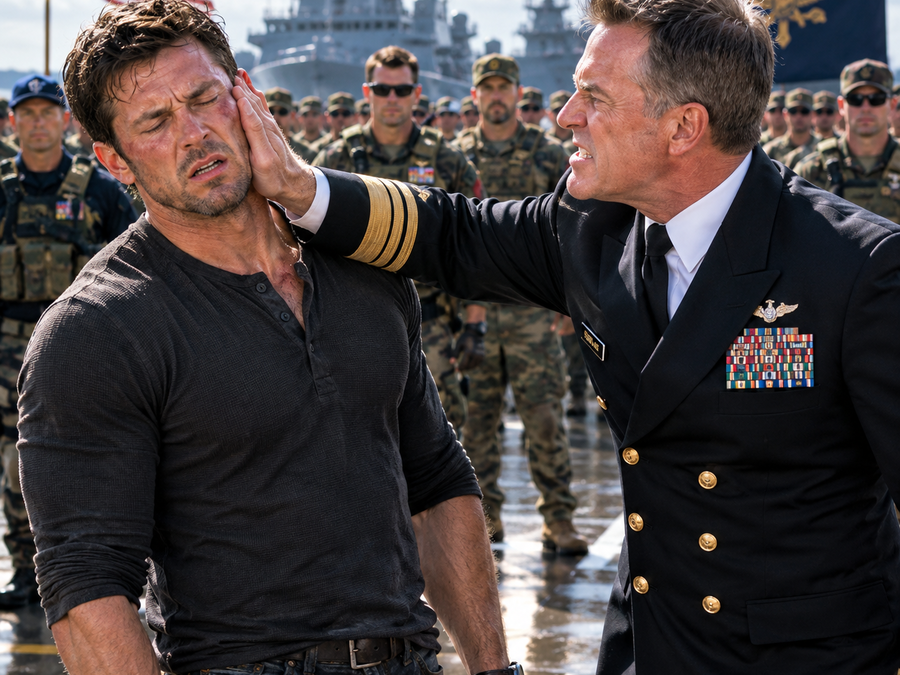
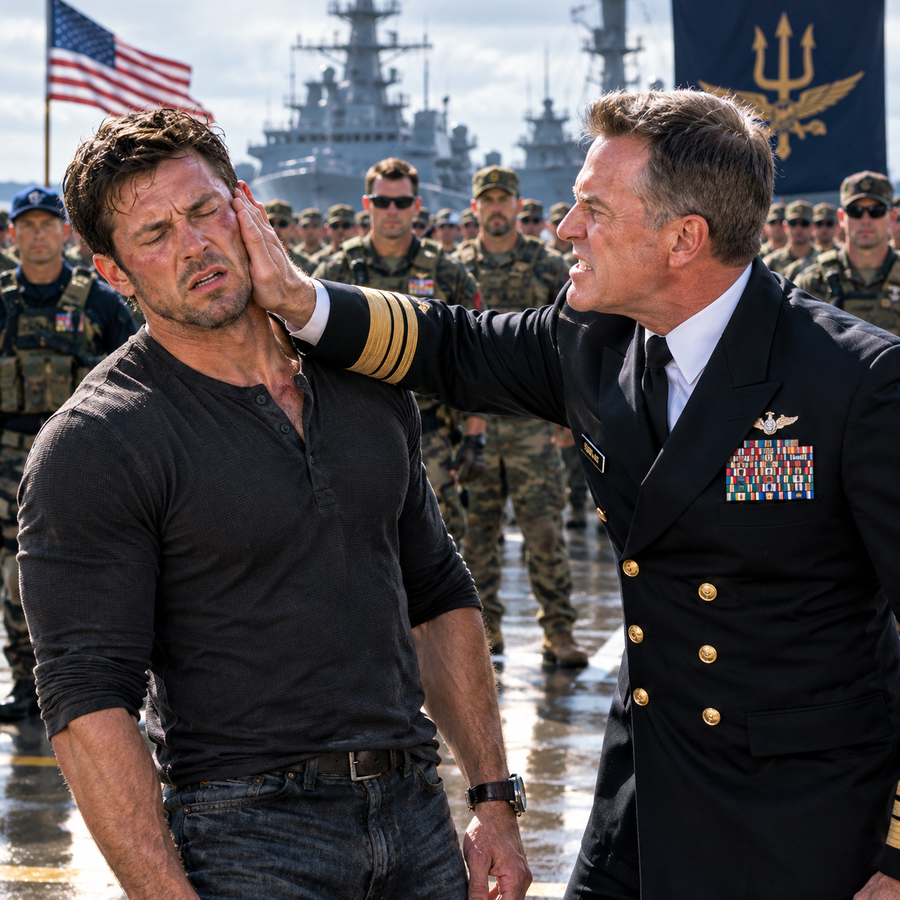
The admiral’s hand came back and struck Adrien Brooks across the face so hard the sound cracked over ten thousand men like a rifle shot.
Nobody moved. Nobody breathed.
Adrien didn’t stumble.
He didn’t raise his hands.
He just stood there, a box of emergency medical supplies still clutched against his chest, blood beading at the corner of his mouth, and he smiled. Not with anger.
With something far more dangerous.
Something ten thousand soldiers had never seen on the face of a man who’d just been humiliated.
Because what Admiral Richard Vaughn didn’t know—what nobody on that parade ground knew—was that the quiet single father he’d just slapped had once carried a nation’s most impossible missions on his back.
And his name still made enemies whisper in the dark. The morning it happened, Adrien Brooks woke up at 4:15 a. m.
Same as every morning. And the first thing he did was check on his daughter.
He didn’t turn on the light.
He never did.
He just eased open the door to Lily’s room and stood there in the dark, listening for the soft rhythm of her breathing.
The way a man listens for something he’s afraid to lose.
She was seven years old.
She slept with one arm thrown over a stuffed rabbit that had lost an eye two Christmases ago, and Adrien had sewn a button back on it at midnight because she couldn’t sleep without it.
Nobody at the base knew he did things like that. To them, Adrien Brooks was the logistics guy. The civilian in the tan coveralls who drove the supply cart, who knew where every crate was stored, who fixed the loading dock hydraulics when the contractor said it would take three weeks.
He was polite. He was quiet.
He was the kind of man people talked over in the break room without ever noticing they were doing it. And that was exactly how he wanted it.
He made Lily’s lunch before she woke up.
Peanut butter, crusts cut off, a note tucked inside the way he always did.
Today’s said, “Be brave.
Be kind.
Dad loves you more than the whole sky.”
He’d been writing her a note every single day for two years, ever since her mother left.
He never missed one. Not when he had the flu.
Not when the base flooded. Not once.
Because Adrien had learned something in another life—a life he never talked about.
He’d learned that the men who survive are the ones who never break routine.
Who never let the small disciplines slip. You keep the small promises, and the big ones keep themselves.
He dropped Lily at the base daycare at 6:30.
She hugged his leg and looked up at him and said, “Daddy, are you going to be a hero today?”
He crouched down to her level.
“I’m going to deliver some boxes, baby.
That’s about as heroic as it gets.”
She giggled.
“You’re my hero anyway.”
He kissed the top of her head.
“Damn right I am.”
He didn’t know.
Couldn’t know.
That by the end of that day, ten thousand strangers would be calling him exactly that word. The base was buzzing before dawn.
Everybody knew about the readiness ceremony. It had been in the works for months.
A massive joint demonstration, brass flying in from Washington. Nearly ten thousand personnel from four commands assembling on the main parade ground. Sailors, Marines, special warfare units.
The whole spectacle. Flags and formations and speeches about strength and sacrifice.
Adrien didn’t have anything to do with the ceremony.
His job was the boring part. Making sure the medical stations along the perimeter were stocked, the water was distributed, the emergency kits were where they were supposed to be.
He’d been at it since five that morning, driving his cart back and forth, checking boxes off a clipboard.
Around 9:40, his radio crackled.
“Logistics, this is Medical Station 4.
We got a situation.”
Adrien keyed the handset.
“Go ahead.”
“We got a kid down.
Young airman, may be twenty. Diabetic emergency.
His blood sugar’s crashing, and our glucagon kit is empty.
Somebody grabbed the wrong crate this morning.
We need an emergency kit at Station 4 now, or we’re calling a medevac.”
Adrien was already moving.
“Where’s the nearest full kit?”
A pause.
Then the voice, tight: “Central supply.
But that’s on the far side of the parade ground.
The ceremony’s starting.
You’ll never get around in time.
It’s a fifteen-minute drive around the perimeter.”
Adrien looked across the field. Ten thousand men and women were forming up in perfect ranks. The reviewing stand was filling with brass.
In about four minutes, the whole thing was going to lock down, and nothing on wheels was getting through.
But a man on foot, cutting straight across the edge of the formation—”How long does the kid have?”
Adrien asked.
“Minutes.
Maybe less.
He’s going into shock.”
Adrien didn’t hesitate.
He’d made a thousand decisions like this in his old life.
Decisions where the math was simple and brutal. A life on one side, a rule on the other. You picked the life.
Every single time. You picked the life, and you dealt with the rules later.
“Central supply, this is logistics,” he said into the radio.
“I’m getting the kit.
Have someone meet me halfway.”
“Adrien, the ceremony—” “A kid’s dying,” he said.
“The ceremony can wait.”
He grabbed the emergency medical kit from central supply, tucked it under his arm, and started across the parade ground at a dead run. He almost made it.
He was moving fast and clean along the edge of the formation, staying low, cutting the corner where the ranks hadn’t fully closed.
Most of the soldiers didn’t even see him.
Just a blur in tan coveralls, moving with a purpose. A couple of them turned their heads.
One older chief, a grizzled man near the back of a special warfare detachment, watched Adrien go by, and something flickered across his face. A frown.
A memory trying to surface. I know that run, the chief thought.
I’ve seen a man move like that before.
Where the hell have I seen that? But Adrien was already past him. He was forty yards from Medical Station 4, close enough to see the medic waving him in, close enough to see the young airman on the ground surrounded by three panicked corpsmen, when the voice came booming over the entire parade ground.
“You there!
Civilian!
Stop right there!”
The whole field seemed to freeze.
Adrien didn’t stop.
He couldn’t.
The kid was right there. He took another three steps.
“I said stop!
That is a direct order!”
And then the crowd parted, and Admiral Richard Vaughn came striding across the parade ground like a thundercloud, his face purple with fury, two aides scrambling to keep up with him. Adrien stopped. He had to.
But he kept the kit clutched against his chest.
And he called out, “Sir, I’ve got a medical emergency.
There’s a diabetic airman going into shock at Station 4.
I need to—” “I don’t want to hear it.”
Vaughn roared. He was close now. Close enough that Adrien could see the veins standing out on his neck.
“Do you have any idea what you just did?
Do you have any idea how many people are watching this?
You just walked across a formation of ten thousand personnel during a joint command ceremony in front of the secretary’s representatives who authorized you to be on this field.”
“Sir, there’s a young man dying forty yards from here.”
“There are medical personnel for that.”
“Their kit was empty.
Sir, I’m bringing the kit.
If you’ll just let me—” “You’ll do nothing until I say so.”
Vaughn’s voice cracked like a whip.
He turned to his aides.
“Who is this man?
Get me his name, his employer, his clearance status.
I want him off my base by tonight.”
“Sir.”
Adrien’s voice stayed level.
Calm. Almost gentle.
“With respect, the airman does not have time for this conversation.
Slap the cuffs on me after. Court-martial me if you want. But let me hand this kit to that medic right now, or a twenty-year-old kid is going to die on your parade ground in front of ten thousand witnesses.
And that is a headline neither of us wants.”
For a heartbeat, something almost human passed through Vaughn’s eyes.
And then the admiral looked around—at the ten thousand faces watching, at the reviewing stand, at the cameras. And Adrien understood in that instant that this had stopped being about the airman. It had stopped being about protocol.
It was about a powerful man who felt himself challenged in front of an audience and could not, would not, be seen to back down to a civilian in coveralls.
“You,” Vaughn said, low and vicious.
“Do not give me orders.”
And he slapped him. The sound of it carried. That was the thing people would remember later.
How far the sound traveled. Ten thousand men and women.
And in the terrible silence that followed, it seemed like every single one of them had heard the crack of the admiral’s palm against Adrien Brooks’s face.
Adrien’s head turned with the blow.
His feet stayed planted. When he brought his face back around, there was a thin line of blood at the corner of his mouth, and his eyes were perfectly, unnervingly calm.
He did not raise his hands. A lesser man—a man without his history—might have swung back.
Might have crumpled. Might have shouted.
Adrien did none of those things. He stood there with the medical kit still pressed to his chest, and he looked at Admiral Richard Vaughn with an expression that would haunt the older man for the rest of his life.
It was not anger. It was not fear.
It was pity. The pity of a man who had faced death in a dozen countries, looking at a man who had never faced anything worse than a bad performance review.
“Sir,” Adrien said quietly, “I’m going to give this kit to the medic now.
You can do whatever you feel you need to do about that afterward.”
And he turned, slowly, deliberately, giving the admiral every chance to see that this was not defiance but necessity. And he walked the last forty yards to Medical Station 4. And he handed the emergency kit to the shaking corpsman kneeling over the young airman.
“Glucagon’s in the red pouch,” Adrien said.
“Loaded.
Hit him in the outer thigh. Hold ten seconds.
Go.”
The corpsman fumbled. His hands were shaking too badly.
“Look at me.”
Adrien dropped to one knee beside him. Blood still on his lip, and his voice changed.
Became something low and steady and absolutely certain. A voice built for exactly this moment. A voice that had talked wounded men through the worst nights of their lives.
“You’ve got this.
Red pouch. Snap the vial. Draw it.
His life is in your hands, and your hands are good hands.
Now breathe and do it.”
The corpsman breathed. His hands steadied.
Thirty seconds later, the injection was in.
Ninety seconds later, the young airman’s eyes fluttered open.
Adrien Brooks stayed on one knee in the dirt, one hand resting on the kid’s shoulder, until the color came back into his face, until his breathing evened out, until the ambulance rolled up and the medics loaded him onto a gurney.
And the whole time, ten thousand people watched. And Admiral Vaughn stood forty yards away. And nobody said a word.
The airman’s name was Danny Reyes.
He was nineteen years old.
He had a mother in El Paso who would find out that night that a stranger in tan coveralls had run across a parade ground of ten thousand people and taken a slap from an admiral to save her son’s life.
But Adrien didn’t know any of that yet.
He just knew what he’d always known.
You pick the life. Every time.
You pick the life, and you deal with the rules later. The rules came for him fast.
👉👈
Part 2
Two military police officers approached. Young.
Uncertain. Clearly uncomfortable.
They’d seen the whole thing—everyone had—but an order was an order.
“Mr.Brooks,” one of them said quietly.
“Sir, we’ve been instructed to detain you.
Interference with a ceremony and failure to obey a lawful order.”
Adrien stood up slowly. He looked at the young MP, and something in his face made the kid drop his eyes.
“It’s all right, son,” Adrien said.
“You’re just doing your job.
Where do you want me?”
He held out his wrists. And that was when the strangeness began.
Because as the MPs moved to take him, that grizzled old chief from the back of the special warfare detachment—the one who’d frowned when Adrien ran past—pushed his way out of formation.
He was maybe sixty, built like a fireplug, with a face like weathered leather and eyes that had seen too much.
He walked straight up to the MPs and said, “Hold on.
Hold on just one damn second.”
“Chief, please return to—” “I need to see this man’s face.”
The old chief stepped in close to Adrien. Stared at him.
And Adrien, who had spent two years being invisible, stared back. And for the first time in a very long time, he was seen.
The chief’s weathered face went slack.
“My God,” he whispered.
“It’s you.”
Adrien said nothing.
“Kandahar,” the chief breathed.
“The valley.
The extraction that never happened. The one they never wrote up.
Nineteen guys pinned down, and one operator who came back through the pass alone at night and pulled them out one at a time. Nobody ever knew his name.
They just called him—” The chief’s voice cracked.
“They called him Ghost Tide.”
The two young MPs looked at each other, confused. But something was happening in the ranks. The words were moving.
That name—Ghost Tide—was passing from mouth to ear across the special warfare detachment like a current running through water. Older operators were turning, craning their necks, staring at the man in tan coveralls with the blood on his lip.
“That’s not possible,” someone muttered.
“Ghost Tide’s a legend.
He’s not even real.
He’s a story they tell at BUD/S to scare recruits.”
“He’s real,” the old chief said, not taking his eyes off Adrien.
“I owe him my life.
So do eighteen other men.
Half of them probably standing on this field right now.”
He turned to the MPs, and his voice was shaking with something between fury and awe.
“You are not putting cuffs on this man.
Do you understand me?
You are not putting cuffs on this man.”
But Adrien raised a hand. Gently.
Calmly.
“It’s okay, Chief,” he said.
“Let them do their job.
I did break the rules. I walked across a formation.
That part’s true.”
He looked at the old man. And something passed between them. Some understanding forged in a country neither of them ever talked about.
“I stopped being that man a long time ago.
I’m just the logistics guy now.
I’ve got a little girl in the daycare who needs me to come home tonight, and I’d appreciate it if we could keep this quiet.”
“Quiet.”
The chief laughed. A broken, disbelieving sound.
“Son, an admiral just slapped Ghost Tide across the face in front of ten thousand people.
There is no version of this where it stays quiet.”
Forty yards away, Admiral Richard Vaughn was watching the whole thing and understanding none of it. He saw the old chief break formation.
He saw the whispers spreading. He saw the way the crowd—his crowd, his ceremony, his moment—was no longer looking at the reviewing stand or the flags or the assembled might of four commands.
They were all looking at the man in the tan coveralls. The man he had slapped.
“What is going on down there?”
Vaughn snapped at his aide.
“Why is that chief out of formation?
Get him back in line.”
“Sir,” the aide said slowly, staring at his phone.
“Sir, I ran the civilian’s name like you asked.
Adrien Brooks.
And sir, I—” The aide swallowed.
“The records are sealed.
I tried to pull his file, and the system locked me out.
There’s a flag on it.
A federal flag. It says he turned the phone so Vaughn could see.
“It says clearance insufficient.
Unauthorized access attempt recorded.
Sir, I’ve never seen that on a civilian logistics employee before.
I’ve only ever seen that on—” He stopped.
“On what?”
Vaughn demanded.
The aide’s voice dropped.
“On operators, sir.
Special access.
The kind of files you need a three-star and a reason to even look at.”
And for the first time that morning, Admiral Richard Vaughn felt something cold move through his chest. He looked back down at the man in the coveralls. The man was standing perfectly still while two MPs hesitated around him, while a decorated old chief stood between him and the cuffs, while the whisper of a single name moved through ten thousand people like wind through wheat.
Ghost Tide.
Vaughn didn’t know that name.
He’d spent his career in command billets and Washington offices, climbing the ladder, shaking the right hands.
He’d never gone through the valley.
He’d never carried a man out on his back.
He had medals. Yes. A whole rack of them.
But he had earned them in conference rooms and ceremonies, not in the dark.
He didn’t know that name.
But he was about to learn it. Because a hundred miles away, in a windowless office at the Naval Special Warfare Command, a phone had just started ringing.
And the man who answered it went very, very quiet when he heard what had happened on a parade ground in Virginia.
And then he said four words that would end Admiral Richard Vaughn’s career.
“Get me that base.”
Adrien Brooks sat in the back of the MP vehicle, hands loosely cuffed in his lap.
And he wasn’t thinking about the admiral.
He wasn’t thinking about the slap or the blood drying on his lip or the whispers or the name he’d worked so hard to bury.
He was thinking about a peanut butter sandwich with the crusts cut off.
He was thinking about a note that said, “Be brave.
Be kind.”
He was thinking about a seven-year-old girl in a daycare on the far side of the base, and about the promise he’d made to her that morning.
The promise he made every single morning.
That he’d come home.
That he’d always come home.
And he was thinking about how a man could spend years running from who he used to be. Could change his clothes and change his name and change his whole life.
Could disappear into the beautiful, ordinary work of raising a child. And how the past always, always finds a way to catch up.
The old chief walked alongside the MP vehicle as it pulled away, and through the window he caught Adrien’s eye one last time.
He didn’t salute.
Not yet.
It wasn’t the moment for that.
He just nodded. One warrior to another.
One survivor to the man who’d made his survival possible.
And he mouthed two words through the glass.
“Thank you.”
Adrien held his gaze until the vehicle turned the corner and the parade ground disappeared from view. He closed his eyes.
He had walked away from that world for a reason.
He had buried Ghost Tide in a grave he dug with his own hands because he’d learned the hardest way a man can learn that glory is a lie.
That medals don’t bring back the dead.
That the only thing worth living for is the small, warm weight of a child’s hand in yours.
He had promised himself he would never go back. But somewhere in a windowless room, a phone was ringing.
And somewhere in that formation, nineteen men he’d once saved were realizing whose face they’d just seen.
And somewhere on the far side of the base, a little girl was drawing a picture of her daddy. The hero.
Not knowing how right she’d always been.
The past was coming. And this time, Adrien Brooks was going to have to decide whether the man he used to be still had one more mission left in him.
The MP vehicle had barely cleared the parade ground when the first phone call reached the base commander’s office.
And it was not the phone call anyone expected. Rear Admiral Grace Holloway had commanded Naval Station Norfolk for two years, and in that time she had learned to read the sound of a ringing phone the way a sailor reads weather. Some rings were routine.
Some rings were problems. And some rings—the ones that came in on the secure line, the one with no caller ID and no ringtone, but a single flat tone—meant that something had happened that was already too big to contain. That was the line that was ringing now.
She picked it up on the second tone.
“Holloway.”
“Admiral, this is Captain Reyes at Naval Special Warfare Command.
I need to confirm something, and I need you to confirm it fast.
Did an admiral just physically strike a civilian logistics employee named Adrien Brooks on your parade ground in front of a joint formation approximately eleven minutes ago?”
Holloway sat down slowly.
“How do you already know about that?”
“Ma’am, in the last eleven minutes, I have received four separate calls from operators who were standing in that formation.
Two of them are decorated Master Chiefs.
One of them is retired and drove ninety minutes to reach a landline because he didn’t trust his cell.
They are all telling me the same thing.
And I need you to understand that if what they’re telling me is true, you have a situation on your base that is about to involve people far above both our pay grades.
So I’m going to ask you one more time, and I need a straight answer.
Is Adrien Brooks in custody?”
“He was detained for interfering with the ceremony,” Holloway said carefully.
“Admiral Vaughn ordered it.”
There was a long silence on the line. When Captain Reyes spoke again, his voice had dropped into something quiet and dangerous.
“Admiral Holloway, I’m going to say this once, and I am going to say it plainly, and then I am going to get in a car.
That man in your custody is not a logistics employee. That is his cover. And it is a cover that was approved at a level you and I do not have access to.
Do not process him. Do not fingerprint him. Do not enter his name into any system.
Do not let anyone near him. Put him in a room by himself.
Put a guard you trust on the door and wait for me.
I’ll be there in ninety minutes.
And Admiral—” A pause.
“Wherever Admiral Vaughn is right now, keep him away from that man for his own sake.”
The line went dead. Grace Holloway sat with the phone still in her hand for a long moment, staring at nothing.
She had been in the Navy for thirty-one years. She had seen careers rise and careers end.
And every instinct she had, every hard-earned piece of judgment that had carried her to a command billet, was telling her the same thing. The flat, dead tone in her ear was telling her. Something enormous had just landed on her base.
And Richard Vaughn had no idea he was standing on top of it. She stood up and grabbed her cover.
“Get me a car,” she barked at her aide.
“And get me the location of the civilian they just detained.
Now.”
👉👈
Part 3
Two floors down and a building over, Adrien Brooks was sitting alone in a bare interview room. His cuffs removed.
A paper cup of cold coffee in front of him that he hadn’t touched.
The young MP who’d detained him—a kid named Corporal Willis—had brought it in with an apology in his eyes that he couldn’t say out loud.
Adrien had thanked him. By name.
That was the thing about Adrien.
Even now, even here, he’d looked at the kid’s name tape and thanked him by name.
And Willis had walked out of that room feeling like he’d done something wrong, even though he’d only followed orders.
Adrien wasn’t thinking about any of that.
He was watching the clock on the wall. And he was doing math.
It was 10:52 in the morning.
Lily’s daycare group had snack at 11:00.
Then story time. Then quiet rest until 1:00.
If he wasn’t out of here by 2:00, he wouldn’t be there for pickup.
And Lily had never once been the last kid at pickup. Not one single time in two years. Because Adrien had built his entire life around making sure of it.
He’d turned down better-paying contracts because they’d have kept him past three.
He’d said no to overtime a hundred times.
The whole architecture of his existence was engineered around a seven-year-old’s schedule.
And now that architecture was cracking because of ninety seconds of a stranger’s slap.
And the thing that was tightening in Adrien’s chest was not anger at the admiral.
It was fear.
Fear that he’d be late for his daughter.
The door opened. Adrien looked up, expecting Willis.
It was Admiral Vaughn. He came in alone, which was his first mistake. And he shut the door behind him, which was his second.
He’d had eleven minutes to think.
And in those eleven minutes, the cold thing that had moved through his chest on the parade ground had curdled into something uglier. Richard Vaughn was a man who had spent thirty years learning that the way you handled a threat to your authority was to double down on it before anyone else could see the crack.
His aide had told him the file was sealed. His aide had told him about the federal flag.
And instead of pausing, instead of stepping back, Vaughn had decided that the only way out of this was through it. He was going to make this civilian understand exactly how small he was.
“Stand up when I enter a room,” Vaughn said.
Adrien didn’t stand up.
He looked at the admiral for a long moment. And then he looked back at the clock.
“You have a daughter in the daycare,” Adrien said.
It wasn’t a question.
“So do about four hundred other people on this base.
I’m going to need to be there by two to pick mine up.”
“Whatever you came in here to do, I’d ask you to do it fast so I can get back to being nobody.”
The calm of it. The sheer, flat calm of it. It seemed to enrage Vaughn more than any insult could have.
“You think this is going to just go away?
You assaulted the integrity of a joint command ceremony.
You made me look—” He caught himself.
But not fast enough. And Adrien heard the true confession inside the unfinished sentence. You made me look.
Not you endangered the ceremony. Not you violated protocol. You made me look.
That was what this had always been about. A powerful man who could not survive being looked at the wrong way.
“You made yourself look, sir,” Adrien said quietly.
“I just delivered a medical kit.”
Vaughn crossed the room in three strides and planted both hands on the table and leaned down into Adrien’s face.
And Adrien did not move. Did not blink. Did not lean back a single inch.
And that stillness was so total, so absolute, that some animal part of Vaughn’s brain finally registered that something was wrong.
That men did not sit this still.
That in thirty years of intimidating subordinates, he had never once leaned into a man’s face and had the man simply hold his gaze like he was watching weather.
“Who are you?”
Vaughn said. And for the first time, there was something underneath the fury. Something like doubt.
And Adrien, who had spent two years making sure nobody ever asked him that question, looked up at the admiral and made a decision. Not to reveal himself.
Not yet. But to give the man one chance. One single chance to walk away from the cliff he was about to drive off.
“I’m the man who’s telling you,” Adrien said, “that in about an hour, some people are going to walk through that door.
And when they do, everything you think you understand about this situation is going to turn inside out.
And the only thing that’s going to matter then is what you did in the next sixty minutes.
So I’m going to give you some advice, Admiral.
And I’m going to give it to you for free.
Because I’ve got a daughter and you’ve got a daughter, and that makes us more alike than you’d like to think.
Let me go. Write it up however you need to.
Call it a misunderstanding.
Send me back to my cart, and this whole thing disappears, and you keep your command, and both of us go home to our kids tonight.”
He paused.
“Or don’t.
And find out.”
For one held breath, it hung in the balance. Grace Holloway would later learn that Vaughn had actually hesitated in that room. That some survival instinct had flickered.
That a wiser man might have taken the exit Adrien was holding open for him. But Richard Vaughn had built his entire identity on never backing down.
And a man cannot dismantle in sixty seconds what he has spent thirty years constructing. He straightened up.
“Are you threatening me?”
“No, sir,” Adrien said.
And there was something almost sad in it now.
“I’m trying to save you.
There’s a difference.
You’ll understand it in about an hour.”
Vaughn’s jaw tightened.
“I’m adding threatening a superior officer to the charges.”
He turned toward the door.
“Enjoy your cell.
I’ll make sure someone tells your daughter why her father isn’t coming home.”
And that was the sentence that changed everything. Because up until that sentence, Adrien Brooks had been managing a situation.
A man keeping his own peace. A man willing to sit in a cold room and drink cold coffee and take a slap and take an insult and let it all wash over him because none of it touched the only thing he cared about.
But Vaughn had just reached past all of it and put his hand on the one thing Adrien had built his second life to protect. And something in the room changed.
It didn’t get loud.
It got quiet. It got so quiet that Vaughn, with his hand already on the doorknob, felt the change on the back of his neck before he understood it and turned around.
Adrien was still sitting down.
He hadn’t moved.
But his eyes had changed. And Vaughn, who had never in his life been in genuine physical danger, felt for the first time the specific, animal certainty of a man looking at something that could end him.
“You’re going to want to leave my daughter’s name out of your mouth,” Adrien said softly.
Almost gently. And that gentleness was the most frightening thing Vaughn had ever heard.
“Everything else I’ll forgive you for.
The slap. The cuffs. The charges.
All of it.
I’ve had worse mornings, Admiral.
In places you couldn’t find on a map.
But you’re going to leave her out of it.
That’s the one line.
And you just put your foot on it.”
The two men looked at each other across a cheap government table. And the balance of power in that room, which had seemed so obvious ninety seconds ago, had somehow completely reversed. And neither of them had raised his voice.
Then the door opened, and Corporal Willis stuck his head in, pale.
“Admiral Vaughn, sir?
Admiral Holloway is here.
She’s asking for you.
She says it’s urgent.”
Vaughn straightened his uniform, grateful for the interruption, and walked out without another word. And he took his sense of control out the door with him.
Not knowing that he’d never get it back.
Grace Holloway was waiting in the hallway with two of her own senior staff.
And one look at her face told Vaughn that whatever was happening had grown teeth while he’d been in that room.
She didn’t waste time.
“Richard.
We need to talk. Now.
Not here.”
She steered him into an empty office and shut the door and turned on him with an intensity that made him blink.
“I just got off the phone with Naval Special Warfare Command.
Do you know why they’re calling my base about the civilian?”
Vaughn tried to keep his voice level.
“Grace, I appreciate that you’re concerned, but I have this handled.
The man walked across a joint formation.
Whatever cover story he’s got—” “It’s not a cover story.”
Holloway’s voice was flat.
“Richard, listen to me very carefully, because I need you to understand what you’ve done before this gets any further out of our hands.
That man is not a logistics employee. That is a legend. A protected identity.
Special warfare has already had four separate calls from senior operators who recognized him in that formation.
One of them drove ninety minutes to a landline because he didn’t trust his cell phone to say the name out loud.”
She let that sink in.
“Do you understand what I’m telling you?
Grown Master Chiefs.
Men who have seen things you and I will never be cleared to read about are treating this man’s name like it’s radioactive.
And you slapped him in front of ten thousand people with cameras rolling.”
Vaughn felt the floor tilt very slightly under him.
“There were cameras?”
And that—Grace Holloway would say later—was the moment she knew for certain that Richard Vaughn’s career was over.
Because in the middle of learning that he had struck one of the most protected operators in the United States military, the first thing that surfaced in the man’s mind—the reflex that came up before any thought of the young airman, or the medical emergency, or the human being he’d assaulted—was a worry about the cameras.
About the optics. About how it would look.
“Yes, Richard,” Holloway said.
“There were cameras.
There are always cameras. And in about eighty minutes, Captain Reyes from Special Warfare is going to walk through the front gate of my base, and he is going to want to know exactly what happened to that man.
And I am going to have to explain to him why a decorated operator is sitting in an interview room being threatened with charges instead of being on his way home to his kid.”
She stepped closer.
“So I’ll ask you one time.
Is there any version of the last two hours that I can put in front of that man that doesn’t end your career?
Because I’ve been running it in my head since I got the call, and I can’t find one.”
Vaughn’s mouth had gone dry.
But even now, even standing in the wreckage, the thirty years of reflex held.
“He assaulted the ceremony,” he said.
“I acted within my authority.
Any officer would have.”
“No,” Holloway said.
“They wouldn’t have.
That’s the whole point, Richard.
You didn’t correct a protocol breach.
You correct a protocol breach with your words. You slapped a man across the face because he embarrassed you in front of an audience.
And I watched you do it from the reviewing stand, and I told myself, ‘Grace, there’s got to be more to this.
Richard’s not that man.’
But you are. You are exactly that man.
And now everyone knows it.”
The door opened without a knock.
It was one of Holloway’s staff officers, and he was holding a tablet, and his face was gray.
“Admiral.
Ma’am, you need to see this.”
He turned the screen around. Someone in the formation had filmed the whole thing. The slap.
The airman. All of it. It was already online.
It went up forty minutes ago. He swallowed.
“It has two million views.”
The room went silent.
“Two million?”
Holloway repeated.
“It’s doubling every ten minutes, ma’am.
The comments—” He hesitated.
“People are already trying to identify the civilian.
Someone claiming to be a former SEAL posted that the man is, quote, ‘a ghost,’ that he saved nineteen guys in a valley nobody’s allowed to talk about.
It’s got a hundred thousand likes.
The story is writing itself, and it’s not writing itself in the admiral’s favor.”
Vaughn sat down.
He didn’t decide to.
His legs simply stopped holding him, and there was a chair, and he found himself in it. For the first time, the full architecture of what he had done began to assemble itself in front of him.
And it was so much larger than a slap. He had not just struck a man.
He had struck a symbol. On camera. In front of ten thousand witnesses.
And now two million strangers. And every single one of them was watching a video in which a quiet man in coveralls ran across a field to save a dying kid and got slapped by an admiral for his trouble. There was no context that survived that video.
There was no explanation. The story was already told, and Richard Vaughn was the villain of it.
And he had cast himself in the role with his own hand.
“I need to make a statement,” Vaughn said faintly.
“I need to get ahead of this.
If I explain the security situation, the protocol—” “You need to stop talking,” Holloway said.
And there was something almost merciful in how tired her voice had become.
“Anything you say right now, on camera or off, makes it worse.
There’s only one thing left that can help you.
Even a little, Richard.
And you’re not going to like it.”
“What?”
“You’re going to go into that room and you’re going to apologize to that man.
Not for the cameras. Not for the record. To him.
Face to face. Before special warfare gets here. Before this becomes the only thing your name means for the rest of your life.
It won’t save your career.
Nothing saves your career now.
But it might save something smaller and more important than that.”
She held his eyes.
“It might let you look at yourself in the mirror again someday.”
But Richard Vaughn was already shaking his head. Because he could not do it. Because thirty years of never backing down had hollowed out the part of him that knew how.
And the tragedy of the man was that even at the edge of the cliff, with the whole world watching him fall, he reached for the only tool he’d ever trusted.
“He threatened me,” Vaughn said.
“In that room, he threatened me directly.
That changes the calculus.
If I can document that he made a credible threat against a flag officer—”
Grace Holloway looked at him for a long moment, and something in her face closed like a door.
“Get out of my sight, Richard,” she said quietly.
“Go to your quarters.
Don’t talk to anyone.
Don’t touch that man.
Don’t touch that video.
Just go.
Before you make this so much worse that even I can’t stand in the room while it happens.”
And she turned her back on him. Which, for a flag officer to do to another flag officer, is a thing so deliberate and so final that Vaughn actually flinched.
And then she walked out to go do the thing he could not do. Which was to go find Adrien Brooks and tell him he was free to go.
👉👈
Part 4
Down the hall in the bare interview room, Adrien was still watching the clock. It was 11:24.
Snack was over. Now, story time. Lily would be sitting cross-legged on the blue carpet with her stuffed rabbit in her lap, and she would not be worried yet.
Because she had never once had a reason to worry. Because her father had never once been late. But if this dragged on, that would change today.
And Adrien found that the prospect of his daughter learning to worry was harder to bear than anything the admiral could do to him.
The door opened, and this time it was a woman he didn’t recognize, in the uniform of a rear admiral.
And she came in and did something none of them had done all morning. She pulled out the chair across from him and sat down at his level and looked him in the eye like a person looking at another person.
“Mr.Brooks,” she said.
“My name is Grace Holloway.
I command this station. And I owe you an apology on behalf of every uniform on this base.
Starting with mine.”
She paused.
“I understand you have a daughter to pick up.”
Something moved behind Adrien’s eyes.
A flicker of the human being under the stillness.
“Two o’clock,” he said.
“She’s never had to wait for me.
I’d like to keep it that way.”
“You’ll be there,” Holloway said.
“I’ll drive you myself if I have to.
You’re not being charged with anything.
There’s no interference, no failure to obey.
None of it.
What happened this morning was a decorated admiral making a catastrophic mistake, and it’s going to be handled at a level that has nothing to do with you.”
She hesitated, then added more quietly, “For what it’s worth, the airman’s going to be fine.
Danny Reyes. Nineteen years old.
His mother’s already been notified about what you did.
She wanted me to tell you. She said to tell you that God sent you across that field.
Her words.”
Adrien looked down at the cold coffee for a long moment. And Holloway watched something complicated pass across his face. And she realized she was watching a man who did not know how to receive gratitude.
Who had spent his whole life on the giving end of rescue and had no framework for being thanked.
“I just delivered a kit,” he said finally.
“No,” Holloway said.
“You didn’t.
And I think you know you didn’t.
But I’ll let you keep saying it if it’s easier.”
She stood up.
“Captain Reyes from Special Warfare is on his way here.
He’ll want to talk to you.
I don’t know everything about who you used to be, Mr.Brooks.
And I’ve been doing this long enough to know I’m not cleared to.
But I know this. Whatever you buried when you took that logistics job, it climbed out of the ground this morning.
And it’s not going back in easy.
There are two million people watching a video of you right now.
By tonight, it’ll be ten million.
Your face is on it.
Your daughter’s father is about to become the most famous man in America, and you didn’t ask for any of it.
And I am sorry about that, too.
Because I can see it’s the last thing on earth you wanted.”
Adrien was quiet for a long moment.
“Ten million,” he said.
“Probably more.”
He closed his eyes. And Grace Holloway watched a man who had run into gunfire on four continents look genuinely afraid for the first time all morning.
And she understood exactly what he was afraid of. Because it was written all over him.
He wasn’t afraid of the attention.
He was afraid of what the attention would do to the small, quiet, ordinary life he’d built like a fortress around one little girl.
He was afraid that the world had just found the one door he’d tried hardest to lock.
“Admiral Holloway,” he said, opening his eyes.
“I need to ask you for something.
And I don’t have any right to ask it.”
“Ask.”
“My daughter.
Lily.
She’s seven.
She doesn’t know anything about who I used to be.
She thinks I drive a supply cart.
And that’s all I’ve ever wanted her to think.
Because the man I used to be got people killed. And the man I am now cuts the crusts off her sandwiches. And she deserves the second one.
Not the first.”
His voice was perfectly steady, but Holloway could hear what it cost him to keep it that way.
“Whatever happens with all of this—the video, the captain, the admiral—I need you to help me keep her out of it.
Keep her name out of it. Keep the cameras away from her school.
She didn’t sign up for any of this.
She’s just a kid who wants her dad to pick her up at two o’clock.
Can you do that for me?
Because I’ll walk back into any fire you point me at.
I’ll do whatever special warfare needs.
I’ll stand up in front of every camera in the country if that’s the price.
But her—you keep out of it.”
And Grace Holloway, thirty-one years in the Navy, a woman who had ordered men into harm’s way and buried more than one of them, felt her throat tighten in a way it hadn’t in years.
“I’ll protect her like she’s mine,” she said.
“You have my word.
Officer to father.”
“Thank you,” Adrien said.
And then, because he could not help it, because it was the truest thing in him, he glanced at the clock again. 11:31.
“Is there any chance,” he said, “that I could just go now?
I know the captain wants to talk.
I’ll talk to him.
I’ll talk to anybody.
But it’s a long walk to that daycare, and I’ve got a couple hours, and I’d rather spend them being early than waiting here to be on time.”
Holloway almost laughed. And it came out as something closer to a sob.
Here was a man the entire national security apparatus was scrambling to protect. A man ten million strangers were about to make a hero.
And all he wanted was to walk across a base and be early to pick up his kid.
“Captain Reyes is going to be here in fifty minutes,” she said.
“And he’s going to be very unhappy if you’re gone.
So here’s what we’re going to do.”
She stood and opened the door.
“Willis, get a car.
You’re driving Mr.Brooks and me to the daycare.
We’ll wait with him there.
If the captain wants to talk to him, the captain can come to us.”
She turned back to Adrien.
“You’re not spending one more minute in a room today than you have to.
Let’s go get you to your daughter.”
And for the first time all morning, Adrien Brooks smiled. A real one.
Small and tired and human. And he stood up from the table and left the cold coffee behind and walked out of that room, a free man. Not knowing that walking out that door was the last quiet moment he would have before the world truly found him.
Because as the three of them stepped out into the corridor, Willis’s radio crackled, and a voice came through it that stopped all of them where they stood.
It was the gate. And the gate was reporting that a convoy had just arrived unannounced. Credentials that lit up every board.
And at the front of it was not Captain Reyes. It was the admiral of Naval Special Warfare himself. The commander of the entire community.
A man who did not leave Washington for anything. Who had not set foot on this base in a decade.
And who had just driven through the gate personally, an hour early, because when he’d heard the name Ghost Tide come across his desk attached to the word slapped, he had stood up from his chair in the Pentagon and said the words that were now moving ahead of him down the chain like a shockwave: “I’m going myself.”
And somewhere in his quarters, alone, watching the view count climb past three million on a video that had already ended his life as he knew it, Admiral Richard Vaughn got a phone call telling him that the most powerful man in Naval Special Warfare had just arrived on the base and wanted to see him.
And Vaughn understood at last, with a cold that reached all the way to the bottom of him, that the man he’d slapped that morning had told him the exact truth in that interview room.
Everything he thought he understood about the situation was about to turn inside out.
And the only thing that mattered now was what he’d done in the hour he’d been given.
And he had done nothing but make it worse. 👉👈
Part 5
The convoy came through the main gate at 11:43. And every man who saw it knew instantly that something extraordinary was happening.
Because vehicles like these did not come to a base like this without a reason that would be written about later. At the front of it, in the second vehicle, sat a man in his early sixties with silver hair cut close and a face that had been carved by four decades of decisions that other men could not have lived with. His name was Admiral William Cross.
And he commanded the entire Naval Special Warfare community. Every SEAL team. Every operator.
Every classified program that the country pretended not to have. He had not left Washington in fourteen months. He did not attend ceremonies.
He did not visit bases. He worked in a windowless suite of offices where the most dangerous decisions in the country were made in total silence. And he had built a reputation over thirty years as a man who felt nothing.
Who could send men to their deaths without his pulse changing. Who was as cold and precise as the missions he authorized.
And two hours ago, sitting at his desk, William Cross had received a single-line report that a decorated operator under a protected identity had been physically struck by a flag officer during a public ceremony. And for the first time in fourteen months, the man who felt nothing had felt something. And it had brought him out of his chair and into a car and onto the interstate at speeds that made his security detail nervous.
Because William Cross knew exactly who Ghost Tide was. He had signed the orders. All of them.
Every impossible mission. And he had signed one more order two years ago that no one else alive had seen.
And it was the memory of that order that had his jaw set like stone as the convoy rolled toward the command building. Grace Holloway got the call while she was still in the corridor with Adrien and Corporal Willis.
And she listened for exactly four seconds before she said, “Understood,” and hung up.
And her face had changed.
“Change of plan,” she said.
“That’s not Captain Reyes at the gate.
That’s Admiral William Cross.”
Adrien went very still. Holloway saw it.
She saw the name land on him.
Saw something cross his face that hadn’t been there all morning.
Not during the slap. Not during the threats. Not during the cuffs.
It was the first time she’d seen Adrien Brooks look like a man hearing a name from a life he thought he’d buried.
“You know him,” she said.
“I know him,” Adrien said quietly.
And that was all he said. But the weight of it filled the corridor.
“Mr.Brooks.”
Holloway lowered her voice, aware of Willis standing three feet away.
“The commander of all of Naval Special Warfare just drove out of the Pentagon and came to my base personally, an hour early.
And I have been doing this for thirty-one years, and I have never once heard of that man leaving Washington for anything. So whoever you were to each other, it was not nothing.
And I need to know if I’m walking you into a room with a friend or something else.”
Adrien was quiet for a moment.
“I don’t know,” he said honestly.
“The last time I saw William Cross, I told him I was done.
I told him I was walking away, and I was never coming back, and he was never going to find me.
And he looked at me across a desk, and he said, ‘You’ll come back.
Men like us always come back.
You just don’t know your way home yet.’
” Adrien’s jaw tightened.
“And I told him he was wrong.
And I meant it.
And I’ve spent two years proving it.
Cutting sandwiches. Driving a cart.
Being nobody. And it was working.
It was working, Admiral.
And now he’s here.”
Holloway understood then that she was watching a collision two years in the making. And that the slap on the parade ground had only been the spark.
The real story was older than this morning. It was a story about a man who had tried to escape who he was, and the one person in the world who had never believed he could.
“Do you want to see him?”
she asked. Adrien looked at the clock at the end of the corridor.
11:47.
“No,” he said.
“But it’s not about what I want.
It never was.”
He straightened.
“Take me to him.
Let’s get it over with.
I’ve still got a two o’clock.”
They met in Holloway’s own conference room, cleared of everyone, doors guarded by Cross’s detail.
Grace Holloway walked Adrien to the door, and then, at a look from one of the security men, understood that she was not invited inside. And for a woman who commanded the entire station, being shut out of a room on her own base should have stung.
But she found that it didn’t.
Because she understood she was witnessing something that belonged to the two men behind that door and to no one else. Adrien walked in alone.
William Cross was standing by the window, and he turned when the door opened, and for a long moment the two men just looked at each other across fourteen years of shared history. And neither one spoke. Because everything that mattered between them had already been said in other rooms.
In briefings before missions that killed better men than either of them.
In the silence after the ones who didn’t come back.
“Hello, Ghost,” Cross said finally.
“Don’t call me that,” Adrien said.
“That man’s dead.
I buried him myself.”
“I know you did.”
Cross came away from the window and stood across the table from him. And up close, Adrien could see that the years had cost the old man, too. That even a man who felt nothing paid a price for it eventually.
“I read the eulogy you left on my desk.
The resignation letter. Best thing you ever wrote.
I keep it in a drawer.”
He almost smiled.
“I take it out sometimes when I need to remember why we do any of this.”
“Then you know why I left.”
“I know exactly why you left.”
Cross’s voice was quiet.
“You left because of Kandahar.
Because of the valley. Because you carried nineteen men out through that pass, and it was the greatest thing any operator has ever done.
And you came home and you couldn’t sleep because you could still feel the three you couldn’t carry.
The three you had to leave. And no medal in the world was going to fix that.
So you did the only sane thing a man in that position can do.”
He paused.
“You found something worth living for that had nothing to do with any of us.
You found that little girl.”
Adrien’s composure cracked.
Just slightly. Just at the edges.
“You’ve been watching me.”
“Of course I’ve been watching you,” Cross said.
And there was no apology in it.
“You’re the most valuable human being I ever put in the field.
And you walked off into a civilian life with a target on your back and a kid to protect. You think I was going to just let you disappear?
I’ve had a light-touch protective detail on you for two years, Adrien.
You never saw them because they’re good, and because I ordered them to stay far enough back that you’d never know.
That federal flag on your file that locked out the admiral’s aide this morning?
I put that there. That protected identity? I built it.
The logistics job, the clearance that made sense of it, the paper trail that made Adrien Brooks look real all the way down.”
He let it sit.
“That was me.
I gave you the quiet life because I owed you that.
And because some part of me hoped that if I kept you safe long enough, you’d finish grieving and come home on your own.”
The room was silent.
“That’s why you’re here,” Adrien said slowly, understanding it now.
“Not because an admiral slapped a civilian.
You don’t leave Washington for that.
You’re here because someone slapped a man you’ve been protecting for two years.
You’re here because I’m yours.”
“You were always mine,” Cross said.
“That never changed.
You just stopped answering the phone.”
And there it was. The twist under the twist. The thing that reframed the entire morning.
This had never been the story of a random civilian who turned out to be a legend. It had been, the whole time, the story of a man the most powerful figure in special operations had personally hidden and personally watched over for two years, waiting for him to come home.
Vaughn hadn’t slapped a nobody.
He hadn’t even slapped a legend.
He had slapped the one man in the United States military that William Cross would burn the world down to protect. Adrien sat down heavily in one of the chairs.
And for a moment the mask came all the way off, and Cross saw the exhaustion underneath. The two years of vigilance.
The constant, low-grade fear of exactly this. Of the day the wall came down.
“There’s a video,” Adrien said.
“Holloway told me.
Millions of people.
Twelve million now,” Cross said.
“And climbing.
Half the country’s watching a man in coveralls save a kid and take a slap for it.
They don’t know your name.
They’re calling you the Coverall Hero.”
He shook his head slowly.
“You spent two years learning to be invisible, and you became the most visible man in America by lunchtime.
There’s a terrible kind of poetry in it.”
“Lily,” Adrien said.
And it came out raw.
“Cross, my daughter.
If this gets to her, if they find her, if some reporter shows up at that daycare—” “It won’t happen.”
Cross’s voice went flat and absolute.
And for the first time, Adrien heard the man who ran the darkest programs in the country.
“I’ve already moved on it.
The daycare’s being quietly secured as we speak.
Staffed with my people, in civilian clothes. No reporter gets within a hundred yards of that child.
Her name never appears anywhere.
I promised myself two years ago I’d protect that little girl as fiercely as I ever protected you.
And I don’t break promises, Adrien.
You know that about me.
Whatever else I am.”
He paused.
“She’s safe.
She’s going to stay safe.
You have my word.
And you know exactly what my word is worth.”
And Adrien believed him. Because he did know.
And the knowledge that Lily was protected let something in his chest unclench for the first time since 9:40 that morning. And the relief of it was so total that he had to look away.
“Thank you,” he said.
“Don’t thank me yet.”
Cross pulled out the chair across from him and sat, and his expression changed into something more careful.
“Because I didn’t drive four hours just to tell you your daughter’s safe.
I could have done that with a phone call.
I came because there’s a decision that has to be made today.
And it’s not mine to make.
And it’s not the Navy’s.
And it sure as hell isn’t Richard Vaughn’s.
It’s yours.
And I need you to hear all of it before you make it.”
Adrien looked at him wearily.
“Say it.”
“That video isn’t going away,” Cross said.
“Twelve million views by lunch means a hundred million by tomorrow.
The country has fallen in love with a mystery man, and mysteries don’t stay mysteries.
Someone is going to identify you. Maybe one of the guys from the valley talks.
Maybe a reporter digs.
Maybe it’s next week.
Maybe it’s next month.
But Adrien Brooks, the logistics employee, cannot survive this level of attention. Because the cover was built for a man nobody was looking at.
And now everybody’s looking.”
He leaned forward.
“So you’ve got two roads.
And I need you to understand both of them. Road one: I make you disappear tonight.
I have the authority, and I have the means. New name, new identity, new base on the other side of the country.
Deeper cover than before. You and Lily are gone by morning.
And the Coverall Hero becomes an unsolved internet mystery that people forget about in a month. You get your quiet life back.
But it costs you everything you’ve built here.
Her school. Her friends.
The only home she remembers. You start over from nothing again.
And you spend the rest of your life looking over your shoulder, because that’s what deep cover is.”
“And road two?”
Adrien said.
“Road two: you stop running.”
Cross held his eyes.
“You let the truth come out.
Not the classified parts. Never those. But the shape of it.
That the man who saved that airman was a decorated veteran who left the teams to raise his daughter.
You let the country have its hero on your terms, with my office controlling every piece of what’s released and what stays buried.
You stop being a ghost. You become a man with a name and a past and a kid, living in the open.
And you never run again.”
He sat back.
“It’s more dangerous in some ways.
You can’t hide once the world knows your face.
But you’d be done hiding.
And there’s a version of that, Adrien, where you finally get to put the running down.
Where Lily gets to grow up in one place, with a father who isn’t afraid of a knock on the door.”
Adrien was quiet for a long time. The clock on the wall read 12:04.
“Why does it feel like you already know which one I’m going to pick?”
he said.
“Because I know you,” Cross said simply.
“And because there’s a third thing I haven’t told you yet.
And it might make the choice for you.”
He reached into his jacket and pulled out a folded piece of paper and slid it across the table.
“That young airman.
Danny Reyes. While you were sitting in that interview room, my people did what we always do.
We ran everyone connected to the incident. Standard procedure.
And we found something.”
Adrien unfolded the paper. He read it. And Cross watched the blood drain slowly out of his face.
“Reyes,” Adrien said.
His voice had gone strange.
“Danny Reyes.”
“His father was Master Sergeant Miguel Reyes,” Cross said quietly.
“Army Ranger.
Attached to your task force for the Kandahar operation as a liaison. He was one of the three, Adrien.
One of the three you couldn’t carry out of the valley.
You’ve spent two years thinking you failed those three men.
And this morning, without knowing it, you ran across a parade ground and saved the son of one of them.”
Cross’s voice was very soft.
“Now that nineteen-year-old kid dying on the grass was Miguel Reyes’s boy.
And you’re the reason he’s still breathing.”

