Single Dad Fought 6 Men to Save a CEO—Their Leader Saw His Scar and Froze in Shock (Part 1)
Single Dad Fought 6 Men to Save a CEO—Their Leader Saw His Scar and Froze in Shock (Part 1)
PART 1
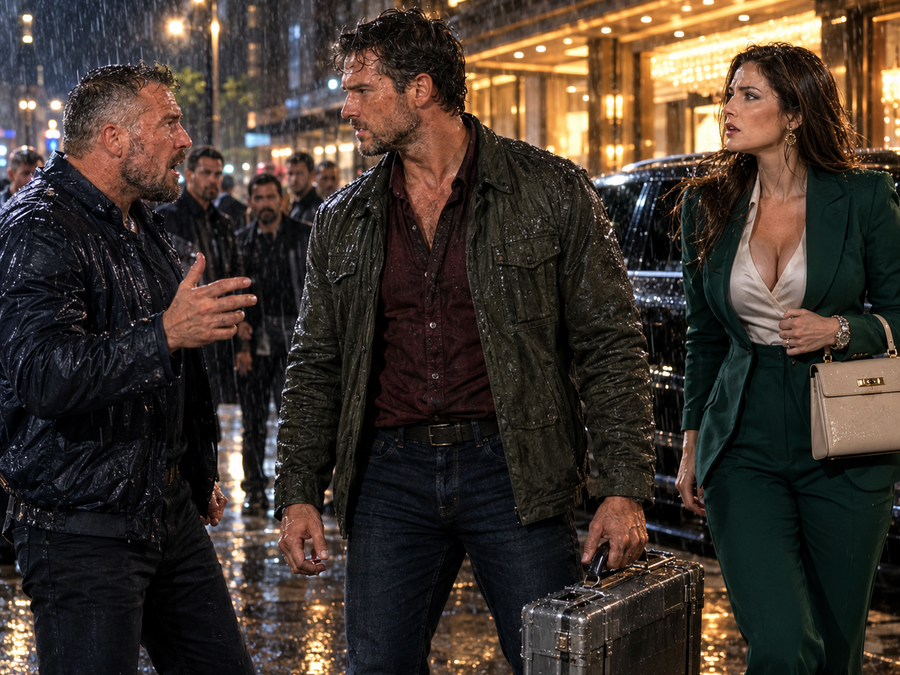
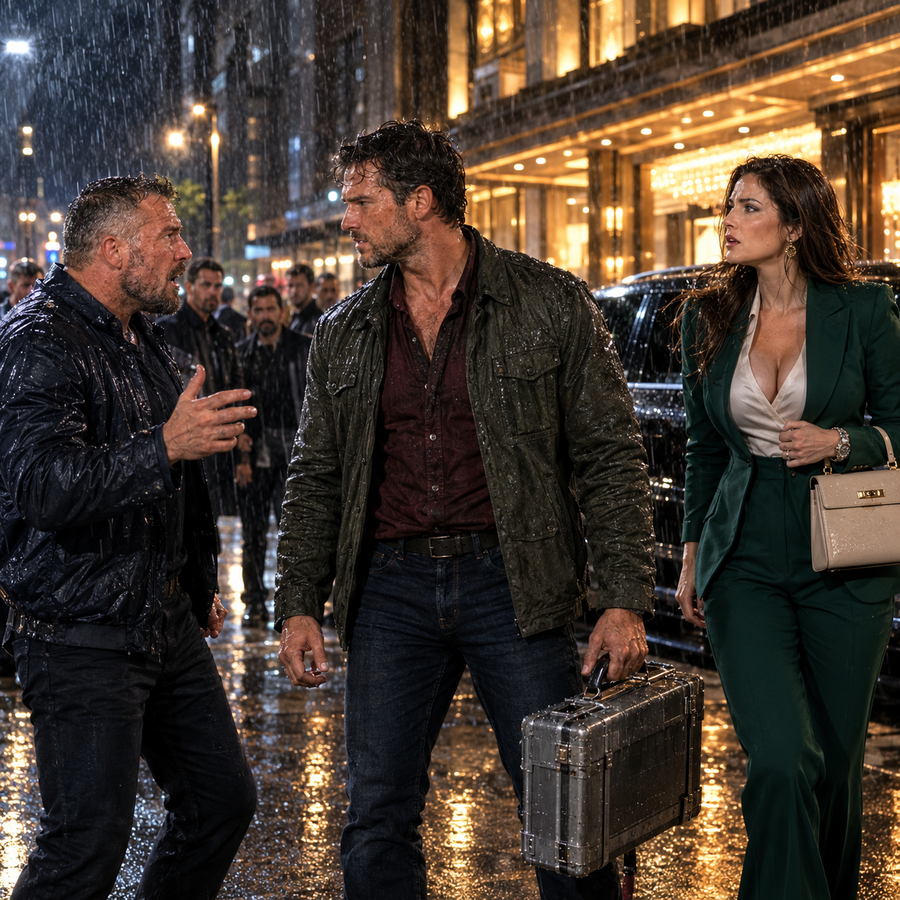
He grabbed the first man by the collar and threw him into the hood of a luxury car like he weighed nothing. The crowd stopped breathing. Six. Six against one.
A tired 50-year-old man in a maintenance uniform, grease still on his hands. A torn strap on his old backpack. And he didn’t flinch. Not once.
But the moment the leader of those six men looked down and saw the scar running across that man’s shoulder, he went completely pale. His hands started shaking, and in a voice barely above a whisper, he said a name that hadn’t been spoken aloud in over 15 years.
The call came in at 2:47 in the afternoon on a Thursday in October. Not a phone call, not a radio dispatch, just a scream. High, sharp. The kind of sound that cuts through traffic noise and lunch conversations and the ordinary hum of a city going about its business.
The kind of scream that makes your stomach drop before your brain even processes what it heard. Daniel Carter heard it from half a block away. He was walking south on Meridian Avenue, heading toward the bus stop that would take him home after a 9-hour shift at the Harrove building, a glass and steel financial tower that employed roughly 1,200 people and required a maintenance crew of 11 just to keep it functional.
Daniel was the supervisor of that crew. Had been for 4 years. Before that, he’d worked as a line tech for six. 10 years total in that building. 10 years of fixing what broke and replacing what wore out. 10 years of knowing every pipe and circuit and pressure valve in that structure the way another man might know the lines of his own face.
He was 50 years old, broad across the shoulders in a way that had nothing to do with vanity and everything to do with work. His hair had gone mostly gray at the temples, and there were lines around his eyes that hadn’t been there a decade ago. He carried a backpack that was older than some of his co-workers. Faded black canvas, a frayed zipper on the left side pocket, a small laminated photo of a teenage girl tucked under the cloth front flap where he could see it if he opened the bag.
He looked like what he was. A tired man at the end of a long day. He looked like exactly the kind of man you’d walk past without a second glance. He heard the scream. He stopped walking.
Most people, when they hear a sound like that in a city, do the same thing. They look, they register, they tell themselves that someone is probably already handling it, that it’s none of their business, that getting involved in something they don’t understand can only make things worse.
It’s not cowardice, exactly. It’s the math that urban life teaches you over years of proximity to strangers. Keep your head down. Keep moving. Mind the distance between yourself and trouble. Daniel knew that math. He’d learned it the same way everyone does. But he’d also spent a significant portion of his adult life in situations where minding that distance meant someone died.
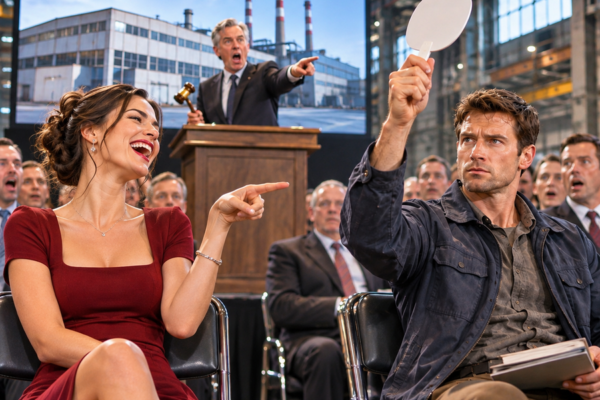
So he looked, and what he saw made something shift in his chest. Not fear, not anger, but something older and quieter and much more decisive. 40 feet ahead, beside a silver Mercedes S-Class parked at the curb outside the Harrove building’s side entrance, stood a woman he recognized. Victoria Hayes.
He knew her the way everyone in the building knew her. From the security briefings, from the company newsletter, from the photographs that lined the executive corridor on the 41st floor. CEO of Hayes Dynamics, one of the most successful technology investment firms in the state. 42 years old, Harvard MBA, built her company from 11 employees to over 400 in 8 years.
There was a profile on her in Forbes last spring. And someone had taped a copy to the breakroom corkboard with the caption, “Our boss’s boss’s boss,” written in red marker. She was standing with her back against the rear door of the Mercedes, and the six men surrounding her were not her security detail.
Daniel could tell the difference immediately. Her security was a man named Reeves. Mid-40s, ex-military, wore the same dark blazer every day. Reeves was not here. What was here were six men in civilian clothes. Jeans, hoodies, one in a gray jacket, arranged in a loose semicircle that had been tightening by degrees, the way certain kinds of trouble always tightens slowly until there’s nowhere left to go.
The man closest to Victoria was speaking. Daniel couldn’t hear the words yet, but he could hear the tone, and tone carries meaning across distance the way words can’t. It was the tone of someone who believed that they had already won. He set his backpack down on the sidewalk beside a newspaper box. Not dramatically, not like a man preparing for a movie moment. He just set it down the way you’d set down groceries before opening a door. Practically, without ceremony, because carrying it would slow him down.
And he was already moving. He walked toward them. He didn’t run. Running announces itself. Running changes the dynamic before you have information. And Daniel had spent enough years in situations where information was the difference between outcomes to know that you gather what you can for as long as you can. He was close enough to hear now.
“Last time,” the closest man was saying. He was maybe 35. Heavy-set through the jaw and neck, with a flat affect in his voice that Daniel recognized immediately. The particular flatness of someone who has stopped caring about consequences. “You want to do this out here, or you want to do it somewhere quieter? Because either way, you’re coming with us.”
Victoria’s voice, when she answered, was steadier than most people’s would have been in that moment. “I told your employer no three weeks ago. I told him no in writing two weeks ago. I’m telling you no right now. If any of you touch me, you will be arrested and prosecuted to the full extent of the law.” The man took a step closer. “Nobody here cares about prosecuted.”
“I do.” The voice was Daniel’s. All six men turned. The one who had been speaking, Daniel noted his position, his weight distribution, the way his left shoulder was slightly dropped, looked Daniel up and down the way people look at things they’ve already decided. “Don’t matter. Walk away, old man.” “I heard a woman say no three times,” Daniel said. He had stopped about 8 feet from the nearest man, which was close enough to act and far enough to assess. “I’m asking you all to step back from her vehicle.”
” Asking?” The man repeated the word like it was foreign. He looked at the others and a few of them laughed. That specific laugh that says this will be easier than we thought. “That’s nice. He’s asking.” “I am,” Daniel said. “That’s the part where you have a choice.” “And if we don’t?” Daniel didn’t answer that. He just waited.
Something in the stillness of him, the complete absence of performance in the way he stood there. No trembling, no shifting of weight, no scanning for an escape route, made the man’s laugh die before it fully formed. “Who are you?” the man said. “Someone who heard her say no,” Daniel said. “That’s enough.”
Victoria was looking at him. He could see her in his peripheral vision, her expression cycling through confusion, hope, something that might have been the earliest stage of recognition. She didn’t know him. Not personally. He was maintenance. He was the man who made sure the building’s heating worked in February and the elevators ran smooth. They’d been in the same structure for 4 years and exchanged maybe six words. But she looked at him the way people look at someone who says, “I’ve got you,” and sounds like they mean it.
Daniel turned his attention back to the six men and said calmly and clearly, “If you want her, you’ll have to go through me.” The first one came in fast. Not the one who’d been talking. The one on the left. The youngest of the group, maybe 25. Moving with the reckless confidence of someone who’d never been in a real fight but had been in enough small ones to think they understood what a fight was.
He threw a wide right hand, aimed at Daniel’s jaw. Daniel moved his head 3 inches to the left, and the fist passed close enough that he felt the air from it. Then he caught the man’s extended arm at the wrist and the elbow, used the momentum that was already there, and redirected it in a way that the young man’s own forward motion did most of the work. The sound of him hitting the pavement was loud and flat.
The second one came almost simultaneously from the right. Smarter. Lower. Going for a tackle around the waist. Daniel dropped his weight, planted his left foot, and brought his knee up into the man’s path. Contact. The man crumpled. Three seconds. Two men down.
The remaining four stopped. This was the moment Daniel recognized. The moment when the math of a confrontation gets recalculated. When what looked like an easy problem reveals itself as something else entirely. The heavy-set man who had been doing the talking looked at his two associates on the ground and then looked back at Daniel. “Who are you?” he said again. But the tone was completely different.
“Now step away from her,” Daniel said. “I’m not asking anymore.” The man said, and there was genuine anger in it now. The kind that comes from being surprised and disrespected simultaneously. He pulled something from his jacket. Not a weapon. A phone. He made a call, said four words. “We need the others.”
Daniel’s jaw tightened slightly. He glanced at Victoria. “Get inside the building right now.” “I’m not leaving you.” “Miss Hayes.” His voice was quiet, but it carried the absolute certainty of someone who did not expect to be argued with in this particular moment. “Please. Inside. Tell the security desk to call 911.”
She looked at him for one more second. Then she moved toward the side entrance, and Daniel turned back to the four men standing in front of him. What happened in the next four minutes was not something Daniel had planned, prepared for that morning, or thought about in any conscious way during the years he spent maintaining HVAC systems and filing work orders. It was older than thought. It was the thing that had been trained into him in another life, in another version of himself that he’d spent a decade trying to gently set aside.
The first two men had recovered enough to get up, so there were six again. They didn’t come in pairs this time. They came together. Daniel had fought worse odds. He wouldn’t have said that to anyone. It would have raised questions he wasn’t prepared to answer. But it was simply true. There had been a point in his life when the situation he was now in would not have been the most difficult thing he’d faced that month.
He worked with what the space gave him. The side of the Mercedes to his left, the newspaper box he’d walked past, the curb. He used angles and leverage and the simple physics of bodies in motion. And he didn’t fight the way people imagine fights. Dramatic, sustained, a back-and-forth contest of strength. He ended things quickly, precisely, and without excess.
One man went into the door of the Mercedes hard enough to set off the alarm. Another stumbled into the space between two parked cars and didn’t get back up. A third grabbed his arm from behind and found himself on the ground before he’d finished the motion. The fourth backed into the heavy-set man, and they tangled briefly, and that was enough.
By the time the wail of police sirens could be heard from three blocks south, five of the six men were down or stumbling. The sixth was the one who had made the call. He was the one who hadn’t moved since the moment Daniel’s elbow had connected with the second attacker. The one who had been watching.
Daniel turned to face him. They were both breathing hard. Daniel more than he would have liked. He was 50, not 30. And the body keeps its own honest ledger regardless of what the mind believes. The heavy-set man stared at him across 8 feet of sidewalk with an expression Daniel couldn’t immediately read. Not defiance, not surrender. Something more complicated than either.
His eyes traveled down from Daniel’s face to his right shoulder, where his work shirt had torn along the seam during the struggle. The scar was visible. It ran from below the collarbone diagonally across the shoulder to the top of the deltoid. About 5 inches long, pale and precise against the skin. The kind of mark that doesn’t come from an accident. That particular geometry, that particular angle, is made by specific things under specific circumstances.
The man’s face changed entirely. Daniel watched it happen in real time. The calculation behind the man’s eyes. The processing. The arrival at a conclusion that clearly landed somewhere between impossible and undeniable. The man’s hands, which had been balled into fists, fell open at his sides. His mouth formed a word. One word. “Guardian 7.”
Daniel felt something he hadn’t felt in a very long time. Not fear, not recognition. Something colder and more complicated than either. He kept his voice level. “Don’t.” The man took a step back. Not away, exactly. Back. The way you step back from something you need distance to actually see. “You’re supposed to be dead. Or gone. Or—” He stopped. His jaw was working like he was trying to find words in a language he hadn’t used in a long time. “We were told the unit was dissolved. We were told you—”
“I said don’t.” Daniel’s voice was quiet. Absolutely quiet. The kind of quiet that is not the absence of force, but the complete containment of it. The sirens were close now. A block, maybe less. The leader of the six men looked at Daniel Carter. At the maintenance supervisor. At the tired father with the old backpack and the grease on his hands. And for just a moment, every pretension of threat dissolved out of him.
What replaced it was something that looked unmistakably like recognition. Not of a man he’d expected to find here, but of something in that man that he understood and had not expected to find anywhere. The police arrived in three vehicles. Two uniformed officers were first out of the lead car, and they took in the scene. Six men in various states of distress. One woman watching from behind the building’s glass side doors. One man standing alone at the center of it.
And to their credit, they didn’t hesitate. “Sir,” the first officer said, approaching Daniel with her hand near her belt. “Are you injured?” “No,” Daniel said. “Can you tell me what happened here?” He could. He did. Concisely, factually, without editorializing. He described what he’d seen, what had been said, and what he’d done in the straightforward language of a man who understood how much detail an official report needed, and not one word more.
The second officer was already with the men on the ground, assessing, calling for medical. Victoria had come back outside. She walked past the officers directly to Daniel, which surprised both the officers and, based on her own expression, herself. “You—” She stopped. Looked at him. “You should be sitting down.” “I’m fine.” “You fought six men. I was there.” “He agreed.” She almost smiled at that. Then the almost smile became something more complicated.
“Who are you?” “Daniel Carter. I run maintenance in your building.” She absorbed that. “You’ve worked here for 10 years. Almost. I’ve never—” She caught herself, looked briefly embarrassed. “I should know everyone in my building.” “You have 1,200 employees,” Daniel said, without any particular edge to it. “And I fix things. People don’t generally need to know my name until something stops working.”
The first officer had moved to where the heavy-set man was sitting against the Mercedes, his wrists being secured with zip ties while he waited for a second cruiser. Daniel watched the exchange without seeming to watch it. The way he’d learned to process peripheral information without making it obvious. The heavy-set man was looking at Daniel over the officer’s shoulder. He wasn’t struggling, wasn’t making demands, wasn’t doing anything that men in his situation typically did. He was just watching.
And on his face, beneath everything else—the arrest, the humiliation, the certain knowledge of what came next—was something that Daniel couldn’t entirely dismiss. It looked like a man who had just been forced to rewrite something he had believed for a very long time.
Daniel’s daughter called at 3:22. He heard the phone buzz in his torn shirt pocket and looked at the screen. Emma. Home. She was 17, got off the school bus at 3:15, and had standing instructions to call if he wasn’t back by 3:30. He was never late without calling first. She knew that. “Excuse me,” he said to Victoria, and stepped a few feet away.
“Dad.” Emma’s voice brightened, slightly wary, the way 17-year-old voices get when things don’t add up. “You’re not on the bus. I called the bus route tracker.” “I got held up at work,” he said, which was in the most compressed possible terms accurate. “Held up. How? Are you okay?” “I’m fine. I’ll be on the 4:15. There’s pasta in the fridge. The kind you like. Start it without me.” A pause. “Okay. But are you sure you’re okay? You sound—” “I’m good, Em. I promise. 4:15.” “Okay.”
He could hear her deciding to believe him. It was a sound he’d learned over 17 years. The moment she chose trust over worry. It was one of the most important sounds in his life. “I’ll have it ready.” “Thank you, sweetheart.”
He hung up, turned around. Victoria Hayes was watching him with an expression he couldn’t immediately categorize. “Your daughter?” she asked. “Emma. 17.” “You called her sweetheart.” “She is one.” Victoria looked at him for a long moment. There was something shifting in her face, some reassessment happening at a level below the professional composure she wore like a second skin.
“Mr. Carter,” she said. “Daniel.” “Daniel.” She glanced at the scene still being processed behind her. The officers. The men being loaded into vehicles. A detective who had arrived and was taking notes. Then she looked back at him. “I have a great deal of questions.” “I imagine you do.” “Most of them,” she said, “are about who you actually are.”
Daniel picked up his backpack from beside the newspaper box. It was still there. Undisturbed. Because whatever chaos had occurred, nobody had bothered with a faded canvas bag. And settled it over his shoulder. “I’m the man who fixes your building,” he said. He said it simply, without irony, without performance. And he meant it.
But Victoria Hayes, standing in the October afternoon with the sound of the last police radio crackling behind her, looked at him with the particular expression of someone who has just realized that the most interesting answer to a question is never the first one she gets.
The detective wanted a statement. Daniel gave one. It took 40 minutes. He was precise about everything he could be precise about. The time, the location, the words that were exchanged, the sequence of physical events. When the detective asked him how he had managed to subdue six men, he said simply, “I’ve had some training.” “What kind of training?” “Situational awareness. I was in a field that required it.” “What field?” “Emergency response.”
The detective wrote it down, looked up. He was a lean man, maybe 45, with the professionally skeptical eyes of someone who had heard a lot of explanations over the years. “Emergency response covers a wide range of things.” “Yes, it does,” Daniel agreed. Another pause. The detective decided not to push. He’d get the rest from the record, probably. Or he wouldn’t. And either way, the story in front of him was simple enough. Six men had threatened a woman. One man had stopped them. And everybody involved had their information on record.
“We may have more questions,” the detective said. “I’ll be at work tomorrow,” Daniel said. “Same building.”
He caught the 4:15 bus. He sat in the second-to-last row the way he always did. Window seat, left side, which gave him a view of the road behind them as well as ahead. A habit from another life that he’d never been entirely able to break. He looked at the photo of Emma inside his bag’s front pocket for a moment. She was 14 in the picture, grinning at something off camera, her hair still in the braids her mother used to put in it.
He’d taken the photo on a Saturday morning 3 years ago. Before she decided she was too old for braids. Before a lot of things had changed. He closed the flap. Outside the window, the city moved past in its ordinary late afternoon rhythm. Storefronts, the stop signs, the small clusters of people waiting at corners. He watched it the way he always did. Not with surveillance, but with the habit of someone who had learned long ago to understand that what a city looks like when nothing is wrong is the standard against which everything else gets measured.
He thought about the scar on his shoulder. He thought about two words spoken in a voice he’d never expected to hear again. Guardian 7. He hadn’t been that in 15 years. He’d worked hard not to be. He thought about what the heavy-set man’s face looked like in that moment. Not the aggression of before, but the afterward. The something underneath it. He had expected recognition. He had not expected what had come with it.
He turned away from the window. The bus rolled south. He had pasta to eat and a daughter to sit with. And the ordinary, remarkable business of a Thursday evening to attend to. And for now, for tonight, that was what mattered. Everything else could wait. He just wasn’t sure, for the first time in a very long time, whether it would.
The pasta was overcooked. Emma had set the timer wrong, or forgotten to set it at all, which was the kind of thing that happened when a 17-year-old was preoccupied with something other than dinner. Daniel discovered this the moment he walked through the front door of their apartment. The slightly starchy smell that meant noodles had been sitting in hot water about 4 minutes longer than they should have been.
Under any other circumstances, he would have teased her about it gently and eaten every bite without complaint. Tonight, he stood in the doorway of the kitchen and looked at his daughter standing at the stove with a wooden spoon in her hand and her phone tucked between her ear and her shoulder, talking to someone about something that was clearly very important. And he felt something in his chest that he had no immediate word for. Relief. Maybe the specific relief of arriving somewhere safe.
“Dad.” Emma spotted him and lowered the phone without finishing her sentence to whoever was on the other end. She looked at him the way she’d been looking at him since she was small. With the directness of someone who had learned early that her father was hard to read and had decided to compensate by watching him very carefully. “You look terrible.” “Thank you.” “I mean it. Your shirt is torn.” “I know.”
She put the spoon down, took a step toward him. “What happened?” “There was a situation at work.” He said he moved to the cabinet, got a glass, filled it from the tap, drank. “It’s handled. Nobody got hurt.” “Nobody got hurt, meaning you didn’t get hurt? Or nobody got hurt, meaning—” Emma. She stopped, read his face, did the calculation that she’d been doing for 17 years. The one where she weighed how much to push against how much he needed her not to, and arrived at the decision to let it go. For now.
“Pasta’s ready,” she said. “It’s a little soft.” “Sounds perfect.”
They ate at the kitchen table the way they always did, with the television off and the window cracked, and Emma talked about her day. A history test she thought she’d done well on. A disagreement with her best friend Jasmine that was already mostly resolved. A college application essay she was stuck on. And Daniel listened the way he always did, with his complete attention, asking the right questions in the right places.
By the time they’d finished eating and Emma had taken the plates to the sink, the torn shirt and the afternoon on Meridian Avenue had receded to something that existed in a separate compartment. He was good at compartments. He’d had to be.
It was only later, after Emma had gone to her room to finish an assignment and the apartment had gone quiet, that Daniel sat at the kitchen table with a cup of coffee going cold in front of him and let himself think about what had actually happened. Two words. Guardian 7.
He said them in his head quietly, like pressing on a bruise to test whether it still hurt. It did. He hadn’t heard that designation spoken aloud since he was 34 years old, in a situation that had ended badly enough to reroute the entire trajectory of his life.
He’d been part of a unit. Not military, though several of its members had military backgrounds. A specialized emergency response organization that operated in the spaces between official jurisdictions. Handling situations that required capabilities that conventional agencies either didn’t have or couldn’t deploy without creating political complications. He’d been recruited out of a federal program when he was 28. Had spent 6 years becoming very good at something he never talked about. And had left at 34, after an operation in Eastern Europe that went wrong in a specific and unforgivable way.
The operation had a code name he’d also stopped using. The unit had been seven people. He was the seventh. Hence the designation. Guardian 7. Three members of the team had been compromised. Two had gotten out clean. One, a man named Reyes, had not made it at all.
And Daniel had carried Reyes out. Had carried him for two miles through territory that had gone hostile the moment the operation’s cover fractured. With a wound in his own shoulder that should have incapacitated him. Had refused to incapacitate him. Had simply hurt with a consistency and intensity that he decided to treat as information rather than obstacle.
When it was over, he’d filed his report, had his shoulder seen to, received a commendation he’d never displayed, and resigned. Not in anger, not in despair. In the quiet, deliberate way of a man who had looked at the thing he was doing and decided with complete clarity that it was time to stop. He’d met a woman named Sandra 6 months later. Married her 2 years after that. Emma arrived the year after. And then Sandra got sick. And then Sandra was gone.
And Daniel was 50 years old with a gray-templed head and a torn work shirt and a cup of cold coffee, sitting alone in a kitchen that still sometimes felt like it was waiting for a person who wasn’t coming back.
He picked up the coffee cup, set it down without drinking. The heavy-set man’s face was still in his head. The man had said Guardian 7 the way you say the name of someone you thought was dead. Which meant he knew about the operation. Which meant his presence outside the Harrove building today was not a coincidence in the way Daniel had initially allowed himself to believe it might be.
He pulled out his phone. There was a text from a number he didn’t recognize. Sent at 4:47, while he’d been on the bus. It said, “We should talk tonight if possible. This is not what you think it is.” He stared at it for a long moment. Then he put the phone face down on the table.
He didn’t sleep well. He woke at 5:15 the way he always did, made coffee, stood at the kitchen window in the gray pre-dawn, and thought about the same things he’d been thinking about when he’d finally gotten into bed at midnight. Then he made Emma’s lunch. Turkey on whole wheat. The apple she preferred cut into slices because she’d had braces two years ago and the habit had stuck. And left it in the refrigerator with a note that said, “History test—how’d it go? Dad.”
He was at the Harrove building by 7. He was not surprised to find a visitor badge waiting for him at the security desk. He was slightly surprised by the name on the badge requisition. Victoria Hayes. Personal meeting. Conference room 41. 9:00 a.m. He looked at the security guard, a young man named Torres, who had worked the morning desk for 2 years. “Miss Hayes left that last night,” Torres said. “To make sure you got it, did she?” “Also said—” Torres checked a sticky note. “And I’m quoting directly here—’Tell him it’s not optional.'”
Daniel considered that for a moment. “Okay,” he said. He spent the first two hours of the morning doing exactly what he always did. Walking the building systems, checking overnight alerts on the maintenance tablet, dispatching two of his crew to handle a pressure irregularity on the 23rd floor and a lighting issue in the east stairwell. He did the work with the same attention he’d given it for 10 years. Because the work mattered regardless of what else was happening. And because the rhythm of it, familiar, physical, purposeful, was something he’d come to depend on in a way that was harder to explain than it sounded.
At 8:55, he took the elevator to 41. The executive floor had a different quality from the rest of the building. Quieter, more deliberate. The kind of space that communicates importance through understatement. A receptionist he didn’t know showed him to conference room 41 without conversation. Victoria was already there. So was someone else.
The second person in the room was a man Daniel had never seen before. Mid-50s. Trim. The kind of posture that comes from years of being in rooms where posture signals authority. He was wearing a charcoal suit and no tie, and he was sitting at the conference table with a leather portfolio open in front of him. And when Daniel walked in, he looked up with an expression that was carefully neutral in a way only practiced people can manage.
Daniel stopped in the doorway. “Mr. Carter,” Victoria said, standing. “Please come in. Close the door.” He closed it. Didn’t sit. “Who is he?” Daniel said. The man in the suit answered for himself. “My name is Raymond Cross. I’m with the Office of Special Investigations, which is a federal oversight body. You’ve probably never heard of it because we’re very deliberate about that.” He paused. “But you’ve heard of the organization we audit.”
The silence in the room had weight. “Sit down,” Daniel. Victoria said quietly. “Please.” He sat. Cross opened the portfolio. “Yesterday’s incident on Meridian Avenue was not a random criminal act directed at Miss Hayes. The six men were contracted by a group with significant financial interest in destroying certain proprietary data her company holds. We’ve been tracking this group for 14 months.” He looked up. “What we did not anticipate was that their field leader would turn out to be Marcus Vale.”
The name landed like a stone dropped in still water. Daniel’s face did not change, but something behind it did. “You know that name,” Cross said. “I know a lot of names,” Daniel said. “Marcus Vale, age 51, former intelligence analyst, specialized in operational security and field coordination. He worked with your unit from 2008 to 2011. In an advisory capacity.” Cross turned a page. “He was not part of your team on the Krevsky operation.”
“Don’t,” Daniel said. “He was, however,” Cross continued without pausing, “briefed on it afterward as part of an internal review.” Daniel was very still. “And based on that briefing, Cross said, he apparently spent the next 15 years believing something about that operation that is not accurate.”
Victoria, who had been sitting quietly at the end of the table, leaned forward slightly. “Daniel, what is the Krevsky operation?” “It’s classified,” Cross said before Daniel could speak. “Or it was. The classification was lifted six months ago as part of a broader transparency initiative.” He looked at Daniel. “Which is why I’m able to tell him in front of you that the internal review Vale received was incomplete. Deliberately so. By people who are no longer in their positions, for reasons that are no longer in dispute.”
Daniel looked at the table. His hands were resting flat on the surface. Very still. “You’re telling me,” he said, and his voice was careful in a way that Victoria noticed and Cross expected, “that the review concluded something.” “The review concluded that Guardian 7 abandoned his team under fire.” The words sat in the room. “That’s what Vale was told,” Cross continued. “That’s what several people were told. It served a purpose at the time because there were people in the organization who needed a reason why the operation had failed that didn’t implicate them.”
“It was a lie,” Daniel said. “It was a lie,” Cross confirmed without hesitation and without softening it. The silence stretched. Then Daniel said, “Reyes.” Cross nodded. “We know.” “Do you know that I carried him for two miles?” “We know.” “Do you know that the compromise originated from inside the organization? Not from my team. Not from anything my team did or failed to do.” “We know that now,” Cross said. “The full picture took longer to assemble than it should have. But yes.”
He walked to the window, stood there with his back to both of them. Victoria looked at Cross. Cross looked at his portfolio and said nothing. When Daniel turned back around, his face was composed in that particular way. The absolute steadiness that was not the absence of emotion, but its complete containment. “Why are you telling me this now?” he said.
“Because Marcus Vale is in federal custody as of this morning,” Cross said. “He was processed overnight after yesterday’s arrest. And in his intake interview, he said something that required us to move faster than we’d planned.” He turned a page. “He said, ‘I need to talk to Guardian 7 before I tell you anything. Not because I’m making demands. Because I owe him something and I want to pay it before this goes further.'” The room was very quiet. “He asked for you specifically,” Cross said. “By name?” “By your real name.”
Victoria had good coffee in the conference room. Not the building’s standard supply. Something better, from a machine that cost more than Daniel’s monthly rent. She poured him a cup while Cross excused himself to take a phone call in the hallway, and she set it in front of him and sat down at the chair closest to him rather than returning to the end of the table. “You don’t have to tell me anything,” she said. “I know.” “I’m asking anyway.”
She held his gaze. “Not as your employer. Not in any official capacity. Just—” She stopped, reconsidered. “Yesterday you put yourself between me and six men because you heard me say no and you decided that was enough reason. You didn’t know me. You didn’t have any stake in it. You just—” She shook her head slightly. “People don’t do that. Not without a reason.”
“I had a reason.” “What was it?” He thought about how to answer that. He thought about the scream he’d heard from half a block away. About the tight semicircle of men. About the particular quality of Victoria’s voice in that moment. Not panic, but something more controlled and more frightening. The voice of someone who understood the danger and was managing it alone because there was no alternative.
“My wife,” he said. “Before she died, she was sick for about 14 months. Toward the end, she needed things I couldn’t always provide. Appointments, transportation, medication adjustments in the middle of the night. There were times when I had to ask strangers for help. People who owed us nothing. Who had their own problems, their own days, their own reasons to look away.” He paused. “Some of them helped anyway.”
Victoria was listening. “I decided a long time ago that I wanted to be one of the people who helped anyway,” he said. “That’s the whole reason.” She was quiet for a moment. “That’s a very simple answer,” she said. “It’s a very simple decision,” he said. “The execution gets complicated sometimes. But the decision itself is simple.”
Cross came back in. “They can have him at the detention center at 1 this afternoon,” he said to Daniel. “Vale. If you want to go.” Daniel looked at the untouched coffee in front of him. He thought about Emma, who would be in school until 3. He thought about the pressure irregularity on 23 that his crew was probably halfway through by now. He thought about two words spoken on a sidewalk by a man who had believed something false about him for 15 years. “I’ll be there,” he said.