“Take That Off!” Judge Shouted at Single Dad—Until a SEAL Admiral Heard His Callsign (Part 1)
“Take That Off!” Judge Shouted at Single Dad—Until a SEAL Admiral Heard His Callsign (Part 1)
PART 1
Take that off. The gavel cracked like a rifle shot, and Judge Richard Holloway was already on his feet before anyone in that Norfolk courtroom understood what was happening. “I said, take that filthy jacket off, or I’ll have you removed from my courtroom in handcuffs.” His finger stabbed the air, pointed straight at the quiet man standing alone at the defendant’s table. A maintenance worker in a faded tactical coat, a man everyone had already decided was nobody.
But the man didn’t flinch. He didn’t beg. He looked the judge dead in the eye and said seven words that would change everything. “This jacket is a promise, your honor.” And out in the hallway, a four-star Navy SEAL admiral froze mid-step because he just heard a name he buried four years ago. The man’s name was Ethan Walker, and at 8:47 that morning, he was still just a janitor.
He’d been up since four. Not because the hearing started early. It didn’t. It started at nine, but because Lily needed her hair braided the way her mother used to do it. And Ethan Walker had spent the better part of four years learning to do a thing his hands were never built for. His hands were built for other work. Harder work. Work he never talked about.
“Daddy, you’re pulling.” “Sorry, baby. Hold still one more second.” “You always say one more second.” “And I’m always lying,” he said. And Lily laughed. And for one moment, just one, the fist that had been squeezing his chest since midnight let go. Then his phone buzzed on the kitchen counter, and the fist came right back.
It was the lawyer, the one the court had assigned him because Ethan couldn’t afford a real one. A tired public defender named Marcus Bell who returned calls at strange hours and always sounded like he was eating something. “Walker, you up?” “Been up.” “Good. Listen to me. Nine o’clock, courtroom four. Judge’s Holloway. You got to know something.” Bell paused, and Ethan heard the crinkle of a wrapper. “He’s old school. He’s mean, and he judges a man the second the man walks through the door. So you clean up. You hear me? You wear the nicest thing you own.”
Ethan looked down at the jacket hanging over the back of the kitchen chair. Faded olive drab, frayed at the cuffs. A coffee stain near the second button that had been there so long it might as well have been part of the fabric. “I’ll wear what I always wear,” Ethan said. There was a silence on the line that lasted a beat too long.
“Walker, I’m telling you, this isn’t the day to make a statement. This is the day to blend in. You want your daughter. You look like a man who deserves her. You understand what I’m saying to you?” Ethan looked at Lily. She’d wandered to the window and was breathing little clouds onto the glass, drawing hearts with her fingertip. Eight years old. The whole world in a pink sweatshirt. “I understand,” Ethan said. And then he hung up, and he put on the jacket anyway, because Marcus Bell didn’t know what the jacket was. Nobody in Norfolk did.
The custody hearing had a simple name and a simple docket number, but there was nothing simple about how Ethan had ended up here. Six weeks ago, his life had been quiet. Small, but quiet. He fixed broken things at a naval training facility. Leaky pipes, busted door hinges, the fluorescent lights that flickered in the long gray hallways where recruits ran drills. He got there before the sun and left after it went down. He never spoke more than he had to. And every day at 3:15, no matter what, he was standing at the corner of Lily’s elementary school with two hands in his pockets and a smile he kept just for her. That was the whole life. That was all he wanted.
Then Logan Pierce happened. Ethan hadn’t even wanted to be at that restaurant. He’d been picking up dinner, a rare treat, Lily’s birthday coming up, and he’d saved for two weeks to take her somewhere with cloth napkins. He was standing at the counter waiting for a to-go bag when he heard it from the parking lot. A woman’s voice, the particular pitch of a voice that has stopped asking and started fearing.
Some men hear that sound and freeze. Some men hear it and walk the other way, tell themselves it’s not their business, tell themselves someone else will handle it. Ethan Walker was not built like those men. Ethan Walker had spent years of his life running toward exactly that sound. By the time he got out the door, a man in a two-thousand-dollar suit had a woman pinned against the side of a black SUV, and his hand was where no hand should ever be.
What happened next took eleven seconds. Ethan did not throw a wild punch. He did not shout. He crossed the distance, took the man’s wrist, and folded him clean. Controlled. Precise. The way you take down a threat when you have been trained by the best men on earth to end violence without becoming violence. The man in the suit hit the pavement and he stayed there, and the woman ran, and it was over. Eleven seconds. That was all it should have been.
But the man in the suit was Logan Pierce. And Logan Pierce’s father owned half of Norfolk. “You went too far,” Marcus Bell had said three days after the arrest in a visiting room that smelled like bleach and burnt coffee. “That’s what they’re going to say. You went too far. You’re some kind of trained killer, and you assaulted a defenseless businessman in a parking lot.” “He was assaulting a woman.” “There’s no woman.”
Ethan stared at him. “She’s gone. She disappeared. There’s no witness. There’s a police report that says you attacked Logan Pierce unprovoked. There’s two guys who say they saw the whole thing and it was all you. And there’s a very rich, very angry man named Gerald Pierce who has decided to end your entire life.” And Lily. Bell had gone quiet then. That was the quiet Ethan couldn’t stand.
“Child Protective Services opened a file,” Bell said finally. “The moment you got charged with a violent felony, they’re saying you’re a danger. They’re saying the girl isn’t safe. Pierce’s people made a phone call.” “To who?” “Ethan, I don’t know who to. Doesn’t matter. There’s a custody review, and if it goes bad—” “It’s not going to go bad.” “If it goes bad, they take her. They put her in the system. And you spend the next two years fighting to get her back while she grows up in a stranger’s house calling somebody else mom.”
Ethan had stood up so fast the metal chair screamed against the floor. “Whoa. Whoa.” Bell had put his hands up. “See that? That right there? That’s the thing you can’t do in front of the judge. You can’t do that.” Ethan had sat back down slowly, and he’d put both hands flat on the table, palms down, and he’d made them stop shaking through sheer force of will. The way he’d once made them stop shaking with a man’s life bleeding out under them. “Tell me how to get my daughter back,” he’d said quietly. “And I’ll do it. Whatever it is, I’ll do it.”
Bell had looked at him for a long moment. “Show up looking like a man they can respect,” he’d said. “And don’t say a word until I tell you to.” Ethan had agreed to exactly one of those two things.
Courtroom 4 was on the third floor at the end of a hallway lined with old wooden benches and older men waiting for their names to be called. Ethan sat with Lily on one of those benches at 8:52, holding her small hand in his large one, and he could feel every eye in that hallway slide over him and make its judgment. A janitor. A worn coat. A man clearly out of his depth. He’d felt those eyes before. He’d felt them everywhere for four years. He’d made a kind of peace with them. Let them look. Let them decide. He knew who he was, and that was enough. And it had always been enough, right up until they threatened to take his little girl over it.
“Daddy.” “Yeah, baby.” “Are you scared?” Ethan Walker had been a lot of places a man should be scared. He’d been pinned down on a rooftop with three rounds left in his rifle and no way out. He’d carried a friend six miles with the friend’s blood soaking through his own shirt. He’d sat in a dark helicopter and counted the men who came back and come up short of the men who went out. He’d learned a long time ago that you never tell the truth about fear to someone who’s leaning on you. “No, baby,” he said. “I’m not scared.” “You know why?” “Why?” “Because I’ve got the best girl in the whole world sitting right next to me. And a man with the best girl in the whole world doesn’t have anything to be scared of.”
Lily leaned her head against his arm, and a woman two benches down, gray hair, kind eyes, some other stranger caught in the gears of some other courthouse tragedy, watched them and pressed her lips together and looked away because there are some things that are too tender to keep watching. At 8:58, Marcus Bell came hurrying down the hall. Tie crooked, folder under his arm. He took one look at Ethan and stopped dead. “You wore the jacket.” “I wore the jacket.” “I told you—” “I know, Marcus.”
Ethan stood, and he set his hand on Lily’s shoulder so she’d stay put, and he stepped a little away so she wouldn’t hear. “I’m going to walk into that room and I’m going to tell the truth. And the truth is that I protected a woman from a man who was hurting her. That’s what happened. That’s the whole story. If a judge can’t hear that story from a man in a work jacket, then that judge was never going to hear it from me in a suit either.” Bell opened his mouth, closed it, and something in Ethan’s voice, some quality that Marcus Bell had heard maybe twice in a fifteen-year career, some flat, steady certainty that had no fear in it at all, made the lawyer decide just this once not to argue. “Just let me do the talking,” Bell said. “Please.” “I’ll let you do the talking,” Ethan said. “Right up until they tell a lie I can’t let stand.”
Inside, courtroom 4 was smaller than Ethan expected. Fluorescent lights, a worn carpet the color of a raincloud, and behind the bench, already seated, already frowning, Judge Richard Holloway. Holloway was seventy-one years old and had been on the bench for thirty of them. He had a full head of white hair combed straight back, a face like a closed fist, and eyes that had spent three decades looking down at people and deciding in about four seconds exactly what kind of people they were. He had convicted the guilty and more than once the innocent, and he had never once lost a night’s sleep over the difference, because Richard Holloway believed down to the marrow of him that a man’s character was written on the outside of him. In his clothes and his posture and the way he held his chin.
He looked up when Ethan walked in, and Ethan watched the judgment happen in real time. Watched the old man’s eyes drop to the frayed cuffs, the coffee stain, the faded olive drab. Watched the corner of Holloway’s mouth pull down. Watched the whole verdict get written before a single word was spoken. Nobody said the judge’s face. Trash. A poor man who solves his problems with his fists. Get him out of my courtroom.
Across the aisle sat the other table. And that table had money written all over it. Two attorneys in gray suits that cost more than Ethan made in three months. A CPS caseworker with a thick binder. And sitting just behind the rail in the gallery, arms crossed, a smile on his face like a man who has already won, Gerald Pierce. Gerald Pierce did not look at Ethan the way the judge did. The judge looked at Ethan and saw nothing. Gerald Pierce looked at Ethan and saw everything, because Gerald Pierce knew exactly who he was destroying, and Gerald Pierce was enjoying it. Their eyes met just for a second, and Gerald Pierce smiled wider.
“Be seated,” said the bailiff, and the room sat, and Judge Holloway shuffled his papers and cleared his throat and did not look up as he began. “We are here in the matter of the minor child, Lily Walker, and the fitness of the father, Ethan Walker, to retain custody in light of pending criminal charges of felony assault.” He said it flat, bored, a man reading a grocery list. “I’ve reviewed the preliminary filings. Mr. Bell, you represent the father.” “I do, your honor, and I’d like to say at the outset—” “You’ll say what I let you say when I let you say it.” Holloway still hadn’t looked up. “Mr. Whitfield, you represent the state’s interest and the child services petition.” “We do, your honor.”
The lead gray suit rose smoothly. “And I’ll be brief. Mr. Walker stands accused of a serious violent crime. The victim, Mr. Logan Pierce, sustained injuries requiring medical attention. There are two witnesses. There is a police report. Given the nature of these charges, a man clearly capable of severe physical violence, the state has grave concerns about the safety of a young child in his sole care. We are requesting an immediate temporary placement pending the outcome of the criminal trial.” The words hit Ethan in the chest one at a time. Immediate temporary placement. Which meant they wanted to take Lily out of his arms today. Right now. Before lunch. His hand resting on the table curled slowly into a fist. He made it uncurl.
“Your honor,” Marcus Bell said, rising. “That request is grotesque. My client has no prior record. None. He’s raised his daughter alone for four years with no complaints, no incidents, a spotless history. Teachers, neighbors, everyone will tell you the same thing. This is a good father. And the so-called assault was—” “I’ve read the report, counselor. You’ve read a report. You haven’t heard what happened, and I’m sure I’ll be riveted.” Holloway finally looked up, and now his eyes went deliberately slowly to Ethan, up and down, and his lip curled. “Though I confess, I’m having some difficulty taking any of this with the seriousness you’d like.” The courtroom went quiet.
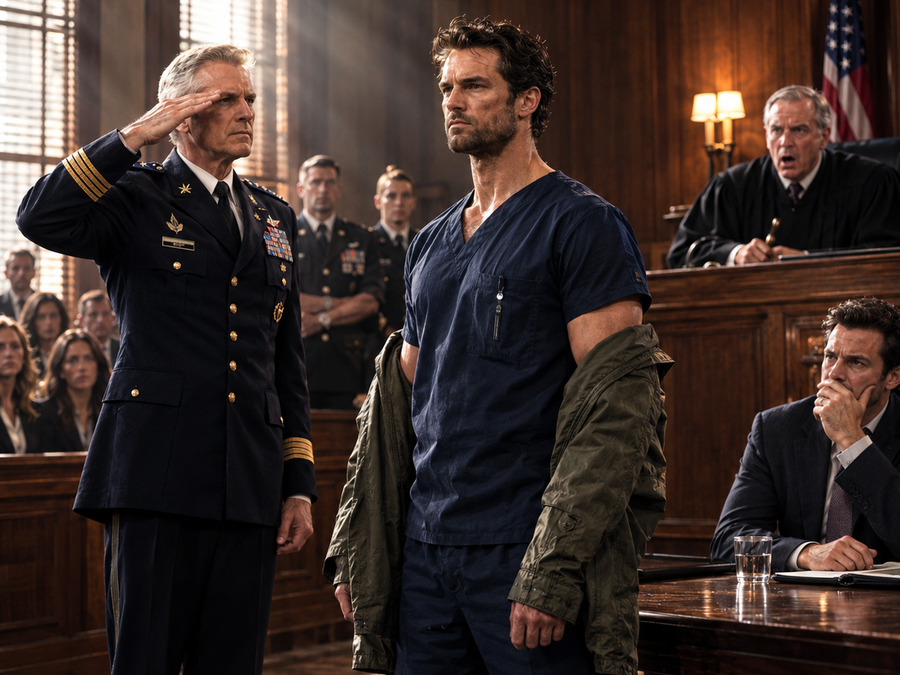
“Your honor,” Bell said carefully. “Mr. Walker.” Holloway leaned back. “Stand up.” Ethan stood. “You knew you were coming to court today.” “Yes, your honor.” “You knew you’d be standing before a judge in a hearing about whether you’re fit to raise a child.” “Yes, your honor.” “And that—” Holloway lifted one hand and gestured at the jacket, at all of it, with a flick of contempt that was somehow worse than shouting. “—is what you chose to wear.”
Ethan said nothing. “You come into my courtroom,” Holloway went on, his voice rising now, warming to it, a man settling into the one thing he was truly good at, “dressed like you crawled out from under a truck. And you expect me to believe you take this seriously? You expect me to hand a little girl’s future to a man who won’t even show this court the basic respect of a clean shirt?” He shook his head. “It tells me everything I need to know. A man’s respect for a place is written on his back. And you, sir, are wearing exactly what you think of all of us.”
“That’s not what it means, your honor,” Ethan said quietly. “I didn’t ask you what it means.” “You did, though.” Ethan’s voice stayed even. “You just told the whole room what my jacket means. And you’re wrong.” The gavel came down. Crack. “You will not speak to me like that.” “I’m not speaking to you anyway, your honor. I’m telling you that you don’t know what this is.” Ethan touched the frayed cuff of his own sleeve once, lightly, the way a man touches something sacred. “And you decided you did the second I walked in the door.”
Now the room had gone very still. Even Gerald Pierce had stopped smiling. Marcus Bell had a hand on Ethan’s arm, whispering, “Sit down. Sit down. Please sit down.” And Ethan wasn’t sitting down. Judge Holloway’s face had gone from red to a dark, dangerous purple. “I have been on this bench for thirty years,” he said, low and cold. “And I have never, never been lectured by a defendant in a filthy coat. You want to talk to me about respect, Mr. Walker? Then you will take that thing off right now. You will remove that jacket, and you will fold it, and you will set it on that table, and you will stand before this court like a man. Or I will hold you in contempt and have you dragged out of here in irons, and you will not see the outside of a cell or your daughter for thirty days. Do I make myself clear?”
The last words landed like a hammer. Or your daughter. And for one long, terrible moment, everyone in that room watched Ethan Walker’s face and waited to see it break. It didn’t break, but something in it changed. Some door somewhere behind his eyes. A door that had been shut for four years creaked open just an inch, and what stood behind that door was not a janitor.
“No,” Ethan said. The word wasn’t loud. That was the thing about it. It wasn’t shouted. It was just placed there in the center of the room, immovable, like a stone dropped into still water. Holloway blinked. “Excuse me?” “I said no.” Ethan lifted his chin. “You can hold me in contempt. You can put me in a cell. You can do whatever this court gives you the power to do, and I’ll stand here and take it. But I am not taking off this jacket. Not for you. Not for anybody. Not today. Not ever.”
“And why?” Holloway said, his voice shaking now with fury. “Is one filthy coat worth thirty days in a cage and losing your child?” And that was when Ethan Walker told him. “Because it isn’t a coat, your honor,” Ethan said. And for the first time all morning, his voice carried something that made the hair stand up on the back of every neck in that room. “It’s a promise. I made it to eleven men. Eight of them are still alive because of what I did while I was wearing it. Three of them aren’t. And there’s a name stitched inside this sleeve. A name that men bled to death saying because it was the last thing that made them feel like somebody was coming for them.”
He put one hand flat against his own chest, over his heart, over the jacket. “I don’t take it off in front of people who never earned the right to see what’s underneath. And you, your honor, with all the respect I have left in me, did not earn that right the moment you decided a man in old clothes wasn’t worth listening to.”
The silence in courtroom 4 was total. Absolute. Not a cough, not a shuffle, not a breath. Marcus Bell had let go of Ethan’s arm. He was just staring now, mouth slightly open. A man realizing he had spent six weeks representing a client he did not know at all. And Gerald Pierce in the gallery had gone very, very still, because Gerald Pierce had done his homework. Gerald Pierce had paid people to dig up everything there was to dig up on Ethan Walker. And Gerald Pierce’s people had come back with four blank years. Four years where the man simply did not exist. And Gerald Pierce had assumed that meant nothing. He was beginning to suspect it meant everything.
“Bailiff,” Judge Holloway said. His voice had lost some of its thunder. “Remove the jacket. If he won’t take it off, take it off him.” Two security officers stepped forward from the wall. And Ethan Walker turned to face them. He didn’t raise his fists. He didn’t drop into a stance. He didn’t do any of the things a violent man does. He simply looked at them, and his voice when it came was not loud, and it was not angry, and it froze both of those men where they stood as surely as if he’d put a hand on each of their chests. “Do not,” Ethan said, “touch me.”
That was all. Four words. But those four words did not come out of the mouth of a janitor. They came out of the mouth of a man who had, in another life, given orders that men obeyed with their lives on the line. Orders given in the dark, under fire, when obeying meant living and hesitating meant dying. There is a particular register the human voice can reach. A frequency of pure command that some men earn. And most men never hear. And both of those young security officers heard it now, and their bodies obeyed before their minds could catch up. They stopped. They stopped, and they looked at each other, and neither one of them could have told you why.
“I gave you an order,” Holloway barked from the bench. “Remove the—” “Your honor.” One of the officers, the older of the two, a man with fifteen years on the job, was looking at Ethan strangely now. “Your honor, I don’t—” And that was the moment the door at the back of the courtroom opened. It didn’t slam. It didn’t bang. It simply opened the way a heavy door opens when a very deliberate hand is pushing it. And every head in courtroom 4 turned toward the sound.
The man who walked in was in his early sixties, tall, straight-backed, with silver hair cut close to the scalp and a bearing that seemed to raise the ceiling as he entered. He wasn’t in uniform. He was in a plain dark suit. But you did not need a uniform to know what this man was. It was in the way he moved, the way the room seemed to rearrange itself around him, the way the two security officers who had ignored a direct order from a judge thirty seconds ago straightened instinctively without being told. Later, people who were in that courtroom would say they knew even before anyone said his name that they were in the presence of someone. That the temperature of the room had changed. That whatever this hearing had been about ninety seconds ago, it was about to be about something else entirely.
The man’s name was Admiral Thomas Reynolds. He wore four stars when the occasion called for them. Thirty-eight years in the United States Navy, most of them in the part of the Navy that does not get talked about. The part that operates in the dark places of the world and comes home without parades. He had come to this courthouse that morning on an entirely unrelated matter. A scheduling thing. A signature. Ten minutes of his day. And he had been walking down the third-floor hallway toward the elevators when he’d heard, through the open door of courtroom 4, a voice say the words that stopped his heart cold in his chest. A name stitched inside this sleeve. A name that men bled to death saying.
Reynolds had frozen in that hallway. Because there was only one name that could mean. Because he had spent four years believing that the man who carried that name was dead. Had, in fact, stood at a memorial and said as much. Because there had been no body and no trace and no answer. Only a hole where a hero used to be. And then he had heard the voice again, closer, clearer, and something in his chest had cracked wide open. And Admiral Thomas Reynolds, who had not run for anything in fifteen years, had walked very fast to that door and pushed it open. Now he stood at the back of the courtroom, and he was looking at Ethan Walker, and Ethan Walker had turned to look at him, and the whole room hung suspended between them like the moment before a bridge collapses.
“This is a closed hearing,” Judge Holloway snapped. But there was uncertainty in it now. “Sir, you’ll have to—” Reynolds didn’t hear him. Reynolds took one step forward. Then another. His eyes never left Ethan’s face. Searching it. Reading it. Checking it against a memory four years old. Against a younger face and a stronger body and a man he’d last seen carrying two wounded teammates through a wall of gunfire. And his voice when it finally came was not the voice of a four-star admiral. It was the voice of a man seeing a ghost. It cracked. It broke clean in half. “Ghost 7.”
The two words dropped into the silent courtroom like stones into a still pond. Ethan Walker’s jaw tightened. His eyes, which had been so steady, so flat, so controlled through everything Holloway had thrown at him, filled all at once. And he had to look at the ceiling to keep it from spilling over, because nobody had called him that name in four years. Because the last time he’d heard it, it was screamed over a radio by a man who didn’t make it home. “Sir,” Ethan said, and his voice was barely a whisper.
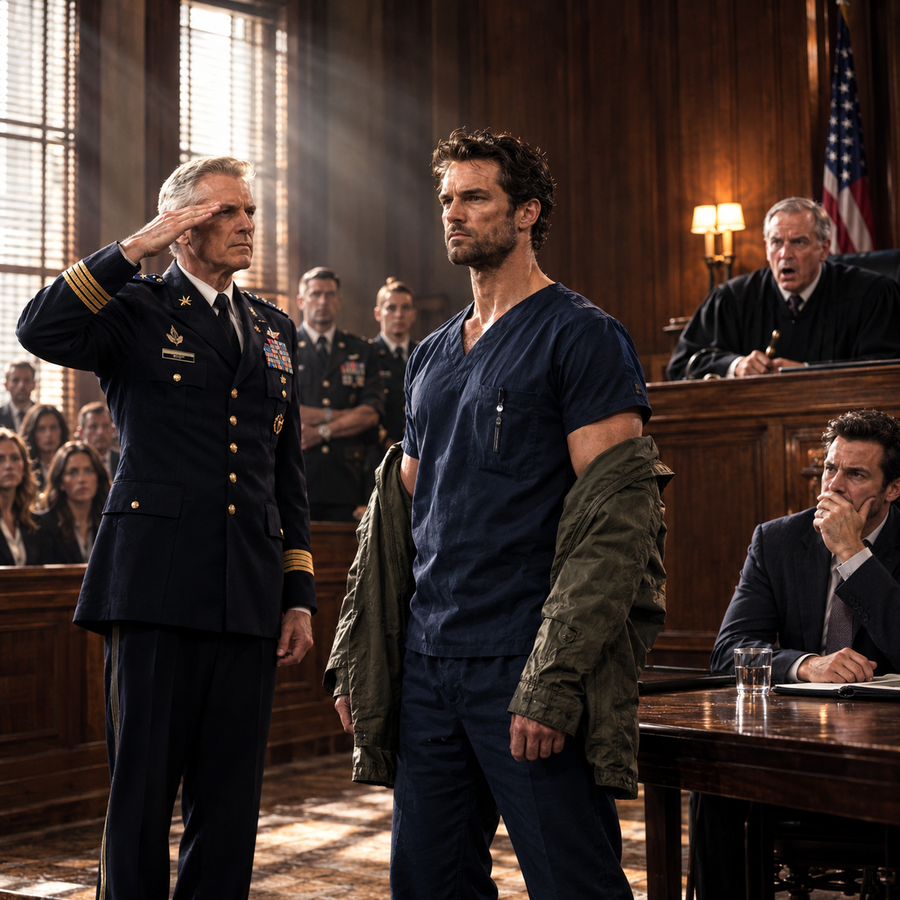
And Admiral Thomas Reynolds, in the middle of a Norfolk custody courtroom, in front of a judge and two lawyers and a rich man and a caseworker and a bailiff and two security guards and a little girl watching through the small window in the courtroom door, Admiral Thomas Reynolds came to attention. And he saluted. He held that salute, and his hand was shaking. “Do you have any idea?” the admiral said, and now he was not talking to Ethan. He was turning slowly to face the bench, and his voice was gathering itself back into something terrible. “Do you have any idea who you have been screaming at?”
Judge Holloway opened his mouth. Nothing came out. Later, much later, when the whole thing was over and the truth was out and the world had rearranged itself around what happened in courtroom 4 that morning, people would argue about which moment was the one that mattered. Some would say it was the salute. Some would say it was the two words, Ghost 7. Some would say it was the truth about Logan Pierce, which was still hours from coming out. But the people who understood, the ones who had really been paying attention, knew the moment that mattered had already happened quietly before the admiral ever walked through that door.
The moment that mattered was when a broken, tired man in a coffee-stained jacket, with everything to lose and a little girl watching, looked a powerful judge in the eye and refused to become smaller than he was. The moment that mattered was the word no. Everything after that was just the world finally catching up to a truth that had been standing in the room the whole time. The truth that you cannot tell what a man is worth by looking at his coat. That the quietest man in the room is sometimes the one who has bled the most. That there are heroes walking among us right now, braiding their daughter’s hair at four in the morning, fixing broken pipes in gray hallways, asking for nothing, saying nothing, carrying names stitched into their sleeves that would stop your heart if you knew them.
Judge Richard Holloway had spent thirty years believing a man’s character was written on the outside of him. He was about to spend the rest of his life knowing how wrong he’d been. Because standing in front of him in a jacket he’d called filthy was the reason eight men were alive to raise their own children. Standing in front of him was a call sign that soldiers still whispered like a prayer. Standing in front of him was Ghost 7. And the admiral wasn’t finished. Not by a long way.
The salute hung in the air, and for a moment nobody in courtroom 4 seemed able to breathe. Admiral Thomas Reynolds held his hand at his brow, rigid, trembling, and he did not lower it. He was not going to lower it until this room understood something. And Judge Richard Holloway, seventy-one years old, thirty years on the bench, a man who had never once in his career been made to feel small in his own courtroom, sat behind that high desk with his mouth slightly open and no words coming out.
“Sir,” Holloway finally managed. “Sir, I don’t know who you are, but this is a closed—” “My name is Admiral Thomas Reynolds,” the older man said, and he lowered his hand at last, slowly, deliberately, the way you set down something heavy. “United States Navy. Thirty-eight years of service. And the man you just threatened to drag out of here in irons is the reason I’m still alive to stand in your courtroom.” The words landed and scattered like buckshot.
Marcus Bell, the public defender, had stopped breathing entirely. He was staring at his own client the way you’d stare at a stranger who’d been sitting in your living room for six weeks. Across the aisle, the two gray suits had gone very still. And in the gallery, Gerald Pierce leaned forward an inch, and the smile that had been living on his face all morning was gone, now wiped clean, replaced by something that looked almost like the first cold touch of fear.
“That’s—that’s a very moving claim,” Holloway said, gathering himself, reaching for the authority that had never once failed him before. “But this is a court of law, Admiral, not a—not a reunion. And I have a defendant who has refused a direct order, who is in contempt, and I will not have my courtroom turned into—” “You want to talk to me about contempt?” Reynolds said quietly. And it was the quiet of it that stopped Holloway cold. Because Reynolds hadn’t raised his voice. He’d lowered it. And any man who’s spent time around real power knows that the truly dangerous ones don’t shout. They go soft. They go soft, and the room leans in.
“You’ve been holding this man in contempt of a coat,” Reynolds said. “I’d like to talk to you about contempt of what he did in it.” Holloway said nothing. “May I approach, your honor?” The admiral’s tone was scrupulously correct now, formal, but there was steel underneath every syllable. “I think this court is about to make a mistake it will not recover from, and I’d like to prevent that. Out of respect for the bench. Which is more respect than the bench has shown this man all morning.”
For a long moment, Holloway just looked at him, and you could see the calculation happening behind those hard old eyes. The instinct to slam the gavel, to reassert control, to throw this uninvited admiral out along with the janitor. But there was something else there too. Because thirty years on the bench teaches a man to read a room, and every instinct Richard Holloway had was screaming at him that the ground had shifted. That the man in the coat was not what he’d assumed. And that if he doubled down now, in front of all these witnesses, he might be doubling down on the worst mistake of his life. “Approach,” Holloway said.
But Reynolds didn’t approach the bench. Instead, he turned, and he walked slowly, every eye tracking him across the courtroom floor, to where Ethan Walker stood. And he stopped in front of him, and the two men looked at each other, and four years passed between them without a word. “Look at you,” the admiral finally said, and his voice broke again, right down the middle. “We buried you, son. Do you understand that? There’s a stone with your name on it at the memorial wall. I stood in front of it. I gave the speech. I told a room full of your brothers that Ghost 7 didn’t come home.” He shook his head slowly. “And you’ve been here this whole time. Forty minutes down the road from my office. Fixing pipes.”
“I didn’t want to be found, sir,” Ethan said. “I know.” Reynolds’s jaw worked. “I know you didn’t. And I hate that I understand why.” “Be—them—” Judge Holloway cleared his throat. “Admiral, if you have something for this court, I’ll hear it. But I need to understand what I’m looking at.”
Reynolds turned back to the bench. And when he spoke now, he spoke to the whole room, in the clear, carrying voice of a man who had briefed presidents. “Four years ago,” he said, “there was an operation. I can’t tell you where. I can’t tell you the details. Most of them are still classified and will be long after everyone in this room is dead. But I can tell you what I’m allowed to tell you.” He paused. “There was a team on the ground. Good men. The best men I ever served with. And the operation went wrong. It went as wrong as an operation can go. The extraction fell apart. The team was pinned down, cut off, surrounded, with wounded who couldn’t walk and no way out. And the clock running down on all of them.”
The courtroom was so silent you could hear the fluorescent lights hum. “And there was one,” Reynolds went on. “One man on that team whose job—whose job, gentlemen—was to go into that and bring people out. A combat rescue specialist. The man who runs toward the thing everyone else is running away from.” He looked at Ethan. “That man had a call sign. And the call sign was Ghost 7.”
“Admiral,” one of the gray suits started, “with respect, we don’t see how a military—” “Sit down,” the admiral said. He didn’t even look at him. He just said it. Two words. Flat. And the lawyer, a man who billed six hundred dollars an hour and was not accustomed to being told to sit down by anyone, sat down. “For six hours,” Reynolds continued, “Ghost 7 kept those men alive. Six hours. He coordinated the whole rescue with a voice on a radio because half the command structure was gone. He went out on foot, exposed, into fire, and he carried men back one at a time. Not once. Not twice. Over and over, until his hands didn’t work anymore. And when the birds finally came, when we finally got them a way out, do you know what he did?”
Nobody answered. Nobody could. “He put every single one of them on the helicopter first,” Reynolds said. “Everyone. And he stayed on the ground to hold the line so the wounded could get out. He was the last man to leave. And he almost didn’t leave at all.” The admiral’s voice dropped. “Eight men came home who should have died in that place. Eight men who have wives and kids and mortgages and Sunday dinners and whole entire lives because one man decided their lives were worth more than his own comfort, his own safety, his own everything.” He turned and pointed at Ethan, and his hand was shaking. “That man is standing in your courtroom in the coat you called filthy. And you were about to put him in a cell.”
The silence after that was a physical thing. It pressed down on everyone. And then, in the gallery, Gerald Pierce made a sound. A small, dismissive scoff, an exhale through the nose. The sound of a man used to buying his way out of every room he’d ever been trapped in. The admiral’s head turned. “Something funny?” Pierce spread his hands, unbothered, the picture of reasonable wealth. “It’s a very touching story, Admiral. Truly. War hero falls on hard times. We all feel for him. But none of it changes the fact that this man put my son in the hospital. Whatever he did four years ago doesn’t give him a license to break bones in a parking lot today. A hero can still be a criminal. The two aren’t mutually exclusive.”
“And who,” Reynolds said slowly, “are you?” “Gerald Pierce.” “Gerald Pierce.” Reynolds nodded, like he was filing the name away somewhere. “And your son is the alleged victim.” “My son is the victim. Not alleged. There’s a police report.” “There’s a police report,” Reynolds repeated. And then he did something that made the hair on the back of Ethan’s neck stand up. He smiled. It was not a warm smile. “You know, Mr. Pierce, I’ve read a lot of reports in my career. Written a few myself. And one thing I learned, thirty-eight years in—a report is only ever as honest as the man who filed it.”
“Is that an accusation, Admiral?” “It’s an observation, gentlemen.” Holloway’s gavel came down, but softly now, almost tentatively. A man trying to reassert control of a room that had gotten away from him. “This is not the criminal trial. This is a custody hearing. Admiral Reynolds, I appreciate—I do appreciate the context you’ve provided. It’s changed my understanding of this situation considerably. But my hands are somewhat tied. There are charges pending, and regardless of Mr. Walker’s service, however extraordinary, I have a responsibility to the child.”
“Then let’s talk about the child,” Reynolds said. He walked to the courtroom door and opened it. And there in the hallway, sitting on the wooden bench where her father had left her, was Lily Walker. Eight years old, pink sweatshirt, two hands folded in her lap. She’d been watching the whole thing through the little window in the door, and her face was streaked with tears. She was trying very hard not to let anyone see. “Come here, sweetheart,” Reynolds said gently. “It’s okay. Come here.”
Lily looked past him into the courtroom and found her father. “Daddy—” “It’s okay, baby,” Ethan said, and his voice cracked on the word. “Come here. It’s okay.” She got up off the bench, and she walked into that courtroom, full of powerful men, and she went straight past all of them. Past the admiral, past the lawyers. And she wrapped her arms around her father’s waist and buried her face in the filthy coat that a judge had wanted to tear off his back. And Ethan Walker put his hand on the back of his daughter’s head. And for the first time all morning, the steel cracked, and a single tear slid down his face and disappeared into her hair.
“This,” the admiral said quietly to the whole room, “is what you were going to take him from. Over a coat.” Nobody moved. The CPS caseworker, a woman named Diane Foley, who had come into that courtroom absolutely certain of her position, was looking at the little girl clinging to her father. And something was happening behind her eyes. Some recalculation. Some quiet collapse of a certainty she’d carried through the door.
“Your honor,” Marcus Bell said, and he had to clear his throat and start again because his voice wasn’t working right. “Your honor, in light of—in light of everything the admiral has told us, I’d like to renew my objection to any temporary removal of the child. There is no evidence, none, that Mr. Walker is anything other than a devoted father. What we have is a rush to judgment based on a man’s appearance and a police report that the admiral has just, I think, fairly called into question.” “I have not called anything into question,” Holloway said. But the fight had gone out of it. “You called his coat filthy,” Bell said. “Twice.” And that stopped the judge. Because it was true, and it was on the record, and there were witnesses, and one of those witnesses was a four-star admiral.
10:22 in the morning. Twenty-two minutes into a hearing that was supposed to be a formality. And Richard Holloway, for the first time in three decades, did not know what to do. He took off his glasses. He rubbed the bridge of his nose. And when he spoke again, his voice was different. Smaller. Older. Uncertain in a way none of them had heard from him. “I’m going to take a recess,” he said. “Fifteen minutes. Counsel will remain. Admiral, I—I’d like you to remain as well, if you’re willing. Mr. Walker.” He paused. He looked at the man and the little girl. And something moved in the old man’s face. Something that might have been the very first crack in thirty years of certainty. “Mr. Walker, you may—you and your daughter may step into the hall. Take a moment.”
The gavel came down gently, and Ethan Walker walked his daughter out of courtroom 4 with the admiral’s eyes on his back and the whole room watching and a coffee-stained coat on his shoulders that half of them had spent the morning despising and would spend the rest of their lives thinking about.
In the hallway, Ethan knelt down so he was eye to eye with his daughter, and he wiped her face with his thumb. “Hey. Hey, look at me. I need you to hear me, okay?” “They were being so mean to you.” Lily’s chin was trembling. “The man in the tall chair, he was yelling at you, and you didn’t do anything wrong.” “I know it looked scary.” “Are they going to take me away?” And there it was. The question he’d been dreading for six weeks. The question that had kept him up every single night since the arrest. Sitting at the kitchen table in the dark, staring at nothing. “No,” Ethan said. And he meant it with everything in him, even though he wasn’t sure it was true. Because sometimes you have to say a thing out loud to make it true. “No, baby. Nobody is taking you anywhere. You hear me? Not today. Not ever. I will burn the whole world down before I let anybody take you away from me.”
Lily threw her arms around his neck, and over her shoulder, Ethan saw the admiral come out of the courtroom and stand a respectful distance away, giving them the moment, but watching. Always watching. With the look of a man who has found something he thought was lost forever and is not going to lose it again. “Sir,” Ethan said, standing, keeping one hand on Lily’s shoulder. “You didn’t have to do that.” “Yes, I did.” Reynolds came closer. “Ethan, look at me. You saved eight men. Do you have any idea what those men would do—what I would do—if we found out you’d been sitting in a jail cell and nobody came? You think I wouldn’t have torn that courthouse apart brick by brick?” He shook his head. “You disappeared on us, son. You want to talk about that?” “Not right now.” “Right now we’ve got a fight in there. But you and I are going to talk about that.”
“There’s nothing to talk about, sir. I just—I couldn’t do it anymore. The medals, the speeches, everybody looking at me like I was supposed to be something.” He glanced down at Lily. “I just wanted to be her dad. That’s all I ever wanted.” The admiral looked at the little girl, and his hard face softened all the way through. “Well,” he said, “you’re a hell of a dad. That much is obvious. And I’m going to make sure that judge in there understands it before this is over.” He straightened. “But Ethan, I need you to understand something. That man in the gallery, Pierce—that’s not a random rich man having a bad day. I’ve been in enough rooms to know a predator when I see one. He came here to destroy you. He’s been working on it for weeks. And he’s not going to stop just because I walked in the door and made a speech.” His eyes hardened. “Tell me what really happened. Everything. Right now. Because if we’re going to win this, I need the truth, and I need all of it.”
So Ethan told him. Standing in that courthouse hallway with his daughter’s hand in his, he told the admiral about the restaurant, and the woman’s voice in the parking lot, and the man in the two-thousand-dollar suit with his hand where it shouldn’t have been. He told him about the eleven seconds. And he told him about how, by the time the police arrived, the woman was gone, and there were suddenly two witnesses saying he’d attacked Logan Pierce out of nowhere, for no reason, like an animal.
“The woman,” Reynolds said. “The one you protected. You’d recognize her in a second. Did anyone else see her? Anyone at all?” Ethan thought about it hard, reaching back through six weeks of nightmares to the eleven seconds that had detonated his whole life. “There was a valet,” he said slowly. “A kid. Nineteen, maybe twenty. He was standing by the podium when it started. He saw the whole thing. I remember because right before I went out the door, he—he took a step toward the parking lot like he was going to help her, and then he just froze. He froze.” “Yeah.” Reynolds and Ethan looked at each other.
“A nineteen-year-old valet,” the admiral said slowly, “working the door at a restaurant where the son of the richest man in the county likes to eat. Who saw a rich man assaulting a woman. And who, by the time the police showed up, had somehow decided he didn’t see anything at all.” He nodded to himself, grim. “That’s a scared kid, Ethan. That’s a kid who got told, real fast and real clear, that his memory better change if he liked having a job. Or worse. You think he’d talk?” “I think,” Reynolds said, “that a scared kid who watched a good man get railroaded for doing the right thing has been carrying that around for six weeks. And I think there is nothing heavier in this world than a truth you’re too afraid to tell.” He pulled out his phone. “What was the name of the restaurant?” Ethan told him, and Reynolds stepped away, already dialing, already talking low and fast to somebody on the other end. A man who was used to making things happen with a phone call. And Ethan stood in that hallway with his daughter and felt, for the first time in six weeks, something he’d almost forgotten the shape of. Hope.
10:31 in the morning. Inside courtroom 4, the recess was not going the way Gerald Pierce wanted it to go. “I want to know who let him in here,” Pierce was saying, low and hard, to the lead gray suit, whose name was Whitfield. “That admiral. Nobody put him on any list. This is a closed hearing. He walked in off the street and blew up my entire—” “Mr. Pierce.” Whitfield’s voice was tight. “With respect, lower your voice.” “Don’t tell me to lower my—” “He’s a four-star admiral, Gerald.” Whitfield turned to face his client. And for the first time, there was something in the lawyer’s expression that hadn’t been there this morning. Doubt. Fear. The look of a man who has realized he might be on the wrong side of something much bigger than he was paid to handle. “Do you understand what that means? Do you understand the kind of attention that man can bring down on all of us if he decides he wants to? We came in here to quietly handle a custody matter. That is not what this is anymore. This is now a decorated war hero, publicly, on the record, in front of witnesses, being persecuted by—” He stopped himself. “By what?” Pierce said coldly. “Finish the sentence, counselor. Persecuted by what?” Whitfield didn’t finish the sentence.
“Get your associate,” Pierce said. “Get him on the phone. I want to know everything about Reynolds. Everything. Where he lives, what he wants, what he’s afraid of. Every man has a pressure point. Find his.” “Gerald—” “Find his.” And that was the moment Diane Foley, the CPS caseworker who had been sitting quietly at the end of the table pretending to read her binder, closed the binder.
She’d been in this job for eleven years. She had removed children from genuinely dangerous homes, and she had more than once watched families get torn apart by a system that moves too fast and judges too quick. She had walked into this hearing that morning with a recommendation already written. Temporary removal pending trial, because the file said felony assault and the file said danger, and she had trusted the file. But she just watched a little girl run across a courtroom and cling to her father like he was the only safe thing in the world. And now she was sitting three feet away from a rich man telling his lawyer to find another man’s pressure point. And Diane Foley thought, I’ve been on the wrong side of this since I walked in.
“Mr. Pierce,” she said. Both men turned, surprised, as if the furniture had spoken. “I don’t think you should say things like that out loud,” Diane said carefully. “In a courtroom. With a witness sitting eight feet away.” Pierce looked at her the way you’d look at a fly. “And who are you?” “I’m the person,” Diane said, “who was supposed to recommend that you get what you came here for.” The silence stretched. “Was,” Pierce said. “Was,” Diane agreed. And she picked up her binder, and she stood, and she walked to the other end of the room, and she sat down in a chair by herself. Deliberately. Visibly. Putting distance between herself and Gerald Pierce in front of God and everyone. It was a small thing. But everybody in that room saw it. And Gerald Pierce, who had spent his whole life reading rooms and counting the people on his side, watched one of them get up and walk away, and felt, for the very first time that morning, the ground move under his feet.
At 10:45, Judge Holloway returned to the bench. He had, in the fifteen minutes of that recess, done something he had not done in twenty years. He had gone into his chambers, and he had sat down at his desk, and he had put his head in his hands, and he had thought about a man in a coffee-stained coat. Because Richard Holloway was many things. Proud. Hard. Quick to judge. Slow to admit fault. But he was not, at his core, a corrupt man. He had genuinely believed, for thirty years, that he could read a man’s worth off his surface. It had been the organizing principle of his entire career. And in the space of one morning, that principle had been detonated in front of him by a four-star admiral and an eight-year-old girl, and he was old enough and honest enough with himself, in the privacy of his own chambers, to know it. The question was what he was going to do about it.
“Be seated,” the bailiff said, and the room sat. Holloway looked out over the courtroom. He looked at the gray suits. He looked at Gerald Pierce, sitting alone now, his caseworker having abandoned him. He looked at Admiral Reynolds, standing at the back with his arms crossed. And he looked at Ethan Walker, who had returned to the defendant’s table with his daughter, because Holloway, in a break from every protocol he’d ever enforced, had quietly told the bailiff to let the girl stay in the room at her father’s side.
“Mr. Walker,” Holloway said. Ethan stood. “Your honor, I owe you an explanation.” The judge’s voice was steady, but there was something raw underneath it. Not an apology. Not yet. “I haven’t earned the right to apologize, and you haven’t heard enough for me to know whether I mean it. But an explanation. When you walked into my courtroom this morning, I looked at you, and I made a decision about who you were. I’ve made that decision about ten thousand men over thirty years, and I have been right—I told myself—more often than I’ve been wrong.” He paused. “I don’t know anymore how many times I was wrong and never found out. But I know I was wrong today. And I know I found out. And that is a thing a man my age does not get many more chances to learn.”
The courtroom was silent. “So here is what we’re going to do,” Holloway continued, and his voice found its old authority again. But it was pointed in a new direction now. “This is a custody hearing, but it exists only because of a pending criminal charge. And I am no longer satisfied—I am no longer remotely satisfied—that I understand the truth of that charge. So I am going to do something unusual. Mr. Whitfield, Mr. Bell, I am going to hear testimony right now on the underlying incident. Because I will not rule on this child’s future based on a police report that a United States admiral has, on the record, invited me to doubt.”
“Your honor,” Whitfield said, rising, and there was real alarm in his voice now. “That’s—this is a custody proceeding. The criminal matter is a separate—” “I am aware of what this is, counselor. I’ve been doing this since before you could shave.” Holloway’s eyes were hard again. But the hardness was aimed somewhere new. “Sit down.” Mr. Walker. You’ve been very eager to speak all morning. I denied you that. I’m not going to deny you anymore.” He gestured to the witness stand. “Tell me what happened in that parking lot. All of it. Under oath.”
And Ethan Walker looked down at his daughter, and he squeezed her hand, and he handed her gently to the admiral, who took her small hand in his weathered one like it was the most precious thing he’d ever held. Then Ethan walked to the witness stand. He raised his right hand. He swore to tell the truth. And he sat down, in a coffee-stained coat, in front of a judge who had wanted to tear it off him an hour ago. And he began to speak.
“I was picking up dinner,” Ethan said. “My daughter’s birthday is coming up. I saved for two weeks to take her somewhere nice. I was standing at the counter waiting for the food, and I heard a woman scream in the parking lot.” “What kind of scream?” Holloway asked. “The kind you don’t ignore,” Ethan said. “The kind that means somebody’s out of options.” “Go on.” “I went outside. There was a woman pinned against a black SUV. There was a man holding her there. He had one hand over her mouth and the other hand—” Ethan stopped. He glanced toward Lily and lowered his voice. “The other hand was somewhere it had no business being. She was fighting him. She couldn’t get free. He was too big, and she was too scared.”
“And you recognized this man?” “Not at the time. I didn’t know who he was. I found out later it was Logan Pierce.” At the sound of his son’s name, Gerald Pierce shifted in his seat. “What did you do?” Holloway asked. “I stopped him.” “How?” Ethan was quiet for a moment. “Your honor, I’ve spent a lot of my life learning how to stop a man from hurting someone. And most of what I learned, I learned so that I could do it without killing anybody. That’s the whole point of the training. Anybody can hurt a person. It takes discipline to stop a threat and leave him breathing.” He looked at his hands. “I took his wrist. I put him on the ground. I controlled him until he stopped fighting. Eleven seconds.”
“He had bruising and a dislocated shoulder that they put right back in at the hospital that same night. He was never in any danger of dying. He was never in any danger of anything except not being able to hurt that woman anymore.” “And the woman? She ran. I don’t blame her. She was terrified. By the time the police came, she was gone.” Ethan’s jaw tightened. “And that’s when the story changed. Because suddenly there were two men saying I attacked Logan Pierce for no reason. Suddenly there was no woman at all. Suddenly I was the criminal, and the man with his hand over a woman’s mouth was the victim.”
“You’re saying the witnesses lied.” “I’m saying,” Ethan said carefully, “that money talks, your honor. And I didn’t have any.” The courtroom was dead silent. And then, at the back of the room, the door opened again. Every head turned. And this time it was a young man who stepped through. Nineteen, maybe twenty, in a cheap collared shirt, with the terrified, resolute look of a kid who had made a decision he was not at all sure he was brave enough to keep. Behind him stood a man Reynolds had sent. One phone call, one favor, one honorable admiral, pulling on one thread. And the man gave Reynolds a small nod. The valet.
Ethan sat up straight in the witness box. Gerald Pierce went white. “Your honor,” Admiral Reynolds said, rising to his feet, his voice ringing through the courtroom with the calm certainty of a man who has just watched the tide turn. “I believe there’s someone here who saw exactly what happened in that parking lot. And I believe, for the first time in six weeks, he’s finally ready to tell the truth.” The young man swallowed hard. He looked at Gerald Pierce, and you could see it cost him everything he had not to look away. And then he looked at Ethan Walker. At the man in the coffee-stained coat who’d been called a criminal for doing the one thing that valet wished, every single night for six weeks, that he’d been brave enough to do himself.
“My name is Danny Alvarez,” the young man said, and his voice shook, but he did not stop. “I was working the door that night, and I saw everything, and I’ve been too scared to say so because a man came to my house and told me what would happen to my family if I did.” He lifted his chin. “I’m not scared anymore.” The words hung in courtroom 4 like the echo after a gunshot. And for a moment, nobody moved.
Then Gerald Pierce came halfway out of his seat. “Your honor, this is outrageous. This—this boy—you can’t just let some kid wander in off the street. And I object. I object to all of this. This is a custody hearing, not a—a circus and ambush. This is—” “Sit down, Mr. Pierce.” “I will not—” “You will. Or the bailiff will assist you.” Holloway’s voice was flat and cold and utterly certain. Whatever had cracked in the old judge during that recess, it had reset something in him. Some compass that had been spinning wildly all morning and had finally found north.
“You are not a party to the custody question,” Holloway said. “You are here as a courtesy. As the father of the alleged victim in the related criminal matter. And your courtesy is very nearly exhausted. Now sit down.” Gerald Pierce sat down. But his eyes fixed on Danny Alvarez, and they promised a thousand kinds of ruin. And Danny Alvarez saw those eyes. And to his credit—to the everlasting credit of a nineteen-year-old kid making eleven dollars an hour parking cars—he did not look away.
“Young man,” Holloway said, and his tone shifted, gentled, the way you’d speak to a spooked animal you didn’t want to bolt. “Come forward. What’s your name again?” “Danny, sir. Danny Alvarez.” “Danny. You said you saw what happened in the parking lot six weeks ago.” “Yes, sir.” “You understand where you are. You understand this is a court of law. And if you speak, you speak under oath. Which means if you lie—if you lie—there are consequences.” “I understand, sir.” Danny’s voice cracked, and he cleared his throat and tried again. “I’ve been—the reason I’m here is because I’m tired of lying. I already lied to the police. Six weeks ago, I lied to the police, and I’ve been sick about it every day since. So no, sir. I’m not going to lie in here.”
Holloway studied him for a long moment. Then he nodded to the bailiff. “Swear him in.” The lead gray suit, Whitfield, was on his feet. “Your honor, this witness has no bearing on custody. The criminal matter is the only reason we’re all in this room.” “Counselor, as I’ve now said three times,” Holloway didn’t even look at him, “I am going to hear this young man. If it turns out the police report that started this entire proceeding was built on lies, I would like to know that before I make a decision about where a little girl sleeps tonight. Now, unless you have something useful to contribute, sit down.”
Whitfield sat down, and it did not escape anyone’s notice that he sat down slowly, and that when he looked at Gerald Pierce, there was something new in his face. The dawning, sinking horror of a lawyer who is beginning to suspect that his client lied to him, too. Danny Alvarez took the stand. He swore to tell the truth. His hand was shaking when he raised it, and he pressed it flat against his thigh when he sat down to make it stop. “Take your time, Danny,” Holloway said. “Tell me what you saw.” And Danny Alvarez told them.
“I was working the valet stand. It was a slow night. Tuesday, maybe eight o’clock. Mr. Pierce—the younger one, Logan—he’d been inside a couple hours, drinking. He came out with a woman. I’d seen her go in earlier, but not with him. She came in by herself.” Danny swallowed. “They were walking toward the lot, and I could tell—even from where I was standing, I could tell she didn’t want to be walking with him. She kept trying to step away. And he kept—like—steering her. Hand on the back of her neck. And she was saying stuff like, ‘I’m okay, I can call a cab, I’m fine.’ The kind of thing you say when you’re trying not to make somebody mad.”

