“If you sign this deal, you’re mine to protect—and mine to destroy, if you give me a reason.”
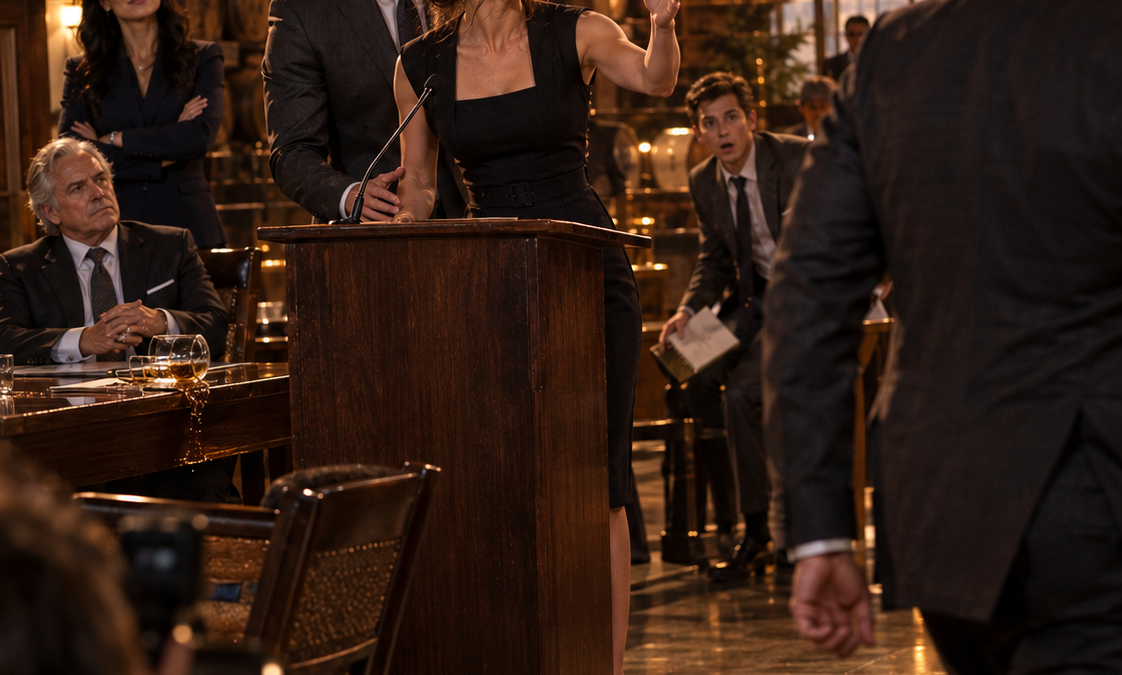
“If you sign this deal, you’re mine to protect—and mine to destroy, if you give me a reason.”
She thought she’d lost her family’s legacy when her brother sold it out from under her. She never expected to build a new one—with the most dangerous man in Kentucky.
The pen scratched across the page like a knife through silk, and Charlotte Hartwell watched her birthright die in cursive.
“Sign it, Charlie.” Everett’s voice had that reasonable tone he’d perfected since their father’s funeral—the one that made strangling him feel like the only sane response. “The family council has spoken.”
She didn’t look at the document. Instead, she looked at the six people seated around the mahogany table in the distillery’s boardroom—the same table where her father had taught her to nose bourbon at age twelve, where she’d first learned that the angel’s share wasn’t just evaporation but everything time stole from you when you weren’t paying attention.
Aunt Margaret, seventy-three and dressed like she was attending a garden party rather than dismantling a legacy, wouldn’t meet her eyes.
Uncle Robert, who’d flown in from London, kept checking his phone.
Cousin Diana, São Paulo, had arrived this morning and already looked like she wanted to leave.
Two empty chairs. Two family members who hadn’t been reachable—Cousin Marcus in Sydney, Aunt Josephine in Dublin. The bylaws required quorum. Seven of nine.
“We don’t have quorum,” Charlotte said quietly.
Everett’s jaw tightened. “We have six voting members present. The bylaws allow for—”
“The bylaws require seven for decisions involving the aging reserve.” She’d memorized those bylaws at fourteen, the same year her father had first let her into the rickhouse alone. “You know that, Ev. You wrote the amendment yourself six years ago.”
“I wrote it when we had nine active members. Marcus hasn’t voted in three years, and Josephine—”
“Hasn’t formally resigned. Which means she’s still a voting member, which means you need seven, which means this vote is void.”
The room went very still.
Then Gerald Ashford, the family’s attorney for forty-two years, cleared his throat and slid a single sheet of paper across the table. “Actually, Charlotte, that’s not entirely accurate.”
She recognized the paper before she touched it. Her father’s handwriting—or a copy of it—dated eleven years ago. A codicil to the family trust.
“In the event that a quorum cannot be achieved within seventy-two hours of a proposed vote on asset liquidation exceeding ten million dollars,” Gerald read, his voice as dry as the county clerk he’d once been, “the acting chairman may proceed with a simple majority of available voting members, provided the decision is notarized under the provisions of the 1987 Uniform Family Trust Act.”
Charlotte’s blood went cold. “That’s not—”
“The 1987 Act was superseded in 1994,” Gerald continued, and something in his tone made her look up. His eyes, behind wire-rimmed glasses, held something she couldn’t read. “However, the codicil specifies that any notarization must use the language and form prescribed by the Act as it existed at the time of the trust’s creation. The notary must certify under penalty of perjury that all reasonable efforts were made to contact absent members, and that such efforts are documented.”
Everett was already reaching for the document. “We have documentation. Marcus’s phone records, Josephine’s—”
“Josephine’s phone records show three missed calls from an unknown number,” Gerald said mildly. “No voicemail. No written notice. No registered letter. Under the 1987 Act, that doesn’t constitute ‘reasonable efforts.’ It constitutes a procedural defect.”
The silence that followed had teeth.
Charlotte looked at Gerald Ashford—really looked at him—and saw for the first time that the old man’s hands were trembling slightly. Not from age. From something else.
“The notarization,” Gerald said, “is void. The vote is void. The sale of the aging reserve cannot proceed.”
Everett’s fist hit the table. “You son of a—”
“I serve the trust,” Gerald said, and for a moment, his voice wasn’t dry at all. It was steel wrapped in old paper. “Not any single member of this family. Your father knew exactly what he was doing when he wrote that codicil. He knew exactly what kind of man you’d become.”
Charlotte’s brother went very, very still.
And Charlotte—standing in the wreckage of what she’d been sure was her final defeat—felt the first stirring of something that wasn’t quite hope.
It was more dangerous than hope.
It was possibility.
The parking lot of Hartwell Distillery smelled like wet limestone and yeast, the way it always did after a spring rain. Charlotte stood by her truck—a 1978 Ford F-150 her father had taught her to drive in, the same truck she’d used to haul barrels before she was old enough to legally taste what was in them—and tried to remember how to breathe.
“Miss Hartwell.”
She turned. Gerald Ashford stood ten feet away, his coat over his arm, his face unreadable in the amber light of the distillery’s security lamps.
“You knew,” she said. “You knew that codicil would void the vote. You wrote it that way.”
“I witnessed your father sign it.” He walked closer, his footsteps quiet on the gravel. “He wasn’t a trusting man, Charlotte. He loved you, but he didn’t trust your brother. And he had reason.”
“What reason?”
Gerald was quiet for a long moment. Then: “Your brother has debts. Significant ones. The kind that don’t show up on the distillery’s books but have a way of finding their way home.”
“Debts to whom?”
“To people who don’t extend credit out of kindness.” He reached into his pocket and withdrew a business card, plain white, embossed with nothing but a name and a phone number. “You’ll need help. The kind of help that doesn’t come from within this family. Call this number. Tomorrow. Not tonight—tonight, you should go home and lock your doors.”
Charlotte took the card. The name on it meant nothing to her.
Sinclair Global Holdings.
“What is this?”
“Insurance,” Gerald said. “Your father’s, not mine. He knew that one day, you’d need to fight for what’s yours. He made sure you’d have the means.”
He turned and walked toward his car, a nondescript sedan that had seen better decades.
“Gerald.” Her voice stopped him. “Why did you wait until now? Why not tell me before?”
The old lawyer looked back at her, and for a moment, he looked every one of his seventy-nine years.
“Because before now, you never needed to know how much your father believed in you.” He opened his car door. “Don’t waste it.”
The sedan pulled away, and Charlotte stood alone in the dark, the card in her hand, the distillery rising behind her like a monument to everything she was about to lose.
Or fight for.
She got in her truck and drove home, the card on the passenger seat, and didn’t sleep.
Chapter 2: The Man at the Gate
The Sinclair Global Holdings offices occupied the top twelve floors of a glass tower in downtown Louisville—a building that looked like it had been designed by someone who wanted to make sure everyone within a ten-mile radius knew exactly who owned the skyline.
Charlotte had been sitting in the lobby for forty-seven minutes when the receptionist finally looked up.
“Mr. Sinclair will see you now.”
The elevator ride took another three minutes. The doors opened onto a floor that was all white marble and floor-to-ceiling windows, the Ohio River visible in the distance. A woman in a razor-sharp suit gestured toward a set of double doors.
“He’s expecting you.”
Charlotte walked through the doors and into an office the size of her entire house.
Julian Sinclair stood by the window, his back to her, his silhouette cut against the gray spring sky. He didn’t turn when she entered. He didn’t speak.
She waited.
Three seconds. Five. Ten.
“Gerald Ashford called me last night,” he said finally. His voice was low, unhurried, the kind of voice that had never needed to be raised to be heard. “He said you’d be coming.”
“He didn’t tell me he’d called you.”
“He wouldn’t.” Julian turned, and Charlotte understood immediately why the room felt smaller than it was. He wasn’t tall—not absurdly so—but he occupied space like a gravitational field. Dark hair, dark suit, dark eyes that catalogued her in a single sweep and gave away nothing in return. “You’re Charlotte Hartwell.”
“You know who I am.”
“Everyone in this industry knows who you are.” He moved toward his desk, not offering his hand, not offering a seat. “The master blender who won three international awards before she turned thirty. The daughter who should have inherited the distillery. The sister who got outmaneuvered by a man with a gambling problem and a desperate need for cash.”
Charlotte felt her jaw tighten. “You seem well-informed.”
“I make it my business to be well-informed.” He sat, finally, gesturing toward the chair across from him. “Sit.”
She didn’t sit.
“My father knew your father,” Julian said, and something in his tone shifted—a crack in the ice, barely visible. “They met at a conference in Chicago in 1998. Spent three days arguing about barrel char levels and somehow became friends. When your father died, he left something with my father. A request. A debt. Call it whatever you want.”
“What kind of request?”
“A promise that if you ever needed help—real help, the kind that costs something—I’d provide it.” Julian leaned back in his chair. “I don’t like promises. They’re inefficient. But my father was a stubborn man, and I made it before I understood what I was agreeing to.”
Charlotte took the chair. She had the sense that sitting was a negotiation in this room, and she’d just conceded ground.
“You know about the vote,” she said.
“I know about the vote. I know the sale was meant to go to a Chinese conglomerate. I know your brother owes about fourteen million dollars to a man named Victor Kreel, who doesn’t negotiate terms, he dictates them. I know that if the sale had gone through, your brother would have been able to pay off his debts and still walk away with enough to buy himself a comfortable life. And I know that none of that information is something your family would want you to have.”
Charlotte’s throat was dry. “How do you know all that?”
“Because I make it my business to know things.” Julian’s eyes held hers, and she felt, absurdly, like she was standing in the rickhouse as a child, learning to read the bourbon in the dark. “The real question is what you’re going to do with it.”
“I want to stop the sale.”
“It’s already stopped. The vote is void.”
“For now. Everett will find another way. He’ll pressure Marcus, or forge Josephine’s signature, or—”
“You’re right.” Julian nodded slowly. “He will. Unless you have something he can’t take away.”
“Like what?”
He studied her for a long moment. Then he reached into his desk drawer and withdrew a folder, thick with documents, and placed it in front of her.
“Before your father died, he transferred 30% of Hartwell Distillery’s shares into a separate trust. A trust that requires two signatures to access—yours and mine.”
Charlotte opened the folder. The documents were real, notarized, dated six weeks before her father’s fatal heart attack. She read the first page, then the second, then looked up.
“This gives me controlling interest.”
“This gives you controlling interest—if you have my signature. Without it, the shares are locked, and your brother’s 40% makes him the de facto majority. He can’t sell the aging reserve without council approval, but he can do plenty of other damage in the meantime.”
“What do you want in exchange for your signature?”
Julian smiled, and it wasn’t a warm expression. It was the smile of a man who had been waiting for exactly this question.
“I want a merger. Sinclair Global Holdings acquires a 51% stake in Hartwell Distillery. You stay on as master blender and CEO. Your brother loses all operational control. Your family name stays on the door. Your father’s legacy survives.”
Charlotte’s hands were shaking. She set the folder down.
“What’s the catch?”
“The catch is that your brother will fight. He’ll try to discredit you, disinherit you, destroy you. He’ll use everything he has—including things you don’t know about. And when he does, he’ll come after me, too.” Julian’s voice hadn’t changed, but the temperature in the room had dropped. “I don’t like being attacked. I don’t like being threatened. And I really don’t like having to clean up messes that other people create.”
“That’s not a catch. That’s a warning.”
“No.” Julian leaned forward, and for the first time, she saw something in his eyes that wasn’t calculation. Something darker, and older, and more personal. “The catch is that I’ve been watching your family for years. Watching you. And I don’t do things halfway. If you sign this deal, you’re mine to protect—and mine to destroy, if you give me a reason.”
Charlotte met his eyes and didn’t flinch.
“You don’t know me well enough to threaten me.”
“I know you well enough to know you just walked into the lion’s den with nothing but a business card and a grudge.” Julian stood. “That’s either the bravest thing I’ve seen this year or the stupidest. Either way, it’s interesting.”
He walked to the door and held it open.
“Think about it. You have until Friday.”
Charlotte stood, the folder in her hand, her heart pounding in a way she refused to acknowledge.
“And if I say no?”
“Then you go back to your distillery and you watch your brother drink it into the ground.” Julian’s expression was unreadable. “I’ll still own the shares. I just won’t be motivated to use them.”
She walked past him through the door. In the elevator, alone, she opened the folder again and read the last page—a letter in her father’s handwriting, dated the day before he died.
Charlie—
I know you’ll fight. You’ve always fought. But some fights can’t be won alone. I hope you’ll forgive me for the company I’ve chosen for you. He’s not an easy man. But he’s the only one I trust to keep you safe.
Do what you do best. Trust your nose. Trust your gut.
Trust yourself.
I love you.
Dad
Charlotte closed the folder and pressed her forehead against the elevator’s cool metal wall.
She had three days.
She spent two of them in the rickhouse, alone, moving between barrels that held decades of her family’s history. Her father’s voice echoed in her memory—smell that, Charlie? That’s the angel’s share. That’s what the years took from us. But what’s left is better.
On the third day, she called Julian Sinclair.
“I have conditions,” she said.
“I expected you would.”
“One: The Hartwell name stays on the distillery. Not Sinclair-Hartwell. Hartwell. Two: I have final say on all blending decisions, all product releases, all—”
“Agreed.”
“I’m not finished. Three: You don’t interfere with how I run my house. Four: Whatever’s between you and my brother, you don’t use me as a weapon. And five—” She paused, her voice steady. “You tell me the truth. About everything. Starting now.”
The silence on the line stretched.
“That’s a lot of conditions,” Julian said finally.
“I’m a lot of woman.”
A pause. Then, something that might have been a laugh, quickly suppressed.
“Friday,” he said. “My office. Bring the folder.”
He hung up before she could respond.
Charlotte stared at her phone, then at the rickhouse around her, then at the empty space where her father’s presence still lingered.
“Okay, Dad,” she said quietly. “I hope you know what you’re doing.”
The barrels said nothing. But outside, the rain had stopped, and the sun was breaking through the clouds over the bluegrass.
It was, she decided, a sign.
Or maybe just weather.
She went inside to pack.
Chapter 3: Terms of Engagement
The contract was ninety-four pages long, and Charlotte read every word.
Julian watched her from across his desk, his expression unreadable, as she worked through the document with a red pen. She marked clauses, made notes in the margins, circled phrases that made her pause. Twice, she looked up to find his eyes on her and didn’t look away.
“You’re thorough,” he said when she finally set the pen down.
“I’m careful. There’s a difference.”
“Is there?”
“Thorough is about doing the work. Careful is about knowing what happens if you don’t.” She pushed the contract toward him. “I have questions.”
“Of course you do.”
“Page forty-one, section three, clause C. It says the merger includes ‘all intellectual property, including but not limited to trademarks, trade secrets, and blending formulas.’ That’s too broad. The Hartwell mash bill is proprietary. It’s been in my family for six generations. I want it excluded.”
Julian’s eyes narrowed slightly. “The mash bill is part of the company’s value. Excluding it devalues the deal.”
“The mash bill is my family’s legacy. You want the distillery, you get the distillery. You don’t get the recipe that makes it worth having.”
“Everything has a price.”
“Not this.” Charlotte’s voice was flat. “You want to walk into my rickhouse and taste my bourbon, fine. You want to look at my ledgers, fine. But you don’t get to put my father’s secret in a vault and call it an asset. That recipe dies with me, or it stays with the family. Those are the options.”
Julian was quiet for a long moment. Then he picked up the contract and wrote something in the margin.
“Agreed. What else?”
“Page sixty-seven. The clause about operational control. It says you have final approval on all major expenditures.”
“I’m the majority shareholder. That’s standard.”
“It’s not standard when it means you can veto my decision to buy new barrels or hire a new rickhouse manager.” She held his gaze. “I’m not going to be a figurehead. If you want my name and my expertise, you get my judgment too. I make the call on day-to-day operations. You get consulted on decisions above two hundred fifty thousand dollars. That’s the line.”
“Five hundred thousand.”
“Three.”
“Four.”
“Fine.” She made a note. “Four hundred thousand. But you don’t get to override me without a written explanation, and I get the right to appeal to the board.”
“There is no board.”
“There will be. I want an advisory board—three people, one chosen by you, one by me, one mutually agreed. They review all major decisions. That’s non-negotiable.”
Julian leaned back in his chair, studying her. “You’ve thought about this.”
“I’ve had three days.” Charlotte’s voice didn’t waver. “I’ve thought about nothing else.”
“Anything else?”
“One more thing.” She reached into her bag and withdrew a single sheet of paper—old, yellowed, covered in her father’s handwriting. “This is a copy of the codicil Gerald Ashford used to void the vote. I want you to read it.”
Julian took the paper. His eyes moved across the lines, and something shifted in his expression—a flicker of recognition, quickly hidden.
“Your father was a careful man,” he said finally.
“He was a suspicious man. He knew exactly what he was doing when he wrote this.” Charlotte leaned forward. “My question is why. What did he know about my brother that I don’t?”
Julian set the paper down. He didn’t answer immediately.
“There are things about your family,” he said slowly, “that you’re not going to want to hear.”
“I’ve spent my whole life not wanting to hear things about my family. That’s never stopped them from being true.”
“Some truths are heavier than others.”
“I’m not fragile.”
“No.” Julian’s eyes held hers. “You’re not. But you’re also not prepared for what your brother has done.”
Charlotte felt something cold settle in her chest. “Tell me.”
Julian stood and walked to the window, his back to her.
“Your brother has been embezzling from the distillery for eight years. Small amounts at first—enough to cover his gambling debts without raising suspicion. But it’s escalated. He’s taken approximately six million dollars from the company’s accounts, hidden in shell companies and offshore accounts. And last year, he borrowed another eight million from Victor Kreel, using the distillery’s assets as collateral—assets he didn’t own and had no right to leverage.”
Charlotte’s hands were shaking. She pressed them flat against her thighs.
“You can prove this?”
“I have documentation. Bank records, wire transfers, a signed loan agreement with Kreel that lists the aging reserve as security.” Julian turned. “If your brother doesn’t pay back that loan—or if he doesn’t sell the reserve to cover it—Kreel will take possession of the distillery. Not the shares. The physical property. Every barrel, every building, every bottle.”
“That’s not possible. The distillery is owned by the family trust—”
“Kreel doesn’t care about legal technicalities. He has a signed agreement and a very good legal team. He’ll tie the distillery up in court for years, drain every penny of its value, and walk away with the land while your family’s name gets dragged through every headline in the country.” Julian’s voice was flat. “Your brother didn’t just betray you. He put a target on your family’s entire legacy.”
Charlotte stood. Her legs felt unsteady, but she refused to sit.
“Why are you telling me this?”
“Because you asked.”
“That’s not an answer.”
Julian was quiet for a moment. Then: “Because your father asked me to protect you. And because I don’t like men who destroy things they were meant to protect.”
“That’s still not an answer.”
“It’s the only one you’re getting.” He walked back to his desk. “The deal I’m offering solves this. Sinclair Global Holdings acquires 51% of Hartwell Distillery. We absorb the debt, negotiate with Kreel, and give your brother an exit that doesn’t involve handcuffs. You keep your name, your position, your legacy. Your brother keeps his freedom, if not his reputation.”
“And what do you get?”
“I get a distillery with award-winning products, a master blender with a reputation that adds ten points of value to every bottle, and a foothold in Kentucky that I’ve wanted for years.” Julian’s eyes met hers. “And I get to keep a promise to a man I respected.”
Charlotte looked at the contract on the desk. Ninety-four pages of terms and conditions, each one a brick in a wall she was building around everything she loved.
“If I sign this,” she said slowly, “what happens to my brother?”
“He’ll fight. He’ll lose. And then he’ll either accept the settlement I’m offering or he’ll find himself in a courtroom.” Julian’s voice was cold. “That part isn’t up to me. It’s up to him.”
Charlotte picked up the pen.
She thought about her father. About the rickhouse. About the barrels that held decades of her family’s history, each one a promise to the future.
She signed.
“Welcome to Sinclair Global Holdings, Miss Hartwell.” Julian’s voice was formal, but something flickered in his eyes—something that might have been respect. “I’ll have my team contact you about the transition.”
“One more thing.”
“I’m listening.”
“The merger announcement. When does it go public?”
“Tomorrow morning. Press conference at the distillery. Your brother will be notified this afternoon.”
Charlotte nodded slowly. “He’s going to be furious.”
“He’s going to be desperate. There’s a difference.”
“No.” She stood, gathering the folder. “For a man like my brother, there’s no difference at all.”
She walked to the door, then paused.
“Thank you,” she said, without turning around. “For telling me the truth.”
“Don’t thank me yet.” Julian’s voice followed her into the hallway. “The truth is only the beginning.”
Chapter 4: The Announcement
The press conference was scheduled for ten in the morning, but Everett Hartwell arrived at eight.
Charlotte was in the rickhouse when she heard his car—the low growl of the Porsche he’d bought two years ago with money that should have gone into barrel repairs. She set down her hydrometer and walked out into the gray morning light.
Her brother stood by the main entrance, flanked by two men she didn’t recognize. They looked like lawyers. They looked like trouble.
“Charlotte.” Everett’s smile was a knife wrapped in silk. “I heard you’ve been busy.”
“You heard wrong. I’ve been working. That’s what people do when they care about something other than themselves.”
“Careful, Charlie. You’re not as clever as you think.”
“I’m clever enough to know what you’ve done.” She walked toward him, her boots crunching on the gravel. “Six million dollars, Ev. You stole six million dollars from our father’s legacy. And then you borrowed eight million more from a man who makes his living destroying families.”
Everett’s smile didn’t falter, but something in his eyes went cold. “You’ve been talking to the wrong people.”
“I’ve been talking to the right people. The ones who can stop you.”
“There’s nothing to stop. The distillery is mine to run. The council voted—”
“The council vote was void. You knew that when you held it.” Charlotte stopped three feet from her brother, close enough to see the sweat at his temples despite the cool morning. “You tried to sell our family’s future to cover your own mistakes. That ends now.”
“You can’t—”
“I can. And I have.” She pulled a folded document from her jacket pocket—a copy of the merger agreement, signed and notarized. “As of nine this morning, Sinclair Global Holdings owns 51% of Hartwell Distillery. I remain CEO and master blender. You retain your shares, but all operational control has been transferred. You’ll still receive dividends. You won’t be allowed within a hundred feet of the rickhouse.”
Everett stared at the document like it was a snake.
“You sold our family to a stranger.”
“I saved our family from you.” Charlotte’s voice was steady. “You’re my brother. I love you. But I won’t let you destroy everything Dad built.”
“You’ll regret this.”
“I’ve regretted a lot of things. This isn’t one of them.”
Everett’s hand moved—fast, angry, reaching for the document. Charlotte stepped back, and one of the lawyers caught his arm.
“Mr. Hartwell,” the lawyer said quietly. “I’d advise restraint.”
Everett shook him off. He looked at Charlotte with something that wasn’t quite hatred—something worse. Something like grief.
“You were always his favorite,” he said. “You know that? He never looked at me the way he looked at you. Never trusted me the way he trusted you. And now you’ve proven him right.”
“I didn’t prove anything. You did that yourself.” Charlotte felt tears prick her eyes, but she refused to let them fall. “Go home, Ev. Talk to your lawyers. Figure out how to accept what’s happening, because it’s happening whether you fight it or not.”
He turned and walked toward his car. Then he stopped.
“She’s not what you think, you know.”
Charlotte frowned. “Who?”
“Julian Sinclair’s woman. The one who’s been warming his bed for the last two years.” Everett turned back, his smile returning, sharper now. “Celeste. You’ll meet her at the press conference. She’s very good at making people believe she’s on their side.”
Charlotte’s blood went cold. “What are you talking about?”
“Ask your new partner. Ask him why his ‘assistant’ has access to every deal he’s ever made—including this one.” Everett opened his car door. “Ask him who she really is.”
He drove away before Charlotte could respond.
She stood in the gravel, the document in her hand, the morning light around her, and felt the first crack in the foundation she’d just built.
The press conference was held in the distillery’s visitor center—a renovated barn that had been in the Hartwell family for a hundred and forty years. Journalists from Louisville, Lexington, and three national outlets filled the wooden chairs. Charlotte stood at the podium, Julian Sinclair at her side, and tried not to think about her brother’s words.
She failed.
“Miss Hartwell,” a reporter called out. “Can you confirm that the merger with Sinclair Global Holdings was prompted by financial difficulties at the distillery?”
Charlotte leaned into the microphone. “The merger was prompted by a shared vision for the future of Kentucky bourbon. Sinclair Global Holdings brings resources and reach that will allow Hartwell Distillery to expand into new markets while preserving the craftsmanship that has defined our brand for six generations.”
“Mr. Sinclair,” another reporter called. “What do you say to concerns that this merger represents a hostile takeover of a family legacy?”
Julian’s smile was smooth as aged whiskey. “I’d say that family legacies are best preserved by people who understand their value. Hartwell Distillery is a Kentucky institution. My goal is to help it remain one.”
Charlotte felt, rather than saw, the woman who stepped into the back of the room. Tall, blonde, dressed in a gray suit that probably cost more than Charlotte’s truck. She moved like she belonged—like she’d always belonged—and when Julian’s eyes flickered toward the door, something passed between them.
Something Charlotte couldn’t name.
After the conference, in the chaos of journalists and handshakes and flashbulbs, Charlotte found herself face to face with the woman.
“You must be Charlotte.” Her voice was warm, Southern, and completely controlled. “I’m Celeste Ashford. Julian’s… associate.”
The name landed like a punch.
“Ashford,” Charlotte repeated. “As in Gerald Ashford?”
“His niece.” Celeste’s smile was perfect, practiced. “I’ve worked with Julian for three years. He asked me to help with the transition. Make sure everything goes smoothly.”
Charlotte’s mind was racing. Gerald Ashford—the lawyer who’d given her the business card—had a niece who worked for Julian Sinclair? A niece who was, according to her brother, warming Julian’s bed?
“That’s very generous of you,” she said carefully.
“Not generous. Practical.” Celeste’s eyes held hers, and for a moment, the warmth in them flickered into something harder. “This merger is important to Julian. And what’s important to Julian is important to me.”
“Then we have something in common.”
Celeste’s smile didn’t waver. “Yes. I suppose we do.”
She walked away, and Charlotte watched her go, her father’s words echoing in her memory.
Trust your nose. Trust your gut.
Her gut was telling her that Celeste Ashford was dangerous.
Her nose was telling her there was more to this story than anyone was saying.
And her heart—her foolish, stubborn heart—was telling her that Julian Sinclair was hiding something.
She just didn’t know what.
Chapter 5: The First Night
The distillery had a guest house—a small stone cottage at the edge of the property, built in 1921 for the original master distiller. Charlotte had lived there for the last three years, since her father’s death, since her divorce from a man who’d loved her name more than he’d loved her.
Tonight, she couldn’t sleep.
She walked the grounds instead, past the rickhouses, past the fermentation tanks, past the old stone building where her father had first taught her to taste. The night was cool and clear, the bluegrass whispering around her, the smell of oak and aging whiskey in the air.
She found herself at the family cemetery—a small plot behind the main house where generations of Hartwells were buried. Her father’s grave was still fresh, the grass not quite grown over, the headstone simple: Thomas Hartwell, 1954-2024. Master Distiller. Beloved Father.
She sat on the grass beside him.
“I don’t know what I’m doing, Dad,” she said quietly. “I signed a deal with a man I don’t trust. My brother hates me. And there’s a woman who claims to be your lawyer’s niece and Julian’s… something, and I don’t know what to make of any of it.”
The wind rustled through the trees.
“You always said trust your gut. But my gut is telling me to run, and my heart is telling me to stay, and I don’t know which one to listen to.”
She closed her eyes.
“Mom would know what to do. She always knew what to do. But she’s gone too, and I’m alone, and I’m scared, and I don’t know if I’m strong enough for this.”
The silence stretched. Then, soft footsteps on the grass.
“You should be sleeping.”
Charlotte didn’t turn. “You shouldn’t be here.”
“I know.” Julian sat down beside her, his suit jacket discarded, his shirt sleeves rolled up. He looked different in the moonlight—younger, less armored. “But I couldn’t sleep either.”
“Why are you here?”
He was quiet for a long moment.
“Because your father asked me to protect you. And I’ve been protecting people my whole life—it’s what I do, it’s what my family does, it’s the only thing I’m good at. But I’ve never had to protect someone who didn’t want to be protected.” He looked at her. “You don’t want to be protected, do you?”
“I want to stand on my own two feet.”
“That’s not the same thing as refusing help.”
“It is when the help comes with strings attached.” Charlotte turned to face him. “Who is Celeste Ashford?”
Julian’s expression didn’t change, but something in his eyes shuttered.
“She works for me.”
“That’s not what I asked.”
“She’s Gerald Ashford’s niece. She’s been with Sinclair Global for three years. She’s good at her job.”
“And what else is she?”
Julian was quiet.
“My brother told me she’s your lover.”
A pause. Then, unexpectedly, Julian laughed—a short, harsh sound.
“Your brother is an idiot.”
“That’s not an answer.”
“No. It’s not.” Julian stood, brushing grass from his pants. “But it’s the only one you’re getting tonight. Go to bed, Charlotte. Tomorrow’s going to be a long day.”
He walked away before she could respond.
Charlotte sat alone in the dark, surrounded by the dead, and wondered if she’d just made the biggest mistake of her life.
Chapter 6: The Transition
The first week of the merger was chaos.
Sinclair Global Holdings’ transition team descended on the distillery like a swarm of very expensive locusts—accountants, lawyers, marketing consultants, all of them with opinions about how things should be done. Charlotte spent three days in meetings, defending decisions her family had made for a century against people who’d never tasted a barrel sample in their lives.
“We’re recommending a rebrand,” the marketing consultant said on day four. He was young, maybe twenty-eight, with the kind of confidence that came from never having failed at anything important. “The Hartwell name is strong in Kentucky, but nationally, it’s too traditional. We want something more… modern.”
Charlotte set down her pen. “You want to change the label.”
“We want to update the aesthetic. Make it more appealing to younger consumers.”
“Younger consumers don’t buy $80 bourbon. They buy $30 bourbon and mix it with Coke.” Charlotte leaned forward. “Our customers are collectors, connoisseurs, people who know the difference between a 12-year and a 15-year. They don’t care about ‘modern aesthetics.’ They care about quality.”
“With respect, Miss Hartwell—”
“With respect,” Charlotte interrupted, “I’ve been making whiskey since I was twelve years old. I’ve won three international awards. My family has been distilling on this land since 1887. You’ve been in marketing for six years. I’m not changing the label.”
The consultant looked at Julian, who was sitting at the head of the table, his expression unreadable.
“Mr. Sinclair?”
Julian didn’t look up from his phone. “You heard the lady.”
The consultant shut his laptop and left.
Charlotte stared at Julian. “That’s it?”
“That’s it.” He finally looked up. “You’re the master blender. You have final say on all product decisions. That was the deal.”
“I didn’t think you’d actually honor it.”
“I’m many things, Miss Hartwell. But I’m not a liar.” He stood. “Walk with me.”
She followed him out of the conference room, down the stairs, out into the spring sunshine. The distillery was alive with activity—barrels being moved, grain being delivered, the eternal rhythm of production that never stopped.
“What do you see?” Julian asked.
“I see a distillery.”
“Look closer.”
Charlotte looked. She saw the rickhouses, the fermentation tanks, the old stone building where her father had worked. She saw the men and women who’d been with the company for decades—the ones who’d stayed through the hard times, who believed in what the Hartwell name meant.
“I see people who care about what we do,” she said finally.
“Exactly.” Julian turned to face her. “That’s why I bought this company. Not for the assets, not for the brand—for the people. You can’t buy loyalty like that. You can only inherit it. Your father built something here. Something real. I want to make sure it survives.”
“And what do you get out of it?”
“Satisfaction.” He smiled, and it was almost warm. “And a very good bottle of bourbon.”
Charlotte found herself smiling back.
“Come on,” she said. “Let me show you the rickhouse.”
The rickhouse was dark and cool, the air thick with the smell of aging whiskey and old wood. Charlotte led Julian through the rows of barrels, her hand resting lightly on each one as she passed.
“This is where the magic happens,” she said. “Every barrel is different. Every year changes the whiskey in ways you can’t predict. You can control the grain, the water, the char level—but you can’t control time. Time does what it wants.”
“And you can taste the difference?”
“Blindfolded.” She stopped at a barrel marked with a white chalk circle. “This one’s a 15-year. Laid down in 2010, right after my mom died. Dad was so broken he couldn’t work for a month. But he came back, and he made this. He said it was for me. For my wedding.”
Julian was quiet.
“I got divorced three years ago,” Charlotte continued. “My husband didn’t want a wife who worked seventy hours a week. He wanted someone who’d stay home and look pretty at dinner parties. I couldn’t do that.”
“So you chose the distillery.”
“I chose myself.” She turned to face him. “That’s what my father taught me. That’s what this place is—a reminder that you can lose everything and still build something new.”
Julian looked at her for a long moment. Then he reached out and touched the barrel—not the way a businessman would, assessing its value, but the way someone might touch a memory.
“My father built Sinclair Global from nothing,” he said quietly. “He came to this country with five dollars and a dream. And he worked—God, he worked. Sixty years, seven days a week, never took a vacation. And when he died, he left me a company worth twelve billion dollars and a note that said ‘Don’t screw it up.'”
“That’s a lot of pressure.”
“It’s not pressure. It’s purpose.” Julian’s hand dropped. “I don’t know how to do anything else. I don’t know how to not work. I don’t know how to be anything other than what he made me.”
“And what did he make you?”
“A weapon.” Julian’s voice was flat. “Something to point at his enemies. Something to protect his legacy. I’ve spent my whole life being what he needed. I don’t know what I am when no one’s watching.”
Charlotte reached out and took his hand.
He looked down at their fingers, then back at her face. Something in his expression shifted—a door opening, just a crack.
“I don’t know how to be anything else either,” she said. “But maybe that’s okay. Maybe we figure it out together.”
Julian’s hand tightened around hers.
Then he let go.
“I should go,” he said. “I have a call with Tokyo.”
He walked out of the rickhouse, and Charlotte watched him go, her heart pounding in a way she refused to acknowledge.
 [Tap here for the Next Part ]

