Part 2: At 19, She Climbed a Locked Mountain Gate Into Her Father’s Hidden Valley
He was 71 with eyebrows like a pair of white caterpillars and a gray cardigan with one sleeve pushed to the elbow, and when Odalis pushed Linnea into the chair across from him, he looked at her over his glasses for a full 10 seconds.
Youre Nils Halletts girl, he said. I was at your christening.
You screamed through the whole thing. He pulled a thin file from a drawer.
He sat in that chair six years ago and wrote a will, and he told me to hold my tongue until you came and asked.
Youve come and asked. What did your stepmother put in front of you?
Linnea told him.
She told it in order, the way she would have told a customers order, from the folder on the table to the sleeping bag on the cot, and left out how she felt.
When she reached the pouch, he took off his glasses and rubbed his eyes.
All right, said Calm Rion.
Here is what I can tell you today.
He opened the file.
The deed your stepmother recorded Monday morning is good.
It transfers to you, as the will required, all that real property known as Larch Mountain, being Section 14 as patented to Abram Hallett in 1911. She copied that wording from your fathers will.
Probably did not read it. He looked up.
The county tax map shows 40 acres.
The patent shows 320. Somewhere in the 1970s, a clerk with a ruler clipped the north end of your mountain off the map.
The deed controls, not the map.
It always has. Linnea heard it in the middle of her chest, like a door closing, soft and final.
The taxes on all 320 acres have been paid through 2030 out of a land trust account at Tarn Fork Savings, set up by your father, which your stepmother never had a signature on. You owe the county nothing, not a dime.
He tapped the page.
As for that packet she asked you to sign, ratification and release, I havent seen it, but I know what it is.
A trustees powers end the day the trust does, which was your birthday in March.
After that, anything she signs as trustee isnt binding on you unless you say it is.
What that packet does is say it is.
He closed the folder. You did right, Ms.Hallett.
A good many people have signed their names on less than a flag.
She sat there with her hands in her lap.
Ratify what?
I dont know yet, said Calm. But a woman does not take a girls phone and truck and wallet to get one signature unless the signature is worth more than all of it put together.
They were halfway down the stairs with the smell of nails and linseed oil coming up from the store when a gray pickup truck swung in beside Odaliss and a man climbed out of it with a briefcase. He was 38, sandy-haired and soft-spoken in a blue quarter zip with a tiny logo on the chest, a bottle with a drop in it, and he walked up the sidewalk with his hands visible like a man who had learned to approach slowly.
Ms.Hallett, Spencer Doll, Summit Spring Water.
I hoped I might find you.
He held out a card.
Your stepmother tells me youve agreed to the sale. I havent agreed to anything, said Linnea.
He stopped.
His face changed, a small honest crumple of surprise.
I see, he said.
What sale? Mrs.Roque signed an option with us in November, $1,200,000 for the Lodge Mountain tract and the creek that comes off it.
We paid $60,000 down.
Its all in writing. He cleared his throat.
She told me in September that youd be signing the closing papers by the 15th of October. She was very sure.
She was wrong, said Linnea.
Yes. Doll looked at the card in his hand and then, unexpectedly, at Odalis.
Maam, I dont like surprises. My company is not in the business of taking land from girls who dont know theyre selling it.
He seemed to make up his mind.
Theres something else.
At the post office in August, the clerk mentioned a certified letter for your fathers estate from some Chestnut Foundation. Your stepmother signed for it.
She told me later it was a hobby group, and I took her word. He pushed his glasses up.
But, Ive thought about it since.
Nobody sends a certified letter about a hobby. What foundation?
said Colm Riordan from the stair.
Heartwood, said Spencer Doll.
Heartwood Chestnut Trust, and Id call them before Saturday if I were you.
I dont think its a letter your stepmother wanted anyone to read. Colm Riordan telephoned Heartwood on Thursday morning with the speaker on and the two women in the chairs in front of his desk.
When he gave the name Hallett, there was a pause so long he thought the line had gone dead.
Mr.Riordan, said a womans voice.
This is Helen Faraday. I have written to your clients estate 11 times since June.
She did not sound angry.
She sounded like someone who had been walking toward a lit window for a long time. Nils Hallett wrote to us for 5 years.
He would never say where the trees were.
He said he would show them to his daughter when she was old enough to choose. Then, he stopped answering, and in August we sent a certified letter.
Signed for on the 12th of August, said Colm, by the trustee.
I doubt anyone else ever read it. Is the daughter there?
Im here, said Linnea. Miss Hallett, I am very sorry about your father.
May I come on Sunday, and you may tell me to go away? Come Sunday, said Linnea.
Afterward, Colm laid out what he had found that morning at the recorders counter without a word of commentary.
A mortgage on the Roark Event Barn, $310,000, due the 1st of November. A notice of default dated August.
A memorandum of option for Summit Spring, $1,200, closing the 15th of October.
Linea read them the way her father read soil reports. She needs $310,000 in a month, she said calmly.
Summit pays $1,200,000 if I sign. The 60,000 they gave her is already spent on the barn.
And if the mountain were worth more than that, the rest would be mine, not hers.
So, she had to have my signature first before anyone asked what the land was really worth.
Thats why she hid the letter. She touched the packet.
And the ratification says I approve of everything she did, including the option.
She looked up.
She isnt a monster.
Shes frightened.
Those two things are not mutually exclusive, said Calm. Im learning that, said Linea.
On Friday, a little before 5:00, the white SUV came up the logging road.
Linea was splitting kindling behind the shed in her fathers work gloves.
She heard the engine a mile off and put down the hatchet and walked down to the clearing with her heart steady and her stomach in a knot.
Odalis had said that morning, she will not see the gate, not today, not ever, unless you decide. Delphine got out carrying a covered casserole dish.
She wore a soft cream cardigan and her good pearl earrings.
Her eyes were red and she looked 10 years older than she had on Monday. Reese was not with her.
Linea, she said. Oh, honey, look at you.
I made a terrible mistake.
Her voice shook and it did not seem to be an act. I took things that werent mine to take and I havent slept.
Here is your phone turned back on. Theres a lasagna.
Theres a room at my friend Pats in town. No questions.
She held out a long envelope and $2,000.
I only want to put it right.
You sign the little settlement, the taxes go away, and were a family again.
The cover said, Settlement of tax arrears and estate matters. Linnea sat down on the step with the packet and began at the first page.
You dont have to read it all, honey. I do, said Linnea.
Dad taught me to. Page two was taxes.
Page four was a list of expenses.
On page six, in small type, were the words Summit Spring Water Company and option agreement dated the 11th of November and the beneficiary hereby ratifies and confirms. She laid her finger on the line.
Page six says I approve the option.
Its a formality, sweetheart.
A way of putting the old paperwork to bed.
The taxes are paid through 2030, Linnea said. Mr.Reardon checked, and the mortgage on the barn is due in a month.
All the warmth went out of Delphines face at once, like a candle shut in a box.
Who told you that?
Nobody had to. You sold your mothers diamond in Hallsbridge.
You paid for a sandwich with quarters.
Everyone in town can see it, Delphine.
They just didnt want to say it to your face.
I did it for Reese.
It came out high and sharp. Do you know what it is to be a girl in a trailer with a mother counting cans?
I will not go back there. I did what was sensible.
I know youre afraid, said Linnea.
She stood up, and she was taller than she had thought. But Im not signing.
Im not selling, and Im not letting you hold anything else for me.
Im keeping it. A girl cant carry a mountain alone.
I wont be alone. Delphine looked past her at the goat lying across Linneas boot with her fathers brass bell on her neck, and something crossed her face and was gone.
She set the casserole on the step.
She got into the car and did not look at the path that wound up under the hemlocks.
At the first bend, the brake lights flickered and went on.
Linnea slept little that night in the stone house with the kiln ticking.
She thought, I could sign it. Nobody would ever blame me.
Then she thought of 19 small trees in a row and of a man on his knees in the cold March ground planting for someone he would not live to see. She got up before dawn and walked to the row and sat under tree one until the first light slid across the grass.
When Odalis came through the gate at 8:00 with her braid still damp from the creek, Linnea was waiting on the path. Im staying, she said.
This is mine. I want to see the six.
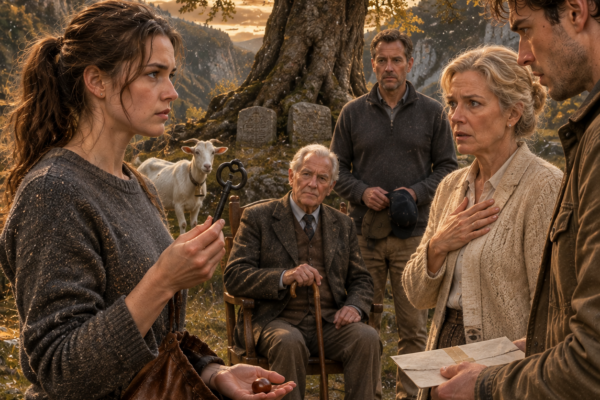
The old woman closed her eyes. Then she took out the ring and they walked together down the swept path past the pond with the goat in front of them to the back wall where the black iron gate stood in the stone with its green lock.
Before that key turns, tell me in the comments, what did someone plant, build, or save for you without ever saying it was for you? Then stay with Linnea because the little iron gate in the cliff was about to open on something older than the town.
Odalis fitted the key.
It turned with a sound like a breath. The gate swung in on oiled hinges and a cool wind came out of the dark smelling of wet leaves and an old deep clean green.
Beyond it, a tunnel of living rock ran back 60 ft, rough-walled and dim with a pale light at the far end. Odalis took Linneas hand, which she had not done before, and they went in together with the goats bell chiming ahead of them off the walls.
The tunnel opened. It opened into a second valley no bigger than a churchyard, a pit in the mountain open to the sky, a bowl inside the bowl with gray walls rising on every side and the morning sun falling into it in one column like light into a well.
Grass grew there, thick and bright. A spring rose at one end and slid across the floor in a silver thread.
Two more goats, a brown one and a gray, lifted their heads from the grass and called, and Bramble answered them with her bell. And standing in the grass in a ring with their roots in the sun and their crowns far above the rim of the rock stood six trees.
She had thought she knew what a tree was. She was a nurserymans daughter.
She stood in the mouth of the tunnel and understood that she had known nothing. They were chestnuts, taller than any tree she had ever seen, 130 ft or more.
Their trunks as broad as the cab of a truck, deeply furrowed and spiral grained, rising into crowns that spread out like green thunderheads against the blue.
The leaves were long and clean. The bark was whole.
Not one of them bore the sunken orange scars she had seen in old photographs of the dying forests.
They were healthy and they were alive. And at their feet lay a carpet of burrs, 10,000 split open in the light.
At the foot of each tree stood a small gray stone with a name cut into it. Abram, Solveig, Canute, Birgit, Thorvald, Ingrid.
Your grandfather named them for the Hallets who walked here first, Odalie said very low. 1957.
He came over the ridge after a deer and fell into this sinkhole.
And when he climbed out, he sat on the rim and wept.
The blight killed 4 billion chestnuts. It killed every one of them for a thousand miles.
Somehow it never found these.
She shook her head.
I have been inside nine times in my life and I still cant walk in without taking my hat off. She took it off now, an old canvas cap, and held it against her chest.
Linnea realized she was crying again.
She was beginning to think she might do it for the rest of her life, quietly, in good places.
She walked into the ring. The grass was cool and wet through her boots.
She laid her palm flat against the trunk of the largest tree, the one that said Abram, and the bark was warm, as though it had held the sun all night, and under her hand, she felt something so slight she might have invented it, a long slow hum, like a held breath. Why did he keep it secret?
she said.
All of this, for all those years. Because the minute its known, the world comes.
Odalisque put her cap back on.
Collectors, loggers, fools with pocketknives who want one twig. A graft from these trees is worth more than gold to the people who have spent 40 years trying to bring the chestnut home.
Your father said a thing this rare cannot be protected by being famous.
It can only be protected by being loved by somebody who is not for sale. Not for sale?
Linnea whispered. That was the whole of his plan.
The old woman smiled. He just wasnt certain youd come.
Linnea looked up through the branches to the small blue square of sky and thought how many autumns the light had fallen into this pit without one human eye to see it. Her father had stood where she stood.
His father had stood here before him and had wept on the rim and had gone home and said nothing year after year to a town that called his mountain rock. She had never in her life been trusted with anything this large.
She felt it settle on her shoulders, not like a weight, but like a coat held out by someone who had known exactly her size.
Linnea knelt and picked up a bur.
It was heavier than it looked.
She split it with her thumbnail and three glossy brown nuts lay in the pale lining like jewels in a box, each with a small tan tuft at the tip. And she turned them over in her fingers and thought of every person in the world who would give up a year of their life to hold one.
And then she thought of Delphine in the cream cardigan saying worthless and a laugh came up in her throat that she had to put her hand over. Nobody plants a chestnut for themselves, she said aloud.
No, said Odalis. And nobody was supposed to have to find that out the hard way.
On the flat stone in the center of the ring stood a tin box rusted at the corners, bolted to the rock with a bracket as if someone had meant it to outlast him.
Linnea went to it. The lid lifted with a small squeal.
Inside lay a folded paper in a plastic sleeve. It was a letter of intent on the heavy cream paper of the Heartwood Chestnut Trust dated the 2nd of April, 2026.
It had been typed and signed in ink in the square hand she knew better than her own. And the printed lines said that the owner of the property known as Larch Mountain intended to place a perpetual conservation easement on the valley and to license its seed to the public without royalty in return for a payment from the trusts donors of $3,400,000.
Beneath the signature, in pencil, in a different and shakier hand, he had written one last line. Lynn decides, not me, not anyone else.
They stayed in the glen until the light left the rim. Odalis told the rest of it sitting on the stone with the tin box open on her knee.
Nils Hallett had written to Heartwood Chestnut Trust 5 years ago, never giving his address or the mountains name. He had sent them a single leaf in an envelope and then another in a different season.
They had asked where the tree grew.
He had answered, I will tell you when my daughter is old enough to say yes. He was not a patient man about most things, said Odalis.
About this, he was a glacier.
The moment he told them, it would have been everyones. A hundred people with clipboards, a trail, a parking lot.
She turned the letter of intent over in its sleeve. So, he asked for the one thing nobody asks for.
He asked that you decide whether to sell the seed, give it, or keep it shut forever.
He signed this in April of last year, a week before he went into the hospital. He wanted it ready in case he was too late.
$3,400,000, she said slowly, for a promise not to cut them down.
For a promise that nobody will ever own them, said Odalis.
Its not the same.
That night, Linnea slept in the stone house with the door open to the warm dark, the first sound sleep she had had in a year and a half.
Dr.Helen Faraday came up the logging road on Sunday afternoon in a dusty green hatchback and she did not look like anyone who could change a life. She was 54, small and square with short gray hair, a rain jacket the color of oatmeal, and a hand lens on a cord around her neck.
She stopped at the rusted gate and stood looking up at the rope still hanging over the top rail.
I wont touch anything until you tell me I may. She said.
I have 31 years of habit, Ms.Hallett, in which people with property say yes and then find theyve said it wrong.
Id like it to go the other way. You may come in.
Said Linnea.
They walked the swept path past the pond and the row.
Dr.Faraday said nothing about the row, but she slowed at tree one and put two fingers against the bark and then took them away as if she had touched a stove. At the second gate, Odalis opened the lock and the tunnel breathed out its cold green air and the scientist went in first ahead of anyone and did not come out of the dark for a long time.
When Linnea came through behind her, the woman was kneeling in the grass in front of the stone marked Abram with her hand lens in her fist, not using it. Tears ran down both sides of her face and she did not wipe them.
Im sorry.
She said.
Im not behaving like a professional.
Youre behaving like someone whos been looking a long time.
Said Linnea.
31 years.
She laughed wetly. Nobody has ever found a stand of mature trees that never crossed with the Asian kind.
Only saplings and stumps that sprout and die. She looked up at the crowns, 130 ft of green against the blue.
These have been standing here since before the blight. They may carry every resistance gene that matters.
They could be the mother trees of a million orchards. Dad said they werent his to give.
He was right.
They arent anybodys.
She stood.
Her knees cracked. I would like to take 11 leaves, six burs, and a thimble of bark.
With your leave, it will tell me whether Im right in 4 weeks. And Id like to tell you what the trust can do, and then I will go away and stay away for as long as you like.
The trust would pay $3,400,000 in three installments, to buy a perpetual conservation easement on the valley and the glen, so that no one could ever cut, quarry, subdivide, or sell them. In return, the trust would receive the right to collect seed and graft wood for propagation, and to pass them on free to any orchard, school, tribe, or church group that asked.
The royalty-free part had been Nilss own wording. Linnea would keep the land.
She would keep the house, the goats, the right to live there as long as she wished, and the authority to say who walked in. And if I say no?
said Linnea.
Then Ill thank you for letting me stand here, said Dr.Faraday, and Ill never write you another letter.
Linnea stood in the long grass with her hands in the pockets of her fathers old sweater.
She did not know the first thing about easements. She knew what a girl had felt in the cab of a truck, watching her father touch a leather pouch.
She knew what he had meant by someday.
Everybody I need to hear from hasnt been heard yet, she said. I wont decide until Ive read every page, and until Mr.Reardon has, and I want the others there when I do.
What others? said the scientist.
The people who tried to take it, said Linnea. I want them to see it before I give it away.
Colm Reardons office was cold on Monday morning, the radiator knocking in the corner, and he met them at the stair with a thick envelope held away from his body like a dead fish. Dr.Faraday left me her copy of the certified letter, he he August 12th, signed for by Delphine Roark as trustee.
It reaffirms the trusts offer of $3,400,000 and asks the estate to name a day for a visit. He spread it on the desk.
And she sent this as well, their phone log.
On the 20th of August, a woman who gave her name only as family called Heartwood and asked whether the offer could be withdrawn. She was told only the owner could withdraw it.
She said that would not be necessary.
He took off his glasses. She was very polite, they remember.
She knew, Linnea said. She knew there was a nonprofit that wanted to put a legal fence around the mountain.
She knew the figure. His eyebrows lowered.
She did not know about the trees. Id stake my license on it.
She hid the letter for a simpler reason. An easement would have killed the summit sale.
The summit sale paid her debt on the 15th of October.
Heartwoods money comes in installments over many months. Her loan was due the 1st of November.
He folded the glasses. She did not hide a treasure from you, Miss Hallett.
She hid a better offer than the one she needed because it would not arrive in time.
Linnea sat with that. A monster would have been simple.
A frightened woman with an unpaid loan took far more understanding. Theres one more thing, said Calm.
He took a document from the file with a paper clip on the corner and read from it slowly. Your fathers will gives the trustee, and I quote, the power to hold, manage, and protect the property known as Larch Mountain, but not to sell, convey, lease, or encumber it in any manner whatever until the beneficiary has reached her 19th year and has consented in writing.
He looked up.
She had no power to give Summit Spring an option. None.
It was never hers to give. The option is void unless you ratify it, which is why that packet had a page six.
Without your signature, Mr.Dolls $60,000 buys him nothing.
In plain words, you owe nobody a dollar and Summit has a claim against Mrs.Roark and no one else.
And the deposit? Spent.
Mostly on the barn.
He sighed. Shell owe him that.
And the truck and the college money and the box and the phone and an accounting to the court of every cent she moved.
A civil matter if shes sensible. He pushed up his glasses.
Ill write to her and to the son and to Mr.Doll.
I propose Saturday, 2:00 at your gate.
No papers need to be signed that day except the ones you choose to sign.
It is, I think, what you asked for. It is.
Linnea said.
The letters went out that afternoon by hand. One to the house on Alder Lane, one to the lumber yard, one to the motel where Spencer Doll was staying.
By the end of the day, Dolls acceptance had come back. Two lines in blue ink.
I would be glad to attend and I would like to apologize in person.
No reply came from Alder Lane. Reese Roark was standing at the foot of the logging road when Odellie drove Linnea home that evening, leaning on the post with the rust-holed sign.
In his lumber yard boots, with his hands in his jacket and no vehicle in sight.
He must have walked the last mile.
He straightened up when he saw the pickup and the first thing he did was look past Linnea at the goat on the seat beside her. Is she all right?
he said. The old goat.
Shes fine. Good.
He looked at his boots. He was 23 and for the first time Linnea saw that he looked like his mother around the mouth.
Shes been sitting in the kitchen for 2 days with the lights off, he said. She wont open the mail.
She keeps saying she did what was sensible. A long pause.
I should have said something at the table. Yes, said Linnea.
You should have.
He nodded quickly as if it had been a blow he had been expecting.
He did not offer an excuse. That was the thing she would remember afterward.
He said, Saturday.
And then he turned and walked back down the dark road with his hands still in his pockets and he did not look back and she could not tell what he meant to do. Doors not shut on that one, said Odalis.
I know, said Linnea.
Im in no hurry to open it. The lightning came that night.
It came without rain, a flicker along the western ridge after midnight, white and soundless, and then a long dry rumble that rolled across the valley and rattled the jars on the shelves. Linnea awoke and stood at the stone house window in her fathers sweater.
Beyond the rim of the cliff, the sky pulsed again and again like a lamp with a bad connection. Not one drop of rain fell.
The smoke started on Tuesday. It came as a thin gray smear along the far side of Larch Ridge, 6 miles west.
By noon it was a column leaning east. By evening, the radio in Odaliss truck had given it a name, the Dry Fork Fire, and a size, 400 acres, and the first words of a long season, which were uncontained.
A mans voice read the numbers in the careful tone men use for bad news.
Winds out of the west at 10, gusting to 20, humidity 11%, a red flag warning from Wednesday through Saturday.
Itll sit on the far side of the ridge, Odalis said, standing at the pond with her binoculars. The winds taking it away from us.
She lowered them. For now.
Haze lay over the valley by Wednesday, and the sun came up the color of a coin. They hauled brush from around the stone house until the ground was bare dirt for 40 ft.
They filled the old barrels from the pond, bucket by bucket, and soaked a stack of wool blankets and laid them on the roof slates.
Linnea thought of Anders, whom she had never met, on this same roof in 1988, with wet wool in his arms, saving eight strangers whose names he never asked. Her palms blistered, and she did not stop.
You think its coming here? she said on Thursday evening.
I think its October, said Odalis.
And October has a habit.
She held up the weather sheet shed copied off the radio.
A front on Saturday, a hard one.
The wind goes round to the northwest around 4:00 in the afternoon, and when it does, everything on that ridge has a new direction.
Linnea took the sheet and read it twice.
Saturday, 2:00.
The wind at 4:00.
We could cancel, she said. Move it to Sunday.
We could.
Odalis did not look at her. Its your gate.
She thought about Delphine in the dark kitchen with the unopened mail, and about Reese walking back down the road in the dusk, and about her fathers shaky pencil under a $3 million signature.
Lynn decides.
No, she said.
I want them to see it where he built it, before I decide a single thing. She folded the sheet and put it in her pocket.
If the wind turns, well deal with the wind. The smoke thickened on Friday.
By evening, the sun went down red behind the ridge, enormous and dim, and the goats gathered close around the stone house of their own accord, and not one of them called. Odalis slept on the cot that night, and Linnea on the floor with the dented bell on its strap beside her head.
And sometime before dawn, she woke to find Bramble standing over her, looking at the window. Saturday morning broke hot and strange.
The sky was the color of weak tea. The air smelled like a struck match, and a fine white ash, like the first snow of some other country, had begun to settle on the benches and the water of the pond.
At 1:00, Linnea swept it off the step of the seed house, and set out six chairs under tree one, and felt absurdly that she was getting ready for company.
At 10 minutes to 2:00, from the cleft in the cliff, she heard the long low sound of engines. Three vehicles were coming up the logging road, one behind another, raising a plume of dust.
Beyond them, over the ridge to the west, a dark brown wall of smoke stood on the horizon like a second mountain, and it had begun, very slowly, to lean. The first car out of the dust was Colm Reardons gray sedan, driven with great care around every pothole.
Spencer Dolls pickup came behind it.
The white SUV came last, and when it stopped in the clearing, it sat there with its engine running for nearly a minute before the door opened. Odalis had unlocked the main gate and left it standing open.
Linnea waited on the path inside it in her fathers gray sweater with the goat at her knee, and watched them come up through the hemlocks one at a time. Colm walked with a cane she had not seen before.
Behind them came Reese, and a step behind him, in a cream cardigan gone gray with ash, Delphine. They came down the swept path, and the grove opened, and And whole green bowl lay below them under the bronze sky, the pond steaming faintly, the round trees dropping their burrs, the stone house with its thread of smoke.
Doll took off his cap, Calm leaned on his cane and said nothing at all.
Delphine did not speak at all. She stood with one hand pressed flat against her breastbone and Linnea watched her look for the word worthless and find nothing left to put it on.
They sat in six chairs under tree one with the ash drifting down. She said, Mr.Reardon, will you tell them what the papers say?
And Calm told them in his dry, plain voice in 4 minutes. The deed was good.
The patent was 320 acres and the will had given the trustee the power to hold the mountain and no other. So, the option was void unless the beneficiary signed.
He did not raise his voice. He said, Mrs.Roark, you have a duty to account to this young woman for everything you moved and I would advise you to make it right before anyone else has to advise you of anything.
Miss Hallett, said Spencer Doll.
He stood up with his cap in both hands. I took Mrs.Roark at her word and I should have asked you first.
Summit Spring is withdrawing.
Ill bring the paper Monday.
The moneys between her and the company and Ill see it doesnt fall on you.
He swallowed.
This is the most beautiful place Ive ever stood in and I came to put a pipe in it.
Linnea found she believed him.
Then Reese stood up. He had said nothing the whole time.
He reached inside his work jacket and took out a small cracked leather pouch with a drawstring, dark with handling, and held it out with both hands as if it were hot.
I took it out of the sack in the car, he said.
His voice came out rough.
That Monday, nobody keeps a tobacco bag on his belt for 20 years. I didnt know what it was for.
I just didnt want it to go to the church sale.
He looked at her.
Its been in my glove box for 12 days.
I should have driven it up here the first night. I was afraid of her.
Im not saying that as an excuse. Linnea took the pouch.
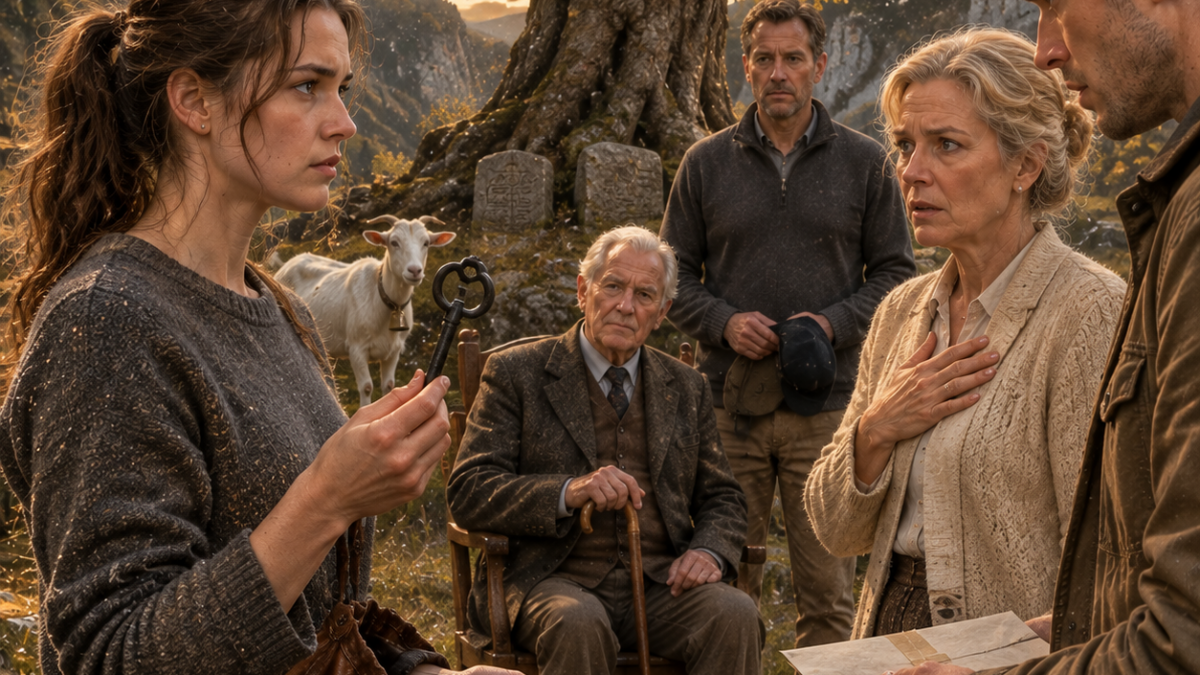
It was lighter than she had expected. She loosened the drawstring and tipped it into her palm and out slid a long iron key, black and heavy, and beside it a single chestnut as glossy as a polished stone.
She closed her fist around them and could not speak for a moment.
And this.
Reese held out a folded paper with a tear across one corner. It was the copy of the hardwood letter, taped together.
She threw it in the kitchen trash in August. I took it out and put it in a drawer.
I didnt read it until Tuesday.
His chin shook. I kept thinking someone ought to have it.
Thank you, Reese. said Linnea quietly.
It was not forgiveness. They both knew it, but he sat down with his shoulders a little less bowed, and Bramble got up and walked across the grass and leaned her old white side against his boot.
That left Delphine. She had not moved.
She sat very straight in her ash-gray cardigan with her hands in her lap, and for a long while she looked at the roots of the chestnut tree where the bench was built around them. When she spoke, it came out of her so low that Colm leaned forward to hear.
I was born in a trailer on a county road, she said. My mother counted cans on a shelf every night to know how long we had.
I told myself I would never count anything again. I built the barn from nothing, and I borrowed against it to make it grand.
And when the weddings thinned out, I could not tell anyone because then I would have been that girl again. She drew a long, shaking breath.
When your father died, I thought, There is a mountain no one wants, and a girl who doesnt understand it, and I could fix everything in a month.
I read that letter in August and saw $3 million and I thought, It will come too slowly, and I hid it.
I told myself it was sensible.
If it was sensible, then I was not a thief.
 [Tap here for the Next Part ]