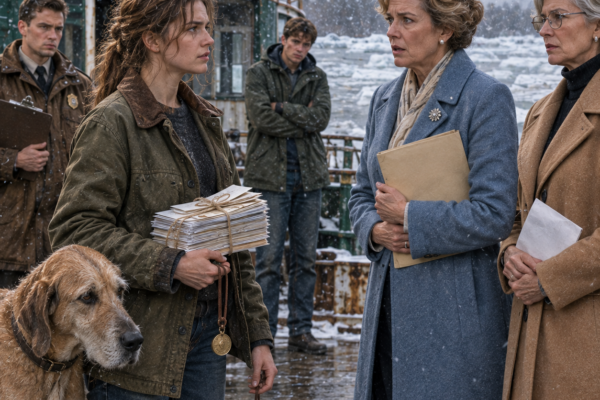
Part 2: Homeless at 19, She Bought a $12 Ferry Nobody Wanted — Then Something Knocked Behind the Engine
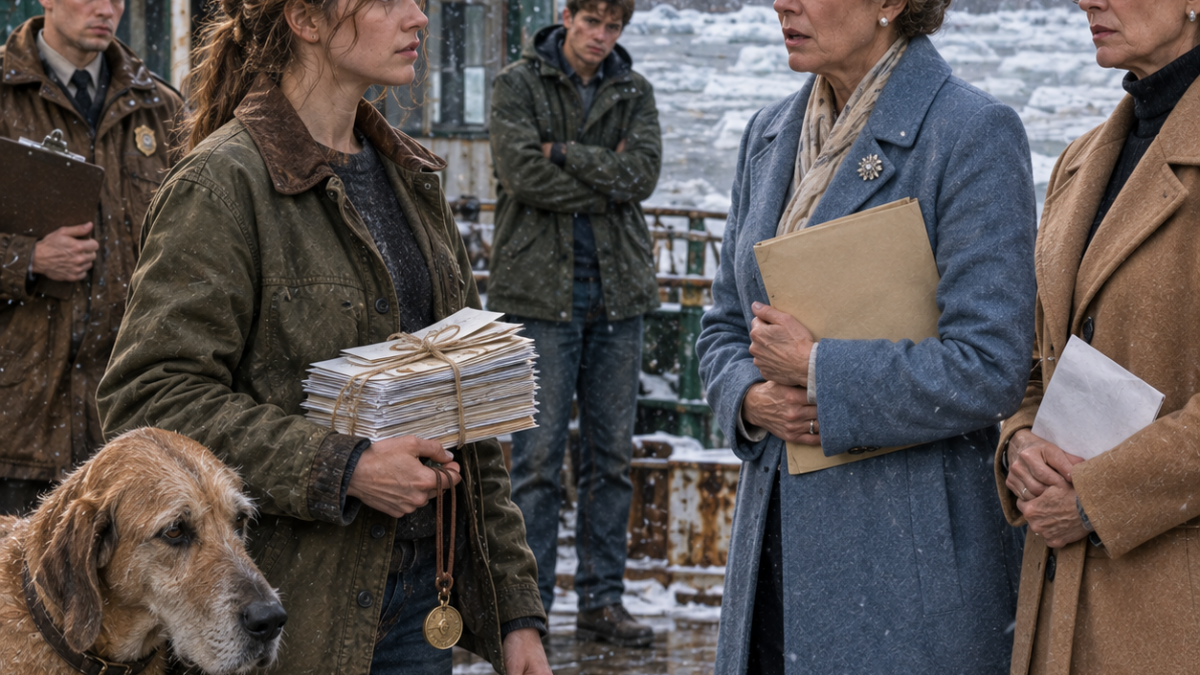
When it comes up, see that its cheap and see that its early so she cant get here in time to bid.
I said, Why would you want her sold? He said, I dont.
I want her sold to the right person. So I moved that sale up an hour and I put the minimum at $12, which is the filing fee, and the board did as I told it because the board is me and two men who owe me for fish.
He gave a short laugh.
I thought Id done it for nobody and then a girl came down the wharf with a duffel bag.
Maron looked at the gray window and the white shore beyond it.
He died the 14th of October, Merritt said gently, at the county care home in Brantley, where your aunt had moved him in August, at 91.
I wasnt let in at the end.
And that dog walked 11 miles home through a snowstorm that night.
He lay under that tarp for 86 days. I put a bowl out every night, and every morning it was nearly full.
He nodded at the floor.
He ate properly for you the first afternoon. I saw you from the shop.
I thought, Well, shes aboard.
At the sound of his name, Bosun raised his head, glancing from one of them to the other, and his tail moved once on the boards.
Theres a chest, Marin said, when she could, in the firebox. Copper, with a brass padlock.
I never touched it.
Id take an oath I dont know whats in it. And the key?
He says he put it where he put what he couldnt afford to lose.
Merritt began to laugh, a dry, cracked sound that turned halfway into something else. He took out a handkerchief.
That old devil, he said. Theres not a safe place on this river that isnt also the first place anybody looks.
I havent got the key.
I wish I did.
He found a clipboard and wrote, and tore off the sheet, and set four bills on it. I need somebody to mind the minnow tanks and the till on weekday mornings.
15 an hour.
It isnt charity.
Id have to hire somebody, and Id rather it was somebody who can add. 4 hours today, in advance.
Dont argue with an old man on a Monday. She did not argue.
She put the money in her boot, where she had kept the $12, and picked up the sack, and felt, for the first time since Saturday, the weight of something she was allowed to carry.
On Tuesday, he drove her into Brantley in a green pickup with a plow mounted ahead of the grill, because the road needed plowing, and he said it was no trouble.
Bosun rode on the seat between them with his chin on the dashboard.
Billy Garrity, Merritt said at the first stop sign. She has an office on the square in the old bank.
She was Ebens lawyer.
Shes written to you three times since October. Id say you never saw the letters.
No, Id say your aunt did.
He kept his eyes on the road. Go and see her when youve eaten.
First you need soup and a pair of gloves. She bought the gloves at the farm store with her own 20 thick brown leather, lined with something warm.
At the dairy bar, she went in by the back, as she always had, and found Hank Dobbs at the grill with his apron tied up under his arms.
Maren, thought youd gone. Gone where?
Your aunt called Saturday afternoon, said youd left, not well, gone to stay with relatives out of state.
He frowned. I gave your shift to Janelle.
Im not sick, Hank. I live on a ferry now.
Ill need my hours back by Friday, if youve got them.
He stared, and then, slowly, grinned.
Friday, 6:00 to 2:00. He lowered his voice.
And Maren, Stan came in last week asking for credit on the lunch special.
He never asks for credit. She went out thoughtful.
Across the square, the old brick bank stood with its tall windows lit, and in one of them, a green lamp glowed over a roll-top desk. She did not cross.
She stood in the new gloves and thought, Three letters.
Then she turned and saw Quade Glass and Mirror.
It stood on the corner of Main and Third, a squat brick shop whose plate glass window she had washed on Saturday mornings for 7 years.
Half the racks in the window were bare. A yellow notice was taped inside the door and across the bottom of the glass, a rushed red sign said, Closing sale.
Everything must go. Through the glass at the back of the shop stood her aunt in the powder blue coat with a pen in her hand and beside her a man Marin had never seen, smooth-faced in a very good gray overcoat, a slim leather portfolio tucked under one arm.
On the desk between them lay a large paper map held flat by a stapler and a coffee cup. Her aunts finger moved down a blue ribbon that might have been a river and stopped on the far bank on a place outlined in red and tapped twice.
The man nodded.
Her aunt smiled the wide bright smile she kept for church and then, as if she had felt it on the back of her neck, Bobby Quaid lifted her head and looked straight through the glass at the girl standing across the street. Her aunt came out of the shop alone, crossed Main Street with a gloved hand lifted in greeting and had her smile fully restored by the time she reached the curb.
Marin, thank heaven. Bobbys eyes dropped to the big dog against Marins knee.
Thats Daddys dog.
Ill take him home, honey. Hell be better off in a house.
Hes fine where he is. The care home, the funeral, the shop, it all falls on Stan and me.
And Marin, if you happen on any of Daddys papers aboard that boat, they belong to the estate.
Im the executor. I havent found anything, Marin said.
It was the first lie she had told Bobby Quaid in 7 years and it came out so evenly that she was a little frightened by it. Her aunt patted her arm twice and went back across the street and through the glass Marin watched the man in the gray overcoat fold his map.
Billy Garrity kept her office on the upper floor of the old bank, up a cracked marble stair, a long high room with a roll-top desk and a tall window over the frozen street.
The woman who rose from behind the desk was about 60, compact in a long camel coat she had not taken off, with short silver hair and tortoiseshell glasses.
Miss Albright, I have been trying to reach you for 83 days.
She laid three envelopes on the blotter, each with a small green card clipped to it. I wrote on the 20th of October, the 12th of November, and the 6th of December, certified to 63 Pearl Street.
Every card came back signed R.
Quade.
A guardian may sign for a wards mail until the ward turns 19.
What did you say in them?
That your grandfather had died, and Id like to see you. Here is what I know.
In August of 2019, Eben came here with two witnesses and a notary and signed a will.
Then he took the original away.
I asked for a copy, and he laughed at me.
He said, If I leave it in your drawer, Billy, its the first place anyone will look.
Something in Marions chest began to beat very slowly. The will on file with the court is from 2011.
It leaves everything to your aunt. Now, in plain words, Billy leaned forward.
A later will beats an earlier one.
If Eben signed a proper one in 2019, it replaces the one on file, and the court must listen as long as the estate is open. Roberta cannot sell what a valid later will gives to somebody else, and a contract to sell what she cannot deliver is worth exactly the paper its printed on.
What contract? Billy slid a stapled document across the desk, a red county stamp on its corner.
A memorandum of option recorded the 9th of December, signed by your aunt as executor, Riverbend Terminals, Mercer Landing, 140 acres of the East Bank, directly across from the slip.
$2,150,000, closing no later than the 28th of January.
Section six.
The seller delivers the property free of any vessel, structure, or claim.
They want a barge landing. And Im told the Brantley Savings Bank holds a balloon note of 318,000 against the Quades shop and house, due the 2nd of February.
Its a small county. People talk to tellers.
Marin laid the pieces down aloud, one by one, because it was the only way to be sure they were real.
The shop is closing. The note is due the 2nd.
The buyer closes by the 28th.
And needs the slip cleared and nobody elses name on the paper. And Im somebody elses name.
Her voice did not shake.
So she needed my signature, and she needed the Kittywake gone, and she sent me to the landing the day it was sold. She didnt expect you to bid.
She didnt expect me to have $12.
Billy took a thin manila envelope from a locked drawer, soft with age. He left this in my safe in 2019.
It was to go into your hand and nobody elses.
It was an old color print, faded orange. A tall man in a navy peacoat at the wheel of a ferry with a very small girl on his hip.
He had a face like a cliff, and he was laughing.
The child had both fists in his collar and a red knitted hat on crooked, laughing with her whole mouth at someone behind the camera. Beyond the glass, the river was blue and wide and full of light.
She could not remember the day being two, but she knew the wheel and the shape of the hand on the rail, and she knew the face. It was the man at the back of the church with his hat in his hands.
She turned it over, pencil, square and hard, Mar in two, first crossing. The coat never left the boat, neither did I.
E, the coat.
She had turned out its pockets and looked at nothing else. A man who sewed his own pockets into his own lining could keep a key there for decades and nobody would find it who did not think to ask the coat.
Pause here and leave a comment. Who in your life stood just out of sight and loved you from there?
Then stay with Mar in because the navy coat on the pilot house peg was about to surrender the one thing her aunt never thought to search.
She stood so fast that the chair went over behind her. Miss Albright.
I need to go back to the river.
Mar in said, Please. Right now.
Billy Garrity looked at the photograph in her hand and at the girl and her dry composed face did something it had not done in 30 years of practice. Go, she said.
Dont tell your aunt anything. Dont sign anything.
And Mar in, she was already reaching for her own coat. Whatever you find, dont open it without a witness.
Ill follow you out in the morning.
Tell Mr.Sorley Ill want his plow ahead of me. On the way back, she told Merritt about the photograph and the coat.
He drove with his knuckles pale on the wheel and said nothing until the pavement gave out.
30 years I worked beside that man, he said then, and I never once saw him hang that coat anywhere but its peg. I thought it was habit.
He shook his head. He was guarding it.
Bosun between them gave a long groaning yawn as if he had known all along.
Merit held the photograph flat on her knee with one fingertip on the childs red hat, and watched the white fields go by.
And for the first time in days, she was not cold.
It was dusk when they reached the landing, a blue, deepening dusk with the river gone the color of slate, and a single star over the east bank.
Merit did not ask a question.
He parked and followed her down the wharf and aboard with a flashlight.
And when she crossed the pilot house and lifted the navy coat off its peg, he took off his cap.
She laid it on the chart table. It was heavy as a wet blanket and cold, and it smelled of tobacco and diesel and old wool.
The lining was black sateen, worn to a shine at the elbows.
She ran her fingers down the seams, first one side and then the other. At the hem, on the left, a little below the pocket, the stitching changed.
It was a different thread, a heavier gray, in short, strong stitches too small and too regular to be a repair. Beneath them, when she pressed, something small and hard gave back through the cloth.
Merit put a jackknife into her hand without a word. The thread parted.
She slid two fingers into the hem and drew out a small brass key on a loop of leather, the head shaped like a ships wheel.
Nobody spoke. The brass lay warm in her palm.
Bosun, at her feet, let out a long, soft breath through his nose. All those years, Merit sorely said, finally.
He stood in front of me every day of my life in that coat. They went down together through the plate into the little brick room, the old man and the girl and the dog, and she lit the lantern, and the whole curved wall of firebrick leaped gold.
Hold the boat for whoevers running. The copper chest sat in the firebox with its brass padlock dull in the light.
Her hand shook so badly it took two tries. The key slid in without a sound.
It turned as though the lock had been oiled that morning and the padlock opened in her hand. She had only lifted the hasp when the dog stood up, stiff-legged, and Merritt said, Hush.
And every one of them heard it. It came faintly through the steel hull from the top of the grade, an engine, a car coming down the grade with its tires spitting gravel.
Shut it.
Merritt said, very low.
Lock it, quick. She snapped the padlock closed and shoved the key down her sleeve.
They went up through the plate and she bolted it fast with the wrench from the pegboard, hands shaking, six turns, and the old man put his cap on and said, Let me do the talking.
And the dog went ahead of them up the ladder with his hackles raised. The tan sedan slid to a stop at the head of the slip.
Her aunt got out with her folder and her husband after her and in the back seat, with his hands pulled up inside his sleeves and his face turned to the window, sat Teddy. There she is.
Bobby called brightly, coming down the wharf with her heels clicking on the planks. Merritt, you old fox.
I thought Id find you here.
I only wanted to catch the girl before the light went.
Saturday weeks the usual day for visitors. Merritt said.
Dont be difficult.
Its family. Bobby stopped at the foot of the ramp and her gaze went over the ferry, the frosted pilot house, the open stern, the black lane of water, and came to rest on Meron on the deck.
Sweetheart, Ill be quick.
Ive spoken to the notary and he has a gap at noon on Saturday the 22nd. Well come out here, the three of us, and have everything wrapped up.
Bring the release.
Bring anything of Daddys you may have turned up. She smiled, and the smile did not reach her eyes at all.
Id hate for you to have to spend a second week out here in the cold. The 22nd, Maren said.
At noon.
Think about it, honey. I mean that kindly.
She turned and went back up the wharf. Stan, who had never gotten out of the car, put it in reverse.
In the back seat, Teddy turned his face for 1 second toward the ferry, and Maren saw him look at her through the glass.
His lips moved. She could not hear it, but she knew the shape of those three words as surely as her own name.
Dont sign it. Then the sedan swung round and went away up the road, and the dusk swallowed it.
11 days, Merritt said softly.
11 days, said Maren.
She stood a moment at the rail after the tail lights were gone, with the river going dark in front of her. For 7 years, she had said thank you.
She had said it for every meal and every ride, and for the cake with the sticker on the box. She turned the word over and found that there was nothing left in it.
It had been spent a long time ago. She was done being grateful for crumbs, and she did not yet know what she would be instead.
Down in the brick room, with the lantern lit and Merritt standing witness at her shoulder as Billy had asked, she knelt at the chest and put the key back into the lock.
The padlock opened. She lifted the lid.
Cedar. Dry, clean, sweet.
The same smell that had been in the firebrick all along. Under the lid lay an oilcloth packet tied with twine, and on top of it, flat, a long envelope of heavy cream paper.
Across it, in the large square hand she knew now as well as her own, were five words. For Maron, read this first.
She broke the seal and drew out the first page and read the first line aloud in a voice she did not recognize. I, Eben Josiah Mercer, being of sound mind and a stubborn heart, give to my granddaughter, Maron Lena Albright, Merritt took off his cap again and sat down on the end of a cot because it seemed to him, he said afterward, the sort of paper you should hear sitting down.
She read it aloud by the lantern in the voice that was not quite hers. It was two typed pages and a third with signatures and it said what it said in plain words with a stubborn old mans refusal to be anything else.
I give to my granddaughter, Maron Lena Albright, the whole of Mercer Landing, 140 acres more or less, on the east bank of the Coil River, as recorded in book 22 at page 114, together with the motor vessel Kittywake and all her gear, to be hers absolutely.
I revoke every will I have made before this one.
There was a line for his daughter Roberta, who was to have the house at 12 River Road and the balance of his account at the Brantley Savings Bank and my blessing, which I hope she may find a use for.
There was a line for Merritt Sorely, my compass and a debt of 11 minutes, which I consider paid.
At that, the old man made a short sound in his throat and turned to look at the wall.
Below the signatures ran two witness names and a notarys seal and a paragraph in smaller type that Billy Garrity would later call, with great satisfaction, a self-proving affidavit.
Maron did not know what that was.
She knew only that her grandfather had signed it on the 14th of August, 2019, in a hand that did not shake, and that every word of it had been meant.
Under the will lay the letter, three pages of lined paper folded in thirds. She read it to herself.
Maren, if this paper is open, then you have the boat, and I have been dead long enough for somebody to count the days. The land is yours.
It is 140 acres of river bottom, cottonwood and sand, and a landing the old boats used. I bought it in 1977 with 11 years of savings, and I have paid the taxes on it every year since.
Someone will want to buy it. They will offer more money than you have ever seen.
I will not tell you what to do. It is yours.
I will tell you only that whatever you decide, keep a door on it.
I should tell you what I told your aunt. In September, when I knew I would not get up from that bed, I told Roberta everything.
I said, The Kittywake and the landing are Lenas girls. It is all in the box.
You will not touch it. I wanted her to have the chance to do right.
I think a man should not die with that unsaid. She said, Of course, Daddy.
In the voice she uses.
I watched her face, and I saw her begin to count.
She was not always so.
Her mother died when she was nine.
I raised two girls on a ferry with a hard hand and no softness in me, and Roberta learned that a person who is afraid of being poor will take whatever is offered. I do not say that to excuse her.
I say that I helped make her, and that when you meet her, you will remember it. Your mother was never ashamed of you.
She was ashamed of me, and she was right to be.
You were the best crossing either of us ever made. You are the last person on this river I ever held the boat for.
Take the will to Billy Garrity before you do anything else.
Do not carry it about in your pocket.
The kittiwake wants a new plate on her bottom by spring, and Merritt knows where to find one. Feed the dog.
Your grandfather.
Maren read the last line twice.
Then she folded the letter along its old creases and pressed it flat under both hands, and the dog got up from the cot and pushed his head under her arm, and for a long minute nobody in the little brick room said anything.
Under the letter, at the very bottom of the chest, lay a bundle tied with butchers twine.
It was a heavy stack of envelopes, and it took both her hands to lift.
Every one was addressed in the square pencil hand to Miss Maren Albright, 63 Pearl Street, Brantley. Every one had been opened along the top, neatly with a knife, and closed again with a strip of tape.
And across the face of every one, in blue ballpoint, was a single word in a looped and perfectly even handwriting she had seen on 7 years of permission slips and Christmas cards and one cake-shaped birthday note, refused. She counted them.
There were 79, one for every month from March of 2021 to September of last year.
The first was postmarked the month after her mothers funeral.
I never saw them, she said. No, said Merritt.
His voice was very quiet.
She opened them.
She was surprised at how steady her hands were. She read every one, and she wrote refused and sent them back to him, and told me he wanted nothing to do with us.
Merritt sorely said something under his breath that was not fit for a church.
Then he said, Put them back in the the Miss Albright.
Put them back exactly as they were.
Theres a woman in a camel coat wholl want to look at everyone.
Billy Garrity came out on Wednesday morning in her gray pickup, in her camel coat and rubber boots, with a leather satchel and a small tape recorder and a notary named Mr.Pomeroy who wore a muffler to his eyebrows and said nothing at all.
She went down through the plate on her knees and stood in the brick room for a long time with her hat in her hand. She read the will twice.
She read the witness names and said, Dolores Kemp and Frank Aldridge of the register of deeds.
Id know their handwriting in my sleep.
She looked at the 79 envelopes and her mouth went into a very thin line.
Then she made a record aloud into the recorder of every item in the chest and Mr.Pomeroy witnessed it and Merritt and Merryn.
And when she had finished, she snapped the case shut.
Now, she said, here is what we are going to do and I want you to hear all of it.
Roberta Quade is the courts executor. If I walk into the clerks office tomorrow and file a petition, she will be served within a day or two and she will know.
She is a woman with a note due on the 2nd of February, a buyer who closes on the 28th and a great deal of practice at being reasonable. I would rather not give her a week to think.
So we wait, Merryn said.
We wait until Friday the 21st.
At 4:00 that afternoon, I file the will with a petition to admit it and an emergency order freezing the sale of any asset of the estate until the hearing, which the judge will sign because I have 11 things in this chest he cannot ignore.
And on Saturday, when your aunt drives out here at noon with a notary and a pen, a deputy of the sheriffs department will be standing on this deck and I will hand her the order myself.
As for the ferry, Mr.Sorleys lean sale stands as a sale and the will gives her to you besides. Either road leads to the same wharf.
She almost smiled.
She asked for a witness, Maron.
I think we should give her several.
Through the days that followed, Maron worked. She minded the minnow tanks and the till for Merritt in the mornings and ran the engine at dawn and on Fridays she carried plates of the dairy bar from 6:00 until 2:00 and no one asked her a single question and Hank Dobbs gave her a free milkshake and a look.
On Wednesday evening, a second brown sack appeared on the bait shop step with a bag of dog food, two cans of soup and a new box of matches and no note at all.
She carried it to the pickup in silence. So did Merritt.
She thought about the three words in the back window of the sedan.
She did not know whether Teddy was her friend or an enemy and she suspected he did not know either. She thought of the brass token on its leather cord and where it might be and put the thought away.
It was on the Wednesday of the following week, the 19th, that the radio spoke. It lived in the pilot house, a squat gray marine set above the chart table and Merritt turned it on every morning to hear the river reports.
The voice from it that day was a flat young womans voice reading from a card.
A winter storm warning is in effect for the upper coil valley from noon Saturday through Monday morning. An Arctic front will move through Saturday afternoon.
Temperatures will fall to 19 below zero by midnight. Heavy ice loading is reported on the river above Brantley with a risk of ice jam and sudden ice movement down river.
Travel will become impossible.
Merit stood very still with his hand on the dial.
Then he went to the window and looked out at the white, wide, silent river and tapped the glass of the old barometer by the door with a knuckle. The needle trembled and went on falling.
Ive heard that voice once before, he said, the 11th of February, 1984. Merit, Im only saying.
He turned to her and his pale eyes were calm.
The hull is sound.
The plate is sound. The stoves got coal for a week.
Well put the cots out Friday and a gallon of water and Ill bring the lamp oil.
Its a good room. Better than any house in the county.
He tried to smile.
You cant hold the boat if you arent aboard her. On Friday evening, the 21st, a little after 5:00, the telephone rang in the bait shop and Merit held it out to her across the counter without a word.
Its done, Billy Garrity said, very dry and very far away.
4:10.
The judge signed on the first page.
The clerk is the most discreet man alive and nobody has breathed a word. Tomorrow, then.
Marin set the telephone down and stood a moment with her hand flat on the counter.
Outside, the sky was the color of a bruise and a thin wind had begun to stir the dry weed tops along the shore. The thermometer on the wall said 14° on Saturday morning at 9:00 and by half past 10:00 it said 8:00.
The sky had gone the color of pewter from edge to edge with a thick, low light that made the snow glow blue and the cottonwoods on the east bank stood motionless like men listening.
Marin stood on the car deck at 11:00 with the dog at her side and the brass key tied round her neck on a cord, and did not feel afraid, only entirely awake. Billy arrived at 20 past 11:00 in her gray pickup with her satchel and her recorder, and beside her a young deputy in a heavy brown coat who carried a clipboard and a folded paper and was named Kowal and appeared to be enjoying himself.
Merit stood on the wharf with his thermos.
In the pilot house, the little oil heater ticked.
At noon exactly, the tan sedan came down the grade. It stopped at the head of the slip.
Her aunt got out in the powder blue coat, the Manila folder against her chest, and Stan after her, gray-faced, hands deep in his vest, and a small round man in a muffler with a stamp case.
Behind them, the gray hatchback slid to a stop on the shoulder, and Teddy got out alone in his green parka and stood by the car with his arms wrapped around himself, looking at the ferry.
A first flake of snow fell between them, then another. There she is, Bobby called, coming down the wharf.
She did not slow when she saw Billy Garrity standing at the rail. She did not slow when she saw the deputy, but her smile, for the first time that winter, stopped a quarter of an inch short of where she had pinned it.
Billy, what a surprise. I do hope this isnt the kind of thing that wants a lawyer.
Good afternoon, Roberta, Billy said.
Behind her, on the river, a long low sound rose out of the ice.
A long groan rose up through the soles of everyones boots, like a door opening very slowly in a very large house.
Billy Garrity came down the wharf one step at a time, the way a person crosses a floor she has already decided to own. She stopped an arms length from Bobby Quade.
The flakes ticked on the folder in Bobbys hands.
Roberta, this is Deputy Kowal. He is going to read you something and I would ask you not to interrupt him.
He has been practicing.
The young man unfolded his paper and read it standing very straight in the voice of someone who had never read aloud anything that mattered so much.
It was an order of the county court signed the 21st of January at 10 minutes past 4.
It forbade the executor of the estate of Eben Josiah Mercer to sell, convey, mortgage, or grant any option upon any asset of the estate until the court had heard a petition to admit a later will.
At the word option, Bobbys face did not change at all and that was how Marin knew the word had struck.
A later will. Bobby said pleasantly.
Billy, I wasnt aware of any later will. You were aware there might be one.
Billy said. You walked this boat with a pry bar four times this winter.
Your father signed it on the 14th of August 2019 at my desk before two witnesses from the register of deeds and a notary.
It leaves the landing and this vessel to his granddaughter. It revokes the will on file.
Daddy was an old man in 2019.
He was not himself.
He was 83.
He drove to my office alone, corrected my spelling of coil, and took the original away because he did not trust my drawer. I have never met a man who was more himself.
Bobby turned her whole careful body toward the deck and the warm voice came back. The voice that had held a cake and a folder.
Sweetheart, you dont want to be dragged into a lawsuit by a woman with a briefcase.
Sign the release and Ill give you back your $12 and tonight you will sleep in your own bed. Maren had expected her knees to shake.
They did not.
She walked down the ramp with Bosun at her side and stopped one pace from her aunt with the bundle of envelopes under her arm tied in butchers twine. No, she said.
It was a very small word, and she had never before said it to Bobby Quaid on her feet. I wont sign the release, Aunt Bobby.
I wont sign anything of yours again.
She held up the bundle. 79.
One for every month from March of 2021 to last September. I counted them in the dark.
You wrote the same word on every one, and you wrote it beautifully.
Bobby looked at the envelopes.
Maren watched her read her own handwriting.
The smile did not fall all at once. It came away the way ice comes off a roof in pieces with a kind of slow certainty, and behind her Stan closed his eyes.
Those were daddys to send and mine to refuse, Bobby said, and her voice had gone thin.
You were a child.
I was only protecting you. You were protecting the plan, said Maren.
I am not angry that you were afraid. Im only finished being what you paid for it with.
That was when the wind came. It did not build.
It arrived out of the north in one long hard push that laid the snow flat and set every chain on the rail ringing. In the time it took to draw a breath, the thermometer on the pilot house wall fell from five above to one, and from far upstream came a sound like a heavy door slammed in an empty house.
Merit had gone very still with his thermos hanging from his hand. Thats the jam letting go above the bend.
It will be here by dark. Then well leave, said Bobby.
Stan, the car.
Maam, said Deputy Kowal with one hand cupped over the radio on his shoulder. The plows came off the county roads at noon.
The grade is drifting shut, and its going to 19 below. Youd be in a ditch before dark.
Hes right, Merritt said. The shop sits on the flat, and when that ice comes ashore, it comes ashore on the flat.
He looked at the green hull and the notch of the slip and the little brass bell in the pilot house roof.
Your grandfather Josiah cut this slip so the ice would go around her.
There is one place on this river it wont touch.
Everyone aboard, said Billy Garrity. Quickly, bring whatever you carry.
Eight people and a dog went down through the plate that afternoon, one at a time, with the wind screaming over the car deck above them. The little room that had held 17 strangers in 1984 now held a deputy, a notary named Mr.Tuttle, a lawyer, a wharfmaster, three Quades, a girl, and a dog, and was a good deal quieter.
Merritt unhooked the cots. Marin lit the stove.
Stan, who had not spoken since the wharf, took the coal bucket out of her hands and fed the fire without being asked, and he kept at it all night, and from Stan, that was a speech. Bobby sat on the end of a cot, coat still buttoned, gloves off.
For a long time she looked at the curved brick and the cans and the calendar on its nail and at last at the white letters over the firebox.
 [Tap here for the Next Part ]