Part 3: Homeless at 19, She Bought a $12 Ferry Nobody Wanted — Then Something Knocked Behind the Engine
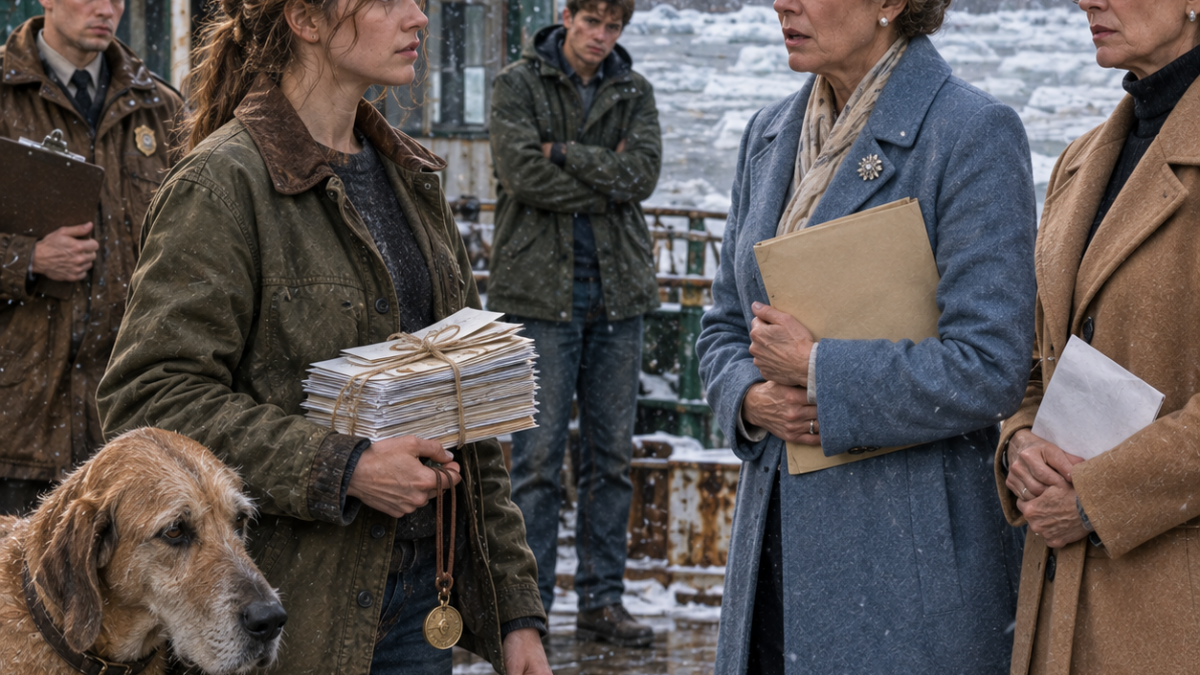
She read them with her lips moving the way a child reads. He built this, Bobby said.
It was not quite a question. His father did, said Merritt.
Your father opened it.
February the 11th, 1984. 17 of us slept on this floor, and he stayed on deck alone with the ice.
I remember, I was 10.
Everyone on this river has a story about the night Eben Mercer held the boat.
The dog had stretched himself out across her shoes. She did not move him.
Sometime after 10:00, with the wind a steady howl in the steel, Marin spoke from her cot. She had not planned to.
I only want to know one thing, Aunt Bobby, and then Ill leave it alone. Why?
Bobby looked at the stove for a while.
When she spoke, it was in the same soft level voice as ever, but the smile was gone, and without it her face was smaller and older, the face of a woman who has run a long way carrying something that was too heavy. I was nine when my mother died.
Daddy took the two of us onto that boat and never said her name again, and he held that ferry for every stranger on the river, and came home to eat his supper in silence.
We ate what was cheapest and wore what was given, and at 10 years old I promised myself I would never be afraid of a bill again. Then the shop failed, and the note came, and I looked at you, 19, and not knowing what you had, and I told myself it was the responsible thing.
I said it so many times that it stopped sounding like anything at all. I am not asking you to forgive me.
I know.
Marin said. I dont know yet if I can.
I only wanted to hear it said.
She had thought it would feel like a victory. It felt like setting down a bucket she had carried a very long way, and finding her arm did not know how to hang.
It was Teddy who moved next.
He had sat all evening on the bottom rung of the ladder with his sleeves pulled over his hands, and now he stood and crossed to her cot and put something in her palm.
It was warm from his pocket, a small brass disc on a leather cord stamped with the outline of a fairy, good for one crossing.
She had no words. I took it out of the box the day before Christmas, Teddy said.
His voice cracked and he went on anyway. Mom had it with the sweaters for the church sale.
I kept meaning to give it back, and I couldnt work out how without saying why I had it.
She asked me to witness the release, and I said no, so she got Mr.Tuttle.
The notary studied his shoes. She did, he said.
I drove her out here four times.
I put the sacks on Mr.Sorleys step.
I should have done a lot more, a lot sooner. Im sorry that it took a blizzard.
Marin closed her fingers over the brass. She had told herself, a long time ago, that the word was spent, that seven years of saying it to the wrong people had worn it down to nothing.
She found there was one left, and that it meant exactly what it said.
Thank you, Teddy.
He nodded and wiped his nose on his wrist and went and sat down by his mother. After a minute, without looking at him, Bobby put one hand over his sleeve.
It was a little before 3:00 in the morning that the river let go. Marin was awake, with the dog against her feet, when the sound came.
It began far upstream as a long, dull thunder under the wind and grew until it was not a sound at all, but a pressure in the chest.
The whole hull rang like a bell. The lantern leaped on its chain and struck the plate.
Talk, talk, talk, hard and fast, like a fist.
Slabs of ice the size of barns drove down the coil and climbed the flats and piled one on another, and the kittiwake lifted and shuddered and held.
Bobby had seized Stans sleeve, and Stan, who had not touched another human being in public for as long as Marin had known him, put his arm around his wife and held on.
Merritt sorely sat on the end of his cot with his watch in his hand. He had looked at it when the first slab struck.
When the grinding stopped and the silence came down like a lid, he looked at it again and shut his eyes and said nothing at all. Later he would tell Marin, quietly, at the bait shop stove, that it had lasted 11 minutes.
The dawn was gray and enormous.
Marin climbed out through the engine room with the dog into a cold so sharp it hurt her teeth.
On the car deck she stopped. The river was gone.
In its place lay a broken white country of tilted slabs stacked high along the east bank, and the wharfs last 20 ft lay buckled like a dropped ruler, and on either side of the kittywake, in her notch, the ice had banked up and gone around her like two white walls.
The front ran through faster than the radio had promised.
By noon the wind had dropped to nothing, and at 2:00 Merritts plow broke through the drift at the grade, and nobody was hurt.
Not one, not even the dog. On Monday Bobby Quade resigned as executor.
On the 26th the judge admitted the will of 2019 and took a long look at the 79 envelopes and River Bend Terminals let the 28th pass in silence. The Quades sold the glass shop to pay the note and moved into the house on River Road, which was smaller and said Hank Dobbs more honest.
On the 1st of February a cashiers check came to the bait shop for $33,660. Her mothers insurance and her coffee can to the dollar.
Under it lay a slip in a looped even hand. I am sorry.
I do not expect an answer.
Maren put the check in the bank and the slip in a drawer.
She did not answer it, and she did not throw it away, and she thought that might be an answer of its own. That month, Grant Ostler of Riverbend Terminals offered her $2,600,000 for Mercer Landing.
Maren read him one line from a folded paper, Keep a door on it, and told him no, politely.
She kept the land.
She rented the East Bank pasture to a family named Dunlap for hay, and the rent bought a new plate for the Kittywakes bottom.
Teddy came out the first Saturday of February asking Merritt for work, and Merritt said, Can you add? And for the first time in anyones memory, Teddy pushed his sleeves up to his elbows.
The door between him and Maren stood open a hands width, and neither of them was in any hurry to push it. By May, the Kittywake wore fresh green paint and a board on her ramp that said, No fare, because the river was not Marens to sell.
Every October, she restocked the little room behind the plate. On the 8th of January, 2029, a Monday, Maren Albright turned 20.
The thermometer on the pilot house wall read two below, and the river was white from bank to bank. She stood on the car deck with her hands in her pockets, with Bosun beside her.
10 years old now, gray to the eyes and sleeping on his feet, the brass token warm against her collarbone under her coat.
She was thinking of nothing in particular when the dog lifted his head. Someone was coming down the landing road on foot.
It was a small, slight woman in a long charcoal coat with short gray curls and wire-rimmed glasses hauling a battered red rolling suitcase whose wheels had given up in the snow. She was carrying it now in both arms against her chest.
She stopped at the head of the slip and stood there looking at the ferry the way you look at a house you have been told about by a stranger.
Maren went down the ramp. The dog came after her in stages like a very old man.
I was told at the bus depot that the road ends at a ferry. The woman said.
Her voice was tired and perfectly steady.
Im Hester Dunn.
I had a niece in Aldrich and it turns out that I dont.
Theres soup on at the shop.
She said.
And a stove down here thats already lit.
Youre welcome at either. I should tell you I havent any money and I dont want charity.
Then dont take any. Maren said gravely.
Nobody here is counting. You can wash the pot tomorrow if it makes you easier.
Something in the small face loosened very slightly the way ice loosens in the thaw. Why would you do this for a stranger?
Maren thought of an old man in a yellow slicker 40 ft out in the stream looking back over his shoulder at a man with a duffel bag.
She thought of a bait shop receipt, a bowl of dog food, a brown sack on a step.
Somebody held the boat for me once. She said.
When I was running.
I am only holding it for you.
Bosun pushed his gray muzzle into the womans gloved hand and after a moment Hester Dunn stooped and laid her palm on his head.
In the engine room Maren shut off the diesel and drew the six bolts and the plate came away with a little sigh of grease.
Warm air rolled out smelling of cedar and coal and very faintly of pipe tobacco and the small brass lantern swung on its chain just inside the opening as it had swung for 60 years.
It touched the steel talk A pause as long as three breaths. Talk.
Hester looked up at the white letters above the firebox. She read them aloud under her breath, and then she lowered herself onto the nearest cot and put both hands over her face.
Maren set the kettle on the stove.
Behind her, the lantern tapped the plate once more, softly, like a knuckle on a door, and it was no longer a question, only a greeting.
The room had been warm all winter, and the stove was laid, and the door was never locked in case somebody came running.