Part 2: “I’m not between careers. I’m between deployments. That’s different.”
PART 4 — THE DINNER
The table was set for twelve.
Crystal glasses. Silverware that gleamed under the chandelier. Napkins folded into shapes I didn’t recognize. A centerpiece of white roses that must have cost more than my monthly truck payment.
I counted the exits out of habit. Front door. Back door through the kitchen. A French door on the far wall that led to a garden. Old training. It never turned off.
Frank was seated at the far end of the table. Across from him was Patricia. Next to him was a woman I didn’t know. He didn’t look at me. He was talking to Patricia about something—real estate, maybe, or the weather. His face was calm. Unreadable.
Karen took my arm. “Come on. Let me introduce you.”
She led me around the table. I shook hands with people I’d met at the party. Gerald Connelly, private equity. Richard Morrison, car dealerships. A couple named the Hartleys. A woman named Susan who owned an art gallery.
And then Mark Davidson.
“David,” he said. “Sit here. Next to me.”
He gestured to the chair on his right. Karen sat on his left. I sat where he pointed.
“Karen tells me you’re between careers,” Mark said.
“That’s what she tells people.”
“What do you tell people?”
I looked at him. “I tell them the truth.”
“And what’s the truth?”
“That I’m a retired Marine.”
Mark smiled. “A retired Marine. That’s interesting.”
“Why is it interesting?”
“No reason. I just—I’ve always been fascinated by the military. The discipline. The sacrifice. The way you people are willing to do things that most of us can’t even imagine.”
“You people.”
“No offense.”
“None taken.”
A server appeared with a bottle of wine. Poured for Mark first. Then Karen. Then me. I put my hand over my glass.
“Not drinking?” Mark asked.
“No.”
“Any particular reason?”
“I don’t drink.”
“Ever?”
“Not anymore.”
Mark nodded slowly. “I see. Karen didn’t mention that.”
“There’s a lot Karen doesn’t mention.”
Karen’s hand tightened on her wine glass. She gave me a look—part warning, part plea. I ignored it.
The dinner was four courses.
Soup. Salad. Lamb. Dessert. Each course was served by a team of servers who moved around the table like they’d been choreographed. Mark watched them the way a general watches his troops. Checking. Approving. Making sure everything was perfect.
The conversation was light. Business. Real estate. A new development downtown. A charity gala someone was planning. The kind of talk that filled space without saying anything.
I ate my lamb and listened. Frank was still at the far end of the table. Still not looking at me. But I could feel him. The way you feel a man in the room who knows you. Who’s been where you’ve been. Who’s carrying the same weight.
Halfway through the main course, Mark turned to me.
“So, David. What did you do in the Marines?”
“I was in Force Recon.”
“Force Recon.” He said it slowly, like he was tasting the words. “That’s special operations, right?”
“Yes.”
“Like the SEALs?”
“Similar. Different mission set.”
“What kind of missions?”
I set down my fork. “The kind I can’t talk about.”
Mark laughed. It was a practiced laugh. The kind that was meant to put people at ease. It didn’t.
“Come on,” he said. “It’s a dinner party. Not a security clearance review. Give us something.”
“I did what I was trained to do. I served with good men. I came home.”
“That’s it?”
“That’s all you need to know.”
Mark leaned back in his chair. Studied me. The way a man studies a poker opponent.
“You know what I think?” he said. “I think you’re being modest. I think you did more than you’re saying.”
“I think you’re right,” I said. “But that doesn’t change my answer.”
Someone at the table laughed. Richard, the car dealer. A nervous laugh. The kind that comes when a conversation takes a turn no one expected.
Karen jumped in. “David doesn’t like to talk about his service. It’s a privacy thing. You understand.”
“Of course,” Mark said. “I completely understand. My father was in the military. He never talked about it either.”
I looked at Mark. “What branch?”
“Navy. He was a corpsman. Vietnam.”
“Was he career?”
“No. He did one tour and got out. Said he’d seen enough.”
I nodded. “A lot of men did.”
“He died when I was twelve. Heart attack. I think the war had something to do with it. He was never the same after he came home.”
“I’m sorry,” I said.
“Thank you.” Mark picked up his wine glass. Swirled it. Took a sip. “That’s why I do what I do. Real estate. Development. It’s not about the money. It’s about building something. Creating a legacy. Something my father didn’t have the chance to do.”
“That’s a good reason.”
“You think so?”
“I think it’s better than most.”
Mark smiled. This time it looked almost genuine.
Dessert came. Chocolate mousse in small crystal bowls. Coffee for those who wanted it. I took mine black.
The conversation drifted. Patricia talked about her daughter’s wedding. Helen complained about her contractor. Gerald told a story about a golf game that I stopped listening to halfway through.
I watched Frank. He was eating his dessert slowly. Listening. Waiting.
He still hadn’t looked at me.
Then Mark said something that changed everything.
“You know, David,” he said, “I did some research on you. Before tonight.”
I set down my coffee cup. “Research.”
“Just a little. Background check. Standard stuff for anyone I do business with.”
“I’m not doing business with you.”
“Your wife is. Which means you are.” He smiled. “That’s how marriage works, isn’t it?”
“What did you find?”
“Not much. That’s what was interesting. Your service record is—how should I put this—sparse. It says you were in the Marines. It says you retired. It doesn’t say much else.”
“That’s how it works.”
“Is it? Because I know people. I know how to find things. And I couldn’t find anything about what you actually did. No news articles. No citations. No medals. Just—nothing.”
I looked at him. He was watching me the way a cat watches a mouse.
“That’s not unusual,” I said.
“Maybe not. But it’s interesting.” He leaned forward. “It makes me wonder—what are you hiding?”
“Mark,” Karen said. Her voice was tight. “That’s not—”
“It’s fine,” I said.
I looked at Mark. At his cold eyes and his practiced smile. At the wine glass in his hand and the watch on his wrist that cost more than most people’s cars.
“I’m not hiding anything,” I said. “I did my job. I came home. I don’t need to prove anything to you.”
“No. But you might need to prove something to your wife.”
Silence.
The table went quiet. I could hear the chandelier creak. I could hear someone’s fork clink against a plate.
“What’s that supposed to mean?” Karen said.
Mark shrugged. “Nothing. Just an observation. David’s record is remarkably empty for a man who claims to have been in special operations. And I couldn’t help but notice that you’ve never mentioned his military service to anyone. Not once. In four years.”
Karen’s face went pale.
“I respect the military,” Mark said. “My father served. But I also know there are a lot of guys out there who talk a big game. Who claim they were special forces when they were really just—I don’t know. Cooks. Mechanics. Supply clerks. It’s hard to tell the difference.”
I felt something shift in my chest. Not anger. Something older. Colder.
“You think I’m lying,” I said.
“I think the evidence is—inconclusive.”
“Mark,” Patricia said. “This is inappropriate.”
“No, it’s fine,” I said. “Let him finish.”
Mark spread his hands. “I’m not accusing. I’m just saying—I’d feel better about investing in Karen’s business if I knew exactly who I was getting into bed with. Metaphorically speaking.”
Karen looked at me. Her eyes were wide. Scared. Not for me. For herself. For the deal. For the money.
“David,” she said. “Just tell him. Tell him what you did.”
I looked at her.
“You want me to tell him?”
“Yes. So he understands. So he knows.”
“You want me to talk about the war. At a dinner party. With people you told me wouldn’t understand.”
She flinched. “That’s not—I didn’t mean—”
“What did you mean, Karen? When you told your book club I was between careers? When you told Patricia I was finding myself? What did you mean?”
“I meant—”
“You meant you were ashamed. Say it.”
“I’m not ashamed.”
“Say it.”
The room was so quiet I could hear the ice melting in someone’s glass.
Karen stared at me. Her mouth opened. Closed. Opened again.
“I’m not ashamed,” she said again. But her voice cracked. And everyone heard it.
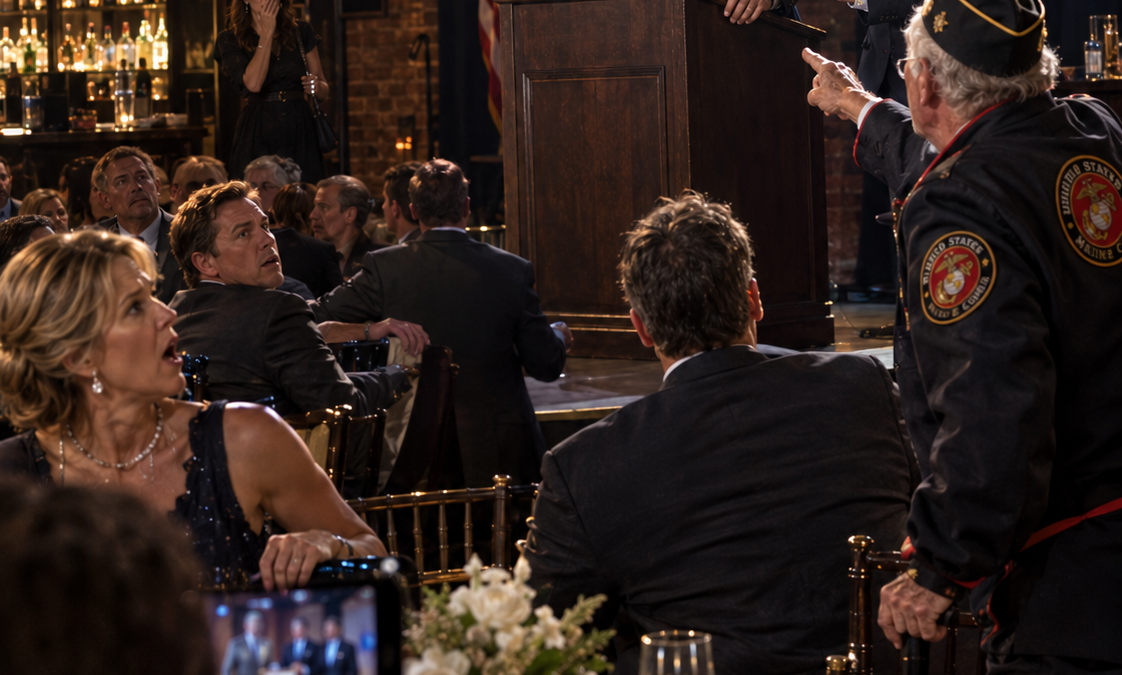
Frank Alverez set down his coffee cup.
It made a sound like a gavel.
“I’ve been listening to this conversation,” Frank said, “for about twenty minutes now. And I’ve been trying very hard not to say anything. Because it’s not my dinner. It’s not my table. But I think it’s time I said something.”
Everyone looked at him. The old man with the cane at the end of the table. The Marine Corps League jacket. The face like cracked leather.
“Frank,” Mark said. “You don’t have to—”
“I know I don’t have to. I want to.” He looked at me. “You remember 2004, Cole?”
“Yes.”
“You remember Ramadi?”
“Yes.”
“You remember the house on the east side of the city? The one with the blue door?”
I didn’t say anything. But I remembered. I remembered everything.
“There were eight of us in that house,” Frank said. He looked at the table. At the investors. At Karen. At Mark. “Eight Marines. Three of us were wounded in the first ten minutes. One of us was shot in the neck. One of us lost a hand. And one of us—” He paused. “One of us went into the next room and killed four men with his bare hands. Then he carried two wounded Marines out of the line of fire. Then he went back for a third.”
The room was silent.
“That Marine was David Cole,” Frank said. “I was there. I saw it. I recommended him for the Silver Star. It was awarded in 2005. I don’t know if he still has the medal. I don’t know if he ever showed anyone. But I know it exists. And I know what he did to earn it.”
He looked at Mark.
“You said his record was empty. It’s not empty. It’s redacted. There’s a difference. The things David Cole did in Iraq and Afghanistan are not in his record because they’re classified. They’re not in his record because men like you were never supposed to know about them. That’s not a gap in his service. That’s a measure of it.”
Mark’s face was unreadable. “You expect me to believe—”
“I don’t expect you to believe anything. I’m telling you what I know. And what I know is that David Cole is one of the finest Marines I ever served with. He saved my life. He saved Jason Marsh’s life. He saved a lot of lives. And if you’re going to sit at this table and question whether he’s telling the truth about who he is, then you’re not questioning him. You’re questioning me. And I don’t take that lightly.”
He picked up his cane. Slowly. Deliberately. And he stood.
“I think I’ve said enough,” he said. “David, walk me out.”
I followed him to the front door.
The night air was cold. The street was quiet. A car passed at the end of the block and turned the corner.
“You didn’t have to do that,” I said.
“Yes, I did.”
“You didn’t. It wasn’t your fight.”
“It was exactly my fight.” He turned to face me. “That woman in there—your wife—she doesn’t know who you are. She doesn’t want to know. And that man—Mark—he’s not interested in the truth. He’s interested in power. He wants to make you small so he can feel big. I’ve seen it before. I’ve lived it before.”
“I can handle myself.”
“I know you can. But you shouldn’t have to.” He put a hand on my shoulder. “You spent twenty-three years handling yourself. Handling everything. Alone. That’s not a life, Cole. That’s a sentence.”
I didn’t say anything.
“You need to decide what you want,” he said. “Not what she wants. Not what Mark wants. What you want. And then you need to act like it.”
“And if I don’t know what I want?”
“Then you need to find out. Fast.” He opened his car door. “Call me. Tomorrow. Not next week. Tomorrow.”
He got in and drove away.
I stood on the sidewalk for a long time.
Then I went back inside.
The dinner broke up twenty minutes later.
Mark shook my hand at the door. His grip was firm. His eyes were cold.
“It was a pleasure,” he said.
“No, it wasn’t.”
He smiled. “No. It wasn’t. But I think you and I are going to be seeing a lot more of each other. Whether you like it or not.”
“Is that a threat?”
“It’s a prediction.”
I walked out. Karen followed. She didn’t say goodbye to Mark. She didn’t say anything. She just got in the car and started the engine.
We drove home in silence.
When we got to the house, she went straight to the bedroom. I went to the kitchen. Made coffee. Sat at the table.
Ten minutes later, she came out.
“I’m sorry,” she said.
I looked at her. “For what?”
“For tonight. For Mark. For—everything.”
“You told him I was lying.”
“I didn’t tell him that. I just—I didn’t correct him.”
“You didn’t defend me.”
“I was scared.”
“Scared of what?”
“Scared of losing the deal. Scared of losing everything I’ve worked for.” She sat down across from me. “David, you have to understand. This business is everything to me. It’s the only thing I’ve ever built. If it fails—”
“What? What happens if it fails?”
“I don’t know. I’d be—nothing. I’d be nobody.”
“Karen. You’re not nobody. You’re a successful real estate agent. You’re a business owner. You’re my wife.”
“Am I?”
I looked at her. “What?”
“Am I your wife? Really? Because it feels like—it feels like we’ve been living separate lives for years. You in your world. Me in mine.”
“You built the separate lives. You built the lies. You built the version of me that you could present to your friends.”
“I know. And I’m sorry.”
“Sorry isn’t enough.”
“Then what is? What do you want me to do?”
I stood up. Poured my coffee down the sink. Set the cup in the dishwasher.
“I don’t know,” I said. “But I know what I’m going to do.”
“What?”
“Tomorrow, I’m calling Frank. I’m going to the Marine Corps League meeting. I’m going to reconnect with the people who actually know who I am. And then—”
“And then what?”
“And then I’m going to decide what to do about us.”
Her eyes filled with tears. “David—”
“I’m not going to live like this anymore, Karen. I’m not going to be your secret. I’m not going to be the thing you hide. I’m not going to be between careers. I’m a Marine. That’s not a job. It’s not a phase. It’s who I am. And if you can’t accept that—”
I stopped.
“If I can’t accept that, what?”
I looked at her. At the woman I’d married. At the life we’d built.
“I don’t know,” I said. “But I’m about to find out.”
I walked out of the kitchen. Walked through the living room. Walked out the front door.
Sat in my truck.
Called Frank.
It was 10:47 p.m.
“I’m in,” I said.
“Good,” he said. “Meeting’s Tuesday. I’ll text you the address.”
He hung up.
I sat there in the dark and looked at the house.
The lights were still on in the kitchen. Karen was still in there. Probably crying. Probably wondering what had just happened.
I didn’t go inside.
I just started the engine and drove.
PART 5 — THE BROKEN ARROW
I drove for an hour.
No destination. Just the highway. The truck’s headlights cutting through the dark. The radio off. The heater on low.
I ended up in Fredericksburg. I didn’t plan it. My hands just knew where to go. Muscle memory. The way they used to know how to field-strip a rifle in the dark.
The Broken Arrow was still open. The parking lot was half full. A few trucks. A couple of sedans. The neon sign in the window glowed faintly—a broken arrow, the symbol of the 506th Infantry. I’d never asked why a Marine bar had an Army sign. Some things you don’t question.
I parked and went inside.
The same bartender was there. The same old men at the bar. A football game played on the television with the sound off. The place smelled like whiskey and wood polish and something frying in the back.
I took a seat at the end of the bar. The bartender—a thick-shouldered man with a gray beard and a tattoo of the Marine Corps emblem on his forearm—looked at me.
“What’ll it be?”
“Coffee.”
He nodded. Poured a cup. Set it in front of me.
“You’re the guy Jason brought in,” he said. “Last week.”
“That’s me.”
“He talks about you. Says you’re a legend.”
“I’m just a man.”
“That’s what all the legends say.”
He went back to wiping glasses. I drank my coffee and stared at the wall. Photographs of Marines. Old ones. Young ones. Men who’d come home and men who hadn’t.
After a while, the door opened. I didn’t turn around. Old habit—never turn your back on a door. But I heard the footsteps. Heavy. Slow.
“Gunny Cole.”
I turned.
Frank Alverez stood behind me. Cane in one hand. A look on his face that was part anger, part worry, part something else.
“You followed me,” I said.
“I followed you.” He sat down on the stool next to me. Groaned as he did it. “Getting old is a bitch.”
“How’d you know I’d be here?”
“Jason told me about this place. I figured you’d end up somewhere like it.” He ordered a whiskey. Neat. The bartender brought it without a word. “You left your wife at home.”
“I know.”
“You going back?”
“I don’t know.”
Frank took a sip of his whiskey. Let it sit. Then he said, “I’ve been where you are. Not exactly. But close. A woman who wanted me to be someone I wasn’t. A life that felt like a costume I couldn’t take off.”
“What did you do?”
“I left.”
“Just like that?”
“Not just like that. It took me three years. Three years of trying. Three years of lying to myself. Three years of pretending I could be happy in a life that was slowly killing me.” He set down his glass. “Then one day I woke up and realized I’d rather be alone than be someone else.”
I looked at him. “And you were alone?”
“For a while. Then I met someone who understood. A woman who’d been through her own war. Not the same war. But she knew what it meant to carry something heavy.”
“Where is she now?”
“Died. Five years ago. Cancer.” He said it plainly. No self-pity. Just fact. “I miss her every day. But I don’t regret a single minute with her. Because she saw me. The real me. Not the version I pretended to be.”
I drank my coffee. Thought about Karen. About the seven-hundred-dollar suit. About the words “between careers.”
“I don’t know if I can leave,” I said.
“Why not?”
“Because I made a vow. For better or worse. Till death do us part.”
“And she made a vow too. To love you. To honor you. To respect you. Does she?”
I didn’t answer.
“That’s what I thought.” Frank finished his whiskey. “You’re not leaving her because you want to. You’re leaving her because she already left you. Years ago. She just didn’t tell you.”
I stared at my coffee cup.
“I need to think,” I said.
“Then think. But don’t take too long.” He stood up. Groaned again. “You want my advice?”
“Sure.”
“Don’t go home tonight. Stay here. Or somewhere. Give yourself a night. One night. To remember who you are.”
He put a hand on my shoulder. Squeezed.
“Tomorrow,” he said, “you’ll know what to do.”
He walked out. The door swung shut behind him.
I stayed at a motel off the highway.
Fifty-nine dollars a night. A bed with a lumpy mattress. A television with bad reception. A bathroom with a shower that ran cold after ten minutes.
I didn’t sleep much. I lay on the bed and stared at the ceiling and thought about Karen. About the party. About the book on her nightstand with the notes in the margins.
Is this what he did?
He never talks about this.
Is this who I married?
The answer to that last question was yes. I was exactly who she married. She just hadn’t wanted to see it.
At some point, I must have fallen asleep. When I woke up, the sun was coming through the curtains. My phone had three missed calls. All from Karen.
I didn’t listen to the voicemails. I checked the time. 7:42 a.m. Sunday.
I got up. Showered. Dressed in the same clothes from last night. Went to a diner down the street and ordered breakfast—eggs, bacon, toast, coffee. I ate slowly. Watching the waitress move between tables. Watching the families at the other booths. A father and son sharing pancakes. A young couple laughing at something on a phone.
Normal life. Normal people.
I wondered if I’d ever had that.
My phone rang again. Karen.
I answered.
“David.” Her voice was raw. Like she’d been crying all night. “Where are you?”
“Fredericksburg.”
“What? Why?”
“I needed to think.”
“David, please come home. We need to talk.”
“We talked last night.”
“That wasn’t talking. That was—I don’t know what that was. Please. Just come home. I’m not mad. I just want to see you.”
I was quiet for a moment.
“Karen,” I said. “Do you remember the day we got married?”
“Of course I do.”
“Do you remember what you said to me? Right before the ceremony? In the church basement?”
She hesitated. “I said—I said I was nervous.”
“You said you didn’t know who I was.”
“I didn’t mean it like that. I was just—scared. It was a big day.”
“You said, ‘I feel like I’m marrying a stranger.'”
“I remember.”
“And I said, ‘You’re marrying a Marine. That’s who I am.’ And you said, ‘I know.’ And then we got married. And you spent the next five years pretending that conversation never happened.”
Silence.
“I’m not coming home today,” I said.
“Then when?”
“I don’t know.”
“David—”
“I need to figure out who I am again. Because I’ve been letting you tell me. And it’s not working.”
I hung up.
The waitress came by. Refilled my coffee. I didn’t touch it.
I paid the bill. Walked to my truck. Sat in the driver’s seat and looked at my phone.
Then I called Frank.
“I need something to do,” I said.
“What do you mean?”
“I mean I need a mission. A purpose. Something that isn’t sitting in a house where I’m a secret.”
Frank was quiet for a moment. Then he said, “There’s a vet in Richmond. Young guy. Name’s Luis Reyes. He’s been having trouble. Drinking. Fighting. Losing jobs. His wife left him. He’s got a kid he’s not allowed to see.”
“What do you want me to do?”
“Talk to him. That’s all. Just talk to him.”
“I’m not a therapist.”
“No. But you’re a Marine. And he needs one right now.”
He gave me the address. A trailer park on the south side of Richmond.
I started the engine.
Luis Reyes was twenty-nine years old.
He’d done two tours in Afghanistan. Marine Corps infantry. He’d come home with a TBI, PTSD, and a failing marriage. He’d been drinking since he got out. He’d been in three fights in the last six months. He’d lost his job at a warehouse three weeks ago. His wife had taken his daughter and moved in with her mother.
He was sitting on the steps of his trailer when I pulled up. A beer in his hand. A black eye. A look in his eyes that I recognized.
I knew that look.
I’d seen it in the mirror.
“Who the hell are you?” he said.
“My name is David Cole. Frank Alverez sent me.”
“Frank? The old guy from the Marine Corps League?”
“That’s him.”
“What do you want?”
“To talk.”
“I don’t want to talk.”
“Too bad.”
He stared at me. I stared back. Old training. Don’t blink first.
After a second, he laughed. It was a bitter sound. “You’re not gonna leave, are you?”
“Nope.”
He sighed. Took a drink of his beer. “Fine. Talk.”
I sat down on the steps next to him. Not too close. Not too far. The way I’d learned to sit with men who were hurting.
“I’m not here to tell you to stop drinking,” I said. “I’m not here to tell you to get your life together. I’m not here to give you advice.”
“Then what are you here for?”
“To tell you I’ve been where you are.”
He looked at me. “You don’t know where I am.”
“I’ve been shot twice. Stabbed once. Blown out of a building. Watched friends die. Held a man in my arms while he bled out. I’ve woken up screaming. I’ve gone days without sleeping. I’ve sat in the dark and wondered why I came home and they didn’t.”
He was quiet for a long time.
“So what happened?” he said finally. “What fixed it?”
“Nothing fixed it. It doesn’t get fixed. It gets—managed. You learn to carry it. You find people who understand. You stop pretending you’re okay when you’re not.”
“And if I can’t?”
“Then you end up like me. Alone. In a motel. Wondering what happened to your life.”
He looked at his beer. Then at the ground. Then at me.
“What do I do?” he said.
“First thing—you throw that beer away. Not because it’s bad. But because it’s not helping. Second thing—you call your wife. Not to beg. Not to yell. Just to talk. Third thing—you come to the meeting Tuesday. The Marine Corps League. It’s a room full of guys who’ve been where you are. It’s not therapy. It’s just—a room.”
He didn’t say anything. But he set the beer down on the step. Didn’t throw it away. But he set it down.
It was a start.
I stayed with Luis for two hours.
We didn’t talk about the war much. We talked about his daughter. Her name was Sofia. She was four. He showed me a picture on his phone. A little girl with pigtails and a gap-toothed smile. He said he missed her. He said he’d do anything to see her again.
“Then do it,” I said.
“It’s not that simple.”
“It’s not simple. But it’s possible. You just have to be the person she needs you to be.”
He nodded. Didn’t say anything. But I saw something in his eyes. A flicker. The same thing I’d seen in Jason Marsh’s eyes when he was twenty years old and frozen in a wadi in Afghanistan.
It was the look of a man deciding whether to get up.
I gave him my number. Told him to call if he needed anything. Then I left.
I sat in my truck and looked at the trailer. At the broken lawn chair on the porch. At the faded flag hanging in the window. I thought about Benitez. About all the men who’d come home and fallen through the cracks.
Then my phone buzzed. A text from Jason.
“Gunny—something’s happening. Mark Davidson called my boss. He’s asking questions about you. About your service record. He’s trying to find proof you’re lying.”
I stared at the message.
Then I typed back: “Let him look.”
Three dots appeared. Then Jason’s reply: “He’s also asking about your wife. He’s been asking about her for a while. I don’t know what he’s planning. But it’s not good.”
I put the phone down. Started the engine.
Mark Davidson wanted to play games. That was fine.
I’d played worse.
PART 6 — THE PAPER TRAIL
I called Frank from the road.
“Mark Davidson is digging,” I said. “He’s asking about my service record.”
“I know.”
“You know?”
“He called the Marine Corps League yesterday. Said he was doing a background check on a potential business partner. Asked for documentation of your service. Awards. Citations. Anything that would prove you are who you say you are.”
“What did you tell him?”
“I told him to file a Freedom of Information Act request. Like everyone else.” Frank laughed. “He didn’t like that.”
“He’s not going to stop.”
“No. He’s not.” Frank paused. “But here’s the thing, Cole. He’s not the real problem.”
“What do you mean?”
“I mean your wife is the real problem. Davidson is just the tool. He’s using her business as leverage. He’s using you as the pressure point. But she’s the one letting him in.”
I sat at a red light and stared at the dashboard.
“What’s his angle?” I asked.
“Money. Control. Same as always.” Frank paused again. “I did some checking of my own. Mark Davidson isn’t just an investor. He’s got a reputation. He finds small businesses. Women-owned, usually. Gets them to sign deals with terms they don’t read carefully. Then he squeezes them. Takes over. Assets get transferred. Bank accounts get drained. By the time they figure out what happened, it’s too late.”
“And Karen is his next target.”
“Karen is his current target. He’s been working on her for six months. The dinner wasn’t the beginning. It was just the next step.”
The light turned green. I didn’t move.
“Frank,” I said. “I need everything you have on him.”
“I’ll send it tonight.”
“And I need one more thing.”
“Name it.”
“Get me into the Marine Corps League meeting Tuesday. But not just as a guest. I want to speak.”
Frank was quiet for a moment. Then he said, “What are you planning, Cole?”
“I don’t know yet. But I’ll know by Tuesday.”
“Be careful.”
“Always am.”
I hung up. Drove home.
Karen was in the kitchen when I walked in.
She looked worse than I’d ever seen her. No makeup. Hair pulled back in a messy ponytail. Eyes red. She was holding a coffee cup with both hands like it was the only thing keeping her upright.
“You came back,” she said.
“For now.”
She nodded. Didn’t argue. Didn’t ask where I’d been. Just stood there looking at me like she was seeing me for the first time.
“I talked to Mark today,” she said.
“When?”
“This morning. He called me. Said he wanted to discuss the deal.”
“And?”
“And he said—” She stopped. Set down her coffee. Looked at the floor. “He said he wasn’t sure he could invest. He said he had concerns. About you.”
“What kind of concerns?”
“He said he didn’t think you were who you said you were. He said he thought you were—” She stopped again.
“Say it.”
“He said he thought you might be lying about your military service. He said he’d seen guys do it before. Pretend to be something they weren’t. He said it was a red flag.”
I sat down at the kitchen table. Kept my voice level. Old training.
“And what did you say?”
“I told him I didn’t know. I told him you didn’t talk about it. I told him I’d never seen any proof.”
“You’ve never asked for proof.”
“I know.”
“You’ve been married to me for five years. You’ve never once asked me to tell you what I did.”
“I know.”
“You told your friends I was between careers. You told Mark I might be lying. You’ve spent five years erasing me. And now you’re surprised that he thinks I’m a fraud.”
She started crying. Not loud. Just tears running down her face.
“I’m sorry,” she said. “I’m sorry. I’m sorry.”
“You keep saying that.”
“Because I mean it.”
“Do you? Or do you mean you’re sorry you got caught?”
She looked up. “What?”
“You’re not sorry about what you did. You’re sorry about the consequences. You’re sorry Mark is pulling out. You’re sorry the deal is falling apart. You’re sorry because it affects you. Not because it hurt me.”
“That’s not true.”
“Then prove it.”
She stared at me.
“Prove it,” I said again. “Show me you’re sorry. Not with words. With actions.”
“How?”
I stood up. “First, you need to understand something. Mark Davidson isn’t your friend. He’s not your business partner. He’s a predator. And if you sign his deal, he’s going to take everything you’ve built and leave you with nothing.”
Karen’s face went pale. “What are you talking about?”
“I have evidence. Frank has been checking. Davidson has done this before. At least three times in the last four years. Women-owned businesses. Favorable terms on the surface. Hidden clauses underneath. By the time they realized what happened, they’d signed away their assets.”
“You’re lying.”
“I’m not.”
“Mark wouldn’t do that.”
“Mark is exactly the kind of man who would do that. Open your eyes.”
She was shaking. “I don’t—I can’t—”
“You can. But you have to trust me.”
“Trust you? I don’t even know you.”
I looked at her. Really looked at her. The woman I’d married. The woman I’d shared a bed with for five years. The woman who’d never once asked me about the most important part of my life.
“No,” I said. “You don’t. And that’s the problem.”
I spent the next two days putting things in motion.
Frank sent me everything on Mark Davidson. It was worse than I’d expected. Three lawsuits that had been settled out of court. Two women who’d gone bankrupt after signing deals with him. One who’d lost her house.
And a trail of limited liability companies, all registered in Delaware, all connected to a holding company that was connected to a trust that was connected to Mark Davidson.
It was a shell game. Old money, new crimes.
I called Jason. Told him what I’d found. He said he’d talk to his boss, the board member, Gerald Connelly. Patricia’s husband. The man who’d sat at the dinner table and said nothing while Mark questioned my service.
“He needs to know,” Jason said. “If he’s on the board of our nonprofit, and he’s also an investor in Karen’s business, he’s exposed.”
“He’s also an old man who probably doesn’t want to admit he got played.”
“Maybe. But he’s a good man. I think he’ll listen.”
“Then call him.”
I also called Luis Reyes. He’d thrown away the beer. He’d called his wife. She’d agreed to let him see Sofia on Saturday. He wanted me to be there.
“I’ll be there,” I said.
“Thanks, Gunny.”
“You don’t have to call me that.”
“I know. But I want to.”
I hung up and sat in my truck for a long time.
Everything was in motion. Frank. Jason. Luis. The information on Mark. The meeting Tuesday. The pieces were moving the way they always did before an operation. Quiet. Deliberate. Invisible.
But I still didn’t know what the objective was.
I didn’t know what I wanted from Karen. I didn’t know if I wanted to save the marriage or end it. I didn’t know if I wanted to fight Mark or walk away.
I just knew I couldn’t keep living the way I’d been living.
That was enough for now.
Tuesday morning, I woke up early.
Karen was already awake. She was sitting at the kitchen table with a stack of papers. I recognized them. The deal documents. Mark’s proposal.
“I’ve been reading,” she said.
“And?”
“And I think you’re right. I think there are things in here I didn’t see.” She pushed the papers toward me. “Look at page fourteen.”
I sat down and read.
Page fourteen was a clause about “operational control.” It said that in the event of a “material default,” the investor would have the right to assume operational control of the business. It defined “material default” as “any breach of the operating agreement, including but not limited to any failure to meet financial projections for two consecutive quarters.”
It was buried. It was technical. It was exactly the kind of thing a person would skip over.
“He could take your business,” I said.
“Within six months. If I don’t hit projections.” She looked at me. “I would never hit these projections. They’re unrealistic. He set them that way.”
“On purpose.”
“On purpose.”
She looked like a woman who’d just discovered her house had been built on a sinkhole.
“What do I do?” she asked.
“Don’t sign.”
“I can’t. The deal is supposed to close Friday. If I walk away now, I lose everything. I lose the investors. I lose the capital. I lose—”
“You lose a business that would have been stolen from you anyway.”
She was quiet.
“Karen,” I said. “I have a meeting tonight. With the Marine Corps League. I want you to come.”
She looked up. “Why?”
“Because I want you to see who I am. The people I served with. The life I had before you. And I want you to decide—after you see that—whether you want to be married to me.”
“David—”
“Just come. That’s all I’m asking.”
She hesitated. Then she nodded.
“Okay.”
The meeting was at a VFW hall on the north side of Richmond.
It was a plain building. Brick. No windows. A parking lot filled with pickup trucks. A sign by the door that said MARINE CORPS LEAGUE, RICHMOND CHAPTER 346.
I parked. Karen sat in the passenger seat. She’d put on a simple dress. No jewelry. No makeup. She looked nervous. Small. Like a woman who knew she was walking into a room where she didn’t belong.
“You don’t have to come,” I said.
“No. I do.” She took a deep breath. “I want to understand.”
We walked in.
The hall was full. Maybe sixty men. Mostly older. A few younger. All of them in Marine Corps League jackets or shirts or hats. The walls were covered with photographs. Iwo Jima. Korea. Vietnam. Desert Storm. Fallujah. The history of the Corps, painted on the walls in black and white and sepia.
At the front of the room was a podium. Behind it, a large American flag. Next to it, a Marine Corps flag.
Frank stood by the door. He saw me and nodded. Then he saw Karen. His face didn’t change. But I saw something flicker in his eyes.
“Cole,” he said. “You made it.”
“Frank, this is my wife, Karen.”
Frank looked at her. “Ma’am.”
“Master Sergeant,” she said.
“I’m retired. But thank you.”
He led us to seats in the second row. Karen sat next to me. She looked around the room. At the men. At the photos. At the flags.
“You didn’t tell me it would be like this,” she whispered.
“Like what?”
“Like—this.”
“It’s just a meeting.”
“No. It’s not.”
She was right. It wasn’t.
The meeting started at seven.
Frank opened with a prayer. Then the pledge. Then the reading of the minutes. Then the old business. New business. Announcements. A fundraiser for a veteran who’d lost his house in a fire. A request for volunteers at a VA hospital.
Then Frank stood up and said, “We have a guest tonight. Gunnery Sergeant David Cole. Force Recon. He served with 2nd Recon in Iraq and Afghanistan. He’s going to say a few words.”
He looked at me.
I stood up. Walked to the podium.
Sixty faces looked at me. Old men. Young men. Men who’d seen what I’d seen. Men who carried what I carried.
Karen sat in the second row. Watching. Waiting.
I took a breath.
“Thank you for having me,” I said. “I’m not much of a speaker. So I’ll keep this short.”
I looked at the room. At the photos on the wall. At the flag behind me.
“I’ve been out of the Corps for seven years,” I said. “For most of that time, I tried to put it behind me. I got a job. I got married. I built a life that didn’t have room for the past. I thought that was how you moved on.”
I paused.
“I was wrong.”
The room was quiet.
“You don’t move on from the Corps. You move forward with it. It’s part of you. It’s in your blood. It’s in your bones. And when you try to pretend it isn’t—when you try to hide it—you lose yourself.”
I looked at Karen.
“I almost lost myself. I almost let someone else decide who I was. Someone who didn’t understand. Someone who was afraid of the truth.”
Karen’s eyes were wet.
“But I’m not afraid anymore. I’m a Marine. I always will be. And if the people around me can’t accept that—then I need to find people who can.”
I looked back at the room.
“Thank you for letting me be here. For letting me be who I am.”
I sat down.
For a moment, nothing happened.
Then Frank started clapping. One man. Two. Three. Then the whole room. Sixty men standing. Clapping. Not for the speech. For the truth.
Karen was crying.
Frank stood up. “We have one more thing tonight,” he said. “Something we’ve been waiting to do for a long time.”
He looked at me.
“Gunny Cole. Please stand up.”
I stood.
“Gunnery Sergeant David Cole,” Frank said. “For extraordinary heroism in action against the enemy in Fallujah, Iraq, on April 14, 2004, you were awarded the Silver Star. You never had a ceremony. You never had anyone pin it on you. Tonight, that changes.”
He reached into his pocket and pulled out a small box. Opened it.
The Silver Star.
“I’m not a general,” Frank said. “I’m not an admiral. I’m just a Master Sergeant. But I served with you. I saw what you did. And I think it’s time you wear this.”
He handed me the medal.
I looked at it. At the gold star and the blue ribbon. At the citation that had been written twenty years ago.
Then I looked at Karen.
She was on her feet. Her hand over her mouth. Tears running down her face.
I pinned the medal to my shirt.
The room erupted.
PART 7 — THE RECKONING
The room didn’t quiet down for a full minute.
Men I’d never met came up to shake my hand. Old Marines with canes and hearing aids and tattoos faded to gray. They told me their names. Their units. Their wars. They said things like “Welcome home” and “Semper Fi” and “It’s about damn time.”
Frank stood by the podium and watched. His face was unreadable. But his eyes were wet.
Karen stayed in her seat.
She was still crying. Not loud. Just tears running down her cheeks. She didn’t wipe them away. She just sat there and watched me. Like she was seeing me for the first time.
After a while, the crowd thinned. Frank came over. Put a hand on my shoulder.
“You okay, Cole?”
“I don’t know.”
“That’s normal.” He looked at Karen. “Ma’am. You okay?”
She nodded. Couldn’t speak.
“You want to talk to your husband alone? I can give you the back room.”
“No,” I said. “I think we’ve done enough talking in back rooms.”
Frank nodded. “Fair enough.” He reached into his pocket and pulled out a key. “The hall’s yours for another hour. Lock up when you leave.”
He walked away.
Karen and I sat in the second row and didn’t say anything.
The flag hung behind the podium. The photographs lined the walls. Sixty empty chairs. One Silver Star pinned to my shirt.
“I didn’t know,” Karen said finally.
“I know.”
“How could I not know? I’ve been married to you for five years. I slept next to you. I ate dinner with you. I—”
“You didn’t want to know.”
She looked at me. “What?”
“You didn’t want to know. You asked me about my day. You asked me about my work. But you never asked me about the war. Not once. Not really. You’d say things like ‘Do you want to talk about it?’ but only if you knew the answer was no. If I ever started to open up, you’d change the subject. If I ever mentioned the names of men I lost, you’d look away.”
“That’s not true.”
“It is true. You were afraid. You didn’t want the weight. You wanted the version of me that fit your life.”
She was quiet.
“I’m not saying that to hurt you,” I said. “I’m saying it because it’s true. And because you need to understand what you’ve been doing. Not just to me. To yourself.”
She looked at the floor. “What do I do now?”
“That’s up to you.”
“It’s up to me?”
“Yes.”
“David, I don’t even know where to start.”
“Start by deciding what you want. Not what I want. Not what Mark wants. Not what your friends want. What you want.”
She looked at me. “I want to save my marriage.”
“Do you? Or do you want to save the version of your marriage that you’ve been performing?”
She didn’t answer.
“Karen,” I said. “I love you. I’ve loved you since the day I met you at Whole Foods. But I can’t be married to someone who’s ashamed of me. I can’t be married to someone who hides who I am. I can’t be married to someone who lets a man like Mark Davidson humiliate me at a dinner party and says nothing.”
“I know. I’m sorry. I—”
“You keep saying that. Stop saying it. Do something.”
“Like what?”
I stood up. Walked to the podium. Looked at the flag.
“Like calling Gerald Connelly,” I said. “Like telling him what Mark is planning. Like standing up for yourself and for your business. And maybe—maybe—standing up for me.”
She stood up. Walked toward me. Stopped a few feet away.
“What if I do all that?” she said. “What if I call Gerald and I cancel the deal and I tell Mark to go to hell? Would you stay?”
I looked at her.
“I don’t know,” I said. “But I’d be willing to find out.”
She nodded slowly. Then she reached into her purse and pulled out her phone.
“I’ll call Gerald now,” she said.
“Now?”
“Yes. Now.”
She dialed. Put the phone to her ear. Walked to the corner of the room.
I sat back down and watched her. Watched the way she stood. The way she moved. The way she held the phone.
She was trying. That was something.
She was on the phone for fifteen minutes.
I couldn’t hear the words. Just the tone. At first it was nervous. Then it was angry. Then it was something else. Something I hadn’t heard from her in a long time.
Conviction.
She hung up. Walked back to me. Her face was different. Older, somehow. More solid.
“Gerald knew,” she said. “Not everything. But enough. Mark had approached him last year about a similar deal. Gerald turned him down. He said he didn’t trust him. Patricia told him about the dinner. About what Mark said to you. He was—he was angry. He said he was going to call the board.”
“So Jason was right.”
“Jason?”
“A Marine I served with. He works for a nonprofit. Gerald is on the board. Jason’s been talking to him.”
Karen looked at me. “You’ve been planning this.”
“I’ve been talking to people who care about me. There’s a difference.”
She almost smiled. Almost.
“What do I do about the deal?” she asked.
“Don’t sign it.”
“And if he retaliates?”
“He will. But you’ll have people on your side. Gerald. Jason. Frank. Me.”
She looked at me. “You’ll be there?”
“I’ll be there.”
She nodded. Then she did something I didn’t expect. She reached out and touched the Silver Star on my chest. Just lightly. The way you touch something fragile.
“It’s heavy,” she said.
“It is.”
“What does it feel like?”
I thought about it. About Benitez. About the house in Fallujah. About all the men who’d died and all the men who’d lived.
“Like something I didn’t earn,” I said. “Because the men who died earned it more than I did.”
She looked at me. Really looked at me. And for the first time in five years, I thought she might actually see me.
“I’m sorry,” she said. “Not for what happened. For what I did. For the way I treated you. For the way I treated your service. It wasn’t right. It wasn’t fair. And I’m sorry.”
I didn’t say anything. But I nodded.
She nodded back.
We walked out of the VFW hall together.
The next few days were quiet.
Karen called Mark Wednesday morning. She told him the deal was off. He was calm. Polite. He said he understood. He said he wished her the best. Then he sent her an email that same afternoon—a letter from his lawyer. It said she’d breached a letter of intent. It said she owed him “consulting fees” totaling forty thousand dollars. It said if she didn’t pay within seven days, he’d file suit.
Karen forwarded it to me. I forwarded it to Frank. Frank forwarded it to a lawyer he knew—a JAG reservist who’d served in Iraq. The lawyer sent it back with a one-line note: “This is a bluff. He has no case. I’ll draft a response.”
Karen forwarded that to Mark. Mark didn’t reply.
That felt like a win.
But I knew better than to celebrate too early.
Thursday night, I got a call from Jason.
“Gunny,” he said. “You need to see this.”
“See what?”
“Check your email. I’m sending you something.”
I opened my laptop. A link to a Facebook page. A page I didn’t recognize. An event called “Richmond Veterans Appreciation Night.”
The event was scheduled for Saturday. At a bar downtown. Hosted by—I read the name twice to make sure I wasn’t mistaken.
Mark Davidson.
“It’s a fake,” Jason said. “He’s been planning it for weeks. He’s telling people he’s honoring veterans. But look at the guest list.”
I scrolled down. Names. Businesses. People who’d been at the dinner. People who’d been at the party.
And at the bottom, a line that made my stomach turn.
“Featuring a special tribute to local veteran David Cole.”
“What the hell is this?” I said.
“I don’t know. But it’s going to be bad. He’s going to use you. He’s going to make a show of honoring you in front of everyone—and then he’s going to humiliate you. Or try to.”
“How do you know?”
“Because that’s what guys like him do. I’ve seen it before. He’ll get you up on stage. He’ll say nice things. Then he’ll ask you questions he knows you can’t answer. He’ll try to trip you up. Make you look like a liar.”
I was quiet.
“Gunny? You there?”
“I’m here.”
“What are you going to do?”
I thought about it. About the dinner. About the way Mark had looked at me. About the way he’d questioned my service in front of my wife and her friends.
“I’m going to go,” I said.
“You’re going to go?”
“He wants to put me on stage. Fine. I’ll be there.”
“Gunny, that’s a bad idea.”
“Maybe. But it’s my idea.”
“You can’t just walk into a trap.”
“It’s only a trap if you don’t see it coming.” I paused. “And I see it coming.”
Jason was quiet for a moment.
“You’re going to let him try.”
“I’m going to let him try.”
“And then?”
“And then we’ll see.”
Friday morning, I called Frank.
“I heard,” he said before I could speak. “It’s all over the League. Mark Davidson is putting on a veterans’ tribute. And he’s putting you in the middle of it.”
“Are you going?”
“Wouldn’t miss it.”
“Good. I need you there.”
“For what?”
“I need you to be my witness. I need you to stand up and tell the truth if I can’t.”
“Cole, what are you planning?”
“I’m not planning anything. I’m just going to show up. And I’m going to let him make his move. And when he does—”
“When he does what?”
“I’m going to answer honestly. That’s all.”
Frank was quiet. Then he laughed. A dry, rasping sound.
“You’re going to kill him with kindness.”
“No. I’m going to kill him with the truth. There’s a difference.”
“You’re a dangerous man, David Cole.”
“No. I’m just a man who’s tired of hiding.”
I hung up.
Saturday night, I put on the suit.
Not the seven-hundred-dollar suit. The other one. The one I’d bought at a surplus store ten years ago. Plain. Simple. Nothing special.
But on my chest, pinned over my heart, was the Silver Star.
Karen watched me get dressed. She didn’t say anything at first. Just stood in the doorway and watched.
“You’re really going to do this,” she said.
“Yes.”
“He’s going to try to destroy you.”
“He’s going to try.”
“And if he succeeds?”
I looked at her.
“He won’t.”
“How do you know?”
I picked up my keys. Walked past her. Stopped at the door.
“Because I’ve faced worse,” I said. “And I’m still here.”
The bar was packed.
It was a place called The Armory. Downtown Richmond. Exposed brick. High ceilings. A long bar and a stage in the back. It looked like a hundred other bars in a hundred other cities. The kind of place where people went to be seen.
Mark stood by the door. Shaking hands. Smiling. Working the room.
He saw me walk in. His smile didn’t falter. But something in his eyes shifted.
“David,” he said. “You came.”
“I said I would.”
“Karen didn’t come?”
“No.”
“Shame. I would have liked to see her.”
“I’m sure you would.”
He laughed. Patted me on the shoulder. “Come on. Let me introduce you to some people. Tonight is for you.”
I followed him inside.
The room was full. Two hundred people, maybe more. Patricia and Gerald were there. Helen and Richard. The Hartleys. Susan from the art gallery. All the investors. All the friends.
And in the corner, near the bar, standing quietly with a glass of water—Frank Alverez. In his Marine Corps League jacket. Watching.
I made eye contact with him. He nodded. I nodded back.
Mark led me to a table near the stage. “Sit here,” he said. “You’re the guest of honor.”
“Am I?”
“Of course. Tonight is all about you.”
He walked away. I sat down. I didn’t touch the drink the waiter brought me.
The night began.
Mark took the stage at nine.
The room quieted. He stood behind a microphone. A spotlight on his face. He looked like a politician. A man who’d spent his life learning how to be looked at.
“Thank you all for coming,” he said. “Tonight is a special night. A night to honor our veterans. The men and women who served our country. The ones who gave everything so we could be here.”
Applause.
“But tonight isn’t just about veterans in general. Tonight is about one veteran in particular. A man I’ve come to know. A man of quiet dignity. A man of service. A man who—and I mean this sincerely—has been an inspiration to me.”
He looked at me.
“David Cole. Would you come up here?”
I stood up. Walked to the stage. The spotlight hit my face. I could feel the room watching.
Mark shook my hand. Put an arm around my shoulder. The way a friend would. The way a man who respected you would.
“David is a former Marine,” Mark said. “Force Recon. Special operations. He served in Iraq and Afghanistan. He’s a Silver Star recipient.”
He pointed at my chest. At the medal.
“That’s it right there. The third-highest award for valor in the United States military. And David never talks about it. He never brags. He never tells war stories. He just—serves.”
More applause.
“But here’s the thing,” Mark said. His voice changed. Slightly. Just slightly. “I didn’t know any of this. Until recently. When David’s wife told me—she told me she didn’t even know. She’d been married to him for five years, and she’d never seen that medal. She’d never heard the stories. She’d never known.”
He looked at me.
“Why is that, David?”
The room went quiet.
“Why did you hide it? Why did you hide who you were? From your own wife?”
I looked at him. At his cold eyes and his practiced smile. At the spotlight on his face.
Then I looked at the crowd. At Patricia and Gerald. At Helen and Richard. At Frank in the corner.
“I didn’t hide it,” I said. “I just didn’t talk about it.”
“There’s a difference?”
“Yes.”
“What’s the difference?”
“The difference is that hiding means you’re ashamed. Not talking means you’re carrying something heavy and you don’t want to burden other people with it.”
Mark smiled. “That sounds like a convenient excuse.”
“Does it?”
“David, I’m going to be honest with you. I’ve done a lot of research on you. And the more I dig, the more I find—nothing. No news articles. No interviews. No citations. Just a discharge paper and a medal that could have come from anywhere.”
The room was silent.
“So I’m going to ask you directly. In front of all these people. And I want you to answer honestly.”
He leaned into the microphone.
“Did you really earn that Silver Star? Or is it something you bought online?”
The room gasped. Someone whispered. Someone else laughed nervously.
I looked at Mark. At his face. At the trap he’d set.
Then I looked at Frank.
Frank stood up.
“Mr. Davidson,” he said. His voice carried across the room. “I can answer that question.”
Mark’s smile faltered.
“Who are you?”
“Master Sergeant Frank Alverez. United States Marine Corps. Retired. I served with Gunnery Sergeant Cole in Iraq. In 2004. In Fallujah. I saw what he did. I recommended him for the Silver Star. And if you question his service one more time, you’re going to have to question mine.”
The room turned to look at Frank. The old man with the cane. The Marine Corps League jacket. The face like cracked leather.
Mark recovered quickly. “Master Sergeant. With all due respect—”
“There’s no due respect in what you’re doing. You invited this man here to humiliate him. You set a trap. You thought you’d make him look like a liar. But the only liar in this room is you.”
The room erupted.
Not applause. Not anger. Something else. Murmurs. Confusion. People looking at each other, unsure of what to do.
Frank walked to the stage. He didn’t use the stairs. He just walked up and stood next to me.
“Gunnery Sergeant David Cole,” he said, “was awarded the Silver Star for actions in Fallujah on April 14, 2004. He entered a house occupied by four insurgents. He killed all four. He carried two wounded Marines out of the line of fire. One of them died in his arms. The other one is still alive. I can give you his name. I can give you his phone number. He’ll tell you the same thing.”
He looked at Mark.
“Your research was lazy. And your intentions were cruel. And I think it’s time you apologized.”
Mark looked at the crowd. At the faces watching him. At the phones recording.
“I—” he started.
“Apologize,” Frank said. “Now.”
Silence.
Then someone in the back started clapping. Then someone else. Then the whole room. Not for Mark. Not for Frank. For me.
The truth.
 [Tap here for the Next Part ]


