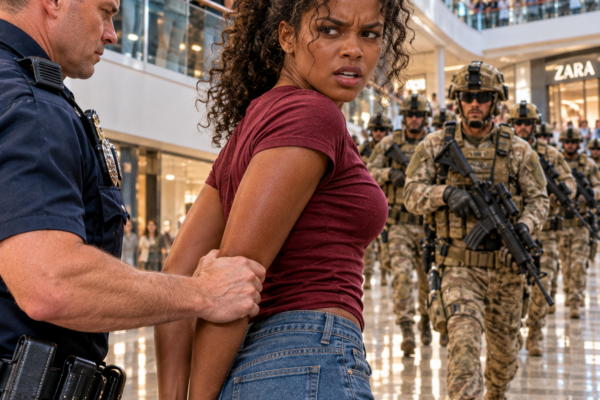
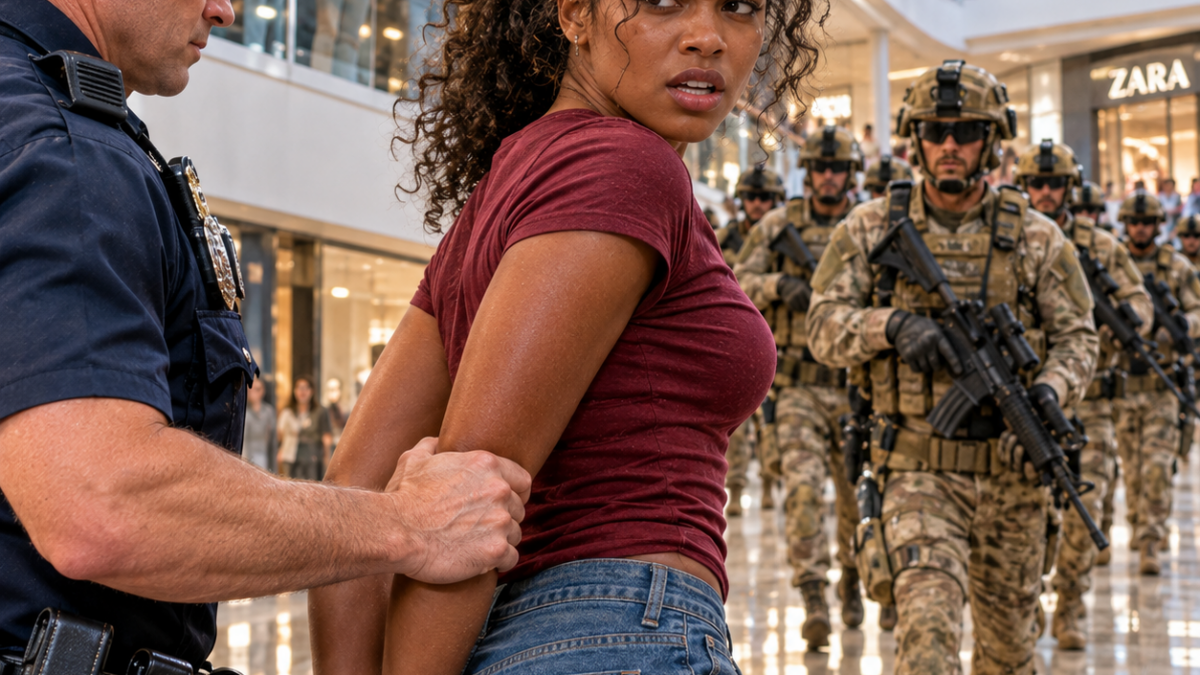
Part 4: Cop Arrested Woman At The Mall—Then 15 Navy SEALs Walked In And Silently Stood Behind Her
I am the manager of this mall, she said. What happened here today happened in my building under my name and I am sorry to Miss Dalton and to everyone who watched it.
We will have outside review of our security office. We will have it in writing.
An older man in a good gray suit pushed through behind her, breathing hard, and he stopped in front of Ruth Anne with his hat in his hands. He was Mr.Kesler and she knew him from his voice on the phone, but he was smaller than that voice.
Mrs.Dalton, my store made that call. He said, I told my clerk to watch for trouble, and she watched for the wrong thing.
Thats mine, not hers. Mine.
Behind him, Brenda Lo was crying with her whole face, the way young people do. Im so sorry, she kept saying.
Im so sorry I didnt.
I should have said it cleared.
I just I got scared. Ruth Anne took the girls hands in both of hers.
They were cold as a window in January. You were new and you were afraid.
And somebody told you to be afraid of the wrong thing, she said. Learn from it and then let it go.
All right.
Brenda nodded weteyed. Yes, maam.
Mom.
Carla was suddenly beside her.
Her jaw set so hard that her whole face had gone narrow.
She had Josies drawing folded in her fist like a weapon.
Ive got a lawyer, friend. We sue everyone.
The department, the mall, that store, all of them.
Every last one, Carla.
They put handcuffs on you. They did, Ruth Anne said.
And Im going to think about it, but not tonight, honey.
Wait for me.
Will you do that? Carla looked at her for a long moment, and the fury in her face softened into something older and more tired.
Fine, she said.
Ill wait, but Im not promising for long. A paramedic with a kind, unhurried face came up with a blue bag, and Ruth Anne let him sit her on the edge of the planter and look at her wrist.
He turned it in the light.
Red marks, a darkening bruise on the right side, good movement in the fingers, no numbness. He wrapped it loosely and told her to ice it.
Ruth Anne took out her small gray notebook, the one that always wrote in her purse, and she wrote the time and the findings in her neat block hand. Under it, she signed her name.
You write down your own injuries? he asked.
Write it down? Time it.
Sign it, she said. Habbit.
Senior Chief Calvin Boyd had been waiting a respectful distance off. 15 men standing easy behind him like a row of oaks.
He came forward now, unhurried, and Dne Noah for once did not make a joke.
Doc, Boyd said in his soft Georgia draw. Ive got to ask.
Its near 6. You still want to give that speech.
Ruth Anne looked up at the clock above the escalators. The hands read 5:48.
She looked at the crowd and at the empty stage with its microphone waiting under the lights.
I have a speech to give, she said.
And a friend who needs a watch. She gave herself one breath the way she used to before walking into a trauma bay.
And then she climbed the three steps to the stage. It was 6:40 in the evening, 40 minutes late, and the atrium looked nothing like it had that morning.
Someone had dimmed the overhead lights.
A warm glow fell on the little stage, and the fountain behind the folding chairs threw soft ripples of light up the walls.
The cinnamon pretzel smell still drifted over everything, faint now, like a memory of the afternoon. On the big screen, the spinning mattress ad had finally been replaced by a simple blue banner that read, Second win scholarship.
Every chair was full.
People stood along the railings of the upper level and sat on the edge of the planters.
15 men in plain shirts had taken the back wall, arms folded, quiet as a church. And in the front row, in a gray suit that had seen a few too many hospital hallways, sat Dr.Amos Puit, hands on his knees, looking up at her as if she were about to give him bad news, and he was ready to hear it.
Ruth Annes right wrist was wrapped in a clean white bandage under her sleeve. It throbbed a little when she gripped the edge of the lectern.
She set her gray notebook down beside the microphone and did not open it.
Good evening, she said.
Thank you for waiting.
I know it was a long afternoon and I know some of you have questions about it. We will get to the facts in their own time.
Tonight is not about me and it is certainly not about anybody I might be angry at.
Tonight is about children who need somebody to say, You are not alone and here is the money to prove it.
A few people laughed softly, the kind of laugh that lets out a held breath.
I want to thank every one of you who stayed. Most people would have gone home.
She looked down at the notebook, then back up. She had planned to say something about the scholarship.
She had written three tidy paragraphs about it last week at her kitchen table. They felt thin now, like paper cups.
Let me tell you why we are here, she said instead.
Not the brochure version. The room settled.
In 2013, I was a senior chief on a deployment I will not describe tonight. There was a young lieutenant named Danny Reyes.
He was 29. He played the harmonica badly and he knew it and he played it anyway every evening because he said the guys deserved a little noise.
He had a daughter back home who was 4 years old and a wife who sent him drawings of a purple horse. Her voice did not shake.
She had learned long ago that the steadier she kept it, the more the listeners could bear to hear. On a bad night, Dany was hurt, and I was the one who was supposed to fix it.
I did everything I had been taught.
I did some things I had taught others. I worked on him for a long time, and he died anyway.
Nobody moved. In the front row, Dr.Puit closed his eyes for a moment, the way a man does when he recognizes something.
I carried that for years. I still carry it.
But a few months after I found out his daughter, Marabel, wanted to study to be a nurse and her mother did not know how they would pay for it. And I thought, well, I could not save the father.
Maybe I could keep a door open for the daughter. She paused and let the quiet do its work.
Marbel graduates in May. She is a student nurse at Ohio State.
She asked me to tell you she would have come tonight, but she has a clinical shift.
She said to tell you thank you and to tell you she checks peoples pulses very very carefully. The sound that went through the atrium was half laugh and half sobb.
Ruth Anne saw an older woman in the third row press a napkin to her mouth. She saw a man in a work jacket wipe his face with the back of his hand and look embarrassed about it.
That is what second wind is.
A second wind for a child who thought the race was over. We have sent 11 students to college so far.
With your help tonight, I would like it to be more.
She took a step back from the microphone, meaning to sit down, and a deep, easy voice from the back wall said, Maam, we are not done.
Senior Chief Calvin Boyd walked up the center aisle, tall and unhurried. with the same calm she remembered from a helicopter floor in Helmond.
Under his arm, he carried a flat wooden plaque wrapped in a dish towel, which was clearly the best wrapping paper 15 men could find on short notice.
The others came behind him and lined up along the foot of the stage, shoulders squared, hands loose and visible.
Ruth Anne, Boyd said into the microphone she had left for him. You told us once that a corman does not get thanked.
A corman gets a quiet drive home, so we figured we would arrange a loud one.
He pulled off the towel.
The plaque was dark walnut with a brass plate, and Ruth Anne read it before he could for the one who taught us to stay calm and keep our hands on the patient.
From the men and women you sent back alive, she put her good hand against her mouth. 15 of us flew in or drove in today.
Boyd said, Some of us came a long way. We were supposed to surprise you at 3:00, and I guess we did, though not the way I planned.
The crowd chuckled kindly.
Boyd handed the microphone to the man beside him.
Dne Okafor, 32, grinning, took it like a man who had been waiting all week for his turn. I just want to say, chief, that you once told me my suturing looked like a spider had a stroke.
I have thought about that every single day, and my stitching is much better. Thank you.
The laughter rolled all the way to the balconies. Ruth Anne laughed too, a short surprised sound and wiped her eye with her knuckle.
Big Tom Haskell, gray beard and all, cleared his throat twice and said, I have two sons because of how you taught me to tie a tourniquet. Thats the whole speech.
The last in line was Eli Vance, 27, the youngest, who looked as if he would rather have been shot at again than be standing there.
He held the microphone with both hands. Maam, I was 19 in your class and I was scared out of my mind.
First week, I froze on a practice scenario.
I stood there with my mouth open. Everybody stared and you walked over and you did not say one word about it.
You just knelt down next to the dummy and said, Eli, what is the first thing you see?
And I said, Blood. And you said, Good.
Now, what is the second thing?
And I started to move. I have been moving ever since.
I have asked myself that question in some very bad places. First thing, then second thing, I am alive and so are people with me because of those two questions.
He gave the microphone back to Boyd with a shaking hand. The applause did not start all at once.
It began with a few people near the front, then rolled back until the whole atrium rang with it, until the fountain itself seemed to sparkle in time. Ruth Anne held the plaque against her chest.
She waited until the room was quiet again.
You boys, she said, and then shook her head because they were men now and had been for a long while.
You listened to me for 9 years and apparently learned the wrong half of it.
More laughter. She set the plaque on the lectern next to the notebook.
I will say one thing about this afternoon and then I will leave it alone. A lot of you saw what happened or heard about it.
I have a rule I taught every one of these folks.
Hands visible, voices low, and let the facts walk in. It does not mean be silent.
It means do not shout the truth into being. Stand where everyone can see you.
Speak so people lean closer and trust that a fact when you set it down plainly will find its own way across the room.
Sometimes it takes a few hours.
Today it took about three.
She glanced up at the big screen, dark now behind its blue banner, and some people in the crowd glanced up with her.
I am not asking anybody to be angry. I am asking everybody to be patient and to be honest.
That is the whole recipe.
It is not fancy, but it has held up for a long time.
Mrs.Hines was the first to stand.
The white-haired woman from the third row, still holding her napkin. $5,000, she said.
In my late husbands name, he was a Marine, and he would have hated all this fuss. The owner of the Lakeside Diner rose next, and pledged every Sundays breakfast profit for a year.
Then a small, silver-haired man in a pressed suit stood up near the aisle. It was Mr.Kesler of Kesler and Daughters, who had driven over from the shop with his coat still halfbuttoned.
I will match every gift made in this room tonight, dollar for dollar, he said, up to 40,000.
and I owe this lady an apology on behalf of my store, which I will make again in private and in public. Priya Anand, the mall manager, stood beside him with her phone in her hand and her face pale but steady.
Silver Lake Galleria will donate todays entire profits, she said. All of them.
On the big screen, the number began to climb, and the crowd watched it as people watch a kettle.
60,000, 90, 130.
Then the numbers slowed and a hush came and the last digits ticked over.
$212,000.
Ruth Anne did not say anything.
She only nodded once toward the sky she could not see.
Then she took the small velvet box out of her pocket, walked down the steps, and crossed to the front row. Dr.Puit stood up slowly.
He was 70 and his knees told him so.
Amos, she said, you put my life back together on a table in 2009. This is for the hands that did it.
He opened the box. The green face glowed under the dimmed lights.
He turned the silver case over and read the engraving, lips moving, steady hands, warm heart.
His own hands, the surgeons hands, began to tremble, and he tried twice to speak and could not.
At last, he lifted his eyes and said quietly so that only the first rose could hear, You never stopped being the one who checks on everybody.
She laughed through her tears.
A small hand tugged at her sleeve and Josie stood there with a marker in her fist. Grandma, will you draw a lighthouse with me now?
The big kind. Now, Ruth Anne said, the big kind.
By 9:00, the chairs were stacked and the crowd was gone.
The atrium was cool and nearly silent, only the fountain whispering. Ruth Anne sat on the stone edge with her shoes off, her wrist propped on her knee.
Boyd sat on one side of her, Carla on the other, her daughters head against her shoulder.
Tired, Mom? Carla asked.
Calm?
Ruth Anne said.
Its different.
Lieutenant Naomi Fuentes came across the floor with her hat in her hand and sat on the fountains edge across from them. She looked as if she had not sat down since dawn.
I want you to hear this from me, she said.
Tomorrow there will be interviews, a formal investigation, statements, timelines, the recordings, all of it.
Maybe a trial, maybe more than one. It will be slow and it will be dull and it will not look like tonight.
She rubbed her tired eyes.
Tomorrow starts the part nobody films.
Ruth Anne nodded because she knew that was where truth is kept.
That night, Ruth Anne sat in her kitchen with her shoes off and a cold cup of tea she had forgotten to drink. The red marks on her right wrist had darkened to the color of a plum.
She turned the gray notebook over in her hands, opened it, and wrote the date at the top of a clean page. Then she wrote in her small square hand what Lieutenant Fuentes had said at the curb.
Tomorrow starts the part nobody films. She signed it the way she signed everything.
Fuentes was right.
The cameras went home.
The balloons were swept out of the atrium and the work turned slow and quiet. On Thursday morning, Fuentes came to the yellow house herself with a state investigator named Mr.Albbright, a patient man with reading glasses on a cord.
They sat at the kitchen table. Ruth Anne gave them the notebook, and Albright read the entries aloud, one at a time, as if he were checking a patients chart.
210 entered the jeweler.
231 stopped. 244 cuffed.
You wrote the times down while it was happening, he asked. Afterward in the security office while I still had them, Ruth Anne said, Memory is a poor witness after a few hours.
Paper is better. Albright nodded and made a small mark of his own.
Fuentes, who had not slept much, poured the coffee herself. It took 11 days for the radio company to answer.
The server in a warehouse two states away had kept every transmission from that afternoon.
Whatever Lyall Brandt had told his office.
Fuentes called Ruth Anne with the news and her voice sounded lighter than it had in weeks.
Its all there.
240. Brandts own voice.
Transaction cleared.
No fraud on file.
Price answers. Copy that.
4 minutes later, he cuffs you. Ruth Anne closed her eyes.
She thought of the spinning mattress ad and how absurd it had looked above the whole thing and the body camera. Thats the other piece.
40 seconds missing and we know why now. The file was deleted from his unit at 5 3 from his own login.
Albrights people pulled the trace.
So he knew he knew.
Fuentes said he just hoped nobody would ask. Lyall Brandt was fired within the week.
Then the county prosecutor charged him with tampering with records. And with that came the other story, the one he had carried from one town to the next.
A sheriffs office three counties over had let him go years earlier over a locker of evidence that never made it to the courthouse. Two retired deputies were glad to say so to Albbright.
Brandts lawyer asked for time and then asked for more time and in the end Brandt stood in a small courtroom in a suit that no longer fit him and said very little at all. Price took longer.
He hired a lawyer, a tired woman with a rolling briefcase who clearly advised him to stop fighting the recordings. In January, he stood before the judge and pleaded guilty to unlawful detention and to filing a false report.
He gave up his badge that same morning.
Ruth Anne sat in the third row and watched the back of his neck.
It was reddened, the way a young mans neck gets when he has run out of places to look. She had been asked kindly whether she wished to speak at sentencing.
She had said yes before the question was finished.
When her name was called, she stood with her notebook in her hand, though she did not open it.
The courtroom smelled of floor wax and old paper.
She said her name and her rank. And she said that she was not there to ask for anger.
Your honor, I spent 26 years in rooms where a bad decision could cost a life. And I learned that a mistake is not always a monster.
Sometimes it is a tired man who decided too early.
Officer Price hurt me and heard something larger, which is the trust a town gives to a badge. I would like him to spend his next years repairing that community service in the same streets he patrolled real retraining with people who will not flatter him.
And I ask that the settlement the city owes me go to the Danny Reyes scholarship so that something good grows from this. The judge, a gray-haired man who had not smiled all morning, looked at her over his glasses for a long moment.
You understand? This is more than the law requires you to offer.
I understand, sir. It is less than the truth deserves, but it is what I can carry.
Price did not look at her, but his lawyer did, and her shoulders eased, the way a persons do when a heavy bag is lifted off them.
3 weeks later, an envelope came, addressed in blue ballpoint.
Ruth Anne carried it out to the porch swing before she opened it.
The letter was one page short, and the handwriting leaned hard to the right. Miss Dalton, I am not writing to be forgiven.
I decided who you were before I knew and then I protected that decision instead of the facts. I saw your hands the whole time and they never moved.
That is what I think about.
I am learning to listen.
Gordon Price.
She read it twice. Then she folded it along its own creases and slid it into the back of the gray notebook behind Jallens passcode card where she kept the things that mattered most.
She did not write anything beside it. Some entries needed no comment.
Spring brought the changes and they arrived in ordinary ways. Priya Anand, the mall manager, asked Ruth Anne to write the first training outline for her staff.
It was two pages long.
Greet before you suspect. Verify before you call.
Never ever hold a person on a hunch.
Brenda Lo, the nervous clerk from Kesler and Daughters, came to the first session and sat in the front row. And when it was over, she stayed to stack chairs.
Mr.Kesler had paid for her to start night classes in business.
She was taking two. I should have called the store back, Brenda said, folding a chair with great care.
When the card cleared, I knew it was fine.
You did the right thing in the end, Ruth Anne said.
You told the truth when it was your turn. That counts for more than people think.
A new rule followed. Every camera feed in the mall would be copied off site to a place no single manager could reach.
Priya called it the Dalton rule and Ruth Anne asked her to stop and Priya did not. The police department wrote a new body camera policy with automatic upload and a written note for every gap.
By the next autumn, the council had given it a name, and the name was hers. She went to the meeting in her good blouse, listened to the vote, and thanked them for something she would have preferred to do without.
Letters came from strangers, a basket of them by the end of the year. A retired school teacher in Oregon, a sailors mother in Texas, a young man who wrote only that he had been cuffed once, too tight, and nobody had apologized, and he wanted her to know he had read about her and sat up straighter.
Ruth Anne answered everyone by hand at the kitchen table with the radio turned low. Jaylen Moss, the intern, got a real job at Channel 9 with a lanyard and a desk of his own.
He told her over the phone that the first thing he did was buy a second laptop and a drive and set both to record in case, he said.
She laughed so hard that she had to sit down. The red marks faded slowly.
By Christmas, there was only a thin pale line around her wrist, like the ghost of a bracelet.
And some mornings, she did not notice it at all.
Other mornings, she traced it with her thumb while the coffee brewed, not in anger, only in the way you check a door you have already locked. On a warm Saturday in June, a car she did not know pulled up in front of the yellow house.
Dr.Amos Puit got out slowly, one hand on the roof of the car. He was 70 now and looked it and he carried a small box wrapped in plain brown paper.
Ruth Anne met him at the gate. You didnt have to drive all this way, doctor.
I did actually. A man should deliver his own.
Thank you.
He smiled.
Though I think its the other way around.
They sat on the porch, the swing creaking the way Walts swing always creaked.
Josie, who was visiting, brought out lemonade and then hovered with her chin on the railing, plainly curious about the box.
Dr.Puit opened it and lifted out the pocket watch, its deep green face catching the light and the silver case warm from his hand.
He read the engraving aloud, steady hands, warm heart.
Then he looked at Ruth Anne for a while without saying anything.
He set the watch on the porch rail where the afternoon sun fell across it, and they all listened to it tick. He took out his phone, glanced at it, and held it up.
Exactly right, he said. To the second, Josie giggled.
Thats because its a good watch.
Its because somebody kept it safe, said Dr.Puit.
Inside, on the refrigerator door, a lighthouse drawing hung beside a letter on heavy cream paper.
Josie had drawn the lighthouse in crayon with a beam of yellow stretching all the way to the edge of the page and underneath she had printed in careful capitals for grandma who keeps the light on.
The letter beside it came from the scholarship office.
It said that the first four students from the Danny Reyes fund had been accepted into college that fall and it listed their names.
Ruth Anne read those names each morning before she did anything else.
She had never told anyone why.
That evening, after Dr.Puit had gone and Josie had been tucked in upstairs, Ruth Anne carried a mug of chamomile out to the porch swing.
The street was quiet.
A moth tapped at the porch light and somewhere a screen door closed.
Her phone buzzed on the cushion beside her and then buzzed again and again.
She looked down.
15 messages, one after another, from 15 numbers she knew by heart.
Each one said the same thing.
Good night, senior chief. She did not answer them.
She only held the phone against her chest for a moment. The way you hold something you have waited a long time for.
Then she opened the gray notebook on her knee, wrote the date, and wrote nothing else but a single line. Time it, sign it.
She signed it and closed the cover. The swing rocked gently.
The porch light made a small gold room in the dark, and the whole street lay quiet around it, as if it too had listened.
The truth had walked in that October afternoon with its hands open and its voice low, and it had never left.
It sat with her now, easy as an old friend, while the night settled down over the yellow