Homeless at 20, He Slept in a Rusted School Bus — Under the Floor Lay a Hidden Fortune
Homeless at 20, He Slept in a Rusted School Bus — Under the Floor Lay a Hidden Fortune
At 20, Jonah Whittaker had learned not to expect much from the woman who had married his father.
So, when his stepmother took the house, the truck keys, his phone, and the envelope of hardware store wages he had saved for 2 years, and then drove him out to a rusted school bus in a weed-choked yard, he thanked her for the ride.
The yard sat 11 miles from the nearest town at the end of a gravel road with no signal and no neighbors.
On his first night there, a stray hound pawed at the rubber mat in the aisle, and the floor beneath it answered with a hollow knock.
Under that floor was a steel ladder and a hidden room directly beneath the one place his stepmother had sent him to be forgotten.
To understand what he found, you have to start with the morning he lost everything.
It began on a Thursday, the 7th of October, in the kitchen of the house on Marlowe Street, where Jonah had been born. His father had been gone since the 12th of March.
Mark Whittaker had driven a school bus for the county for 22 years, and he had left the world the way quiet men do, without a speech. And the house had not been the same since.
Jonah came in from the porch with his boots in his hand because that was the rule in that kitchen, and found his stepmother already seated at the table with a folder in front of her and her reading glasses on. Delia Stroud was 51 years old, neat as a pressed tablecloth, with silver coming in at her temples and a way of folding her hands that made every conversation feel like a consultation.
Sit down, Jonah, she said.
Nobody is angry.
He sat.
Across the room, Tory stood at the sink with her back half turned, drying a mug that had been dry for some time.
Tory was 24, Delias daughter from an earlier marriage, and in the 6 years she had lived under that roof, she had never once taken Jonahs side.
She had never taken anyones. Besides the folder, lay a stack of envelopes with red lettering across the top.
The good dining set had gone in August, and more than once, after dark, Jonah had heard Delia on the back porch with the phone pressed to her ear.
I have been thinking about what is best for everyone, she said.
For you, most of all.
She said it the way people say a thing they have practiced in a mirror. It was the voice she used on everyone, soft and level and full of care, the voice of a woman who had never raised it because she had never needed to.
In her mouth, taking sounded exactly like looking after.
The house is mine, you know that. Your fathers will was plain, and I am not going to apologize for what he wanted.
But I cannot carry another grown man on this household, not this winter, and not with everything the way it is.
I can pay rent, Jonah said.
I have the envelope.
That is what I wanted to talk about.
I found it in your dresser when I was dusting.
$1,860. I counted it twice.
Let me hold that for you, honey.
Money in a drawer only gets lost.
He thought of the 2 years it had taken, the early shifts on Main Street, and the 10s and 20s folded into a bank envelope each Friday. He did not say so.
He had been raised not to say things that could not be taken back. The truck stays, naturally.
It is titled to me now, and I will have to sell it toward the house. The keys, please.
He set them on the table.
They They a small flat sound. And the phone?
It is on my plan and I am closing the plan on Friday.
She held out her palm.
He placed the phone in it and she switched it off before he could see who had last called. My mothers box, he said.
Stays in the attic.
Where it is safe.
You cannot walk out of here carrying a cedar chest and a duffel bag.
I will keep all of it for you, Jonah.
He understood then the whole shape of it. Everything he owned was going to be kept for him carefully by someone who would never give it back.
Where am I supposed to go?
Delia opened the folder with the unhurried air of a woman turning to the next item on a list. Your mothers father had that old bus yard out on Calvert Road, the Dunning place.
He passed last summer and the whole property is tangled in his estate with a lien nobody can clear. It is nothing but weeds and rust, which is why no one will buy you there.
There is a bus with a roof and bench seats.
Just until I sell the house and we all land on our feet.
I never met him, Jonah said.
No? Well, she turned the page.
He was not an easy man.
She slid a single sheet across the table. And one small thing.
All this says is that I may speak for you on the yard with the county and the lender so you need not trouble yourself.
Sign whenever you like. The top line read limited authorization and below it was a great deal of small print and his name already typed on a line.
I would like to read it first, he said.
Something moved across Delias face.
There and gone like the shadow of a bird over a field.
Of course. Take it with you.
I will drive out Sunday and we can go over it together.
Tory, the green pail, please.
It can go in the donation bag. Tory lifted the dented green lunch pail from the shelf above the stove.
It had been his fathers. It still smelled faintly of coffee and machine oil, and inside the lid, under yellowed tape, was an index card in his fathers block capitals that read only Route 9.
Jonah had looked at that card a hundred times and never learned what it meant. I would like to keep that, he said.
Jonah, you cannot carry everything, Delia said.
Be reasonable. Tory held the pail against her apron a moment longer than she needed to.
Her thumb moved once over the dent in the lid. She said nothing.
She did not look up. Jonah would remember that silence for months, the way you remember the one stair that creaks in a dark house.
He was allowed one duffel bag.
He packed it in 11 minutes. Three shirts, two pairs of work pants, wool socks, his boots, his razor, and his fathers old canvas jacket with the torn pocket.
At the back door, Delia handed him a canvas sack she had filled herself.
Inside were a loaf of bread, a jar of peanut butter, four cans of baked beans, a flashlight, two wool blankets, a gallon jug of water, and a toothbrush still in its package. It was exactly enough to say she had not sent him out with nothing.
They drove in her gray sedan.
After 6 miles, the pavement gave out.
At the end of Calvert Road stood a chain-link gate with a padlock the size of a mans fist, and Delia got out and opened it with a key from her own ring. Jonah noticed that.
He noticed it the way you notice a stone in your shoe and decide to keep walking. Inside lay a long yard gone to goldenrod and thistle, and in it, scattered like the bones of something large, six old school buses.
At the far end, nearest the tree line, sat the last of them, and Delia drove straight to it as if she had chosen it ahead of time. The paint had faded to the color of a dry lemon.
Rust had crept up from the wheel wells in long brown fingers, and on the side, still just legible, was the number nine.
She did not get out again.
I will see you Sunday, she said through the window. Do read that form.
Jonah thanked her.
It was a habit his father had given him.
Say thank you, Jonah, even when it hurts, especially then. It is the one thing nobody can take from you.
So, he stood in the gravel with his hand on the roof of her car, and said, Thank you for the ride, Delia. And he meant it as a courtesy, and nothing more.
The sedan turned around in the weeds and went back the way it came.
It did not slow at the gate. Delia did not look in the mirror, and Jonah, who had watched a good many people leave in his life, stood in the road until the dust had settled.
Then, it was quiet in a way he had never heard before.
11 mi from town, no phone, no truck, no money, and 4 mi, he guessed, to the nearest roof. Everything he owned now fit in a duffel bag and a canvas sack.
Everything else sat in a house on Marlow Street being kept for him. The bus was colder inside than out.
It smelled of dust, mouse nests, and old vinyl, and underneath it all, faintly, of machine oil.
Green bench seats ran down both sides, split and sprouting stuffing. Down the middle of the aisle, from the steps to the emergency door at the back, ran a thick black rubber mat, cracked at the edges and heavy as a carpet of tires.
He spread the blankets over the back bench and then he sat down and read Delias paper with his finger under the lines because he was not a fast reader and had never pretended to be. It said what she had told him it said and one thing more.
In the fourth paragraph, in language so dull that a persons eyes slid off it, it said that the undersigned would have no say in any sale of the property or its contents.
A woman who wanted nothing from a worthless yard would not have bothered with a clause about its contents.
He folded the page in thirds and put it in the torn pocket. Around 4:00, he saw the dog.
She stood at the edge of the tall grass by the tree line, perfectly still, a lean brindle hound with a long narrow head and a torn left ear. Her ribs showed through her coat in neat rows.
She watched him like an animal who had been disappointed by people but had not entirely given up on the idea.
When he stood up on the step, she was gone. He ate a slice of bread with peanut butter as the sun went down.
One loaf, one jar, four cans of beans, a gallon of water, already a third gone. The air fell toward 50° as he watched.
It was full dark when he heard the whining. It came from under the bus, thin and cracked and almost apologetic.
Jonah took the flashlight, whose batteries had already begun to yellow, and crouched at the bottom step.
Two eyes shown back at him from beneath the frame and then the rest of her slid into the beam, belly low, tail tucked, shivering all over.
She was a plott hound, brindle dark on dark, perhaps 4 years old with a pale ring of flattened fur around her neck where a collar had once been.
Whoever had taken the collar had not taken the dog.
The dog had stayed. Hey girl, he said softly, come on out.
She did not move.
He went back inside and opened a can of beans with the pull ring, and then he stopped with the can in his hand and counted again.
Four cans and no knowing how many days until Sunday and no certainty that Sunday would bring anything but a form to sign.
A sensible man would have eaten the whole can himself. He set it on the bottom step in the beam of the flashlight and sat back.
She came out an inch at a time.
She ate the way starving things eat, fast and then abruptly slow, as though ashamed. And when the can was empty, she licked the ring of it for a long while.
Jonah had kept four spoonfuls for himself. He did not regret the rest.
Penny, he said, because under the flashlight, her coat had the dull copper sheen of an old coin, and because a thing ought to have a name. She lifted her head at the sound, one torn ear turning toward him, and he thought nothing of it.
It would be weeks before he understood that she had been called that before. She slept on the floor beside his bench with her back against his boots.
The night fell to 41° cold for the first week of October, though not winter and not yet anything he could not bear.
He lay under two blankets and his fathers jacket and thought about a green lunch pail, a cedar box in an attic, and a careful hand holding a key.
Sometime past midnight, he woke without knowing why.
Penny was at the back of the bus on the mat, and she was digging.
Not the lazy circling of a dog making a bed, but short, hard, hurried scrapes of her front paws over and over as though she were trying to open a door. She whined once, low in her chest, and looked back at him in the moonlight.
Penny, hush. She did not hush.
She stopped, put her nose to the edge of the mat where it curled away from the floor, and held perfectly still breathing in. Jonah got up.
His feet went numb on the steel as he walked the length of the aisle in his socks, and when he reached her, he felt it against his ankles, a thin, steady breath of air, cooler than the air in the bus, coming up along the edge of the mat.
It smelled of old oil and dry earth and something else, something cold and clean like the inside of a stone. He knelt.
He knocked on the floor with his knuckle once, the way he might have knocked on a neighbors door.
The floor answered with a hollow knock. It was not the flat sound of steel over framing.
It was the sound of a deep, empty space that had been waiting a long while to be asked.
He took hold of the curled edge of the mat with both hands and pulled.
It came away in a long, black roll, heavy and stiff and loud, and under it lay bare steel scored with decades of boot marks.
Set into the floor, cut as cleanly as a window and a little more than a yard square, was a plate with four bolt heads at its corners.
Someone had painted the bolts over in the same faded yellow as the bus so that in daylight no one would ever have noticed them. He fitted the socket end of the tire iron over the first bolt.
The paint cracked, the bolt squealed, and it turned.
He did the second, and the third, and the fourth was so rusted that he had to rest the bar on his knee and lean on it until it let go with a sound like a sigh. The plate moved on a hidden hinge.
He lifted it by the edge, inch by inch, until it stood upright against the back seat with a long groan of old metal. Cold air rolled out of the dark, and Penny backed away from it, then crept forward again.
Jonah pointed the flashlight down. The beam, yellowed and thin, found the first rung of a steel ladder, and then the second.
It found a hook set into the wall of the shaft, and on the hook hung an old brass and glass lantern, and the glass of that lantern was clean.
Someone had wiped it.
Someone had kept it ready. He did not go down at once.
He sat on his heels at the edge of the opening with the cold breathing up into his face and listened to his good sense telling him that a sensible man did not climb into a hole in the ground at midnight.
Then he put the flashlight in his teeth, turned around, and took the first rung.
There were 11 rungs, each cold enough to ache. Besides the lantern hook, a flat tin was bolted to the shaft wall, and inside it, wrapped in wax paper and dry as bone, lay a box of kitchen matches.
He took the lantern down.
It was heavy with oil. The first match flared and died.
The second caught, and he held it to the wick the way his father had on the one camping trip they ever took, until a small blue flame climbed and turned yellow.
Below the bus lay a service pit that someone had turned into a room. The walls were poured concrete lined with cedar planks and it ran sideways beneath the yard, 12 ft wide and 20 long.
Its ceiling braced with railroad ties.
A cot stood against one wall with its blankets folded in clear sealed bags and beside it a plank table and two chairs.
Shelves ran the length of the far wall and on them stood rows of canned food with dates written on the lids in marker and 10 glass jugs of water and a steel can of dog biscuits with its label turned neatly to the front.
Over the cot painted in white letters a hand high was a single line.
Nobody gets left at the last stop.
The air smelled of cedar and lamp oil and there was not a speck of dust on the table. A pipe the width of his wrist rose from one corner of the ceiling and it took him a moment to understand that it was the old exhaust stack of a bus and that it was breathing for the room.
On the table squarely in the lamplight lay an envelope. The name on it was written in thick black capitals that made the back of his neck go cold because he knew those letters.
They were his fathers, the same stiff capitals as on the card inside the lid of the green lunch pail, Jonah Dunning Whitaker.
Beneath the envelope lay a cloth-bound ledger as thick as a family Bible with route book nine stamped on its cover in gold that had mostly worn away.
He opened the envelope first. His hands were not quite steady.
The paper inside was lined, torn from a pad and the writing covered both sides. Jonah, I have started this letter 11 times and the first 10 were an old man making excuses.
This one will be short. If you are reading it, you found the flaw yourself, which means you were patient, and that is more than I ever was.
I am your mothers father.
I was a proud fool, and I would not go to her wedding because the man she was marrying had no land to his name. That man drove my Route 9 for 4 years, and was the best driver I ever hired.
I told him so only after I had insulted him. Your father forgave me.
Your mother never did, and she was right not to.
I did not stay away from you because you were not mine.
I stayed away because I was ashamed, and shame is the poorest reason a man ever had for missing a boys whole life.
There has been a seat for you on Route 9 since the day you were born. I never let it go to anyone else.
Now the practical part, because I never trusted a man who wept without writing down what to do next.
One, you are standing in a room I dug under my own bus.
The yard is paid for. Nobody holds a lien on it.
Anyone who tells you different has not read the deed.
Two, go to Dorothea Quill, Third Street, Harbin Springs. She holds my will.
She has been trying to reach your father since the summer I died. Three, sign nothing for anybody until she has read that will to you.
Four, the black box on the middle shelf is for the last stop. It will not open by force, and you should not try.
The key is at the end of the route, where every child I ever carried was safe.
You will know the place when you see it. Five, eat something.
I change the cans in the spring.
I had one rule in 41 years of driving, and I broke it with my own blood. Nobody gets left at the last stop.
Do not break it with anyone else.
Cyrus Dunning. Jonah read it twice, and somewhere in the middle of the second time, the page began to swim.
He did not cry loudly. He had been raised by a quiet man in a quiet house, and he did it with his jaw set and his shoulders still, while the lantern flame stood straight up in the unmoving air.
A seat for you. In 20 years, no one had ever told him there was one held for him anywhere.
When he could see again, the first thing that came to him was not the box or the room.
It was a single sentence in the middle of the letter. Nobody holds a lean on it.
He trimmed the wick, sat very still, and let that one settle into place like a stone dropped into a well, and listened to the long way down. Some people leave money behind, and some leave a lantern burning.
Above him, Penny whined. He had forgotten her.
He climbed the ladder, found her at the lip of the opening with her ears flat, and her whole body straining toward the sound of his voice.
And he knelt and slid one arm beneath her chest and the other under her hindquarters. She was a 60-lb hound, thin as a rail and lighter than she should have been, and he carried her down 11 rungs one at a time, with her breath hot against his neck.
When he set her on the cool concrete, she stood a moment with her legs braced, then walked straight to the cot and lay down in front of it as if she had been doing it all her life.
He fed her from the steel can, six biscuits slowly from his open hand.
Then he took a can of peaches off the shelf and a spoon from the table drawer, sat down across from the cot, and ate the first thing since the kitchen that was not bread or beans. It sat on the middle shelf between a case of canned tomatoes and a coil of rope, squat and black and plainly very heavy.
Jonah lifted one end and lowered it quickly.
It was perhaps 2 ft long and a foot deep, riveted steel with a brass lock plate the size of a playing card and a brass tag wired to its handle.
On the tag, in the same square capitals, were four words. For the last stop.
He did not try to force it.
His father would not have and the letter had asked him not to.
And besides, the box looked like the kind of thing that had been made to outlast hammers. He ran his thumb across the lock.
Whatever fit it was small and it was somewhere on a route that ended where every child had been safe. He opened the ledger instead.
Cyrus Dunning had kept a record of every school day for 41 years.
Each page held columns in a tight slanting hand, the date, the weather, the number of children, the miles. Beside most days was a single remark and the remarks were small and strange and tender.
Snow, nine aboard.
Billy Marsh has no gloves, gave him mine.
Fog, 12.
Waited at the Pruitt gate 11 minutes until the porch light came on. Ice on the hill, took the long way.
Every child delivered to a lit door.
Those four words appeared on page after page in year after year.
Porch light came on. Near the front, he found a line that made him stop.
June 1999, new driver this week, Whitaker, Mark, careful, does not talk, will do.
Jonah put his finger on his fathers name and left it there.
He turned to the back. The last entries were in a shakier hand and they were not about children.
The final page was dated the 30th of July, a little less than 3 weeks before the date on Cyrus Dunnings headstone, which Jonah would not see until much later.
It read, A man in a clean jacket walked the yard today with a measuring wheel and a boy to hold the other end.
Kent Aldous, he says, a company called Crestline offered me a number I did not ask for.
I told him the yard is not for sale because it is not mine to sell.
It is Annes boys. He smiled.
I did not like how he smiled.
He asked who the boy was.
Below that, a single line told him nothing, told Dorothea everything.
Jonah closed the book. The lantern burned low and golden and the dog slept and in the silence, something that had been loose in his mind for months finally turned over and clicked.
In May, the spring his father died, a registered letter had come to the house on Marlowe Street.
He had been in the front yard when the mail truck stopped. He had watched Delia sign for it at the door in her good blue cardigan and when he asked, she folded it once and said it was only a collection notice, nothing to worry about, the kind of thing that came after a death.
The return address had been a law office. He had seen that much.
She had put the envelope in her cardigan pocket and he never saw it again. In June, a man in a clean jacket had come to the house on a weekday afternoon.
Delia had sent Jonah to the hardware store for a box of picture hooks they did not need and told him to take his time. When he came back, there had been a second coffee cup in the sink and Delia was humming.
In July, she had said the word lean for the first time at supper to nobody in particular as though she were trying it out for fit.
A lean on the old Dunning place, a tangle, a shame.
Nothing anybody would want. Nothing anybody would want, Jonah thought, and he looked at the lantern and the 10 jugs of water and the black box that would not open by force and the line over the cot that somebody had painted to be read by a person who had nowhere else to go.
She had not put him in the yard because it was worthless. She had put him there because it was the one place on earth she could keep him quiet, close, and signed.
He sat for a long time without moving. Then he did the small practical things because they were the only things a person could do.
He ate a second can, gave Penny the heel of the bread, dragged the blankets from their sealed bags still smelling of cedar, and lay down on the cot with the dog on the concrete beside him and the letter on his chest.
And the last thing he saw before sleep took him was the white line of paint held steady in the light.
He woke to gray daylight falling down the shaft, warm for the first time since the kitchen, and for a moment, he forgot what had happened and lay there simply content. Then he remembered and he put the letter and the ledger inside his fathers jacket, checked the box once more, and climbed.
The yard looked different in the morning. The golden rod stood wet and silver.
The five dead buses looked less like bones and more like animals asleep.
He lowered the plate over the opening, set the four bolts back into their holes without tightening them, and dragged the black mat over it, and Penny watched him with her head cocked as if she approved of the arrangement. Anyone looking would see a rusted bus with a floor mat in it.
He had made up his mind about the first thing.
He would walk to town and find Dorothea Quill, 11 miles on foot if he had to, and he would not sign anything for anybody.
He had reached the bottom step with Penny at his heel when he heard it, the grind of an engine on the gravel coming slowly up Calvert Road from the direction of town. Not the quiet hum of a gray sedan, a heavy, rattling, old truck sound with a loose tailgate chain knocking in the rhythm of its wheels.
Pennys head came up.
Her tail swung once, hard, and then she was trotting toward the gate with her whole body wagging, and Jonah, who had no phone and no keys and no money and nowhere to hide, stood on the step with the letter against his ribs and watched an old green pickup stop at the gate, and a small white-haired woman climb down from it with a key in her hand, already calling a name that was not his.
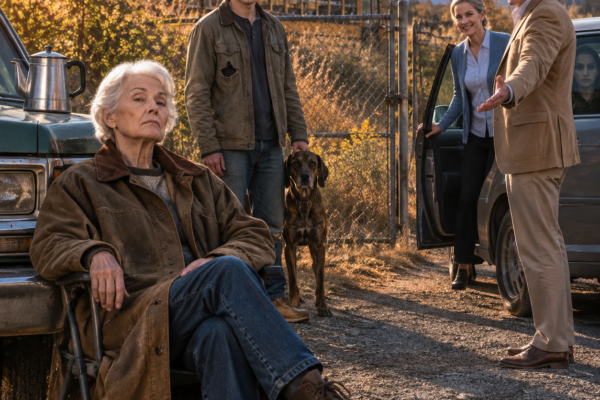
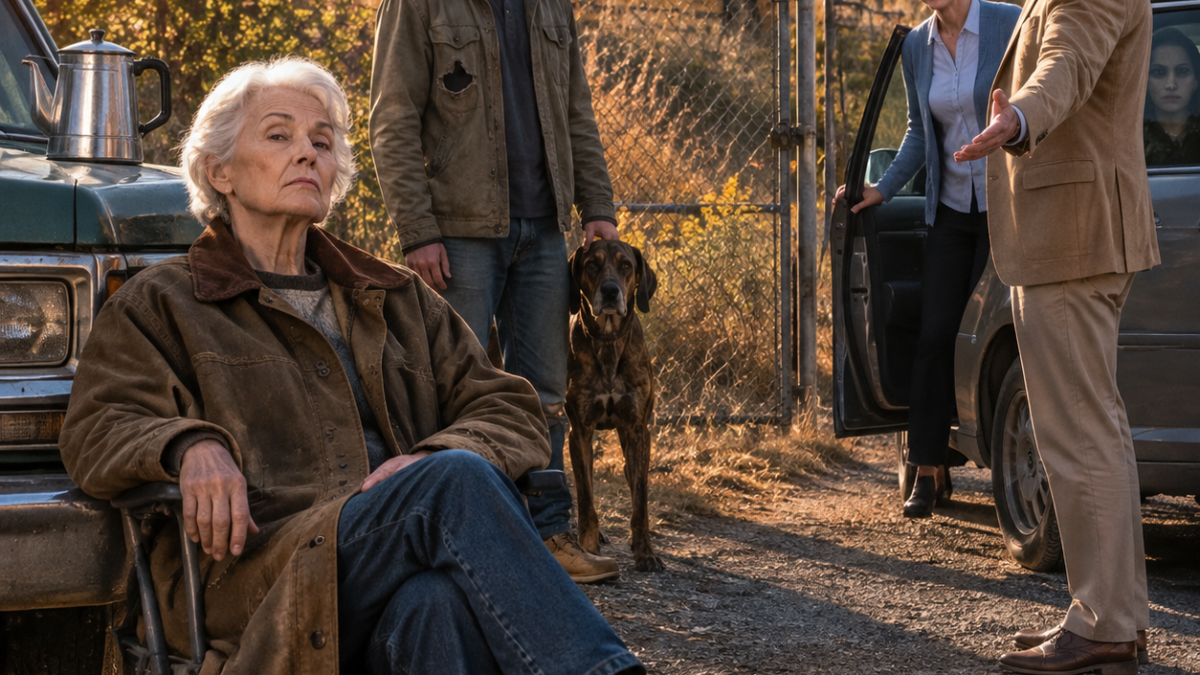
The woman opened the gate with the ease of someone who had done it many times, and she did not so much as glance at Jonah until the dog reached her. Then she went down on one knee in the wet gravel in a mans barn coat that came to her shins, and took the hounds long head in both hands.
Penny, she said. Oh, Penny, where have you been, you stubborn girl?
She was small and straight-backed, perhaps 70, with white hair cut short as a boys, and a face that had been out in a great deal of weather.
Penny wriggled and whined and pressed her whole thin length against the womans knees, and the woman closed her eyes and let her.
When she finally looked up, it was at Jonah, and her gaze went over him once, slowly, from the boots to the torn jacket to the face, and stopped there. You have Anns eyes, she said, and you have his jaw.
God help you. You are Marks boy.
Jonah, he said, Jonah Whitaker. Midge Oakley.
She got up, one hand on her knee.
I kept the dispatch desk for Dunning Transit for 31 years. I have driven out here every Friday since the 19th of August last year because Cyrus asked me to see to the yard until the right person came for it.
She looked at the bus, at the black rubber mat just visible through the folding door, and then back at him. I did not think the right person would be sleeping in the yard.
I was put here, Jonah said, yesterday. Something in his voice made her look at him a second time, harder.
Penny, meanwhile, had trotted past them both to the front of the bus and was standing by the bottom step, head lowered, tail swinging, waiting. Midge followed her, bent down and parted the thistles at the foot of the step with her hand.
A steel bowl lay there on its side, dented and furred with rust. Around its rim, hammered into the metal letter by letter with a nail, was a single word, Penny.
He fed her here every morning at 6:00, Midge said.
The week after we buried him, she went off into those trees, and I put food at this gate every Friday for months. It was always gone when I came back, but she never let me within 30 ft.
I thought it was the raccoons.
She straightened.
She was not waiting for me. She was waiting at his step for someone who never came.
Jonah looked at the bowl and at the bottom step where he had set a can of beans the night before, and he did not trust himself to say anything. How did she find you?
Midge asked quietly.
I did not name her, he said.
I mean, I did. I called her Penny.
I do not know why.
Of course you do not. Her voice had gone soft and dry.
Some things know their own names.
She did not ask about the mat or the dust on his knees.
She looked at the sack with its last four slices of bread and at the way a young man stood when he had been up all night and had learned something he could not say.
Then she put both hands in her coat pockets and said, Have you eaten a hot breakfast since Wednesday? I had peaches, he said.
This morning.
Cold.
Get in the truck, Mrs.Oakley.
I cannot pay you.
Dont thank me, Midge said, and dont pay me. Cyrus paid for this breakfast in 1984.
I am only the one carrying the plate. Her farmhouse stood 4 mi down Calvert Road, a low white house with a deep porch and a yellow light burning over the door, although it was past 8:00 in the morning.
She cooked in a cast-iron skillet without looking at it, eggs, thick bacon, a pan of biscuits kept warm in a towel.
Jonah ate until his stomach hurt.
Penny lay under the table with her chin on his boot and a strip of bacon hidden between her paws as though someone might take it back. I will tell you what I know, Midge said, and you may do as you like with it.
Cyrus Dunning ran school buses in this county for 41 years. His father did it before him.
He was hard and proud, and he said 10 words a day, and nine of them were no. But in all that time, he lost not one child.
She turned an egg.
In 1984, a substitute driver on the Pruitt route let a 6-year-old boy sleep through the last stop.
The bus went back to the yard with the boy asleep on the back seat, and it was an hour and 10 minutes before anyone found him.
It was January and cold, and the boy was fine.
He was entirely fine.
She set the skillet down. Cyrus was not fine.
He walked the whole of that route in the dark afterward, house by house, and apologized to every mother on it.
And then he made himself a rule.
At the end of every run, he walked the length of his bus, seat by seat, and he would not drive off from any stop until the porch light came on and the door opened, and he had seen the child go in. In 41 years, he never broke it.
Folks joked about it for a while, then they started setting their clocks by him. Porch light came on.
Jonah had read those words 40 times in a ledger the night before, and it had meant nothing to him until now. That was his rule, Midge said.
Nobody gets left at the last stop.
He would say it to new drivers on their first morning. He said it to your father.
My father never told me any of this. Your father was a kind man who knew when a thing was not his to tell.
Ann was Cyruss only child. He lost her to his own pride before he lost her to anything else, and he knew it.
He sat at his kitchen window in the evenings, looking at the road, and nothing ever came down it.
I mailed his letters for him.
I never found out whether they were opened.
Quill, Jonah said. He wrote that I should go to a lawyer named Dorothea Quill.
Midge looked at him for a long moment.
He wrote you?
He touched the jacket where the page lay folded against his ribs, and then, because she had fed him, and because he was 20 and tired, he told her the part he could tell. He told her about the kitchen and the truck keys, and the paper about the contents of the yard, and the registered letter in May, and the man in the clean jacket in June.
He did not tell her about the ladder, or the lantern, or the box.
 [Tap here for the Next Part ]