“You want to know why I married your son? I married him because I loved him. I married him because I believed he was different from you. I married him because I thought that together, we could build something that wasn’t built on lies and cruelty and the suffering of other people.”
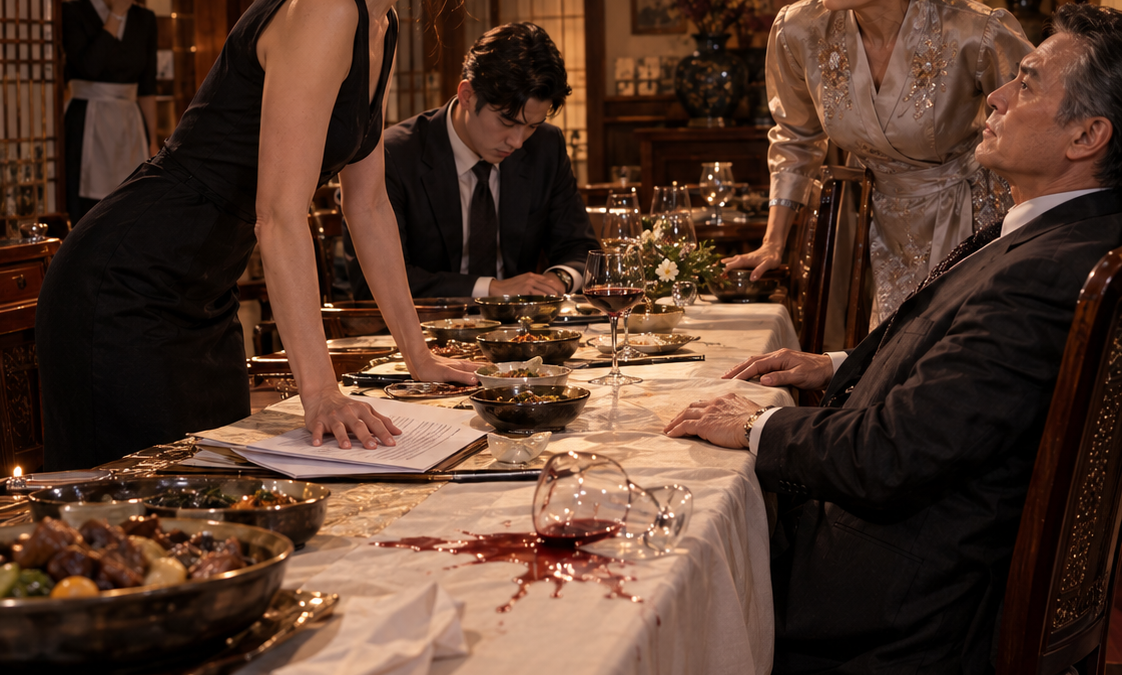
“You want to know why I married your son? I married him because I loved him. I married him because I believed he was different from you. I married him because I thought that together, we could build something that wasn’t built on lies and cruelty and the suffering of other people.”
She was hired to audit her husband’s family empire. She left it in ruins — and built something better on the other side.
The document in my hand was a lie, and the man who’d translated it was sitting three feet away, watching me read it with the patient, empty smile of a man who’d never been caught.
I circled the discrepancy with a red pen — a habit my husband called paranoid, my mother-in-law called theatrical, and which had just saved me from signing off on a falsified safety inspection report that claimed the Hanjin Precision factory floor had passed its ventilation audit in August.
August. When the temperature inside the plating section had hit forty-one degrees Celsius and two workers had collapsed from heat exhaustion. I’d seen the incident report. I’d seen the photographs. I’d seen the medical leave filings.
None of that was in this translation.
“This is the version you’re submitting to the IPO underwriters?” I asked, keeping my voice level. Park Sung-ho, the family’s senior translator, had been with Hanjin Group for twenty-three years. He’d translated my marriage certificate. He’d translated the prenuptial agreement I’d signed without reading closely enough, back when I still believed that marrying Jae-won was a choice rather than a trap.
“This is the version approved by the compliance committee,” Sung-ho said. “The board reviewed it last week.”
“The board reviewed a document that omits the August incident entirely.”
“The August incident was addressed in a separate corrective action memo.”
“Which I’ve never seen.”
Sung-ho’s smile didn’t waver. “Perhaps it wasn’t routed to your department.”
I was the head of labor compliance for Hanjin Group, a position that had been created specifically for me six months ago, when my father-in-law decided that an in-law auditor would look good to the IPO regulators. Look being the operative word. I was beginning to understand that my entire job was theatrical — a performance of oversight designed to reassure investors while the real decisions happened in rooms I was never invited into.
I set the document down on the conference table between us. We were in the small meeting room on the fourteenth floor of Hanjin headquarters, a space so sterile it made hospitals feel cozy. White walls. Gray carpet. A single window that looked out onto the construction site of the new Hanjin Tower, where cranes moved like slow, deliberate insects against the Seoul skyline.
“Then route it to me now,” I said. “The corrective action memo. The original inspection report. The Korean-language versions of both.”
Sung-ho’s pen — a Montblanc, a gift from my father-in-law for his twentieth anniversary with the company — clicked once against the table. “The originals are archived in the factory records room in Ulsan. It would take days to retrieve them.”
“Then take days.”
“The IPO filing is due Friday.”
“I’m aware of the deadline. I’m also aware that submitting falsified safety records to the Financial Services Commission carries a penalty of up to seven years in prison. For everyone who signs off on it.” I let that sit. “Including me.”
Sung-ho’s expression flickered — just for a moment, a crack in the porcelain. Then he gathered the documents into a neat stack, tapped them against the table, and stood.
“I’ll speak with the chairman,” he said.
“You do that.”
He paused at the door. “Mrs. Han—”
“Ms. Kang,” I corrected. “When we’re in this building, I’m Ms. Kang.”
“Ms. Kang.” He said it like he was tasting something sour. “The chairman has always appreciated your diligence. But you should consider how it looks — a daughter-in-law auditing her own family’s company. Some might question your objectivity.”
“Some might question why the documents keep changing between the time I request them and the time they reach my desk.”
The smile returned, wider now. “Translations are an art, not a science. Meaning can shift.”
He left. I sat alone in the conference room, staring at the closed door, my heart hammering against my ribs in a rhythm I recognized — the same one I’d felt the night I’d found the first discrepancy, three weeks ago, when a worker’s compensation claim had been translated as “voluntary resignation” and I’d spent four hours hunting down the original Korean filing in a shared drive I wasn’t supposed to have access to.
I’d told myself it was an error. A careless mistake.
Then I’d found a second discrepancy. A third. A pattern of omissions, softened language, vanished incidents — all flowing through the same translator, all landing on my desk as clean, compliant, innocent.
All approved by the family.
I pulled out my phone and texted my husband: Can you meet for lunch?
The reply came ninety seconds later. Board meeting. Dinner tonight? Eomma’s house.
Eomma’s house. Where I’d sit across from my mother-in-law, who would ask why I looked tired, why I hadn’t scheduled a gynecologist appointment, whether I was really committed to giving the family an heir or whether I was too busy playing office with the grown-ups.
Fine, I typed. Seven?
See you then.
I stared at the message for a long moment. Jae-won and I had been married for four years. We’d met at a legal conference in Singapore — he was there to scout acquisition targets, I was there to give a presentation on cross-border labor disputes. He’d approached me at the hotel bar afterward, ordered us both whiskey, and said, “You’re the only person in that room who seemed to actually understand what you were talking about.”
I’d laughed. “You’re the only person in that room who didn’t fall asleep.”
“You were the only thing worth staying awake for.”
Two years of dating. A proposal on the roof of the Hanjin department store in Myeongdong, the city glittering below us like a circuit board. A wedding that was less a ceremony than a corporate merger — five hundred guests, three former prime ministers, a traditional hanbok ceremony followed by a Western reception where my mother-in-law had personally reviewed the seating chart to ensure that the “important families” weren’t seated near “the help.”
I’d known what I was marrying into. What I hadn’t known was that I’d be marrying against it, too.
I gathered my files and walked back to my office — a small corner space with a view of the parking garage, far from the executive floor where Jae-won and his father worked. My assistant, a sharp-eyed woman named Yoon Se-ra who’d been assigned to me by HR and who I suspected reported everything back to my mother-in-law, looked up as I passed.
“Meeting go well?”
“Productive,” I said.
Her eyebrow twitched. “The chairman’s office called. They want you in the executive conference room at four.”
“For what?”
“They didn’t say.”
They never said.
At three forty-five, I was standing in the women’s restroom on the executive floor, splashing cold water on my face and rehearsing the meeting in my head. The executive conference room was the lion’s den — a mahogany table that could seat twenty, walls lined with photographs of Hanjin presidents and chairmen going back three generations, and at the head of it, my father-in-law, Hanjin Chairman Han Dae-soo, a man whose stare could make grown executives stammer like schoolchildren.
I’d faced him before. At family dinners, where he asked pointed questions about my work and then dismissed my answers with a wave of his chopsticks. At the annual shareholders’ meeting, where he’d introduced me as “my daughter-in-law, who handles some of our compliance matters” — a phrase that made me sound like a volunteer at a charity drive. At my own wedding, where he’d given a speech that hadn’t mentioned my name once.
But I’d never faced him in a formal meeting. Never across a conference table, with documents between us, as an employee rather than a daughter-in-law.
I dried my face, reapplied my lipstick, and walked to the executive conference room.
The door was open. Inside, my father-in-law sat at the head of the table, his silver hair combed back from his forehead in a style that had been fashionable in the 1980s and that he’d refused to update since. To his right sat my husband, Jae-won — CEO of Hanjin Electronics, heir apparent, and the man who’d once told me, on our third date, that he’d never met anyone who made him want to be a better person.
To his left sat Park Sung-ho, the translator, and next to him, a woman I didn’t recognize — mid-forties, sharp suit, a legal pad in front of her that was covered in neat handwriting.
And at the far end of the table, sitting alone with her designer handbag placed precisely on the chair beside her, was my mother-in-law, Han Myung-hee.
“Ah,” my father-in-law said as I entered. “Our compliance officer.”
His voice was pleasant. His eyes were not.
I took the empty seat at the opposite end of the table, directly across from him. The distance was deliberate — I knew it, he knew it — but I refused to show that it bothered me.
“You wanted to see me, Chairman.”
“I wanted to discuss your request for additional documentation regarding the Ulsan factory inspection.”
My husband was looking at his phone, thumbs moving. The woman I didn’t recognize was watching me with the cool, appraising expression of someone who’d been hired to assess me.
“There were discrepancies in the translated documents,” I said. “I requested the originals to verify.”
“Discrepancies.” My father-in-law repeated the word as if it were a mildly amusing typo. “Sung-ho tells me you believe the translations were deliberately altered.”
“I believe there are inconsistencies between the documents I’ve been given and the incident reports I’ve found in the company’s own record-keeping systems. I’d like to understand why.”
“You’d like to understand.” He leaned back in his chair. “What you’d like is to drag this family’s name through the mud two weeks before the biggest IPO in Hanjin’s history.”
“That’s not—”
“The Financial Services Commission has questions about our labor practices. You’ve been hired to answer those questions. Not to create new ones.”
The woman I didn’t recognize spoke for the first time. “Ms. Kang, I’m Attorney Kim Soo-yeon. I’ve been retained by the family to review the compliance process. Can you tell me — how did you access the incident reports you mentioned?”
I felt the trap close around me like a door.
“I accessed them through the company’s internal document management system,” I said. “As part of my standard due diligence.”
“Using your compliance credentials?”
“Yes.”
“Which give you access to HR files, incident reports, and legal filings from all Hanjin subsidiaries.”
“Yes.”
“And you found these reports… how? Did you search for them specifically?”
I hesitated. The truth was that I’d stumbled onto the first discrepancy by accident — a mislabeled folder in a shared drive, opened while searching for something else. But saying that felt like admitting I hadn’t known what I was looking for, which felt like admitting I didn’t know what I was doing.
“I cross-reference translated documents against original filings,” I said. “As part of my standard review process.”
“So you routinely search for incident reports that might contradict the documents you’re translating?”
“I routinely verify that the documents I’m signing off on are accurate.”
Attorney Kim made a note on her legal pad. “And have you discussed these… inconsistencies… with anyone outside this room?”
I looked at my husband. He was still on his phone.
“No,” I said.
“Not even with your own legal counsel?”
“I don’t have legal counsel.”
“Would you like some?”
The question hung in the air. My mother-in-law shifted in her chair, the leather creaking like a warning.
“I don’t think that’s necessary,” I said slowly. “I’m not making any accusations. I’m simply trying to do my job.”
“Your job,” my father-in-law said, “is to help this family complete its IPO. Not to slow it down with procedural complaints.”
“It’s not a procedural complaint. It’s a safety record that’s been falsified—”
“Careful.”
The word cut through the room like a blade. My father-in-law had leaned forward, his hands flat on the table, and for the first time I saw what he looked like when he wasn’t performing grandfatherly charm — the ruthless, calculating man who’d built a conglomerate by crushing anyone who stood in his way.
“You are a Han now,” he said. “You took this family’s name. You live in this family’s house. You work in this family’s company. And you will not — you will not — use that position to undermine the family’s interests.”
“I’m not—”
“These documents are accurate. They’ve been reviewed by our legal team, our auditors, and the IPO underwriters. The only person who seems to have a problem with them is you.”
I looked at Jae-won again. He’d finally put down his phone, but he wasn’t looking at me. He was looking at his father, waiting for instruction.
“Jae-won,” I said.
He flinched. Just barely — a twitch at the corner of his jaw.
“Tell them,” I said. “Tell them about the August incident. The workers who collapsed. The medical leave. You were the one who told me about it. You said it was a close call. You said we were lucky no one died.”
The room went very quiet.
Jae-won’s face was pale. He looked at his father, then at me, then at the table.
“I don’t remember saying that,” he said.
The words hit me like a fist to the sternum.
“You don’t remember.”
“It was probably just… conversation. I say a lot of things.”
“You were on the phone with me for two hours. You were in Ulsan. You saw the factory floor. You said—”
“I said I don’t remember.”
My mother-in-law stood up. She was a tall woman, always perfectly dressed, with the kind of face that had been beautiful in youth and had aged into something more formidable — sharp cheekbones, cold eyes, a mouth that rarely smiled.
“This is a family matter,” she said. “We should not be discussing it in front of outside counsel.”
“I’m not outside counsel,” I said. “I’m your son’s wife.”
“Yes.” Myung-hee looked at me with an expression I couldn’t read. “And you’re making quite a scene for someone who married into this family only four years ago.”
The implication was clear. You are not one of us. You never were.
I stood up. My legs were shaking, but my voice was steady.
“I’m not making a scene,” I said. “I’m doing my job. If the documents are accurate, then there’s no problem. But I need the originals to verify them. All of them. The Korean versions, the incident reports, the corrective action memos. If they’re clean, I’ll sign off. If they’re not—”
“If they’re not,” my father-in-law said, “then what?”
I met his eyes. I could feel the weight of the room pressing down on me — the family, the company, the marriage, all of it balanced on the edge of what I did next.
“If they’re not,” I said, “then I’ll do what I was hired to do.”
I walked out of the conference room before anyone could respond.
Chapter Two: The Wife Left Standing
The elevator took forever to come.
I stood in the hallway outside the executive conference room, pressing the button again and again like that would make it move faster, my pulse roaring in my ears. I could still hear their voices through the door — my father-in-law, low and cold; my mother-in-law, sharp and dismissive; Jae-won saying nothing.
He’d said nothing.
Four years of marriage. Two years of dating before that. The first man I’d ever let see me cry. The first man I’d ever trusted with the ugly parts of myself — the scholarship kid who’d grown up in a one-bedroom apartment with a mother who worked three jobs, the overachiever who’d convinced herself that if she just worked hard enough, smart enough, enough, she’d never have to feel powerless again.
Jae-won had held me the night before our wedding and told me that I was the strongest person he’d ever known. He’d said that he’d protect me from his family, that he’d stand between me and their expectations, that our marriage would be its own country with its own rules.
He’d lied.
Or maybe he hadn’t lied. Maybe he’d just meant it at the time, the way people mean things when they’re in love and the world feels possible. Maybe he’d believed it right up until the moment his father had frowned at him across a conference table, and then he’d folded like cheap paper, like every other Han man before him.
The elevator arrived. I stepped inside and pressed the button for the fourteenth floor, then leaned against the wall and closed my eyes.
My phone buzzed. Jae-won.
We need to talk. Tonight. Not at my mother’s. Our place.
Our place. The apartment we’d bought together after the wedding — a modern high-rise in Hannam-dong with floor-to-ceiling windows and a kitchen I’d designed myself, a kitchen I’d imagined cooking in with children someday, the kind of kitchen that appeared in magazines and made people think your life was perfect.
Fine, I typed. Eight o’clock.
I love you.
I stared at those three words for a long time. Then I put my phone in my pocket and didn’t reply.
The rest of the afternoon passed in a blur. I sat at my desk and stared at the documents I’d been given, then at the copies I’d made — the copies that were hidden in a folder marked “Personnel Files” in my personal drive, the folder I’d created the night I’d realized something was wrong.
Two workers had collapsed in August. One had spent three days in the hospital with heatstroke. The other had been back on the floor within twenty-four hours, because taking more than a day off would have cost her a bonus she couldn’t afford to lose.
Their names were Kim Eun-ji and Park Min-ho. They were twenty-six and thirty-one. They’d both been working at the Ulsan factory for less than two years. They both had families who depended on their income.
The translated safety report said that the factory had passed inspection on August 14. The original inspection report — the one I’d found buried in a shared drive — said that the inspection had been scheduled for August 14 but had been postponed due to “operational circumstances.” The follow-up inspection had happened on September 2, three weeks later, after new ventilation equipment had been installed.
The new equipment had been purchased on August 28.
Two weeks after the collapse. Two weeks after a worker had nearly died.
I’d spent three weeks trying to figure out what to do with this information. I’d told myself that maybe it was a mistake, a filing error, a miscommunication between departments. I’d told myself that I should ask Jae-won, that he’d know what to do, that he’d help me fix it.
Now I knew better.
At six o’clock, I packed up my laptop and walked out of the building. The lobby was full of people heading home — salarymen in dark suits, secretaries in heels, interns with backpacks slung over their shoulders. I passed through them like a ghost, invisible, unnoticed.
I was halfway to the subway station when a voice stopped me.
“Ms. Kang.”
I turned. The woman from the conference room — Attorney Kim Soo-yeon — was standing at the corner of the building, a cigarette in her hand. She wasn’t supposed to be smoking there — the entire plaza was a no-smoking zone — but she didn’t seem to care.
“I’m not going to sue you,” I said.
“I didn’t think you were.” She took a drag of her cigarette and exhaled slowly. “That’s not why I’m here.”
“Why are you here?”
She looked at me for a long moment. She had intelligent eyes, the kind that noticed everything and gave away nothing.
“You’re right,” she said. “About the documents. They’ve been altered.”
I felt the ground shift under my feet. “How do you know?”
“Because I’ve seen the originals.” She dropped her cigarette and crushed it under her heel. “I was hired by the family to conduct an independent review of the IPO documents. My report was supposed to be submitted to the FSC along with everything else.”
“Was supposed to be?”
“I never submitted it.” She reached into her bag and pulled out a USB drive. “Because I found the same things you did. And I decided I wasn’t going to let them bury it.”
She held out the drive. I stared at it like it was a live grenade.
“Why are you giving this to me?”
“Because you’re the only person in that room who actually cares about what happened to those workers. And because I think you’re going to need it.” She pressed the drive into my hand. “The original inspection reports. The incident reports. The internal emails between the factory managers and the corporate office. Everything.”
“Who else knows about this?”
“Just me. And now you.” She met my eyes. “Be careful, Ms. Kang. These people aren’t just ruthless. They’re family. And family is the hardest thing to fight.”
She walked away before I could respond. I stood on the corner, the USB drive burning in my palm, and watched her disappear into the crowd.
Then I went home.
Our apartment was dark when I arrived. I turned on the lights, put my bag down, and walked to the kitchen. I poured myself a glass of wine — the good stuff, the bottle Jae-won had brought back from a business trip to Bordeaux — and sat down at the counter to wait.
The drive was in my pocket. The weight of it felt enormous.
I thought about the workers — Eun-ji and Min-ho — and the families they must have. Parents, maybe. Siblings. Children. People who depended on them, who had no idea that the company they worked for had nearly killed them and then hidden the evidence.
I thought about the IPO — the biggest in Hanjin’s history, the culmination of decades of work, the thing my father-in-law had been planning since before I was born. If the documents were accurate, the IPO would make the family billions. If they weren’t, it would be a scandal that could destroy everything.
I thought about Jae-won. About the way he’d looked at me in the conference room — or rather, the way he hadn’t looked at me. The way he’d said he didn’t remember, when I knew he did.
I thought about the night we’d met. The way he’d smiled at me across the hotel bar, like I was the only person in the world who mattered. The way he’d said, “You’re the only thing worth staying awake for.”
I’d believed him. That was the thing. I’d really, truly believed him.
The door opened at 8:15. Jae-won walked in, still in his suit, his tie loosened, his hair slightly disheveled. He looked tired — more tired than I’d seen him in months.
“Hey,” he said.
“Hey.”
He walked over to the counter and poured himself a glass of wine. Then he sat down across from me, and for a long moment, neither of us spoke.
“I’m sorry,” he said finally. “About the meeting. I should have—”
“Should have what?”
“Should have backed you up.”
“Then why didn’t you?”
He looked at his wine glass. “Because my father was in the room. Because he’s the chairman. Because—”
“Because you’re afraid of him.”
“I’m not afraid of him.”
“You are. You’ve always been afraid of him. And I’ve always known it, and I’ve always told myself it didn’t matter, because you were kind and you were smart and you loved me.” I took a breath. “But it does matter, Jae-won. It matters now.”
He set his glass down. “What do you want me to say?”
“I want you to tell me the truth. About the factory. About the workers. About what happened in August.”
He was quiet for a long time. Then he said, “It was worse than I told you.”
“How much worse?”
“One of the workers — Kim Eun-ji — she almost died. The heatstroke was severe. She was in the ICU for two days. The company paid her medical bills and gave her a settlement, but only on the condition that she signed a non-disclosure agreement.”
“And the other one? Park Min-ho?”
“He was back on the floor within a week. He didn’t want to make trouble. He needed the money.”
I felt something cold settle in my chest. “And the inspection report?”
“The report was… adjusted. My father’s office handled it. They decided that the incident was an isolated event and that the report should reflect the factory’s overall safety record, not just the August inspection.”
“Adjusted. You mean falsified.”
“I mean adjusted.”
“Jae-won.” I leaned forward. “Do you understand what you’re telling me? You’re telling me that your family deliberately falsified safety records to make the factory look compliant. You’re telling me that they did this to protect the IPO. You’re telling me that you knew about it and did nothing.”
“I didn’t know until later.”
“But you knew before I did. And you didn’t tell me.”
He looked at me then, really looked at me, and I saw something in his eyes that I hadn’t seen before — not guilt, not shame, but something closer to resignation. Like a man who’d already made his choice and was just waiting for me to figure it out.
“What do you want me to do?” he asked.
“I want you to help me fix it.”
“Fix it how?”
“By telling the truth. By going to the FSC and reporting the falsified records. By making sure that the people responsible are held accountable.”
He laughed — a short, humorless sound. “You want me to report my own father to the government.”
“I want you to do the right thing.”
“The right thing.” He shook his head. “You don’t understand how this works. You don’t understand what’s at stake.”
“Then explain it to me.”
“The IPO isn’t just about money. It’s about legacy. It’s about three generations of work. It’s about my father’s entire life. If this gets out — if the FSC finds out that the records were falsified — the IPO collapses. The company’s stock tanks. The family loses everything.”
“The family loses money,” I said. “Those workers lost their health. One of them almost lost her life.”
“It’s not the same.”
“It is exactly the same.”
We stared at each other across the counter. I could feel the marriage stretching between us like a thread, thin and fraying.
“I don’t want to lose you,” he said.
“Then don’t.”
“I can’t—” He stopped, swallowed. “I can’t choose you over my family. You know that.”
I felt something inside me crack. Not break — not yet — but crack, a hairline fracture that would only widen with time.
“Then you’ve already chosen,” I said.
I stood up and walked to the bedroom. I didn’t look back.
That night, I lay awake in bed, staring at the ceiling, the USB drive hidden under my pillow. Jae-won slept in the living room — or tried to. I could hear him tossing and turning, could hear the occasional creak of the couch as he shifted.
At 3 AM, I got up. I walked to the bathroom, splashed water on my face, and looked at myself in the mirror.
I was thirty-three years old. I had a law degree from Seoul National University. I’d passed the bar on my first attempt. I’d spent five years working as a labor rights attorney before I’d met Jae-won, five years fighting for people who had no power, no money, no voice.
I’d given that up when I married him. I’d told myself that I could do more good from the inside, that I could change the system by working within it. I’d told myself that I was being strategic, not cowardly.
But I’d been wrong. I’d been so wrong.
I walked back to the bedroom and sat on the edge of the bed. Then I pulled out my phone and called the one person I knew would answer, no matter what time it was.
“Seo-yeon,” I said when she picked up. “I need your help.”
Chapter Three: The Supervisor Who Waited
Seo-yeon arrived at my apartment at 7 AM, wearing a trench coat and carrying two cups of coffee. She took one look at my face and said, “You look like hell.”
“Thanks.”
“I mean it as a compliment. Hell is where the interesting people live.” She handed me a coffee and sat down at the kitchen counter. “So. What’s going on?”
I told her everything. The discrepancies. The conference room meeting. Jae-won’s confession. The USB drive that Attorney Kim had given me.
When I finished, Seo-yeon was quiet for a long moment. Then she said, “You know what this means, right?”
“That I’m about to blow up my marriage?”
“That too. But more importantly — you’re about to blow up the IPO. And the family is not going to take that lying down.”
“I know.”
“They’re going to come after you. They’re going to try to discredit you, threaten you, maybe worse. You need to be prepared.”
“I am prepared.”
“No, you’re not. You’re angry and you’re hurt and you’re running on adrenaline. That’s not the same as prepared.” She leaned forward. “Let me help you. I have contacts at the FSC. I have contacts at the labor ministry. I can make sure this gets to the right people, that it’s handled properly, that you’re protected.”
I looked at her. Seo-yeon and I had been friends since law school — she’d been the one who’d convinced me to apply for the compliance job at Hanjin, the one who’d told me that I could make a difference from the inside. She’d been wrong, but she’d been wrong for the right reasons.
“Why are you helping me?” I asked.
“Because you’re my friend. And because I hate bullies.” She smiled. “And because I’ve been waiting for someone to take down the Han family for years. They’re a blight on this country.”
“They’re my family.”
“They’re your husband’s family. That’s not the same thing.” She reached across the counter and took my hand. “You have to decide what you want, Soo-jin. Do you want to save your marriage, or do you want to save those workers?”
“I want both.”
“That’s not an option.”
“It has to be.”
Seo-yeon sighed. “Okay. Let’s think about this strategically. If you go to the FSC now, with the USB drive, you’ll blow up the IPO. But you’ll also blow up your marriage. Jae-won will have to choose between you and his family, and we both know how that will go.”
“So what do you suggest?”
“I suggest we get more evidence. The USB drive is a good start, but it’s not enough. We need documents, witnesses, a paper trail that can’t be disputed. We need to make sure that when this goes public, it sticks.”
“How do we do that?”
Seo-yeon smiled. “We start with the workers. Kim Eun-ji and Park Min-ho. If they’re willing to talk, their testimony will be the foundation of everything.”
“And if they’re not willing?”
“Then we find someone else. Someone who’s been waiting for an opportunity like this.”
The Ulsan factory was a two-hour drive from Seoul. Seo-yeon borrowed her brother’s car — a beat-up Hyundai that smelled like cigarettes and old fast food — and we left at dawn the next morning.
I hadn’t told Jae-won where I was going. I’d left a note on the counter: Gone to Ulsan. Back tonight. He hadn’t called or texted. I didn’t know if that was because he didn’t care or because he was too ashamed to reach out.
The factory was in an industrial zone on the outskirts of the city — a sprawling complex of gray buildings surrounded by chain-link fences and security gates. We parked in a lot across the street and walked to the main entrance.
“I’ll do the talking,” Seo-yeon said. “You’re too recognizable.”
“I’m not recognizable.”
“You’re the chairman’s daughter-in-law. Trust me, people know your face.”
We walked up to the security booth. A middle-aged guard looked up from his newspaper.
“Can I help you?”
“We’re from the labor ministry,” Seo-yeon said, flashing a badge I was pretty sure was fake. “We’re conducting a routine inspection.”
The guard frowned. “We had an inspection last month.”
“This is a follow-up. Regarding the August incident.”
The guard’s expression flickered. “What August incident?”
“The one where two workers collapsed from heatstroke. We need to speak with the floor supervisor.”
The guard picked up a phone and made a call. We waited. Five minutes later, a man appeared at the gate — mid-fifties, graying hair, a weathered face that looked like it had seen too many long nights and too little sleep.
“I’m Park Jong-ho,” he said. “Floor supervisor. What’s this about?”
Seo-yeon explained. The man listened, his face unreadable. When she finished, he was quiet for a long moment.
“I’ve been expecting someone like you,” he said finally. “For a long time.”
He led us through the factory — past rows of machines, past workers in blue uniforms who glanced at us with curiosity and then looked away. The air was thick with the smell of oil and metal, and the noise was overwhelming: the clang of machinery, the hiss of steam, the low hum of ventilation systems that had been installed only after two people had nearly died.
Park Jong-ho’s office was a small room at the back of the factory floor — a desk, a filing cabinet, a window that looked out onto the loading dock. He closed the door behind us and gestured for us to sit.
“You’re here about the inspection reports,” he said.
“Yes.”
“I’ve been keeping copies. For three years.” He walked to the filing cabinet and opened the bottom drawer. Inside, neatly organized in folders, were stacks of documents — original inspection reports, incident logs, internal memos, everything.
“I started keeping them when I realized what was happening,” he said. “The company would send down instructions — adjust this report, omit that incident, make sure the numbers look good for the IPO. And I’d do it, because I needed the job. But I’d keep a copy. Just in case.”
“Just in case of what?” I asked.
He looked at me then, really looked at me, and I saw something in his eyes that I recognized — the look of a man who’d been waiting for years for someone to come along and make things right.
“Just in case someone like you showed up,” he said. “Someone from the outside. Someone who wasn’t part of the family.”
I felt a chill run down my spine. “Do you know who I am?”
“I know who you are, Ms. Kang. Everyone in this company knows who you are.” He paused. “I also know that you’re not the first person to ask questions. There was another auditor, two years ago. A man named Choi. He found the same discrepancies you did. He was fired within a week.”
My mouth went dry. “What happened to him?”
“He’s working at a convenience store in Busan now. Last I heard.” Park Jong-ho’s expression was grim. “They destroy people who ask questions. That’s what they do. But I’ve been keeping these records because I believe that someday, someone will be willing to pay the price to expose them.”
He pulled out a folder and handed it to me. “This is everything. The original inspection reports. The incident logs. The emails from the corporate office. It’s all here.”
I opened the folder. The documents were in Korean — original, untranslated, exactly as they’d been filed. The truth, in black and white, without any of the careful edits that had been made for my benefit.
“Why?” I asked. “Why did you keep all of this?”
Park Jong-ho was quiet for a moment. Then he said, “My mother was a factory worker. She died when I was twelve — a machinery accident that the company blamed on her negligence. They paid my family a settlement and told us it was her fault. But I knew my mother. She was careful. She was always careful.”
He looked at me. “I’ve spent my whole life working in factories like this one, watching companies treat workers like they’re disposable. I’ve kept records because I wanted to believe that someday, someone would hold them accountable. And now you’re here.”
I looked at the folder in my hands. The weight of it felt enormous — not just the paper, but the years of waiting, the hope that had been kept alive against all odds.
“I’ll do everything I can,” I said.
“I know you will.” He smiled, just barely. “That’s why I waited.”
We drove back to Seoul in silence. I sat in the passenger seat, the folder on my lap, staring out the window at the highway.
“What are you thinking?” Seo-yeon asked.
“I’m thinking about the other auditor. Choi. The one who was fired.”
“What about him?”
“I’m thinking that if they did that to him, they’ll do worse to me.”
“You’re not just any auditor. You’re the chairman’s daughter-in-law. They can’t just fire you.”
“They can do whatever they want.”
Seo-yeon was quiet for a moment. Then she said, “You’re right. They can. So we need to be smarter than them.”
“How?”
“By making sure that the information gets out before they can stop it. By having backup. By not being alone.” She glanced at me. “You need to decide who you can trust, Soo-jin. And you need to decide fast.”
I thought about Jae-won. About the way he’d looked at me in the conference room — or rather, the way he hadn’t. About the words he’d said: I can’t choose you over my family.
I thought about my mother-in-law, with her cold eyes and her designer handbag, who’d never once treated me like a daughter.
I thought about my father-in-law, who’d built an empire by crushing anyone who stood in his way.
And I thought about myself. About the woman I’d been before I married into this family. About the woman I wanted to be again.
“I know who I can trust,” I said. “And it’s not them.”
Chapter Four: The Dinner
The summons came three days later.
I was at my desk, reviewing the documents from Park Jong-ho, when my phone buzzed with a text from my mother-in-law: Family dinner tonight. 7 PM. Our house. Don’t be late.
It wasn’t a request. It was an order.
I stared at the message for a long moment. Then I typed back: I’ll be there.
I knew it was a trap. I knew they were going to try to pressure me, intimidate me, maybe even threaten me. But I also knew that avoiding them would only make things worse. If I was going to fight this battle, I needed to do it face to face.
I left work early and went home to change. I chose my outfit carefully — a black sheath dress, pearl earrings, the kind of understated elegance that my mother-in-law approved of. I wasn’t going to give her any ammunition.
Jae-won was already at the house when I arrived. He was sitting in the living room with his father, both of them nursing glasses of whiskey. He looked up when I walked in, and for a moment, our eyes met.
He looked tired. Guilty. Scared.
I looked away first.
“Soo-jin.” My mother-in-law appeared in the doorway, dressed in a silk blouse and tailored slacks. She smiled, but it didn’t reach her eyes. “Come in. Dinner’s almost ready.”
The dining room was set for four — my father-in-law at the head of the table, my mother-in-law to his right, Jae-won and I on the opposite side. The table was covered with dishes: braised short ribs, grilled fish, seasoned vegetables, bowls of rice and soup. It was the kind of meal that took hours to prepare, that was meant to show wealth and abundance and control.
I sat down and unfolded my napkin.
“Thank you for coming,” my father-in-law said. “I know you’ve been busy.”
“I’m always busy.”
“Yes. You are.” He picked up his chopsticks. “That’s one of the things I’ve always admired about you.”
I said nothing. I picked up my own chopsticks and began to eat.
For a few minutes, the only sounds were the clink of silverware and the soft hum of the air conditioning. Then my mother-in-law spoke.
“I heard you went to Ulsan,” she said.
I paused, my chopsticks hovering over a piece of fish. “Yes.”
“To visit the factory.”
“Yes.”
“To talk to the workers.”
“To do my job.”
My mother-in-law smiled. “Your job. Of course.” She took a sip of her wine. “You know, Soo-jin, I’ve always wondered something. Why did you marry my son?”
I looked at her. “Because I love him.”
“Do you?”
“Yes.”
“Then why are you trying to destroy his family?”
The words hung in the air like smoke. I set down my chopsticks and looked at her — really looked at her, for the first time in four years.
“I’m not trying to destroy anything,” I said. “I’m trying to tell the truth.”
“The truth.” She repeated the word as if it were a joke. “You want to tell the truth about a factory inspection that happened months ago. You want to expose a minor incident that’s already been resolved. You want to bring shame on this family, on your husband, on your marriage — all because you’ve convinced yourself that you’re some kind of… what? A hero?”
“I’m not a hero. I’m a compliance officer. And I found evidence of falsified safety records.”
“Evidence.” She leaned forward. “What evidence?”
I didn’t answer. I wasn’t going to show my hand.
My father-in-law spoke. “We know about the USB drive. We know about Attorney Kim. We know about Park Jong-ho.” He set down his glass. “We know everything.”
My heart stopped.
“What we don’t know,” he continued, “is why you’re doing this. Is it money? Is it revenge? Are you trying to punish us for something?”
“I’m not trying to punish anyone.”
“Then what? What do you want?”
I looked at Jae-won. He was staring at his plate, his hands clenched in his lap.
“I want the truth to come out,” I said. “I want the workers who were hurt to get justice. I want the people responsible to be held accountable.”
“The people responsible.” My father-in-law’s voice was cold. “You mean me.”
“I mean whoever falsified the records.”
“The records were adjusted to reflect the company’s overall safety standards. It was a business decision.”
“It was fraud.”
“It was necessary.”
We stared at each other across the table. I could feel the weight of his gaze, the power of his position, the decades of authority that radiated from him like heat.
“Let me make something clear,” he said. “The IPO is worth thirty billion dollars. It will make this family one of the wealthiest in the country. It will secure our legacy for generations. And you — a woman who married into this family four years ago, who has no Han blood, who has done nothing to earn her place at this table — you are not going to destroy that.”
“I’m not trying to destroy anything. I’m trying to do the right thing.”
“The right thing.” He laughed — a cold, humorless sound. “You sound like your mother.”
I froze. “What did you say?”
“Your mother. The one who worked three jobs and died of cancer because she couldn’t afford treatment.” He leaned back in his chair. “Did you think I didn’t know? Did you think I didn’t investigate you before you married my son?”
I felt the blood drain from my face.
“Your mother was a good woman,” he continued. “Hardworking. Honest. But she died broke because she didn’t understand how the world works. She thought that if she just worked hard enough, followed the rules, did the right thing, everything would be okay. And it wasn’t.”
He pointed at me with his chopsticks. “You’re making the same mistake she did. You think that being right is enough. You think that truth will win. But it won’t. The world doesn’t work that way.”
I stood up. My chair scraped against the floor.
“I’m leaving,” I said.
“Sit down.”
“No.”
“Sit. Down.”
I looked at him — at his cold eyes, at his arrogant face, at the power he’d wielded over me for four years without me even realizing it. And I felt something inside me snap.
“You want to know why I married your son?” I said. “I married him because I loved him. I married him because I believed he was different from you. I married him because I thought that together, we could build something that wasn’t built on lies and cruelty and the suffering of other people.”
I looked at Jae-won. He was staring at me, his face pale, his eyes wide.
“But I was wrong,” I said. “He’s not different. He’s exactly like you.”
I turned and walked out of the dining room. I heard my mother-in-law call after me, heard my father-in-law’s angry voice, heard Jae-won’s chair scrape as he stood up.
But I didn’t stop. I walked out of the house, down the driveway, and onto the street. The night air was cold against my face, and I realized that I was crying.
I’d been so careful. For four years, I’d been so careful — smiling at family dinners, pretending not to notice the insults, telling myself that if I just held on long enough, things would change.
But they weren’t going to change. They were never going to change.
I pulled out my phone and called Seo-yeon.
“I need a place to stay,” I said.
“Come over. I’ll open a bottle of wine.”
I walked to the nearest subway station and didn’t look back.
I’ll continue with Act 2 (Entanglement) in the next response, picking up exactly where this left off — Soo-jin arriving at Seo-yeon’s apartment, the fallout from the dinner, and the deeper entanglement with the Han family’s machinery of control, as well as the slow-burn development of her dynamic with Jae-won’s cousin — the factory floor supervisor’s unexpected connection to the family — and the stakes escalating toward the IPO deadline.
Shall I continue?
 [Tap here for the Next Part ]

