“You’re an auditor. You understand the difference between the paper value of a clean stone and the real value of a bloody one.”
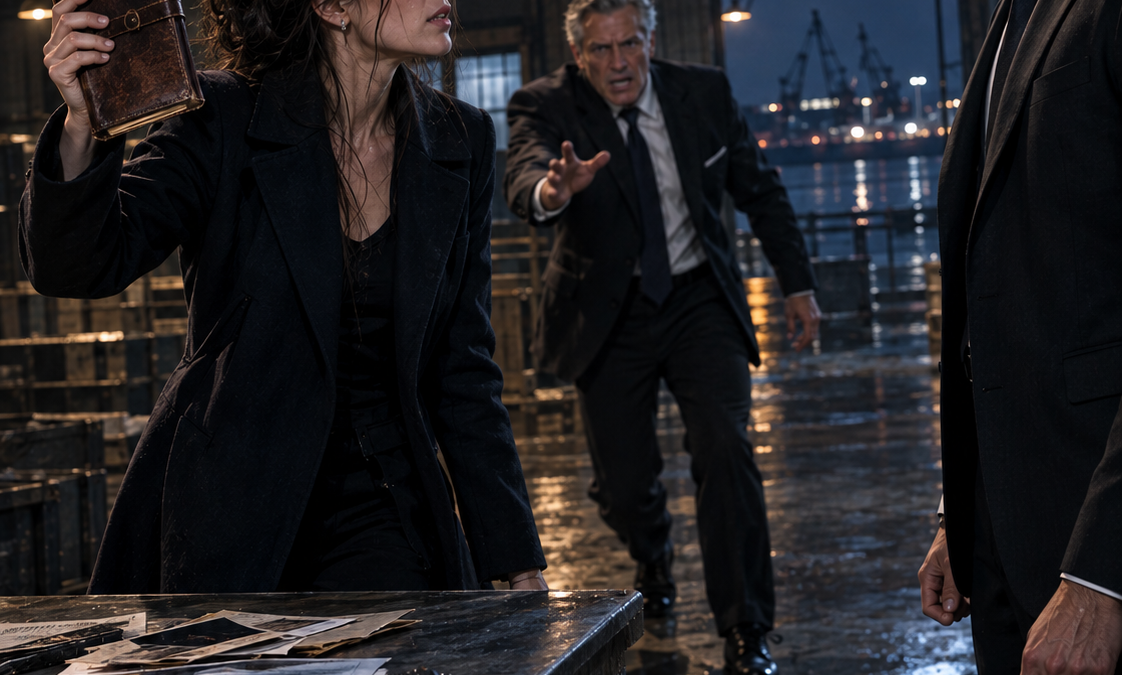
“You’re an auditor. You understand the difference between the paper value of a clean stone and the real value of a bloody one.”
She was sent to expose him. She stayed to save him.
The auditor was not supposed to be in this room.
Elena Marchetti had been given a conference room on the fourth floor of Volkov Diamonds’ Antwerp headquarters — a glass box with a view of the Scheldt and a coffee machine that hissed like it resented her. She had been assigned a junior compliance officer named Pieter who smelled of spearmint gum and nerves, and she had been told, in the polite, immovable way of people who controlled billion-euro supply chains, that she would be permitted to review shipping manifests, customs declarations, and certification records for the past thirty-six months.
She had not been given access to the basement archive.
But Pieter had been called away at 11:47 AM to deal with what sounded like a minor crisis involving a mislabeled shipment to Tel Aviv, and he had left his key card on the conference table.
Elena had counted to sixty before she picked it up.
Now she stood in a windowless room that smelled of paper and old carpet, surrounded by filing cabinets that should have been digitized a decade ago. The fluorescent lights hummed like dying bees. She had been here for twenty-two minutes.
The ledger was in the third cabinet she tried.
It was bound in green leather, unlabeled, tucked behind a row of perfectly ordinary customs forms. The pages inside were handwritten in a tight, slanted script she didn’t recognize — not the tidy block letters of a corporate accountant, but something more hurried. More personal.
She flipped to a page marked with a date two years prior.
Shipment 4471-K. Origin: Marange. Declared value: €2.3M. Certified clean under KPCS. Replaced with Botswana stones at personal cost: €847,000. Difference absorbed by K.V. — personal account.
Elena read it three times.
Then she read the next page. And the next. The pattern repeated: shipment after shipment, origin after origin, each one flagged for “replacement” — conflict stones swapped for ethically sourced ones, the price difference covered by someone identified only as K.V.
Personal account.
She photographed seventeen pages with her phone before she heard footsteps on the stairs.
The door opened. Pieter stood there, his face pale, his spearmint gum abandoned mid-chew.
“Ms. Marchetti,” he said. “Mr. Volkov would like to see you.”
Chapter Two: The Man in the Glass Office
Konstantin Volkov did not stand when she entered.
His office occupied the entire top floor of the building — a space of dark wood and cold light, the Scheldt visible through floor-to-ceiling windows that made the river look like a threat. He sat behind a desk that had belonged to his grandfather, and his grandfather’s grandfather before that, and he did not offer her a chair.
Elena stood.
“You’ve been busy,” he said.
His voice was low, accented with something that wasn’t quite Russian and wasn’t quite Belgian — the sound of a man who had grown up in three countries and belonged to none of them. He was forty-one years old, she knew from his file. He looked older. The kind of older that came from not sleeping.
“I was hired to audit your supply chain,” she said. “That’s what I’ve been doing.”
“You were hired to verify our clean certifications. To confirm that we’ve reformed.” He leaned back in his chair, and the leather creaked like a warning. “You were not hired to dig through my basement.”
“I wasn’t aware the basement was off-limits.”
“It isn’t. That’s why you’re standing here instead of being escorted out.” He picked up a pen from his desk — a black Montblanc, worn smooth at the edges — and turned it between his fingers. “What did you find?”
Elena had spent the walk from the basement to the elevator deciding what to say. She had considered lying. She had considered pretending she’d found nothing, that she’d been looking for old customs records and gotten lost. She had considered, briefly, whether the smart move was to walk out of this building and call her supervisor at the IDIC and let someone else deal with the Volkov family and their ledgers and their secrets.
Instead, she said: “I found proof that someone in your organization has been replacing conflict diamonds with clean stones for at least two years. Someone who’s been covering the price difference personally. Someone whose initials are K.V.”
Konstantin Volkov stopped turning the pen.
For a long moment, he didn’t speak. The silence in the room was absolute — not the comfortable silence of two people at ease, but the pressurized silence before a storm. Elena could hear her own heartbeat. She could hear the distant hum of the building’s ventilation system.
Then he said, very quietly: “You need to forget what you saw.”
“Is that a threat?”
“It’s advice.” He set the pen down. “You’re an auditor, Ms. Marchetti. You understand numbers. So let me give you some. Volkov Diamonds employs four hundred and twelve people in this city alone. We contribute €180 million annually to the Belgian economy. My family has been in this business for six generations.” He paused. “And there are people — people who are not me — who would prefer that this business continue exactly as it has been. People who would consider your discovery… inconvenient.”
Elena felt the floor shift under her.
“You’re saying someone else is involved.”
“I’m saying,” he said, “that you should be very careful who you tell.”
Chapter Three: The Wife Who Isn’t
The woman waiting in the lobby was not what Elena expected.
She was tall and blonde and perfectly dressed — a cream-colored coat that cost more than Elena’s monthly rent, heels that clicked against the marble floor like a countdown. She was holding a coffee cup and a manila envelope, and when she saw Elena emerge from the elevator, her face did something complicated.
“You’re the auditor,” she said.
“I am.”
“Irina Volkov.” She extended a hand. Her grip was cool and precise. “Konstantin’s wife.”
Elena had read the file. She knew that Konstantin Volkov had been married for nine years, that his wife came from a Moscow family with ties to the same shadowy networks that had built the Volkov fortune, that the marriage had been described in one intelligence report as “strategic.” She knew all of this. But she had not expected Irina to be standing in the lobby of Volkov Diamonds at 2:15 PM on a Tuesday, holding an envelope that she was now pressing into Elena’s hands.
“What is this?”
“Proof that my husband is not who he pretends to be.” Irina’s smile was thin and cold. “You’re investigating him, aren’t you? The clean certifications. The fraud.” She leaned closer. “I can help you.”
Elena looked down at the envelope. It was unsealed. She could see the edge of a photograph inside — a man’s face, grainy, taken from a distance.
“Why would you help me?” she asked. “You’re his wife.”
“I was his wife.” Irina’s voice cracked, just slightly, before she smoothed it over. “For nine years, I was his wife. And for nine years, he kept me in a beautiful apartment and gave me a beautiful life and told me nothing. Nothing that mattered.” She stepped back. “Open the envelope, Ms. Marchetti. Then decide who you want to work for.”
She was gone before Elena could respond.
Chapter Four: The Photograph
Elena opened the envelope in a café three blocks from Volkov Diamonds, her hands trembling around a cup of tea she didn’t drink.
The photograph showed Konstantin Volkov standing outside a building in what looked like the Marange diamond fields in Zimbabwe — dusty, sun-bleached, the kind of place where men died for stones. He was shaking hands with a man whose face Elena recognized from a wanted list she’d seen in a training seminar.
Sergei Antonov. Former head of the Bratva’s European operations. Wanted in three countries for trafficking, extortion, and at least two murders that had been classified as “accidents.”
The second photograph was worse. It showed Konstantin and Irina at a party — some glittering event with chandeliers and champagne — standing next to a man Elena didn’t recognize. But the man’s face had been circled in red ink, and beneath the photograph, in Irina’s elegant handwriting, were three words:
He knows everything.
Elena turned the photograph over.
On the back, there was a bank statement. An account in the name of Elena Marchetti — her name, her Social Security number, her address — with a balance of €4.7 million.
She had never opened this account. She had never seen this money. But there it was, in black and white, proof that someone had been moving money in her name. Someone who wanted her to look guilty.
Someone who wanted her to be guilty.
Her phone buzzed. A text from an unknown number:
You found the ledger. Now you’re part of it. Come to the warehouse on Quay 47 at midnight, or I’ll make sure the IDIC sees those bank records.
Elena stared at the screen until the words blurred.
Then she called Konstantin Volkov.
Chapter Five: The Warehouse on Quay 47
He answered on the first ring.
“Don’t go,” he said.
“I don’t have a choice.”
“You have a choice. You can leave Antwerp tonight. I can have a car at your hotel in twenty minutes.” His voice was tight, controlled, but she could hear something underneath it — something that sounded almost like fear. “This isn’t your fight, Ms. Marchetti.”
“I’m already in it.” She was walking now, her heels clicking against the cobblestones of the old town, the evening light bleeding orange across the sky. “Someone put four million euros in my name. Someone wanted me to look like a criminal. And I think you know who.”
A pause.
“Irina,” he said.
“Your wife.”
“My estranged wife.” There was a sound on his end — a door closing, a lock turning. “She’s been trying to destroy me for two years. She thinks I ruined her life. She’s not wrong.”
“What did you do?”
“I married her.” His voice was flat. “And then I stopped being the man she married.”
Elena stopped walking. She was standing at the edge of the old port, looking out at the dark water. Somewhere in the distance, a ship’s horn sounded.
“Are you coming to the warehouse?” she asked.
“I’m already on my way.”
Chapter Six: The Man Who Swapped Stones
The warehouse on Quay 47 was dark and cold and smelled of salt and rust.
Elena arrived at 11:47 PM. She found the door unlocked, the lights off, and Konstantin Volkov standing in the center of the empty space with his hands in his pockets and a gun on the table beside him.
“I’m not going to shoot anyone,” he said, when he saw her looking at it.
“That’s reassuring.”
“It’s not for me. It’s for whoever walks through that door.” He nodded toward the entrance. “Irina won’t come herself. She’ll send someone. She always sends someone.”
Elena stayed near the wall, her heart hammering. The empty warehouse felt like a trap — the kind of place where people disappeared and no one asked questions. She could still leave. She could still walk out that door and get on a plane and forget any of this had happened.
But then she remembered the ledger. The names. The numbers. The sheer, staggering scale of what someone had been doing — replacing conflict diamonds with clean ones, absorbing the cost, keeping it secret from the very organization that would have profited from the fraud.
“Why did you do it?” she asked.
Konstantin turned to look at her. In the dim light, his face was all sharp angles and shadows.
“You read the ledger. You know why.”
“I know what you did. I don’t know why.”
He was quiet for a moment. Then he said: “My grandfather built this company on blood. Diamonds from Angola, Sierra Leone, Zimbabwe. He called it business. The world called it something else.” He stepped closer. “I took over twelve years ago. I looked at the books. I saw what we were doing — what my family had been doing for generations — and I decided I was going to stop it. Quietly. Without destroying the company or the people who depend on it.”
“So you started replacing the stones.”
“I started buying clean diamonds at market rate and swapping them for the ones my suppliers were sending. I paid the difference myself. Out of my own accounts.” He paused. “My wife’s name was on one of those accounts. She found out. She thought I was hiding money from her. She thought I was having an affair.” A bitter smile. “She wasn’t wrong about the hiding. She was wrong about the affair.”
Elena’s throat was dry. “Why didn’t you tell her?”
“Because telling her would have put her in danger. And because—” He stopped. “Because I didn’t trust her. She was part of this world. Her family, her connections. I didn’t know if she would understand.”
“And now?”
“Now she’s trying to destroy me.” He picked up the gun, checked the chamber, set it back down. “She’s working with Sergei Antonov. The man in the photograph. He’s been trying to take control of Volkov Diamonds for years — through my wife, through my uncle, through anyone he can find. He wants the company back. He wants the old ways back.”
“He wants the conflict diamonds.”
“He wants the money that comes with them.” Konstantin looked at her. “You’re an auditor. You understand the difference between the paper value of a clean stone and the real value of a bloody one. He wants that difference. He’s willing to kill for it.”
The door creaked open.
Chapter Seven: The Man Who Wasn’t There
The man who walked in was not Sergei Antonov.
He was smaller, older, with silver hair and a face that Elena recognized from the Volkov family portrait in the lobby — the man in the background, the one who was never named.
“You’re K.V.,” she said.
The man smiled. “Viktor Volkov. Konstantin’s uncle.” He looked at the gun on the table, then at Konstantin, then back at Elena. “I see you’ve met my nephew. He’s told you his little story?”
“He’s told me the truth.”
“He’s told you *a* truth.” Viktor stepped closer, his shoes clicking against the concrete. “The truth is, my nephew has been running a scheme for two years — swapping stones, covering costs, building a little reputation as the ethical heir. The truth is, he’s been doing it with my money, in accounts I set up, under a name I chose.” He picked up the ledger that Elena hadn’t noticed on the table. “And the truth is, he was always going to be the fall guy.”
Konstantin didn’t move. “The account was in your wife’s name,” he said. “You set it up. You told her it was a safety net.”
“I told her a lot of things.” Viktor’s smile widened. “She believed me. She always believed me. That’s why she came to me when she found out what you were doing. She thought I would help her. She thought I would protect her.” He laughed, soft and cold. “I’ve been protecting her for years. From you. From the truth.”
Elena’s hands were shaking. “What truth?”
“Ask him.” Viktor nodded at Konstantin. “Ask him why his wife left. Ask him what happened nine years ago, when they were first married, when she was pregnant and he was—”
“Enough.” Konstantin’s voice cracked through the warehouse like a gunshot. “That’s enough.”
But Viktor kept going, his voice soft and poisonous. “She lost the baby. Did he tell you that? She lost the baby, and he wasn’t there. He was in Zimbabwe, negotiating with Antonov, buying bloody stones with my money. She called him. She called him eleven times. He never answered.”
Elena looked at Konstantin. His face was pale, his jaw tight, his hands clenched at his sides.
“I didn’t know,” he said. “I didn’t know she was pregnant. I didn’t know she was—”
“She told you. She left you a message.” Viktor held up his phone. “I have it. I saved it. Do you want to hear it?”
“No.”
“Ask him about the divorce,” Viktor said, turning to Elena. “Ask him why it’s been stalled for two years. Ask him what he’s been hiding.”
Konstantin said nothing.
Elena looked at the gun on the table. She looked at the two men — the uncle who had been manipulating everyone, the nephew who had been trying to do the right thing and failed. She looked at the ledger, the photographs, the trail of evidence that had led her here.
Then she said: “I don’t care about the divorce.”
Both men stared at her.
“I’m an auditor,” she said. “I care about the numbers. And the numbers say that someone has been committing fraud for two years — not just Konstantin, but everyone who knew and didn’t stop it. The numbers say that you, Viktor Volkov, have been using your nephew’s guilt to hide your own crimes. The numbers say that the IDIC will be very interested in what I found in that basement.”
She picked up the gun.
“I’m not going to shoot anyone,” she said. “But I’m going to walk out of this warehouse, and I’m going to call my supervisor, and I’m going to tell them everything. And you can either kill me — which will only make things worse for you — or you can let me go and hope that the truth is enough.”
Viktor Volkov looked at her for a long moment.
Then he stepped aside.
Chapter Eight: The Man Who Stayed
Elena walked out of the warehouse and into the cold Antwerp night.
She made it three blocks before her legs gave out.
She sat on a bench by the river, her hands still shaking, the gun still in her bag, and she cried — not because she was scared, but because she was tired. Tired of being used. Tired of being a pawn. Tired of watching powerful men destroy each other and everyone around them.
A car pulled up beside her. Konstantin got out.
“I’m sorry,” he said.
“For what?”
“For all of it.” He sat down next to her, close but not touching. “For dragging you into this. For not telling you the truth from the beginning. For—” He stopped. “For everything.”
Elena wiped her eyes. “Your uncle is going to be arrested. So is your wife. The evidence I found — the ledger, the photographs, the bank records — it’s enough to bring down the whole operation.”
“I know.”
“You’ll lose the company.”
“Probably.” He looked out at the water. “I’ve been trying to save it for so long. But maybe some things can’t be saved. Maybe some things shouldn’t be.”
Elena was quiet for a moment. Then she said: “The account. The one in my name. You knew about it.”
“I suspected. I couldn’t prove it without exposing myself.” He turned to look at her. “I’m sorry I couldn’t protect you.”
“You didn’t have to protect me. I’m not your wife.” She met his eyes. “I’m your auditor. And I’m going to do my job.”
“What does that mean?”
“It means I’m going to report the truth — all of it. Including the part where you’ve been swapping stones. Including the part where you’ve been lying to your family and your company and everyone who trusted you.” She stood up. “But I’m also going to report the part where you tried to do the right thing. Where you risked everything to make things better. Where you failed, but you tried.”
Konstantin stood up too. He was close now — close enough that she could see the exhaustion in his face, the lines around his eyes, the way his hands were still trembling.
“Why would you do that?” he asked.
“Because I’m an auditor. I care about the truth.” She paused. “And because someone should.”
Chapter Nine: The Quiet Before
The next three weeks were a blur of interviews, depositions, and paperwork.
Elena gave her report to the IDIC. She testified to the Belgian authorities. She watched Viktor Volkov and Irina Volkov and eleven other people get arrested, charged, and held without bail. She watched Sergei Antonov disappear back into whatever hole he’d crawled out of, untouchable as always.
And she watched Konstantin Volkov lose everything.
The company was seized. The assets were frozen. The family name — the name that had been printed on certificates and contracts and buildings for six generations — was dragged through every newspaper in Europe.
He didn’t fight it. That was the thing that surprised her most. He could have fought it — could have hired lawyers, called in favors, used the same ruthless tactics his family had used for centuries. But he didn’t.
“They’ll rebuild,” he told her, when she asked him why. “Not me. But the company. The people. They’ll find a way.”
They were sitting in a café near her hotel, the same café where she’d opened the envelope and seen her name on a bank statement. It was raining outside. The city looked gray and tired.
“What about you?” she asked. “What will you do?”
“I don’t know.” He turned his coffee cup in his hands. “I’ve spent twelve years trying to fix something that was broken before I was born. Maybe it’s time to stop trying.”
Elena looked at him — really looked at him — and saw something she hadn’t seen before. Not the powerful CEO. Not the dangerous heir. Not the man who had been lying to everyone for so long that he’d forgotten how to tell the truth.
Just a man. Tired. Alone. Trying.
“I’m not going to write about the baby,” she said.
He looked up. “What?”
“In my report. I’m not going to write about the baby. That’s not my story to tell.”
Konstantin was quiet for a long moment. Then he said: “Thank you.”
“I’m not doing it for you.” She stood up. “I’m doing it because it’s not relevant to the fraud investigation, and because I’m not a monster.”
She walked out of the café and into the rain.
Chapter Ten: The Man Who Followed
He followed her.
Not in a creepy way — at least, that’s what she told herself. He followed her because she was walking in the rain without an umbrella, and he had an umbrella, and it seemed like the kind of thing a decent person would do.
“You don’t have to walk me home,” she said.
“I know.”
“You don’t have to protect me.”
“I know.”
“Then why are you doing it?”
He was quiet for a moment. The rain drummed on the umbrella. The streetlights reflected in the puddles.
“Because I want to,” he said.
Elena stopped walking. They were standing outside her hotel, the neon sign flickering above them. She could see the question in his eyes — the same question that had been there since the warehouse, since the café, since the moment she’d walked into his office and told him what she’d found.
“Your wife—” she started.
“Ex-wife.”
“—is in jail. Your company is gone. Your family has disowned you. You have no money, no power, no reputation.” She looked at him. “What do you want from me?”
“I don’t know.” He lowered the umbrella. The rain was letting up. “I just know that I don’t want to be alone.”
Elena stood there, in the cold, in the rain, and felt something shift inside her. Something she hadn’t felt in a long time.
“One night,” she said. “One night, and then we’ll see.”
Chapter Eleven: The Man in the Morning
He was still there when she woke up.
Elena lay still for a moment, watching him sleep. The morning light filtered through the cheap curtains of her hotel room, catching the silver at his temples, the lines around his mouth. He looked younger when he slept. Softer. Like the man he might have been if the world hadn’t made him into something else.
She got up. Made coffee. Stood by the window and watched Antwerp wake up.
“You’re still here,” he said, from the bed.
“You’re still here too.”
“I didn’t know if you’d want me to leave.”
“I didn’t know either.” She turned around. He was sitting up, the sheet pooled around his waist, his hair a mess. “What do we do now?”
“I don’t know.” He looked at her. “What do you want to do?”
Elena thought about it. She thought about the report she’d filed, the testimony she’d given, the career she’d built on telling the truth about people like him. She thought about the way he’d looked at her in the warehouse, the way he’d followed her through the rain, the way he’d stayed.
“I want to go back to work,” she said. “I want to finish the audit. I want to make sure that what happened here never happens again.”
“And me?”
“I don’t know.” She sat down on the edge of the bed. “You’re not who I thought you were. You’re not a villain. But you’re not a hero either. You’re just—” She stopped. “You’re just a man.”
“Is that enough?”
“I don’t know.” She met his eyes. “Is it?”
Chapter Twelve: The Offer
Three days later, the IDIC offered Elena a new assignment.
The Volkov case had made her famous — or as famous as an auditor could be. The newspapers called her “the woman who brought down the diamond dynasty.” The IDIC called her “a valuable asset.” And the Belgian government called her “a witness” and “a potential liability” and “someone we should keep an eye on.”
The new assignment was in London. A private equity firm called Marchetti Holdings — no relation, they assured her — was under investigation for money laundering. The firm was owned by a man named Alessandro Marchetti, which was a coincidence, they assured her, and not a sign that she was being set up.
Elena had learned not to trust coincidences.
She called Konstantin.
“Don’t go,” he said.
“It’s my job.”
“It’s a trap.” His voice was tight, controlled, the same voice he’d used in the warehouse. “Someone wants you out of Antwerp. Someone wants you somewhere they can control you.”
“You don’t know that.”
“I know this world.” A pause. “Let me come with you.”
“You’re not my bodyguard.”
“I’m not offering to be your bodyguard.” Another pause. “I’m offering to be your partner.”
Elena closed her eyes. She could feel the weight of the phone in her hand, the weight of the decision she was about to make.
“What kind of partner?” she asked.
“The kind who watches your back. The kind who knows the enemy.” His voice dropped. “The kind who doesn’t leave.”
She should say no. She knew she should say no. He was dangerous, complicated, a man with a past that could destroy them both. But she also knew that she couldn’t do this alone — not anymore. The world she was walking into was dark and full of shadows, and she needed someone who understood it.
“One condition,” she said.
“Name it.”
“You tell me everything. No more secrets. No more lies.”
A long silence.
“Everything,” he said. “I promise.”
Chapter Thirteen: The Flight to London
They flew to London together, economy class, sitting side by side in seats that were too small for him and too uncomfortable for her. He bought her a sandwich from the airport kiosk and a bottle of water and a bag of crisps, and she ate them all while he watched her with something that might have been affection.
“You’re staring,” she said.
“You’re eating.”
“I’m hungry.”
“You’re always hungry.” A small smile. “I noticed that about you. You eat like you’re not sure where your next meal is coming from.”
Elena paused, the sandwich halfway to her mouth. “That’s a strange thing to notice.”
“I notice everything about you.” He looked away. “I can’t help it.”
She didn’t know what to say to that, so she said nothing. They sat in silence as the plane took off, the city of Antwerp shrinking beneath them, the clouds swallowing the ground.
“Tell me about the baby,” she said, after a while.
He flinched. She saw it — the way his shoulders tightened, the way his hands curled into fists on his knees.
“I told you I don’t—”
“You told me you’d tell me everything.” She turned to look at him. “No more secrets.”
He was quiet for a long moment. Then he said: “Her name was Sofia. She was born at 24 weeks. She lived for three hours.”
Elena felt her throat tighten. “I’m sorry.”
“I wasn’t there.” His voice was flat. “I was in Africa. I was negotiating a deal with Antonov. I was trying to fix something that was already broken.” He paused. “Irina called me eleven times. I didn’t answer. I was too busy being a hero.”
“You didn’t know.”
“I should have known. I should have been there.” He turned to look at her. “That’s what I’ve been trying to atone for. That’s why I started swapping the stones. That’s why I’ve been doing everything I’ve been doing.” A bitter smile. “I thought if I could save the company, if I could make it clean, it would make up for what I did. For what I didn’t do.”
Elena reached over and took his hand. His fingers were cold and shaking.
“You can’t save her,” she said. “But you can save yourself.”
Chapter Fourteen: The Firm in the Shadows
Marchetti Holdings was in a glass tower in Canary Wharf, and the man who ran it was not Alessandro Marchetti.
He was Grigori Volkov — Konstantin’s cousin, a man with the same sharp features and the same cold eyes and the same family name. He was sitting in an office that looked exactly like Konstantin’s old office, behind a desk that was almost identical, and he was smiling like a man who had been waiting for this moment for years.
“Konstantin,” he said. “I heard you lost everything. How’s that working out for you?”
“I heard you bought a private equity firm.” Konstantin didn’t sit. “How’s that working out for you?”
Grigori laughed. “I see you brought the auditor. What’s the matter — can’t do your own dirty work anymore?”
“I’m not here for dirty work.” Elena stepped forward. “I’m here to audit your books. The same way I audited your cousin’s. The same way I’ll audit every Volkov operation until there’s nothing left to audit.”
Grigori’s smile didn’t falter. “You think you can threaten me? You think I’m afraid of some bureaucratic—”
“I think you’re afraid of what I’ll find.” She held up her phone. “I have evidence that Marchetti Holdings has been laundering money for Russian organized crime. I have evidence that you’ve been using your position to facilitate the same diamond smuggling that your cousin spent two years trying to stop. And I have evidence that you’re not the only Volkov involved.”
Grigori’s smile finally slipped.
“What do you want?” he asked.
“I want you to tell me everything. About the smuggling. About the money. About your uncle.” She paused. “And about the people who are still working for him.”
Chapter Fifteen: The Confession
They met in a pub near the Thames, a dark little place with sticky tables and a jukebox that played 80s pop at low volume. Grigori was drunk, which made him easier to handle, and honest, which made him dangerous.
“I didn’t want to be part of it,” he said, staring into his whiskey. “I wanted to be a musician. I wanted to play piano in a jazz bar and date women who didn’t know my last name.” He laughed. “But the family doesn’t work that way. You’re a Volkov, you’re part of the business. You’re part of the blood.”
“What did you do?” Elena asked.
“I sold stones. Bloody stones. For ten years, I sold them to anyone with money — warlords, cartels, governments. I didn’t care. It was just business.” He looked up. “And then Konstantin started his little crusade. Swapping stones, covering costs, making everyone look like criminals. He didn’t care about the family. He didn’t care about us. He only cared about his own guilt.”
“He cared about doing the right thing.”
“He cared about his dead baby.” Grigori’s voice cracked. “He cared about his dead baby and his dead marriage and his dead soul. He didn’t care about us.”
Konstantin stood up. “That’s enough.”
“Sit down.” Elena put a hand on his arm. “Let him talk.”
Grigori looked at her, his eyes red and bleary. “You want to know the real story? You want to know what happened? I’ll tell you.” He leaned forward. “Sergei Antonov is still alive. He’s still running things. And he’s not just involved in diamonds. He’s involved in everything — drugs, guns, people. And he’s not going to stop just because you arrested his puppet.”
“Where is he?” Konstantin asked.
“You think I know? You think I have any idea where Sergei is?” Grigori laughed. “He could be anywhere. He could be in this pub. He could be sitting at the next table.” He leaned back. “The only person who knows where Sergei is — the only person he trusts — is your wife.”
Chapter Sixteen: The Woman in the Cell
Irina Volkov looked smaller in prison.
She was wearing a gray uniform that washed the color out of her skin, and her blonde hair was pulled back in a tight bun, and she had no makeup, no jewelry, no armor. She looked, for the first time in her life, like a regular person.
Elena sat across from her.
“I’m not supposed to be here,” she said. “You’re not supposed to see anyone but your lawyer.”
“I know.” Irina’s voice was flat. “What do you want?”
“I want to know where Sergei Antonov is.”
Irina laughed — a short, bitter sound. “You think I’d tell you?”
“I think you’d tell me if it meant hurting Konstantin.”
Irina was quiet for a moment. Then she said: “He told you about Sofia.”
“Yes.”
“He told you it was his fault.”
“He told me he wasn’t there.”
“He wasn’t.” Irina’s hands were clenched on the table. “He wasn’t there because he was with Sergei. He was with Sergei because he was trying to save the company. He was trying to save the company because his uncle was threatening to expose him.” She paused. “That’s the thing you don’t understand about the Volkov family, Ms. Marchetti. They don’t just hurt you. They make you hurt yourself.”
Elena leaned forward. “Where is Sergei?”
“Sergei is everywhere. Sergei is nowhere.” Irina leaned forward too. “Sergei is the man who was at our wedding. Sergei is the man who paid for our house. Sergei is the man who gave me everything I have and took everything I am.” Her eyes were cold. “Sergei is the man who told me Konstantin was cheating on me. The man who told me Konstantin was stealing from me. The man who told me Konstantin was the reason I lost my baby.”
“But he was lying.”
“He wasn’t lying. He was just not telling the whole truth.” Irina sat back. “That’s the Volkov way. You never tell the whole truth. You tell just enough to make people hurt each other.”
Elena stood up.
“Thank you,” she said.
“For what?”
“For telling me the truth.” She paused. “Even if it’s not the whole truth.”
Chapter Seventeen: The Quiet Night
Konstantin was waiting for her outside the prison.
He was leaning against a black car — not his, not anymore, but a rental that smelled of someone else’s cigarettes — and he looked tired. Tired and worried and something else, something she couldn’t quite name.
“You saw her,” he said.
“I saw her.”
“What did she say?”
“She said you weren’t there when Sofia died.” Elena walked toward him. “She said you were with Sergei.”
Konstantin didn’t flinch. “That’s true.”
“Was it worth it? Whatever you were doing with Sergei — was it worth missing your daughter’s birth?”
He was quiet for a long moment. Then he said: “No. It wasn’t worth anything. It was a mistake. The biggest mistake of my life.”
Elena stopped in front of him. The prison loomed behind her, gray and cold and full of secrets. But she wasn’t looking at the prison. She was looking at him.
“I don’t know if I can forgive you,” she said.
“I know.”
“I don’t know if I can trust you.”
“I know.”
“But I want to try.” She reached out and took his hand. “I want to try because I’ve seen what happens when people don’t try. I’ve seen what happens when people let the pain win.”
Konstantin looked at her hand in his. Then he looked up at her face.
“What happens when the pain wins?” he asked.
“People die,” she said. “And the people who love them die with them.”
Chapter Eighteen: The Plan
They made a plan.
Elena would go back to the IDIC and report everything — everything Irina had said, everything Grigori had said, everything she’d learned since she walked into Konstantin’s office and found that ledger. She would tell them about Sergei Antonov and his network and the people who were still working for him.
And then she would ask for something in return.
“What?” Konstantin asked.
“Protection,” she said. “For you. For your family. For everyone who’s been hurt by this.”
“You think they’ll give it?”
“I think they have to.” She smiled. “I’m a very good auditor.”
Konstantin laughed — the first real laugh she’d heard from him in weeks. “You’re terrifying.”
“I know.”
They were sitting on the balcony of her hotel room, looking out at the city lights. It was late — too late for coffee, too late for anything but this: two people sitting together in the dark, trying to figure out what came next.
“Elena,” he said.
“Yes?”
“After this is over. After we stop Sergei and expose the rest of the family and do all the things we said we’d do.” He turned to look at her. “What do you want to do?”
She thought about it. She thought about the job in London, the career she’d built, the life she’d made for herself before all of this. She thought about the man beside her, the weight of his hand, the warmth of his shoulder.
“I want to go home,” she said. “I want to go back to Antwerp and open a bookshop and never look at another ledger again.”
“Really?”
“No.” She laughed. “I want to keep doing this. I want to keep fighting. I want to keep making sure that people like Viktor and Sergei don’t get away with what they’ve done.”
“And me?”
“You can come with me.” She turned to look at him. “If you want.”
“I want.”
Chapter Nineteen: The Second Betrayal
The IDIC offices were in Brussels, in a building that looked like a bank and smelled like a library. Elena had been there a hundred times. She knew the security guards, the receptionists, the coffee machine that was always out of milk.
But today, something was wrong.
There was a man waiting for her in the lobby. He was tall and bald and wearing a suit that fit too well for someone who wasn’t a banker. He had a folder in his hand and a look on his face that made her skin crawl.
“Ms. Marchetti,” he said. “I’m here to escort you to a meeting.”
“What kind of meeting?”
“The kind where you answer questions.” He held up the folder. “We’ve received some interesting information about you. Information that suggests you’ve been working with the Volkov family. Information that suggests you’ve been compromised.”
Elena felt the floor drop out from under her.
“That’s not true,” she said.
“Isn’t it?” The man smiled. “We have a witness. Someone who says you’ve been meeting with Konstantin Volkov privately. Someone who says you’ve been feeding him information. Someone who says you’ve been sleeping with the enemy.”
Elena thought of Irina. She thought of Grigori. She thought of everyone who had ever wanted to hurt her or Konstantin or both.
And then she thought of the one person who had access to all of it. The one person who knew where she was staying, who knew who she was meeting, who knew everything.
“I want to see the witness,” she said.
“That’s not—”
“I want to see the witness, or I want my lawyer. Those are your options.”
The man’s smile faltered. He stepped back.
“Follow me,” he said.
 [Tap here for the Next Part ]


