“You’re So Selfish!” My Son And His Wife Threw Wine At Me, So I Called My Lawyer!
“You’re So Selfish!” My Son And His Wife Threw Wine At Me, So I Called My Lawyer!
I am 65. I used to believe family meant loyalty.
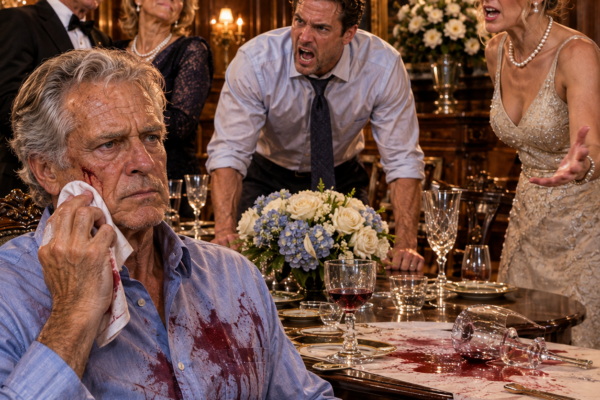
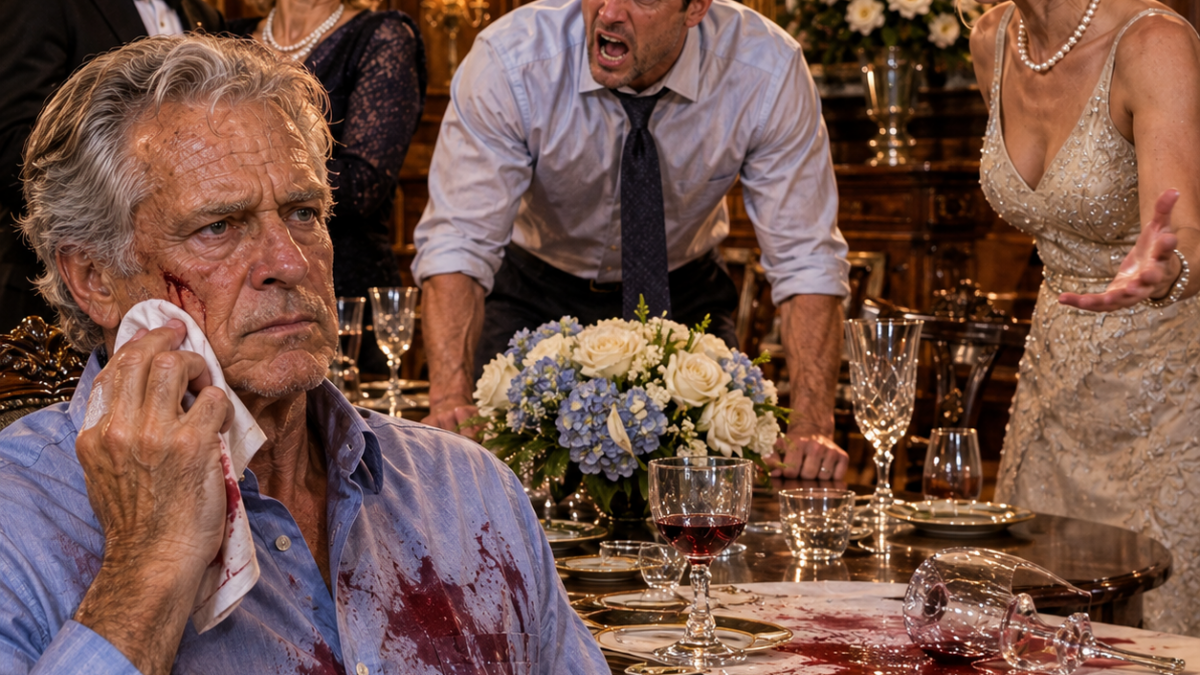
At Easter dinner, my daughter-in-law threw a crystal wine glass at my face because I refused to house her bankrupt parents.
It shattered on impact.
Blood ran down my cheek. My son didnt help me.
He called me selfish.
I didnt argue.
I didnt react.
I drove myself to the emergency room.
Then I made one phone call.
They thought it was a family dispute.
It was the beginning of something else.
Thank you for being here. Drop your city or country in the comments.
So, I know where this story is reaching tonight.
And a quick note, parts of this story are dramatized for storytelling and learning purposes. Any similarity to real people or locations is purely coincidental, but the lesson is absolutely intentional.
The dining room felt airtight, as if the walls themselves were holding their breath. The rich scent of roasted lamb and layered perfume clung to the air, heavy and oppressive, masking the bitterness spreading across the long mahogany table.
Crystal glasses reflected the chandeliers warm glow, but there was nothing warm about the atmosphere.
I sat at the head of the table, posture straight hands, resting calmly near my plate, watching the performance unfold. Across from me were not loved ones, but predators wearing the familiar faces of family.
Trenton sat directly opposite, shoulder, stiff jaw, tight, his gaze flickering anxiously between me and his wife.
He looked like a man preparing to execute a plan he had rehearsed too many times in his head. Beside him, Camille radiated entitlement as naturally as she wore her designer pearls.
Her chin was slightly lifted, eyes sharp and appraising, as though she were evaluating a piece of property rather than addressing her father-in-law. To my right sat Howard and Cynthia Reed Camilles bankrupt parents.
Once proud enough to boast about risky ventures and visionary investments, they now wore desperation like a second skin.
After liquidating what little they had left, they were weeks away from eviction. Yet there was no humility in their posture.
They stared at me with the quiet calculation of scavengers assessing the strength of wounded prey. The silence before Trenton spoke was not polite.
It was loaded.
It was the kind of silence that precedes an ambush. Trenton cleared his throat fingers, drumming a nervous rhythm against the white linen tablecloth.
He pushed his untouched plate aside and leaned forward, elbows braced on the table. He said they had been discussing the future as though this were a collaborative family meeting.
He explained that Howard and Cynthia were being forced out of their temporary apartment at the end of the month. Then he looked at me directly firmly and informed me that it was time for me to open my home to them.
He did not frame it as a request.
He presented it as a solution that had already been agreed upon by everyone but me.
He reasoned that I lived alone in a four-bedroom estate and that it was unreasonable, even immoral, for one older man to occupy so much unused space while family struggled. He spoke about fairness, about compassion, about duty.
His tone carried the authority of someone who believed compliance was inevitable. He expected me to lower my head, surrender my sanctuary, and quietly absorb the burden of two people who had never shown me the slightest trace of respect.
I studied Trentons face, then Camilles.
What I saw was not concern.
It was calculation.
They did not see my home as the place where I had built decades of work and memory. They saw square footage, asset value, liquidity.
In their eyes, I was no longer a father. I was a resource nearing expiration, an aging widowerower with more space than leverage.
Slowly, I set my silver fork down.
The metallic click against porcelain echoed in the strained, quiet, sharper than any raised voice.
I lifted my gaze and looked directly at my son. When I spoke, my voice was steady, stripped of emotion.
No.
I told him clearly that my home was a private sanctuary, not a public shelter.
I said that Howard and Cynthia were responsible for their own financial collapse, and that I would not carry the consequences of their reckless decisions. My tone did not waver.
There was no anger in it, only finality.
The explosion was immediate.
Trenton slammed both palms onto the table, rattling crystal glasses and fine china. His face contorted into open fury.
He called me selfish, miserable, a hoarder of space and wealth.
He accused me of having a heart made of stone.
His voice rose echoing off the high ceilings as he demanded to know what kind of father refuses to help his own family in their darkest hour.
He said I valued empty guest rooms and dusty antiques more than blood.
He told me I deserve to die alone in my massive empty house. Camille leaned forward, feeding the blaze, her cheeks flushed eyes burning with indignation.
She jabbed a manicured finger in my direction and began listing every perceived injustice she believed I had committed over the years. She called me controlling, tight-fisted, manipulative.
She accused me of using my financial stability to make them feel inferior. Her words were sharp and rehearsed as though she had been waiting for the right moment to release them.
Howard and Cynthia said nothing. They did not need to.
Their silence functioned as endorsement. Their stillness signaled agreement.
They watched the verbal assault unfold with grim satisfaction. In that moment, the final illusion of familial respect dissolved.
Whatever fragile veneer had once existed between us was gone.
Beneath it lay something raw and venomous, an entitlement so deep it no longer bothered to disguise itself as love.
I did not raise my voice to compete with theirs. I remained seated, allowing the insults to roll over me.
I memorized them. every accusation, every distortion, every word intended to break me.
When Camille paused for breath, I looked at her and said calmly that she was out of line. Then I turned to Trenton.
I reminded him without theatrics that for the past 5 years, I had quietly subsidized his failing logistics company. I had kept him from bankruptcy court.
I had absorbed losses he never acknowledged. I had shielded him from creditors who would have dismantled his operation within months.
My assistance had not been public.
It had not been paraded. It had simply existed.
I told him that generosity has limits.
My voice never rose. My posture never shifted.
But something in my tone signaled a line had been drawn. They had come expecting surrender.
What they received instead was refusal.
And in that refusal, something fundamental changed.
My refusal was the fracture point. The calm in my voice, the absence of fear, the simple word no.
Those were the final threads holding Camilles composure together.
When she realized I would not bend, that I would not surrender my home or my will under collective pressure, something inside her snapped.
The rejection did not merely anger her. It dismantled her.
Her hand shot toward her crystal goblet. The stem was thick, the bowl wide, the glass heavy and expensive.
It was filled nearly to the rim with dark red wine, the surface trembling from the force of her movement.
There was a split second, a thin, fragile pause, where reason might have returned.
It did not.
With a raw guttural scream that tore through the dining room, she hurled the goblet at my face. I had no time to react, no time to lift a hand in defense.
The weighted base of the crystal struck me squarely on my right cheekbone just beneath the eye.
The sound was sharp and violent, a crack that seemed too loud for a private home. The goblet shattered on impact, exploding into shards that scattered across the mahogany table and onto the polished floor.
A blinding surge of pain burst behind my eyes.
It was immediate white hot, disorienting. Then came the warmth, thick, heavy, unmistakable.
Blood streamed down my face, mixing with the spilled wine that splashed across my shirt and the wall behind me. Dark red bled into white linen, staining everything it touched.
The shouting ceased instantly.
The room fell into a crushing silence, so complete it felt physical.
Howard released a strangled, involuntary gasp.
Cynthia clapped both hands over her mouth, eyes wide with horror. Trenton stood frozen, his expression drained of color, staring at the damage his wife had inflicted.
He did not move toward me. He did not rebuke her.
He did not ask if I was hurt.
He simply took one slow, cautious step backward, as though distancing himself from responsibility.
Camille remained standing at the table, chest rising and falling rapidly, her hand empty her mind, struggling to comprehend the violence she had just committed. I did not shout.
I did not curse.
I did not reach for retaliation.
Instead, the pain sharpened my focus. I rose slowly from my chair.
The movement was deliberate controlled.
I reached into the inside pocket of my jacket and withdrew a pristine white linen handkerchief. With steady fingers, I pressed it firmly against the open wound on my cheek.
I felt the fabric absorb the blood almost instantly warmth soaking through to my palm. I lifted my gaze.
I looked at Trenton.
Then I looked at Camille. I allowed them to see the void in my eyes.
Not anger, not shock, something colder, something calculated. Without another word, I turned my back on them.
I walked out of the dining room, leaving the broken crystal, the overturned chairs, and the remains of Easter dinner behind me.
I passed through the front door and stepped into the cool open night air.
The contrast was stark. Outside, the world was calm.
The sky was dark and unbothered.
Crickets hummed faintly in the distance. Inside, everything had changed.
I walked to my car parked in the driveway.
My steps were measured, my breathing steady.
My hands did not tremble as I unlocked the door and slid behind the leather steering wheel.
The metallic taste of blood mingled with the bitter residue of wine on my lips. I started the engine.
I did not drive home.
I drove toward the county hospital.
Street lights flickered rhythmically through the windshield, casting alternating shadows across the interior of the car.
Each pulse of pain in my cheek reaffirmed a single truth. This was no longer a domestic disagreement.
It had crossed into criminal violence. They had escalated the conflict beyond words.
And in doing so, they had handed me the instrument I needed.
I pulled into the emergency room parking lot, the fluorescent lights harsh against the darkness. I turned off the engine, but remained seated for a moment.
The handkerchief in my hand was soaked through now, crimson spreading across the white fabric. I reached for my phone and dialed Jonathan Pierce.
He answered on the second ring alert despite the late hour.
I did not waste time with pleasantries.
Phase one is complete, I said.
My voice echoed faintly inside the quiet car.
I informed him that the assault had become physical, that Camille had struck me in the face with a heavy glass object, that I was currently bleeding in the hospital parking lot. Jonathan did not interrupt.
He did not ask for dramatic detail. He simply acknowledged the information and stated that he was activating the protocols we had previously discussed.
His tone was calm, precise. He instructed me to ensure that medical staff documented every injury thoroughly and to request a full report.
I ended the call.
I stepped out of the car and walked toward the sliding glass doors of the emergency entrance.
The fluorescent lighting illuminated my reflection in the glass.
Blood stre across my cheek shirt, stained expression unbroken. The automatic doors parted inside the sterile brightness of the triage area replaced the cool night air.
I approached the front desk with controlled steps. The nurse behind the counter looked up and visibly recoiled at the sight of my face.
I stood straight. I require immediate medical attention for a facial laceration, I said evenly.
Then without hesitation, I added and please contact the local police precinct. I need to file a formal felony assault report against my daughter-in-law.
The words were measured.
Precise. This was no emotional outburst, no revenge-driven impulse.
This was documentation.
This was procedure. The nurse nodded, already reaching for the phone.
As she called for assistance, I felt something settle inside me. The shouting at the dinner table had been chaos.
This this was order.
The silent adjustment had begun, and the paper trail once started would not be erased. I did not return to my house that night.
The silence there would have been too loud, too fresh, with the memory of shattered crystal and spilled blood. Jonathan Pierce arranged a private suite for me at a discrete downtown hotel far from Trentons neighborhood and the curious eyes of neighbors.
While I rested behind locked doors and drawn curtains, the legal machinery began to turn quietly, efficiently, without emotion. The following morning, I sat across from Jonathan in his sleek glasswalled office overlooking the city skyline.
A cup of black coffee cooled in my hand while the stitches along my cheek pulsed with a steady controlled ache. The pain no longer felt chaotic.
It felt useful. Jonathan did not offer hollow words of comfort.
He did not ask how I was feeling.
Instead, he rotated his laptop toward me and pressed play. The screen filled with the grainy clarity of police body camera footage from the previous evening.
Two uniformed officers walked up the manicured stone pathway leading to Trenton and Camilles suburban home.
The porch lights glowed warmly giving the illusion of peace.
Through the large front window, the camera captured a scene of absurd normaly. Trent and Camille Howard and Cynthia were seated at the dining table sharing slices of gourmet cheesecake.
They were laughing. Forks clinkedked lightly against porcelain plates.
Their faces were relaxed, satisfied. There was no sign of remorse, no sign of concern.
They had sent me to the hospital bleeding, and yet they were celebrating dessert. They believed the confrontation had ended in their favor.
They mistook my silence for weakness. They assumed I had retreated in defeat.
What they did not know was that a night court judge had already signed a warrant for felony assault with a deadly weapon.
On the screen, the lead officer raised his fist and knocked hard against the heavy oak door. The sound was deliberate and unyielding, echoing into the quiet suburban night.
Inside, I saw Trenton paws mid laugh. He frowned, dabbing his mouth with a napkin, irritation crossing his features.
He rose from the table with visible annoyance rather than concern.
In his mind, I suspect he assumed I had returned, perhaps to apologize, perhaps to negotiate. He walked toward the door with confidence, shoulders squared, prepared to deliver another lecture about my alleged selfishness.
He opened the door and found himself staring into the impassive faces of two county sheriffs. Red and blue patrol lights flashed across his pale expression.
bathing his features in alternating color.
For a fleeting second, confusion flickered in his eyes.
Then pride returned.
Trenton puffed out his chest, attempting to reclaim authority. He asked what the officers wanted.
He demanded to know why they were disturbing his family at such a late hour. The lead officer did not offer pleasantries.
He did not acknowledge Trentons tone. He simply shifted his gaze past Trentons shoulder into the well-lit dining room and called out for Camille by her full legal name, instructing her to step forward and identify herself.
On the screen, Camille froze halfway through a bite of cheesecake.
The smug composure she had worn all evening dissolved instantly. Her fork hovered in the air before lowering slowly to the plate.
Panic replaced arrogance. She stood unsteady.
Trenton immediately moved to block the doorway, positioning himself between his wife and the officers as though he could physically shield her from consequence.
He insisted that she had done nothing wrong.
He described the incident as a minor family misunderstanding, exaggerated by an emotional old man.
The lead officer did not engage in debate.
He stepped across the threshold with quiet authority, forcing Trenton to stumble backward.
The second officer followed closely, one hand resting calmly on his utility belt.
They entered the dining room without hesitation. The mood shifted instantly.
The polished wood table, the expensive china, the soft lighting, none of it offered protection. Howard and Cynthia shrank visibly in their seats, their confidence evaporating.
The predatory posture they had displayed earlier vanished.
They were no longer scavengers circling perceived weakness. They were witnesses to a power far greater than their own.
The lead officer addressed Camille again, this time, reading directly from the warrant clipped to his vest. His voice was steady, procedural, devoid of emotion.
He informed her that she was under arrest for aggravated assault with a deadly weapon and felony elder abuse.
The words seemed to hang in the air before landing with full force. Camille released a sharp, piercing shriek.
She staggered backward, colliding with the edge of the mahogany table and knocking over a glass of water. She shouted that it was a lie.
She insisted that I had attacked her. She demanded that Trenton intervene.
Trenton fumbled for his phone, threatening to call the mayor, the police commissioner, anyone he believed might bend reality back in his favor.
His voice rose brittle and desperate. The officers remained unmoved.
The lead officer stepped forward and took Camille firmly by the wrist. His grip was controlled practiced.
With fluid efficiency, he guided her arm behind her back.
The sound of steel handcuffs snapping shut echoed through the dining room. It was a sharp, decisive click.
Camilles composure collapsed entirely.
Tears streaked down her face as she struggled against the restraint, her designer dress wrinkling and twisting beneath the officers hold. Her earlier rage was gone, replaced by raw disbelief.
I watched the footage without blinking. The illusion of control had shattered, and the law had entered their sanctuary uninvited.
The officers marched Camille out of the dining room, dragging her toward the front door.
She dragged her feet, pleading and crying loudly, begging Trenton to save her.
Trenton followed them to the porch, shouting empty legal threats that the officers ignored. The neighborhood was wide awake.
The flashing police lights had drawn the attention of every affluent resident on the street. Neighbors stood on their manicured lawns and peered through their front windows, watching the spectacle unfold.
They saw Camille, the self-appointed queen of the neighborhood association, being shoved into the back of a police cruiser in handcuffs with her mascara running down her face.
Her reputation was instantly and permanently destroyed.
The cruiser doors slammed shut with a final metallic authority, cutting off Camilles hysterical screams midcry. The sound reverberated through the quiet suburban street like a judges gavel.
The officers climbed into the front seats without hesitation. Seconds later, the patrol car pulled away red and blue lights flashing across manicured lawns and pristine facades.
Trenton remained standing alone on his front lawn, illuminated by the harsh glare of security lights mounted above the garage. His silhouette looked smaller, now diminished.
The confident host of moments earlier was gone.
He stared after the departing cruiser as though disbelief alone might bring it back.
Inside the house, Howard and Cynthia did not step forward to defend their daughter.
They lingered in the shadows beyond the doorway, unwilling to share in the consequences of the chaos they had helped fuel.
In Jonathans silent office, I watched the footage without blinking. I felt no sympathy, no regret.
Only the quiet mechanical satisfaction of precision. A trap once set correctly does not require emotion.
It requires patience. And the trap had closed exactly as designed.
Morning sunlight flooded through the floor to ceiling windows of the law office, casting long angular shadows across the polished concrete floor. The heavy oak door was sealed shut, isolating us from the distant hum of the city below.
I sat in a highbacked black leather chair, my stitched cheek pulsing faintly, my phone resting in my palm.
The screen displayed 12 missed calls and three unheard voice messages, all from Trenton. Jonathan sat across from me behind his expansive mahogany desks, posture immaculate hands folded neatly a top a fresh legal pad.
He instructed me to place the phone in the center of the desk and activate the speaker so that the contents could be formally documented.
I set the device down. The automated voice system echoed into the room.
The first message was timestamped 2 a.m.Trenton sounded breathless. His voice bounced faintly distorted by the cavernous acoustics of the county jail waiting area.
He did not ask how my face was healing.
He did not inquire about the stitches.
He did not express concern.
He began with accusation.
He demanded I stop acting dramatic. He informed me that Camille had been formally booked and was sitting in a holding cell alongside actual criminals.
He ordered me to drive to the precinct immediately, tell the duty sergeant that I had fallen and injured myself and withdraw the charges.
He insisted the situation was a gross overreaction to a simple misunderstanding.
According to him, I was embarrassing the family. He told me to fix my mistake.
The message ended abruptly with a sharp click of disconnection. Jonathan made a single deliberate notation on his pad.
I felt nothing.
The second message arrived 45 minutes later.
The transformation in tone was stark. The commanding arrogance had dissolved into uncontrolled rage.
Trenton was shouting now, the sterile hum of the police station barely audible beneath his fury.
He screamed that the night magistrate had imposed an enormous cash bail because the charge was classified as a violent felony against a vulnerable elderly individual.
He blamed me entirely for the financial burden.
He called me vindictive, spiteful, a bitter old man who could not tolerate his sons success. He declared that if I did not correct the situation before sunrise, he would sever all contact permanently.
He threatened to remove me from their lives and let me rot alone in my empty house.
He claimed Howard and Cynthia were traumatized by the arrest. He called me a monster.
I glanced at Jonathan. He raised one eyebrow, calculating, but remained silent.
The room absorbed Trentons rage without reaction.
The final message was recorded shortly after 6:00 a.m.The background noise had shifted to the low vibration of a car engine.
Trenton had posted bail. Camilles sobbing could be heard faintly from the passenger seat, her cries raw and unfiltered.
Trenton was no longer shouting.
His voice was cold now, controlled, flat.
He told me they were driving home. He said the gloves were off.
He declared that I had crossed an unforgivable line and had declared war on my own blood. He promised I would pay for humiliating his wife publicly.
Then came the real threat.
He stated he would contact his own attorneys and petition the court to declare me mentally incompetent. He swore he would prove I was unfit to live alone.
He vowed to have me forcibly removed from my home and committed to a state facility. He said he would take control of my estate, liquidate the property, and use the proceeds to protect Camille from prison.
He finished by telling me I was dead to him.
The room fell silent as the message ended.
Jonathan reached forward calmly and tapped the screen, transferring the audio files to his secure server.
The hum of the upload bar filled the stillness.
He leaned back slightly and looked at me, eyes sharp, analytical.
He just gave us exactly what we needed, he said. Trenton believed he was issuing threats.
In reality, he was confessing intent, and intent once documented becomes leverage.
The trap had not only closed, it had recorded itself. The silence that followed the final voicemail was dense and absolute.
Trentons threats lingered in the air of Jonathans office like a corrosive fog.
His voice, cold, cert, and venomous, still echoed faintly in my mind. He truly believed he held all the leverage.
In his imagination, I was nothing more than an aging man clinging to a single valuable property of frail obstacles standing between him and the life he felt entitled to claim. In Trentons version of reality, he was the visionary entrepreneur, the rising titan of industry.
I was the relic, outdated, irrelevant, easily displaced. He saw himself as a self-made success story forged by ambition and grit.
He saw me as a burden in the way of his inevitable expansion. The delusion would have been almost amusing if it were not wrapped so tightly around genuine malice.
Jonathan Pierce allowed the silence to settle. He did not interrupt my thoughts with commentary or reassurance.
Instead, he leaned forward and unlocked the heavy bottom drawer of his mahogany desk.
From within, he retrieved a thick black leather binder and placed it carefully between us. This was not a folder containing medical directives or modest retirement statements.
This binder held the complete operational framework and private financial records of Summit commercial management.
I am not a man surviving on a predictable pension.
For 40 relentless years, I acquired developed and managed high value commercial real estate throughout the state.
I built a portfolio methodically property by property, contract by contract. I structured it behind layered corporate trusts and holding entities designed for insulation and longevity.
I never needed public recognition. I needed stability, leverage, and control.
When my wife passed away, I chose simplicity.
I remained in our family home.
I drove an older vehicle. I wore practical clothes.
I had no desire to broadcast wealth.
There was nothing left to prove. But Trenton interpreted restraint as decline.
He mistook discretion for weakness. He assumed that my quiet lifestyle reflected dwindling resources rather than disciplined abundance.
Jonathan opened the binder and turned to its central tab. He slid a clean, crisp legal document toward me across the polished desk surface.
It was the master lease agreement for a massive industrial warehouse complex on the southern edge of the city, the very facility from which Trenton operates his booming logistics enterprise.
5 years earlier, Trenton had walked into my living room wearing a tailored suit purchased on borrowed confidence.
He demanded a substantial cash infusion to launch his delivery and warehousing company.
He spoke to me with thinly veiled contempt, dismissing my conservative financial council as obsolete. He called himself a natural entrepreneur.
He insisted I lacked vision. I refused to hand him unrestricted capital.
I knew his arrogance would devour liquidity faster than revenue could replace it. But at that time, I still loved my son without condition.
I wanted him to succeed even if he did not value my guidance. So I intervened quietly.
Through one of my holding companies, I purchased the warehouse complex he had been eyeing. Then through Summit Commercial Management, I extended him a long-term commercial lease at a rate so far below market value, it bordered on absurd.
The current market rate for that size facility in that location is $40,000 per month. Trenton pays $8,000.
For five consecutive years, I have absorbed a $32,000 monthly deficit through my corporate structure.
That deficit was not a clerical error. It was deliberate support.
Every month, without recognition, without gratitude, without disclosure, I sustained his company. I have been the invisible foundation beneath his entire operation.
At country clubs, Trenton boasts about razor thin efficiency and exceptional margins. He presents himself as a self-made executive with uncommon instinct.
He purchases diamond necklaces for Camille.
He leases imported sports cars.
He funds a lifestyle that suggests success. He believes the numbers on his profit and loss statements validate his genius.
He does not realize those numbers are artificially stabilized by my silent subsidy.
Without the reduced lease rate, his overhead would have crushed his margins within the first year. Without my intervention, creditors would have dismantled his operation long ago.
The franchise he parades as proof of superiority is structurally dependent on generosity he now repays with threats. His empire is not steel and concrete.
It is paper and illusion, and illusions collapse the moment reality withdraws support. Jonathan closed the binder slowly.
Trenton believes he declared war.
What he has actually done is threaten the architect of the very ground he stands upon and foundations once removed do not negotiate. Jonathan lifted a silver pen and tapped the final paragraph of the master lease agreement.
The gesture was small, almost casual, but the implication was enormous.
His pen rested directly on the stringent morality and default provisions we had embedded deep within the original contract clauses drafted with precision buried beneath layers of dense legal language. Trenton had believed he was negotiating from a position of strength when he signed that lease five years ago.
Convinced he had outmaneuvered a struggling corporate landlord, he rushed through the documents without retaining competent counsel.
He skimmed, assumed, and signed.
In his arrogance, he agreed to a provision granting the landlord immediate and uncontested termination rights if the primary tenant or any immediate family member became subject to violent criminal charges.
He never imagined that clause would apply to him.
By allowing Camille to assault me and subsequently face felony charges, Trenton had triggered the very mechanism that would dismantle his own enterprise. The destruction of his company was not emotional.
It was contractual.
He had unknowingly signed his own financial execution order, and the architect of that consequence was seated across from me in a quiet law office.
I studied the bold, overconfident signature at the bottom of the page.
My sons name written with flourish and certainty now bound him to the outcome he never foresaw.
He had declared me mentally unfit. He had attempted to weaponize the probate court to seize my home and liquidate my estate in order to shield his wife from prison.
He intended to dismantle my life entirely. I looked up at Jonathan.
Draft the eviction notice, I said evenly, and the lease termination documents. My instructions were deliberate.
The papers were not to be emailed, not couriered casually. They would be printed on premium heavy stock paper and placed inside a sealed unmarked envelope.
I would deliver them personally. The lifeline that had sustained him for 5 years, the silent subsidy that preserved his illusion of success was officially severed.
I remained at the hotel for two additional days. I did not contact Trenton.
I did not respond to his calls. Silence can be more destabilizing than confrontation.
I knew his temperament well. Arrogance rarely tolerates uncertainty.
Backed into a corner by criminal charges and unaware of the financial collapse advancing toward him, he would react predictably.
Desperation sharpens recklessness.
On the third morning, a heavy knock echoed through the suite.
It was sharp and authoritative. I opened the door to find a man in a poorly fitted gray suit holding a thick manila envelope.
He confirmed my name, then pressed the envelope firmly against my chest.
Youve been served, he said flatly before turning down the hallway.
I closed the door and carried the packet to the desk near the window.
The wax seal cracked cleanly under my thumb.
Inside was a substantial stack of legal documents stamped with the bold red insignia of the county probate court.
Trenton had escalated.
He had filed an emergency petition seeking temporary medical conservatorship.
I read the petition slowly, my expression unchanged. He was asking a judge to strip me of my autonomy and transfer control of my health care and finances to him.
The narrative he constructed was elaborate.
He alleged severe and rapidly progressing dementia. He claimed I suffered from paranoid delusions and episodes of violent self harm.
Most grotesque was his distortion of the Easter dinner incident.
According to his sworn statement, Camille had not attacked me.
Instead, he asserted that I had experienced a psychotic break and smashed the crystal goblet into my own face while verbally abusing them.
He portrayed himself as a burdened, exhausted son, seeking court intervention to protect his unstable father from further harm.
It was malicious fiction carefully composed.
To obtain an emergency order, the court required medical validation.
Trenton had anticipated that requirement. Attached to the petition was a sworn affidavit from a licensed psychiatrist.
I recognized the name immediately. He had attended Camilles dinner parties, expensive evenings filled with curated wine and calculated flattery.
He had a reputation for lavish tastes and a discreet but widely rumored gambling problem.
Without examining me, without conducting an evaluation, he had signed a legal document diagnosing me with severe cognitive decline and violent psychosis.
He had traded professional integrity for influence.
Based on that affidavit, the judge granted a temporary 14-day emergency injunction. The final pages detailed the immediate consequences.
Trenton had been awarded temporary power of attorney over my health care decisions and certain financial accounts.
Attached to the packet was correspondence from my primary retail bank.
My personal checking and savings accounts, the modest accounts used for pension deposits and daily expenses, had been frozen. Trenton believed he had executed a strategic master stroke.
By restricting my liquidity, he assumed I would be unable to retain counsel or maintain accommodations. He thought deprivation would force submission.
He believed he had neutralized me. He did not understand that those accounts were decoys functional but insignificant components of a far more complex structure.
I retrieved my phone and called Jonathan. I read the injunction line by line.
He did not express alarm. His tone was measured analytical.
Theyve committed perjury, he said. And the psychiatrist has exposed himself to federal medical fraud.
By filing knowingly false affidavit with a probate court, Trenton and the physician had transformed a domestic dispute into a criminal conspiracy.
I asked about the frozen accounts. Jonathan reassured me immediately.
The wealth contained within Summit Commercial Management and its affiliated trusts was legally insulated. Those entities existed under separate tax identification numbers governed by layered holding structures and asset protection frameworks.
Trenton was unaware of their existence.
He had frozen the visible accounts, the ones designed to appear ordinary, groceries, utilities, minor transactions. He believed he had isolated me financially.
In reality, he had revealed intent. Every false statement in that petition, every fabricated diagnosis, every fraudulent signature, each action was documented and timestamped.
He thought he was closing in. Instead, he was stepping deeper into exposure.
The lease termination sat drafted and ready.
The eviction notice awaited delivery. The conservatorship petition provided new leverage.
Trenton assumed he was seizing control of the board. He did not realize the game had always been structured around contingencies he could not see.
And now he had moved precisely where I needed him to.
I stood at the wide hotel window, looking down at the relentless movement of the city below.
Cars streamed through intersections.
Pedestrians crossed streets with purpose.
Life continued indifferent and orderly.
My stitched cheek pulsed with a steady controlled ache, but my thoughts were razor sharp.
Pain clarifies. Betrayal simplifies.
Trenton believed he was holding a winning hand.
In his mind, he had cornered me. He thought he had locked me inside a legal cage and severed the only financial artery keeping me alive.
He believed he had acted decisively brilliantly.
What he did not understand was that I had left the door open on purpose. I had allowed him to obtain that temporary authority because I knew exactly what a desperate, greedy man would do once handed even a fragment of control.
He would not exercise restraint.
He would overreach. He would stretch his new power beyond its legal boundaries in an attempt to secure something far larger.
He would try to save himself.
And in doing so, he would expose himself completely. I had been waiting for retaliation, waiting for escalation.
The moment he filed that fraudulent conservatorship petition, the final piece slid into place.
The stage was set.
The Trojan horse was already inside his gates. He just did not know it.
The following afternoon, I returned to my property.
The row iron gates parted silently and my car moved up the long curved driveway toward the sprawling stone estate I had built through decades of measured risk and calculated discipline. Ancient oaks framed the property.
The lawns were trimmed with geometric precision. From the outside it looked exactly as it always had, but the atmosphere had shifted.
This was no longer a sanctuary.
It was a battlefield. I parked in the garage and entered through the side door, stepping into the cool stillness of the grand foyer.
 [Tap here for the Next Part ]