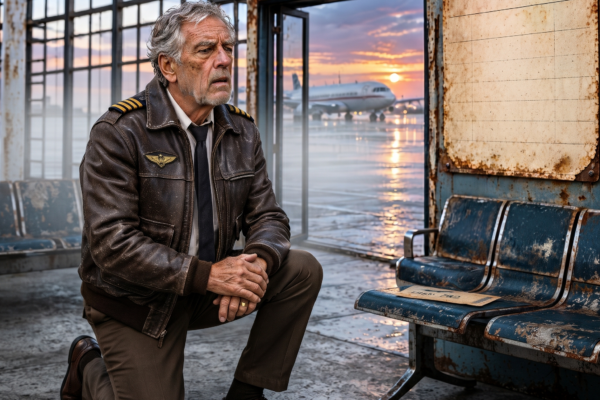
A Soldier Returned Home Disguised As A Homeless Man — His Family’s Reaction Broke His Heart
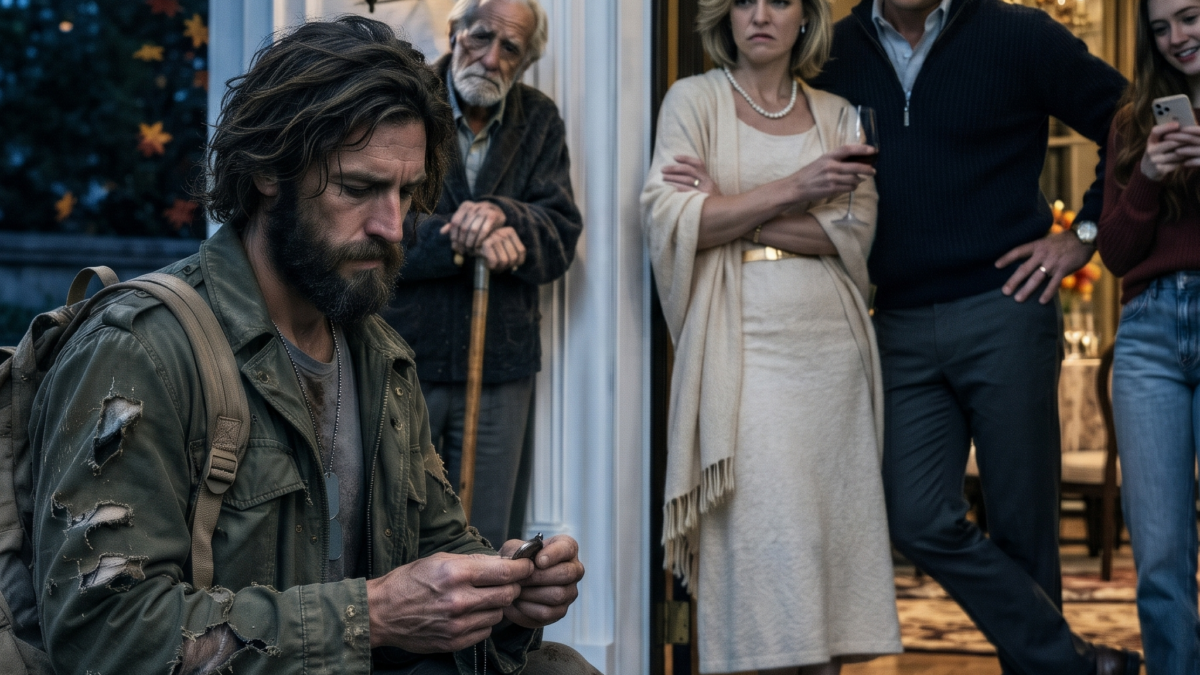
THE SOLDIER WHO CAME HOME AS A STRANGER
The first thing I heard when the door opened was my wife telling me to go away.
Not hello. Not Are you all right? Not even the cautious question people ask when a stranger appears on their porch after dark.
Just three words.
“Go somewhere else.”
I stood beneath the porch light with my hands visible and my shoulders slightly hunched against the cold. My coat was too thin for a November evening, my boots were worn through at the heels, and a week’s worth of gray stubble covered my face. I had deliberately left my hair untrimmed. A healing cut disappeared beneath it, and the rest of my face had changed enough that someone who hadn’t seen me in years might struggle to recognize me.
Vanessa stared at me from the doorway.
She looked older than I remembered, though not by much. Her hair was perfectly arranged, and she wore the sort of sweater I’d once bought her for Christmas. Behind her, the house glowed with warm light. I could see a long dining table, polished silverware, glasses filled with wine, and a golden turkey surrounded by dishes.
Thanksgiving.
I had pictured coming home on Thanksgiving many times during the months I spent recovering. In those pictures, Vanessa would run to me. Lily would cling to my waist. My father would stand in the kitchen pretending he hadn’t been waiting by the window all afternoon.
Instead, I was standing outside like a man asking for spare change.
“Ma’am,” I said, keeping my voice low, “I’m not selling anything. I served with the 82nd Airborne. I just need a plate of food. That’s all I’m asking.”
Vanessa glanced over her shoulder.
“Marcus?”
My younger brother appeared in the hallway, holding a drink.
“What is it?”
“Some man wants food.”
Marcus came to the door and looked me over. His eyes moved from my muddy boots to my unshaven face. He didn’t recognize me.
That should have hurt more than it did.
“There’s a shelter on Fifth Street,” he said. “They serve people like you.”
“I know where it is.”
“Then go there.”
“I haven’t had a hot meal in days.”
Marcus made a show of sniffing the air.
“Uncle Marcus, he smells like a gas station,” Lily said from somewhere inside.
A few people laughed.
I looked past them and caught a glimpse of my daughter. She was holding her phone, the camera aimed at me. She was taller now, her hair longer, her face beginning to resemble Vanessa’s. I had last seen her as a little girl who still needed help tying her shoes.
She was recording me.
“Please,” I said. “It’s Thanksgiving.”
Vanessa’s expression hardened.
“Then you’ve come to the wrong house.”
Marcus glanced at his watch.
“Thirty seconds. I’m calling the police if you’re still here.”
I stood on the porch and looked at the people inside. The dining room was full. I recognized two neighbors, a man who used to work at my father’s repair shop, and a couple I’d met at our wedding.
Not one of them asked my name.
“All right,” I said. “I’ll go.”
I turned.
“Shame on this house tonight,” someone muttered.
I stopped.
The voice belonged to a man sitting near the fireplace. He had white hair, a deeply lined face, and a blanket over his knees. His name was Henry Hayes.
My father.
He was thinner than I remembered. His shoulders had become narrow, and age had taken some of the strength from his hands. But I knew those hands. I’d watched them change tires, repair engines, and pull me out from beneath a car when I was nine.
He looked at the doorway.
Then he looked at me.
“Marcus,” he said, “leave him alone.”
“Come on, Dad. We have guests.”
“He’s hungry.”
“He can be hungry somewhere else.”
My father pushed himself out of his chair.
“Six years, Vanessa,” he said quietly. “Six years I’ve been paying for that door. And you don’t even know the man’s voice.”
Vanessa frowned.
“Henry, don’t start.”
My father walked past her and stepped onto the porch.
“Mind if an old man sits down?”
I swallowed.
“Of course not, sir.”
He lowered himself onto the wooden bench beside me. For a moment, he simply looked out at the dark garden.
Then he got up again.
“Wait here.”
He disappeared into the house.
I could hear Vanessa complaining, but my father ignored her. A minute later, he returned with a plate piled with turkey, mashed potatoes, stuffing, and a piece of pie.
He set it beside me.
“Eat.”
I looked at him.
“Thank you, sir. I mean it.”
“Don’t thank me. It’s Thanksgiving.”
He reached into his coat and produced a thermos.
“Coffee?”
I nodded.
“Black. Three sugars.”
He paused.
“Don’t ask how I guessed.”
I looked at him.
My father had known how I drank coffee since I was seventeen. He used to make it before I left for school, always too strong, always with exactly three sugars.
He poured a cup and handed it to me.
“Funny thing,” he said. “My boy drank it the same way.”
I lowered my eyes.
“Was he in the service?”
“Staff Sergeant. Daniel Hayes. 82nd Airborne.”
I held the cup between my hands.
“What happened to him?”
“They told us he went missing overseas. Then they told us he was gone.”
“I’m sorry.”
“Are you?”
I looked up.
He was studying me with an expression I couldn’t quite read.
“I suppose I am,” I said.
He nodded slowly.
“Some men come home. Some men just arrive. There’s a difference.”
I didn’t know what to say.
He pushed the plate closer.
“Eat while it’s warm.”
I did.
After a moment, I asked, “Why are you being kind to me? They threw me off the porch.”
“Because somebody should be.”
He looked toward the house.
“That’s all there is to it.”
When I finished, he gave me the address of St. Brendan’s shelter on Fifth Street.
“Tell Father Declan that Henry sent you.”
I stood.
“Thank you, Mr. Hayes.”
“Henry.”
“Thank you, Henry.”
He watched me walk down the driveway.
I didn’t look back until I reached the street.
He was still standing beneath the porch light.
And for the first time since I had returned to America, I wasn’t sure I could keep pretending to be a stranger.
I had been away for six years.
Not missing for six years. Not dead for six years. Away.
I had joined the Army young, and the years had gone by in deployments, training, and long stretches when the people at home became voices at the other end of a bad telephone connection.
Then came the last mission.
Five months missing.
Eight months in a hospital bed.
A succession of operations, rehabilitation, and paperwork that seemed to stretch longer than the war itself.
The Army had finally discharged me from Landstuhl on Tuesday. I flew into JFK on Wednesday.
My family had received the news months earlier.
I didn’t know that yet.
For most of my recovery, I had written letters to my father. Twenty-six of them, every one describing something small: a doctor who told bad jokes, a nurse who kept stealing my pudding, a memory of the garage, or the way I hoped to spend my first Sunday home.
I had sent money whenever I could.
Every dollar I could spare.
I believed my father was receiving it. I believed Vanessa was keeping him informed. I believed Lily still knew I loved her.
When I returned, I wanted to see what remained of those beliefs.
I could have walked straight into the house, shaved, shown them my discharge papers, and told them who I was.
Instead, I wanted to know how they treated a man they thought had nothing.
I got my answer on the porch.
A familiar voice answered when I called the number I had memorized from years ago.
“Hayes Auto Repair. This is Mateo.”
“Hey, brother.”
Silence.
Then a chair scraped across the floor.
“Daniel?”
“It’s me.”
“You’re home?”
“Made it.”
“You’re actually home.”
“I am.”
Mateo Ruiz had served with me in the 82nd. He was the sort of man who could turn an awful day into something worth laughing about. He had been with me during the mission when I disappeared, and he had spent weeks insisting that I would come back.
“Tell me everything,” he said. “Did Vanessa cry? Did your father start yelling? Did Lily tackle you?”
I stared at the empty street.
“They didn’t recognize me.”
“What?”
“Vanessa told me to go to the shelter. Marcus threatened to call the police. Lily filmed it.”
Mateo didn’t say anything.
“My father came outside,” I continued. “He gave me a plate of food.”
“At least Henry did something.”
“Yes.”
“Did he recognize you?”
I hesitated.
“I’m not sure.”
“Daniel, you’re overthinking this. Shave, walk back in, and say your name.”
“I can’t.”
“Why not?”
“Because if I walk in tomorrow, Marcus can hide the papers by Monday.”
“What papers?”
“I don’t know yet. But there’s something wrong with that house.”
Mateo sighed.
“You can’t sleep in a shelter forever.”
“I know.”
“What are you going to do?”
I watched a bus pass through the intersection.
“Find out who they are when they think I’m nobody. Then decide who I am to them.”
“That’s a dangerous game.”
“So was jumping out of airplanes.”
He laughed quietly.
“You’re still an idiot, Hayes.”
“Some things don’t change.”
St. Brendan’s shelter was a converted church hall with a leaky roof and a kitchen that smelled of vegetables, disinfectant, and old coffee.
Father Declan greeted me at the door.
“Henry sent you?”
“Yes, Father.”
He looked at my coat.
“Come in. There’s room.”
The shelter was crowded, but clean. A dozen men sat around tables, and a few women were gathered near the far wall. Some had come from the streets. Others had lost their homes after medical bills or family disputes. Nobody looked particularly interested in asking how anyone had ended up there.
I was grateful for that.
A volunteer brought me a blanket and showed me a narrow bed near the back.
“You’re new here, son. Who sent you?”
“An old man named Henry Hayes.”
The volunteer’s expression changed.
“Henry?”
“Yes.”
“Well, I’ll be.”
“What?”
“He’s been coming here every Thursday since spring, asking whether a soldier has checked in.”
I stared at him.
“Every Thursday?”
“Every one. He brings coffee sometimes. Three sugars in yours, I expect.”
I looked away.
The volunteer smiled.
“Sleep well, son.”
I sat on the bed for a long time after he left.
My father had been looking for me.
Every Thursday.
For months.
And the people in my house had told him I was gone.
The next morning, I returned to the old shop.
Hayes Auto Repair stood at the edge of town, just off the main road. Its sign had faded, but the building itself was still solid. I had grown up there. I learned to change a tire in the rear bay when I was nine. My father had taught me how to lift an engine without damaging the frame, how to recognize a failing alternator by its sound, and how to keep a customer from feeling foolish when they didn’t know what was wrong with their car.
The shop was more than property.
It was my childhood.
A glossy sign had been placed near the entrance.
COMING SOON: PRESCOTT AUTO AND DEVELOPMENT.
I stood across the road, staring at it.
A black SUV pulled into the parking lot.
Marcus climbed out, followed by a man in a business suit.
The man carried a folder.
“Is everything ready?” Marcus asked.
“Almost,” the man replied. “Your father’s signature is the only thing holding up the transfer.”
Marcus laughed.
“He signed.”
“Then we’re fine.”
“The notary is a friend of mine. The copy is clean.”
“There’s still the date.”
“What’s the problem with the date?”
“The clinic records show Henry was at the VA that morning.”
Marcus shrugged.
“He was at the clinic. Nobody says he couldn’t have signed before he went.”
I felt my jaw tighten.
The man opened the folder.
“If anyone checks the notary’s records, this could become a problem.”
“No one is going to check. The notary is a friend. The town wants to sell the property, the council wants a new development, and my father can’t remember what day it is. Just finish the transfer.”
The two men entered the building.
I stayed across the road until they were gone.
Then I walked up to the sign and touched the edge of it.
My father had built that shop with his hands.
I had spent my teenage years working there beside him.
I had sent money home for six years so he could keep it.
Now someone was selling it while he was still alive.
Not while I was breathing.
I learned the rest of the plan that afternoon.
Vanessa was at home when the Army called.
I wasn’t inside the house, but I had returned to the porch to retrieve a small tool bag I had left in the garden during my previous visit. The back door was open, and I could hear her speaking on the telephone.
“Yes, this is Mrs. Hayes.”
A pause.
“Daniel?”
I froze.
“You’re saying Staff Sergeant Hayes was discharged from Landstuhl on Tuesday?”
Another pause.
“He flew into JFK on Wednesday?”
She glanced toward the kitchen.
“No. He hasn’t contacted us. I’ll let you know if he does.”
I stepped back from the window.
She ended the call.
Marcus entered from the hallway.
“Who was that?”
“The Army.”
He stopped.
“About Daniel?”
“They confirmed he’s in the country.”
Marcus looked toward the door.
“Then where is he?”
“I don’t know.”
“Vanessa, we should have said something in March.”
“And give back the money we’ve already spent?”
“Four hundred thousand dollars, Marcus.”
“Exactly. If he walks in before Sunday, the house sale falls apart. The benefit gets reviewed. We’ll both be in trouble.”
Marcus’s voice grew quieter.
“So what do we do?”
“Nothing. He’s still officially missing to most people. The memorial has already been planned. The town has accepted it.”
“Henry knows something.”
“Henry believes whatever story we give him.”
“What about Lily?”
Vanessa sighed.
“She asked about Daniel’s scar last night.”
“She believes whatever you tell her.”
“She’s not a baby anymore.”
“Then make sure she doesn’t ask questions.”
I moved away from the window.
There was no misunderstanding.
They knew I was alive.
They had known for months.
They had been waiting for me to disappear long enough to sell the house, transfer the shop, and keep the money.
And my father had been writing letters into a world where the people closest to him were quietly making sure none of them reached me.
That evening, I met Henry at a small diner near the shelter.
He was sitting in a booth by the window, wearing the same old coat he had worn on Thanksgiving. He looked tired, but his eyes brightened when he saw me.
“There’s my soldier.”
I sat opposite him.
“You come here often?”
“Every Thursday.”
“Why?”
He looked at me.
“Coffee.”
I almost smiled.
The waitress approached.
“Same as usual, Henry?”
“Yes, dear.”
She turned to me.
“What about you?”
“Black coffee. Three sugars.”
She nodded and left.
Henry watched me.
“Funny thing. My boy liked it that way.”
I lowered my eyes.
“Tell me about him.”
He considered the question.
“Smart kid. Strong. Stubborn enough to make a mule look cooperative. He was ashamed of the grease under my fingernails when he got older.”
“Why?”
“Thought he needed to be better than me. Maybe he was right. I was just a mechanic with an old shop and too many bills.”
He smiled faintly.
“He joined the Army. I was proud of him, though I didn’t say it enough. He sent money home. Lots of it. Maybe he thought that made up for being away.”
“Did it?”
Henry looked out the window.
“Money buys a lot of things. It doesn’t buy a phone call on Sunday.”
I let the silence settle.
“Did he write?”
“Every week, he said he would. Then he went missing. We got a few letters, and then nothing.”
He stirred his coffee.
“Vanessa told me there weren’t any more.”
I stared at him.
“Did you believe her?”
“I believed what I could see. That’s what old men do when they don’t have much else.”
The waitress brought our coffee.
Henry took a sip.
“Black. Three sugars.”
I looked at him.
He smiled.
“I remember the important things.”
My throat tightened.
“Henry…”
He lifted a hand.
“Don’t. Not yet.”
I stared at him.
He knew.
Somewhere inside the old man, he had known from the moment I stepped onto his porch. He had given me food, watched my hands, listened to my voice, and waited.
But he had not said my name.
I understood then that he was giving me the chance to finish what I had started.
“Tell me something,” I said. “If your son came home, would you forgive him?”
Henry sat quietly.
“That depends.”
“On what?”
“On whether he comes home because he misses us, or because he needs something.”
He looked straight at me.
“Some men come home. Some men just arrive.”
I nodded.
“I understand.”
He pushed a small envelope across the table.
“What is this?”
“Letters.”
I opened it.
Twenty-six envelopes.
Every one addressed to Henry Hayes.
Every one stamped RETURN TO SENDER.
I stared at the handwriting.
It was mine.
“Where did you find these?”
“In Vanessa’s recycling bin. April. I was looking for a newspaper and found the first one. Then I found the rest.”
He watched my face.
“She opened every one.”
I couldn’t speak.
Henry took my hand.
“Don’t do anything foolish, son.”
I looked at him.
“You knew?”
“I knew the second you knocked on the door.”
I closed my eyes.
“Why didn’t you say anything?”
“Because you came back as a stranger to see who your family really was. I wanted to know something, too.”
“What?”
“Whether my boy still knew how to come home.”
I gripped his hand.
He smiled.
“I think I have my answer.”
The following morning, Henry’s condition worsened.
He had been complaining of chest pain for days, but he kept dismissing it as indigestion. When I visited the shop, he was sitting in the office with a hand pressed against his chest.
“Henry?”
He tried to smile.
“Just a little tired.”
“You’re going to the hospital.”
“No.”
“That’s not a request.”
He raised an eyebrow.
“You’re getting bossy.”
“I learned from you.”
He laughed, then winced.
I reached for my phone.
Before I could call, Vanessa’s car pulled into the lot.
She climbed out with Marcus.
“Henry,” she said, “the Cedar Hollow van comes tomorrow morning.”
My father looked at her.
“Tomorrow? It’s Saturday.”
“The facility has an opening.”
“I don’t want to go.”
“It’s a lovely place,” she replied. “You’ll make friends.”
“Cedar Hollow is a warehouse for old people.”
“That’s unfair.”
“It’s state-funded, Vanessa. You know I don’t want to go.”
Marcus walked toward us.
“You can’t keep wandering around town. You need supervision.”
Henry tried to stand.
“I can look after myself.”
“Clearly you can’t.”
I stepped forward.
“Did he sign the intake papers himself?”
Vanessa looked at me.
“Excuse me?”
“Did he sign them?”
“That’s none of your business.”
“It becomes my business when you’re trying to move a man into a care home against his wishes.”
Marcus moved between us.
“Stay out of it.”
I held his gaze.
“Answer the question.”
Vanessa folded her arms.
“He has power of attorney.”
Henry looked at her.
“Since when?”
“Since you signed the documents.”
“I never signed anything.”
“You’re confused, Henry.”
He shook his head.
I could see how frightened he was becoming.
Marcus grabbed his arm.
“Come on. We’re going.”
Henry winced.
I caught Marcus’s wrist.
“Let go.”
He turned toward me.
“Who the hell do you think you are?”
“Someone asking you to release an old man’s arm.”
He shoved me.
I barely moved.
“Get off him,” I said.
Vanessa pulled Marcus away.
“Call the police.”
I looked at Henry.
He was pale, breathing shallowly.
“Son,” he whispered.
I turned toward him.
His hand was trembling.
Then he collapsed.
The ambulance arrived in minutes.
Henry was taken to the hospital with cardiac symptoms. The paramedics stabilized him, but the doctor told me he would need to remain under observation.
Vanessa arrived shortly afterward.
She took one look at me and pointed.
“You did this.”
I stared at her.
“Your father-in-law is in the emergency department.”
“If he hadn’t wandered off with you, he wouldn’t have been stressed.”
“He’s been stressed for months because you’re trying to take his home.”
Marcus stepped in.
“Don’t listen to him. He’s a stranger who has been following the family.”
Lily appeared behind them.
“He’s not a stranger.”
Everyone turned.
She looked at me.
Then at her mother.
“He’s Dad.”
Vanessa froze.
“Get in the car, Lily.”
“No.”
“Now.”
“I heard you talking. You knew Dad was alive. You knew since March.”
Marcus’s expression changed.
“Lily, you don’t understand.”
“I understand enough.”
Vanessa grabbed her arm.
“You’re coming with me.”
Lily pulled away.
“Let go.”
I stepped toward them.
“Don’t touch her.”
Vanessa stared at me.
“You have no right to interfere with my daughter.”
I looked at Lily.
“Do you want to go with her?”
She shook her head.
“Then stay here.”
Vanessa’s face tightened.
“This isn’t over.”
“No,” I said. “It isn’t.”
She left with Marcus.
Lily remained beside me, trembling.
I put my hand on her shoulder.
“You’re all right.”
She looked up.
“I’m sorry I laughed.”
I knelt in front of her.
“Don’t worry about that now.”
“I filmed you.”
“I know.”
“I thought you were just some man asking for food.”
“I know.”
She wiped her eyes.
“Can I call you Dad?”
I couldn’t answer for a moment.
Then I held out my arms.
She hugged me.
And six years of waiting finally broke.
Henry was moved to a cardiac unit.
Father Declan arrived at the hospital just after midnight.
He had been the one who introduced me to the shelter, and he had become a quiet ally in the days since my return.
“Your father asked for you,” he said.
I went to the room.
Henry lay in bed with an oxygen line beneath his nose. He looked exhausted, but he smiled when he saw me.
“There’s my boy.”
I sat beside him.
“How are you feeling?”
“Like someone drove a truck over my chest.”
“That’s not funny.”
“Didn’t say it was.”
He watched me for a moment.
“Tomorrow.”
I nodded.
“Tomorrow.”
“Finish it.”
“I will.”
He closed his eyes.
“Promise me.”
“I promise.”
The doctor came in and checked his monitor.
“We need him to rest. He can be released for a short supervised outing tomorrow, but only if his condition remains stable.”
Father Declan nodded.
“I’m very good at supervising.”
The doctor smiled.
“Then keep him out of trouble.”
Henry looked at me.
“You heard him.”
I stood.
“Rest. We’ll see you at noon.”
He held my wrist.
“Say it where it matters, son. Say your name where they can’t take it back.”
I nodded.
“I will.”
I spent the rest of the night with Maggie.
Maggie Cole had been a local reporter for years. She had covered the town council, school board elections, and the sort of small-town stories that rarely attracted anyone outside the county.
She had also known my father for decades.
When I showed her the letters, her expression changed.
“Twenty-six?”
“Every one opened.”
She read the return stamps.
“These could establish that someone deliberately interfered with your correspondence.”
“They’re all in Vanessa’s handwriting.”
She looked up.
“Are you sure?”
“I’d recognize it.”
I showed her the notarized property transfer.
“The document says my father signed it at Larson’s office on September ninth, at ten in the morning.”
“What’s wrong with that?”
“He was at the VA clinic.”
I placed the appointment record beside it.
Maggie read the time.
“Cardiac scan. Nine forty-five to eleven thirty.”
“Exactly.”
She looked at me.
“That means the signature couldn’t have been witnessed at Larson’s office.”
“Not unless someone moved him without the clinic noticing.”
“Who is Larson?”
“A notary Marcus knows.”
Maggie leaned back.
“That’s enough to start asking questions. Do you have anything else?”
“The Army contacted Vanessa in March. She told them I hadn’t come home.”
Maggie took a breath.
“And the town?”
“Nobody told my father. The Hometown Heroes ceremony is tomorrow. They’re announcing a memorial in my name, and Marcus intends to sign away the shop.”
She looked through the folder.
“That’s quite a story.”
“It’s my family.”
“I know.”
She picked up her phone.
“The ceremony will be broadcast live. The mayor will be there, the council, half the county. If you walk onto that stage, I’ll keep the camera on you.”
I looked at the letters.
“Then don’t cut away.”
Maggie gave me a small smile.
“I wouldn’t dream of it.”
Saturday morning, Lily came to the hospital.
She had taken two buses and told Vanessa she was spending the day at a friend’s house.
I found her waiting in the corridor with a backpack.
“Grandpa?”
I hurried toward her.
“Where is he?”
“Sleeping.”
She looked up at me.
“Mom thinks I’m at Ava’s.”
I smiled.
“You’re quite the escape artist.”
She looked embarrassed.
“I heard Mom and Uncle Marcus talking. They spent Dad’s money. They forged Grandpa’s papers. They knew you were alive.”
“I know.”
“Why didn’t you come home earlier?”
I looked at her.
“I was trying to understand what had happened.”
“Did you think we didn’t love you?”
I took her hand.
“No. I was trying to find out who still did.”
She looked down.
“I did.”
I squeezed her fingers.
“I know.”
She glanced toward Henry’s room.
“Grandpa knows too.”
I smiled.
“He does.”
A nurse called for help.
We turned.
Henry was struggling to breathe.
His monitor alarmed.
“Get the doctor!”
A nurse hurried into the room.
“Clear the way. Cardiac patient.”
They pushed the bed toward the treatment area. I walked beside it until the doors closed.
Lily grabbed my hand.
“Is Grandpa going to die?”
“No.”
I said it with more certainty than I felt.
“He’s going to make it.”
Father Declan arrived, breathless.
“What happened?”
“His heart.”
The priest looked toward the treatment room.
“Then we’ll pray.”
We waited.
Every minute felt longer than the last.
Finally, the doctor came out.
“He’s stable. We managed to restore his rhythm, and he’s responding to treatment. He needs rest, but he’s strong.”
Lily began to cry.
I put my arms around her.
“We’ll see him soon.”
That afternoon, Vanessa came to the hospital with Marcus.
She looked at Lily, then at me.
“You’re coming home.”
Lily moved behind my shoulder.
“I’m staying with Dad.”
Vanessa frowned.
“Daniel isn’t here.”
I looked at her.
She had said my name without understanding what it meant.
“Are you sure?”
“Don’t play games with me.”
Marcus stepped forward.
“Listen, we have a lot to discuss. The property transfer, the ceremony, the money—”
“There’s nothing to discuss.”
“You have no idea what’s at stake.”
“I know exactly what’s at stake.”
He lowered his voice.
“Four hundred thousand dollars has already been spent. If this becomes public, the Army can demand repayment. You could lose everything.”
“Then you should have thought about that before you spent it.”
Vanessa’s face tightened.
“You can’t destroy this family.”
I looked at her.
“You did that yourself.”
She stepped closer.
“Daniel, I made mistakes. I panicked. When they said you were missing, we had already spent the money. I didn’t know how to fix it.”
“You had twenty-six letters to tell me.”
She looked away.
“I was scared.”
“You had six months.”
“Please.”
I looked at her.
“I don’t want to hear another excuse.”
Marcus shook his head.
“You’re still acting like you’re better than everyone else.”
I met his eyes.
“No. I’m acting like someone who spent five years learning what happens when you trust the wrong people.”
He opened his mouth.
I turned away.
“Tomorrow, the truth comes out.”
The Hometown Heroes ceremony began at noon.
The town green had been transformed into a public event space. A large banner displayed photographs of local veterans, and a stage had been set up in front of the plaza.
A brass band played near the entrance.
The mayor stood beside Graham Prescott, the developer who intended to buy the repair shop and surrounding land. Marcus had arranged the transfer, and Vanessa was expected to deliver a speech about the family’s generous contribution to the town.
Maggie waited near the cameras.
I arrived with Lily, Father Declan, and Henry.
The doctors had cleared my father for a short supervised outing in a wheelchair. He wore his old brown coat and carried a thermos.
“Black coffee,” he said.
“Three sugars.”
He smiled.
“Don’t forget.”
I knelt beside him.
“Are you ready?”
“Been ready all week.”
The ceremony began.
Vanessa stepped onto the stage.
She wore a dark dress and an expression of practiced sorrow.
“My husband, Staff Sergeant Daniel Hayes, gave everything for this country,” she began. “Though he is gone, his memory will live in every family who walks through this plaza.”
The audience applauded.
She continued.
“Today, our family is proud to work with the town to create a lasting tribute to his sacrifice. The land once occupied by Hayes Auto Repair will be redeveloped into a community space, ensuring that his name lives on for generations.”
I looked at the old photograph displayed beside the stage.
It showed me in uniform.
My father sat motionless.
Vanessa gestured toward Graham Prescott.
“We are honored to have Mr. Prescott with us today to finalize the agreement.”
Graham stepped forward with a folder.
The mayor smiled.
“Please, whenever you’re ready.”
He opened the document.
I stood.
“Before you sign that, there’s something this town needs to hear.”
The audience turned.
Vanessa’s face changed.
“Security, get him out of here!”
Maggie stepped toward the cameras.
“Let him speak.”
I walked toward the stage.
“One minute. That’s all I’m asking.”
The mayor looked at me.
“Sir, who are you?”
I stopped in front of the microphone.
“My name is Staff Sergeant Daniel Hayes. I served with the 82nd Airborne. And I’m not dead.”
The crowd fell silent.
Lily stood.
“Dad!”
I looked at her.
“Hi, sweetheart.”
She ran toward me.
I held her close.
Vanessa stared as though the ground had opened beneath her.
“No.”
I turned toward the stage.
“Yes, Vanessa. I’m home.”
Marcus took a step backward.
“This is insane. Some drifter stole a dog tag.”
Maggie moved closer with a folder.
“Mr. Mayor, the Army notified Mrs. Hayes that Staff Sergeant Daniel Hayes had been discharged from Landstuhl on March fourth. He landed in the United States on Wednesday.”
The mayor looked at Vanessa.
“Is that true?”
She couldn’t answer.
I continued.
“Twenty-six letters were sent to my father. Every one was returned. Every one was opened. They were found in Vanessa’s recycling bin.”
I held up the envelopes.
“These are my letters.”
The audience murmured.
Graham Prescott examined the property transfer.
“And this document?”
“The transfer says my father signed it at Larson’s notary office on September ninth, at ten in the morning. At that exact time, he was at the VA clinic receiving a cardiac scan.”
Maggie placed the medical record beside it.
“The clinic’s time stamp confirms that.”
The mayor looked toward Henry.
“Mr. Hayes, did you sign the sale?”
My father straightened in his wheelchair.
“No.”
He raised his voice.
“I never signed anything. That is my shop. I built it with my hands, and nobody has the right to sell it while I’m alive.”
The crowd erupted.
Marcus tried to speak.
“Your Honor, there is a misunderstanding—”
“There’s no misunderstanding,” I said.
I held up the Army notification.
“My family knew I was alive. They kept it from my father. They used my military benefits, concealed my letters, and attempted to sell his property using a forged document.”
Vanessa began to cry.
“Daniel, please. You don’t understand.”
I looked at her.
“I understand perfectly.”
The mayor asked the police to secure the documents.
Graham Prescott closed his folder.
“I won’t sign anything until the ownership is verified. If the signature is fraudulent, this deal is over.”
Marcus stepped toward him.
“You can’t just walk away!”
Graham looked at him.
“I can, and I will.”
Vanessa approached me.
“Daniel, we can work this out. I’ll give you the house. The accounts. The cars. Everything. Just don’t press charges.”
I looked at her.
“Keep the house.”
She blinked.
“What?”
“Sell it if you need to. Use the proceeds to repay the Army for the money you took. That’s between you and them.”
She began crying harder.
“Please. Don’t destroy us.”
I looked at Marcus.
“You’re the one who tried to sell my father’s shop.”
He looked away.
“That was a business decision.”
“No. It was theft.”
The police began speaking with the people involved.
My father reached for my hand.
“Come here, son.”
I knelt beside him.
“You’re home.”
I smiled.
“I’m home, Dad.”
He squeezed my hand.
“That’s all I wanted.”
After the ceremony, we took Henry back to the hospital for a final examination.
The doctors were satisfied with his condition, though they insisted he would need further treatment.
Lily sat beside his bed.
“Grandpa, you should have told me.”
Henry smiled.
“Which part?”
“That you knew Dad was alive.”
He looked at me.
I shrugged.
“She has a point.”
My father chuckled.
“I knew him the moment he knocked on the door.”
I stared at him.
“You did?”
“Of course.”
He looked toward my hands.
“You still hold your coffee cup the same way. And that scar on your hand…”
I looked down.
The scar ran across the back of my left hand, a pale line I’d received when I was nine. I’d slipped while trying to help him lift an old engine. He had wrapped the injury in a shop rag, then taken me for ice cream.
“You recognized me from that?”
“That and the way you stood.”
I frowned.
“Then why didn’t you say anything?”
Henry leaned back.
“Because you came home to test them. I wasn’t going to ruin your test.”
He glanced toward Lily.
“And I needed to know something myself.”
“What?”
“Whether my son still knew where home was.”
I looked at him.
“Of course I did.”
He smiled.
“Then why did it take you so long?”
I lowered my head.
“Because I was afraid.”
“Of what?”
“Of finding out that everything had changed.”
My father looked toward the window.
“Everything changes, Daniel. That’s no reason to stop coming home.”
I nodded.
He reached for his thermos.
“Did you bring the coffee?”
I laughed.
“Black. Three sugars.”
He smiled.
“Good boy.”
The town eventually learned the full story.
The notary’s records were examined. The VA clinic confirmed Henry’s appointment, and the Army provided the original notice of my return. Vanessa’s handling of the military benefits was investigated, as were the forged signatures and the attempted property transfer.
Marcus tried to blame Vanessa.
Vanessa tried to blame Marcus.
Neither was able to explain the letters.
I did not celebrate when the truth came out.
There was no satisfaction in watching people I had once loved lose everything. I had already lost enough years to resentment.
But I would not protect them from the consequences of their actions.
My father needed somewhere safe to recover, and I needed to rebuild a life that had been interrupted.
I started by going back to the shop.
The sign had been removed. The property was still ours, though the town council had to review the records before everything could be finalized.
I stood in the rear bay for a long time.
The concrete floor still had the old oil stains. The workbench still carried the marks from years of repairs. A photograph of my father and me hung crookedly near the office.
Lily came in behind me.
“This is where you taught me to change a tire?”
I smiled.
“You were nine.”
“I remember.”
“You dropped the wrench on your foot.”
She laughed.
“I remember that too.”
I picked up an old spanner.
“Your grandpa used to say that a good mechanic listens before he starts fixing anything.”
“What does that mean?”
“It means you need to understand the problem before you try to solve it.”
She considered that.
“Sounds like good advice.”
“It is.”
She looked toward the shop entrance.
“Are we going to reopen?”
“If Grandpa wants to.”
“He does.”
I looked toward the office.
Henry had arrived in his wheelchair, with Father Declan pushing him through the doorway.
“Don’t make me wait too long,” he called. “I’ve got work to do.”
I laughed.
“You’re supposed to be resting.”
“I’m resting right now.”
He gestured at the workbench.
“That engine still needs fixing.”
I looked at the engine.
“Then let’s get started.”
A week later, Graham Prescott approached me with a new offer.
He wanted to purchase the property outright.
The land was worth a considerable amount. The town was growing, and the location was valuable enough that the sale could have secured our financial future for years.
He offered me two million four hundred thousand dollars.
I listened to the proposal.
Then I declined.
Graham frowned.
“That’s a lot of money to turn down.”
“I know.”
“You could retire tomorrow.”
“I don’t want to retire.”
He glanced toward Henry.
“Your father could live comfortably in a new facility. Your daughter could go to any college she wants.”
I looked at him.
“My father already has a place to live.”
“And your daughter?”
“She has a family.”
Graham studied me.
“You’re making an emotional decision.”
“Maybe.”
I looked around the shop.
“But this building is where my father taught me how to work. It’s where I learned to repair a car, change a tire, and keep my word. I spent six years sending money home so he could keep it.”
I shook my head.
“I’m not selling it.”
Graham closed his folder.
“Then I won’t waste your time.”
He left.
Henry watched from the office.
“That was a lot of money.”
“Yes.”
“Enough to buy a very comfortable life.”
“We have one.”
He smiled.
“Good answer.”
Vanessa came to the shop one afternoon.
She looked tired. Her clothes were less expensive than before, and the confident expression she used to wear had disappeared.
I stepped outside.
“What do you want?”
She held a folder.
“The money has been transferred. I made arrangements to repay the Army benefits. The house is being sold.”
I nodded.
“All right.”
She looked toward the garage.
“Can I see Lily?”
“That’s up to her.”
“Daniel, I’m still her mother.”
“Then start acting like it.”
She flinched.
“I know I made mistakes.”
“You lied about me being dead.”
“I panicked.”
“You intercepted twenty-six letters.”
“I was scared.”
“You knew my father was looking for me every week.”
She lowered her eyes.
“I didn’t think he would find out.”
I watched her for a moment.
“Do you know what I remembered most during the hospital?”
She looked up.
“I remembered the little things. Lily’s laugh. Dad’s coffee. The smell of the shop. I thought about coming home and finally having dinner with all of you again.”
I paused.
“Then I came home and found out that the people I had been thinking about had already decided I was worth more dead than alive.”
She began to cry.
“I didn’t mean—”
“I don’t want to hear it.”
I turned toward the door.
“You can write Lily a letter. I’ll give it to her. What she does with it is her decision.”
Vanessa nodded.
Then she walked away.
I didn’t follow.
Lily and I went fishing with Henry the following Sunday.
It was his first proper outing since the hospital. Father Declan had insisted on coming along, partly because he wanted to supervise Henry and partly because he enjoyed having someone else do the driving.
We found a quiet spot near the river.
The weather was cool, and the water was calm. Henry sat on a folding chair while Lily prepared the fishing rods.
“Grandpa, did you really come here every Sunday with Dad?”
“Until he decided he was too important for Sundays.”
I looked at him.
“I was busy.”
“Of course you were.”
Lily laughed.
“You’re never going to let him forget that, are you?”
“Not a chance.”
I sat beside my father.
He handed me a thermos.
I unscrewed the lid.
Black coffee.
Three sugars.
I smiled.
“Still perfect.”
“You’re welcome.”
We watched the river for a while.
Lily looked at me.
“Do you miss the big house?”
I thought about the beautiful rooms, the warm lights, and the front door that had closed in my face.
Then I looked at the old man beside me.
I remembered the plate of turkey, the cold porch, and the hand that had reached out when everyone else had turned away.
“No,” I said. “I came home to a mansion, and they shut the door on me. An old man walked a mile in the cold with a plate of dry turkey.”
Henry smiled.
“Wasn’t that far.”
“It was far enough.”
I looked at Lily.
“Real wealth isn’t the house you live in. It’s the people who stand beside you when you have nothing left to give.”
She leaned against my arm.
“Then we’re rich.”
I kissed the top of her head.
“Yes, sweetheart. We are.”
Henry stretched his legs.
“Took you long enough to learn that.”
I laughed.
“I had a good teacher.”
He looked toward the water.
“He just had to wait.”
Lily cast her line.
The hook landed badly, splashing water near the bank.
Henry shook his head.
“Terrible cast.”
“Then teach me!”
“All right. First, hold it like this.”
I watched them together.
For years, I had believed that coming home meant returning to the life I had left behind. I imagined the same house, the same people, the same conversations waiting for me.
But life didn’t wait.
People changed. Trust broke. Some doors closed, and some could never be opened again.
I had learned that much in the Army.
I had learned it again on my own porch.
Yet there was still something worth saving.
An old man with a thermos.
A little girl who had finally found her father.
A repair shop waiting for its doors to open again.
And a Sunday afternoon with nowhere else I needed to be.
Lily turned toward me.
“Best Sunday ever, Dad.”
I looked at her and smiled.
“Best one in years, sweetheart.”