Does It Hurt—A Female Billionaire Froze When Her Silent Daughter Whispered to a Single Dad Ex SEAL
Does It Hurt—A Female Billionaire Froze When Her Silent Daughter Whispered to a Single Dad Ex SEAL
She didn’t lose her company in that hotel.
She lost something worth infinitely more. When the fire alarm ripped through the Grand Meridian Hotel on a Tuesday morning in October, Aurora Sinclair, 30 years old, worth $4 billion, founder of Sinclair Capital, dropped everything and ran. Not toward the exit, toward the wrong floor, the wrong corridor.
And then after seven agonizing minutes of screaming her daughter’s name into smoke thickened air while strangers in expensive suits rushed past her without a second glance, she stopped running because Lily was already gone.
The Grand Meridian Hotel stood 42 floors above the Chicago River.
And on the morning of October 14th, it was packed with precisely the kind of people who believed their time was worth more than anyone else’s.
The Midwest Business Leadership Summit had drawn 800 attendees, venture capitalists, hedge fund managers, tech founders, a handful of senators who preferred to call themselves advisers when they were billing by the hour. The ballrooms were full by 8:30. The networking corridors smelled like fresh coffee and ambition.
Somewhere on the mezzanine level, a man from Dallas was already telling someone he didn’t need to be there.
He was only there as a favor. Aurora Sinclair had arrived at 6:45.
She always arrived early to conferences like this, not because she enjoyed them, but because walking in before the crowd gave her a few minutes to stand in an empty room and remember why she’d built her company in the first place.
before the handshakes and the careful smiles and the conversations that meant three different things depending on who was listening. Sinclair Capital managed 11 billion dollars across four funds.
Aurora had started it at 24 with borrowed office space, a secondhand laptop, and the kind of controlled recklessness that older men in the industry like to call instinct when they were being generous and luck when they weren’t.
She’d proven them wrong methodically, one quarter at a time, until proving them wrong stopped being satisfying and became simply the baseline.
She was good at her work. She knew that what she was less good at, what she had always been less good at, even before the accident, was switching it off.
Lily was with her because school was out for a teacher development day and because Aurora’s regular sitter had called in sick and because the backup sitter had a family emergency.
And because Aurora had genuinely believed standing in her hotel suite at 6:00 in the morning while Lily slept that bringing a seven-year-old to a business summit was manageable. She had her own room key. She knew the floor number.
Aurora had walked her through everything twice.
“If anything happens,” Aurora had told her, crouching down to Lily’s level, smoothing her daughter’s dark hair back from her face.
“You go to the front desk and you say my name.
You remember my name?”
Lily had looked at her the way she always looked at people lately, careful, measuring, like she was calculating the exact distance between herself and whatever might hurt her next.
She didn’t answer out loud.
She touched Aurora’s wrist once lightly, which was Lily’s way of saying yes.
Aurora had taken that and told herself it was enough. Lily was supposed to stay in the suite. She had her tablet, her bird books, the small sketch pad she carried everywhere.
Room service was authorized. The plan was simple and the plan was solid.
And the plan, like most plans, didn’t account for a seven-year-old who woke up an hour after her mother left and decided she needed to find her.
The fire alarm went off at 9:47. Aurora was mid-sentence in a panel discussion about latestage investment strategy when the sound hit.
Not gradual, not gentle, the kind of alarm designed to cut through conversation and coffee and the comfortable certainty that nothing bad would happen to people like this in places like this. The panel moderator held up one hand.
Someone in the front row checked their phone. A hotel staff member appeared at the side door and the expression on her face said everything.
The alarm was already saying louder. We need to ask everyone to begin moving toward the emergency exits in an orderly.
The rest of her sentence disappeared into the sound of 800 people standing up at once. Aurora was already moving, not toward the exit. She understood that intellectually she knew the exits were down, not up.
She knew the drill, but her feet were already taking her toward the elevator bank before the rational part of her brain caught up with the part that had been calculating distance to her daughter since the moment the alarm started. A security guard caught her arm.
Ma’am, the stairwells are My daughter is on the 31st floor.
Aurora’s voice came out flat and precise, stripped of everything except information.
She’s 7 years old and she doesn’t speak to strangers.
If she gets separated from building staff, she won’t tell them her name.
She won’t tell them anything.
The guard’s expression shifted.
Elevators are locked during I know. Aurora pulled her arm free and went for the stairs.
She moved fast, faster than she should have in heels, which she kicked off on the 28th floor landing and left there, not breaking stride. The stairwell was crowded, people moving down in the careful, controlled chaos of people who were frightened, but not yet panicking, maintaining the fiction that everything was fine by moving in the right direction at a reasonable pace.
Going up
against that current was like pushing through water. Aurora used her shoulders.
She used her elbows when she had to. She stopped apologizing after the first landing, 29th floor, 30th. The crowd thinned as she climbed.
She hit the 31st floor door and went into the corridor at something close to a run. The hallway was mostly empty. A few people wheeling luggage toward the stairwell, a hotel staff member going door to door.
Aurora went straight to their suite and used her key and pushed the door open and stood in the doorway of an empty room.
Lily’s tablet was on the bed.
The sketch pad was on the nightstand, open to a drawing of a bird Aurora didn’t recognize.
The room service menu had been pulled from its holder and left face down on the carpet like Lily had been sitting with it and then stood up suddenly.
Aurora’s hand tightened on the door frame.
She checked the bathroom. She checked the closet. She went back into the hallway and grabbed the hotel staff member by the arm and described Lily.
dark hair, yellow sweater, probably carrying nothing, definitely not talking, and watched the woman’s face do the same thing every face did when Aurora explained about Lily’s silence.
That brief recalibration, that subtle shift from this is manageable to this is more complicated than I prepared for.
“We’ll alert our team,” the woman said.
“If she’s in the building, we’ll she’s in the building,” Aurora said.
“She has to be in the building.”
She said it with more certainty than she felt. She went back to the stairwell and started going down.
Um, the Midwest Contractor and Electrical Expo occupied two ballrooms on the conference level, three floors below the main summit. It was a different kind of gathering than the one Aurora had come from. Men and women with company names embroidered on their jackets, product samples on folding tables, conversations about commercial wiring codes and supply chain delays.
Nobody was billing by the hour. A few people had brought their kids.
Cole Mercer had brought a folding chair and a thermos of coffee that had gone cold an hour ago.
And he’d been sitting in front of the booth for Mercer Electrical Solutions, which was him, two part-time guys named Daario and S, and a lease on a workshop space in Evston for 3 hours when the alarm went off.
He stood up the way he always stood up when something changed without warning, completely immediately without visible reaction.
His heart rate didn’t spike.
That particular response had been trained out of him over years of environments where a spike in heart rate could get you killed. What he felt instead was something closer to a shift in attention, a broadening of awareness that took in the room, the exits, the crowd, the noise, and started sorting.
Most people were moving toward the main corridor. The crowd was dense near the primary exit, but thinner near the secondary door on the east side.
Cole picked up his jacket, left the thermos, and started moving. not rushing, just moving with purpose at a pace that let him stay aware of what was around him. He saw the girl near the service corridor.
She was sitting on the floor with her back against the wall, her knees pulled up to her chest, watching the crowd move past her with the expression of someone who had decided that stillness was the safest available option. yellow sweater, dark hair,
seven, maybe eight years old. Not crying, not calling for anyone, just watching with eyes that were too careful for her age.
Cole stopped. Around him, people moved. A man in a gray suit stepped over her feet without looking down.
A woman with a rolling suitcase veered around her.
The girl didn’t flinch at either of them.
She just watched them go, and her expression didn’t change.
And that stillness, that particular practiced deliberate stillness was what made Cole crouch down about 6 ft away from her instead of walking over.
He’d seen it before, not in children usually, but the quality of it was the same.
The way an animal goes quiet when it’s cornered, not because it’s given up, but because it’s calculating.
He didn’t introduce himself.
He didn’t ask her name or if she was okay or where her parents were.
He settled onto the floor beside her, put his back against the wall the same way she had hers, and reached into his jacket pocket for the silver dollar he’d been carrying since his last deployment.
It had started as a habit, something to do with his hands during the long stretches of waiting that made up most of every mission, and somewhere along the way, it had become just a thing he carried. He started rolling it across his knuckles.
The technique wasn’t complicated, but it took practice.
the coin moving from finger to finger in a smooth arc, the light catching it on each pass. Cole did it without looking at his hands.
He looked at the far wall instead, like he had nowhere to be and nothing to accomplish, and the coin was just something that happened to be there. He was aware in his peripheral vision of the girl watching.
He didn’t acknowledge it.
3 minutes passed, maybe four. The crowd in the corridor was thinning as people moved toward the exits.
A hotel security guard appeared at the far end of the hall, and Cole watched him without moving, and the guard’s eyes swept the corridor and then moved on.
He hadn’t looked down far enough.
The coin moved across Cole’s knuckles.
Catch, roll, catch. How do you do that?
The voice was small and very quiet and had the slightly unused quality of something that hadn’t been exercised much lately.
Cole didn’t react to it the way most adults would have.
No big smile. No turning to face her.
No, oh, you can talk. Great.
I’m so glad.
He kept his eyes on the far wall. He let two or three seconds pass.
Practice, he said, mostly just dropping it a lot at first. Silence. Then, can I see it?
Cole held the coin out flat on his palm, not extending his arm toward her, just making it available.
She’d have to come to it or not?
Her choice. There was a pause. Then he felt the light brush of small fingers against his palm and the coin was gone.
He didn’t look at her.
“It’s heavy,” she said.
“Silver usually is another pause.”
He could feel her working something out the way you could sometimes feel a question forming in the air before it arrived.
“You’re not going to ask me where my mom is?
I figure you know where she is better than I do.
She’s probably on 31 or the stairs a beat.
She’s going to be really scared.
Yeah. Yeah.
Cole said, “Probably.”
I came down looking for her, but there were too many people and then I couldn’t.
She stopped, started again.
I didn’t want to go outside by myself.
That’s a reasonable call.
People kept trying to talk to me. I noticed nobody was sitting on the floor, so I figured that was the better spot.
There was a silence that felt different from the ones before it. Lighter somehow. The girl turned the coin over in her hands.
And Cole finally looked at her, not sharply, not with the focused attention of an adult assessing a child.
Just a glance, the way you’d look at someone sitting next to you on a bus.
She was looking at the coin like it was something she needed to understand.
I’m Cole, he said.
She thought about this for a moment. Lily.
Okay, Lily.
He said it the same way he’d said everything else.
level, unhurried, like her name wasn’t a gift she’d handed him, because it wasn’t to him.
It was just her name. It would have been fine either way.
They sat there together for another minute or two while the building finished emptying around them.
Cole wasn’t worried about the alarm.
He’d already identified two exits from this corridor, assessed the crowd density, smelled for smoke, listened for any sound that suggested an actual structural emergency rather than a drill or a malfunction.
Whatever had triggered it, it wasn’t a fire on this floor.
They were fine where they were.
Then he heard footsteps coming fast from the stairwell door, barefoot, which was an odd detail and purposeful, and when the door opened, the woman who came through it was moving with the controlled forward momentum of someone who had decided that stopping wasn’t an option until they found what they were looking for.
She was 30 or so, dark-haired, still wearing the kind of suit jacket that cost more than Cole made in a month. And her eyes swept the corridor with a precision that reminded him, weirdly, of a search pattern, not frantic, organized, but underneath the organization, something else.
A tight, coiled fear that she was managing the same way you’d manage a heavy weight, carefully because the alternative was dropping it.
She saw Lily, and her whole body changed.
It didn’t collapse the way some people’s did.
She didn’t cover her mouth or make a sound.
She just stopped walking and the lines in her face all released at once, like a fist opening. And for about 2 seconds, Aurora Sinclair stood absolutely still in a hotel corridor with no shoes on and let herself feel the relief before she started walking again, slower this time.
Lily looked up at her mother.
“I talked to him,” she said.
She said it like it was a report, like Aurora needed to have the information. His name is Cole.
Aurora’s eyes moved from her daughter to the man sitting on the floor beside her, older than she’d expected, broad-shouldered, completely relaxed in a posture that somehow didn’t read as laziness.
An expression that was doing the professional courtesy of not making this moment about him.
She opened her mouth to speak and wasn’t sure what came out first.
Thank you, or are you okay?
Or just Lily’s name again.
Quieter this time, like she needed to say it once more just to be sure.
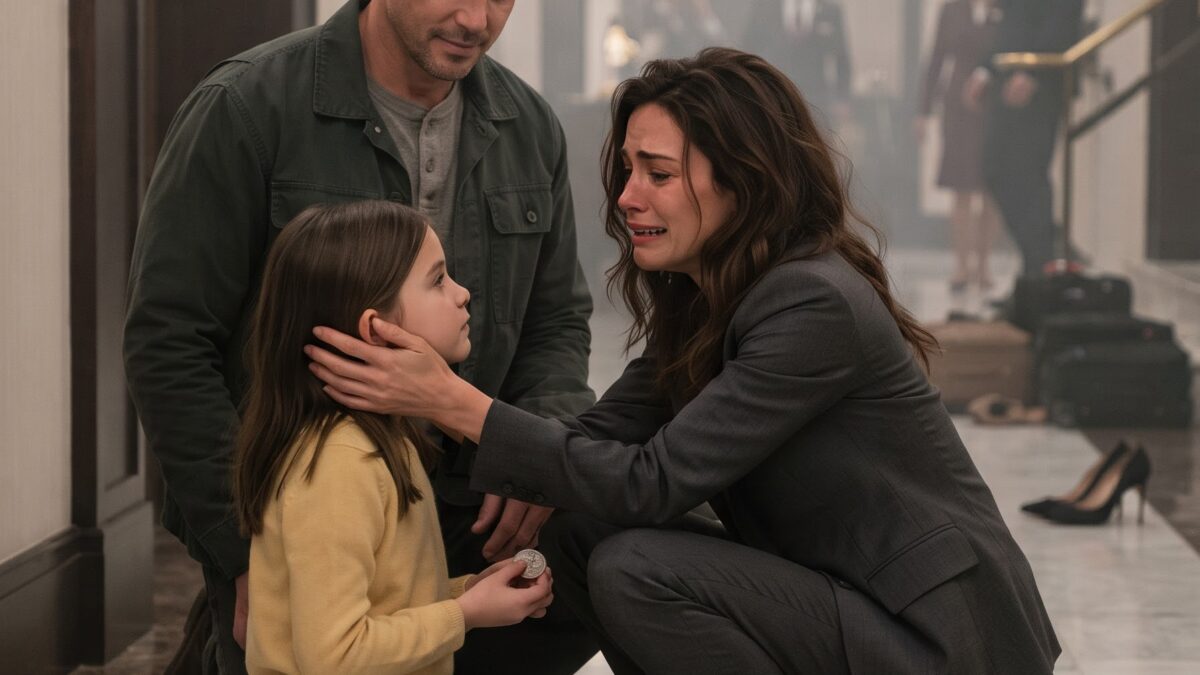
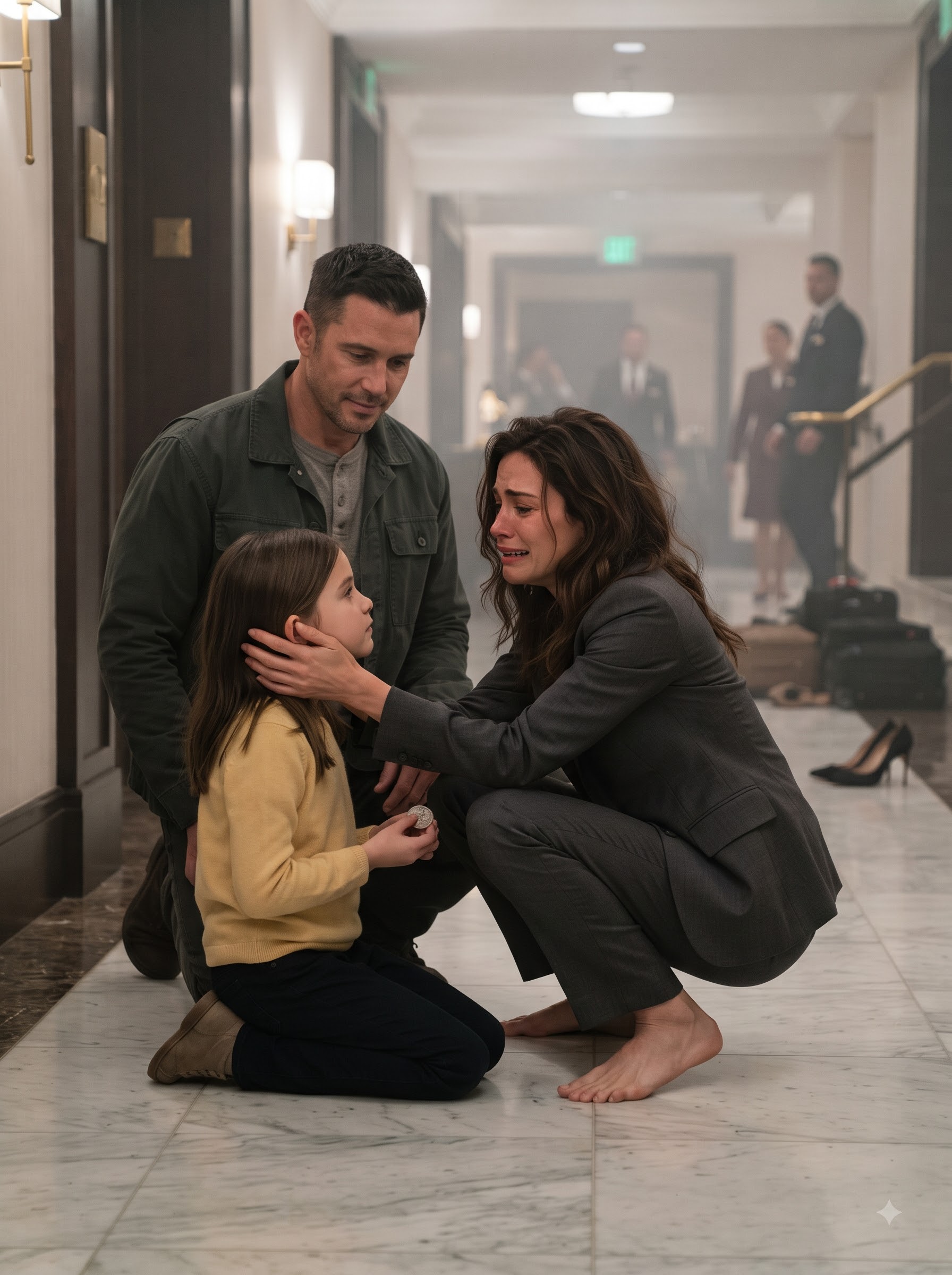
She crossed the corridor and crouched in front of her daughter and put her hands on Lily’s face.
Lily leaned into it the way she used to before the accident, and Aurora had to breathe through her nose for a moment before she trusted her voice.
“I told you she’d be scared,” Lily said to Cole.
“You called it,” Cole agreed.
Aurora looked up at him.
“He’d stood when she came in.
Not quickly, just easily.
The way someone stands when they’ve been sitting comfortably and there’s no longer a reason to stay down.
” He was holding his jacket, the thermos he’d left behind somewhere, apparently, because his hands were empty.
She was sitting here when I found this spot, he said. She seemed like she had it handled. It was a strange thing to say.
It was also, Aurora realized, exactly right.
He’d framed it in a way that gave Lily the agency that didn’t make her the subject of a rescue narrative.
She studied him for a moment with the same precision she brought to evaluating a prospective investment, quickly trying to identify what was real and what was performance.
She didn’t find performance.
I’m Aurora, she said.
Cole Mercer. He glanced at the corridor.
Building’s mostly clear.
We should probably head out.
It wasn’t a command.
It was just information offered neutally. And then he stepped back to let her lead the way.
Aurora stood, took Lily’s hand, and felt her daughter’s fingers close around hers fully, firmly, without hesitation.
She couldn’t remember the last time Lily had reached back first.
She looked down at her daughter’s other hand.
Lily was still holding the silver coin.
“That’s his,” Aurora said quietly.
“He can have it back outside,” Lily said.
Cole, walking a few feet behind them toward the exit, said nothing. But Aurora, who was getting better at reading silences, thought she heard something in his not quite amusement, not quite warmth, but something adjacent to both, something that had been there all along, quiet and unhurried, like the man himself. The October air hit them when they came through the lobby doors, cold and sharp off the river, carrying the smell of water and the distant sound of sirens that were already beginning to fade.
Hotel staff in yellow vests were directing people toward the cordined area.
The crowd stood in clusters, and Aurora moved through it with Lily’s hand in hers, and the strange, unsettled feeling of someone who had just had a long-held belief quietly, firmly contradicted.
She’d spent three years trying to help her daughter.
She’d hired the right people.
She’d followed the right protocols.
She’d made sure Lily had every resource that money could access.
And she tried, God knew she’d tried, to be patient in the way the specialist told her to be patient.
Therapeutic patients, calibrated patients, patients with a plan behind it.
And in less than 10 minutes, a man she didn’t know had sat down on a hotel corridor floor and done something none of it had managed.
He hadn’t fixed anything.
She knew that one conversation wasn’t a cure, and she wasn’t naive enough to call it one.
But something had shifted.
Something in the tightness around Lily’s mouth.
something in the way she was walking, upright and present rather than angled inward, the way she’d learned to hold herself in crowds.