Does It Hurt—A Female Billionaire Froze When Her Silent Daughter Whispered to a Single Dad Ex SEAL (part 2)
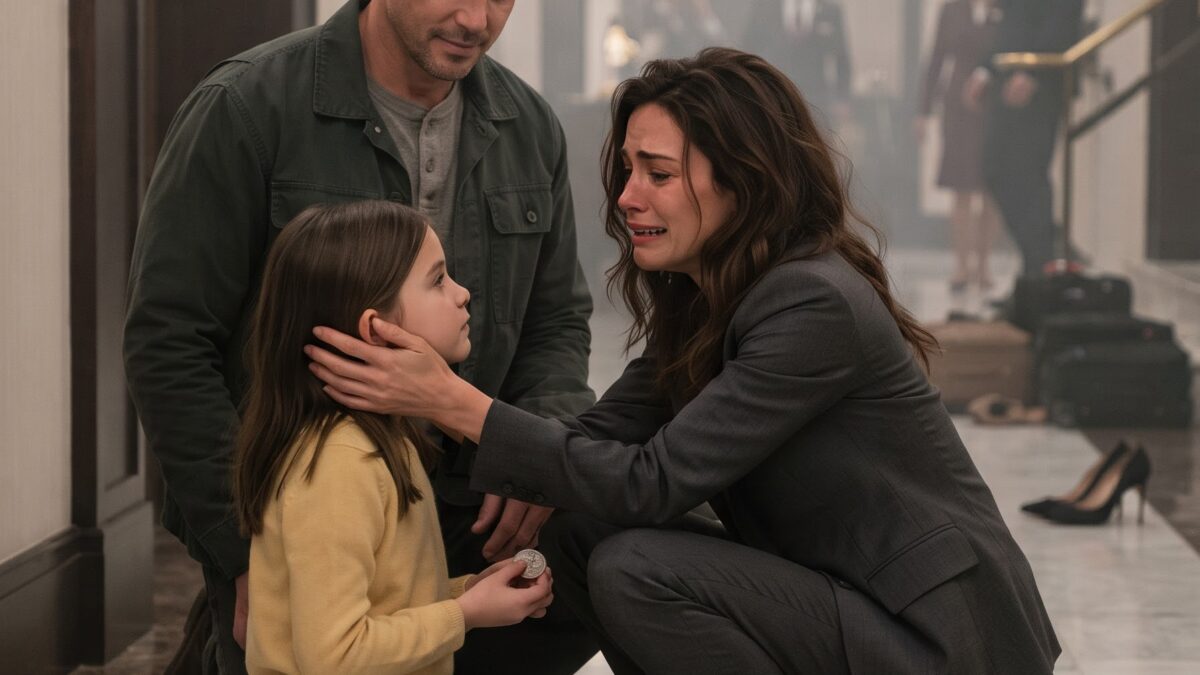
Part 2
Aurora looked back once. Cole Mercer was standing at the edge of the cordined area, hands in his jacket pockets, watching a hotel staff member check the list of evacuated guests.
He didn’t look back.
She didn’t know yet whether she was going to find a way to talk to him again.
She suspected with the same instinct that had built her company from nothing that she was going to try. They let Lily keep the coin for the rest of the afternoon.
Aurora didn’t plan it that way.
It happened because when the allclear came through and the hotel staff confirmed the alarm had been triggered by a malfunctioning sensor on the 22nd floor. Not smoke, not fire, just a corroded detector doing what corroded detectors eventually do.
Cole had walked them back to the lobby, and Lily had looked up at him and held the silver dollar out in her open palm the way he’d offered it to her.
And Cole had looked at it for a second, and then looked at Lily and said, “You can hang on to it for today.
Practice the trick. See if you can get it moving by tonight.
” Lily had closed her hand around it without a word, and that had been that.
Aurora had watched the exchange and felt the familiar pull of the things she’d been doing for 3 years.
The analytical reflex, the urge to understand the mechanism so she could replicate it. Why had that worked?
What was the formula?
She’d caught herself doing it and made herself stop, which was harder than it sounded.
She found Cole’s business card in her jacket pocket that evening after Lily had fallen asleep with the coin on the nightstand beside her sketch pad.
She didn’t remember him giving it to her.
She turned it over in her hands. Mercer Electrical Solutions. Cole Mercer, owner.
A phone number with a 312 area code.
The card was slightly creased along one edge like it had been in his wallet a long time before he’d handed it over.
She set it on the desk and went to bed and spent the better part of an hour staring at the ceiling, which was not something she usually did. The next morning, she was back in meetings by 8:00, and she was good at meetings, and she did not think about Cole Mercer at all for almost four consecutive hours, which she counted privately as a minor victory.
Then her assistant forwarded her a summary of the morning sessions, and somewhere in the middle of reading it, she realized she’d read the same paragraph three times without retaining a word.
She put the summary down and thought about what Lily had said in the corridor. I talked to him, not he talked to me.
The distinction felt important in a way Aurora hadn’t fully worked out yet.
She picked up her phone and sent a text to the number on the card. This is Aurora Sinclair.
I wanted to thank you properly. If you have time this week, coffee or a meal, whatever works for your schedule. She put the phone face down on the desk and made herself go back to the summary.
His response came 3 hours later. No thanks necessary. Glad she was okay.
And then after a pause that she could see represented by the timestamp gap, “But coffee works if you want.
I’m around Thursday.”
It was not the response of a man who was impressed by her name or her offer of a meal, which meant he either didn’t know who she was or didn’t particularly care, and Aurora found, somewhat to her own surprise, that she wasn’t sure which one she preferred.
She wrote back, “Thursday, I’ll be in the city.
You pick the place.”
She figured that was fair. She spent enough time being the one who picked the place.
He sent an address on the north side, a diner, not a restaurant.
She looked it up and the reviews were mostly about the coffee and the fact that parking was easier than you’d expect.
And nobody mentioned the ambiance because there wasn’t any.
Aurora added it to her calendar and told herself this was professional courtesy and nothing else, which was the kind of thing she told herself when she already suspected it wasn’t entirely true.
She flew back to Seattle.
the next day with Lily beside her on the plane and Lily spent most of the flight with the silver coin in her lap attempting the finger roll with the focused slightly resentful concentration of someone who has decided to master something they haven’t mastered yet.
She dropped it 11 times
that Aurora counted. Each time it happened, she picked it up without comment and started again.
Aurora watched her daughter and felt something she hadn’t felt in a long time.
Not hope exactly.
Hope was something she’d made herself careful about because hope had a way of becoming a liability when it wasn’t grounded in evidence, but something adjacent to it.
Something that sat in her chest without demanding anything from her. She looked out the window at 30,000 ft of cloud cover and thought about a man sitting on a hotel corridor floor, not asking questions while the world moved past him.
She thought about how she’d never once in 3 years of trying thought to just sit down.
The session with Lily’s therapist that Friday was the same as it had always been.
Gentle, structured, conducted in the carefully neutral tones of a professional who was very good at her job and had also, Aurora sensed, quietly revised her expectations somewhere along the way. Dr.Ren Callaway was 51, had been working with children for 23 years, and she genuinely cared about Lily. Aurora had never doubted that.
What she’d come to understand slowly and reluctantly was that caring about something and being able to fix it were two entirely different categories.
She spoke to someone, Aurora said after Lily had gone into the inner room and the door had closed. At the hotel, a stranger.
Callaway looked up from the file she’d been opening.
Spontaneously, he sat next to her and didn’t push, didn’t ask her anything.
Just Aurora paused, searching for the right word and finding only the simple one. Waited. Callaway was quiet for a moment.
She had the professional stillness of someone who’d learned not to react to information too quickly, which Aurora had always appreciated.
How did Lily seem afterward? Different.
Aurora looked at her hands.
Not fixed, just lighter, like something had been released that she’d been holding.
That’s significant.
I know it is. She looked up.
She’s been practicing a coin trick he showed her every morning.
She’s determined to get it.
Callaway made a note. Aurora watched her write and felt the familiar frustration she always felt in these rooms.
Not at the therapist, not at the process, but at the general inadequacy of language to describe the things that actually mattered. How did you put in a clinical note the way Lily had closed her hand around that coin?
How did you document the quality of a silence that had done more than three years of careful intervention?
You probably just wrote, “Patient demonstrated increased willingness to engage and moved on.”
Aurora thanked Callaway and went to pick up Lily from the inner room, and Lily was sitting in the small chair by the window with the silver coin in her hand.
And she looked up when Aurora came in and said, “I almost got the third finger today.”
Yeah, dropped it, but I almost had it. Show me at home, Aurora said.
Lily nodded and pocketed the coin with the ease of someone who’d been carrying it her whole life.
They walked to the car in the gray Seattle afternoon, and Aurora held Lily’s hand, and didn’t say anything else, and let it be enough.
Thursday arrived with the specific bleakness of a late October morning in Chicago, the kind of day where the sky looks like a ceiling, and the wind off the lake carries a personal grievance. Aurora took a cab from her hotel held to the address Cole had sent.
And the diner was exactly what the reviews had led her to expect.
A long counter, vinyl booths, a menu on a laminated card, and the kind of coffee that was brewed fast and served hot, and didn’t apologize for being ordinary.
Cole was already there when she arrived.
He was in a booth near the back, not the one with the best sighteline to the door, which he registered as a small data point about the kind of person he was, or at least the kind he’d decided to be now outside the world that had made those habits necessary.
He had both hands around a mug.
He was wearing a dark green work jacket over a gray shirt, and there was a smear of something on his left forearm that might have been grease, which meant he’d come from a job site.
He stood when she approached.
You didn’t have to, she started.
Force of habit, he said, and sat back down. She slid into the booth across from him.
A waitress appeared immediately with a pot of coffee, and Aurora put her hand over the mug before the woman could ask, and the waitress said, “Smart and moved on.”
There was a brief pause that wasn’t quite awkward, but was looking in that direction.
“How’s Lily?”
he asked.
“Practicing the coin trick every day.
She’s getting close.”
Something moved across his face. Not a smile exactly, but adjacent. She will.
She’s got the focus for it.
She dropped it 11 times on the plane home and didn’t stop once.
Then she’ll definitely get it.
Aurora wrapped her hands around the mug she hadn’t let the waitress fill and looked at him across the table.
Up close in flat diner light rather than emergency corridor light. He was different than her first impression and also exactly the same. The lines around his eyes were deeper than they should have been for 37.
And there was something in the way he held his shoulders that read like someone who had learned through long practice to take up less room than his body naturally wanted to. Not submissive, just contained. The difference mattered.
I want to ask you something, she said, “And I want to be upfront that it’s personal and you don’t have to answer.”
He looked at her steadily. Okay.
What made you sit down specifically? Most people walked past her.
He considered this not in the way of someone deciding whether to be honest, but in the way of someone who wanted to give an accurate answer rather than a comfortable one. The stillness, he said finally.
She wasn’t panicking.
She’d already made a decision.
She decided that staying put was safer than moving, and she was right about that. He turned the mug in his hands.
When someone’s already made a good decision, the worst thing you can do is interrupt it by showing up with a lot of noise.
So, you didn’t.
Aurora stopped, rec-calibrated.
You didn’t think she needed help?
I thought she might need company. Those are different things.
She sat with that for a moment. Outside, a bus went past close enough that the windows rattled slightly.
Lily hasn’t spoken to a stranger in 3 years.
Aurora said since a highway accident when she was four. She was in the back seat.
She watched his face, but it stayed level. Her grandmother, my mother, was driving.
She didn’t make it.
I’m sorry, he said.
Not the way people usually said it as social punctuation, like he meant the word specifically.
Lily wasn’t physically hurt.
Not badly. But she stopped talking outside the house about a month after, and it Aurora stopped again.
This was the part she never described well. Not to anyone.
It became permanent.
Selective mutism, the diagnosis is, but that’s just a name for a thing that doesn’t have a name that feels adequate.
How long were you inside trying to reach her? Cole asked.
Before the corridor. The question surprised her. Not its content, but its angle.
Reaching her instead of helping her or treating her. 3 years, she said.
Specialists, therapists. One program in Massachusetts that costs more than I want to think about.
She exhaled.
I’m not saying that critically.
The therapist she has now is excellent. It just she pressed her lips together.
It didn’t move.
Not like that. Cole was quiet for a moment.
Then he said, “Did you ever ask her what she needed?
She doesn’t speak.
That’s she communicated with you before Thursday.
You said she used to touch your wrist when she meant yes.”
He said it without any particular emphasis, just a fact he was returning to her. Aurora went still. She had told him that in the corridor.
She hadn’t remembered telling him that.
I She stopped, started differently.
I didn’t think of it as asking.
Most people don’t.
He picked up his mug.
I’m not criticizing.
You built a whole system of support around her because you love her and you had the resources to do it.
That’s not wrong.
It just sometimes the system becomes the thing that’s in the way.
It was a harder thing to hear than she’d expected, partly because he said it without judgment, without the self-satisfaction that usually came when someone told you you’d been doing something wrong.
He sounded like someone who had arrived at the same conclusion about himself at some point and was just reporting what he’d found.
“You said you have a daughter,” Aurora said.
“Emma, she’s nine.
You’re raising her alone.”
“Yeah.”
A pause. Her mother and I, we tried for about 2 years after I got out of the service.
It didn’t work.
She’s remarried now in Phoenix.
Emma’s with me.
That’s Aurora.
Wasn’t sure how to finish the sentence.
It’s fine, he said.
It’s better than the alternative, which was two people staying in a marriage that wasn’t working because it felt like failure to admit otherwise.
He said it plainly without bitterness.
Emma’s good.
She’s loud and she argues about everything and she has opinions about breakfast foods that she will defend at length.
She’s great.
Aurora found herself almost smiling. Lily has opinions about birds. What kind?
Every kind. She has four field guides.
She can identify a call before she can see the bird. Aurora shook her head. She knows more about the migratory patterns of the Pacific golden clover than most ornithologists.
Probably Emma would lose her mind about that.
Cole said she’d follow her around with a notebook.
The image arrived without announcement and sat in the middle of the conversation like something that belonged there. And for a moment neither of them said anything.
It was an uncomfortable silence.
It was the specific quiet of two people who have unexpectedly arrived somewhere they didn’t intend to go.
The waitress came back. Aurora let her pour the coffee. Cole ordered eggs and toast.
And Aurora, who had eaten a hotel breakfast 2 hours ago, found herself ordering the same thing. And they sat across from each other in a Chicago diner in the late October wind and talked for an hour and 40 minutes about things that had nothing to do with business.
He told her about the electrical company, how he’d started it 3 years after leaving the Navy, how the first year had been financially brutal and the second had been merely difficult, and by the third he’d hired Daario, who was perpetually late but extraordinarily precise, and S, who was the opposite.
He talked about commercial contracts and the specific challenges of older buildings in the city and the way a circuit diagram could be almost elegant when it was done right.
and he said that last part with a kind of quiet enthusiasm that was clearly genuine and also clearly surprised him slightly, like he’d said more than he’d meant to.
She told him about the early years of Sinclair Capital, the clients who hadn’t taken her seriously until they saw the returns, and then took her too seriously in ways that had different problems.
She told him about the morning she’d realized she was managing 11 billion and had no idea what day of the week it was.
She told him that the summit she’d been attending was one she’d normally have sent a deputy to, and that she’d come herself because she’d needed to be somewhere different for a few days, and that she had not told anyone in her company that.
You don’t seem like someone who tells people when they’re struggling, he said.
That’s a polite way to say it.
I could say it less politely.
You’d probably be right either way.
He ate. She ate.
The coffee was exactly as ordinary as advertised and she drank two cups anyway.
At some point, the conversation shifted the way conversations do when the easy surface material has been covered and there’s a question underneath that both people are aware of.
She felt it happening and didn’t try to manage it.
You were in the Navy, she said. Seal 10 years. When did you leave?
About four years ago. He picked up his toast.
It wasn’t there wasn’t a dramatic reason.
I had Emma and her mother and I were already struggling and I looked at the math of what another deployment cycle would do to both situations and decided the math didn’t work anymore.
Do you miss it? He thought about that with the same deliberateness he brought to everything.
Parts of it, the work itself sometimes, the problem solving, the way everything became very clear when the stakes were real. He set the toast down.
I don’t miss what it costs to keep that clarity.
She wanted to ask what he meant.
She didn’t because she thought she already understood and also because some things were better left in the space where they lived rather than brought into fluorescent light.
The way you were with Lily, she said instead, the calmness that’s from there.
Some of it, some of it’s from Emma, he looked at her.
You learn with kids that the panic you show them is the panic they’ll carry.
They’re always watching to see how you handle the thing that goes wrong.
If you fall apart, they fall apart.
If you stay steady, they can be unsteady because there’s something solid to come back to.
Aurora set down her fork. She had heard this principle in some form from therapists, from parenting books, from Callaway more than once. She had understood it intellectually each time.
Hearing it from this man in this diner after 3 years of failing to live it in the way it needed to be lived, it hit differently.
not because he’d said it better, because he’d just been describing something he actually did, not something he’d been trained to articulate.
She looked out the window at the street. A woman was trying to open an umbrella against the wind and losing.
Across the intersection, a construction crew was pulling cable through conduit, and she thought about how Cole would look at that job site differently than she did, would see the logic of it, the pattern, the places where the work was clean, and the places where someone had taken a shortcut they’d regret.
I’ve been trying to solve her, Aurora said quietly enough that it was almost for herself.
I’ve been treating her like a problem with a solution.
If I get the right specialist and the right protocol and give it enough time, she’s not a problem, Cole said.
Not sharply, just factually. I know that. I think you know it up here, he said and tapped his temple once lightly.
I’m not sure it’s got all the way down yet.
She could have pushed back on that.
She didn’t.
Because the thing about being told an accurate thing by someone who didn’t need anything from you was that you couldn’t really argue with it.
He wasn’t trying to sell her a treatment plan.
He wasn’t angling for a referral or building toward a point.
He was just saying what he’d noticed and leaving her to do whatever she wanted with it.
That she thought was rare.
That was so rare she didn’t have a good category for it.
They stayed in the booth until the lunch rush made the waitress look at them apologetically and then they paid.
He insisted on splitting it, which she expected he would, and she didn’t argue because she suspected arguing would have been insulting, and walked out into the wind.
On the sidewalk, with the cold coming off the lake several blocks east, they stood in the way of two people who have run out of the neutral excuse of a shared table, and now have to decide what comes next.
Emma’s going to ask me who I had coffee with, Cole said.
She always does. What are you going to tell her? that I met a woman in a hotel evacuation who has a daughter that knows about birds.
He said it without inflection.
She’ll want to know if she has any field guides she can borrow.
Lily would probably mail them, Aurora said. And then before she could think better of it, you should bring Emma to Seattle sometime.
There’s a wildlife sanctuary 20 minutes from my house.
Lily would walk her through every exhibit.
She said it like it was a casual thing, which it wasn’t.
And he received it the same way, which she appreciated. Maybe, he said.
Not yes and not no, and not a deflection, just an honest maybe, offered by someone who wasn’t going to say a thing he didn’t mean.
He put his hands in his jacket pockets and nodded once, a small, solid gesture, and turned toward the parking structure down the block where he’d left his truck.
Aurora watched him go for a moment, then turned the other direction toward the street corner where her cab would come. She had walked half a block before she realized she was thinking about what Cole had said.
She’s not a problem.
And turning it over the way Lily turned the coin over, looking at all its edges, trying to understand something about the weight of it.
She thought about the way Lily had said, “I talked to him instead of he talked to me.
” She thought about 3 years of careful, expensive, well-intentioned intervention, and one man who had accomplished something she hadn’t by the simple act of deciding that sitting down was enough.
👉 [Tap here for the Next Part ] 👈

