Does It Hurt—A Female Billionaire Froze When Her Silent Daughter Whispered to a Single Dad Ex SEAL (part 3)
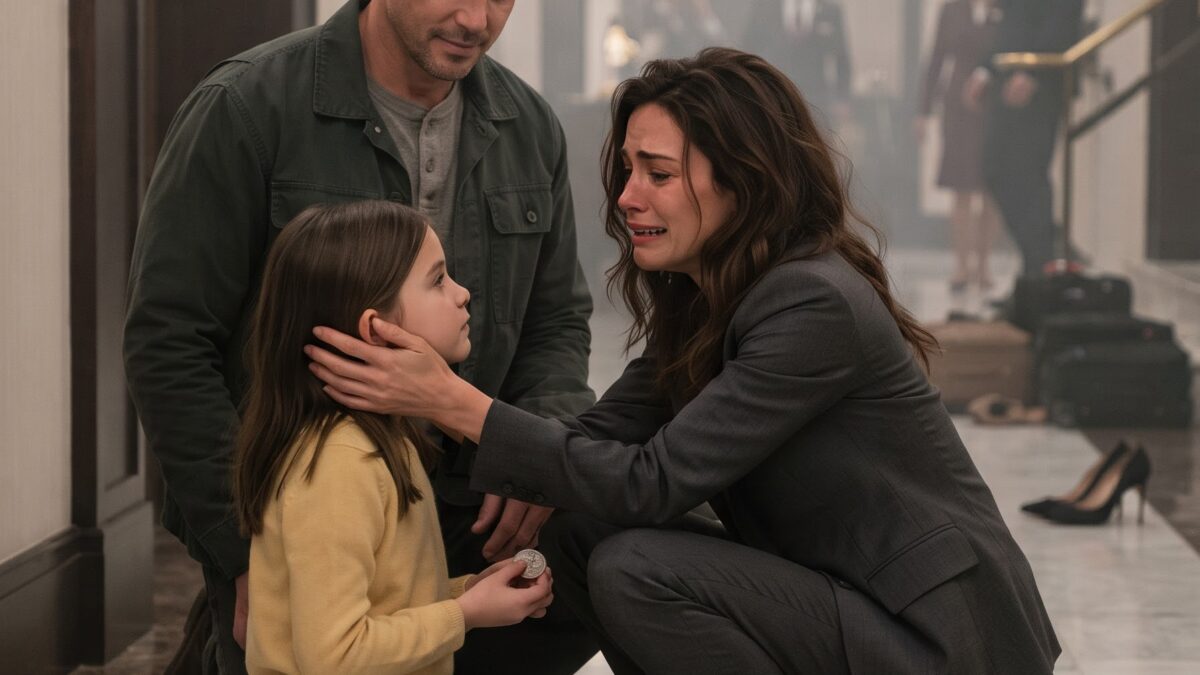
Part 3
She thought about the way he’d described staying steady so that Emma could be unsteady if there’s something solid to come back to, and felt the particular sting of recognizing something true that you’d been unknowingly refusing.
She hadn’t been solid.
She’d been busy.
She’d been competent and present and devoted in the way you could be devoted to something while still underneath it all being terrified of it.
She’d built systems around Lily because systems were what she knew how to build.
And she’d poured resources into those systems because resources were what she had, and none of it had been wrong.
Exactly.
But something had been missing that she couldn’t have named before Thursday and could now name clearly.
She’d been trying to reach Lily from a standing position.
She’d never once sat down on the floor.
The cab came.
She got in and gave the hotel address and sat in the back seat as Chicago moved past the windows, gray and purposeful, and let herself feel the discomfort of understanding something about herself that she couldn’t un understand.
That was the thing about accurate information.
It didn’t give you anywhere comfortable to put it.
You just had to carry it forward and decide one day at a time what you were going to do with the weight. Aurora told herself the second trip to Chicago was for business.
It wasn’t a complete lie.
There was a portfolio company in the West Loop that needed a board conversation and her COO had been flagging the need for a site visit for 6 weeks and the timing worked. She put it on the calendar, briefed her assistant, booked the flight.
All of that was real and necessary and would have happened eventually regardless.
What wouldn’t have happened eventually without a specific decision on her part was the dinner reservation she made for a Thursday evening at a restaurant on the riverfront or the text she sent to a 312 number 3 days before the flight in Chicago again next week.
That dinner offer still stands if you’re free Thursday.
His response came the next morning early enough that she suspected he’d been up for a while.
Thursday works.
Emma’s at her mom’s that weekend so I don’t have to be back early.
She read that detail twice.
She wasn’t sure what to do with it, so she just confirmed the restaurant and let it sit.
The board meeting on Wednesday ran long in the way board meetings always ran long when two members disagreed about something they’d actually decided three meetings ago and had simply neglected to fully commit to.
Aurora managed it the way she managed most things, directly without cruelty, with the kind of patience that came not from temperament, but from the clear understanding that losing patience would cost her more than maintaining it.
By the time she got back to the hotel, it was nearly 9:00, and she had a headache behind her left eye that she’d been ignoring since 4:00.
She ordered room service, ate half of it, and sat by the window looking at the river lights below while Lily called from Seattle. Lily had taken to calling in the evenings when Aurora traveled. Not every night, but most nights, a habit that had developed quietly over the past several weeks since October, since the coin.
She didn’t always talk much.
Sometimes she just showed Aurora things through the phone camera, a bird she’d drawn, the coin trick she’d been working on, a page from a field guide she thought Aurora should see.
Tonight, she held up the silver dollar and did the full sequence, index finger to pinky and back, clean and unbroken. And Aurora felt something loosen behind her sternum. You got it, she said.
3 days ago. Lily turned the coin over.
I didn’t tell you because I wanted to practice more first.
Why?
Lily shrugged in the particular way that meant she’d thought about this already.
Because saying you can do something before you’re sure is she made a face.
premature. Aurora recognized that word.
She’d used it herself recently in a meeting.
She wondered with a complicated feeling she couldn’t quite identify whether Lily had stored it specifically or whether it had just settled into the vocabulary the way words did when you heard them used correctly.
Does Mrs.Navaro know?
That was Lily’s afternoon sitter who had been with them for two years and was one of approximately four non-family adults Lily communicated with directly.
I showed her a pause. She cried a little. That sounds right.
Lily was quiet for a moment.
Then, “Is Cole in Chicago?”
Aurora kept her face neutral, which was harder than it should have been.
“I don’t know.
I have a meeting tomorrow.”
Which was not an answer to the question, and Lily, who was seven and paid close attention, would know that.
Okay, Lily said and let it go, which either meant she’d accepted the non-answer or had made her own determination and was keeping it.
With Lily, it was always one or the other. They said good night.
Aurora set the phone on the desk and looked at the river for another few minutes and then went to bed and slept better than she had in weeks, which she didn’t examine too closely.
Thursday evening, she walked the three blocks from her hotel to the restaurant rather than taking a cab because she’d been inside all day, and the cold air was useful.
The restaurant was a different order of magnitude than the diner. Not aggressively upscale, but real food, real wine list, white tablecloths, the kind of place where conversation was the point rather than an accident.
She’d picked it deliberately and was secondguessing the deliberateness of it.
By the time she came through the door, Cole was already there. He had clearly made an effort. dark button-down instead of a work jacket, his hair slightly less rough than it had been at the diner.
But the effort was understated in a way that felt like him, like someone who had been told to dress for dinner and had done so without surrendering anything in particular. He stood when he saw her. She was beginning to understand that this was not performance.
It was just what he did.
You look like you’ve been in a conference room all day, he said once they’d sat.
Was it that obvious?
You’re holding your shoulders like someone’s been arguing with you.
She made a deliberate effort to relax them, felt the small release, and was mildly annoyed that he’d noticed before she had.
Board meeting long one resolved functionally. Two of them will continue disagreeing in private for another month and then stop because something else will come up.
He nodded. He seemed to understand the dynamics of that without needing elaboration, which she appreciated.
They ordered. The conversation found its level easily, more easily than it had at the diner, the way second conversations usually went when the first one had been honest.
He’d been working a commercial retrofit on a building in Pilson, older structure, mid-century electrical system that someone had added onto incrementally over decades until it was, in his words, a map of every shortcut anyone had ever taken, layered on top of each other.
He described the process of tracing it, identifying what was loadbearing and what was cosmetic and what was actively dangerous.
And there was something in the precision of it that she found herself following more closely than she’d expected.
You actually like this, she said the tracing part specifically. Why specifically that? He thought about it.
Because you can’t fake your way through it.
The system either makes sense or it doesn’t.
You either find the problem or you don’t.
There’s no, he paused, looking for the word.
There’s no interpretation.
It’s just real.
She understood that.
She didn’t say so immediately, but she thought about the early years of building the company, the period before the company became something that required managing rather than something that required building, and remembered feeling exactly that way about the analysis work, the honesty of numbers, the way a balance sheet didn’t negotiate.
Lily got the coin trick, she said. After a while, his expression did the thing it did when he was pleased about something.
Not a wide smile, just a slight softening around the eyes. All four fingers, forward and back, no drops.
How long did it take? About 3 weeks. She practiced every day without being asked.
That’s who she is, he said.
She’s not doing it to impress anyone.
She just decided she was going to get it, and that was that. Aurora turned her wine glass slowly.
She asked if you were in Chicago. silence, not uncomfortable, but waited.
“What did you tell her?”
he asked. That I had a meeting.
She looked up, which was true. Also not an answer.
“No,” she agreed.
“It wasn’t.
There was something in the air between them that they’d both been careful about, had been careful about since the diner, possibly since the corridor, and neither of them addressed it directly, which was a choice they were both making consciously enough that the consciousness of it was itself a kind of acknowledgement.
He refilled her water glass without being asked. She noticed.
After dinner, they walked because the night had gone dry, even if it hadn’t gone warm, and neither of them suggested going back to separate hotels yet.
The river was lit from below, the water moving dark and fast, and they walked along the riverwalk without particular destination, their pace matching without either of them adjusting for it.
Aurora had planned, in a loose way, not to say the thing she’d been carrying since October.
She decided it was unnecessary, that the relevant information had been conveyed, that reopening it served no clear purpose. She decided this on the plane ride over and had revised the decision twice during the board meeting.
And by the time they’d finished dinner, she’d quietly abandoned it.
“I need to tell you something about the accident,” she said.
“The one with my mother.”
Cola walked.
“He didn’t say go ahead or I’m listening or any of the things that would have made it a performance.
He just walked and she understood that meant she could continue whenever she was ready.”
“I was supposed to be driving,” she said.
My mother and I had plans for the day and I was going to drive. And then a deal fell through at 7:00 in the morning.
A deal I’d spent 4 months on.
And I was so deep in damage control that I asked her to take Lily instead.
She said it flat without inflection, which was the way she’d trained herself to say it so she could get through the whole thing.
She didn’t complain.
She never complained. She took Lily and they went to the botanical garden.
And on the way home, a car ran a red light and hit them on the driver’s side.
Cole said nothing. She kept walking. My mother died at the hospital 4 hours later.
Lily was in the back seat behind her and she was she wasn’t hurt badly physically, but she saw everything.
Aurora stopped at the railing and looked at the river.
She was 4 years old and I wasn’t there because I was on a call trying to save a deal that ultimately didn’t matter.
The wind came off the water. A tour boat moved downstream, its lights trailing. Aurora, Cole said.
He said it quietly and without any particular shape to it, not as comfort, not as contradiction, just as her name offered to the space between them.
I know it wasn’t.
She stopped. I know the rational version of this.
I’ve been through it with two therapists.
The accident wasn’t my fault in any causal sense.
It would have happened the same way if I had been driving, or it wouldn’t have happened at all because we’d have left at a different time.
There’s no way to know.
I understand all of that.
and it doesn’t help.
It helps about 40% of the way. She looked at him. The other 60 is just there.
He leaned on the railing beside her, looking at the water. Close enough that she was aware of the warmth of him in the cold air, but not touching, not crowding.
I lost a guy on my last deployment, he said after a moment. Ahmmed. He was 26.
The decision that put him in the wrong position that night was mine.
I’m not saying I made the wrong call.
I made the best call available with what I knew, and the inquiry said so, and I believe that, but he’s still dead.
He turned the collar of his jacket up against the wind. The rational version of that is also correct.
Doesn’t change what I carry.
She looked at his profile. The river light caught the sight of his face, and she thought about what it had cost him to say that, not in the sense of emotional performance, but in the sense of a man who kept things in their correct place, and had just brought one of them out. How do you keep going with it?
She asked. The weight of it. He took a moment.
You stop trying to put it down, he said.
That’s the thing nobody tells you.
You think if you process it enough, understand it well enough, you’ll eventually be able to set it somewhere and walk away.
But some things don’t work that way.
You just you get better at carrying them. Your shoulders get stronger.
You stop noticing the weight as much because it’s just part of you now.
She thought about that about the 3 years of trying to put it down.
the therapists and the analysis and the understanding she’d accumulated and how none of it had made the 60% smaller.
It had only given her better language for describing its shape. Emma knows about Ahmad. She said it was a question phrased as a statement.
Not the specifics.
She knows I’ve carried hard things.
I told her once that brave people aren’t people who don’t feel scared.
They’re people who do the next right thing even when they’re scared.
He paused. She was six. She listened very seriously and then asked if we could have pancakes.
Aurora laughed. It came out unexpected, short and real, and she felt it surprise her.
“That sounds exactly right,” she said.
“It was exactly right.
The pancakes and the question both.”
They stood at the railing for a while.
The city moved around them, a couple passing behind them, someone on a bicycle cutting close to the walkway, the ambient noise of Chicago at night, which had its own particular texture different from Seattle’s.
She’s been different since October.
Aurora said Lily not.
I don’t want to overstate it.
She’s still not talking at school, but at home she’s more present like she came back from somewhere a little.
She glanced at him. She asked Mrs.Navaro about the coin last week. Whether she thought the trick would work with a regular quarter.
Does it? I have no idea.
I assume she’ll find out.
She will.
He said, “She’ll find out, and she’ll have documented the differences, and she’ll have an opinion about the weight distribution.”
That’s extremely accurate.
They walked again, slower now, back in the direction they’d come.
The cold had deepened, but neither of them suggested going in.
“Cole,” she said his name, and then took a moment to get the rest of it organized.
“What you did for her, sitting down, not pushing, just being there.
I understand now that it wasn’t a technique.
It wasn’t a strategy.
But I’ve been trying to figure out how I do that, how I become that for her instead of instead of the person who shows up with solutions.
Yes, he thought about it.
You can’t decide to be calm, he said.
You can’t decide to be patient.
You can do the work that makes you calmer over time, but you can’t just choose it the way you choose a plan.
He looked at her. You know what I think you actually did wrong in that corridor?
You didn’t do anything wrong.
You were terrified for her. You communicated it and she knew.
Kids that age, especially kids like Lily, they can feel what’s underneath what you show them.
She loved you enough to try to protect you from her own fear, and that meant holding it all herself.
Aurora heard this and felt it land in a way she hadn’t prepared for.
She didn’t say anything for a moment.
They walked another 30 yard in silence. She was protecting me, she said.
Not a question. arranging something.
My read, he said, could be wrong.
You’re not wrong.
She had seen it before now that he’d named it.
The way Lily’s silences in Aurora’s presence sometimes had a different quality than her silences elsewhere.
Something careful and caretaking in them, like she was managing her own responses to manage Aurora’s responses.
She’d seen it and interpreted it as withdrawal.
It wasn’t withdrawal.
It was a seven-year-old’s way of standing between her mother and more pain.
The thought hurt in a specific and clarifying way.
She’s 9 years older than her age, Aurora said quietly.
Yeah, so was Emma for a while. Still is sometimes.
How do you undo that?
You show them they don’t have to do it anymore.
He said it plainly. You show them enough times that you can handle your own load that they start putting theirs down.
It takes a while. A couple passed them. A woman walking a dog that pulled toward the railing.
And the small interruption gave Aurora a moment to breathe.
“The deal,” she said after the couple had passed.
“The one I was on the phone for the morning of the accident.”
“Yeah, I don’t remember the company’s name anymore.”
She said it like a confession and it was one.
I’ve tried to remember it and I can’t.
I know the industry. I know approximately what quarter it was in, and the name is just gone. She looked at the water.
I’ve thought about that a lot over the years.
Cole said nothing.
He didn’t fill the silence with reassurance, which was exactly right.
I think about what I was protecting, she said. When I asked my mother to take Lily instead of me, I told myself it was the company, the investors, the responsibility, and that was real.
But some of it was I just didn’t want to leave the call.
I didn’t want to miss the crisis.
And I don’t know if I would have made the same choice differently, even knowing.
She stopped.
That’s the part I can’t put down.
The part where you’re honest about who you were at the moment, Cole said, rather than who you wished you were.
Yes, that’s the hardest kind to carry.
He said it without softening it.
Because you can’t argue with it.
The versions that are just bad luck, those you can eventually make peace with.
The ones where you see yourself clearly and don’t like what you see, those take longer.
She looked at him.
“Did you have one of those from the service?”
He was quiet long enough that she thought he’d decided not to answer.
“More than one,” he said finally.
“Yeah.”
She didn’t push.
She let it be what it was.
They’d circled back to a point near the restaurant, the riverfront thinning as they moved away from the tourist sections, the lighting sparser, the wind louder without the buildings to break it.

