“JUST A NURSE,” They Said — Until a MILITARY K9 Revealed What She Could Really Do (part 2)
Part 2
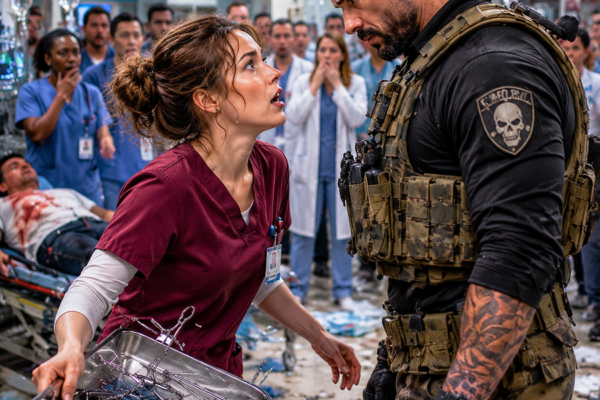
He pressed the comm unit, started giving new coordinates. It was while he was doing that, while Solace was relaying updated positions, and Kellerman was preparing to move Sergeant Marsh to a more secure bay as a secondary precaution, that the door to the annex room opened without a knock and Dr.Harlland Greg walked in.
He looked at the military personnel, at the comm equipment, at Clare standing near the table with the posture she usually didn’t use at this hospital, which was the straight, still posture of someone who has made a decision and is waiting to execute it, rather than the deliberately softened stance she’d maintained for 2 years of being serviceable.
He looked at all of it, and his face did the thing faces do when a narrative collapses faster than the brain can build a replacement.
“What is going on in here?”
he said. Dr.Greg, Claire started, I was told this was a 10-minute conversation.
It’s been, he looked at his watch, 40 minutes.
I have an administrator asking questions I can’t answer.
I have military personnel occupying my annex, and now I’m hearing there are vehicles in our parking structure that nobody has explained to me.
His voice was rising, but it was the rise of genuine bewilderment rather than calculated authority. Clare, what is happening? She looked at him for a moment, just a moment.
She thought about how to package this in a way he would accept. She had spent two years learning his preferences, his blind spots, his specific brand of certainty.
She knew exactly how to talk to him in a register he’d receive as non-threatening.
But she didn’t have time for that.
There are people outside this building who may be looking for me, she said. Captain Solless and Commander Puit are here to help get me to a secure location.
I need about 5 more minutes and then you won’t have to explain anything to anyone in this building.
Greg stared at her. People looking for you. He repeated.
Yes, for you. For Clare Ashford, my triage nurse.
That name isn’t.
She stopped, recalculated.
It’s complicated.
Complicated. He looked at Puit, who was watching this exchange with the careful stillness of someone who has learned to let situations play out unless they require intervention.
Commander, can you explain to me what is happening with my employee? Puit chose his words.
Your employee has a background that requires federal attention. She is cooperating with that process.
I need to ask you to stay in this room until I’m not staying in any room.
Greg’s voice had found its authority again.
This is my hospital.
I don’t know who you people are.
We’re the people trying to get her out safely, Solace said.
She said it without heat, but she said it with enough weight that it landed. And right now, the most useful thing you can do is close that door and not go into the main corridor for the next several minutes.
Greg looked at Clare. She looked back at him. In his face, she could see the collision happening in real time.
The version of her he’d built over 2 years.
the serviceable nurse who corrected doctors without looking like she was doing it and who never talked about her past and who had a strange relationship with a Navy military dog on a Monday morning colliding with the version of her that was currently being assembled from the evidence in this room. Claire, he said, and for the first time all morning there was no authority in it, just a question.
Close the door, she said. Please. He closed it.
The maintenance corridor was exactly as she’d described, tight, institutional, lit by a fixture every 30 ft with two gaps where the bulbs had been out long enough that someone had taped reflective material to the wall as a substitute.
Clare moved through it without slowing. Puit was behind her, then Solace, then Kellerman with Rogue.
Two of Puit’s additional personnel, she still didn’t have their names, had taken positions at each end of the corridor as they moved, 60 ft in the lateral door.
It was metal, painted the same beige as every other surface in the maintenance section with a pushbar handle and a sticker on the upper panel that said, “Loading dock, authorized use only.
” She pushed it open.
The loading dock was below street level as she’d described.
A concrete bay designed for supply trucks, currently empty except for a pallet of linen packages that had been left against the far wall.
The overhead door at the dock’s west end was down.
Ambient light came from the vehicle ramp on the left side. Solace was already on her calm, repositioning a vehicle. 4 minutes, she said.
They waited in the half dark of the dock. It was cold in the way underground spaces are cold regardless of season. The deep concrete kind that has nothing to do with weather.
Clare stood near the pallet of linens with her hands loose at her sides and her eyes on the ramp. Rogue was beside her.
He hadn’t needed a command.
He’d simply matched her position and stayed.
He trained with your team for how long? Kellerman asked. He said it quietly, partly because the acoustics of the dock made sound carry and partly because it was the kind of question you ask carefully.
14 months, Clare said. From the point he was assigned to us to the point Iron Tide went active, he was with specialist Holt. Yes.
Kellerman looked at the dog.
He kept Holt’s color code on his vest.
Even after he was transferred, his handler at the time couldn’t get him to accept a different marker.
They eventually just left it.
She didn’t answer that.
Rogue’s ear twitched.
Then the overhead door at the top of the ramp moved.
Not the large vehicle door, the personnel door set into the wall at the ramp’s upper edge.
It opened 6 in, and a figure appeared in the gap, and for the half second before Clare processed the specific set of the shoulders and the civilian jacket, her entire nervous system went to a place it hadn’t been in 5 years.
the flat, cold, decisive territory of someone who has run out of options except one. Then she recognized the face.
It wasn’t someone from outside.
It was Commander Puit’s second in command, a woman named Terra Vo, who had taken the long road around the building and who was holding the door open and saying quietly and with professional calm, “Vehicles at the west curb.
We need to go.
” The breath Clare let out was controlled.
Even Rogue’s ear flicked back to neutral.
They moved up the ramp in a tight group out through the personnel door and onto the street’s west side in the specific kind of gray Montana afternoon that makes everything look like it happened in a different decade.
A dark blue vehicle, government plates, a type she recognized, was at the curb with the engine running. She was three steps from the door when her hospital pager went off.
She stopped, looked at the pager out of reflex, deep reflex, the kind that two years of work builds into the body before the mind catches up. Bay one active situation. Claire Puit said, the pager went off again.
Bay one, same alert and then a second alert overlapping it. Her own name pulled systemwide, which meant the charge nurse was looking for her specifically. She stood on the sidewalk with the vehicle door open in front of her and the hospital behind her and the alert in her hand.
And she understood something with complete clarity. Whoever was inside that building right now had been her responsibility for 2 years. Not a cover story, not a secondary function.
Real people, real emergencies, the actual work she’d done because it was the only kind she knew how to do.
Go.
Solus said, “We move now.”
She looked back at the building.
She looked at Rogue, who was watching her with that patient, certain attention he’d had all morning.
The look of an animal who has already decided where he stands and is simply waiting for the person beside him to catch up. She took one step toward the vehicle. Her pager went off for the third time, and this time the code was different.
A code she’d only seen twice in her two years at Harlo General.
A code that meant the situation in Bay 1 wasn’t a standard emergency anymore.
It meant there were weapons in the building. She turned around. Claire Puit started.
Someone just pulled a weapon in my ER. She said she was already moving back toward the loading dock entrance before he finished saying her name.
And the thing that surprised all of them, including she suspected herself, was that Rogue was already ahead of her. Rogue hit the personnel door two steps ahead of her and stopped.
Not because he’d been commanded to stop, but because the door was closed and he understood doors.
Clare pushed through it without breaking stride, and they went down the ramp together into the loading dock, her shoes loud on the concrete, his paws silent.
Behind her, she heard Puit say something short and clipped into his comm unit, and then Terrao’s voice, and then the sound of the vehicle door and boots on pavement that meant at least two of them were following.
She didn’t wait to count.
The maintenance corridor swallowed the mayor again. the tight walls, the dead light sections, the beige that had absorbed decades of institutional indifference. She moved fast through the dark patches, not running because running in a confined space with corners was how people got hurt, but close to it, and Rogue matched her without hesitation, his shoulder occasionally brushing her calf in the narrower sections, like a physical confirmation that he was still there.
She was thinking in two tracks simultaneously, which was a skill she had once trained for in conditions that would have made the East Annex corridor look like a hotel lobby. One track was spatial.
The maintenance corridor to the service elevator, the service elevator to the ground floor, the ground floor to the main corridor, the main corridor to bay 1. 45 seconds minimum. A minute if there were personnel blocking any of the transitions.
The second track was tactical. A weapons code in a hospital meant one of two things. Either a patient or visitor had produced a weapon in a crisis, which happened and was dangerous but contained, or someone had brought one in deliberately, which was a different problem with a different solution set.
Given the vehicles in the parking structure, she was not betting on the first option.
The service elevator was where they’d left it.
She hit the button, waited the 3 seconds it took for the door to open, and stepped in. Puit was 10 ft behind her.
Kellerman, Rogu’s leash in hand, but slack because the dog was making his own decisions at this point, came through the corridor door at a jog.
Terrao was last, pulling the maintenance door closed behind her. Five people and a 90lb dog in an elevator designed for supply carts.
Talk to me, Clare said to Puit. He had his comm unit against his ear.
My people inside report two individuals, civilian clothing, no visible ID, entered through the main entrance 4 minutes ago. They bypassed admissions and moved directly toward the trauma bays.
How’d they get through the entrance?
Walked in.
It’s an ER, not a checkpoint.
Fair.
She’d spent 2 years watching people walk through that entrance with all manner of things they shouldn’t have had.
Did they approach anyone? Not yet.
They’re positioning.
Positioning for what? He looked at her.
The elevator was moving.
We think they know you’re still in the building, he said.
The elevator stopped. ground floor. She was through the door before it had fully opened, rogue immediately behind her, and she made the turn into the main corridor at a controlled pace because sprinting nurses caused panic, and panic in an ER was its own kind of emergency.
She saw Sandra Wills first at the charge desk with the tight, controlled expression Sandra wore when things were bad, but she was refusing to let the waiting room see it.
There you are, Sandra said, and it came out like something she’d been holding on to with both hands.
What’s the situation?
Bay one, two men. They came in and told Dr.Greg they needed to speak with a patient.
Greg told them to go through admissions.
They didn’t leave.
One of them put his jacket back when I told him I was calling security. And Terrell, she meant the security officer, Marcus Terrell, a solid man with 20 years of experience who Clare had never once seen rattle.
Terrell saw it. A holster.
Terrell’s in bay one now.
Yes. He called the code and moved everyone back.
They haven’t drawn the weapon.
They’re just standing there.
Sandra lowered her voice. They asked for you, Clare.
By name. The corridor around them was doing what corridors do when a weapons code goes out.
The deliberate controlled emptying of a space. nurses and staff moving patients away from the affected area with the practice deficiency of people who had drilled this enough that the drill had become reflex. Visitors were being redirected.
The waiting room was getting quieter in the way a room gets quieter when someone in authority is managing the sound.
Puit was at Clare’s shoulder.
He’d heard all of it.
“We can take the front,” he said quietly.
“Kellerman, Vo, and two of mine.
Have them step outside. Have them.
They won’t step outside,” Clare said.
They’re here because they’ve run out of time to do this quietly.
They’re not going to respond to an escort request.
Then we make it not a request. In a room with patients and one of your personnel recovering from surgery, she looked at him.
There there are four occupied bays within 30 ft of bay 1. If this goes loud, the medical consequences are not recoverable. His jaw set.
He knew she was right, which didn’t make it easier.
Then what? Vo said. Clare looked down the corridor toward bay 1.
She could see the edge of the bay curtain from here, partially drawn, the way Terrell would have positioned it to give himself sightelines while reducing the patients exposure.
She could see the back of one man’s shoulder, civilian jacket, dark, the kind of unremarkable clothing that was its own kind of uniform.
I go in, she said. Absolutely not, Puit said.
They’re here for me.
As long as I’m not visible, this is a standoff with no resolution.
She kept her voice low and even. If I walk in, they have what they came for. The variable is whether they try to take me out through a room full of patients or whether I give them a reason to change that calculation.
What reason?
She thought about the 11 hours in terrain she hadn’t known with a dog that wouldn’t leave her and evidence that couldn’t be lost and six people who were already dead and couldn’t be undead.
She thought about the thing she’d spent 5 years not being.
“I’ll think of something,” she said.
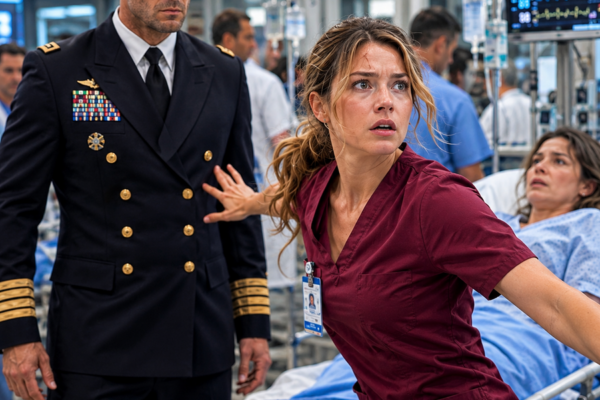
Dr.Greg was standing in the corridor outside Bay1 with the expression of a man who had been steadily revising his understanding of reality for the past hour and had not yet reached a stable new position. He saw Clare coming and he started to say something, her name or possibly a question, and she walked past him without stopping. She pulled the bay curtain open.
Bay 1 had four people in it. Sergeant Marsh was on the bed, awake now, oxygen canula in place. Vitals improved from the earlier pressure wrap fix.
Terrell was at the room’s far edge, hands visible, stance neutral in the deliberate way of a man who had decided that deescalation was the correct call and was holding that decision with both hands.
And the two men in dark civilian jackets were standing near the bay entrance, which was now Clare’s entrance, and they turned when she came through.
The taller one had a face she’d have called bland if she wasn’t reading it carefully, which she was.
Mid-40s, the kind of fitness that comes from regular professional maintenance rather than enthusiasm. His eyes moved to her and then to the space behind her and then back to her in the specific sequence of someone conducting a threat assessment.
The second man was younger, shorter, with a stillness that was trained rather than natural. Neither of them drew anything.
Nurse Ashford, the taller one said, that’s me.
We need you to come with us. On whose authority?
He produced a credential case and held it open at a distance she could read but not touch. Federal identification, a division she recognized as real, a name, Burell T, that she did not recognize as anything. This patient is in my care, she said.
She moved to Marsha’s bedside with the deliberate unhurried efficiency of a nurse doing her job because she was doing her job and also because positioning herself at the bedside meant Burl would have to cross the room to reach her and that changed the geometry.
I’m in the middle of an active clinical situation.
If you have a legal requirement for my presence, you can coordinate with hospital administration.
We’ve been through administration, Burl said, then you know the process.
The process, he said, and his voice dropped slightly, isn’t what I’m here about.
Marsh was watching her from the bed.
His vitals were reading 118 over 74, which was better than she’d hoped.
His eyes were clear.
He’d been awake long enough to understand the room.
“You okay?”
he asked her quietly. The way soldiers ask questions in situations that have stopped being straightforward.
“Working on it,” she said.
She adjusted his oxygen line.
It didn’t need adjusting, but her hands needed to be doing something visible.
She read his monitoring display, logged the numbers in the mental ledger she kept automatically, and she thought about the door behind Burell and the corridor beyond it, and Pruit’s people, and whether Rogue was still in the main corridor, or whether Kellerman had moved him.
Ms.Ashford, Burell said.
He’d taken a step closer, still hadn’t drawn the weapon, still wasn’t drawing it, which told her he’d been instructed to avoid a scene if possible.
We can do this with minimal disruption. Step outside with us, answer some questions, and we can have you back in a few hours.
Questions about what?
That’s not a conversation for this room.
Then I’m not having it.
The younger man shifted his weight. Terrell at the far edge tracked it with his eyes.
You don’t have an option here, Burell said.
The bland face had gotten slightly less bland. You can come willingly, or we can make this complicated.
Either way, you’re coming.
Marsha’s hand, which had been flat on the bed, moved slowly, without drama, he put it over Clare’s wrist.
Not restraining, just a weight.
The kind of contact a person makes when they’re saying something they don’t have words for.
She looked down at it, then at him.
I’m fine,” she said to both questions at once.
Then the bay curtain came open for the second time, and Commander Puit walked in.
He didn’t walk in the way Burl had with the deliberate approach of a man in control of an entrance.
He walked in the way a man walks into a room where he has authority and knows it and isn’t interested in performing it.
Captain Solless was directly behind him, and behind her were Kellerman and Vo.
and the shift in the room’s population was significant enough that even the monitoring equipment seemed to recalibrate.
Burell turned, read the room. His calculation was visible in the 2-cond pause before he spoke. Medical jurisdiction.
Puit said it was true as of approximately 20 minutes ago when he’d made a call from the maintenance corridor that Clare hadn’t heard in full but had understood the purpose of.
Your credentials don’t cover this space.
We have a federal warrant for Clare Ashford, who is currently providing care to an active duty military patient.
Puit’s voice was the voice of a man who had won arguments in much higher pressure rooms than this.
That warrant doesn’t supersede the medical hold she’s operating under.
There is no medical hold. There is now. Captain Solless filed it 11 minutes ago.
He looked at Burell without blinking.
You’re welcome to contest it through the appropriate channels.
The JAG office in Missoula is open until 5. The room was very quiet.
At the far edge, had allowed himself a very small shift in his posture, the microscopic relaxation of a man whose hand had been hovering over a button he’d hoped not to push.
Burell looked at Solless, looked at Clare, looked at the room’s geometry, at the fact that he and his partner were now the minority in a bay that had shifted its weight entirely in the wrong direction.
This isn’t over, he said.
No, Puit agreed pleasantly.
It isn’t.
Burell and the younger man left. The curtain settled behind them.
Nobody in the room spoke for 3 seconds, which was the exact amount of time it took for Marshia’s monitoring to register the change in ambient tension and stop its faint compensatory alerting.
That’s going to hold them for maybe 2 hours, Clare said.
45 minutes, Solace said.
She didn’t sound bothered by the math.
Long enough. For what?
For the people above Burell’s authority level to understand that we’re not bluffing.
Solless looked at her.
I’ve been on a call with the inspector general’s office for the last 20 minutes.
The Iron Tide archive has been formally escalated. What happens in the next few hours determines whether this gets resolved at a departmental level or whether it goes to a congressional oversight committee.
Clare absorbed this.
You’ve been moving faster than you told me,” she said.
“I’ve been moving as fast as the situation required, which has been accelerating.”
Solace’s voice was level, but there was something in it.
Not apology exactly, but acknowledgement. I should have been clear about how close we were to the edge.
“Yes,” Clare said.
“You should have.”
The silence that followed was brief and honest.
Then, Puit said, “We need to establish a defensible position in this building until the IG response is confirmed.
If Burell comes back with a harder warrant, he won’t need a harder warrant.
Clare said she was already thinking past the bay, past the corridor, back to what she’d understood when she saw those men walk in.
The warrant is a prop. The warrant is for the record. If they wanted the legal route, they had 3 weeks after the archive surfaced to execute it.
She looked at Puit.
They didn’t.
They followed your convoy to a regional hospital in Montana because they are out of time and out of options and the warrant is the thing they wave while something else happens. Something else?
Vo said when Burell leaves this building he’s going to make a call.
That call is not going to be to the JAG office. She paused.
Who else is coming? Puit was already on his comm unit.
The next 40 minutes were the kind that collapsed time in both directions.
Each individual minute slow and heavy with decision, the aggregate of them somehow gone before you’d finished processing the first one.
Puit established a defensive perimeter at the three main entrances using the four military personnel he had in the building, which was not enough for a building this size, but was better than nothing. Solless coordinated with a federal contact.
Clare still hadn’t been given the name of, working to confirm the IG escalation through channels that were apparently moving faster than normal for a reason Solace described only as were not the first call this office has gotten today.
Clare went back to work.
Not because it was the tactically optimal choice, because there were patients in this building who needed their medications checked and their dressings changed and their questions answered by someone who wasn’t distracted by the fact that armed men had just walked out of bay 1.
And because she had spent 5 years building the skill of being useful in this building, and she was not going to waste it standing in a corridor waiting for something to happen to her. Sandra Wills watched her move through the bays with an expression that had graduated from controlled alarm to something quieter and harder to name.
The men who were in bay 1, Sandra said at the medication cart. Handled.
Handled how? Temporarily. Clare pulled a chart, reviewed it, moved to the next.
Sandra, I need you to pull the patient census for the east wing and flag anyone who’s ambulatory.
If we need to move people, I want to know who can walk. Sandra stared at her. In case we need to move people, Clare said again.
It’s a precaution.
Will you do that? Who are you? Sandra asked.
It wasn’t hostile.
It was genuine.
Oh, the question of a person who had worked beside someone for 2 years and was realizing she’d been working beside a partial answer.
Someone who should have been more careful.
Clare said, “Please pull the census.”
Sandra pulled the census. Dr.Greg found her in bay 3 at the 40minute mark.
He came in without the tablet, without the authority posture, without the reading glasses pushed up on his forehead.
He came in looking like a man who had been doing his own version of rapid reassessment and had arrived at a position he hadn’t expected.
The man in bay 1, he said the dog, the military officers, the men who just left.
Yes, it’s connected to you.
Yes. He was quiet for a moment.
How much danger is this hospital in? She looked at him directly.
I don’t know exactly.
I think the people who want to find me will try to keep collateral damage low because collateral damage creates attention.
But I’ve been wrong about their risk calculations before.
Greg absorbed this.
His face did several things in quick succession, and then it settled into something that wasn’t quite the man who’d written serviceable in her review, something older and less certain, and she thought more honest.
What do you need from me? he asked.
It was the same question Puit had answered wrong, and Solace had answered partially, and Marsh had answered with the weight of his hand on her wrist. Greg asked it without theater, without making it a performance of generosity.
He asked it the way someone asks a question when they’ve run out of other options.
Keep your staff calm, she said. Keep the patients in their bays unless I say otherwise.
And if anyone comes through that entrance who isn’t wearing a badge or uniform you recognize, you call Puit’s Frequency.
Sandra has the number. All right. And Greg, she paused.
He looked at her.
The patient in Bay 2, Mrs.Lyndon, she’s been asking about her discharge paperwork since 7 this morning.
Can you look at her chart? He blinked.
Now she’s been waiting for 6 hours.
He blinked again. And then, in the specific way that sometimes happens in the middle of a crisis, when the mundane and the impossible are suddenly occupying the same space, he almost laughed. Yeah, he said.
Okay.
He went to look at Mrs.Lyndon’s chart.
Woke. Rogue found her at the nursing station at the 50-minute mark. Kellerman had him on the leash again, but loosely.
The leash more formality than control.
The dog moved to Clare’s side and stood there, not pressing in the way he had that morning, more parallel, like he had established his position and didn’t need to keep negotiating it.
She looked at Kellerman. Marsh stable.
Vio’s with him.
Good. She looked at Rogue.
His ears were doing the thing they’d done in the annex room.
Not quite flat, not forward, angled at a specific point somewhere beyond the wall she was facing. She had seen him do it once before in a drainage channel in the dark approximately 2 minutes before the north ridge lit up.
“Kellerman,” she said, keeping her voice absolutely even.
Ma’am, where’s Puit right now?
East entrance, he called in. His radio crackled. He pulled it from his belt and listened.
And the expression on his face changed in the specific way that expressions change when a situation’s category shifts from serious to something with fewer available responses.
Report.
She said there’s a vehicle on the east side.
Came off the main road and stopped. He pressed the radio.
Puit says it’s not Burl, different vehicle.
three individuals, tactical clothing, tactical clothing, not civilian jackets, not the prop of a warrant and a credential case.
The calculation she’d been running since the maintenance corridor updated itself with a speed that she recognized as the return of something she’d put in a very specific place and tried to leave there.
They changed the approach, she said. Commander Puit is repositioning. How many personnel does he have on the east entrance?
Two. two against three in tactical clothing in an entrance that had a long corridor approach and three branch points and a waiting room full of people who had no idea what the next 5 minutes looked like.
“Where’s Solus?”
she asked. Conference call with get her off it. She was already moving.
Get Puit to hold the east entrance and not advance. Tell him to wait. Wait for what?
She looked at Rogue. The dog was already oriented toward the east corridor, ears fully forward now with the body language of an animal that has received all the information it needs and is ready to act on it.
“Tell him I’m coming,” she said.
The east corridor was 60 ft of straight line exposure between the nursing hub and the entrance lobby. 60 ft with no cover except a row of chairs along the left wall and two structural pillars that would stop a person from being seen but not from being found. She moved through it with Rogue at her left and Kellerman behind her.
And she was thinking about the branch points and the waiting room layout and the fact that three people in tactical clothing who had driven a vehicle to the east entrance of a hospital had made a choice about how visible they were willing to be, which told her something.
They weren’t trying to look like anything anymore.
The waiting room came into view. Seven people in chairs. A woman with a child, two elderly men, a teenager with an iced knee, a man in a work jacket who was asleep against the wall.
The entrance lobby was beyond them. Glass doors, the Harlo general sign in blue on the exterior wall.
Puit’s two personnel were flanking the lobby entrance, positioned well.
She clocked that without breaking stride. The east entrance doors were still closed.
Three figures were visible through the glass. tactical gear, earpieces, and the specific patient stillness of people who were not going to announce themselves before they came through. Puit looked at Clare when she arrived.
His face asked the question he didn’t say out loud.
“The waiting room,” she said quietly.
“We need those people out of this space before those doors open.
If we move them, it signals that we know they’re here.”
“They know we know they’re here.
That’s the point.”
She watched the three figures through the glass.
They’re not trying to be invisible.
They’re showing us they’re willing to do this in a public space.
That’s a message.
What’s the message?
That whoever sent them has decided the quiet option is over. She looked at the glass.
Which means someone above Burell made a decision in the last 45 minutes, which means the IG escalation landed somewhere it wasn’t supposed to land.
And now the people who buried Iron Tide are out of moves except the direct one. Puit processed this in about 2 seconds. The waiting room.
Now, calmly, she turned to Kellerman. Go to Sandra at the nursing desk.
Tell her we have a gas smell. Maintenance concern.
Standard protocol. Move the waiting room to the interior hall.
Don’t use a code.
Gas smell is boring and specific, and people move without panicking. Kellerman went. She watched the three figures through the glass.
They hadn’t moved.
They were waiting for what?
She wasn’t certain.
a signal, maybe confirmation that someone inside had completed something, or maybe just the particular patience of people who had been told the window was closing and were prepared to use it regardless of what was on the other side of the glass.
Rogue’s body had gone absolutely still.
She’d seen him do this once, one time, in a drainage channel in the dark right before the world came apart.
Puit, she said, “I see it.”
The middle figure had moved his hand to his jacket. Not drawing, just the movement of someone confirming position. If they come through those doors, she said, the waiting room is not going to be clear in time.
I know. And your two personnel are not going to hold a threeon two with tactical gear in a public lobby.
I know. His voice was controlled and low.
I’m open to alternatives.
She looked at the lobby at the structural layout she’d memorized in the first week she’d worked here.
not because she’d expected to need it, but because she had never stopped being the kind of person who memorized exits.
The lobby’s check-in desk was solid wood construction, anchored.
The left wall had a fire hose cabinet, recessed, not useful. The right wall had a door marked staff only, that led to the radiology prep hall, which connected back to the main ER hub through a different route. She looked at the glass doors.
She looked at Rogue. Then she did something that was not in any plan anyone had made in the past hour.
She walked forward through Puit’s perimeter, through the lobby, and pushed open the east entrance door.
The cold Montana air hit her face. She stepped outside.
The three figures were 6 ft away.
Up close, they were younger than she’d read through the glass, mid-30s at the oldest, with the kind of physical conditioning that was professional rather than personal.
The one in the middle, the one who’d moved his hand to his jacket, had green eyes and a face that gave her nothing.
“I know why you’re here,” she said.
His eyes moved to the door behind her to the lobby.
“To Rogue, who had come through the door and stopped at her left.”
“Then you know you need to come with us,” he said.
“I know the people who sent you have decided they can’t afford a quiet resolution anymore.”
She kept her voice even. She was aware of every variable in the 6-t space between them.
the cold, the light, the fact that Puit’s people were on the other side of glass that was not bulletproof, the fact that there were seven civilians in the waiting room behind her who were in the process of being moved, but were not yet moved.
I know that the IG escalation went somewhere that scared them, and I know that sending three people in tactical gear to the front door of a hospital was not their first choice. The man in the middle said nothing.
“It was their last one,” she said.
Something moved in his face. not much enough.
Which means, she continued, that whatever they’re trying to protect is closer to exposure than they’ve told you.
You’re not here because they have options.
You’re here because they’re out of them.
That analysis doesn’t change your situation, he said.
No, she agreed. But it changes yours.
She saw him process it.
The specific recalibration of a person who has received information that doesn’t match the briefing they were given.
Step aside, he said. No.
He reached for his jacket. Rogue moved.
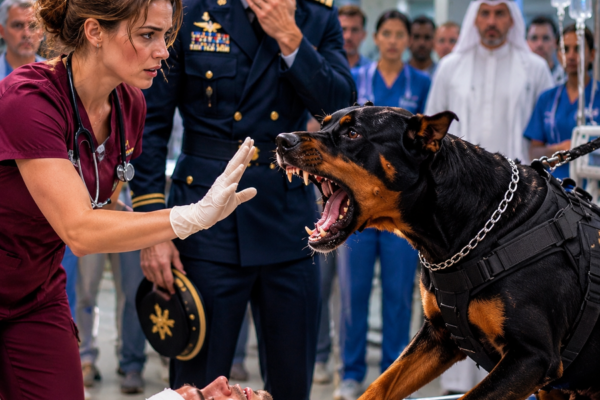
Not at the man, not an attack, not lunging, but forward, placing himself between Clare and the three figures with the complete unhurrieded certainty of an animal that has decided where the line is, and is not interested in negotiating its position. His weight drops slightly, stance widening, and the sound that came from him was not the bark of an agitated dog.
It was something much quieter and much more serious.
The man’s hand stopped.
In the 6 ft between them, nobody moved.
And then, from inside the lobby, Clare heard the sound that changed the room’s arithmetic completely.
The sound of multiple sets of boots and a voice she didn’t recognize, giving crisp declarative commands and the distinctive crackle of federal radio communication that was not Puit’s frequency and not Solless’s channel.
She heard Captain Solless say from somewhere behind the glass, “They’re here.”
The man in the middle looked past Clare through the glass door at whatever was arriving in the lobby behind her. His jaw set, his hand came away from his jacket. She turned through the glass.
She could see the the lobby filling, not with Pruituit’s four personnel, not with hospital security, but with federal agents and marked jackets, and behind them, a woman in a dark suit who was moving with the specific purposeful speed of someone who had traveled fast to get here and was not finished moving yet.
The woman looked through the glass at Clare. She held up a credential case. The name on it was not a name Clare recognized.
The office listed beneath it was the Inspector General’s office, but not the field division, not the regional contact.
Solless had been calling for the past hour. The office listed was the central division, the one that reported directly, and the authorization code below it was a clearance level that Clare had not seen since a mission briefing in 2019 that had been marked above top secret and had preceded the
worst night of her life.
Her hands had gone cold.
Not from fear, from the specific bone deep cold of someone who has just understood that the thing they’ve been surviving for 5 years has finally reached a size that cannot be managed quietly by any single party.
The man in front of her was still 6 ft away. Rogue was still between them.
And from behind the lobby doors, the woman in the dark suit pushed through the glass, stepped outside into the Montana afternoon, looked at the three men in tactical gear, and said in a voice that left no available interpretation, “Step away from her now.”
Two of the three men stepped back. The one in the middle, green eyes, still face, did not.
He looked at Clare.
Something in his expression had shifted in a way she couldn’t fully read, and she’d spent a significant portion of her adult life learning to read the expressions of people in high pressure situations.
Lieutenant Vance, he said, her name, her real name, not Clare Ashford.
Not the name on her badge, the name in the credentiing file, the name Greg had written in a folder, the name she’d buried, the name that meant someone in that building, someone on the other side of the glass with the other side’s
information, had known exactly who she was before any convoy had arrived, before any archive had been flagged, before any Monday morning at Harlo general had sent a Navy dog to find her in a corridor, which meant one thing, and the math of it arrived with the particular cold clarity she’d lived with for 5 ears.
There was someone else in this building, someone who had not come through the east entrance. Her head came up.
She turned, not away from the man in front of her, but toward the hospital’s interior, because Rogue had already turned because his ears had moved in the split second before her own instincts had caught up.
Because 5 years ago, in a drainage channel on a night she couldn’t unknow, he had done the same thing.
She heard Kellerman’s radio go off from inside the lobby.
She heard his voice, sharp and stripped of the professional calm he’d maintained all morning.
Say one sentence. Marsh is gone.
Marsh was gone.
Clare was through the lobby door before Kellerman had finished the sentence, moving past the federal agents, past Solis, past the woman in the dark suit, who started to say something and stopped when she read Clare’s face.
Rogue was with her.
He didn’t need the door held.
Bay One was empty.
The monitoring equipment was still running, vitals display active, oxygen line disconnected and hanging free, the canula on the mattress where Marsha’s face had been.
The IV line had been pulled, not carefully, and there was a small bloom of blood on the sheet where the catheter had come out without a proper removal.
Whoever had taken him had done it in under 4 minutes and hadn’t been gentle about the IV, which told her the person or people involved were not medical.
👉 [Tap here for the Next Part ] 👈