“JUST A NURSE,” They Said — Until a MILITARY K9 Revealed What She Could Really Do
“JUST A NURSE,” They Said — Until a MILITARY K9 Revealed What She Could Really Do
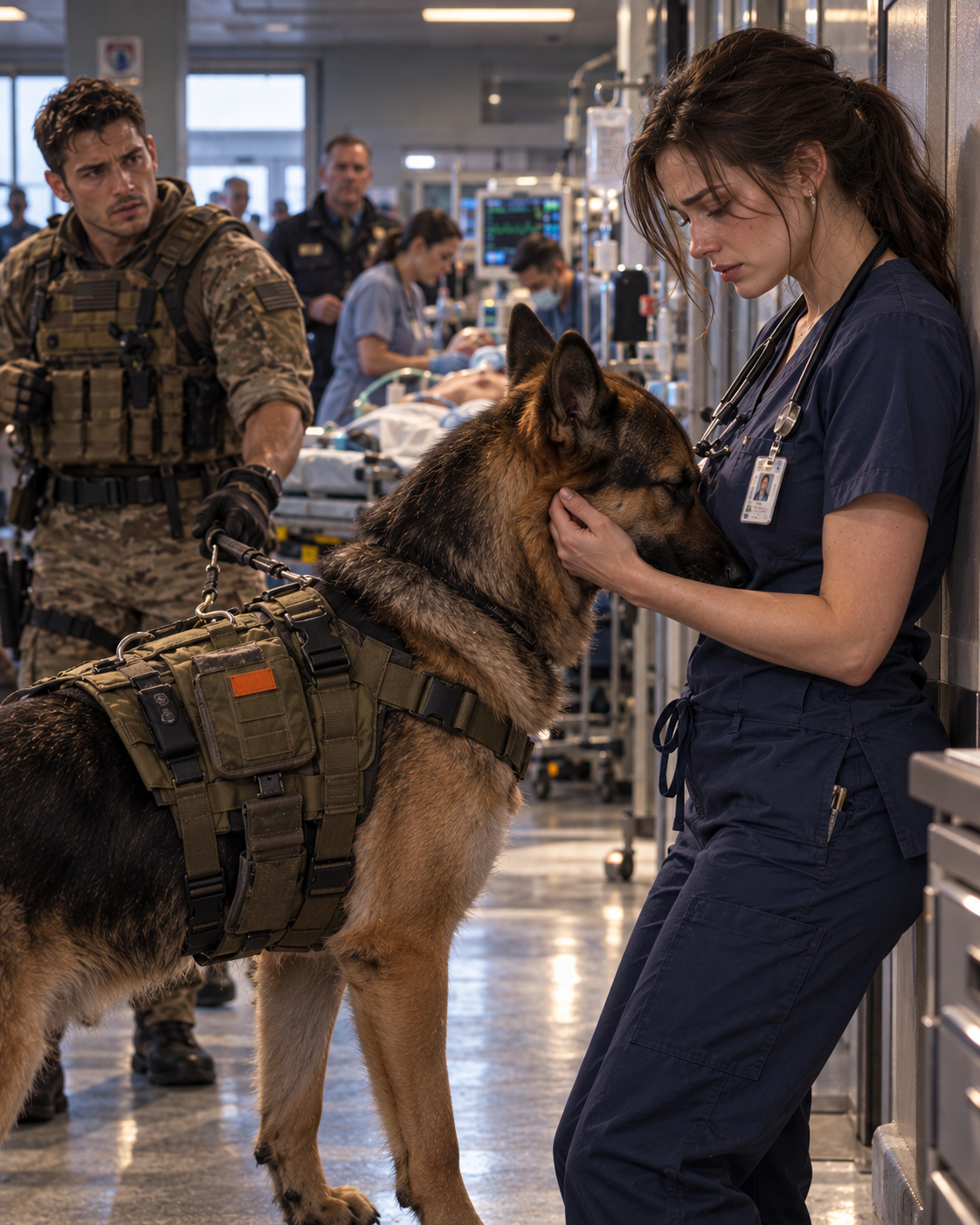
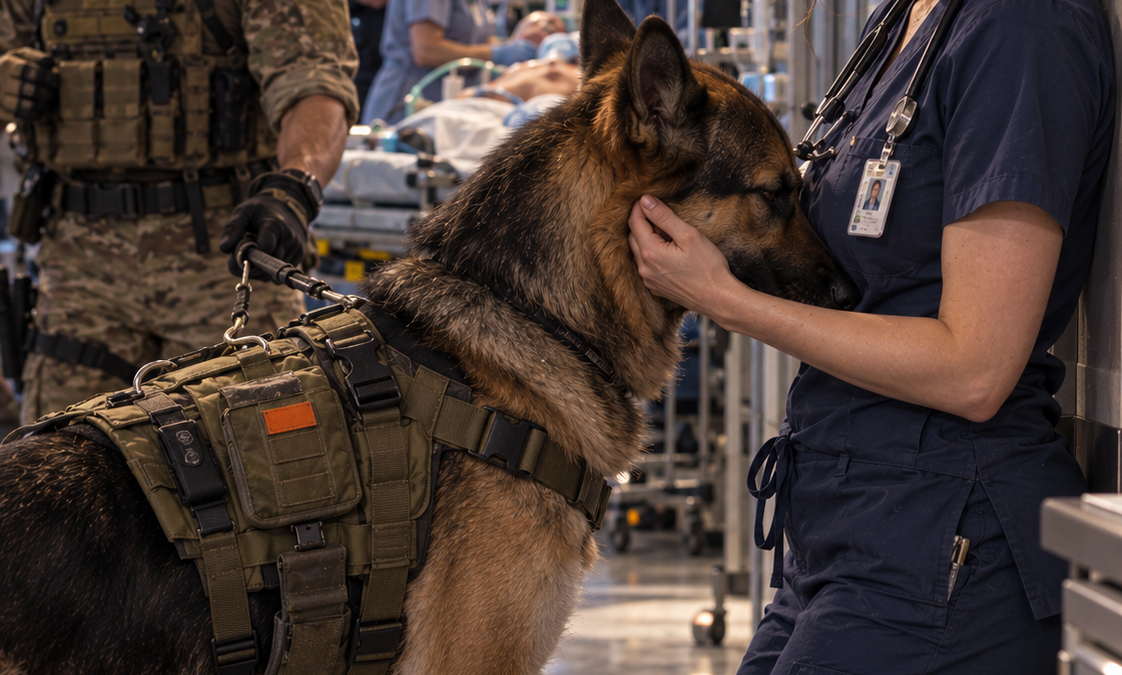
The German Shepherd hit the end of his leash so hard the handler’s boots skidded across the ER floor.
Every soldier in the trauma bay went for their weapon.
The dog wasn’t growling.
He wasn’t attacking.
He was pulling toward a nurse in blue scrubs who was backing against the wall with her hands up. And when he finally reached her, 200 lb of military trained animal dropped his massive head into her palms and made a sound nobody in that room had ever heard a combat dog make before. like he was exhaling three years of grief in a single breath.
Like he had just found someone the world had told him was dead.
The morning had started the way most Mondays started at Harlo General Hospital in Redfield, Montana. Understaffed, overcrowded, and running about 40 minutes behind before 8:00 a.m.had even finished happening.
Nurse Claire Ashford had been on since 6:00.
She’d already drawn blood on a combative patient, talked a panicked father off the ledge of a full meltdown in the pediatric waiting area, and eaten half a granola bar standing over a sink because the breakroom microwave had shorted out again, and she hadn’t had time to care.
Her sneakers had a pen mark on the left toe she’d been meaning to clean off for a week.
There was a coffee ring on her badge from yesterday. She was not, by any definition anyone at Harlo General would have used, remarkable.
That was in fact the word her supervisor, Dr.Harland Greg, had used during her last performance review, serviceable.
He’d actually written it down.
Clare had read it twice, folded the paper in thirds, and put it in her locker without saying anything, which was something she had gotten very good at over the past 5 years, reading situations, calculating responses, and choosing silence. She was 34 years old.
She had medium brown hair she kept pulled back, unremarkable features, and the kind of steady hands that other nurses noticed but never mentioned.
She’d worked trauma intake for 2 years before transferring to general ER.
She never talked about where she was from. She never went to the staff happy hours at the bar on Fifth Street. She was pleasant enough.
She minded her own work. She kept her head down.
Serviceable. The military convoy arrived at 8:17 a.m.Clare was in bay 3 changing a dressing on a 60-year-old man with a badly infected leg wound when she heard the first radio crackle from the ambulance bay. Two voices clipped and overlapping, something about a handler and a K9, something about blood pressure dropping.
She finished taping the dressing clean, tight, no air gaps, and stripped her gloves before pushing through the bay curtain. The ambulance doors were already open.
Two soldiers in tactical gear were helping a third one down. Big guy, mid-30s, a pressure wrap around his upper thigh that was doing about 60% of the job it needed to do.
Behind them, a fourth soldier held a leash that was going absolutely rigid. The dog at the end of it was a German Shepherd, maybe 90 lb, black and tan, with the kind of muscle definition that comes from actual work rather than breeding. He had a tactical vest on, olive drab with a small patch on the left shoulder.
Clare couldn’t read from this distance.
The dog was alert, ears forward, nose working, but not aggressive. Not yet.
He was scanning. Bay one, said the charge nurse, Sandra Wills, already moving. Bring him straight through.
Clare stepped aside. That was the job. Triage was already flagging the wounded soldier, which meant her role was to stay clear until she was needed and do the prep work that would matter in 10 minutes.
A few setup, pressure monitoring, secondary assessment materials laid out and ready. She turned toward the supply cabinet.
She heard the leash snap tight.
Then she heard the handler say with real alarm in his voice, “Rogue, rogue, heal.”
The dog was not healing. Clare turned back just in time to see the shepherd swing his entire body sideways away from the incoming patient, away from the trauma team converging on bay one and fix his attention on her with an intensity that made the hair on her arm stand up before her brain had finished processing what
was happening.
He wasn’t barking.
He wasn’t showing teeth.
He was staring the way a working dog stares when it has located something it was trained to find. And then he took one step in her direction and the leash went rigid again.
And the handler planted both feet and said, “Rogue down.”
And the dog didn’t go down.
“Someone secure that animal,” Dr.Greg said, appearing from the side corridor with his tablet in hand and his reading glasses pushed up on his forehead.
His voice had the particular brand of irritated authority he deployed whenever something complicated his morning. We have a trauma incoming.
He’s secured, sir.
He’s just he doesn’t look secured.
The handler, young 20s name, tape reading Kellerman, had both hands on the leash now and was genuinely struggling.
He’s not aggressive.
He’s just reacting to something.
Rogue, come on, buddy. The dog took another step toward Clare. The leash went bar straight.
Clare stayed completely still. She was aware of several things simultaneously.
The trauma team surrounding the wounded soldier in bay 1. the two other military personnel watching the dog with sharp professional attention.
Dr.Greg’s irritation calcifying into something louder, and the fact that the shepherd’s eyes had not moved from her face since he’d first turned.
Working dogs, she knew, did not stare like that without a reason. Their attention was trained commodity.
You didn’t get that kind of lock on from a noise or a smell alone.
Clare.
Dr.Greg’s voice cut across the room.
What are you doing just standing there waiting for go prep bay 4? We may need overflow.
Bayour’s equipment needs a restock.
I can pull.
I don’t need your analysis of the supply situation.
I need you in bay 4. She almost said something.
She could see from where she stood that the pressure wrap on the incoming soldier was failing. The discoloration was spreading too fast, which meant the wound was deeper than the field dressing had accounted for, and whoever had applied it had gone a size too small.
She’d fixed that problem twice this month on separate patients.
She knew exactly what to do. Go, Greg said.
She went. She was in bay four doing the restock that was absolutely necessary because someone had cleared the cabinet without logging replacements when she heard the commotion increase.
not panic, more like the sound of a situation shifting.
She heard Kellerman’s voice again and then a second older voice she didn’t recognize and then the distinct sound of a grown man losing an argument with a dog.
She was back in the main corridor 30 seconds later. Rogue had pulled free. Not aggressively, Kellerman still had the leash, but the shepherd had moved fast enough and decisively enough that the handler was now two steps behind him, and the dog was covering ground toward bay 4 with the focused, deliberate motion of an animal, executing a task it had been given long before this particular morning.
He came around the corner and stopped 3 ft from Clare.
She went still again, instinctively, a particular kind of still that she’d taught herself not to think about anymore.
and the dog crossed the remaining distance at a walk and pressed his forehead against the palm of her hand. The sound he made was low, not a growl, something softer and older than a growl. Kellerman appeared in the bay entrance, breathing hard.
Ma’am, I’m so sorry.
He doesn’t He’s never done this.
It’s okay, Clare said, and she meant it.
She was already watching the dog’s ears, the set of his shoulders, the way his breathing had actually slowed rather than accelerated because that told her something.
An aggressive dog got faster in the approach. A dog making contact like this was doing something else entirely. She looked at the patch on his vest.
Rogue, Rogue, K9 unit 7, Naval Special Warfare.
He’s Navy, she said, and her voice came out flat and even because she made it come out that way.
Kellerman blinked.
Yes, ma’am.
We were transporting.
It’s kind of a complicated situation.
Sergeant Marsh got hit during a routine security detail, and Rogu’s been with him since it happened.
I figured he’d stay with the Sarge, but he has he done this before with a stranger.
No, Kellerman said it simply, like a fact that disturbed him. Never.
The second military voice Clare had heard from the corridor belonged to a man who appeared in the bay entrance. now older than Kellerman by 20 years at least, with a face that had been weathered into a map of decisions, good and bad.
He wore no rank visible on his civilian jacket, but the way he carried himself in a doorway told Clare everything a rank insignia would have. He looked at Rogue.
He looked at Clare. Something shifted behind his eyes.
“Sir,” Kellerman started.
“I can’t explain why he give me the room,” the older man said quietly.
Kellerman glanced between his commanding officer and the nurse with the Navy K9 pressed against her hand, made a calculation, and stepped back into the corridor. The older man, she would later learn his name was Commander Daleuit, did not move from the doorway.
He studied her the way people study a word they’ve seen before but can’t quite place.
“How long have you worked here?”
he asked.
“2 years before that?”
“Different hospital up north.”
Which one? Clare looked at him.
Is there a reason you’re asking me instead of checking my credentials with administration?
Puit didn’t answer that.
He looked at Rogue again, who had not moved, who had his forehead still pressed against Clare’s palm and was breathing in the steady rhythm of an animal that had decided with complete certainty that it was exactly where it needed to be.
His handler has had him for 3 years, Puit said. Before Kellerman, he was with a specialist out of Virginia Beach. Before that, he paused.
He was part of a team that doesn’t exist on paper anymore.
Clare’s hand didn’t move.
Her breathing didn’t change.
That’s an interesting history for a dog, she said.
It is, Puit agreed.
You know what’s more interesting?
She waited. He responds to about 16 commands. Voice and hand signal both.
In the 3 years I’ve known Rogue, he has never, not once, broken contact with his handler during an active situation.
He looked at her directly. until today.
From the main corridor, Dr.Greg’s voice carried.
Where is Nurse Ashford? I have a situation in Bay 1 that needs I have to go, Clare said.
She took her hand away from Rogue’s head.
He let her do it, but he turned with her. And that was the moment she knew the next few hours were going to be a problem because a 90 lb Navy K9 following her through the ER was going to be very hard to explain and she was already running the numbers on how bad the fallout would be.
Nurse, she stopped. Puit was still in the doorway. His voice had dropped below the ambient noise of the ER so that only she could hear it.
Iron Tide, he said. Two words.
Clare turned around slowly. She looked at the man in the doorway and she looked at the dog who had found her in a hospital corridor on a Monday morning and refused to leave.
And she understood with the particular cold clarity she’d spent 5 years burying that the world she had built around herself, the badge, the scrubs, the coffee stained routine of being serviceable in a place where no one looked twice at her had just developed its first serious crack.
I don’t know what that is, she said.
It was the first real lie she’d told in this building.
Puit nodded like he’d expected exactly that answer.
“Rog does,” he said.
“The situation in bay 1 was, as Clare had predicted from 20 ft away, a pressure wrap failure complicated by a secondary injury that hadn’t been assessed in the field.”
She moved to the bedside without being asked, read the vitals Sandra had just pulled, and said quietly to the attending physician, Dr.Norah Fastbender.
The wrap’s compressing the wrong point.
He’s losing pressure 2 in proximal to where they think he’s losing it.
Fastbender looked at the wound, looked at Clare. You sure? Yes.
Greg’s lead on military cases.
Greg isn’t here yet.
Fastbender made a decision. Show me. Greg arrived 40 seconds later to find Clare at the patients bedside demonstrating exactly where to reposition the compression while Fastbender watched with the focused attention of someone learning something useful.
The patient, Sergeant David
Marsh, 29, a man who had come in pale and going paler, already had better color in his face. What is she doing? Greg said her job.
Fastpender said she’s not assigned to this bay.
She’s fixing the pressure management on a deteriorating patient.
Harlon, you can write the incident report later.
Greg’s jaw tightened.
He was a tall man, silver at the temples, with the kind of credentials he referenced often and loudly. He had been at Harllo General for 11 years, and he treated that tenure like territory. New nurses were his to evaluate.
Military cases were his to supervise.
And Clare Ashford, who had corrected his assessment of a numoththorax back in March without raising her voice, and who had been quietly right about three other things since then, was a specific category of irritant he hadn’t yet found the right way to handle.
Ashford, he
said, you’re reassigned to triage intake for the remainder of your shift.
Sandra can cover the trauma bays.
Clare finished adjusting the wrap, checked the positioning, looked at Marsha’s vitals one more time.
Then she straightened, stripped her gloves, and said, “Understood.”
She did not argue. She walked out of Bay One without making it a scene, because making it a scene would have cost her more than it cost him, and she had always understood that math.
What she hadn’t expected was rogue.
The shepherd was waiting in the corridor outside Bay 1, sitting perfectly still in a way that suggested he had not been told to sit. He had simply decided this was the appropriate posture for the situation. Kellerman was 2 ft away, leash in hand, looking professionally miserable.
“He won’t move,” Kellerman said.
“He doesn’t have to,” Clare said.
“I’m moving.”
She started toward the triage desk. Rogue stood and followed.
“Ma’am, I can’t walk with him,” Kellerman.
“I’m not asking him to stay.”
She heard Greg’s voice from bay one.
“Someone get that animal out of my ER.
She was already at the triage desk. The next hour moved the way busy hours in an ER move. Not fast exactly, but dense.
Three walk-ins. A cardiac monitor throwing a false alarm. A child with a forearm fracture whose mother was close to passing out from the sight of the X-ray.
Clare worked intake with the systematic efficiency she’d built over years of practice.
She documented, assessed, redirected. She talked to the mother about looking at the wall instead of the screen.
She got the child to tell her about his dog. Rogue sat 3 ft from the triage desk the entire time.
She was aware of him the same way you’re aware of something important that you’ve put in a specific place and are trying not to look at.
Peripheral present. Commander Puit appeared at the edge of the waiting area at 10:40.
He didn’t approach the desk.
He found a chair in the corner where he had sightelines to both the entrance and the triage station. And he sat down with the practice patients of a man who had learned how to wait in places where waiting was all you could do.
Clare logged a patient record and said without looking up, “You’re going to be here a while.
She was talking to herself.
She knew she was talking to herself, but Rogue’s ears moved.”
The second crisis arrived at 11:15, which was when two things happened simultaneously. A second military vehicle pulled into the ambulance bay, and Dr.Greg convened what he called an emergency staffing review in the small conference room off the main corridor, which was his way of calling a meeting that had one agenda item. Clare was paged to the conference room at 11:22.
She’d been expecting it.
She went. The room held Greg, Sandra Wills, and hospital administrator Joyce Marin, a compact woman in her 50s who wore reading glasses on a beaded chain and had the careful, measured energy of someone who had seen enough hospital politics to know that most of them were stupid, but some of them were necessary.
“Sit down, Clare,” Greg said.
She sat.
“I want to talk about your conduct this morning.”
“Okay.”
You entered an assigned trauma bay without authorization, countermanded a treatment decision, and created a disruption in the middle of an active patient situation. I adjusted a compression wrap on a patient who was deteriorating.
Dr.Fastbender confirmed the adjustment was correct.
That’s not the point.
What is the point? Greg set his hands flat on the table.
It was a thing he did when he wanted to signal that the conversation had shifted into formal territory. The point is that you have a pattern of stepping outside your assigned scope in ways that create confusion and undermine the authority structure this hospital runs on.
You’re a nurse, Clare, a capable one.
I’ll grant you that.
But capable doesn’t mean you get to override physician decisions on the fly.
I didn’t override anyone.
Dr.Fastbender was present and she agreed. Doctor Fastbender made an on the-spot call that she may have felt pressured to make because you positioned yourself as the authority in that room.
Clare looked at him for a moment.
I didn’t position myself as anything.
I told her where the wrap was failing and she verified it.
Sergeant Marsh’s blood pressure stabilized 8 minutes after the adjustment.
That’s in the record.
The record, Greg said, is exactly what I want to talk about. Yours specifically. He opened a folder.
2 years here prior to that, a facility in northern Montana that closed 18 months ago. Before that, a one-year gap with no employment record.
Before that, you’re in the system at a clinic in Nevada for 4 months.
He looked up.
That’s an unusual history for a trauma nurse of your reported experience level.
The room was quiet.
Joyce Marion hadn’t said anything yet.
She was watching Clare the way she watched everything with the careful attention of someone collecting data. Nurses move around, Clare said.
They do, Greg agreed. But they usually leave references.
You have two and one of them is from a facility that no longer has records we can access. He closed the folder.
I’ve initiated a credentiing review.
Until it’s complete, I’m recommending we move you to a limited capacity role.
You’re suspending me.
I’m protecting the hospital.
From a nurse who correctly identified a pressure wrap failure.
Greg’s voice dropped into something that was almost gentle, which was worse than when it was sharp.
Claire, I’m trying to help you understand that this isn’t personal.
But you’ve created a situation today.
The military personnel, the dog, the unauthorized intervention that I can’t just document and move on from.
People are asking questions. She held very still.
What people?
She said, “The military personnel in the vehicle that arrived this morning.
Someone from their command has already called the administrator’s office.”
He glanced at Marine. Joyce.
Marin unfolded her hands. We received a call at 10:55 from an office requesting verification of your employment and credentials.
They were asking specifically about your background before you joined us. Who was the office?
They didn’t specify a unit.
They identified as federal. The word landed in the room and sat there. Clare was aware that her breathing had shifted.
Not much, barely perceptible, but she corrected it. Slow exhale, steady cadence.
She’d learned that correction a long time ago in conditions that had nothing to do with hospital conference rooms.
Federal, she repeated. Yes. She looked at Greg, then at Maring, then at the door.
Am I being terminated? Not yet, Greg said, but I need your badge while the review is.
The door opened.
Kellerman stood in the frame and his face had the expression of a young man who had been trained for difficult situations but was finding this particular one difficult in a way his training hadn’t covered.
Sorry to interrupt, he said.
He wasn’t sorry.
He was urgent.
Ma’am, Commander Puit needs to speak with Nurse Ashford right now.
Nurse Ashford is in a meeting, Greg said. Yes, sir.
He’s aware.
Then he can wait. Sir.
Kellerman’s voice changed.
not louder, but denser, the way a voice gets when it’s carrying actual weight.
With respect, this isn’t a request.
The silence in the conference room had a different texture after that. Joyce Marion looked at Kellerman, looked at Clare, took off her reading glasses.
Haron, she said quietly.
Let’s give it 5 minutes.
Puit was waiting in the corridor outside, and he was not alone. Beside him stood a woman in navy uniform, dress blues, which meant this had been planned, which meant someone had expected to need the formality of dress blues at a regional hospital in Redfield, Montana on a Monday morning.
The woman’s rank insignia was above commander.
She was not young.
Rogue stood at Puit’s left side, and he was not on his leash.
The dog looked at Clare when she came through the door, and his tail moved once. Not the enthusiastic wag of a pet, but the controlled, deliberate acknowledgement of an animal that used its body language with precision.
Claire, Puit said, what’s happening?
We need to have a conversation. Not here.
I’m being reviewed by my administrator.
I don’t have the option of the administrator will be told this takes precedence.
He said it without ego, without threat, as a fact.
There’s a secure room in the East Annex.
It’ll take 10 minutes.
She looked at the woman in dress blues. The woman had the kind of face that had stopped apologizing for itself a long time ago.
She met Clare’s gaze without performing anything.
Who are you? Clare asked.
Captain Irene Solless, the woman said. Naval Special Warfare Command. Clare held very still for the second time in an hour.
And why is Naval Special Warfare Command at a hospital in Redfield? Solless tilted her head slightly.
because someone put you here 5 years ago and hoped no one would look. The corridor was busy. Two nurses passed, a patient in a wheelchair, an orderly with a cart.
None of it registered as more than background noise. 10 minutes, Puit said.
Clare looked down at Rogue.
The dog looked back up at her, patient, certain, like he had been waiting for this exact moment since a mission that had gone sideways in a way that had never been recorded correctly in a place that had never been named in any document she’d been allowed to see since.
She looked back at Puit.
“Lead the way,” she said, and somewhere behind her, through the conference room door, she heard Dr.Greg’s voice rising with the specific outrage of a man who had spent the morning deciding she was small enough to dismiss and who was about to discover that the world was considerably more complicated than his folder of credentiing paperwork had suggested.
The crack in the wall she’d built was getting wider.
She walked toward the annex and didn’t look back.
The east annex of Harlo General was a hold over from an older version of the building. narrower corridors, lower ceilings, fluorescent lights that buzzed faintly at a frequency most people stopped noticing after the first week. Clare had been through here maybe a dozen times in 2 years, mostly to access the secondary storage rooms when the main supply chain backed up.
It smelled like industrial cleaner and old ventilation, and there was a water stain on the ceiling near the second door that had been there since before she arrived.
Puit led them to a room she’d never used.
A small administrative space with a table, six chairs, and a whiteboard with old marker residue that had been wiped but not fully erased. Captain Solless closed the door. Kellerman stayed outside.
Rogue settled near the door without being told.
“Sit down,” Solless said.
She wasn’t unkind about it.
She said it the way a person says something when they know the next few minutes are going to require everyone to be level. Clare sat. She put her hands flat on the table and looked at both of them and waited.
Puit sat across from her. Solless stayed standing, not to create a power dynamic, Clare read, but because she was the kind of person who thought better on her feet. There was a tablet on the table that neither of them had opened yet.
I’m going to tell you what we know, Puit said.
And I need you to hear all of it before you decide what you want to say. Can you do that? Depends on what you know.
Fair. He leaned forward slightly.
3 weeks ago, a classified file archive from 2019 was flagged during a routine audit.
The archive had been sealed under a special access protocol, meaning it wasn’t visible to standard clearance reviews.
It surfaced because someone made an error during a database migration.
A junior analyst saw the file header, didn’t recognize the classification code, and escalated it instead of burying it the way the original team probably expected any future discovery to be handled.
Clare said nothing. The file, Puit continued, contained the operational record for a mission designated Iron Tide, or rather what someone had recorded as the operational record for Iron Tide, which turned out to be significantly different from what actually happened.
He paused. You were listed as deceased, KIA, circumstances unspecified. Your team, all seven members, listed the same way.
The fluorescent light above them made its small continuous sound. My team, Clare said.
Yes. She looked at the table.
How many of them are actually dead? The pause before his answer told her what she needed to know before he spoke.
Six, Solless said.
As far as we’ve been able to confirm.
One breath in, one breath out.
Who’s the sixth?
Clare asked.
We don’t know yet.
The records for three of your team members are complicated.
We’re still pulling documentation.
She nodded once.
the way you nod when you’re filing something rather than responding to it.
The file also contained, Puit said, a secondary documentation package, mission parameters, target designations, authorization chains. What it described was not a rescue extraction gone wrong. What it described was a sanctioned operation to recover evidence from a covert site.
evidence that connected four senior officers to an unauthorized weapons routing program that had been running for approximately two years before I iron tide.
“I know what it was,” Clare said.
The room adjusted. Solless unclasped her hands.
Puit sat back a fraction. Neither of them spoke.
“I know what the mission was,” Clare said again, and her voice was even, which took more work than she was going to let either of them see.
“I was there.
I was the one who pulled the secondary documents from the site server before the building went down. I was the one who She stopped, recalibrated.
I had the documentation. My team was supposed to extract with me. We were 4 hours from the extraction point when we were rerouted.
Rerouted by whom? By someone with the right codes to push a redirect through our command channel.
At the time, I thought it was weather related.
We’d had a storm system track faster than predicted and the original extraction site was compromised.
She looked at Puit directly.
15 minutes after the reroute, we took fire from a position that couldn’t have been there by accident.
Someone knew where we were going before we knew where we were going. Solless pulled out the chair across from Clare and sat down.
Her expression hadn’t shifted much, but something in her posture had a slight forward lean.
the posture of a person who has been waiting for a specific piece of information to confirm a theory. How did you survive?
She asked. Luck and rogue.
Puit looked at the dog. He was with you on Iron Tide. Solless asked.
He was the team’s asset.
He was attached to Specialist Danny Hol. Dany was the first one hit. She said it flat.
Informational. The ambush came from the north ridge.
We’d been moving along a drainage channel.
Good cover, low profile. The fire came from above and Holt was on point. He went down in the first 8 seconds.
A pause.
Rogue didn’t run.
He stayed with Holt until I pulled him and then he stayed with me for the next 11 hours. The room was very quiet.
11 hours. Puit said, I had the documents on a physical drive. I had Rogue and I had a sidearm and I had 11 hours through terrain that the people trying to find me knew better than I did.
She met his eyes.
I made it to a secondary fallback position that wasn’t on the official mission record.
Personal protocol.
I’d identified it during the pre-m mission recon and I hadn’t put it in the shared brief because I had a habit of keeping one exit to myself.
She paused.
That habit is why I’m sitting here.
Solless looked at her for a long moment. And after the fall back, I had to make a decision.
I had evidence of a covert operation that senior command had authorized. evidence that several officers had been running weapons outside sanctioned channels and I had just watched six of my people get killed by a redirect that came from inside our own command structure.
She folded her hands on the table. If I surfaced through normal channels, I was handing everything to the people who had just tried to bury it. If I ran, I had maybe a 6-month window before my name showed up in the wrong database.
“So you disappeared,” Solu said.
“I built a new record slowly, carefully.”
She looked at neither of them. It took about 8 months to get a workable identity.
Another four to build enough of a professional record to get a nursing position without a full background audit.
I’d done field medicine for 6 years.
I knew the work. I just needed a paper trail that would survive surface level review. It survived ours for 3 weeks.
Puit said there was no judgment in it.
It sounded almost like respect, which was a problem because she couldn’t afford to feel that right now.
What changed? She asked. You said the archive surfaced 3 weeks ago.
Why are you here today? Why rogue? Puit glanced at Solless.
A brief look that carried a specific weight. Because 3 weeks ago, Solless said the people who authorized Iron Tide found out the archive had been flagged.
The silence came back, but different this time, heavier. They moved first, Clare said.
They started pulling records, flagging personnel. anyone who had access to the original operation, anyone who might be able to corroborate what was in those files.
Solus’ voice was level, but there was something underneath it that had edges.
We’ve been working in parallel, trying to get ahead of them, trying to establish a chain of evidence that doesn’t rely on documentation they can suppress.
She paused. We needed a witness, a survivor.
You needed me. Yes.
Clare looked at the table again at her hands at the pen mark she’d been meaning to clean off her badge for a week, which suddenly seemed like a detail from someone else’s life.
“How did Rogue end up here?”
she asked.
“In this hospital on this morning.”
Sergeant Marsha’s detail was routed through Redfield because of a logistical issue with the primary facility, said.
Rogue has been with Marsh’s unit for 14 months.
The only reason any of this happened today is because Marsh took a fall during a security sweep last night and this was the nearest trauma-capable facility. He looked at the dog.
We didn’t know you were here.
No one in our team knew you were here. Rogue knew. She looked at Rogue.
He was watching her from his position near the door.
Still alert with the patient certainty he’d had since the moment he’d found her in the corridor.
His vest had a small strip of faded orange near the collar.
She hadn’t noticed it before.
It was the same orange her team had used on mission equipment, the same shade, same placement, Danny Holt’s color code.
The dog had been carrying it for 5 years. She looked away before the thing building behind her sternum could get any louder.
What do you need from me? She asked. A formal statement on record with council present.
Everything you saw, everything you recovered, the chain of events from the moment you received the reroute command to the moment you reached the fallback position. Solless leaned forward. We have the archive.
We have the documentation trail your analyst uncovered.
What we don’t have is testimony from anyone who was physically present during Iron Tide because everyone else is dead.
Yes.
And my testimony on record through official channels that doesn’t give the people who buried this a road map for making me disappear again.
We’re aware of the risk.
That’s not an answer.
No, Solus said it’s not.
I’m not going to tell you this is safe.
I’m going to tell you that we have a window narrow closing and that the evidence we have without your testimony is circumstantial enough that a good defense council guts it in 6 months.
With your testimony, we have a case. Clare sat with that.
The buzzing light above them continued its small indifferent note. From outside the door, she heard the ER, the movement of it, the noise and rhythm of a building full of people who were hurt and scared and waiting for someone to help them.
She’d listened to that sound for 2 years.
She’d built a life around being close enough to it that she could stay useful without being visible.
I need to think, she said. I understand, Solless said, but I need you to think fast.
How fast? There were two vehicles in our convoy this morning.
The second one, Puit stopped, looked at Solless. The second vehicle, Solless said carefully, is not ours.
The temperature in the room changed in a way that had nothing to do with the air conditioning.
Clare’s eyes moved to Puit.
Since when? We made them about 4 mi out. Black SUV, civilian plates, no markings.
They stayed back, but they tracked the convoy route. He paused.
They’re in the parking structure right now.
How many? We counted three in the vehicle. Could be more.
She looked at the door at Rogue, who was now standing, which he hadn’t been a moment ago, with his ears angled toward the corridor.
“They followed you here,” she said.
“They know you were looking for me.
They may know you’re here,” Solless said.
“We don’t know how deep their access runs.
Deep enough to find a sealed archive. Deep enough to reroute a convoy 5 years ago.
Deep enough to keep six deaths off the books for half a decade.”
She said it without inflection.
“They have access.”
Puit nodded. Which is why we need to move.
Move where? We have a secure facility 40 minutes north.
Joint base. Federal access. Hardened communications.
Once you’re inside, they can’t touch the process.
And getting from this building to a vehicle in a parking structure that has at least three people in it who would very much prefer I not make it to a federal facility. We have a plan for that.
Tell me the plan. He told her the plan. She listened without interrupting, which she had learned was the most efficient way to identify the parts of a plan that were optimistic.
There were two. She noted them.
She didn’t say anything about them yet because the information she would need to propose alternatives was still assembling in a part of her mind that worked better when she didn’t consciously direct it.
The service elevator, she said when he finished, what about it? Your plan roots through the main corridor to the ambulance bay.
The ambulance bay has line of sight from the parking structure second level. She said it matterof factly.
If I were watching this building, that’s where I’d have a secondary position.
Your vehicle comes out.
We’re visible for 40 ft before we make the corner.
Puit looked at her.
You’re thinking about the service elevator.
The east annex has a service elevator that exits into the lower maintenance corridor.
The maintenance corridor connects to the generator building on the building’s north side.
If there’s a vehicle on the north access road, 40 ft puts us out of sight lines from the parking structure.
The north access road is a service route.
It’s not a secured I know what it is.
I’ve worked this building for 2 years.
She met his eyes. I know every exit in this facility.
It’s the first thing I did when I took the job.
The silence that followed was a specific kind.
The kind where someone is revising their understanding of who they’re talking to.
You’ve been running contingencies, Solace said quietly.
Not a question. For 5 years, Clare said. Yes.
The conversation ended when Rogue’s head came up.
Not gradually, sharply, the way a working dog moves when something has registered below the threshold of human perception. His body went still, nose forward, ears locked on a point somewhere beyond the East Annex corridor. Kellerman opened the door 3 seconds later.
His face said the situation had changed. Sir, he said to Puit.
The second vehicle moved.
They’re out of the structure.
Where? Northside.
They they parked on the service road. Clare looked at Puit.
He looked back at her without saying anything, which was the most honest answer he could have given.
They’d just taken her exit.
The next 8 minutes were a controlled version of chaos. the kind where each individual decision was calm and the cumulative effect was still a crisis.
Puit was on a secure comm unit establishing contact with the two additional personnel he had in the building.
Solace was on her phone tur and efficient pulling something together that she didn’t explain.
Clare was standing near the door thinking about the building’s layout in three dimensions, which was something she’d never needed to do at Harlo General and had done anyway because 5 years of living with an exit strategy changed how you looked at every room you walked into.
The east annex, the service elevator, the maintenance corridor, the generator building, the north side, which was now compromised.
She thought about the corridor map she’d filed away and never expected to use.
There’s a secondary access, she said.
Puit looked up from the comm unit. The maintenance corridor connects to the generator building, but it also has a lateral branch.
About 60 ft in, there’s a door that was part of an older section of the facility.
It connects to the loading dock on the hospital’s west side.
She paused. The loading dock is below street level.
It’s not visible from the parking structure or the north service road.
How do you know there’s a door there?
Solless asked. because two months ago we had a supply delivery get misdirected and I had to find the driver.
I walked the maintenance corridor to figure out where he’d come in from.
Puit and Solless looked at each other.
It’s not a clean route.
Clare said, “The maintenance corridor is tight, and there are two sections where the lighting is out, but it puts us on the west side of the building, which they’re not watching.
And from the loading dock, we can move a vehicle into the adjacent street without crossing the sight lines from the parking structure.”
“How certain are you?”
Puit asked. about the route? Completely certain.
About whether the people outside have a third vehicle covering the west side. She shook her head.
I don’t have that information.
