Security Threw a Quiet Nurse Out—Until a Navy SEAL’s K9 Revealed Her Secret
Security Threw a Quiet Nurse Out—Until a Navy SEAL’s K9 Revealed Her Secret
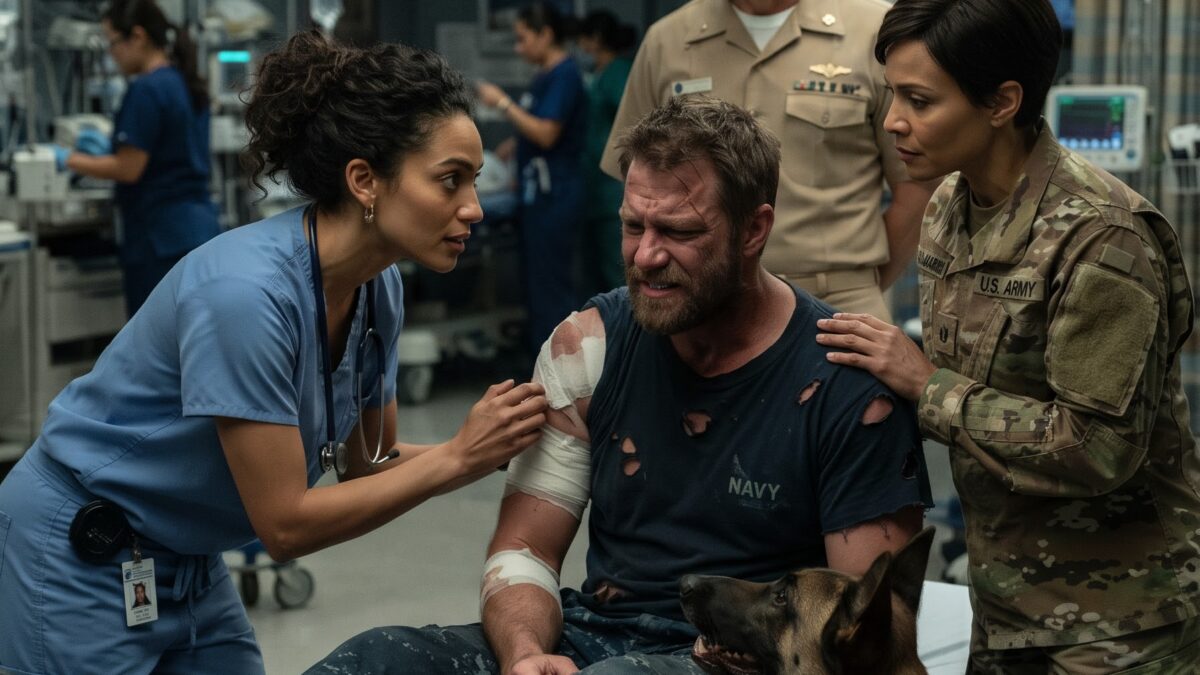
The teenage nurse stood frozen on the hospital floor as armed federal agents flooded the corridor and every officer in the building suddenly stepped back. Not from the agents, from her.
Minutes earlier, Dr.Victor Hail had called her a nobody to her face, blamed her for a crash she didn’t cause, had security drag her out of the trauma bay while a Navy Seal bled out on the table.
But the military dog had recognized her first.
And now the men with badges and clearance levels above the hospital director’s pay grade were asking one question.
The night shift at Harborview Medical Center started the way most nights did, understaffed, overlit, and running on bad coffee and worse morale.
Emma Carter was 40 minutes into her 12-hour shift when the radio call came through. And even then, she almost missed it.
She was restocking a crash cart in bay 3, earbuds in one ear, the other half listening to the trauma coordinator’s voice crackling over the overhead speakers.
Something about an inbound. Something about a military transport. She pulled the earbud out.
Single patient male, late30s, GSW to the left shoulder, and suspected thoracic trauma. ETA 6 minutes, K9 unit on board. Do not separate from handler.
Emma sat down the sailing bags and straightened up. A K9 unit.
Military transport 6 minutes. She moved to the bay window and looked out at the ambulance bay below.
The night was cold, early March, the kind of cold that came in off the Rockies and didn’t apologize for itself.
The parking lot lights threw long yellow shapes across the wet asphalt. Nothing yet. She watched anyway.
Carter. She turned.
Denise Okoro, the charged nurse on shift, was moving fast down the hall with a tablet in her hand and the particular look on her face that meant something was already going sideways.
You’re on intake for the incoming bay one.
Dr.Hail just pulled himself from his office, which means it’s either a VIP or a headache.
Could be both, Emma said. With him, it always is. Denise handed her the tablet without breaking stride.
Get a team ready.
I’ve got Reyes pulling the trauma cart.
Emma scanned the preliminary notes as she walked.
The medic’s handoff was tur the way military handoffs always were, stripped down to numbers and injury sites.
No narrative padding. GSW left shoulder through and through, but the entry angle suggested possible lung involvement. Suspected fractured ribs, two or three.
Patient conscious but deteriorating. Blood pressure trending low.
She already had a picture forming in her head. The bullet path, the probable bleed points. what the chest would sound like on oscultation.
She pushed through the double doors into trauma 1 and snapped on gloves. The team came together fast.
Marcus Reyes, a travel nurse who’d been at Harborview for 6 weeks and already had a handle on how things moved, rolled in the trauma cart.
Lily Huang, the secondyear resident assigned to Bay 1, pulled up the IV setup. Emma checked the intubation tray without being asked.
Confirmed the luringoscope blade, counted the ET tubes.
“What are we looking at?”
Lily asked. GSW through the left shoulder. Possible numoththorax.
He’s losing pressure on the way in.
Emma positioned herself at the head of the bay. When he gets here, I want oxygen on immediately.
We’re not waiting on a formal assessment.
If his breath sounds are unequal, we go for a needle decompression before hail even scrubs in. Lily blinked.
That’s I mean he might want to assess first.
He can assess after we decompress. The patient will still be alive for it.
Reyes gave a small sound that wasn’t quite a laugh.
He’d heard enough.
The bay doors opened and the gurnie came through hard and fast. Two paramedics pushing it. A third keeping pressure on the shoulder wound with both hands.
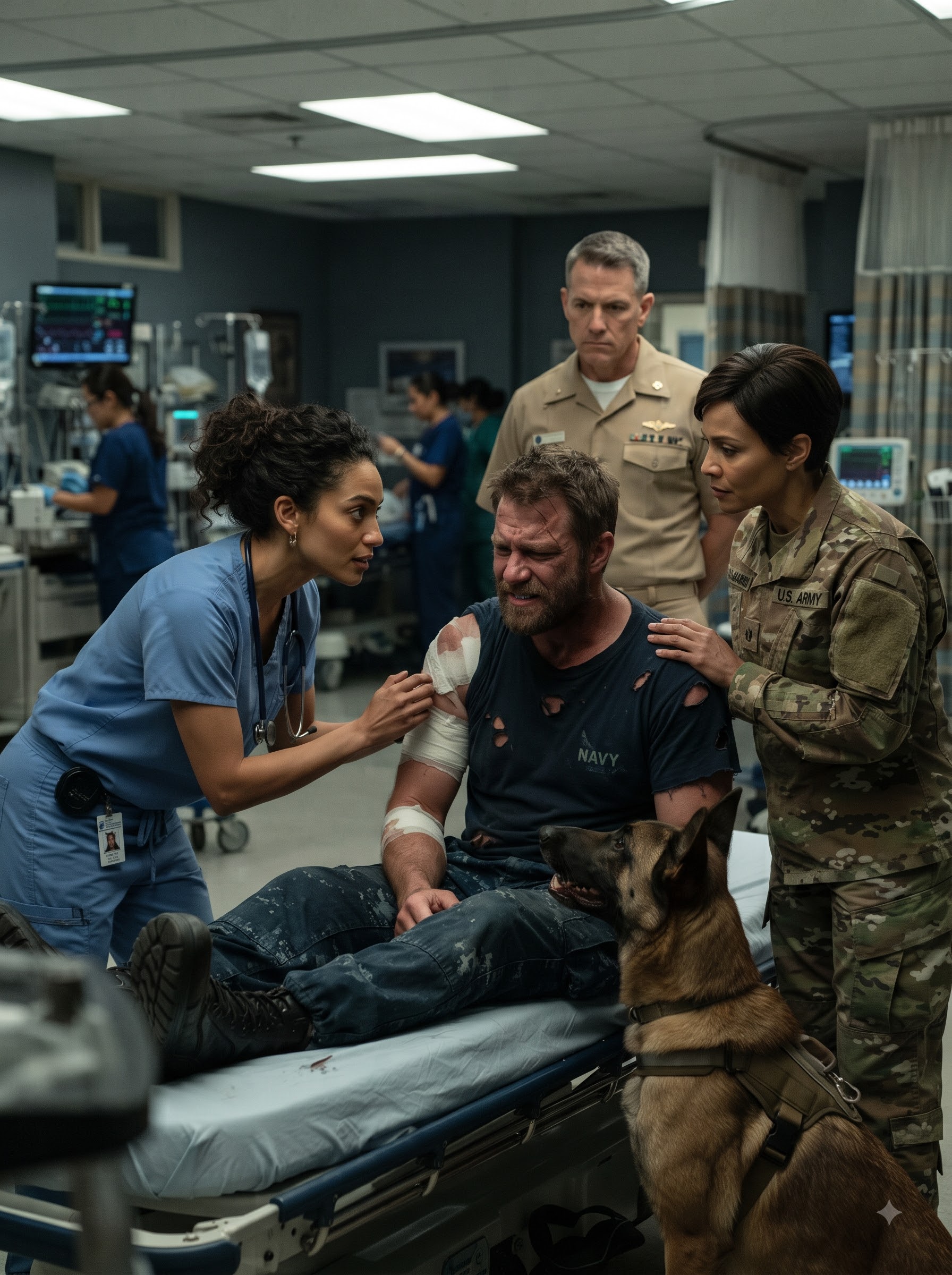
The man on the table was big. Not the theatrical kind of big that made you think of gym photos, but the functional kind, the kind built for carrying weight over distance. He had a short beard going gray at the edges, and his face was a very specific shade of pale that Emma recognized.
The pale of someone who’d been bleeding longer than the ambulance ride.
Beside the gurnie, tethered to the medic’s wrist by a quick release leash, was a Belgian Malininoa.
midsize black muzzle, amber eyes that were scanning the room with a focus that felt almost clinical. The dog was breathing controlled and even despite the chaos. GSW 0117 hours, the lead paramedic called out.
Through and through left shoulder, possible numo BP is 82 over 50 and dropping.
He was coherent on pickup, but he’s been in and out for the last 4 minutes.
Emma was already at the patient’s side, stethoscope on his chest before the gurnie locked into position.
Left lung. She listened, then listened again.
Diminished, not absent, but diminished. And the trachea was She pressed two fingers to his neck, slightly deviated, tension, pumothorax building.
The lung was collapsing and the pressure was starting to push the heart sideways. I need a 14 gauge needle.
Second intercostal mid-clavicular line, she said. Right now, nobody touches him. The voice came from the bay doors.
Dr.Victor Hail walked in the way he always walked in, like the room had been built for him, and everyone else was a temporary inconvenience.
He was 53, silver-haired, with the kind of chin that suggested he’d once been told he was handsome and had never recovered from the information.
He was still pulling on his second glove.
“I’ll take it from here,” he said.
Dr.Hail, his breath sounds are asymmetrical and the trachea is deviating.
He’s building tension.
I heard you, Carter. He moved to the patient without looking at her. Step back.
He needs needle decompression now. His pressure is I said step back.
The voice dropped a register.
He said it the way people say things to children who’ve interrupted an adult conversation.
You’re the intake nurse.
You’ve done your job.
Stand at the wall. Emma stepped back.
Her jaw was tight.
Hail put his own stethoscope to the patient’s chest, listened for 4 seconds, moved the scope, listened again.
Diminished on the left, he said to no one in particular, as if he were narrating a documentary about himself. Possible pneumothorax. He straightened up.
Lily, I want a chest X-ray before we do anything invasive. Lily hesitated.
The patient’s pressure is I know what the pressure is.
X-ray first.
We’re not puncturing this man’s chest wall on a gas.
Emma stood at the wall with her arms at her sides and watched the patient’s monitor.
Blood pressure 79 over 48. Heart rate climbing. She watched the oxygen saturation number and counted backward from what she knew.
3 minutes, maybe four, with the compensatory mechanisms this man’s body was running on.
He’d been trained probably to tolerate physiological stress beyond what civilian bodies could sustain.
That bought time. Not a lot, but some.
She looked at the dog. The Malininoa was sitting beside the gurnie now, leash looped around the bed rail the paramedic had clipped it to before stepping out.
The dog’s eyes were on the patient, ears slightly forward, breathing still even.
Then the dog looked at Emma. It was a direct look, not the scanning look it had given the room when it came in.
This was something else. The dog held her gaze for a full 2 seconds, then looked back at its handler.
Emma felt something move in her chest, not sentiment, something older than that. She looked away. Hail was ordering the portable X-ray.
The technician was already moving. 2 minutes to set up, 30 seconds to shoot, then processing time. She did the math again.
Dr.Hail. She kept her voice professional, flat. His ESAT is dropping.
We’re at 91% and he’s on high flow oxygen.
If this is attention numo, we don’t have time for imaging.
If it’s not attention numo and we needle him unnecessarily, we’ve introduced infection risk and potential iatrogenic injury.
He didn’t look up from the chart he was scanning.
Which part of that risk calculus are you confused about, Carter?
The part where he dies while we’re calculating.
The room got quiet. Hail lowered the chart.
He turned and looked at her with a particular expression she’d seen before.
Not anger exactly, more like the look of someone who’d found a small piece of furniture in an inconvenient place and was considering whether to move it or step over it.
You’re a nurse, he said.
A floor nurse.
You’re not a physician.
You’re not a trauma surgeon.
And you’re not in charge of this bay.
So, I’m going to ask you one more time.
Stand at the wall or I will have you removed from this room and written up for insubordination. Your choice. Emma stood at the wall.
The X-ray tech set up. The shot was taken.
Processing began. On the monitor, 76 over 44.
Oxygen sat 89. Emma watched the dog. The dog watched the patient.
She noticed something she hadn’t before.
The Malinoa was wearing a vest, the tactical kind, lightweight, with a small pouch on the left side. The pouch had a patch on it.
She couldn’t read it from where she was standing.
The X-ray came back. Hail looked at it on the portable display.
Something crossed his face. A brief recalibration almost invisible.
He’d been wrong and he knew it.
And he was deciding how to manage knowing it without letting anyone else know he knew it.
“Tension pumothorax,” he said calmly, as if he’d seen it coming all along.
“Prepare for needle decompression.”
Emma was already stepping forward before she registered she’d moved.
Carter, he said it like a period at the end of a sentence. I can do the decompression.
I’ve done it before.
She held her ground.
Every second we ought you’ve done it before.
He repeated it slowly like he was looking for the joke. A floor nurse has performed needle thorostomy.
On who? Where?
She didn’t answer.
That’s what I thought.
He turned away from her.
Lily, you’re doing the needle.
Walk her through it if you need to. Carter, you are done in this bay.
Lily looked between them. She was 27, a resident 8 months out from medical school, and she had the expression of someone who would very much like to not be in the room where this particular conflict was happening.
I Yes. Okay. Yes.
Emma stepped back again. She watched Lily set up the needle, watched the angle, watched the placement.
She pressed her lips together. The angle was wrong. Slightly wrong.
Not wrong enough to cause catastrophic harm, but wrong enough to miss the intercostal space cleanly and risk hitting the neurovvascular bundle running under the rib.
She’d seen it happen.
Not often, but once was enough. Second intercostal, Emma said quietly. You want to be just above the third rib.
The angle needs to come up a few degrees. Lily paused.
“She’s not,” Hail began.
“She’s right,” Reyes said from the corner.
His voice was low, almost casual, the kind of calm that came from not caring very much what Hail thought of him.
“The angle’s off.
” Lily adjusted slightly, just enough.
The needle went in. The hiss of released air was immediate and audible.
On the monitor, the blood pressure ticked up. 79 81. The oxygen sat climbed back toward 93.
The patients color shifted barely, but it was there. Emma exhaled through her nose.
Now, Hail said, “We get a chest tube in and then imaging for the shoulder.
Someone page cardiothoracic.
” He moved to the sink and began scrubbing over his shoulder without turning around.
“Carter, you’re done here.
Go back to whatever bay they had you stalking.”
“The patient is stabilizing,” Emma said.
I’d like to stay and monitor.
That wasn’t a request.
He turned the water off with his elbow.
Security is going to escort you out of this bay, and if you push this further, I’ll have you suspended pending review.
I don’t care what you think you know.
You are a nurse. Act like one.
She looked at the patient one more time. His breathing was easier. The monitor numbers were still low, but climbing.
She looked at the dog. The Malininoa was watching her again.
still focused. She pulled her gloves off, walked out.
The hallway outside Trauma 1 was cold and bright and smelled like antiseptic and old coffee from the nurses station 20 ft down. Emma stood outside the bay doors for a moment and then started walking. Not away.
She didn’t know where away was.
She just walked.
Denise caught up with her at the nurse’s station.
What happened? Hail.
Emma didn’t elaborate.
Denise’s expression said she didn’t need elaboration.
You okay? Fine.
She picked up a chart that didn’t need picking up.
What else is on? Nothing critical right now. You can grab the curtain area.
We’ve got a hand laceration in four and a possible fracture in seven.
Emma nodded and started down the hall.
She’d made it maybe 30 ft when she heard the monitor alarm from inside trauma 1.
She stopped. She knew that alarm, the pattern of it, the specific rhythm of a patient whose compensatory mechanisms had finally exhausted themselves.
She’d heard it in places and context that had nothing to do with this hospital.
She turned around through the narrow window in the bay door. She could see the monitor.
The waveform was going wide and erratic. The blood pressure readout was flashing. She pushed through the door.
Hail was at the chest tube tray, gloved and gowned, prepped for a procedure that was no longer the priority. Lily was at the monitor looking at it the way you look at something in a language you sort of know, but not really. Reyes was already moving toward the crash cart.
Emma went to the patient’s head.
He’s going into obstructive shock, she said.
The needle decompression bought time, but we didn’t get full relief.
He needs a thoricosttomy. I am about to perform a thoracicosttomy, Hail said, his voice carrying a particular strain in it now, like a cable under load. Not with that kit, Emma scanned the tray.
You’ve got a standard chest tube.
His lung is still partially collapsed and the plural space has reressurized. You need a I know what I need.
Then why isn’t it on the tray?
Hail looked at the tray. She was right. The standard chest tube insertion kit was set up, but if the plural pressure had rebuilt this fast, the anatomy was complicated.
Adhesions or the bullet had nicked something that hadn’t shown clearly on the portable X-ray, or both.
Standard approach risked missing the window.
Emma had positioned herself at the patient’s head without quite planning to.
Her hands were on his jaw, tilting his head to maintain airway. Old reflex. older than this hospital.
Carter Hail’s voice had changed.
It was quieter now, which was in some ways worse. You walk out of this bay right now or I will end your career tonight.
I have the authority and I will use it. That is not a bluff. I know, she said.
She didn’t move.
For 3 seconds, nobody moved. Then the patients monitor screamed.
Full arrhythmia cascade. The heart was going sideways. Not cardiac arrest, not yet, but close enough that the difference was measured in moments.
Crash cart, Emma said. Reyes already had it.
He’d been watching and he’d been ready.
Emma’s hands moved.
She wasn’t thinking about hail anymore.
She wasn’t thinking about careers or writeups or insubordination policies.
She was looking at the patient and the monitor and calculating the gap between where he was and where he needed to be.
and her body was doing what her body had learned to do a long time ago in places that didn’t look anything like this hospital.
Two of a meoderone IV push. I need the pads on now and someone get me a second large bore IV in the right anticubital.
She doesn’t have prescribing authority, Hail said.
But it came out strangely flat like a policy statement at the wrong meeting. You do, Reyes said to him not unkindly.
So do you want to prescribe it or not? Hail stood very still.
The monitor screamed again.
“Prescribe it,” Hail said.
Emma was already going. The next 6 minutes were the particular kind of controlled chaos that looked from outside like disorder, but was actually its own precise language.
Emma moved and spoke and adjusted and the room moved with her in the way that happens when someone in a crisis knows exactly what they’re doing and the people around them sense it and fall into the shape of it almost without deciding to.
The amiiotarone went in. The pads went on.
She watched the rhythm. Called the sequence.
The patient’s heart converted.
Sinus rhythm. Not perfect.
A little fast, a little rough around the edges, but sinus rhythm. His pressure came up to 91 over 60 and held. Emma stepped back.
Her hands were steady.
She noticed them being steady and thought distantly that that there had been a time when she wouldn’t have noticed because it would have been unremarkable.
The dog was sitting very still at the foot of the gurnie. It was looking at her and then she saw it clearly now, close enough to read the patch on the vest, a small emblem, an insignia she recognized. Her stomach dropped in a way that had nothing to do with the patient.
She knew that insignia. She knew exactly what unit it belonged to.
She had worn a version of that patch herself, in a different life, in a different name, in a theater of operations that was supposed to be classified and was supposed to stay that way. She looked up.
Hail was staring at her from across the trauma bay with an expression she couldn’t entirely read.
There was anger in it, yes, but something else, too. Something more calculating.
Security, he said. He said it quietly.
I want her out of this hospital. Emma looked at the patient one last time.
His chest was rising and falling, even steady. She looked at the dog, and the dog held her gaze with those amber eyes, and it made a sound, low, barely audible, not a growl, something that sounded almost like recognition. She turned and walked out into the corridor.
The security guard who came for her was young and embarrassed about it. He walked her to her locker in the breakroom, waited while she pulled her jacket and her bag, and then walked her toward the staff exit.
He didn’t say anything.
She didn’t say anything either.
At the door, he looked at her with the expression of someone who felt they should apologize, but didn’t know if they were allowed to.
“I’m sorry,” he said finally.
“You didn’t do anything,” she said.
She pushed through the door. Outside, the cold hit her immediately. She stood on the concrete step above the parking lot and looked out at the night.
The Rockies were invisible in the dark, but she could feel them. The specific pressure of altitude and mass, the way the cold came from a direction rather than just from everywhere. She pulled her jacket on.
Her phone buzzed. She looked at it. Unknown number.
She declined it. She started walking toward the employee lot. Behind her, through the glass doors, she heard the radio crackle at the security desk.
She didn’t catch the words.
Then the guard’s voice louder.
Wait, say that again. She kept walking.
Her phone buzzed again. Same unknown number. She stopped.
She stood between two parked cars in the employee lot in the cold and looked at her phone. The call ended, went to voicemail. Then 4 seconds later, the voicemail notification appeared.
She almost didn’t listen to it.
She almost got in her car and drove home and made tea and went to bed and dealt with whatever came next in the morning. She was tired. She was cold.
She had just been thrown out of a hospital by a man who thought that being right and having authority were the same thing. She played the voicemail.
The voice on the other end was male, precise, with the particular cadence of someone who had spent years giving information efficiently and expected it to be understood immediately. This message is for Emma Carter. This is Commander Dale Foresight, Navy Special Operations Command.
We are aware of the situation at Harborview Medical Center. We are on route. Do not leave the premises.
Emma lowered her phone. She stood very still in the parking lot for a long moment. Then she looked back at the hospital.
Through the glass doors, she could see the security guard on his radio, and she could see distantly moving fast down the corridor a figure she didn’t recognize.
Then two more. They were wearing civilian clothes, but they moved the way people move when civilian clothes are a costume.
Her hand gripped her phone.
The voice had said, “Don’t leave the premises.”
She looked at the doors. She looked at her car.
She looked at the doors again. She walked back toward the hospital. Inside, the security guard looked up when she came through the door and opened his mouth to tell her something.
She could see it forming on his face.
And then his radio crackled again, and whatever he’d been about to say dissolved into the sound of a lot of things happening at once.
down the corridor, past the nurses station, past the double doors she’d just been walked through 20 minutes ago, a set of lights she’d never seen activated before came on.
Not the standard emergency lighting, something else.
Something that made the shift supervisor step out of her office with a look on her face like she was trying to remember a protocol she’d read once and hoped never to need.
Emma stood in the lobby. She heard before she saw anything the sound of vehicles pulling into the ambulance bay.
Not ambulances, engines that were lower and steadier and more deliberate. Then the front doors opened. Three men came in first.
Then two more.
Then a woman in a navy uniform who moved to the front desk with the specific energy of someone who didn’t wait in lines and hadn’t for a long time.
Behind them, the man from the voicemail. She knew it without being told.
He scanned the lobby and his eyes found her and didn’t move on.
Commander Dale Foresight was somewhere in his late 40s with a jaw that looked like it had absorbed some things and a posture that suggested it had given some things back. He crossed the lobby toward her and stopped 3 ft away.
“Miss Carter,” he said.
“Commander,” she said.
A brief silence, the kind that contained things.
“You were removed from the trauma bay,” he said.
It wasn’t a question.
40 minutes ago. He looked at her for a moment.
Then he looked at the set of double doors leading toward trauma 1, then back at her. His status converted from arhythmia before I was removed.
Pressure was 91 over 60 and holding. He needed a thoricosttomy completed.
Standard chest tube approach was set up. Not ideal for the presentation.
She paused. The K9 is still in the bay.
You should know that for your team. Foresight nodded once.
Then he turned to one of the men behind him and said something low that she didn’t catch.
The man moved toward the double doors. Foresight turned back to Emma.
“You have a history with that unit’s medical support protocols,” he said carefully.
“I don’t know what you’re referring to,” she said just as carefully.
His expression didn’t change.
“That’s fine.
We can clarify terminology later.”
A pause.
“Are you able to assist with your patient?”
“Your patient?
She felt something shift in her chest. I was suspended pending review, she said.
By Dr.Hail, hospital authority.
That’s being addressed, Foresight said.
Down the hallway, she heard a door open, then voices.
Hails among them, sharper than usual, and then another voice she didn’t recognize, firm and clipped, doing the thing that authority does when it meets authority that outranks it.
Forcy’s eyes stayed on her.
Miss Carter, can you assist with your patient? Emma looked down the corridor, then back at him.
“Yes,” she said.
“I can.”
She walked back through those double doors for the second time that night, and this time, no one stopped her.
Foresight’s people had moved fast.
Whatever conversation had happened in the hallway between the commander’s officer and Dr.Hail.
It was already over by the time Emma pushed through into the trauma corridor. She could see Hail standing outside Trauma 1 with his arms crossed and his jaw set in the particular angle of a man who had just been informed that the room had changed shape around him and was still deciding whether to acknowledge it.
He saw her. His face did something complicated.
She didn’t stop walking.
Inside trauma 1, the room had reorganized itself in the minutes she’d been gone.
Lily Huang was still there, standing near the monitor with the posture of someone trying to be invisible. Reyes had the patients chart in his hands and was reading it with the focused look of someone who already knew things were about to shift.
Two of Foresight’s people had positioned themselves near the door, not blocking it, just present, which was its own kind of statement.
The patient was still on the table. His color was better than it had been.
The cardiac conversion had held, but his pressure was sitting at 88 over 58, and there was a tension in the room that told Emma the chest tube situation hadn’t been resolved the way it needed to be.
She went to him.
She didn’t announce herself.
She just went to the bedside and pulled on fresh gloves and put her stethoscope on his chest and listened. Left side, right side, the comparison between them.
She moved the scope twice, pressed two fingers to his neck again, checked the rise of his chest against her palm.
The plural pressure hadn’t fully resolved.
The standard chest tube was in, placed during the window.
She’d been out of the room, but the drainage was sluggish, and the left lung was still not fully reexpanding.
She could hear it. The quality of the breath on that side, the muffled resistance of it.
Tubes kinkedked, she said, or the position’s off.
He’s not draining properly.
Lily looked at the insertion site. I thought it was placed correctly. It probably w probably was when it went in.
He moved during the conversion.
Emma checked the tube’s external position.
Trace the angle of it through the chest wall. The drain is sitting against the posterior plural wall. We need to reposition or place a second tube.
Anterior approach.
From behind her, near the door, she heard Hail’s voice.
She doesn’t have authority to make that call.
Emma didn’t turn around.
She wasn’t sure when he’d come back into the room, and she found she didn’t particularly care.
“Commander Foresight is authorizing her assistance,” said one of the men near the door.
His voice was the flat, professional tone of someone reading a memorized statement.
“This is my hospital,” Hail said.
“My trauma bay.
It’s also a federal patient.”
A pause.
“Sir.”
The room was quiet for a moment.
Emma kept her attention on the chest tube and the drainage canister and the rate at which things were or weren’t moving.
Reyes, she said, can you set up for a second tube insertion, anterior approach, fourth intercostal, anterior axillary line. Reyes was already moving on it. Lily, I need you watching the monitor.
If his rate goes above 110 or the rhythm shifts, you tell me immediately. Lily nodded.
She was pale but focused.
She had the look of someone who’d crossed a line in her own head, the line between following the hierarchy and following what was actually happening, and was still processing what side she’d landed on.
Emma began setting up the insertion site. She worked without rushing, which was itself a particular skill. The instinct in a crisis was to speed up, to throw everything at the problem all at once.
She’d learned differently.
Speed lived in preparation and precision, not in motion for its own sake. The patient stirred.
He’d been in and out since arrival, and this was one of the end moments.
His eyes opened, pale gray, slightly unfocused, and he looked up at the ceiling and then at Emma in the particular order of someone trying to locate themselves in a situation they don’t fully understand.
“Hey,” Emma said, not a medical voice, just a voice.
“You’re at Harbor View.
You’re in Denver.
You’re okay.
His eyes moved. He was trying to say something.
His lips formed a word, but the oxygen mask muffled it.
Don’t talk, she said.
I need you to stay still for about 90 seconds. Can you do that? He held her gaze for a moment.
Something passed between them that didn’t have a clean clinical name.
Then he gave the smallest possible nod.
“Good,” she said.
She inserted the second tube. The drainage was immediate and visible.
A rush of air through the water seal, then dark fluid beginning to track down the drain line. She watched the quantity, the color, the rate, not arterial bleeding.
Too dark, too slow.
Hemothorax probably accumulated before arrival that the first tube hadn’t reached.
The patients oxygen saturation began to climb. 91 93 95.
His blood pressure shifted upward. 93 over 62. Emma stepped back and stripped her gloves.
“He needs cardiothoracic imaging and a surgical consult,” she said to the room.
“The shoulder wound is secondary right now.
The GSW looks like it tracked through the soft tissue and missed the subclavian, but I want a vascular surgery opinion before anyone touches it, and he needs blood.
Two units of packed red cells to start, cross-hatched, and let’s see where his hemoglobin is.”
Lily was writing. Reyes was nodding from the doorway. Nothing from hail.
Emma turned around. Hail was still there.
He hadn’t left.
He was standing with his arms at his sides now, the crossed arm posture abandoned.
And he was watching her with an expression she hadn’t seen from him before.
Not anger, not calculation, something more stripped down than either of those. He knew. She could see it on his face.
He knew what she’d just done and what it meant.
And he was doing the arithmetic on it in real time. She held his gaze for a moment, then looked past him to where foresight had entered the room at some point in the last few minutes and was standing quietly near the wall.
“He’s stabilizing,” she said to the commander.
“He needs surgery for the hemoththorax, a VATS procedure ideally, or open if they can’t get the scope in.
The shoulder can wait 12 hours if it needs to.”
Foresight nodded.
“Thank you.”
It was a simple phrase, two words, but the way he said it was not simple at all. Hail walked out. Emma watched him go.
She felt something move in her chest. Not satisfaction, which would have required caring about him more than she did.
Something more pragmatic, the door swinging shut. She turned back to her patient. The dog was still there.
She’d almost forgotten in the business of the last 20 minutes that the Malininoa was still clipped to the bed rail.
It hadn’t moved during any of it.
It had just watched.
Now, as the room settled into a lower register, it put its head down on its front paws and exhaled a long, controlled breath, and kept its amber eyes on its handler’s face.
“Does he have a name?”
Emma asked.
She wasn’t sure who she was asking.
One of Foresight’s men answered, “The dog is Kota.
The handler is Petty Officer First Class Dale Vickers.”
Emma looked at Vickers, then at Kota.
Cota’s been in theater with him for 3 years, the man added.
She nodded.
She filed that away in the same place she filed other things she wasn’t sure what to do with.
The next two hours were procedural in the way that stabilization is procedural. A series of things that needed to happen in the right order, none of them dramatic, all of them necessary.
The cardiothoracic surgeon on call arrived, reviewed the imaging that finally got done properly, and agreed with Emma’s assessment in the tur slightly territorial way that surgeons agree with nurses when the nurse has been right.
Vickers went to the O at 0340 hours. Cota went with him to the preop area.
Emma was fairly sure that wasn’t standard protocol, but no one from Foresight’s team suggested otherwise.
And the O charged nurse, a woman named Audrey, who had been at Harborview for 22 years and was not easily moved by much.
She simply gestured to a corner of the preo bay and said, “He can stay there.”
With the tone of someone who has seen enough that a military dog in a hospital is not the strangest thing. Emma sat in the break room at 0420 and drank coffee that had been sitting in the car for 2 hours. It tasted like burned rubber, and she drank half of it anyway.
Denise came in and sat across from her without saying anything for almost a full minute.
“Hail filed the suspension paperwork,” Denise said finally.
“I know.”
“He did it at 3:00 in the morning, which tells you something about where his head is at.”
Emma wrapped both hands around the coffee mug.
“Where’s the HR rep?”
“At home.
It’s 4:30.”
Denise paused.
“The commander’s people have been in the administrator on call’s office for the last hour.
I don’t know exactly what they’re talking about, but Gretchen came out twice looking like she’d been asked math questions she wasn’t prepared for.
Gretchen was the administrator on call, a practical woman who managed hospital logistics with the energy of someone who had genuinely tried to anticipate every possible scenario and was now face to face with one she’d missed.
“What’s going to happen?”
Denise asked.
“I don’t know,” Emma said.
She meant it.
She genuinely didn’t know.
And that wasn’t false modesty or deflection.
She knew what she’d done medically tonight.
She knew what foresight’s presence meant in a broad sense.
What she didn’t know was how it all assembled into an outcome.
And she was tired enough that she’d stopped trying to model it.
You want to talk about any of it? Denise asked.
Not really. Okay? Denise stood up.
I’m going to get the real coffee from the third floor.
You want some? Yeah, Emma said.
Please.
She sat alone with the bad coffee and the fluorescent hum and thought about Cota looking at her across the trauma bay, about the patch on the vest, about the specific sound a commander’s voice makes when it’s been stripped of pleasantries.
She hadn’t talked about that part of her life in 4 years, not to anyone at Harborview, not to the people she’d let close enough to share a meal with.
She’d built the gap deliberately, the way you build anything you need to be solid, piece by piece, with attention to the joints.
She’d been a different person then, or the same person in a different context, which sometimes amounted to the same thing.
Her phone buzzed on the table. She looked at it.
Unknown number, not the same one as before. Different last four digits. She picked it up.
Carter, she said. There was a brief pause on the other end, the specific texture of a secure line initializing, then a voice she did not recognize. Older, deliberate.
Miss Carter, my name is Captain Irene Mays, Naval Medical Command. I apologize for the hour. Emma said nothing.
Commander Foresight has briefed us on tonight’s situation.
I wanted to call personally to tell you that Petty Officer Vickers is in surgery and his prognosis is considerably better than it was 3 hours ago and that we are aware of the circumstances that led to the delay in his treatment. Emma looked at the wall. Okay.
I also want to tell you that there will be a formal inquiry into tonight’s events.
Specifically, the Naval Criminal Investigative Service has been notified. A pause. You should expect to be contacted about what specifically about the actions that delayed appropriate care for a federal patient and about the actions that ultimately provided it.
Another pause.
You’re not in any trouble, Miss Carter.
I want to be clear about that. I understand. Do you have legal representation?
I haven’t needed to think about that yet.
You may want to start thinking about it.
Her tone wasn’t threatening.
It was practical.
The way someone sounds when they’re telling you to bring an umbrella because the weather has already decided what it’s doing.
The inquiry will be thorough.
It will look at Dr.Hail’s actions and the hospital administration’s policies.
And it will look at your background. There it was. Emma heard the words and felt them settle the way a stone settles when you drop it into water.
Not dramatic, just a displacement. My background, she said, your prior service, Captain May said gently, which we are aware of, which is as of tonight relevant to this inquiry.
Emma sat with that for a moment.
She’d spent 4 years building the gap, and the gap had just closed.
Not in a way she’d chosen, not on a timeline she’d managed.
It had simply closed.
The way things close when the world catches up with the distance you’ve put between yourself and it.
All right, she said. Someone from our office will be in touch before noon.
Maize said, “Thank you for what you did tonight, Miss Carter.
I mean that.”
The call ended. Emma set her phone down on the table. Denise came back with the third floor coffee.
She set a cup in front of Emma and sat down again and looked at her face and didn’t ask.
Emma picked up the coffee. It was better. Still not good, but better.
At 0610, the surgery team called up to say Vickers was out of the O. The VATS procedure had worked.
The hemothorax had been fully evacuated. The plural space cleared and the lung had reexpanded.
The shoulder wound was clean. Soft tissue damage and a fractured clavicle. nothing vascular, exactly as Emma had assessed.
He was in the recovery unit, sedated, vitals stable.
When the call came through to the nurse’s station, Emma was still in the breakroom.
She heard it through the wall.
She heard Denise’s voice receive it, and she heard the quality of the silence that followed, and she knew.
She sat down the coffee and went back to the floor.
Forsight was in the hallway outside the nurse’s station.
He looked like he hadn’t slept, which she suspected was a chronic condition for him.
He turned when he heard her footsteps.
“He’s out,” she said.
“Yes.”
His voice had something in it she hadn’t heard earlier in the night.
Something that came after the problem is solved, and you’re left standing in the space where the problem was.
The surgical team said the second chest tube placement was critical.
Without it, he wouldn’t have made it through induction.
Emma nodded. I owe you a more complete conversation, Forsythe said, about several things.
Tonight isn’t the right time, but there will be a right time.
Captain Maize called me, Emma said. Something shifted on his face.
Not surprise exactly, more like confirmation that he’d expected this to happen.
She’s thorough.
She mentioned my prior service. Yes. He held her gaze directly.
There’s going to be a process.
It’s going to be uncomfortable for a period of time.
But I want you to hear from me directly. What you did tonight is on the record.
All of it. And who you are is on the record.
That’s not a threat.
That’s the opposite of a threat.
Emma looked at him for a moment. She was trying to read him the way she read situations. Not for what they were presenting, but for what was underneath the presentation.
He seemed like someone who said what he meant, which was either a genuine quality or the best possible performance of it.
and she didn’t have enough information yet to know which “What happens to Hail?”
she asked.
For Scythe’s expression didn’t change, but something behind it did.
A minor shift, like a door opening in a room she couldn’t see into.
“That’s not something I can speak to directly,” he said.
“But I’ll tell you that the NCIS inquiry has a broad mandate.”
“It wasn’t an answer.
It was also,” she thought, exactly as much of an answer as it was going to be right now.
“Okay,” she said.
She went back to the nurse’s station.
She still had 4 hours on her shift.
Technically, she was suspended, but Gretchen had emerged from the administrator on call office at some point in the last hour and said in the careful language of someone who was aware that everything she said was being mentally transcribed, that the suspension is under review pending clarification of the evening’s circumstances and that Emma should
continue in her current capacity for the remainder of the shift, which was a complicated way of saying don’t go anywhere.
Emma didn’t go anywhere.
She saw three patients in the curtain area.
A woman with a dislocated shoulder who’d fallen off her back deck.
A teenage boy with a hand laceration from a kitchen accident that his mother described in significantly more detail than the boy preferred. An older man with chest tightness that turned out to be muscularkeeletal, not cardiac, and who looked profoundly relieved when she told him and then profoundly embarrassed for having been in the ER about it.
Normal things. the ordinary texture of a night shift in an emergency department.
She moved through them and focused on each one the way she always focused completely, which was the only way she knew.

