Single Dad Saved CEO Trapped Under a Car — Then He Disappeared Without a Trace.
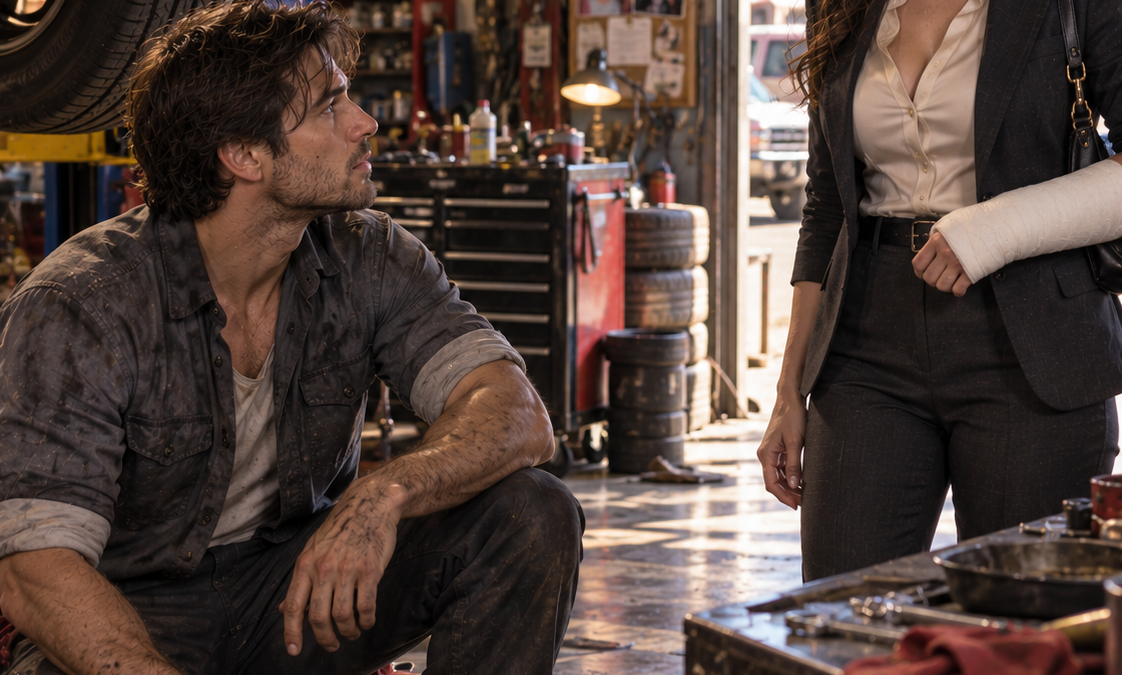
Single Dad Saved CEO Trapped Under a Car — Then He Disappeared Without a Trace.
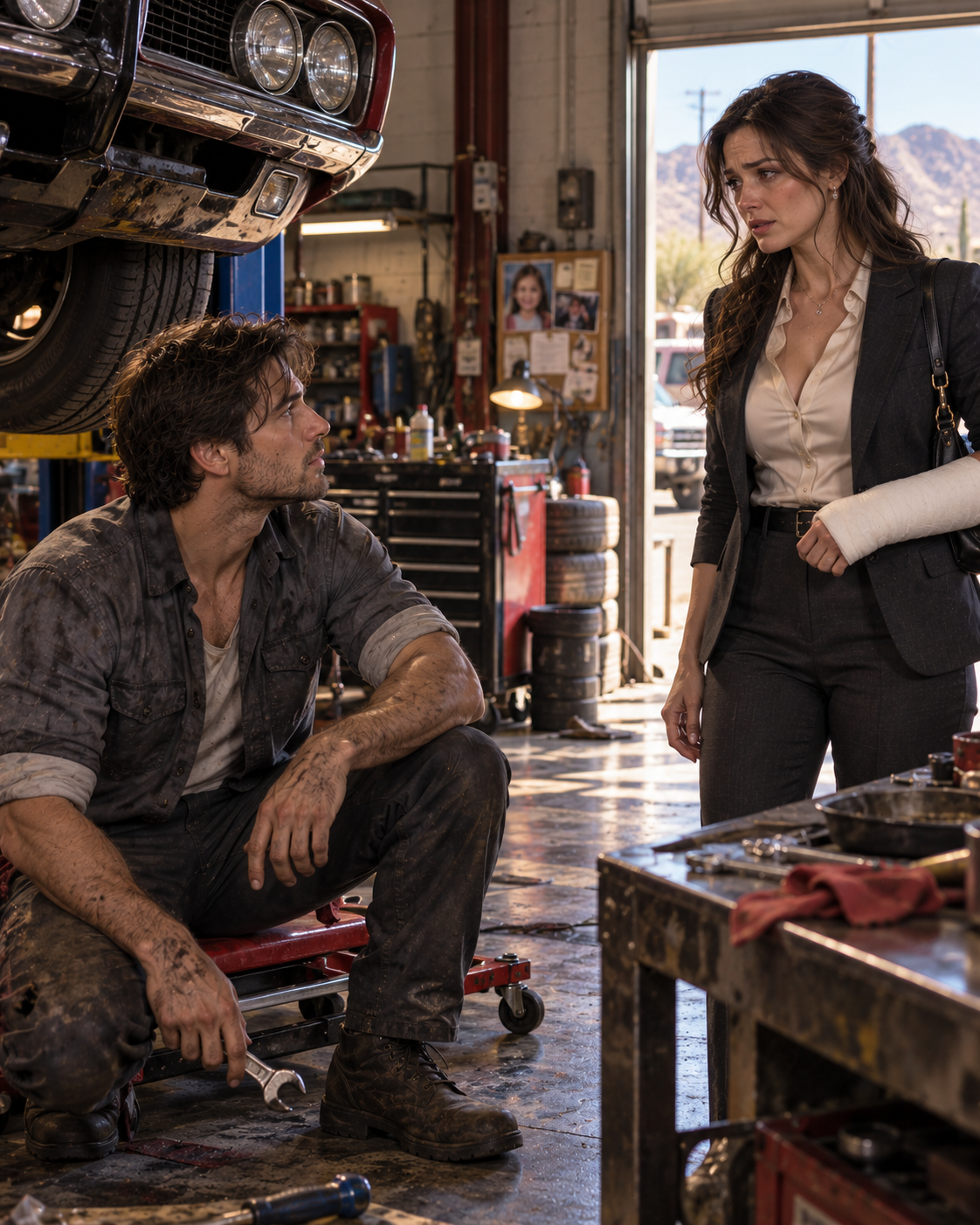
Daniel Carter did not slow down.
He did not think it over. He did not look at the crowd of 20 peoples standing there with their phones up and decide he was braver than them. He just dropped to the asphalt and crawled under a crushed fuel soaked car toward a woman he had never seen before in his life.
The tank was cracked. The frame was groaning. One spark was all it would take.
He went in anyway. And when it was done, when Emma Caldwell was on that stretcher, breathing and alive, Daniel walked back to his truck, started the engine, and drove home to pay his babysitter, nobody got his name.
Nobody got his number. Nobody knew where he went.
Daniel Carter was the kind of tired that sleep doesn’t fix.
Not the tired that comes from one long day. The tired that stacks up over months and years and becomes the background noise of your life. The thing running underneath everything else, always there so familiar you stop noticing.
The way you stop noticing the sound of traffic outside your window. He was 35 years old and he had been working since he was 16.
And he had not taken a vacation in 4 years. And he was driving home
at 9:47 p.m.on a Tuesday night after 11 hours on the shop floor thinking about whether there was anything in the refrigerator worth heating up when the headlights went sideways.
That was how it registered. Not a crash, not an accident, just a pair of headlights doing something.
headlights were never designed to do. Rotating sideways and then downward at a speed and angle that turned his stomach before his brain had finished naming what he was seeing.
He had the breakdown before the thought completed itself. He was out of the truck before the engine finished ticking. He ran behind him.
People were pulling over. Doors were opening.
Voices were rising in that particular pitch humans use when they are witnessing something they cannot yet categorize as manageable.
He didn’t listen to any of it.
His eyes were on the vehicle, which had come to rest on its driver’s side against the base of a concrete barrier, roof folded inward, the front end accordion.
One rear tire still spinning in the air like it hadn’t gotten the message yet that the car had stopped moving.
Five, maybe six people were already standing in a half circle about 20 ft back. Phones up, recording, watching, not moving. Daniel moved.
A man in a red polo shirt stepped into his path with both hands out. Hey, stop.
You can’t go over there.
It’s not stable.
The fuel line. Could someone inside?
Daniel said. The man blinked.
I think so. Yes, but listen.
Then get out of my way. He went around him.
The fuel hit him at 15 ft. That smell. Any mechanic knows it the second it reaches them.
Knows it the way a doctor knows the smell of a room where something is already wrong.
sharp and chemical and serious rising off the asphalt in waves he could feel more than see his eyes tracked to the source immediately swept the undercarriage found the cracked line at the rear found the pool forming and moving following the road’s grade east away from the vehicle away from them not ignited his brain did the math in the time it took to more steps fuel draining
away frame stressed but structured no open flame in his line of sight.
The sirens he could already faintly hear in the distance were real and coming. He had time.
He dropped flat to the asphalt. This was not a new position for Daniel Carter.
He had spent the better part of his adult life horizontal under vehicles in conditions that ranged from inconvenient to genuinely unpleasant. His body knew what to do before his conscious mind gave any instruction.
He swept his flashlight, the one he’d grabbed from the truck’s door pocket without remembering doing it, across the undercarriage and built his picture in 4 seconds.
Frame stressed at the left front pillar, but holding. Roof buckled but not collapsed.
Driver’s door folded inward against the occupant.
Clearance between the asphalt and the lowest stable structural point approximately 18 in. Enough.
Barely enough, but enough.
ma’am.
He kept his voice completely level. The way he talked to Lily when she woke up at 2:00 in the morning, convinced there was a monster somewhere in the dark, calm like still water.
My name is Daniel.
I’m coming in right now.
I need you to keep talking to me. A sound from inside, fractured, halfway between a gasp and a word. The car is moving, she said.
And her voice was fighting itself, fighting the panic that was trying to take it over. I can feel it shifting.
If you come in here, you’ll change the weight distribution and it’s not moving, he said.
He was already inside the shadow of the frame, pulling himself forward on his elbows.
What you’re feeling is your own heartbeat in the metal.
The car is stable. I need you to trust me.
A pause. Short then, okay, one word. But the way she said it told him something important.
This was not a woman who said okay easily. This was a woman who had evaluated the situation and made a decision.
The decision was to trust him.
He’d take it.
What’s your name?
He said, “Emma,” she said.
Emma called well.
“He could see her now.”
Cut on the left cheekbone, bleeding slow. Left arm encased by the door panel.
Right hand pressed flat against the headliner that was now her floor. Left ankle with a section of door assembly across it, awkwardly angled, not deep, but locked.
Her eyes were open, alert, completely focused on his face. No head trauma he could see. Pupils looked even in the flashlight sweep.
“Good, Mema,” he said.
“I’m going to start with your ankle.
Tell me about yourself while I work.”
She stared at him.
“Tell you about myself.”
“Yes, I’m trapped under a car.
I’m aware.”
He said, “Do it anyway.
Trust me, your brain will behave better if it’s talking.”
Another short pause. Then something shifted in her expression.
Not relaxation, more like a decision being made at speed. I run a technology company, she said. Data infrastructure based in Scottsdale.
I was driving back from a conference in Flagstaff when the other driver crossed the center line.
I didn’t even see him until he was already on my side of the road.
How long have you been running the company? 5 years. I started it at 24 out of an apartment in Tempee.
One client, one laptop, $4,000.
And now 240 employees and a federal contract I’m not allowed to discuss in detail.
A pause.
I don’t know why I’m telling you any of this because it’s your real life and your brain knows the difference between real and not real.
Daniel said he had both hands on the door assembly section. Now reading the angle.
Thinking about real things is better than thinking about the fuel you can smell. Emma went very still for just a moment.
That’s a specific thing to say.
She said, “I’ve been in tight spaces before.
Under cars, under cars, under houses. Once under a boat, in a dry dock in Tempe that I would rather not revisit.
” He found the right position.
Ready on your ankle. When you feel the pressure release, draw your fight the angle.
Okay. Three. Two.
He pushed. The metal resisted the way bent metal always resists, which is completely.
And then all at once he felt it flex and then give and he heard Emma make a sharp sound and then her foot was free and they both held completely still for a second.
The way you do when the thing you were afraid wasn’t going to work.
Worked good, he said. Good, she said. She exhaled slowly.
That’s very good.
You’re doing well, he said.
And he meant it. He moved to assess the arm.
What about you? Emma said while he worked.
You told me your name and that you’re coming in.
That’s all I know.
Daniel Carter, he said. Mechanic.
Is that it? Single dad, he said.
Two kids. I was on my way home from a double shift when I saw your headlights go sideways.
Emma was quiet for a moment. How old are your kids?
Marcus is nine. Lily is six.
Where are they right now? Home with the babysitter, Sarah.
She’s reliable, which is worth more to me than almost any other quality a person can have.
He paused. She charges $12 an hour, and I have to stop at the ATM on Chandler Boulevard on the way home because I left the house this morning without enough cash.
Emma made a sound that wanted to be a laugh and almost got there.
You’re under a car at 10:00 at night and you’re thinking about the ATM, she said.
I’m always thinking about the ATM, Daniel said.
It’s a constant feature of my life.
How long have you been a mechanic? Since I was three, he said.
She blinked. Three.
My uncle had a shop. I was handing him tools before I could read. He called it an apprenticeship.
My mom called it unsupervised child development. I called it the best education I ever got. He stopped.
He’d finished his assessment of the arm and arrived at the conclusion he’d been hoping to avoid.
Emma, I need to be straight with you about something. Her eyes moved to his sharp. Ready your arm, he said.
The door assembly has it enclosed on three sides.
I can’t free it from in here without tools I don’t have.
Hydraulic cutter minimum.
She held his gaze and didn’t look away.
Okay, but the frame is stable.
I’ve checked it three times now.
The fuel is moving away from us down the grade. The fire crew is close. I can hear them.
And when they get here, this arm is a 3minut problem with the right equipment.
So we wait,” Emma said.
“So we wait.”
She looked at the frame above them. Then back at him, she was organizing herself around this information in real time, and he could see it happening. Could see her take the facts and build a structure she could operate inside.
“Okay,” she said.
“Then keep talking to me.
” About what about Marcus?
She said, “And Lily, you were telling me.”
Daniel looked at her. Lily painted my living room yellow 3 weeks ago, he said.
Emma’s eyebrows moved.
She painted it. She informed me she wanted it yellow. Drew me a picture of what it would look like.
Very detailed picture for someone who can’t read yet.
Oh, very persuasive argument. He paused.
It’s yellow now.
Emma laughed. An actual laugh.
Small and imperfect and completely real. And he heard what it did to her breathing. The way it knocked the tightest edge off it.
You let a first grader redecorate your house. She said, I have strong opinions about a lot of things, Daniel said. The color of my walls is not one of them.
If it matters to her, it matters to me. He paused. Marcus is baseball.
Not playing it. The history, the stats, the records. He can quote batting averages from players who retired before I was born.
I have genuinely no idea where he got that. You sound like you like them.
Emma said, “They’re the best thing I ever did,” Daniel said simply.
Emma was quiet for a moment. The strobes from the approaching emergency vehicles were starting to color the asphalt around them in rotating pulses of red and white.
“Daniel,” she said.
“Yeah, why did you come over here?”
He kept his eyes on the frame above them. Someone had to. There were 20 people standing 20 ft away with their phones in the air, she said.
None of them came.
“Why you?”
He thought about it.
He didn’t give her the easy answer, the reflexive answer.
He turned the question over and gave her the true one. I have been telling Marcus his whole life that the world runs on people who move when everyone else is standing still. He said that the whole thing, all of it, every piece of how society functions and holds itself together depends on there being enough people who go toward the thing instead of away from it.
He paused.
I’ve been telling him that since he was old enough to understand words, I can’t pull over on the side of a highway and stand there with my phone up.
I can’t do that and go home and look at him the next morning.
Emma didn’t say anything for a long moment.
Does he know? She said finally that you think of him in those moments.
He’s nine, Daniel said.
He thinks I’m just his dad who comes home smelling like motor oil and burns dinner twice a week.
That’s not what you are.
That’s exactly what I am, Daniel said.
And I’m okay with that.
The sirens were on top of them now. Boots hit asphalt, lights swept.
The shift commander was there, organized and fast. Two firefighters flanking her. The hydraulic equipment already coming off the truck.
Sir.
The commander’s voice was professional and firm.
Sir, we have it. Can you slide out to your right?
Daniel looked at Emma. She was looking at him, not at the firefighters.
At him. Her face was composed, fully composed. The woman who had built a company from one laptop in an apartment in Tempe had both hands on herself again and she was steady.
“Go,” she said.
“Go home and pay Sarah and stop at the ATM.
” Something moved in his chest that he did not have a name for.
“You’re going to be fine,” he said.
“I know,” she said.
“Because of what you did.”
“Go,” he went.
He slid out from under the frame and got to his feet and stepped back and stood on the shoulder of the road and watched the crew work. The hydraulic cutter hit the door assembly and the door came away in under four minutes and Emma came out on a backboard try awake and responsive and answering questions in a clear steady voice alive. He stood there for a moment and let that be true around him.
people had moved forward the way people always move forward once the danger is safely managed by someone else. Nobody was looking at him specifically.
He was just a man in a dirty work shirt standing on the shoulder of a highway. He walked back to his truck. He got in.
He started the engine. He pulled back onto the road and headed toward Mesa.
And he ran the ATM math in his head and thought about whether the serial situation at home was going to require a detour to the gas station. on Alma School Road. In his rearview mirror, the lights shrank and curved away.
He turned the radio on. Same station, same slow song. He drove.
He did not feel like a hero. He felt like a man who had done the thing that needed doing and was now behind schedule and slightly scraped up and going to have trouble getting comfortable in bed tonight because his elbows were going to remind him about the asphalt every time he moved.
That was the whole of it for Daniel Carter. That was all it was.
Behind him, a young paramedic finished her section of the incident report and looked up and scanned the shoulder of the highway. No man in a dirty work shirt.
She looked at the shift commander, the guy who went under. Did anyone get his information, name? Anything?
The shift commander looked around, looked at the people, looked at the empty space where a truck had been parked on the shoulder. Good Samaritan, she said.
Right, good Samaritan. And for now, that was the only answer anyone had.
Emma Caldwell loaded into the ambulance with an IV in her arm and a bandage on her cheekbone, stared at the ceiling, and thought about a man who had crawled under a burning car because someone had to, and then left before anyone could ask his name. Emma Caldwell did not cry in the ambulance.
She had not cried at the scene, had not cried when the hydraulic cutter shrieked through the door assembly, and the pressure released from her arm all at once in a wave that made her vision go white at the edges. She had not cried when the paramedics lifted her onto the backboard, and she finally saw the full wreck of her car from the outside, saw how completely it had been destroyed, understood in a single visual instant how close the margin had actually been.
She did not cry. She stared at the ceiling of the ambulance and she thought about a man she did not know who had crawled under that car when nobody else would. And she felt something moved through her that she could not immediately name.
Not gratitude exactly. Gratitude was too small a word for it.
Gratitude was what you felt when someone held a door open for you. This was something else. This was the feeling of having been shown something about the world that you thought you already understood and discovering that you had understood it completely wrong.
The paramedic beside her, young, maybe 25, was asking her questions in a calm, professional rhythm. Did she know what day it was?
Did she know her name? Did she know what hospital she preferred? Emma answered all of them.
But the part of her brain that was not answering questions was replaying the same moment over and over again. The moment when she had heard his voice in the dark under that frame. My name is Daniel.
I’m coming in right now.
Not asking permission, not announcing himself so she could tell him whether or not it was safe. Just stating what was true and what was happening next. She had spent 5 years building a company on the premise that competence was the most attractive quality a person could possess.
Real competence, not the performed kind that showed up in expensive suits and polished presentations. The kind that was so complete and so integrated into a person that they stopped being aware of it the same way you stop being aware of breathing. She had just met the most competent person she had ever encountered in her life.
He worked two jobs.
He drove a truck that she’d barely glimpsed, but that had seen better days.
He had $12 an hour on his mind and an ATM stopped to make, and he had crawled under a burning car with the same matter-of-act calm that other people applied to returning emails. And then he had disappeared. That was the part she kept arriving at.
No matter which way she turned it, he had disappeared. Not rudely, not dramatically.
just quietly stepped out of the frame the moment the professionals arrived and vanished back into the dark the way he had come out of it. She closed her eyes. When she opened them, she was in the emergency department at Banner University Medical Center, and the attending physician was explaining that she had a fractured radius in her left arm, a moderate concussion, and lacerations to the cheekbone that were going to need six stitches.
“You’re lucky,” the doctor said.
He was a compact man in his 50s with reading glasses pushed up on his forehead and the particular tone of someone who had delivered the word lucky to patients many times and understood its full weight. The structural integrity of that vehicle held just long enough. Another 10 15 minutes and the fuel situation alone could have I know.
Emma said you also had someone with you under there who knew what he was doing. The fire crew said whoever went in kept the car from shifting. He braced a section of the frame with something from his vehicle.
Apparently a floor jack, they think. Emma went very still.
He braced the frame, she said.
That’s what the shift commander told the report officer.
The doctor glanced at his clipboard. Good Samaritan, it says here. No other identification.
Emma looked at the ceiling again. He had not just stayed with her.
He had brought tools. He had assessed the structural problem and addressed it with equipment.
He had gone back to his truck to retreat. All while she was focused on his voice, on his words, on the steadying effect of a stranger who refused to let the situation be as bad as it was.
She had not even known he’d done it.
She thought about that for a long time in the hours after the stitches and the X-ray and the CT scan. Thought about a man who braced a failing car frame without mentioning it, who handled the mechanical problem and the human problem simultaneously and mentioned neither.
Her assistant, Jordan, arrived at the hospital at 1 in the morning, slightly breathless and carrying Emma’s emergency bag that was kept in the office for situations that nobody had ever expected would actually occur.
I called your mother, Jordan said immediately.
Jordan, she’s on a flight from Denver.
She lands at 6. Jordan, I told you explicitly not to.
You were under a car, Jordan said. With all due respect, your explicit instructions apply to normal circumstances.
This was not normal circumstances. He set the bag down and looked at her with the expression he used when he had already decided something and was informing her of it rather than asking for approval. Who was he?
The man who helped you. Do Emma looked at him.
Jordan had been with her for 3 years. He was 28 years old and frighteningly efficient.
And he had the particular quality of a person who processed the world primarily through logistics. His first instinct about everything was to find the lever that moved it. Good Samaritan, Emma said.
That’s all the report says.
The fire crew must have seen him. Someone took a photo. There were at least 15 people out there with their phones.
Find out what you can, Emma said. But Jordan, he was already on his phone. Yes.
Don’t make it a press thing.
Don’t put out a public appeal yet.
Don’t call the media.
Jordan lowered the phone slightly. Why not?
Emma thought about a man who stepped back the moment the firefighters arrived.
Who didn’t wait for the thank you.
Who didn’t wait for anything?
Because I don’t think he wants to be found, she said.
And I want to find him the right way. Jordan looked at her for a moment with an expression that said he had approximately 47 questions about that statement, but was choosing to file them for later.
“Okay,” he said.
“I’ll start with the highway patrol report and work outward.”
Emma nodded. Then she lay back against the pillow and stared at the ceiling and thought about yellow living room walls.
It took Jordan 6 days to find nothing.
That was not a statement about Jordan’s ability.
