Ten Experts Failed The Billionaire’s 1968 GTO—Then A Broke Single Dad Fixed It Using Scrap (part 3)
Part 3
Sharon said they’ll coordinate with the police.
There’s already an open file from the storage bay incident, and Terrence is cooperating.
He’s given them a full account of his instructions.
She sat down. Holloway is going to lawyer up the moment they approach him, but the documentary evidence is solid.
The Shell vendor network took 3 years to build and about 36 hours to unravel once we had your father’s records to cross reference against.
Natalie looked at the report. The board is going to want to see this before 5:00.
I’ll have a board ready version to you by noon.
Sharon paused.
There’s one more thing.
The component records your father kept, the serial numbers of the original components that were removed and replaced. Some of those components are recoverable.
The shell vendors still have inventory. When the investigators move on the assets, you may be able to reclaim a significant portion of the originals.
She hadn’t thought about that.
How significant?
We don’t know yet, but it’s worth pursuing.
After Sharon left, Natalie sat with the report for a few minutes. 32 pages.
Three years of careful theft, dismantled, sitting under the fluorescent light of her office like something that should have been heavier.
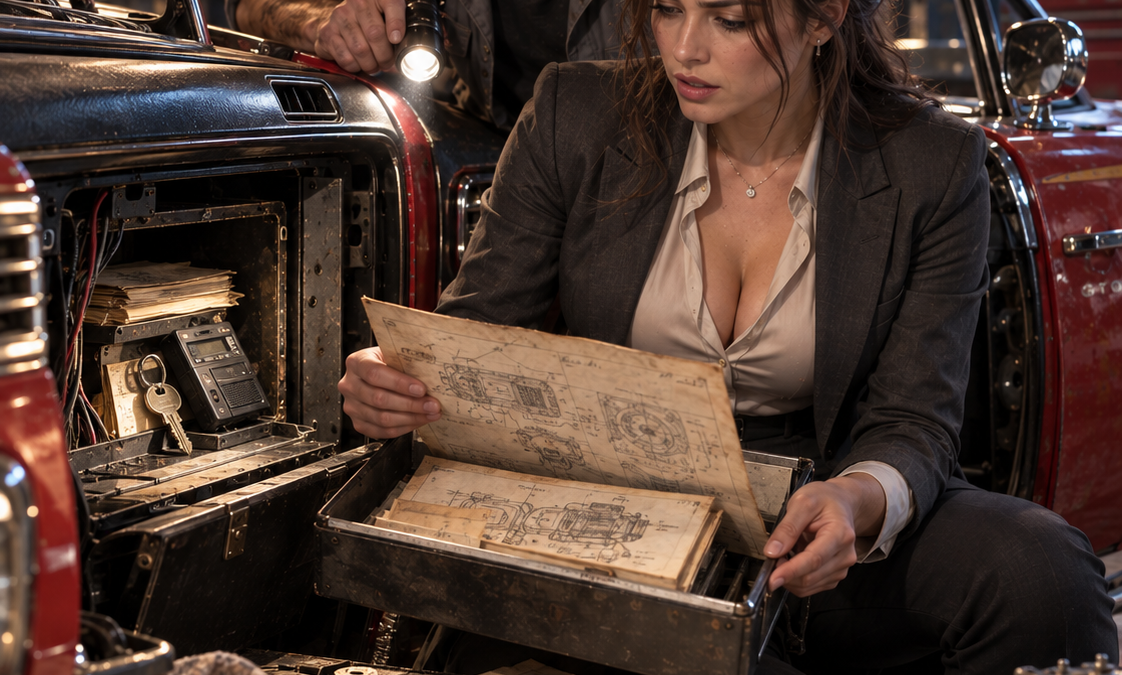
She thought about her father alone in whatever room he’d been in when he’d gotten sick, recording his voice into that small recorder and folding the drawings and putting the case in the compartment he’d built into the car.
She thought about what that must have felt like, having all the pieces of what had been done to him and not enough time to see it through.
She thought about him saying, “I should have been better at saying certain things.”
She did not let herself stay there long.
There was too much to do, and she’d learned in the 22 months since his death that grief had to be scheduled or it would consume the entire calendar.
She picked up the report and went back out to the workshop. At 11:40, Mason called her over to the car.
He’d been installing the regulator for 3 hours, working with the care that expensive things demand.
not slow, but considered each connection made and verified before the next one. Paulo had assisted with the wiring integration, and Greg had materialized at some point and done the work of two people running parts and holding things without being asked.
The workshop had a different quality now than it had at the beginning of the week. Less like a facility under examination, and more like a place where something was being made. Mason straightened up from the engine bay.
He had the look he got when he’d completed a significant step.
Not satisfied exactly, more like someone who has been carrying a weight and has just set it down to check that it’s still intact.
I want to run a static check before we try to start it, he said. Check the electrical connections. Confirm the timing with a light.
He looked at her. Then we try.
What’s your level of confidence?
He thought about that honestly. High.
But I’ve been wrong before.
He paused. The component is built to spec.
The installation is solid. The corrections to the rest of the system that I made Monday should hold.
If there’s something else wrong in there that I haven’t found, he lifted a shoulder.
Then we’ll find it when it runs or doesn’t.
Okay.
She looked at the engine bay at the small, dense assembly of her father’s design sitting in its intended place for the first time in over a year.
Do the static check.
He spent 25 minutes going through it methodically with a timing light and a test meter, checking each connection point, confirming the regulator’s integration with the distributor and the ignition curve.
Twice he stopped and made a small adjustment.
Not a correction of a mistake, just a final calibration, the way you tune an instrument after it’s been assembled.
Paulo watched and Greg watched and Curtis from Sharon’s team wandered in from the document room and stood at the edge of the bay and Natalie stood slightly back from all of it with her arms at her sides.
At 12:18, Mason said, “Okay, let’s try it.”
Greg slid into the driver’s seat.
The workshop was quiet in the specific way it gets when a group of people is simultaneously trying not to hold their breath. Greg turned the key.
The GTO cranked, caught, settled into an idle. Nobody said anything.
10 seconds. 15. The idle was even, not perfectly smooth.
It was a 50-year-old engine that had been through 11 months of repeated failure and repair, and it had the textured quality of something old and real rather than the flat steadiness of something new. But it was running.
The idle held and it kept holding.
And at 30 seconds, Paulo said something quietly in Italian that Mason didn’t understand, but the tone was clear enough.
At 45 seconds, Natalie said, “Revit.”
Greg brought it up to 2,000 RPM. The engine responded cleanly. No hesitation, no stutter.
He held it there, and the sound filled the workshop. That particular GTO sound, broad and low and carrying, the sound of an engine that was built to be heard. He brought it back to idle, still running.
At 2 minutes, Mason said, “Cut it.”
Greg turned the key. The engine stopped cleanly.
Silence.
Greg got out of the car and looked at Mason and said, “Son of a” and stopped himself, which was its own kind of tribute.
Paulo had his hand over his mouth. Curtis had his phone out and was very obviously trying to decide whether photographing this was appropriate and deciding it was not. Mason was looking at the engine bay.
He was not smiling exactly.
His face had the quiet look it got when he’d finished something and was still in the doing of it rather than the having done it.
But there was something there underneath. Natalie looked at the car. She looked at it for a long time.
“Can it sustain a drive?”
she said finally.
“It needs a warm-up period.
The thermostat’s original and it runs conservative.
Give it 15 minutes at idle, then yes.”
He looked at her.
“You want to drive it before Callaway?”
“I want to drive it at Callaway,” she said.
Reginald Callaway was 61 years old and had the demeanor of a man who had spent four decades watching people try to impress him and had developed as a result a nearly impenetrable immunity to being impressed. He arrived with three associates and a lawyer, all of them in dark suits, all of them with the collective energy of a group that has flown in specifically to be persuaded and is reserving judgment on whether persuasion is possible. Natalie met them in the main entrance.
She was wearing a charcoal blazer she’d had in her office closet for situations that required a blazer, and she’d had 20 minutes to make herself look like someone who had slept normally.
She was aware this was not entirely convincing, but it was the best available option.
“Mr.Callaway,” she said.
“Thank you for making the trip.”
Callaway shook her hand with the grip of someone who measures things by grip.
“Miss Ashford, we’ve been looking forward to seeing what you’ve got.”
He looked past her toward the workshop entrance. I understand there have been some developments this week. Word traveled fast.
She’d expected that.
There have, she said.
I’ll give you a full accounting after the demonstration.
She paused.
But I’d like to show you the car first.
She walked them into the workshop. The GTO was in the center of the bay, exactly where it had always been. Someone, Greg, she suspected, had wiped it down, which it needed given the week it had been through.
The carousel red paint still had the patina of age, and some of the chrome still showed pitting, and the car did not look in any way like something that had just been professionally detailed. It looked like what it was, a 58-year-old machine that had been through a great deal, and was still here.
Mason was at the workbench, not positioned to impress anyone, just standing where he’d been standing when he finished the final check.
I was wearing the same gray shirt and jeans.
He had not, as far as Natalie could tell, made any attempt to look different for Callaway’s arrival, which she’d both anticipated and respected.
Callaway looked at the GTO.
He walked around it slowly, the way someone does when they actually know what they’re looking at, rather than performing knowledge.
He stopped at the front and looked at the engine bay, which was still open. He studied it for a moment. This is the regulator, he said, pointing.
The custom piece. Natalie looked at him. You know about it?
I know Richard Ashford, Callaway said. He corrected himself immediately with a slight tightening around the eyes.
New? We went to the same engineering programs, different years.
He told me once that he’d built something into this car that nobody else could replicate.
I thought he was being sentimental. He looked at the component.
That’s handbuilt.
It was rebuilt this week, Natalie said.
From my father’s original engineering drawings by Mason Carter.
she indicated. Mason, who was watching this exchange with the still attention he brought to most things?
Callaway looked at Mason. You built this? Yes, sir.
To what tolerance? Mason told him. Callaway looked back at the component.
In what shop? Laen the back, Mason said. Floor model Southbend.
Callaway’s lawyer leaned in and said something quiet.
Callaway ignored him. Can you start it?
Yes, Natalie said.
I’ll drive it.
She got in.
She’d driven a lot of cars.
Her father had made sure of that, insisting when she was a teenager that understanding cars meant driving them, not just looking at them.
And over the years, she’d driven things that were faster and newer and more technically sophisticated than this.
But when she turned the key and the GTO came alive under her hands, the sound was not like other cars.
It was specific in a way she didn’t have a word for.
It was her father’s engineering and her father’s precision and his voice saying, “I finished the regulator and it was Mason Carter working through three nights without enough sleep because he’d heard an engine from a block away and couldn’t let it go.”
She put it in gear
and drove it out of the workshop into the lot. She ran it through the course that Dererick had laid out, low speed through the yard, then out to the access road where she could open it up.
Three full accelerations to highway speed, smooth and clean each time. the engine responding with a directness that matched exactly what her father had described in the notebooks.
She drove it back into the yard and stopped and let it idle. And then she shut it off and restarted it twice to demonstrate the cold start reliability. She got out, walked back to where Callaway was standing.
His face had changed in a way that he was trying not to let be visible, which told her more than if he’d let it go.
One of his associates was typing on a phone. His lawyer was looking at the car with the expression of someone who has stopped looking for problems and started looking for different things.
The fraud, Callaway said, “Tell me about it.”
She told him, “Not everything.
Not the storage bay at 2:00 in the morning.
Not her father’s voice on the recorder saying I should have been better at saying certain things, but the outline factual and clear.
The scope, the mechanism, the evidence, the status of the investigation.”
30 minutes standing in the yard.
next to the car that hadn’t been able to run a week ago.
Callaway listened without interrupting, which was she had learned how he listened when he was actually listening. When she finished, he was quiet for a moment.
Then he said, “The operations director you’re removing, Holloway, he was the primary contact for our previous preliminary conversations about this contract.”
I know.
And you weren’t aware of his involvement at that time.
No, I became aware this week, but you moved on it immediately when you did. Yes.
Another pause. Callaway looked at the GTO.
The new division you mentioned, restoration and independent testing, who heads it?
She had thought about how to answer this question since the previous afternoon when she’d first begun to understand that she needed to have an answer ready.
I have someone in mind, she said.
I’m still working through the structure of the offer.
Callaway looked across the yard at Mason, who is back at the workshop entrance, watching the conversation from a distance with the careful neutrality of someone who understands he is being discussed and is choosing not to make that anyone’s problem.
“Is it the mechanic?”
“He’s an engineer,” she said.
Callaway made a sound that was almost a laugh.
“Yes,” he looked at her.
“Miss Ashford, my concern coming into this meeting was not primarily the car.
The car is a significant asset, but what I’m investing in is the judgment of the person running the company.
He paused. The way you handled this week tells me more about your judgment than 2 years of financials would.
His lawyer started to say something. Callaway held up a hand briefly.
Let’s talk about the contract terms, he said.
The board meeting at 5 was a different kind of conversation.
12 people around a table that had been her father’s table before.
It was a board table in a room with a window that looked out over the lot where the GTO was now sitting under a cover with its engine quiet and its problems resolved.
Sharon’s summary report was in front of each board member along with the forensic accounting findings and a preliminary statement from the investigators.
Natalie had distributed everything an hour before the meeting so that nobody could claim they were seeing it for the first time.
She presented for 20 minutes the fraud, the investigation, the steps she’d taken in order, beginning with the moment she’d given Mason Carter 20 minutes on a Monday morning.
She did not frame it as a victory.
She presented it as a series of decisions she’d made with incomplete information, some of which turned out to be right, and described what each decision had cost and what it had returned.
The board chair, a white-haired man named Lawrence Puit, who had been on the board since her father built the company, asked most of the questions. Some of them were hard.
She answered them directly, including the ones where the direct answer was, “I don’t know yet, or that’s still being determined.”
She did not perform certainty she didn’t have.
At the end, Puit said, “The Callaway contract signed,” she said, “the letter of intent contingent on final terms being agreed within 30 days.
Reginald Callaway signed it before he left. Silence around the table.
45 million are over 3 years, she said, with an option to extend.
He also expressed interest in the independent testing division as a potential separate engagement once it’s operational.
Puit looked at her for a moment. Then he looked around the table with the quiet authority of someone who has been doing this long enough to know when a room has already decided.
I’d like to move that we table the confidence review scheduled for this meeting, he said.
Given the developments of this week, I think we have sufficient evidence of leadership to proceed without it. The vote was 11 to1.
The one abstension, not dissenting, a board member named Carol who always abstained from personnel matters on principle, which was consistent and which Natalie had always privately respected, even when it was inconvenient. After the board cleared out, Natalie sat in the room alone for a few minutes. She looked at the window and the lot and the covered shape of the car out there in the early evening.
She thought about Thursday becoming Friday and the specific arithmetic of what it had taken to get from one to the other. Then she went downstairs. Mason was still in the workshop, which did not surprise her.
He was cleaning the bench, not because anyone had asked him to, just because it was his nature, apparently, to leave a space the way he’d found it, or better.
His toolbox was closed and set near the door. The drawings were rolled and stacked.
The shop rags were in the industrial laundry bin. The lathe was covered.
He looked up when she came in. Callaway signed, she said. He nodded.
Something in his face that wasn’t quite a smile, but was in that direction.
The board tabled the confidence review.
That’s good.
She came to stand near the GTO. She put her hand on the covered surface over the hood, felt the shape of it under the cloth. I want to offer you a position, she said.
Head of a new division, restoration and independent parts testing. Your own team, your own protocols, built from scratch.
She paused. And an equity stake in the testing operation. He was quiet.
There’s also a finder compensation for the fraud recovery.
standard forensic whistleblower terms. It comes out to somewhere around $500,000 given the scale of what you identified. She looked at him.
That’s separate from the position offer.
It’s yours regardless of whether you take the job.
He picked up his coffee cup and found it empty and set it back down. I need to think about it.
I know the position.
I’ve been on my own for 2 years.
Running a division is different from running a bay. I know that, too. She let a beat go.
What would you need to make it work? He thought about that, not performing deliberation, actually thinking it through the way he approached everything. Autonomy on hiring, he said finally.
I’m not going to put my name on work done by people I didn’t choose.
And the testing protocols have to be independent.
No pressure from the restoration side to clear something that shouldn’t be cleared.
Agreed.
and I need to be able to tell a client that their car can’t be fixed the way they want it fixed and have that stand without being overridden because the client spends a lot of money.
Also agreed. He looked at the car.
Riley’s school is on the east side.
I’d need a schedule that gets me there for pickup on Tuesdays and Thursdays.
She had not expected that one, and the unexpectedness of it was its own kind of thing. What time? 3:15.
That’s manageable, she said.
He was quiet again.
Then you’ve got one more problem.
Only one? A brief sound that was almost a laugh. The dash compartment.
I resealed the panel after we removed your father’s case.
But when I was doing it, I found a secondary space behind the first one. Smaller.
Didn’t have time to open it during the week.
He paused. Might be nothing.
Might be more documentation. Thought you should know before someone else finds it. She looked at him.
Show me.
He went to the car and lifted the cover on the driver’s side and leaned in.
And she crouched beside the door. And he directed her flashlight to a seam behind the first panel that she would not have seen without being told to look.
He pressed a point along the edge and a secondary catch released and the inner panel came away. It was a flat envelope sealed with old tape that had gone brittle.
She opened it carefully. inside photographs dated her father at various points over the previous decade with vehicles and components and in several cases with other people and in the back of the envelope a folded page a letter handwritten addressed to her.
She didn’t read it there.
She folded it again and put it back in the envelope and held it. Mason had stepped back to give her room.
She was aware of him at the edge of the light and of the workshop around them and of the car under her hand.
her father’s car running now finished at last.
“Thank you,” she said, “for all of it,” he said.
“I’ll take the job.”
And that was the whole of his answer, which was exactly the right amount. She read the letter that night, alone at her kitchen table with a cup of tea that went cold before she was halfway through it.
Her father’s handwriting was the same as in the notebooks, tight, precise, the handwriting of someone who had always been more comfortable with specifications than with expression.
But this was different from the notebooks. The notebooks were working documents.
This was something he’d sat down to write, knowing it might be the last thing she ever read from him, and the effort of that showed in the way certain words were pressed harder into the page, in the places where the pen had paused long enough to leave a small blot of ink.
He wrote about the company.
He wrote about what he’d built, and what he’d hoped for it, and what he was afraid of leaving unfinished.
He wrote about Victor, not with anger, she noticed, but with something closer to disappointment, the specific disappointment of a person who had trusted someone for a long time and discovered that the trust had been one directional the whole time. He wrote about the documentation in the safety deposit box and what he hoped it would be enough to do. And then near the end, he wrote about her.
He wrote that he had not been good at saying what he meant when it came to things that mattered most to him and that he was aware she had grown up knowing she was important to him without always knowing how important and that he was sorry for the gap between those two things. He wrote that he had watched her learn to run the company after he got sick and that what he saw in her was not what she probably thought he saw.
Not the performance of competence, not the management of impressions, but something underneath that, something that was just hers. He called it, in the careful language of a man writing outside his comfort zone, a quality of honesty.
He wrote, “You always told the truth, even when it cost you.
I should have told you more often that I noticed.”
He wrote, “The car will run when someone is willing to listen to it instead of telling it what’s wrong.”
I always thought that was a metaphor for something, but I could never work out for what.
Maybe you’ll figure it out.
” She sat with the letter for a long time after she’d finished it.
The kitchen was quiet. Outside, the city made its nighttime sounds.
Distant traffic, someone’s dog, the particular urban quiet that isn’t really quiet at all, but becomes familiar enough that you stop hearing it as noise.
She thought about her father and about the car and about a mechanic she’d given 20 minutes to because she’d run out of better options.
She thought about how much of the important things in a life arrived sideways through doors you didn’t know were doors when you were standing in front of them.
Then she folded the letter, put it back in the envelope, and went to bed. Victor Holloway was formally arrested 9 days after the board meeting.
The investigators had spent those 9 days building the case with the thoroughess that the scale of the fraud required, tracing the Shell vendor network, documenting the financial flows, cross-referencing her father’s records with the transaction data Sharon’s team
had extracted.
Terrence, the young procurement staffer who’d been caught in the storage bay, had accepted a cooperation agreement and provided a detailed account of how the scheme operated and who had directed each component of it.
His account matched the documentary evidence at every verifiable point.
The arrest happened on a Tuesday morning outside Victor’s home.
Natalie learned about it from her attorney at 8:15.
A brief text message that said simply, “Done.”
She was in her office reviewing division staffing plans when she read it.
She sat with it for a moment, the word and what it meant and what it didn’t undo.
And then she set her phone face down on the desk and went back to the staffing plans.
She’d expected to feel more or differently.
What she felt was tired in a way that wasn’t unpleasant.
The tiredness that comes at the end of something rather than the middle of it. The anger had burned off somewhere in the preceding two weeks, through the board meeting, through the Callaway negotiations, through the hours of legal and investigative work that had consumed most of her waking time.
What remained was something quieter and more functional, a problem that had been solved, a space that now needed to be filled with something better. She picked up her phone and called Sharon Reeves. I heard, she said.
Clean arrest, Sharon said. His attorney was already there, so the initial questioning was brief, but the case is solid.
He knows it’s solid.
A pause. The asset recovery process will take longer. The shell companies have accounts in three jurisdictions, but the investigators are confident we can recover a substantial portion.
The original components, the ones Terrence photographed before we stopped him. The investigators used that documentation to identify two of the shell vendor warehouses. They executed search warrants yesterday.
Sharon’s voice carried the particular satisfaction of someone who has found that a mistake by the opposing party has turned into evidence for their own case.
Roughly 40% of the original components from the restoration project are sitting in those warehouses still in the original packaging. 40%.
Not everything, but more than nothing, more than she’d expected, more than Victor had apparently anticipated someone finding.
Can we recover them? Your attorney is filing the civil recovery action today. The criminal proceedings will take time, but the asset recovery can move in parallel.
Sharon paused. Richard would have appreciated the irony. The attempt to destroy the evidence ended up documenting the location of the physical evidence.
After the call, Natalie sat at her window and looked at the lot. The GTO was in the showroom now.
They’d moved it 2 days after the Callaway signing, giving it a proper place after its long time in the workshop.
She could see the showroom window from her office at this angle, just the corner of it, and on certain days when the morning light hit right, she could see the red through the glass.
Mason’s first day in the new role was a Monday, 3 weeks after the board meeting.
The division didn’t have its own space yet.
That was coming, a separate building on the south end of the property that was currently being fitted out. So, he was working out of a section of the main workshop that had been cleared and reorganized.
He arrived at 6:40, which Natalie learned from Greg, who had taken to texting her with this information in a way that she suspected was his version of endorsement. He brought Riley. Natalie arrived at 7:00 and found a 7-year-old girl sitting on a stool at the edge of the main bay, wearing a pink backpack and eating a granola bar and looking at the workshop with the frank evaluative attention of someone conducting a serious assessment.
Mason was at the new bench, longer than his old one, actually equipped with tooling that Natalie had sourced over the previous two weeks, reviewing a technical file on a vehicle intake that had come in over the weekend.
She’s waiting for the school bus, Mason said without looking up.
It picks up at the corner at 7:50. Greg said it was okay. Natalie looked at Greg, who was across the workshop pretending to organize something and very clearly aware of this conversation.
“It’s fine,” she said.
She walked over to the stool.
“Hi,” she said to Riley.
Riley looked at her with the direct, unscentimental appraisal that seven-year-olds bring to adult strangers.
“Are you the boss?”
“I am.
My dad said you gave him a job. He earned it.
Riley considered this. He works a lot, she said, not as a complaint, just as a fact she was reporting accurately.
He does. Natalie paused.
Is that okay? Riley thought about it with genuine seriousness. He comes home, she said.
Some dads don’t come home.
She said it the way kids say things they’ve overheard adults say.
And then she took another bite of her granola bar and looked back at the workshop. Natalie stood there for a moment.
Then she said, “That’s a good point and meant it and went to her office.”
At 7:48, she heard Mason walk Riley to the door and wait with her until the bus came.
She didn’t look out.
She was on a call, but she heard his voice and then the sound of the bus and then the door closing and then his footsteps going back to the bench. The letter from the state engineering board arrived on a Wednesday in late October, 6 weeks after Mason had started. He brought it to her office himself which told her it was significant.
He had not been in the habit of bringing things to her office. He was in the habit of handling things and reporting results. And the distinction said something about what this was.
He set the envelope on her desk. It had already been opened.
She looked at it then at him.
They’re reviewing the case.
He said the false complaint that was filed 6 years ago.
Sharon’s team found documentation in Victor’s records showing that the complaint was coordinated.
Victor knew the people who made the filing.
It was designed to remove me from an engineering position at a vendor company where I’d started identifying the same kind of part substitution scheme he was running here.
She looked at him.
He was holding himself still, but there was something in his face that wasn’t still at all.
Something that had been compressed for a long time and was now under pressure from a different direction. He had you fired, she said.
He had me discredited. Mason said fired was the result.
He paused. The engineering board said the review process takes 60 to 90 days.
If they find what they found the last time someone looked at it carefully, he stopped. Your license, she said.
Yeah. She understood then the full shape of what the last 6 years had been for him.
Not just the borrowed bay and the difficult finances and raising Riley alone. All of that was real, but underneath it had been something else.
the specific weight of being good at something and having that goodness taken from you by someone else’s calculated dishonesty.
Working for 6 years at the level you were allowed to work at when the level you’d actually earned had been stripped away by a lie.
Mason, she said, whatever the board decides, your position here isn’t contingent on the license.
You’ve already demonstrated more than the license would certify.
He looked at her for a moment. I know, he said, but it matters anyway.
I know it does,” she said.
He took the letter back and went to the workshop.
She sat at her desk and thought about the specific quiet cruelty of that kind of damage, the kind that doesn’t leave visible marks, but changes the entire shape of a life, redirects it at a point where redirection costs the most.
She thought about what it had taken for him to walk through the gate of this property with a battered toolbox and $12 in scrap metal, knowing what he knew about himself and what the world had been told about him and ask for 20 minutes. She thought was not a small thing. That was in fact a very large thing and it deserved to be recognized as such.
She opened her laptop and started drafting a formal letter of support for the engineering board review. The review took 73 days.
During those 73 days, the restoration division’s new building was completed and fitted out.
Mason hired four people, two junior technicians, one experienced restoration specialist named Diane, who had 20 years in the field and had heard about the position through Paulo, who had joined the testing division, and one administrative coordinator who turned out to be the most organizationally effective person Natalie had seen in a
professional context since her father’s old office manager.
The independent testing protocols that Mason designed were reviewed by Sharon’s team for procedural integrity and approved by three external specialists.
The first three vehicles came in for testing in the second week of November. The Callaway contract work began in earnest in December.
Regginald Callaway turned out to be a demanding client in the ways that were productive and not in the ways that were destructive.
He had specific standards and communicated them clearly and did not change them arbitrarily, which was in Natalie’s experience the difference between a difficult client and a bad one.
His project manager made the trip to the facility twice in the first month and spent both visits in the testing bay with Mason going through the protocols with the thoroughess of someone who had been burned by inadequate certification before and intended not to be again.
your guy,” the project manager said to Natalie on his second visit, standing at the edge of the bay, watching Mason walk two of the junior technicians through a fuel system integrity check.
“He’s the real thing.”
“I know,” she said.
“Where did you find him?”
He drove past the building and heard an engine. The project manager looked at her to see if she was joking.
She wasn’t.
He turned back to the bay.
“Huh?”
he said. Uh, the letter from the engineering board arrived on a Thursday afternoon in January.
Mason was under a 1971 Chevel when Diane brought it to the workshop. He came out from under the car, wiped his hands, and read it standing at the bench.
Diane and the two junior technicians had the careful awareness of people who understand something significant is happening and have collectively decided to find other things to look at. He read it twice.
Then he set it on the bench and went back under the chvel and finished what he’d been doing, which took about 20 minutes.
When he came back out, he picked up the letter and went to find Natalie. She was in the showroom in the middle of a conversation with a private collector about a potential intake.
She read Mason’s face when he appeared in the doorway, the particular quality of stillness that meant something had resolved, and said to the collector, “Excuse me for one moment.”
and came to the door. He handed her the letter. She read it.
The review had found based on new evidence that the original complaint against Mason Carter had been filed in bad faith and contained materially false statements. The complaint was formally expuned from his record.
His engineering license was reinstated with full standing retroactive to the date of the original suspension. She looked up. He was not crying.
He was doing the thing he did that controlled stillness, but his jaw was set in a way that told her what the stillness was costing. 6 years Riley had been one year old.
He’d been building something and it had been taken.
And he’d spent 6 years working at whatever level he could reach, supporting his daughter, borrowing a bay from a tire shop, driving past buildings where engines spoke to him through walls.
“Congratulations,” she said.
And then because it was true and he deserved to hear it, this was always yours. They just gave it back. He took the letter back.
He nodded once.
He said, “I’m going to call Riley’s school and let her teacher know.
Riley’s been He stopped.
Started again.
She’s been worried.
She’s seven and she understands more than 7-year-olds are supposed to understand.
Go call,” Natalie said.
“Take as long as you need.”
He went outside. She watched through the showroom window as he stood in the parking lot with his phone to his ear and she saw the moment the teacher must have put Riley on.
Something changed in his posture. A fractional shift.
The particular way a person’s body changes when they’re talking to the person they love most.
She turned back to the collector who had the good grace to be looking at a brochure. The plaque went up on a Friday in February.
It had been Natalie’s idea and she’d expected Mason to resist it.
He had the specific discomfort of someone who had spent a long time being invisible and had not fully recalibrated to a world in which being seen was not also being exposed.
But when she showed him the text, he’d read it and been quiet for a moment and then said, “Okay.”
And that was that.
They mounted it on the wall of the showroom beside the GTO’s display space.
Simple brushed steel, the lettering clean and without ornamentation. 1.
94 million or in failed repairs, $12 in scrap metal. One single father who chose to listen.
The GTO stood beneath it in morning light carousel red deepened by the careful cleaning and the compound work Greg had done on the paint in his spare hours.
Not a restoration to showroom new, they’d all agreed on that, but a preservation of what it actually was.
The chrome still had its pitting. The paint still had 58 years in it.
The car looked like time, like use, like something that had been through things and was still here, and that seemed more honest than making it look like it had just left the factory. The first time Riley saw the plaque, she stood in front of it for a long time.
Mason stood behind her with his hands in his pockets, watching her read it.
“That’s about you,” she said.
“Yeah.”
“The $12?”
She turned around to look at him.
“That was the scrap metal you brought?”
“Yeah.”
She looked at the plaque again, then at the car.
She was 7 and a half now, and she had the quality of attention that some kids have where they’re thinking about more than they’re saying.
“Was it scary?”
she said.
“Going in there when you didn’t know if they’d let you.”
Mason thought about it a little, he said.
“Yeah, but you went anyway.”
“I knew what was wrong with the car,” he said.
“That seemed more important than being scared.”
Riley considered this with the seriousness it deserved.
Then she nodded like someone filing something away for later and went to look at the car up close, pressing her face near the driver’s window to see inside.
Natalie was across the showroom and had heard all of this without intending to. She looked at the plaque, then at the car, then at Mason watching his daughter.
She thought about what her father had written. I always thought that was a metaphor for something, but I could never work out for what.
She thought she understood it now. Not completely.
She wasn’t sure it was the kind of thing you ever understood completely, but enough to work with.
You listen to something not because it’s convenient or because the timing is right or because someone has handed you a diagnostic report that tells you where to look.
You listen because the thing in front of you is real and it deserves that much from you and because the truth of what’s wrong with it has been there the whole time, available to anyone willing to be quiet enough to hear it.
The money doesn’t buy you that.
The credentials don’t buy you that.
What buys you that is just willingness. The decision to actually pay attention. It sounds simple.
It isn’t simple.
There are thousand pressures at any given moment pushing you toward assumption, toward precedent, toward the comfort of what you already know. Fighting those pressures is not natural. It costs something every time.
Most people faced with that cost often enough stop paying it. They replace listening with telling and they call it expertise.
And in a lot of cases, nobody notices the difference until the car that was supposed to run has been failing for 11 months and $2 million. And the solution turns out to be something so fundamental it embarrasses everyone.
Mason Carter had never stopped paying that cost.
He’d paid it when it earned him nothing and when it cost him everything, and when the person standing across from him was laughing.
That was the thing Natalie had seen in him from the first morning. Not talent, not cleverness, not the particular brand of competence that performs well under observation. Something harder to name and harder to fake.
A quality of honesty so deep it extended to the way he heard a sick engine from a block away and couldn’t pretend he hadn’t.
She thought about her father writing those words in a letter he didn’t know if she’d ever read.
She thought about the recording, his voice measured and slightly horsearo, saying, “The car will run when someone is willing to listen to it.
” It had taken 58 years and $2 million and a man with $12 in scrap metal.
But he’d been right.
In March, the restoration division took in its eighth vehicle, a 1969 Dodge Charger that arrived on a flatbed from a collector in Colorado non-running with a history of failed restoration attempts that felt to everyone in the workshop pleasantly familiar. Mason walked around it twice the way he did, stood at the front and listened to it not running, which had stopped being strange to the junior technicians by the third week. Then he put his hand flat on the hood and left it there for a moment.
Diane, watching from the bay entrance, said to one of the technicians quietly, “He’s reading it.
” “Reading what?”
She thought about how to explain it.
“Whatever it has to say,” she said finally and went back to her workbench.
Mason lifted his hand from the hood. He looked at the charger for another moment, and something in his face had the quality of a conversation that had just begun.
Then he turned to his team, Diane and the two technicians and Paulo, who had come over from the testing bay for the intake, and said, “Okay, let’s pull the engine documentation and see what we’ve got.
” They went to work.
In the showroom, visible through the open bay door, the GTO sat under its plaque with its engine quiet and its problems resolved.
58 years of history in its paint and its chrome, and the small, dense component in its ignition system that bore, in the precise tolerances of its machine surfaces, the particular signature of a father’s unfinished work, and a stranger’s willingness to finish it.
The morning light moved across the showroom floor and touched the red of the car and kept moving the way light does indifferent to everything it illuminates and illuminating it anyway. Outside spring was making its way toward the city in the slow unannounced way that seasons always do.
Not arriving so much as accumulating degree by degree until one morning you go out to your truck and the air is different and you realize the change has already happened while you were paying attention to other things. Mason Carter had been paying attention to other things his whole life. That was, depending on how you looked at it, either the reason his life had gone the way it had or the reason he was here.
He had decided it was the reason he was here. He picked up his clipboard and went to find out what the Charger had to say.
—END—