The Bodyguard Mocked a Single Dad’s Old Jacket—Then the CEO Realized He Was a Former SEAL
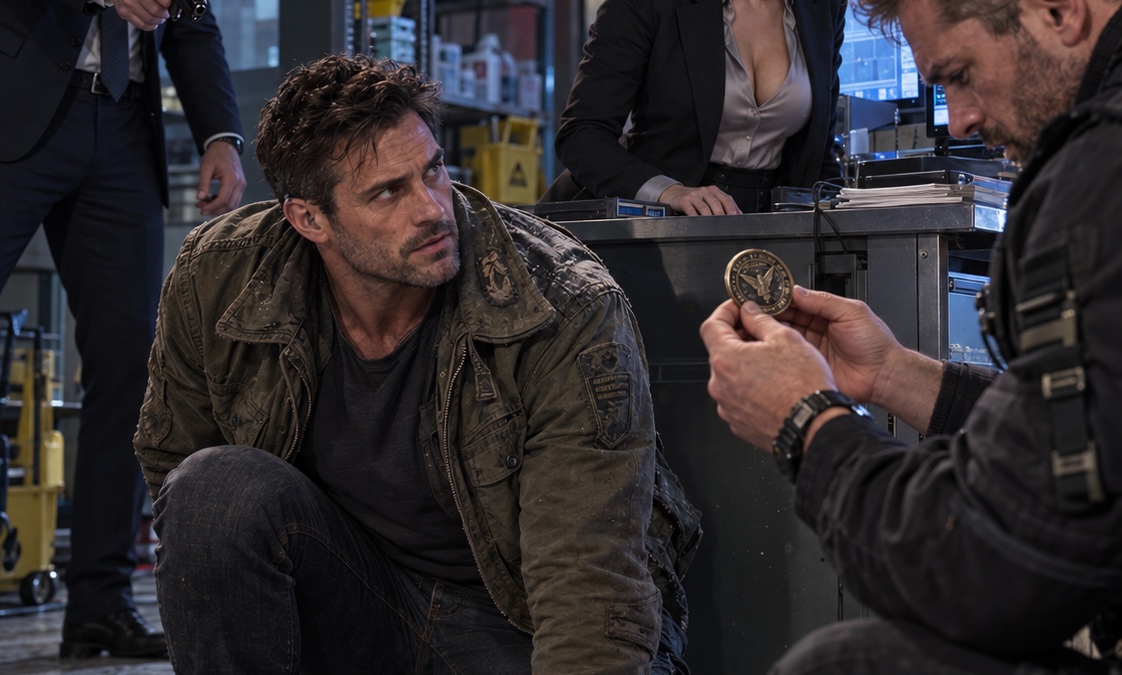
The Bodyguard Mocked a Single Dad’s Old Jacket—Then the CEO Realized He Was a Former SEAL
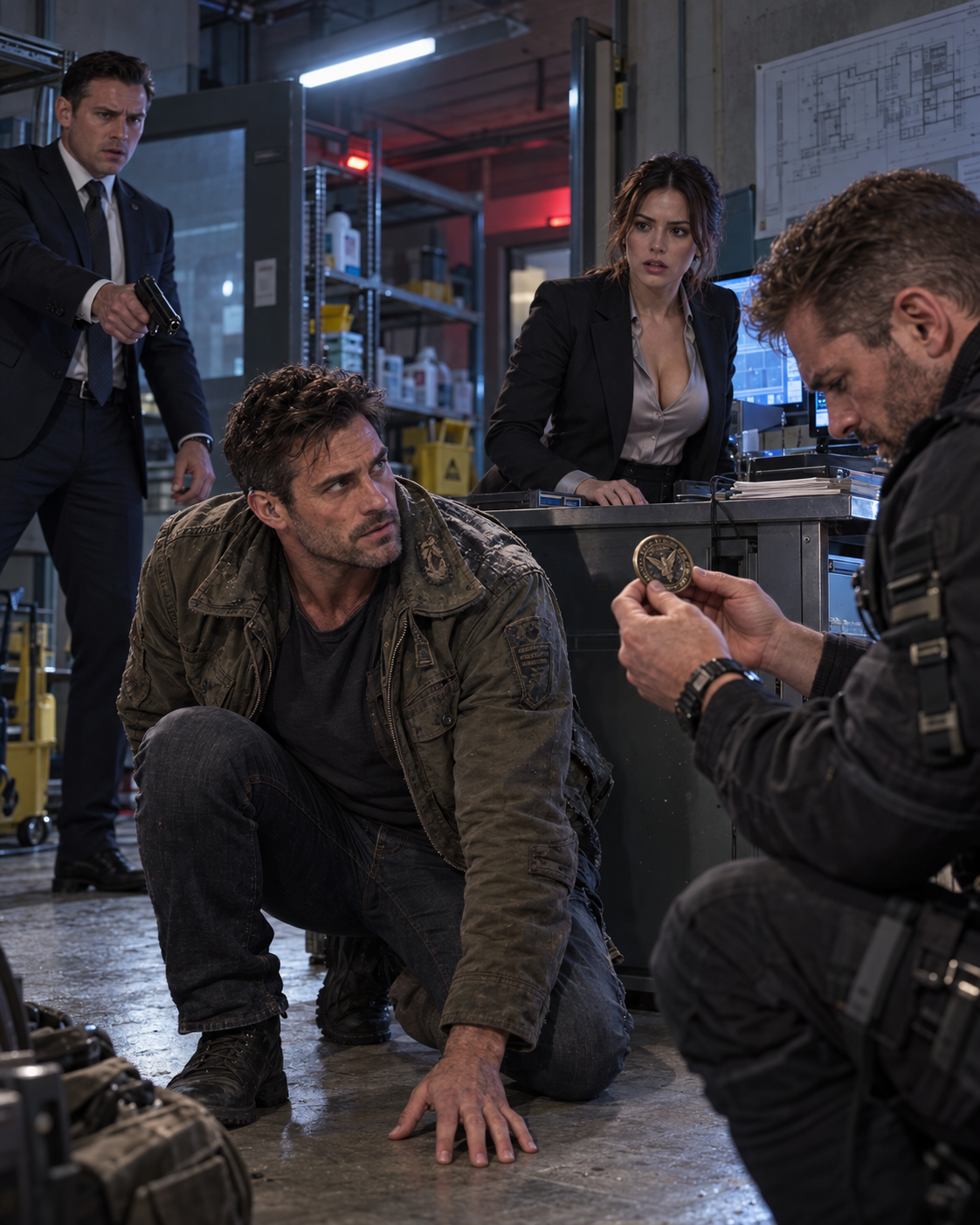
He came to return a leather folder. He left having saved a life. Between those two moments, a man the whole building laughed at revealed himself to be the only person in the building prepared for what was coming.
Cole Merrick was 37 years old, a mechanic by day, a ride share driver by night, and a single father every hour in between.
He wore a battered military field jacket with a repaired sleeve and walked into one of Manhattan’s most powerful corporate headquarters carrying nothing but someone else’s forgotten property.
The lobby of North Veil Dynamics was the kind of space designed to make people feel small. 40 ft of polished marble stretched from the revolving entrance doors to a reception desk that looked more like a museum installation than a place where humans worked.
The walls were glass from floor to ceiling, angled slightly outward so that the morning sky seemed to press down from above, framing the whole scene in pale November light. Two abstract sculptures brushed steel, featureless, deliberately cold, flanked the central elevator bank.
The company logo was etched into the stone floor in letters large enough to read from the mezzanine.
North Veil Dynamics, Innovating Tomorrow’s Defense today.
Cole Merrick walked through the revolving door at 8:47 in the morning and immediately understood that he did not belong here. That was fine.
He hadn’t come to belong anywhere.
He had come to drop off a leather portfolio that a woman had left on the back seat of his car the night before. Dark brown leather, brass snap closures, a monogram embossed near the bottom corner s e.
He had found it wedged between the seat and the door after dropping her off. She had given him this address.
He had looked it up and discovered it was a private corporate headquarters with no public entrance and a front desk that didn’t list a general contact number.
He had decided to just show up. He was wearing the field jacket.
He almost always wore it, a heavy olive drab canvas coat from a surplus store, military cut, repaired along the left sleeve where the original stitching had come apart.
He’d bought it 4 years ago for $30 because it had good pockets and held up in the cold.
The jacket had absorbed a lot of things over the years.
Engine grease, coffee, his daughter Piper’s paint from a school project that had gotten out of hand.
It looked like exactly what it was, a working man’s coat.
The security desk near the entrance had three staff members. Two were looking at monitors.
The third was on the phone. Cole approached and waited for the one on the phone to finish. He was not in a hurry.
He had a morning shift at the garage starting at 10:00. He had time.
What he didn’t have was enough time to avoid the man who came toward him from across the lobby.
Brent Callaway moved the way certain people did when they believed every room was watching them. He was broad through the shoulders, well-dressed in a charcoal suit with a corporate security badge clipped to his lapel, and he carried himself with the careful performance of a man who had confused loudness for authority for so long that he no longer knew the difference. He was 43 or 44.
Cole guest, former law enforcement, maybe the kind who had learned just enough to be dangerous in a controlled environment, but not enough to be useful in one that wasn’t.
Brent stopped about 6 ft from Cole and loo him up and down the way you’d evaluate something that had been left on the sidewalk.
Can I help you?
He said it wasn’t a question.
I’m here to return something that was left in my car.
Cole kept his voice even. A leather folder belongs to someone here with the initials S. E.
Brent didn’t look at the folder.
You a delivery driver? Ride share. Ride share.
Brent repeated the word like he was tasting something off. He glanced back over his shoulder where a small cluster of employees had gathered near the elevator bank waiting for the morning rush.
Two men in expensive suits, a woman with a tablet, a group coming in through the side entrance. You need to use the service entrance.
South side of the building. The person I drove gave me this address.
I don’t care what they gave you.
Brent stepped closer, lowering his voice just enough to make it feel like a warning.
You’re standing in a private corporate lobby, my friend.
You want to leave something, you leave it at the service desk.
You don’t walk in through the front door in He paused and the pause was deliberate.
Whatever that is, you’re wearing.
Cole looked down at his jacket, then back at Brent. I can wait here for someone to come down and confirm they want it, Cole said. That works, too.
It was the wrong answer. Not because it was incorrect, but because it implied that Cole intended to stay. and Brent Callaway had already decided in the first 15 seconds that Cole Merrick needed to leave before anyone important saw him.
Jerry Brent raised his voice without looking away from Cole. One of the lobby security officers turned.
Get missed. He glanced at Cole again.
Whoever this is back outside he can use the side entrance.
I’d like to speak with someone from the executive office.
Cole said you’d like to.
Brent stopped himself and actually laughed. Not a polite laugh. a real one, loud and flat, the kind meant to be heard.
He half turned toward the group near the elevators. You hear this? He wants to speak with someone from the executive office.
A few people looked up. One of the suited men smiled uncertainly.
Brent turned back.
“Son, look at yourself.”
His voice had found its register now, the one he probably used when he wanted an audience. You drove someone across town for $12.
That’s fine.
That’s honorable.
But you don’t walk into North Veil Dynamics dressed like you pulled your coat out of a recycling bin and ask to speak with the executive floor.
That’s not how this works.
Cole said nothing.
That was the thing Brent hadn’t prepared for.
He’d expected push back, an argument, maybe an embarrassing scene that he could use to justify having Cole removed.
Instead, Cole just stood there with the leather folder in one hand and looked at him with an expression that was difficult to read. Not angry, not embarrassed, not cowed, just watching. Get them out, Brent said louder now.
Jerry and another guard stepped forward.
They weren’t rough about it.
They were professionals, but they each took a position on either side of Cole, clearly intending to walk him back toward the revolving door.
Cole didn’t move immediately.
He was looking past Brent, past the elevator bank, up toward the mezzanine level, where an open walkway connected the east and west wings of the building. Three men were moving through that space. They were wearing contractor badges, the kind issued for building maintenance or IT work.
White hard hats, tool vests. One was carrying what looked like an inspection kit. Completely ordinary, unless you knew what to look for.
Cole knew what to look for.
The first man’s shoes were wrong.
Clean, new souls. Nobody doing a morning maintenance walkthrough wore brand new shoes you wore the pair that already had marks on them from the last job.
The sec the second man kept touching the same pocket on the right side of his vest. Not the way you checked for a phone or keys.
A different movement. Habitual.
Reassuring. The third man was not watching his work. He was watching the security camera positions.
Cole’s chest went still in the specific way it did when his brain was moving faster than the rest of him.
He’d spent 11 years learning to read environments the way other people read text on a page quickly in sequence, assembling individual pieces into a single coherent picture.
That kind of reading didn’t fully go away just because you’d tried to become a different person.
It sat dormant and then without invitation, it switched on.
Sir Jerry put a hand lightly on Cole’s arm.
The elevator opened. The woman who stepped out was younger than Cole had expected. 30, maybe 31.
Dark blazer hair pulled back in a way that was professional rather than polished. A tablet under her arm and a phone in her hand. She was already reading something on the screen and talking quietly to an assistant walking just behind her.
Sloan Everheart did not look up immediately. She was three sentences into whatever conversation she was having, and it was clearly more important than whatever was happening in the lobby.
Brent straightened. Miss Everheart, one second, Brent.
We’ve got a situation at the entrance.
Nothing serious.
I’m handling it.
I said one second. She finished what she was reading, said something to the assistant, and then finally looked up. Her eyes moved across the lobby with the practiced efficiency of someone who absorbed information quickly and got annoyed when it was withheld.
She saw Cole. She saw the folder in his hand.
She stopped walking.
“That’s mine,” she said.
“Found it in the back seat last night,” Cole said.
Wanted to return it.
“I’ve been looking for that since 6:00 this morning.”
She crossed the lobby toward him. her expression shifting from relief to something slightly more complicated.
Thank you genuinely. She took the folder and glanced at the brass monogram.
The way you check something you’ve been worried about.
Then she looked at Cole more carefully. You drove all the way here.
I had the address. Brent cleared his throat.
Everheart. I was just explaining to this gentleman. I heard what you were explaining.
Sloan’s tone didn’t change, but something in it closed.
She looked at Brent briefly, then back at Cole. I should give you something for the trip.
That’s not necessary still.
She reached for her phone. Cole was no longer looking at her. He was looking at the mezzanine again.
The three men were gone, but not where they should have gone. Not back through the service, the way maintenance workers moved when they were done with the section. They had separated.
One toward the east wing, one toward the stairwell access. One had simply disappeared from his sight line entirely. His pulse did not change.
That was training.
The pulse didn’t change.
You just noted that it wanted to and chose not to let it.
Don’t go into your boardroom.
Cole said. Sloan stopped. Excuse me.
Cole looked at her directly for the first time. Your boardroom. Whatever meeting you have up there this morning.
Don’t go in yet.
Brent made a sharp sound somewhere between a laugh and a dismissal.
Okay, we’re done here, Jerry.
Why? Sloan asked.
She was watching Cole’s face.
The three men on the mezzanine.
They’re not maintenance workers.
Brent stepped between them. That is enough. Miss Everheart, I am asking you not to engage with this.
The windows on the east side of the building blew inward. The sound arrived as a single hard crack, followed immediately by a deeper concussive pressure that moved through the lobby like a wave.
The sculptures shuddered on their pedestals. Dust rained from the ceiling in a thin curtain.
The glass wall behind the reception desk fractured in a long diagonal line, but didn’t shatter completely.
Then the fire alarms went off. Sprinklers triggered on the floor above. Water began sheeting down the stairwell.
Employees who had been standing near the elevator bank were already moving, some toward the exits, some frozen in place with their hands up and their mouths open, and no clear idea what direction meant safe.
Sloan’s assistant had dropped the tablet.
She was pressing against the wall, staring at the ceiling. Brent recovered quickly.
He was trained for this, whatever else was wrong with him. And he had slown by the arm within seconds. Ms.Everheart, armored vehicle, parking garage.
Now wait now, ma’am, that is not a request stop.
Cole’s voice was not loud, but it landed.
Both of them looked at him. Not the garage, Cole said.
Brent’s eyes went flat.
Who do you think you are? The garage cameras went down 6 minutes before I walked in. I noticed them on the monitors at the desk when I was waiting.
Cole spoke quickly, but without rushing. Your emergency stairwell door is magnetically locked.
It should have released when the alarm triggered.
It didn’t.
And those two vehicles that came through the executive bay while I was standing here used credentials that were swiped too fast, like they’d been preloaded.
Sloan was looking at him with an expression that had moved past confusion into something much more focused. Brent stared at Cole.
You don’t know what you’re talking about.
Then check, Cole said. Right now, check the garage cameras. Check the stairwell door.
check the credential logs. He paused.
Take 30 seconds and check. The lobby around them was emptying.
Employees streaming toward both exits. The sprinklers upstairs still running.
The alarm still screaming. Brent did not want to check.
It was visible in the set of his face. But Sloan had already moved to the security desk and was pulling up the monitoring system herself. 10 seconds.
She looked up from the screen. Her face had gone still in a way that was different from calm.
He’s right, she said.
Garage cameras are offline. Stairwell lock is showing manual override. She pulled up another window.
Two entries in the executive bay. 8 41 and 8 44.
She looked at Brent. Those badges were from a contractor account I suspended 3 weeks ago. Silence.
Not from the building. The building was loud with alarms and distant voices and the hiss of water. But between the three of them, a particular kind of silence.
Brent’s jaw moved without producing words.
Sloan turned back to Cole.
She looked at him the way people looked at something they’d misidentified and were only now seeing clearly.
Her eyes dropped for just a moment to his jacket, specifically to the inside, where the collar had folded back during one of the commotion-filled seconds. There was an insignia stitched into the lining, small, faded, worn down to the edge of unreadable, but there her father had served in the Navy.
He’d had photographs on the wall of his study men in water, men in full kit, men who looked nothing like they wanted their pictures taken.
He’d pointed to unit insignia once when she was young, and explained what they meant.
She recognized this one. She stared at Cole.
“You were a seal,” she said.
“It wasn’t a question.”
Cole didn’t answer immediately.
He was already scanning the lobby again, the exits, the positions of the remaining security staff, the ceiling line, the places where sound was coming from that shouldn’t be coming from.
“We need to move,” he said.
“And we need to go somewhere they’re not expecting.”
He looked at Sloan. Then at the jacket, he was still wearing the old repaired $30 field coat that a man in a charcoal suit had 15 minutes ago, used as evidence that Cole was nobody worth listening to.
Neither of them said anything about that.
There wasn’t time.
The sound of footsteps, deliberate, coordinated, was beginning to rise from the floor above them. Cole moved toward the maintenance corridor behind the reception desk.
After a half second, Sloan followed, and after another half second slower, and with the expression of a man who had run out of better options, so did Brent Callaway. The maintenance corridor behind the reception desk was narrow and poorly lit.
The kind of space that existed in every large building, but that almost nobody with an office thought about. Exposed conduit ran along the ceiling.
The floor was unfinished concrete. A row of metal storage shelves on the left side held cleaning supplies, coiled extension cords, and two folded emergency evacuation maps that had never been unfolded. Cole moved through it quickly, but not carelessly.
He kept one hand trailing along the left wall, not for balance, but for information feeling, for vibration, for the particular pressure change that came when a door opened somewhere in the connected system of corridors. buildings talked if you knew how to listen to them.
This one was telling him things he didn’t entirely like.
Behind him, Sloan moved with more steadiness than he’d expected.
She wasn’t panicking.
She was breathing fast, and her hand was gripped hard around the leather portfolio she’d recovered from him less than 10 minutes ago.
But her feet were sure, and she wasn’t asking questions she didn’t need answered.
That was useful.
Behind her, Brent moved the way a man moved when the situation had just exceeded his training, and he hadn’t admitted it yet.
His hand was on his sidearm, not drawing it, just resting there, and he kept glancing back over his shoulder toward the lobby they’d left, which was the wrong direction to be looking.
“Whatever danger was coming wasn’t behind them anymore.
” “Where exactly are we going?”
Brent said.
“Not loud, but not quiet enough.”
“Keep your voice down,” Cole said without turning.
“Excuse me?”
Sound carries differently in here than it does out there.
Lower your voice or don’t talk.
A pause. Then Brent quieter.
I asked where we’re going.
Away from the garage and away from the main stairwells. After that depends on what I can figure out about their positioning. Cole stopped at a junction where the corridors split left and right.
He stood still for a moment, head slightly tilted, listening. Sloan came up beside him.
You said they’re not searching, she said, keeping her voice low.
Back in the lobby when you told me not to go to the to the garage, you looked like you’d already worked something out.
Still working it out. Give me what you have so far.
He glanced at her.
Most people in her position, scared, displaced, operating in an environment they didn’t control, either went silent or went loud.
She was doing neither. She was asking for information so she could think.
He respected that more than he would have said. The blast came from the boardroom level.
He said it wasn’t big enough to bring down the floor.
That means it wasn’t designed to destroy the room.
It was designed to create a reason to evacuate. Standard displace and direct. You move the target out of a controlled environment into a prepared one.
The garage.
That’s where they want you.
Underground. No sight lines. Two vehicles already in position with credentials.
They had time to clone. He looked down the left corridor. Somebody planned this carefully.
Which means there are pieces of it I haven’t seen yet.
How many of them do you think there are? At minimum, the three on the mezzanine plus whoever placed the vehicles. Probably a coordinating element outside the building.
Could be more inside.
I don’t know yet.
He moved left. Stay close.
Brent caught up and fell into step just behind Cole’s right shoulder, which was the kind of positioning that was either professional habit or an attempt to reassert presence.
I want to make something clear, he said quietly. I am the head of executive security for this company.
Whatever you think you know about what’s happening, Brent.
Sloan’s voice was flat.
Miss Everheart, this man is a ride share driver. He was right about the cameras. He was right about the stairwell lock.
He was right about the credentials. She paused.
You were taking me to the garage.
Brent’s jaw tightened.
That is the designated emergency protocol for a level two incident. The armored vehicle.
The armored vehicle is sitting in a space that’s been prepped for an ambush.
Cole stopped at a door, checked the handle, pushed it open 6 in, and held it there, listening. Nothing. He pushed it open the rest of the way.
If you want to debate procedure, do it after we’re somewhere safer.
They moved through the door into a secondary utility passage. This one wider with better lighting from a strip of fluorescent fixtures mounted high on the wall.
The sound of the fire alarm was duller here, filtered through several layers of concrete and drywall. The sprinkler sound was gone entirely.
Cole oriented himself using the building’s layout as best he remembered it.
From the lobby, the elevator bank had been central, which put them now somewhere in the northeast wing, running parallel to the building’s main corridor, but one layer inside it.
He was thinking about Piper.
He didn’t want to be thinking about Piper because thinking about her pulled his attention in a direction it couldn’t afford to go right now.
But the thought came anyway, the way it always did in situations like this. a brief flash of her face, the particular way she looked when she was asleep, the small crease her pillow left on her cheek.
She would be at school by now. Mrs.Doway next door had walked her over at 8, the same as every morning. She was safe.
She was sitting in a classroom somewhere, working through her multiplication tables and not thinking about any of this. Cole pressed the thought down and refocused.
“There’s a facility’s office about 40 m ahead,” he said.
It should have a hardline phone and a building schematic on the wall.
That’s where we’re going.
How do you know there’s a facilities office?
Sloan asked. The pipe routing in this corridor.
Maintenance hubs always cluster where the utility conduits converge. He pointed upward where three separate conduit lines merged and ran together toward the far end of the passage. Office is at the junction.
Sloan looked up at the pipes, then at Cole.
She didn’t say anything.
Brent said, “Even if we get to a phone, our external communications are likely being jammed.
A standard disruption package would include hardlines run on a different system than wireless.”
Cole said, “If they jammed the building, they jammed the cell and the VIP network.
A copper landline won’t care.
You know a lot about disruption packages for a mechanic.”
Cole didn’t respond to that.
He kept walking.
The facility’s office was exactly where he’d said it would be a metal door with a small placard that said, “Building management, no unauthorized access.”
The lock was a simple keypad. Cole looked at the panel for a moment, then pressed four numbers in sequence.
The door clicked open. Brent stared.
How did you default manufacturer code? Nobody changes them. Cole pushed the door open.
That’s true for about 60% of commercial keypads installed before 2019.
The room inside Moss went cluttered in the specific way of spaces that were used constantly, but never organized a desk covered in maintenance logs, two monitors showing building system readouts, a large printed schematic of all 18 floors mounted behind plastic sheeting on the
wall, and a black desk phone sitting on top of a filing cabinet with its cord plugged directly into the wall. Cole went to the schematic first. He studied it for approximately 20 seconds.
Sloan came and stood beside him.
Show me what you’re looking at, she said.
He traced two routes with his finger without touching the plastic. Main stairwells are here and here.
Both compromised one because the locks been manually overridden. The other because it puts you in line of sight to the garage level.
The service elevator here is mechanical, not electronic if they’ve killed building power to the elevator system.
This one still runs on its own circuit. He moved his finger. Emergency exit on the north face lets out onto the maintenance alley.
No vehicle access, no sight lines from the street facing perimeter.
That’s our exit, Sloan said.
Eventually, not yet. Why not yet?
Because I don’t know where two of the three mezzanine contacts are.
I know the third went toward the east stairwell.
That’s the one that’s locked.
But the other two separated, and I haven’t placed them.
He turned from the schematic. Moving through an unknown building with unlocated threats and no communications is how people get hurt.
Sloan absorbed this. So, we established communications first.
We try. She was already moving toward the desk phone.
She picked it up, got a dial tone, and exhaled once, not dramatically.
Just the small release of someone who’d been holding tension in their chest and could now let a fraction of it go.
She dialed a number from memory. It rang three times.
Then, federal agent. Who is this? This is Sloan Everheart, CEO of North Veil Dynamics.
We have an active incursion at our headquarters at 440 7th Avenue. At least three confirmed intruders, one explosive device detonated on the 14th floor, and I have reason to believe our internal security has been compromised.
She said all of this in the same measured tone she might have used to run through an agenda. I need federal response, not local PD.
Cole listened to her talk and found himself revising his initial read of her. She had not wasted a word. She had not described her own fear or the chaos around her.
She had given location, incident type, number of known threats, and a flag on the specific problem of internal compromise.
That last detail was the one that would change how the response team approached the building, and she’d known to include it without being prompted.
She was good under pressure. Really good.
She finished the call and hung up. 15 to 20 minutes for federal response, possibly longer, depending on what else is active in the city today.
That’s a long time, Brent said.
It is, Cole agreed. Brent had been quiet for several minutes, which was its own kind of signal. He was standing near the door with his arms crossed and his expression set in a way that Cole had begun to recognize as the specific look of a man who was recalculating rather than regrouping.
There was a difference. Regrouping was outward facing.
You reassessed the environment, adjusted your position, figured out what came next. Recalculating was inward.
You were working through something private. Cole filed that observation and said nothing about it. We sit tight, Cole said.
Keep the door locked. Stay away from the monitors.
They may beworked to systems that can be accessed externally. When we hear federal vehicles, we move to the north exit and come out with hands visible.
And if they find us before federal response arrives, Sloan asked, then we deal with that.
That’s not an answer.
It’s the only honest one I have right now.
She accepted that. She sat down on the edge of the desk, set the portfolio in her lap, and looked at Cole with an expression that had shifted from the sharp processing focus of the lobby into something quieter. Something that was trying to fit pieces together.
You were going to just leave, she said. After Brent told you to go, Cole leaned against the wall near the door.
“Yes, but you didn’t.”
“No, because of the men on the mezzanine.
Because of the shoes,” he said, “and the pocket and the cameras.”
He paused.
It’s not complicated.
I saw something wrong.
Leaving when you see something wrong, and don’t say anything about it.
That’s a choice, too.
Sloan was quiet for a moment. Brent humiliated you in front of about 40 people.
Cole’s expression didn’t shift.
He said things about my jacket. He said things about you. My jacket is easier to replace than my conscience.
He glanced at Brent, who was still standing near the door and had been facing slightly away from the conversation.
I’m not carrying any resentment about it.
I genuinely don’t have time for that.
Sloan studied him. Who taught you to be like that?
Cole thought about it for a second. 11 years of being put in situations where resentment was a luxury, he said. You figure out pretty quick which things you can afford to carry and which ones will get you killed.
The room was quiet except for the distant muffled sound of the fire alarm, which had been going for long enough that it had begun to fade into the background the way persistent sounds did. Sloan opened the portfolio in her lap.
She appeared to be checking its contents, checking that everything was there, but her eyes were moving faster than the movements of someone just doing an inventory check. The prototype, she said quietly, almost to herself.
Cole looked at her. The what?
She closed the portfolio, looked up at him. A decision was happening behind her eyes. He could see the weight of it.
The particular expression of someone figuring out how much to say. NorthVale has been developing a communications encryption system for defense applications, she said.
We’ve been working on it for four years.
It’s the most significant thing this company has built.
She paused. The full technical documentation is in here.
Cole stared at the portfolio. The plain brown leather folder he had driven across the city to return. You were carrying it in a ride share, he said.
I know. Why? because I was reviewing it at home last night and I was running late and I made a decision that seemed reasonable at the time and turned out to be spectacularly wrong.
Her voice had gone tight, not with embarrassment, but with the specific frustration of someone who prided themselves on good judgment and had just watched themselves make a bad call.
I don’t usually she stopped.
I made a mistake. Okay, Cole said just that. Not a judgment, just an acknowledgement.
She looked at him. Okay, everyone makes mistakes.
The one you need to think about is whether that folder is related to what’s happening today.
The answer to that was visible in her face before she said it. The prototype has been drawing attention.
We’ve had two attempts at digital intrusion in the last 6 weeks.
Both were traced to a shell structure we couldn’t fully identify.
She looked at the portfolio again.
If someone knew I was carrying the documentations, they’d want to take you, not just the folder, Cole said.
The prototype itself, where is it physically? in a secured lab on the 16th floor.
It requires biometric authorization to access my biometrics winced still. Something settled into place with the cold precision of a key finding the right lock.
That’s why the attack wasn’t bigger, he said mostly to himself.
They needed the building disrupted. They needed the standard evacuation protocols to activate.
They needed you moving through a controlled route. He looked at the wall schematic. They were never going to blow the building.
They were going to take you to the garage, apply whatever pressure was necessary to get biometric authorization, access the lab, and be gone before federal response arrived.
Sloan’s voice was very steady.
They needed me alive.
Yes, that’s not as comforting as it sounds when you say it that way.
No, Cole agreed.
It’s not.
Brent shifted his weight near the door.
It was a small movement, the kind of thing you didn’t notice unless you were already watching for it.
Cole was already watching for it.
Brent hadn’t responded to the thing about the prototype.
He hadn’t asked about the biometric access.
He hadn’t asked what the plan was if the attackers were actively searching the building.
He had gone from arguing about authority to simply standing near the door and the shift had happened right around the moment Sloan mentioned the prototype.
Cole’s red on Brent had been recalibrating for several minutes.
He hadn’t said anything yet because a recalibration wasn’t a conclusion.
You didn’t act on a recalibration.
You gathered more information. He gathered it.
Brent’s radio had not produced a sound since they’d entered this room.
Standard protocol in any active security incident was continuous communication with your team status checks, position updates, threat reports. Even if external comms were being jammed, an internal encrypted radio system would run on its own frequency.
Cole had tested this kind of setup enough to know that jamming a building’s public communications infrastructure left most professional-grade security radios unaffected unless you specifically targeted their band.
Brent’s radio was silent.
Either it wasn’t working or he was choosing not to use it.
Cole also noted that Brent had used his access card twice in the last 12 minutes. Once to enter a passage that should have been on the same lock down override as the stairwells and once to pass through a secondary door that Cole had assumed would require Cole to find another way around. Both times the card worked without hesitation.
Systemwide lockdowns didn’t pick and choose.
Every access card in the building used the same authorization infrastructure. If the intruders had triggered a selective lockdown to control evacuation routing, which they had then all cards should have been affected according to the same logic, unless a specific card had been exempted.
Cole had been thinking about this slowly, carefully, the way he’d been trained to think about things that didn’t add up, not jumping to a conclusion, but letting the evidence accumulate until the conclusion was the only thing left standing.
He was almost there.
“I want to check something,” Cole said casually.
He straightened from the wall and moved toward the building schematic again, angling his path so that he passed close enough to Brent to check something he hadn’t been able to see clearly from across the room.
Brent’s radio.
The channel indicator on the side panel read 7. Standard Northvail security frequency was channel 3.
Cole had seen it on the desk monitors in the security station during the 2 minutes he’d stood waiting before any of this started.
Channel 7 was not in the standard rotation.
It was a number that meant either a custom frequency or a frequency set by someone outside the building’s internal system.
Cole looked at the schematic for a moment, then stepped back. North exit is still the best option, he said. But I want to wait another few minutes before we move.
I need to think through the corridor junctions. You said we were waiting for federal response, Brent said. We are.
I’m just re-examining the route in the meantime.
Brent nodded, turned slightly back toward the door. Cole glanced at Sloan.
She caught his eye. He tilted his head slightly, barely a movement, and she read it.
She was sharp enough to understand that something had shifted in the room, even if she didn’t know exactly what.
She held the portfolio a little tighter and said nothing. Outside in the corridor, a sound came through the wall. Not the fire alarm, not the sprinklers, a different sound.
The soft, compressed impact of boots moving carefully over concrete. Multiple people.
Coordinated spacing. they were being searched for. Cole moved to the light switch and killed the room without announcement.
The monitors cast a faint blue glow that he couldn’t do anything about without drawing attention to what he was doing.
He stepped back toward the center of the room.
“Nobody move,” he said very quietly.
The footsteps outside passed, slowed at a point directly adjacent to the facility’s office wall.
“Paused.
” Cole’s hand moved to the door and he pressed it shut the remaining half inch it had drifted open when Brent last adjusted his position.
The footsteps moved on. Nobody breathed loudly until the sound had faded another 40 m down the corridor.
Then Brent exhaled and said, “We need to move now before they come back.”
“Not yet,” Cole said.
“Why not?
You heard them.
They’re searching this section.
If they come back through, I want to see something first.”
Cole turned. In the near dark, he looked at Brent directly. your radio.
What channel is it set to? A pause. Short but present.
Standard operational frequency, Brent said. Channel 3.
That’s right.
Cole held eye contact with him. I need you to call in a position update to your team.
Another pause. Longer this time.
Comms are jammed. Internal encrypted radios run on a separate band. You know that.
Make the call. The room was quiet.
The blue monitor light fell across Brent’s face from an angle that flattened his expression and made it difficult to read, but his hand, which had been resting near his sidearm for most of the last 20 minutes, moved, not toward the radio.
Sloan understood what she was watching before Cole had to say it. He saw it happen in her face, the specific expression of someone whose understanding of a situation has just been upended in a way that is going to take a while to fully land.
“Brent,” she said.
He didn’t respond.
Brent, her voice had changed. Your card still works. System malfunction.
Every card in this building should be on the same override.
That’s how our lockown protocol works.
I wrote the protocol. Her voice was still controlled, but it had taken on a quality that was close to the edge of something. Your card still works because it was exempted.
Someone exempted it. She stopped.
Who exempted it?
Brent’s hand finished its movement.
He had drawn the weapon. Not at Cole.
At Sloan. Put the portfolio on the desk, he said. His voice had changed too, but in the opposite direction.
It had settled, gone flat and purposeful in the way of someone who had stopped performing and was now just being. Set it down slowly. And you he looked at Cole, hands where I can see them.
Get on your knees. Cole did not get on his knees immediately. He looked at Brent the way he looked at most things steadily, with the particular unhurried patience of a man who is gathering information even now, especially now.
How long? Cole asked.
Brent blinked. He had expected argument or compliance.
He hadn’t expected a question.
How long have you been working with them? Beat.
Then something shifted in Brent’s face.
Not remorse, but the kind of release that happened when a secret you’d been carrying finally had permission to exist in open air.
18 months, he said. Knees now.
Cole lowered himself to the floor. His hands were visible. His face was calm.
His eyes never left Brent. Sloan set the portfolio on the desk. Her hands were shaking not badly, but enough that she held them together afterward to keep them still.
She was staring at Brent with an expression that Cole thought might be the most honest thing he’d seen from her pure, unmanaged shock at discovering that the man who had been responsible for her physical safety for 3 years had been selling pieces of it away.
“You were trying to get rid of me,” Cole said in the lobby.
The whole scene. You wanted me out before I noticed the men on the mezzanine.
Brent didn’t deny it.
You were never supposed to be in the building. And if I had left, you would have walked out and driven your next fair, and none of this would have involved you.
Cole absorbed this and Sloan.
Brent’s jaw shifted.
She wasn’t going to be hurt.
That was the condition. Biometric access.
Hand the system over. She walks away.
No one gets seriously hurt. You believe that?
I was told. You believed people who build bombs believe the condition about not hurting anyone.
Cole’s voice wasn’t contemptuous.
It was almost genuinely curious.
You’ve been in security long enough to know what people like this do to witnesses.
Brent’s grip on the weapon tightened.
Get on the floor. Stop talking. Cole looked at Sloan.
She was watching him. Her hands had steadied.
He shifted his weight onto one knee, which was technically complying and technically something else entirely, and said to her, “The emergency panel for this section is in the corridor outside.
You pass it on the way to the north exit. It has a manual communications reset red handle. Pull down.
Hold for 3 seconds.
If you can get to it, you can restore partial building communications.”
“She’s not going anywhere,” Brent said.
Cole looked back at him.
“I know.”
And he did know that he wasn’t telling Sloan a plan.
He was telling her information for later because he intended for there to be a later and he was making sure she had what she needed to navigate it. That was all. The footsteps in the corridor outside were coming back.
Cole heard them. Brent heard them, too.
He glanced involuntarily toward the door, and in the half second that his attention moved, Cole measured the distance between them, measured the angle, measured what he had and what he didn’t have and what the room would permit.
He noted all of it, filed it, waited.
Brent’s eyes came back.
Don’t,” Brent said.
Cole said nothing, but he had already stopped being the man who drove strangers across the city for tips, and both of them knew it.
The only question left was what happened next, and Cole had already begun working through the answer with the same quiet, methodical precision he’d used to read three men on a mezzanine from 60 ft away and understand exactly what they were.
Outside, the footsteps stopped at their door. The knock came in a specific pattern.
Three short, one long, two short.
Brent’s shoulders dropped a fraction of an inch, almost nothing.
But Cole caught it. A breath released, a body recognizing a signal it had been waiting for.
The weapon in Brent’s hand didn’t lower, but the quality of his grip changed, going from active tension into something more settled, the way a man’s hand changed when he knew backup had arrived.
Cole filed that, too.
“Come in,” Brent said, just loud enough to carry through the door.
The handle turned, the door pushed open. Two men entered not the wide tactical entry of a team expecting resistance, but the careful compressed movement of men accustomed to moving through tight spaces without drawing attention. They were wearing the contractor vests Cole had seen on the mezzanine, though the hard hats were gone now.
The first man was broad, mid-40s, with the particular economy of movement that came from years of physical work, not gym work, real work, the kind that left specific muscle groups overdeveloped and others neglected. He held a compact radio in his left hand and nothing visible in his right, which meant his right hand was the one to watch. The second man was younger, leaner, with a close-cropped beard and the alert, constantly scanning eyes of someone trained to watch perimeters.
He had a weapon drawn and held it with the practiced ease of long familiarity. Neither of them looked at the room the way civilians looked at rooms.
They looked at it the way Cole looked at rooms and zones, checking angles, identifying positions of bodies relative to objects, calculating. The younger one found coal on the floor and kept the weapon on him.
The older one moved to the desk and picked up the portfolio without checking its contents.
That’s it.
The older one asked Brent. Documentation, Brent said. We still need her for the biometrics.
The older man looked at Sloan. He assessed her the way you assessed a piece of equipment, utility, condition, logistics of transport.
She comes with us. I understand the plan, Brent said.
Sloan hadn’t moved from where she was standing near the desk.
Her hands were at her sides now, not clasped together, and Cole noticed that she had quietly positioned herself about 2 ft from the corner of the desk, close enough that the desk was between her and the door, but not so close that it read as deliberate. She was thinking about geometry.
wasn’t sure if she knew she was doing it.
The older man looked at Cole on the floor. Something crossed his face, a brief reassessment, the way a contractor looked at a job site when something was different from the briefing.
Who’s this?
Nobody, Brent said. He walked in off the street.
Rid share driver.
He’ll be detained here until we’re clear.
The older man studied Cole for a moment longer. He on the floor voluntarily.
Yes, Brent said.
The older man’s eyes moved over Cole once more.
the jacket, the hands, the posture, the face. Cole kept his expression neutral and his body language carefully constructed to read as compliant without being so obviously compliant that it triggered suspicion in a professional. There was a line between looking defeated and performing defeat, and men who had done this kind of work long enough could tell the difference.
The older man’s gaze stopped at Cole’s jacket, specifically at the inside collar, which had folded outward again, the same fold that had shown Sloan the insignia 20 minutes earlier.
Cole watched the older man’s face without appearing to watch it.
Something moved behind the man’s eyes.
A flicker of recognition quickly suppressed. He looked away and turned back to Brent.
“We move into 2 minutes.”
“Get her ready.
She’ll cooperate,” Brent said.
“I won’t,” Sloan said.
The room went briefly quiet.
Sloan’s voice had been completely level.
Not brave sounding, which would have been performance, just factual. The way she stated things that were simply true.
She was looking at the older man, not at Brent. Biometric authorization for the prototype requires a voluntary retinal scan and a spoken passphrase. She said the system was designed to detect physiological stress markers.
If I’m coerced, the scan reads my cortisol levels and the access is automatically denied.
That’s a standard defense contract security requirement.
She paused. So, you can take me wherever you want.
It won’t do you any good.
The younger man with the drawn weapon looked at the older one. The older one looked at Brent.