The ER Staff Ridiculed the New Nurse—Until a Navy Helicopter Asked for Her! (PART 3)
PART 3
She stood in the doorway of the administrator’s office and looked down the corridor toward the trauma floor.
And what she felt was not simple. It was not relief, though.
Relief was in there somewhere. It was not resolution.
It was the feeling of a door she had kept her back against for 3 years finally opening in the air on the other side of it being different than she’d expected.
Not dangerous, not cold, but present, real, moving. Tom was at the end of the quarter. He had a cup of coffee in each hand.
And when she walked toward him, he held one out. She took it.
“How was the meeting?”
he asked.
“Fine,” she said.
“Are you staying?”
She looked at him.
“Is that a real question?”
“From where I’m standing,” he said.
“There’s a version of this where the attention gets to be too much and you find a quieter hospital in a different city.
” I wanted to ask before I assumed.
She drank her coffee.
She thought about Danny Reeves on that helicopter and Ben Harrison’s heart starting again under her hands and Marjorie Harrison’s face when they took her husband upstairs.
She thought about the stairwell four flights going up with Tom behind her carrying the secondary kit because she’d said she needed hands and he’d said yes.
She thought about Janelle staging the elevator and Becca setting up bay 1 correctly and Marcus getting the gurnie to the rooftop door. She thought about what it felt like to be useful.
I’m staying, she said.
Tom nodded. He drank his coffee. Outside, through the high windows of the corridor, the lights of news vans were visible at the perimeter of the hospital property.
Their white beams cutting through the dark in the patient relentless way that news cameras wait. At 9:15, a notification spread through the staff phones, not official, just the organic propagation of information through a group of people who are connected that a video had gone viral.
Film from a building overlooking the hospital’s rooftop pad.
Shot on a phone with a long zoom. It showed the military helicopter landing showed the side door opening. Showed a figure in scrubs climbing in.
And then 4 minutes later showed the side door open again and a gurnie moving toward the rooftop access door with three people around it. The video had no audio.
It didn’t need any.
The visual was enough.
The caption someone had put on it read, “Nurse or superhero, St.Gabriel Hospital, Seattle.
Something real just happeneding on that roof. By 9:30, the video had 400,000 views.
By 10:00, it had 1. 2 million. Becca was the one who told Avery.
She walked up to where Avery was finishing her end of shift documentation and held out her phone without saying a word. Avery looked at the screen. She watched the video.
She handed the phone back.
“Okay,” she said.
“1.
2 million views,” Becca said.
in 2 hours. Okay, she said again. Becca stared at her.
You’re watching yourself go viral and you’re saying okay.
What would you like me to say? Something?
Anything? A reaction? A human reaction?
Avery looked at her. Something shifted in her expression.
Not quite a smile, but the space where a smile lives when it’s not quite ready to come out.
Becca, she said, “In 14 years of service, I was in 17 countries, four active conflict zones, and one situation that I am legally not allowed to describe to you.
A viral video is not the most alarming thing on that list.”
Becca blinked.
Then she said, “17 countries, give or take.
Four conflict zones.”
At minimum, Becca sat down in the chair next to the terminal. Not dramatically, just sat down like her legs had made a quiet executive decision.
I told people you were dead weight, she said. You told people what you saw, Avery said. What you saw was accurate for the first 6 hours.
I made it mean something it didn’t mean.
Most people do, Avery said. Most of the time.
Becca looked at the floor.
I’m sorry.
I told you earlier it’s already gone.
It’s not gone for me, Becca said.
That’s the part that’s mine to carry.
Avery considered her for a moment. This woman who had been the first voice of Bckery on day one, who had called the wrong medication concentration for two critical seconds in a code and caught it because someone called the dose clearly, who had set up Bay One correctly when it counted, who
was now sitting in a chair under the weight of something honest.
“You caught the medication,” Avery said.
Becca looked up in the Harrison code. You had the wrong concentration for two seconds, then you caught it. I want you to carry that too, not just the first part.
Becca was quiet. The people who catch their own mistakes in the hardest moments are not the dead weight, Avery said.
They’re the ones I want in the room.
Becca’s jaw tightened in the specific way that means someone is managing a motion rather than performing it.
She looked back at the floor, then she nodded once.
“Okay,” she said.
Okay, Avery said and went back to the documentation. At 10:40, Avery finished her shift documentation. She logged out.
She went to the locker room and changed her scrub top, not the oversized one, a different one she’d brought in her bag because the original was no longer wearable.
And she sat for a moment in the quiet of the empty room. She thought about the flag being updated, the record corrected, the machinery turned away. She thought about 3 years of careful distance of choosing the quietest path of building a life around the principle of invisibility.
And she thought about how completely and irreversibly that had ended tonight. Not in disaster, not in exposure, but in the particular way that the truest things about people tend to end their hiding by being needed, by being called on, by the universe insisting.
She thought about Danny Reeves’ daughter, 14 months old.
She put her bag over her shoulder and stood up and walked out. Marcus Webb was in the corridor. He fell into step beside her as she walked toward the exit.
“My uncle called it the burden of competence,” he said after a moment.
She looked at him.
He said, “The hardest thing about being genuinely good at something is that people always find out,” Marcus said.
“You can run from it, but it catches you because the moment things go wrong, the room turns to the person who can fix it.
Always.”
He walked with her another few steps. He said the only thing worse than being found out was not being there when you were needed. Smart man.
Avery said he was. Marcus said he died 2 years ago.
Pancreatic cancer.
I’m sorry.
He would have liked tonight.
Marcus said to him, “Not the drama.
He hated drama. Just the part where someone did the right thing when it was hard.
He lived for that.”
They reached the main entrance. Marcus stopped. She stopped.
They stood for a moment in that threshold. The cameras are out front, he said. I heard the administrator is going to do a statement at 11:00.
I know. Are you going to talk to them?
She looked at the doors beyond them visible through the glass, the assembled shapes of cameras and lights and the waiting patients of people whose job it is to make what happened here into a story for the people who weren’t here.
Not tonight, she said.
And they’ll be back tomorrow, probably.
and the day after most likely. He looked at her. Does that bother you?
She thought about it honestly, which was not a quick thing. What bothers me, she said finally, is that the part I care about is in bay one with a chest tube and a fighting chance. And the part everyone wants to talk about is the roof, she paused.
The roof was just the work. The work is the part that matters. Marcus looked at her for a long time.
Yeah, he said. Then side exit is through the supply corridor.
Second door on the left turns into the parking structure. She looked at him.
I’m not saying run from it, he said.
I’m saying go home, sleep, and let the administrator handle the cameras tonight.
You can deal with the rest of it when you’ve had 8 hours.
She almost smiled. There it was again.
That space almost inhabited. Thank you, Marcus. See you tomorrow, he said.
And he walked back toward the floor. She took the side exit. The supply corridor was quiet in the way hospitals get after 10.
Not silent hospitals are never silent, but a different register. The sound of the building itself rather than the people in it.
Cooling systems and distant elevators and the particular soft hum of fluorescent lights in an empty hallway. She walked through it and into the parking structure and found her car on level two and sat inside it and did not start the engine for four full minutes.
She thought about the second day of a career she had intended to be quite ordinary, invisible. She thought about what ordinary had cost her today, what it had required, what it had given back.
She thought about Danny Reeves breathing on his own in recovery.
She thought about Tom on the roof coming through the helicopter door after her because she’d said she needed hands and she thought about the particular kind of person who answers that call without a second thought and what it meant to work beside one.
She started the engine. She drove out of the parking structure and into the Seattle night, the rain beginning again the way it does in that city quietly and and without announcement.
The streets wet and dark and lit in orange and white and the radio came on automatically and she left it on this time.
She didn’t know what tomorrow would bring.
She knew the cameras would be there. She knew Price would want another meeting.
She knew the internet had her face now, which was something that could not be undone, which was a door that was open and would not close.
She knew that Commander Watts’s call had rearranged the landscape of the careful life she’d been building.
What she also knew, and this was the thing she held on to through the wet streets in the radio and the rain, was that two people were alive tonight who might not have been, and that she had been exactly where she was needed, doing exactly what she was capable of, and that the long argument she’d been having with herself about what she deserved to be and what she owed the world, had today reached something that felt like a verdict.
She had not gone quietly. She had never actually been capable of going quietly. And maybe this was the thing she let herself think just once in the car before she filed it and moved on.
Maybe that was not the failure she’d always called it.
Maybe that was the whole point. She turned toward home. Behind her at St.Gabriel Medical Center, Douglas Price was stepping in front of a camera.
And in bay one, a young man with a 14-month-old daughter was breathing on his own.
And on the nurse’s station counter, someone no one would ever confirm who had left a scrub top in the right size folded neatly for the morning.
The scrub top was still on the counter when Avery arrived at 6:48 the next morning. She saw it from the end of the quarter folded her size. No note, no name, just the thing itself sitting there with a particular patience of an object that has been placed deliberately.
She picked it up, held it for a moment, and then carried it to the locker room without saying anything about it because some things don’t need to be said to be understood.
She changed into it. It fit. She stood at the locker for exactly 30 seconds and what moved through her in that time was not sentiment exactly but something adjacent to it.
The recognition that belonging to a place is rarely announced. It accumulates.
It happens in small gestures that people make when they think no one is watching.
And sometimes you only understand what those gestures meant after you’ve already received them.
She closed the locker and walked onto the floor. Tom was already there.
He was at the nurse’s station doing the morning check and when he looked up and saw her, he gave a single nod.
The kind of nod that is doing a lot of work without appearing to. She gave one back. That was sufficient.
Becca came in at 7:01 and stopped at the station entrance when she saw Avery. She looked at the scrub top. Her expression shifted through several registers in about 1 second, landed on something that was not quite a smile, but was unmistakably warm.
And then she went to her section of the station and started her morning without commentary. That was also sufficient. Marcus arrived at 7:04 and said morning and Avery said morning.
And that was the entirety of it which was exactly right. The floor felt different. Not dramatically, not in any way that a camera could capture or an outside observer could name.
But the people who work there felt it the particular shift that happens in a group of people after they have collectively witnessed something that changed their understanding of who they are to each other. The taxonomy had been revised.
The assumptions had been updated and the update had not been posted or announced. It had simply entered the air of the place.
The way truth enters a room after a long pretense quietly, finally, and without apology. At 7:20, Dr.Holt walked onto the floor.
The room’s response to her arrival was different from every previous morning.
Not because she was different. She was precisely the same.
Same coat, same bearing, same economy of expression.
But the room’s relationship to her had shifted because something and how she had conducted herself the night before.
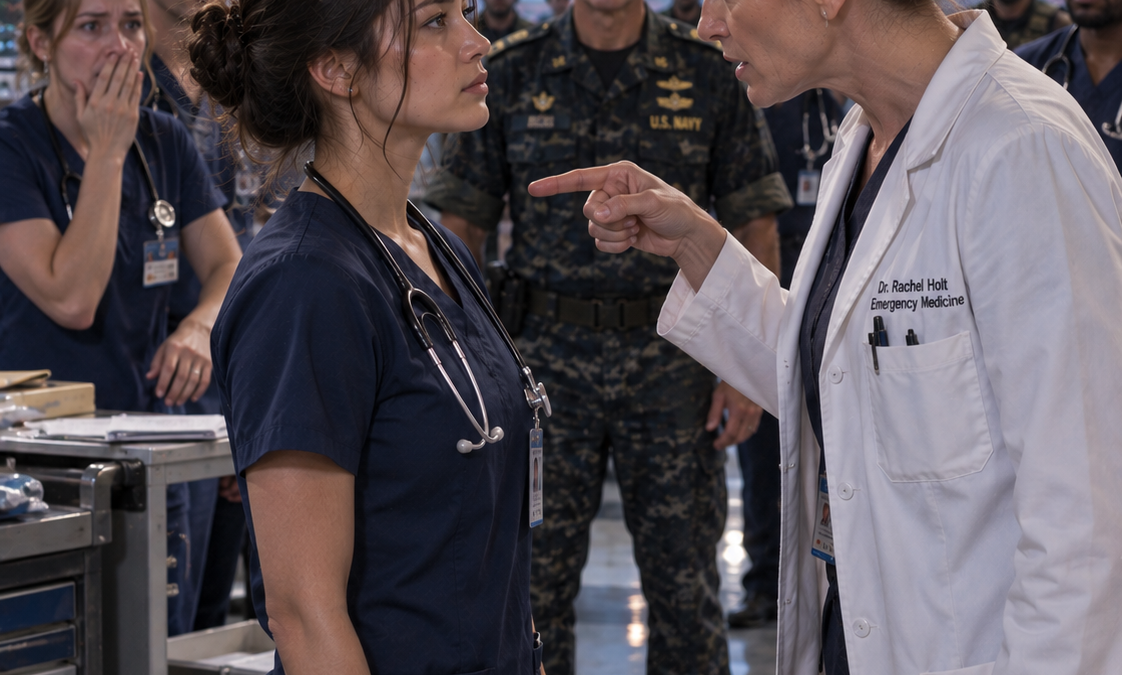
The willingness to walk into that bay to say, “I need to know what you did to sit in a corner during an administrative meeting and say yes.”
She was right. Something in that had changed the temperature around her. Not warmer exactly, more honest.
She came to the station and looked at the board, looked at the patient load, looked at Avery.
Knox, she said, “Dr.Holt, Danny Rivas was moved out of recovery at at 2 this morning.
He’s in the ICU stable.
They’re saying 48 hours and he goes to a regular room.”
Avery absorbed that. Good.
His wife landed at SeaTac at midnight.
She’s been at his bedside since 12:40.
Holt paused.
She’s asking to speak with you.
I’ll go up after rounds.
Hol nodded, then in the same tone she used for clinical updates.
The administrator’s statement last night generated significant media response.
The hospital’s communications team has fielded over 200 interview requests since 6:00 a.m.for you specifically.
Avery said nothing. I told Price that staffing decisions in this department are mine.
Holt said that includes decisions about how my staff interacts with media. If you want to say nothing, you say nothing. If you want to say something, you do it on your terms.
She looked at Avery directly. Is that clear? Yes, Avery said.
Thank you. Hol looked at the board again. We have a heavy morning.
Crane is on at 8. I need you in trauma bay until noon. She started to walk away, stopped, and Knox, the scrub top fits better.
She walked to her office. Becca, from 3 ft away, covered her mouth with her hand.
Tom looked at the ceiling. Marcus turned to face the wall for approximately 2 seconds, composing himself, and then turned back.
Avery picked up the tablet and started the morning assessment. At 8:35, a woman named Sandra Reeves came down from the ICU. She was 31 years old and she walked with the particular posture of someone who has been awake for 36 hours and is running entirely on the fuel of having gotten the outcome they prayed for.
She had dark circles in a coat that was slightly wrinkled from the flight and she stopped at the nurse’s station and said, “I’m looking for Avery Knox.”
Tom pointed. Sandra Reeves walked toward Avery with the directness of someone who has decided exactly what she is going to do and is doing it. She stopped in front of her.
She looked at her for a moment, taking in this person who had been at the center of everything, who was standing here in a scrub top doing regular morning charting like the previous evening had been routine and her face did something complicated and complete.
My husband, she said, and then she stopped because the sentence didn’t need anything else.
I know, Avery said.
Sandra Reeves reached out and took Avery’s hand in both of hers.
She didn’t say anything for a moment.
Then he woke up this morning and the first thing he asked for was a picture of our daughter. Her voice broke.
She held it together by what appeared to be sheer will. He gets to see her grow up.
Because of you. Because of a team, Avery said. A lot of people.
He said your name. Sandra said before he said mine, he said Knox.
He said she didn’t let go.
She squeezed Avery’s hand.
I wanted to look you in the eye and say thank you.
I know you’ll say it was your all.
I know you’ll deflect, but I needed you to know that.
I know. I see it. Avery held her gaze.
She didn’t deflect.
She didn’t redirect.
She accepted the words the way you accept something that is genuinely owed to you, which is the hardest way. Take care of him, Avery said. Make him rest.
Men like your husband always try to do too much too fast. Sandra laughed a real laugh, surprised out of her. the laugh of someone whose body had forgotten what it felt like to do that.
I know, she said. I know exactly.
She let go of Avery’s hand.
She looked around the floor at Tom at Becca at Marcus. All of you, she said. Thank you.
She walked back to the elevator. The floor let out a collective breath. Marcus said quietly to I need a minute.
Take two, Tom said. Marcus walked to the break room.
At 9:50, the hospital’s main entrance received a visitor that no one had scheduled.
The desk receptionist looked up from her morning and found herself facing two men in suits with the particular efficiency of posture that belongs to a specific category of federal employee.
The first man produced identification and said in a voice that was both polite and entirely non-negotiable, “We’re here to see Miss Avery Knox.
We’re from the Department of Defense.”
The receptionist called the administrator. Price called Holt.
Holt came onto the floor with her phone still in her hand and found Avery at Bay 2 and said, “Two men from the Department of Defense are in the lobby.
” Avery stopped typing.
“They didn’t call ahead.”
Holt said they don’t have an appointment.
Price is asking whether to send them up. The floor had stilled again.
This floor had become in 2 and 1/2 days very practiced at the particular stillness that Avery Knox generated when something significant was about to happen. Yes, Avery said. Send them up.
Do you know what this is about? Avery set the tablet down. She looked at Holt.
Probably, she said. Holt searched her face.
Do you need legal representation? The question landed differently than Hol might have intended, not as an alarm, but as something else, as care.
As the question a department chief asks a member of her staff when she’s treating that staff member as something worth protecting.
It was not a question Rachel Holt would have asked three days ago. Avery registered the difference.
No, she said, “But thank you.”
The two men arrived on the trauma floor later. They moved through the space with the practiced neutrality of people trained not to generate reaction in whatever room they entered.
They reached Avery in the senior horse of the two older gray at the temples.
The look of someone who has been in consequential rooms for a long time said, “M Knox, I’m Deputy Director Morrison Department of Defense Office of Personnel Policy.
This is my colleague, Agent Riser.”
Morrison, she said, not a greeting, a confirmation. I know who you are. He looked at her steadily.
Then you probably know why we’re here.
The clearance flag, she said partially, he said.
“May we speak privately?”
Holt said my office. Morrison looked at her.
“She’s my staff,” Holt said.
“The office is on this floor.
That’s as private as this gets.
” Morrison considered this for approximately two seconds and apparently found it acceptable.
They went to Holt’s office.
Holt came with them, which nobody objected to, which was itself a statement. Morrison sat. Riser stood.
Avery sat across from Morrison. Holt stood at the window.
First, Morrison said, “I want to be clear that you are not in any difficulty with the department.
What happened last night was unusual but not unauthorized. Commander Watts has filed his report and it has been reviewed at the appropriate level. He paused.
The flag issue has been corrected as Watts told you. Your record now accurately reflects your civilian status and the reserve classification has been updated to inactive.
That’s not why you’re here, Avery said.
He looked at her.
No, he said it’s not.
Then say what you came to say. He opened a folder actual paper which felt deliberately formal in the way that federal communication sometimes is. Your actions last night performed a field thorictomy under non-standard conditions and produced a successful outcome in a patient who by all medical probability should not have survived transport.
That outcome and the circumstances around it have been reviewed by the Joint Special Operations Medical Command. He placed a document on the desk. Avery looked at it without touching it.
That is a formal commenation, Morrison said. From the Secretary of Defense. It will be part of your permanent record, civilian and military.
He paused. There is also a second document.
He placed another page beside the first. That is an offer.
He said, “A position, civilian contractor status, full benefits, no deployment obligation.
The role is domestic training field medics at the jointbased Lewis McCord facility 40 minutes from here part-time 3 days a month. You would continue your nursing career without interruption. The office was very quiet.
You want me to teach? Avery said we want you to teach the people who will be in the positions you were in. He said because the survival rate of personnel receiving trauma care in the field has a direct relationship with the quality of medic training and there are very few people alive who can teach what you know from the experience of having done it.
Avery looked at the documents. She did not touch them.
She looked at them the way you look at something that is asking something real from you and you are not yet certain what the right answer is. I would need time.
She said, “Of course.
And I would need it to be genuinely part-time.
I have a job here.”
Understood. And I would need the arrangement to be private.
Not classified.
I’m not asking for that, but not publicized.
Morrison looked at her. Given the current media situation, Miss Knox, I think we are well past private.
She held his gaze. The teaching, she said.
That part stays private.
The students don’t need a story.
They need the information. He nodded slowly. that we can agree to.
She looked at the documents one more time.
Then she picked them up and said, “I’ll have an answer for you in 48 hours.”
Morrison stood.
That’s all I ask.
He extended his hand. She shook it.
Riser gave a small nod. They left. Hol waited until their footsteps had faded in the corridor.
Then she turned from the window.
“Teaching,” she said.
“Apparently.
Would you do it?”
Avery set the documents on the edge of Hol’s desk.
I haven’t decided yet.
Hol looked at the papers.
For what it’s worth, she said, and her voice had the quality of someone choosing their words with unusual care.
The people you’d be training would go into the field better prepared than they would be otherwise, and some of them would come home because of it.
She paused. That has value.
So does this floor, Avery said. Holt looked at her.
Yes, she said. It does.
At 11:15, Avery walked back onto the trauma floor and found it in the middle of a full morning. Two new admissions, a procedure in bay 3, a family consultation in progress near the station. The regular metabolism of the place.
She picked up the tablet and stepped back into it without pause, and the floor absorbed her the way a body absorbs a part that has always belonged to it seamlessly, as if there had never been a question.
At 12:40 during the lunch rotation, Janelle found her in the breakroom and sat down across from her with a container of food and said, “Can I ask you something?”
“Yes.
” “Were you scared last night on the roof?”
Avery thought about it honestly.
“Not in the way you mean,” she said.
“When you’re trained for something and you’re in the middle of it, the fear changes shape.
It becomes something you can use.
Fuel,” she turned her coffee cup.
“What I felt on that roof was not fear.
It was urgency.
There’s a difference.
What does fear feel like for you? Janelle asked. Not intrusively, just genuinely.
Avery was quiet for a moment. Quiet thing, though, she said.
Things you can’t fix with action.
The things that happen after the question of whether the life you’ve built is really yours or whether it belongs to somewhere you left.
She paused.
That’s where I feel it.
Janelle looked at her with the particular attention of someone genuinely listening, not waiting to respond.
“And now,” she said softly, “and though,” after everything that happened, Avery looked at the table.
She thought about the scrub top on the counter that morning, about Marjgerie Harrison’s hand, about Tom coming through the helicopter door because she’d said she needed hands.
About Sandra Reeves’s laugh surprised out of her from a body that had forgotten how.
“Naf, fam,” she said.
It’s quieter.
At 2:30, the video reached 8 million views. Marcus came to Avery with his phone and showed her the number in silence.
And she looked at it and then looked at him and said, 8 million people who weren’t there.
8 million people who are very interested in someone who was, he said, that’s their business.
She said, not mine. The comments, he said, and he scrolled for a moment.
He stopped on one and held it out. She read it.
The comment was from a username she didn’t know and it said, “My son is a combat medic deployed right now.
I watched this video and I cried for 20 minutes. Thank you for showing people what these kids do.
Thank you for being there.”
She read it twice. She handed the phone back. She said nothing for a moment.
Then send me that one. Marcus looked at her. Just that one, she said.
“Not the others.”
He sent it. She put her phone in her pocket and went back to work.
At 3:45, the twist that no one had seen coming arrived in the form of a phone call to the nurse’s station, not to the administrator’s office, not to Holt’s desk phone, but to the general station line that any caller could reach if they knew the hospital’s main number and asked for the trauma department by name.
Tom picked it up. St.Gabriel Trauma, this is Tom.
A pause on the line.
Then a woman’s voice older carefully composed.
I’m trying to reach a nurse named Avery Knox.
My name is Eleanor Reyes.
I’m a journalist, not television.
I want to be clear about that. I write for a veterans advocacy publication. I was given this number by someone at the Department of Veterans Affairs who said she stopped, started again.
I’m not calling for a story about the helicopter.
I’m calling because of something else.
Something I think Ms.Knox may not know. Tom looked at Avery across the station.
He held the phone slightly away from his ear and said, “It’s for you.
She says she’s from a veterans publication.”
“She sounds she sounds like she has something to say.”
“Avery came to the station.
” She took the phone.
“This is Avery Knox,” she said.
“M Knox,” the woman said.
“Thank you for taking my call.
I’ll be brief because I imagine your day is not uncomplicated at the moment.”
A dry quality to her voice, not unkind, just precise.
I’ve been covering veterans affairs and military medicine for 21 years.
When your story broke last night, I was sent the standard assignment. Write the viral nurse piece.
But when I pulled your service record through my DO to contacts, the version that your clearance level permits to be partially disclosed, I found something that I don’t think you know is in there.
Avery’s hand tightened slightly on the phone.
What did you find? 3 years ago when you separated from service, a formal commenation was submitted on your behalf by your commanding officer.
It was approved at the highest level. It included a recommendation for the Navy Cross.
Elellanar Reyes paused. The commenation was processed. The medal was approved, but due to an administrative error in the transition office, the same office that left your clearance flag active, the notification was never sent to you.
The medal was issued and has been sitting in a logistics file at Naval Station Everett for 3 years. The trauma floor did not know what was happening at the nurses station.
The floor was doing what floors do, moving, working, managing the endless human need that hospitals exist to meet. But at the station, Tom had gone completely still.
He couldn’t hear the other side of the call.
He could only see Avery’s face.
He had seen her face be many things in three days. controlled, guarded, direct, fierce in action, and quiet in aftermath.
He had not seen it do what it did in this moment, which was nothing a perfect absolute blankness. That is not the absence of feeling, but its precise opposite.
The look of someone registering something so large that the ordinary expressions haven’t caught up yet.
The Navy Cross, she said. Her voice was completely flat.
Yes, Ellen Reyes said, “It’s yours.
It has been yours for 3 years. The recommendation cites an action in Kandahar province in which you performed emergency surgery under direct fire saved four lives and remained at the position until all personnel were evacuated despite sustaining an injury yourself. A pause.
The language in the
citation uses the word extraordinary five times. I counted.
Avery said nothing.
I’m not writing this without your permission, Ellaner said.
I’m not writing anything without your permission.
I called because I thought you deserve to know it. exists. Whatever you do with it is your decision.
Another pause. But Ms.Knox, those 3 years you spent trying to be invisible.
You were never ordinary. The government just forgot to tell you that it knew that.
The line was quiet for a moment. Who do I contact?
Avery said about the notification error. I can send you the name and direct number of the personnel officer at Everett.
Eleanor said. I already have it. Please do that.
In the article, one article Avery said about the administrative failure that left that notification unscent for 3 years.
Not about me specifically, about the systemic issue about how many other veterans have records with errors that they don’t know about.
A pause.
Then Elanor Reyes said with genuine respect, “That’s a better story anyway.
” “I know,” Avery said.
“My number is on the hospital directory.
You can send the contact information there.”
She paused. Thank you for calling.
She hung up. She stood at the station with one hand still on the receiver. Tom waited.
She looked up. Her eyes were completely steady. But behind them, something had moved.
She could feel it. And he could see it. The particular settling of a thing that has been unresolved for a long time reaching its resolution.
Not dramatically, not loudly, just the quiet seismic shift of something finally finding its right position.
“Are you okay?”
Tom asked. She looked at him.
“Yeah,” she said.
“I think I actually am.”
At 4:15, Avery went up to the ICU. Danny Reeves was propped up, slightly still pale, but present the particular brightness of someone who has returned from a very far place and is glad to be back.
His wife was in the chair beside him. When Avery came through the door, Dany looked at her and something happened in his face that veterans do when they see the person who brought them back.
A recognition that goes below language.
Knocks,” he said.
His voice was rough and real. Reeves, she said. She came to the bedside.
How’s the pain managed?
They’ve got good drugs here.
They do. He looked at her. I called you lieutenant on the roof.
You did. Old habit.
I know. Is that He stopped, started again. Was that a problem for you here?
She looked at him for a moment. at this 29year-old man with a wife beside him and a daughter at home who would grow up with a father because of a sequence of events that had started with a flag in a database and ended with a pair of steady hands on a rooftop.
No, she said it wasn’t a problem.
He nodded, his jaw tightened briefly, the expression of a man who is managing more emotion than he will verbalize. Garza told me what you did, the full version.
Garza talks too much. a small sound that was almost a laugh.
He said you didn’t hesitate.
There wasn’t time to hesitate.
There’s always time to hesitate, he said.
So people take it. He looked at her steadily.
You didn’t.
She held his gaze. Get better, she said. Go home to your daughter.
That’s the assignment it.
Yes, ma’am.
He said with the reflex of someone whose bones remembered protocol. She said goodbye to Sandra and walked back to the elevator.
and she stood inside it alone for the ride back down. And in those 30 seconds, she let herself feel the full weight of what Eleanor Reyes had told her of the metal in the logistics file.
The citation with extraordinary five times the 3 years of distance from a self she thought she’d left behind.
And she let it sit in her chest without pushing it down and without performing a reaction for an audience that wasn’t there.
She had done something extraordinary in Kandahar. She had known that she had filed it as function, as duty, as what was required. She had not allowed it to be more than that because allowing it to be more would have meant allowing herself to be defined by a world she was trying to leave.
But Eleanor Reyes was right about something. The leaving had never actually worked.
Not because she hadn’t tried hard enough, because you cannot leave behind the thing that you fundamentally are.
You can change its context. You can change its uniform.
You can walk it into a hospital in Seattle and put it in an oversized scrub top and call it a first week nurse. But when a helicopter lands and a man is dying and the room turns because the room always turns toward the person who can fix it.
Always the thing you or does not stay filed, it answers. It had always been going to answer.
She had come back to St.Gabriel and walked back onto the trauma floor. And now it was 4:30 in the afternoon of her third day and the department looked different. Not because the walls had changed or the equipment or the protocol, but because the people in it had updated what they knew.
And what they knew was this.
The woman who had walked in 3 days ago in a scrub top that didn’t fit, who had been called dead weight in front of a full floor, who had charted correctly and spoken precisely and given nothing away.
That woman was the same person who had performed surgery on a military helicopter on the roof of this building in a Seattle wind. And the distance between those two facts was not a contradiction. It was a whole person.
At 5:50, Hull found Avery near Bay 1 with 15 minutes left in her shift. She came to stand beside her in the particular way she had developed in the last 24 hours of approaching Avery directly without the armor fully deployed, which for Rachel Holt was itself a significant structural change.
I spoke with the
board today. Holt said Avery looked at her. They were concerned about liability, about the procedure on the roof, about protocol.
Holt’s voice was precise and drippy.
I told them that a United States Navy combat medic had performed a life-saving procedure on federal personnel at the formal request of a naval commander and that our department had supported that action and that the patient was alive and that the liability they should be focused on was the liability of being the hospital that tried to punish it. Avery said nothing. The board meeting lasted 40 minutes, Holt said.
The conversation about your position lasted approximately three of those minutes. She paused. You have a job here for as long as you want one.
That is not in question. Avery absorbed that.
Thank you. I also told them, Holt said, and something in her voice changed slightly. Dropped a register, lost some of the clinical distance.
that in 14 years of running in this department, I have made many correct assessments of the people who walked through those doors. She stopped and one significant error. She looked at Avery directly.
I called you dead weight in front of this floor on your first day. She paused.
I was wrong comprehensively and without qualification, and I want that said clearly on this floor so that the same people who heard the wrong thing hear the correction. She turned toward the station where Becca and Marcus and Tom and Janelle were variously occupied. And she said it again at a volume the station could hear.
I was wrong about Knox. She is not dead weight. She is the best clinician who has walked onto this floor in the time I have run it.
That stands. The station was quiet.
Then Marcus Webb said, “Yeah, which was the most eloquent thing anyone said.
” Becca nodded one’s eyes bright looking at her tablet.
Tom looked at Avery and gave her the nod again, the one that was doing a lot of work, and she gave it back. At 6:05, Avery Knox finished her third shift at St.Gabriel Medical Center.
She logged out of the system. She handed off her patients. She walked to the locker room and changed out of the scrub top and folded it carefully because it fit now, and she intended to use it again tomorrow.
She walked back to the station and picked up her bag and said, “Good night to no one in particular and everyone specifically.”
Good night. came back from multiple directions the way it comes back in places where people have stopped being strangers.
She walked out through the main entrance. The news vans were still there fewer than the night before, but present. A camera swung toward her.
She walked past it with the same unhurried stride she brought to everything. Not running, not hiding, not performing, just moving through the evening air toward her car with the particular freedom of someone who no longer has a secret to keep. Because that was the thing.
The secret was gone.
The careful architecture of invisibility had come down not in the way she’d feared, not in exposure and loss, but in the way things come down when their purpose is complete.
She had hidden the extraordinary because she was not ready for it to define her in a new place.
And in 3 days, it had found her anyway, and what had happened was not what she’d been afraid of.
What had happened was Ben Harrison’s heart.
Danny Reeves breathing a scrub top the right size on a counter in the morning.
Tom coming through a helicopter door because she’d said she needed hands.
Holt saying she was wrong in front of the floor and meaning it.
Sandra Reeves’s laugh returning to her body like something retrieved.
What had happened was belonging. Not the belonging she had tried to engineer through silence and invisibility, but the real kind.
and the kind that arrives without being invited because you showed up and you did the work and you didn’t let go when it mattered.
She got into her car.
She thought about the documents still on Holt’s desk, the commenation, the offer to teach.
She knew what she was going to decide and the knowing of it sat in her chest with a clean weight of a right answer. She thought about 3 days ago walking through the doors of this hospital with her orientation packet and her careful plan to be unremarkable.
She thought about how completely and permanently that plan had failed. She thought about how grateful she was that it had had. She started the engine.
She drove out into the Seattle evening and the rain had stopped. And through the clouds somewhere above the city, the sky had gone the deep clear blue that that city produces after weather.
The kind that makes you understand why people stay in a place despite the gray. She drove toward home through streets that were lit and wet and alive with the ordinary motion of a city that does not know what happened on a hospital rooftop today and does not need to.
—END—