They Searched a Single Dad’s Backpack—Then Froze at the Medal No One Knew Existed
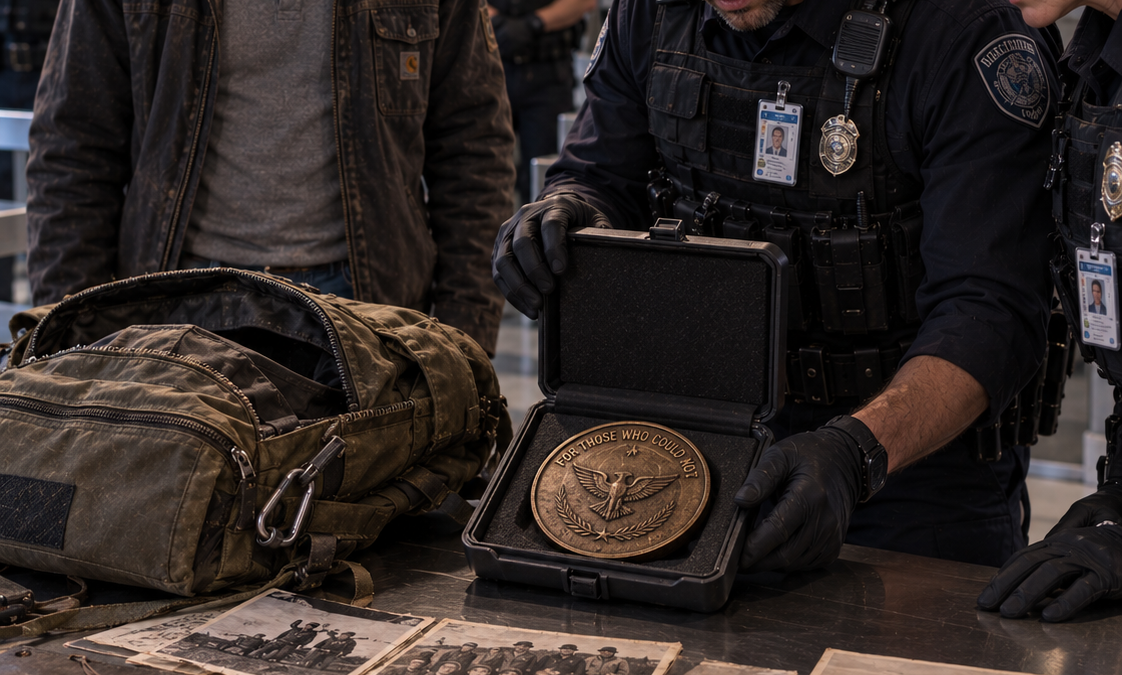
They Searched a Single Dad’s Backpack—Then Froze at the Medal No One Knew Existed
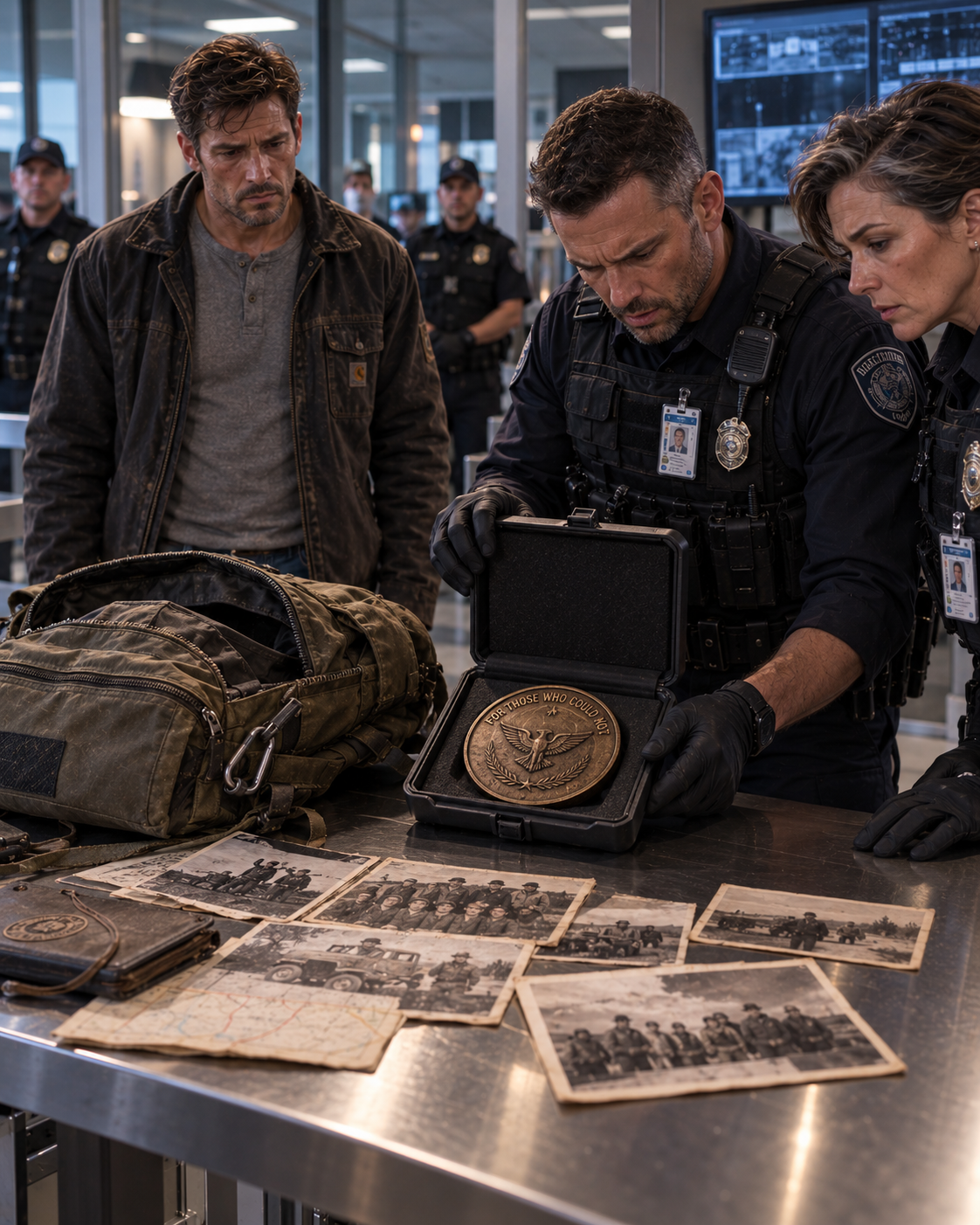
Daniel Carter slammed both hands flat on the security table and the entire room went silent.
Not because he was angry, because he wasn’t.
He stood perfectly still, jaw tight, eyes forward while four armed officers tore through every inch of his old backpack like they expected to find something that would end careers. They found the metal instead. And the senior officer, a 20-year veteran who had seen everything, actually stepped backward.
Nobody spoke for 11 seconds. Then Daniel said quietly. My father told me someone would eventually find it.
The security checkpoint at Holloway Federal Technology Campus wasn’t supposed to be interesting.
That was the honest truth. Officer Marcus Webb had worked that checkpoint for six years.
And in six years, the most dramatic thing he’d ever seen was a contractor trying to sneak in a flask of bourbon inside a hollowedout hard hat.
Webb had laughed about that one for months. But that Tuesday morning in late October, something was different before Daniel Carter even stepped through the door.
Webb felt it first, not saw it, felt it, like the pressure change before a storm rolls in off the coast.
The kind of thing you couldn’t explain to your supervisor, but your body registered anyway.
The way old soldiers always said, their bones knew rain before the clouds showed up. Daniel Carter walked in at 7:43 in the morning, same as he did every Tuesday and Thursday. He was a contract mechanic, one of the guys the facility brought in to maintain the older diesel generators in the lower service bays.
Nobody glamorous, nobody important, just a man who kept the backup power running so that the important could keep doing their important work without interruption. He was 44 years old, medium height, the kind of build that came not from a gym, but from 20 years of actual physical work, shoulders that were broad but not sculpted, hands that were rough and permanently stained at the knuckles from grease that never fully washed out.
He wore the same thing every time. Worn dark jeans, a gray thermal shirt, work boots that had seen better days about 3 years ago. And he carried that backpack, old canvas, faded olive green, the color almost worn to gray at the corners.
One of the side pockets had been repaired with what looked like dental floss, neat stitching. Precise, the kind of repair a man does himself because he takes care of his things rather than replacing them.
The main zipper pull had been replaced with a small carabiner clip.
The whole thing looked like it had crossed deserts, maybe more than once, but Daniel Carter carried it the way most men carry something they’ve decided is irreplaceable.
Webb had checked that backpack before twice. Standard scan, standard visual tools, a thermos, a battered notebook, some protein bars, a couple of photographs tucked into the outer pocket.
nothing he’d examined closely.
But that Tuesday, the facility was under a level two security review. New contract, new protocols, new scrutiny across all personnel contractors included.
Web’s supervisor, senior officer Patricia Holt, had come down from the main security office personally to oversee the enhanced screening.
Holt was 51 years old, built like a former collegiate athlete, and had the kind of voice that didn’t need to get louder to get more serious.
She’d worked federal security for 19 years.
She did not do unnecessary conversation.
“Carter,” she said, stepping forward when Daniel approached the desk.
“Enhanced screening today.
Everything out of the bag, please.
” Daniel set the backpack on the stainless steel examination table without a word.
No complaint, no question, no performance of innocence the way people sometimes did when they felt accused of something that exaggerated cooperative act that actually looked worse than just being calm. He was just calm.
He unzipped the main compartment himself, opened it wide, and stepped back with his hands at his sides. Webb started pulling items out, placing each one on the table.
The tools were first a socket wrench set in a worn canvas roll, a multimeter, a handful of hex keys banded together with a rubber band. Then the thermos, dark green, scratched up, the notebook thick, water damaged at one corner, held shut with a rubber band.
Two protein bars, one already open, a folded piece of paper that turned out to be a work order from 3 weeks ago. And then the photographs.
Webb picked them up without thinking much about it. A handful of them, loose, tucked between the notebook and the inner wall of the bag. Old prints, not digital actual photographs, developed from film.
The kind with the white border and the slight color fade that happened when pictures got old. He glanced at them.
The way you glance at things when you’re doing a job.
Not really looking, just processing. But one of them made him stop.
It was a group photograph. Eight men standing in a row somewhere dusty, somewhere hot.
You could tell that much from the light and the earth and the way the men were squinting.
They were wearing civilian clothing, but there was something about the way they stood that didn’t read as civilian.
Too deliberate, too aware of where every other person was in the frame. Daniel was in that photo.
Younger, maybe late 20s, but unmistakably him. Same jaw, same stillness in the eyes. Who are these men?
Webb asked. Not accusatory, just asking. Old friends, Daniel said.
Where was this taken?
Somewhere I don’t go anymore.
Holt moved closer. She looked at the photograph, then at Daniel, then at the photograph again.
Mr.Carter, she said, we’re going to need you to step to the secondary screening room.
Webb, finish the bag. Daniel nodded once. A young officer named Reyes walked him through the door on the left.
Webb turned back to the backpack. He ran his hands along the inside and compartments the way they were trained to do, not just looking, but feeling.
Checking for false panels, hidden pockets, anything that wasn’t supposed to be there.
Most of the time, it was nothing.
A forgotten pocketk knife, a USB drive someone didn’t want to declare.
Once memorably, a man’s second cell phone that his wife didn’t know about.
Webb’s fingers reached the bottom of the bag and pressed down and felt something that shouldn’t have been there.
Not a hard object, not right away. What he felt was a seam. A deliberate seam running along the bottom interior.
Not quite parallel to the outer edge. Professional stitching. Intentional construction.
Not a manufacturing defect and not an accident. Holt, he said. She came over, he pressed his fingers along the seam again, tracing it.
The bottom of the bag had a false floor thin, maybe a/4 in of separation, but enough. There was a small tab on one end, nearly invisible, flush with the fabric. Web pinched it between two fingers and pulled gently.
The panel lifted and in the space beneath it was a metal case. Not large, about the size of a thick paperback book.
Matte black, no markings on the outside, sealed with a simple latch. The kind of case you might use to store something delicate.
Something you didn’t want scratched or bent.
Webb looked at Holt. Hol looked at the case. Neither of them reached for it immediately.
Get Carter back in here, Hol said.
Her voice hadn’t changed in pitch or volume, but something in it had shifted anyway.
The way certain things shift without moving. When Daniel came back into the room, his eyes went immediately to the case sitting on the table.
Not to Web’s face, not to Holtz, to the case.
Something happened in his expression that Webb watched and couldn’t fully describe later, except to say it wasn’t surprise.
It was more like the way a man’s face changes when he’s been expecting a phone call for years and it finally rings.
He stopped walking. Reyes almost bumped into his back.
Mr.Carter, Holt said, “Can you tell us what’s in this case?”
A pause.
Not hesitation, Daniel Carter didn’t seem like a man who hesitated.
It felt more like he was deciding something like a door he’d kept closed for a very long time was now going to open whether he wanted it to or not.
and he was giving himself one last second on this side of it. Yes, he said. Is it yours?
It was my father’s now.
It’s mine.
What’s inside it?
He looked at Holt directly. You should open it.
She did. The latch released cleanly.
The case opened to reveal a interior lined with black foam cut precisely to hold the object inside. Custom fitted.
Someone had made this case or modified it to hold this specific thing. The metal was circular about 3 in across.
Bronze but darker than standard military bronze, almost brown, oxidized with age. On the face was an embossed image that none of them recognized.
An eagle, but not the American eagle. Different positioning, different detail. Beneath it, five words in a semicircle that Webb had to lean in to read.
For those who could not, on the reverse side, a series of numbers, no name, no date, no branch insignia that Webb recognized. Holt stared at it for a long moment. Then she picked up her radio.
I need verification on a military decoration, she said into it. Unidentified.
Sending images now. She photographed both sides of the metal with her phone and sent them. Webb stood there looking at Daniel Carter who was looking at the metal the way you look at something that has cost you more than anyone around you knows.
Mr.Carter, Webb said, and he wasn’t exactly why he was asking.
But the question came out anyway. What does it mean? The inscription.
Daniel looked at him. His eyes were steady. Not hard steady.
The difference mattered. It means, Daniel said slowly. That some people did something that mattered.
And then the world pretended they didn’t.
The verification took 11 minutes. In those 11 minutes, the room became a different kind of quiet.
Web had been intense situations before, but tension usually had a direction it pointed at something. Like fear pointed at a threat or anger pointed at a target.
What was in the room now didn’t point anywhere.
It just sat there heavy and still.
the way secrets feel when they’re about to become something else.
Two more security supervisors came in. Then a man in a suit named Ellison, who Webb had seen around the building, but never interact acted with one of the facilities federal liaison officers.
The kind of person who existed in the background of government operations and only moved to the foreground when something unusual happened. Ellison looked at the metal. He looked at Daniel.
He looked at the photograph of the eight men that was still lying on the table.
He said, “Where did you get this?”
“From my father’s house.”
Daniel said, “After he died 3 years ago, and your father was one of the people who was supposed to stay quiet about it.
He stayed quiet for 40 years.
He just didn’t throw it away.
” Ellison’s face was doing something careful and controlled.
the expression of a man who has been trained to process information with Audi immediately broadcasting his reaction to it. But Webb was watching closely and he saw it a flicker of something underneath the professional mask. Recognition not of the metal exactly, but of what the metal meant.
What is your father’s name?
Ellison asked. Robert Carter, retired, died three years ago in Caldwell, Virginia. He was 68.
Daniel paused. He worked machinery his whole life, too.
After he came back, came back from where? Daniel looked at Ellison the way a man looks at another man when he suspects that man already knows the answer.
You already know what that metal is, don’t you?
Daniel said.
It wasn’t a question.
Ellison didn’t answer immediately.
He looked at the metal again, then at the photograph. I know what it might be, he said carefully.
Then you know why my father kept it hidden? A silence.
Mr.Carter Ellison said, “I need you to come with me.”
The secondary office was on the third floor.
Past two additional security doors that Web didn’t have clearance to follow through.
He watched Daniel Carter walk down that hallway with Ellison calm straight back carrying nothing now because they’d kept the backpack.
Reyes came and stood beside Webb.
“What was that?”
Rehea said. Webb shook his head slowly.
I don’t know.
You think he’s in trouble?
Webb thought about the way Daniel’s face had looked when he saw the case on the table.
Not scared, not guilty, just ready in the way that people who have been carrying something heavy for a very long time are ready to set it down. No, Webb said.
I don’t think he’s in trouble.
He looked down at the table where the photographs still lay. The eight men, the desert light. eight men, the desert light, who knew exactly how much space they were taking up in the world and had chosen to take up as little of it as possible.
I think Webb said he’s been waiting for someone to find it.
In the room on the third floor, Daniel Carter sat across a table from Ellison and two other men who had been called in. Quickly, their names were given, but not explained.
And Daniel didn’t ask for explanation.
He’d been in rooms like this before.
Different buildings, different furniture, same essential arrangement. People on one side who wanted information, one person on the other side deciding how much to give.
Except this time, Daniel wasn’t protecting a mission.
He was finally telling the truth about one.
My father’s name was Robert Thomas Carter, he began.
He served in a specialized capacity that wasn’t connected to any branch through official paperwork.
If you search his name in standard military databases, you’ll find nothing after 1,979.
That’s intentional.
The two unnamed men were taking notes. Ellison was watching Daniel. He told me about the mission once.
Once in 20 years of me asking. I was 31.
He was in the hospital for a bypass surgery and I think he was scared he wouldn’t make it out and he decided to tell me in case he didn’t.
What did he tell you?
He told me that in 1981 a team of eight men civilians technically but with military training were sent into a location I won’t name yet because I need to know first who’s in this room and what their clearance levels are.
Daniel paused.
I’m not being difficult.
I’m being careful.
There’s a difference.
Ellison looked at the other men. Something passed between them that Daniel watched without reacting to.
Continue, Ellison said. He told me the mission was successful.
The people they went in to bring out came out. All of them. Nobody on their team died during the operation.
But but three of the eight men died in the months after they came back. Two of them in circumstances my father never believed were accidents. one of a sudden illness that moved faster than my father thought was natural.
Daniel’s jaw tightened slightly.
The first physical sign of anything that wasn’t pure composure.
My father believed that the team was being cleaned up. Made quieter than they already were.
That’s a serious allegation.
My father was a serious man. Daniel looked directly at Ellison. He kept that metal because it was the only physical proof that the mission happened.
that those eight men existed in that capacity that they did what they did.
He kept it because he believed that if you destroy all the evidence, you eventually destroy the truth and he wasn’t going to let that happen.
Why didn’t he come forward?
Because he had a son and he didn’t want his son to grow up without a father.
Daniel said it without emotion. The way you say something that has been true for so long, it has become just a fact rather than a wound.
He made a calculation. He chose me over the truth. I spent a long time being angry at him for that.
And now a pause. Now I have a daughter, Daniel said.
She’s 9 years old.
She’s the reason I’m still a mechanic in a small town instead of something else.
So I understand his calculation a little better than I used to. The room was quiet. the metal.
One of the unnamed men said, “Where was it made?
Who authorized it?”
My father didn’t know who made it.
He said, “They found one in each of their packs when they returned from the mission.
No explanation, no ceremony, just the medals and the silence and the understanding that nobody would ever speak about it.
” Daniel looked at the medal still in its case on the table between them.
Whoever made those medals, whoever put them in those packs was telling them something, that someone knew what they’d done, that someone wanted them to know that it mattered.
Even if the world would never hear about it, he leaned forward slightly. My father carried that medal for 40 years.
He never showed it to anyone.
He never talked about it, but he kept it because it was the only thing left that said, “This happened.
These men existed. What they did was real.
He looked at Ellison.
And now I’ve carried it for 3 years.
And every Tuesday and Thursday I bring it in here with me inside a backpack inside a hidden compartment. Not because I wanted it to be found. He paused.
Because my father told me that someday someone would be looking for exactly this. And when they found it, I needed to be ready to talk.
The room held very still. He said that to you?
Ellison said, “Your father specifically said someone would find it.”
He said, “Daniel, keep it close.
Keep it moving.
Don’t put it anywhere that stays in one place too long.
And when someone finally finds it, and someone will tell them everything, because the people who didn’t come home deserve to have their names said out loud at least once before everyone who knew them is gone.”
Daniel sat back. Three of the eight are still living, including me and I, was never officially part of the team. I inherited this from my father, but two of the men who were actually there.
Two of the original eight are still alive. Old now, sick, one of them, but alive.
His voice stayed even.
They’ve been waiting a long time.
Marcus Webb didn’t learn most of this that day.
He learned it in pieces over the following weeks through a colleague who had a friend in the federal liaison office, through a carefully worded conversation with Hol, through the specific silences that fell when he asked certain questions in certain directions. But that Tuesday, standing
in the security checkpoint with the backpack on the table and the photographs still fanned out across the steel surface, Webb understood one thing clearly.
He’d been doing this job for six years.
He’d processed hundreds of people through that checkpoint.
He’d looked inside thousands of bags.
Hes and he had just looked inside a backpack that had been carrying 40 years of someone’s hidden history.
He picked up the photograph again, the eight men, the desert light, the squinting eyes, and he looked at the face of the young man who would eventually become the quiet mechanic who came in every Tuesday and Thursday and fixed generators in the basement and never caused any trouble and never asked for anything. He thought about what Daniel Carter had said.
Some people did something that mattered.
And then the world pretended they didn’t.
Webb set the photograph down carefully. He thought about his own father who had served in Vietnam and come home and never talked about it.
Not once in the 30 years between his return and his death.
Except for one night when Webb was 17 and they were sitting on the back porch and his father had said, “Very quietly, son.
Some things you carry because you have to, not because you want to, because somebody has to.”
Webb had not understood what that meant when he was 17. He thought he was beginning to understand it now.
On the third floor, Daniel Carter answered questions for 4 hours. He was precise. He was methodical.
He gave dates where he had them and said clearly when he didn’t.
He corrected himself twice when he got a detail wrong, catching his own error before anyone else did, which was the kind of thing that made credible witnesses stand out from the kind who were building a story as they went. He answered everything they asked.
And then near the end of the fourth hour, when the questions had slowed and the unnamed men were reviewing their notes, and Ellison was sitting back in his chair with the particular stillness of a man reassessing something significant. Daniel asked a question of his own. The two men who are still alive, he said.
Do you have the authority to do something about that? Ellison looked at him.
I don’t know yet, Ellison said honestly.
They’re in their 70s, Daniel said.
One of them has maybe another year less according to his family. He kept his voice level. But something underneath it had changed.
A weight that had been distributed across his entire body was now concentrated somewhere in his chest. They kept quiet for 40 years because they were asked to because they were scared because they had families and they made the same calculation my father made. He looked at the medal in its case.
They didn’t do what they did for recognition.
I want to be clear about that. They did it because it was the right thing to do and nobody else was going to.
He looked back at Ellison.
But there’s a difference between not needing recognition and having your entire existence erased.
There’s a difference between choosing to be quiet and being made invisible.
A pause. They deserve to have someone say their names out loud, Daniel said.
before it’s too late to say them to their faces.
The room was silent for a moment that’s stretched long at a moment usually stretches.
Then Ellison reached forward and closed the metal case gently, the latch clicking shut with a small precise sound. Mr.Carter, he said, I think you should leave your backpack with us. Daniel nodded.
And I think Ellison continued that we have some work to do. Daniel Carter walked out of the Holloway Federal Technology campus at 4:17 in the afternoon.
Nine hours after he’d walked in, he didn’t have his backpack.
He didn’t have the medal.
He had a business card from Ellison with a phone number and an instruction to keep his phone on and a receipt for the items that had been retained as part of an ongoing inquiry. The parking lot was mostly empty by then, the day shift long gone. The evening crew not yet arrived.
October air, cold and clean, the kind of afternoon that smelled like dead leaves and the memory of summer. He sat in his truck for a moment without starting it.
His hands were on the steering wheel, but he wasn’t gripping it.
He was just sitting there in the quiet in the late afternoon light. And the expression on his face was not relief, and it was not grief, and it was not satisfaction. It was something closer to the way a person looks at the end of a very long walk when they finally set down something heavy and stand up straight for the first time in years.
He pulled his phone from his pocket, dialed three rings and then a small voice.
Daddy, “Hey, baby.”
His voice was different now.
Softer, not performed softness, the kind that comes from a place that the rest of the day hadn’t been allowed to touch.
You home from school?
Yeah, Mrs.Patterson gave us homework, but it’s not that much.
Good. What do you want for dinner?
Can we have grilled cheese? We can definitely have grilled cheese.
Are you coming home soon? He looked out through the windshield at the facility building behind him.
At the flag that hung motionless in the still air, at the ordinaryl looking entrance through which something extraordinary had spent the last 9 hours quietly unfolding. Yeah, he said.
I’m coming home right now.
He started the truck.
He pulled out of the parking lot and onto the county road that ran west toward the small town where he’d built a small life that was not small at all.
Not really. Not when you understood what had been carried to make it possible. Behind him, on the third floor of a federal technology facility, a man named Ellison was making phone calls.
Inside a matte black case on a conference table, a bronze medal bearing five words sat in its foam cradle for those who could not. And somewhere in their 70s in homes that nobody had ever connected to anything remarkable.
Two old men were going about their evenings the way they’d gone about every evening for 40 years, not knowing that today finally a door had opened.
Not knowing that someone had found it. not knowing that Daniel Carter had kept his promise. Ellison made seven phone calls that night.
Daniel didn’t know that he was home by 6:00, standing at the stove making grilled cheese for his daughter, Emma, cutting the crusts off because she’d asked him to every single time since she was four, and he’d never once said no.
She sat at the kitchen counter doing her homework with the focused intensity that 9-year-olds can’t bring to things they actually care about.
her pencil moving in small deliberate circles, her tongue pressed against the corner of her mouth, the way it always did when she was concentrating. He watched her from the corner of his eye while he flipped the sandwiches. She looked like her mother in the jaw and the eyebrows.
She had his stillness, though that particular quality of quiet that settled over her when the world got loud. The way calm water stays calm even when the surface ripples.
He’d noticed it when she was maybe 3 years old, and it had moved something in him that he he couldn’t name and still couldn’t.
Daddy, she said without looking up from her homework. Yeah, you look different. He pressed spatula down on the sandwich.
It sizzled. Different how?
Like something happened. She looked up then 9 years old and those eyes already knew when to press and when to wait. Did something happen at work?
He looked at her for a moment. Thought about 40 years of silence.
Thought about his father on a hospital bed saying, “I need to tell you something in case I don’t come out of this.”
Thought about what it cost a man to carry a truth that heavy for that long. Alone with no one to set half of it down with at the end of the day.
“Something small,” he said.
“Nothing bad.
I’ll tell you about it when you’re older.”
She considered this with the somnity of someone who understood that when you’re older was sometimes a real promise and sometimes a door being quietly closed.
She decided apparently that this was a real promise. She nodded once and went back to her homework.
He put the sandwiches on plates and set hers in front of her and sat down across the counter and they ate together in the easy quiet of people who didn’t need to fill every silence.
And Daniel Carter thought this is why my father stayed quiet. This right here, this kitchen, this child, this ordinary Tuesday evening, that is the important thing in the world.
He understood it.
He just wasn’t sure even now whether understanding it made it right.
His phone buzzed at 9:14 p.m.after Emma was in bed.
a text from a number he didn’t recognize, which meant it was from Ellison or someone connected to Ellison because that was how those men communicated never the same number twice.
Always a new channel, old habits from old training that apparently never fully went away, even when you spent 20 years behind a desk.
The text said, “Preliminary verification complete.
We need to meet Thursday.”
Not at the facility.
I’ll send an address.
Daniel read it twice.
Then he set the phone face down on the coffee table and picked up the book he’d been reading for three weeks without getting past page 40 because his evenings were short and his eyes got heavy fast and the life of a single working father did not leave enormous reserves for leisure.
He didn’t read.
He just held the book. He was thinking about the address Ellison would send.
Thinking about what preliminary verification complete meant, what they’d found or confirmed or been forced to acknowledge existed.
Thinking about the two old men who were still out there, going about their evenings, not knowing that today had happened. He thought about a name his father had said once that one night in the hospital. Raymond Husk.
His father had said it quietly, like the name itself was something fragile. Raymon was the best of us.
Daniel, don’t ever let anyone tell you different.
Whatever they say about that mission, whatever story gets written about it someday, you make sure Raymond Husk’s name is in it.
Daniel had memorized the name the way his father said it, the weight of it, the care.
He’d never been able to find Raymond Husk in any public record, which meant either Raymond Husk was dead or Raymond Husk had been made to disappear, or both.
He fell asleep on the couch at 10:30 with the book open on his chest and the phone face down on the table and the television showing a baseball game he wasn’t watching.
And he dreamed the way he sometimes did about a desert he had never personally been to, but had been described to him so precisely and so many times that his brain had built it anyway, stone by stone, heat by heat, into something that felt like memory. He woke up at 2:00 a.m.The television was still on. The house was quiet.
Emma was asleep down the hall, making the small breathing sounds he could hear through the wall. When everything else went silent, he picked up his phone.
No new messages. He sat there in the blue television light and thought about the fact that somewhere in a building he had now left, a bronze medal with five words on it was sitting in a case on a table.
and tomorrow those words would be read by people who hadn’t known those words existed yesterday.
And something that had been sealed for 40 years was now.
Quietly cracking open, he thought, “Pop, I found them.
I think I finally found them.”
He didn’t say it out loud.
He just thought it in the dark in the house his daughter was sleeping in.
In the town he’d chosen specifically because it was the kind of place where nothing ever happened and nobody ever looked too closely.
And then he went back to sleep. Thursday came fast.
Ellison’s address turned out to be a conference room in a federal building 40 minutes south.
Not a dramatic location, not a secret facility, just a government office building that looked like every other government office building. Beige walls and fluorescent lights and the particular smell of recycled air and old coffee that Daniel associated with bureaucratic authority in all its forms.
He’d been in rooms like this before.
Different context, same smell. There were four people at the table when he walked in.
Ellison he recognized the other three he didn’t.
Two men and a woman all in their 40s or 50s all carrying the specific posture of people who dealt in information that didn’t get written on down in place anyone could find easily.
And then there was a fifth person sitting at the far end of the table away from the others in a chair that had been angled slightly toward the window rather than toward the table. An old man, 70, maybe 72, white hair cut short the way men cut it when they stopped carings about style and started caring only about maintenance. His hands were on his knees and he was looking at the door when Daniel walked in.
And when Daniel’s eyes found his, something happened between them that was not recognition exactly.
They had never met, but something like the feeling of recognition. The feeling of seeing someone who had been described to you so many times in such precise detail that meeting them felt less like an an introduction and more like a confirmation. Daniel stopped walking.
The old man looked at him. Then the old man said in a voice that had probably been strong once and was now working harder to stay steady than it looked.
You’re Robert Carter’s boy.
It wasn’t a question.
Daniel said yes, sir. The old man nodded slowly.
You’ve got his eyes.
He paused. He talked about you. In the early years before we lost contact, he talked about his son.
Daniel pulled out the chair across from Ellison and sat down, but he didn’t look away from the old man.
What’s your name?
My name, the old man said, and something moved through his expression that was complicated and quiet and had a long history behind it. Is Raymond Husk.
The table went silent. Daniel heard his own breathing.
Raymond Husk, the best of us.
Don’t ever let anyone tell you different.
Father, Daniel said carefully talked about you his entire life. Raymond Husk looked at him for a long moment. His jaw worked slightly.
The way a man’s jaw works when he is holding something in that wants very much to come out.
How long ago did Robert pass? 3 years.
A slow exhale.
I didn’t know.
I lost track of the others a long time ago.
It wasn’t safe to stay in contact.
He looked at his hands. I should have found a way.
He would have told you not to, Daniel said. He was careful about that.
He didn’t want anyone to think the group was still communicating.
He was always the most careful of all of us. Raymond looked up.
He was also the bravest.
I want you to know that whatever was said or wasn’t said, your father was the bravest man on that team.
Daniel held that, put it somewhere it would keep.
Then Ellison cleared his throat gently and said, “Gentlemen, I know this is significant, and I want you to have time for it, but we need to start with what we know because there are people in this building who are waiting on information, and the window we have is not unlimited.
” Daniel looked at Ellison.
“What did you find?”
“We found enough,” Ellison said.
“That’s the short answer.
The longer answer is more complicated. Give me the longer answer. Ellison folded his hands on the table.
He was the kind of man who organized his words before he spoke them, which Daniel appreciated. The operation your father described the 1998 extraction does appear in records.
Not under its operational name because that name has been redacted from every document we’ve located, but the record of the operation itself.
the outcome. The personnel count those exist. They were never fully destroyed.
They were buried.
There’s a difference.
What’s the difference?
When you destroy something, it’s gone.
When you bury something, Ellison paused. Someone knew where to look. Who buried it?
That Ellison said is the part that gets complicated.
One of the people Daniel didn’t know.
A woman with a precise haircut and the eyes of someone who read between lines for a living leaned forward slightly. Mr.Carter, what do you know about the operational structure of what your father was part of?
I know it wasn’t military officially.
I know the eight men were recruited from different backgrounds, some with military training, some without. I know they were given civilian covers and sent in without any official connection to the U s government. He paused.
I know that if anything went wrong, they were completely deniable. Nothing went wrong, Raymond Husk said from the end of the table. His voice had steadied.
That’s the part nobody ever said out loud.
Nothing went wrong. We did exactly what we were asked to do. We got those people out.
Every single one of them. His jaw tightened. And then we came home and were told to pretend it never happened.
like what we’d done was something to be ashamed of.
Like the people we’d risked everything for, like their lives weren’t worth acknowledging.
Why? Daniel asked. He looked at Ellison.
Why would a successful mission get buried? Ellison was quiet for a moment. Then because acknowledging the mission would mean acknowledging what created the situation that required the mission.
and that he said carefully would have been politically inconvenient for a number of people who were at that time in positions of significant authority. So they erased it. They attempted to, Ellison said.
And they almost succeeded. Almost, Daniel said.
Ellison looked at the metal case which was sitting on the table between them. Almost. Raymon spoke again.
There were eight of us. You said you know about the three who died afterward.
My father believed two of those deaths weren’t natural, Daniel said.
He said it directly, watching Raymon’s face.
Raymond didn’t flinch.
Your father was right. The woman with the precise haircut wrote something down.
You have evidence of that. Ellison asked Raymond. I have lived with the knowledge of it for 40 years.
Raymon said, “Whether that constitutes evidence in the way you mean is a question for lawyers.”
He looked at Ellison’s steadily.
But I know what I know.
Eddie Marsh died of a heart attack at 34, which was possible, but wasn’t Eddie Marsh.
Eddie ran 8 miles every morning. He was built like a draft horse and he died of a heart attack 6 months after he started asking questions about why certain people who had been on our extraction list had gone silent. He paused.
That kind of coincidence I’ve had 40 years to think about.
I’ve stopped believing it was a coincidence.
The room processed that in silence. Who are the other survivors? Daniel asked.
There’s me, Raymon said.
And there’s a man named Clifford Boon.
He’s in a nursing home in western Tennessee.
He had a stroke 2 years ago. His mind is still sharp, but his body is giving out.
He said it plainly. The way old men sometimes speak about decline. Not without grief, but without flinching from it.
I spoke it to his daughter two months ago. She said he still talks about the mission sometimes. Not to her.
She doesn’t know the details.
He talks to himself. She said at night when he thinks no one can hear.
Daniel thought about his father talking to himself late at night.
He’d heard it through the walls as a child and never understood what the murmuring was.
He understood it now. We need to talk to Clifford Boon. Daniel said.
His family has to agree to that.
The precise haircut woman said, “Then we ask his family.
” Daniel said, “What else?”
Ellison pulled a folder from the stack in front of him and slid it across the table.
“The people who were extracted?
The ones your father’s team brought out?
Do you know anything about them?”
Daniel opened the folder.
There were names partially redacted, some complete, some with only initials and dates and a location code he didn’t recognize.
He scanned them slowly.
My father didn’t tell me the names, he said.
He said he was told not to learn them. That knowing the names was a risk.
That was standard protocol for the unit, Raymond confirmed.
We didn’t know who we were going in for until we were already in.
By the time we knew their faces, we were already responsible for their lives. He paused. Three of them were Americans.
The rest were foreign nationals connected to operations.
I still don’t have clearance to discuss in this kind of setting.
Are any of them still alive? Daniel asked. Ellison looked at him.
Yes. Do they know what it cost the team? A pause.
