She Couldn’t Afford Baby Milk And Was Mocked — Until A Mafia Boss Stepped In And Silenced Everyone – Part 3

At the community clinic, the woman asked if there was a diagnostic record, if there was a specialist’s assessment, if there was any document clearly stating why Lily needed that expensive formula instead of ordinary formula.
Hannah said she had this notebook.
She brought out the hardbound notebook, opened it to the correct page, and inside were over a year of handwritten records, an entry for every day, every feeding, every scoop, every time Lily vomited, and every time she didn’t.
The woman turned through its pages for quite a while. Then she closed it and placed it on the table. I believe you, she said.
But then she went on to explain that this wasn’t a medical record.
In my report, this counts as personal documentation.
It can’t take the place of a specialist’s medical assessment, and I’m not the person who’ll be reading this report.
Then she asked a question without the slightest malice in precisely the voice of someone who was trying to help but wasn’t permitted to.
Do you have anyone who can vouch for you, Miss Sullivan? Hannah stood there.
She looked down at her daughter, sitting on the floor, stacking wooden blocks, utterly unaware of any of it, and heard her own voice before she had time to think.
I have a child who’s still alive.
That’s my proof.
The woman looked at her.
She didn’t respond to those words.
She only nodded once, very slowly, then lowered her head and finished writing her report. Before leaving, she said the case would remain open that Hannah had 15 days to provide additional medical documentation and that after that a determination would be made. If the report was found to have merit, the case would proceed to the next stage.
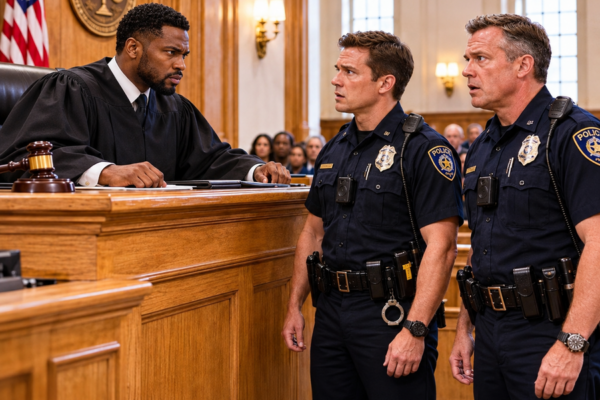
Hannah asked what the next stage was. The woman paused in the doorway and answered honestly because that was her job. Family court, Miss Sullivan.
Then she descended the stairs. Hannah closed the door, leaned back against it, and slid down until she was sitting on the floor.
Lily crawled over, handed her mother a yellow block, and said, “Mommy, you stack it.”
Hannah took it. She placed it on top. But her hand was trembling so badly that the blocks toppled over, and the little girl burst into delighted laughter.
Hannah called him that afternoon, even though she had told herself she wouldn’t.
She briefly explained what had just happened, mentioned the 15 days, said the words family court, and her voice broke on the last word. Nico listened until she had finished.
He asked for the investigator’s name and the case number.
She read them to him. He said he would call her back within an hour, then hung up. 40 minutes later, he called and told her 9:00 Monday morning.
pediatric gastroenterenterology, Hasbro Children’s Hospital on Hope Street, a doctor named Whitaker, and the appointment had already been made.
Hannah said she had requested a specialist appointment for Lily back in April, and they had scheduled her for September. Nico said an opening had come up because someone else had canled.
She was silent for several seconds, then said her insurance wouldn’t cover this part.
He told her to take Lily to the appointment first.
On Monday morning, he didn’t drive her there himself.
Vin arrived to pick up Hannah and Lily, waited outside for the entire 4 hours, and didn’t go inside even once.
Dr.Whitaker examined Lily for 2 hours, ordered blood work, a stool test, and a gastrointestinal challenge test that required her to remain under observation. She asked Hannah whether she had kept any records.
Hannah brought out the hardbound notebook. The doctor turned through it slowly from the first page to the last.
And about halfway through, she stopped, looked up at Hannah, and asked if she had been recording all of this for over 14 months straight.
Hannah said, “Yes.”
The doctor said, “This is data, Miss Sullivan.
This is better than most of the medical records I receive.
” 10 days later, the results came back.
The diagnosis clearly stated nonIG mediated cow’s milk protein allergy accompanied by growth faltering and the treatment instructions specified that the patient had a medically mandatory need for an amino acidbased formula with no medically appropriate alternative available.
Beneath it were the doctor’s signature and medical license number.
Nico didn’t handle the rest himself.
He turned it over to an attorney and the attorney did exactly what the law permitted.
A copy of the diagnostic records was submitted to the investigating agency, accompanied by a letter explaining that the formula in the home came from an order paid 12 months in advance, the garment contract stating Hannah’s weekly wages as proof of stable income, and a written confirmation from the laundromat downstairs that Pearl Donnelly cared for
the child inside the same building rather than taking her elsewhere for child care.
At the same time, another set of documents was filed with the insurance company using the correct forms and meeting the 60-day deadline stated in the third denial letter with a citation to the clause covering medically required nutritional products.
No one called anyone’s home.
No one was stopped in a parking lot. No message of any kind was sent to anyone named Crane. 3 weeks later, the insurance company approved 80% of the cost.
Retroactive for 6 months. 4 days after that, a letter from the Department of Children, Youth, and Families arrived at the Atwells Avenue address.
Hannah opened it in the hallway, read it right there, and had to read it twice before she could believe it. Investigative finding, unsubstantiated, case closed. She carried the letter upstairs, and halfway up the staircase, she had to sit down.
On the afternoon of the 15th that month, Kayla came up with the box of formula as usual.
But this time, she didn’t leave right away.
She set the box down and stood there with her hands twisting together, then lowered herself onto the top step. Hannah asked what was wrong.
Kayla said she had heard what happened. Then she began to cry.
The kind of crying a person tries so hard to hold back that it comes out sounding ugly. And she told Hannah she was sorry. She said that day all she had wanted was for her shift to end early.
She said she had started work at 5:00 that morning. That she had been counting her own loose change in her head because she was short on rent, too.
And that she had repeated the price aloud the second time, not so Hannah could hear it, but so Hannah would hurry.
She said she hadn’t thought about anything at all.
She hadn’t even looked at Hannah.
She had been looking at the clock on the wall. Hannah sat down on the step beside her for a while. She said nothing.
Then she reached out and rested a hand on Kayla’s shoulder.
I know.
She said she wasn’t angry with her.
Kayla shook her head and said, “But people laughed at you and I laughed, too.
” Hannah said, “Yes, that part did hurt.”
Then she said, “It’s all right.
Just those words.”
She stood, went into the kitchen, poured a glass of water, and brought it back to the girl sitting on the stairs of her home. Kayla held the glass in both hands. Upstairs, Lily was singing a song with no discernable words.
The dryer downstairs kept turning in its steady rhythm, and neither woman said anything more until Kayla rose, said goodbye, and went home. With the case closed, and the insurance company having approved coverage, Hannah decided to finish clearing out the safe.
She went down to Pier 9 on a sunny afternoon with Vin waiting outside by the car under the arrangement she had reluctantly agreed to, and she brought two cardboard boxes for sorting. She sat on the concrete floor in front of the open safe and began lifting out the papers one bundle at a time.
Electric bills, welding machine warranties, gas cylinder inspection certificates. She arranged them into three piles.
One to keep, one to throw away, and one for things she didn’t recognize.
In the bottom compartment, deep in the left corner, her hand touched something hard wedged between two folders whose bindings had come apart. She pulled it free. It was an old phone with a thick plastic body and a rubber shockresistant case.
The one Dany had always carried at work because his regular phone couldn’t withstand the dust and oil.
She had assumed it was lost long ago. She turned it over.
Dust had settled across the back in a heavy layer. She wiped it with her handkerchief, pressed the power button, and of course, nothing happened. She slipped it into her coat pocket.
When she got home, she searched through a box of old charging cables, found one with the right connector, and plugged it into the outlet beside the sewing machine. It took nearly an hour before the screen finally lit up.
There was no password. She opened the photo library. Most of the pictures showed welds, equipment, serial numbers, and invoices Dany had photographed for his records.
Hundreds of images like that, the sort of things a working man took pictures of so he wouldn’t have to remember them.
She scrolled through the dates until she reached the end. The last photograph had been taken at 10:51 p.m.on Monday, three nights before that Thursday.
Before it were 17 others, all taken within a span of about 40 minutes, all dark, all shot from a distance, and all showing the same place. Hannah enlarged the first one.
It showed the river at night. A barge was anchored a few dozen yards from shore with its deck lights on, and a large pipe protruded over the side, angled down toward the water. The second photograph had been taken from closer range, and it clearly showed a thick, murky stream pouring into the river, spreading across the surface in a black stain.
The third showed the hull of the barge with an identification number and the name of the operating company painted along its side. She enlarged it as far as the screen allowed, and managed to read both. The next few photographs showed the concrete pier above.
Two men stood there facing each other. The pictures were blurred, but in the 11th photograph, the headlights of a passing truck swept across them. And for that single instant, both faces were clearly visible.
One man held out his hand, the other accepted what he offered. It was a thick brown envelope clasped between his thumb and the rest of his fingers.
The final three photographs showed the man who had taken the envelope walking toward a car. Hannah sat motionless for a very long time with the phone in her hand.
She thought about that Thursday. She thought about the dredging permit application that had been stamped as received the following Monday morning. Then she stood, carried Lily downstairs to Pearl and called Nico.
She said only one sentence. I need to see you right now.
They met at the trucking company office on Eddie Street after business hours. There were only three people in the room.
Nico, Hannah, and Vin standing by the door. Hannah placed the phone on the desk and pushed it toward him.
It was Dany<unky’s.
She told him the safe had been searched, but whoever had done it hadn’t taken the phone, probably because they hadn’t seen it.
It had fallen underneath the files. Nico picked it up.
He opened the photo library and did exactly what she had done. Moving through it from the beginning, slowly without skipping a single photograph.
When he reached the first image in the final sequence, he stopped. He enlarged the pipe extending over the side of the barge. He enlarged the black stain spreading across the water.
He enlarged the identification number painted on the hull and held the image there for several seconds. Then he moved to the next photograph.
His expression didn’t change.
Not a single muscle in his face moved. Standing across the desk from him, Hannah had the strange feeling that she was watching a man read a train schedule.
When he reached the 11th photograph, the one caught in the sweep of the truck’s headlights, he stopped.
He placed two fingers on the screen and enlarged it. Then he enlarged it again, then once more until the face of the man receiving the envelope filled almost the entire screen. Vin stepped half a pace forward from the doorway, then stopped.
No one in the room spoke. A truck passed outside on Eddie Street.
Nico’s finger remained against the screen without moving away.
He studied that photograph longer than he had studied all the others combined. Then he placed the phone on the desk. He lowered it very slowly with both hands as though it weighed far more than it did and left it lying face up with the screen still glowing.
Hannah asked if he recognized the man.
Nico didn’t answer her immediately.
He looked down at the face on the screen for another moment. Then he spoke, his voice still even still low without rising by so much as half a note.
That’s Rocco.
Rocco Ferrante, my cousin. Hannah took a step back from the desk.
What do you mean your cousin? Nico said Rocco had run the port operations under him for 11 years.
Hannah looked at the phone lying face up on the desk, its screen still glowing, the man’s face still there.
So, he’s one of your men?
Nico said yes. She asked if he had known about this.
He said no. She asked him again, her voice different now. Did you know?
I didn’t know and I should have.
Hannah turned away. She took three steps, then turned back and everything in her mind locked into place at once, swift and merciless, the barge dumping contaminated sludge into the river to avoid paying for proper disposal.