A Female Marine Saved a SEAL and His K9—His First Words Changed Everything – Part 4
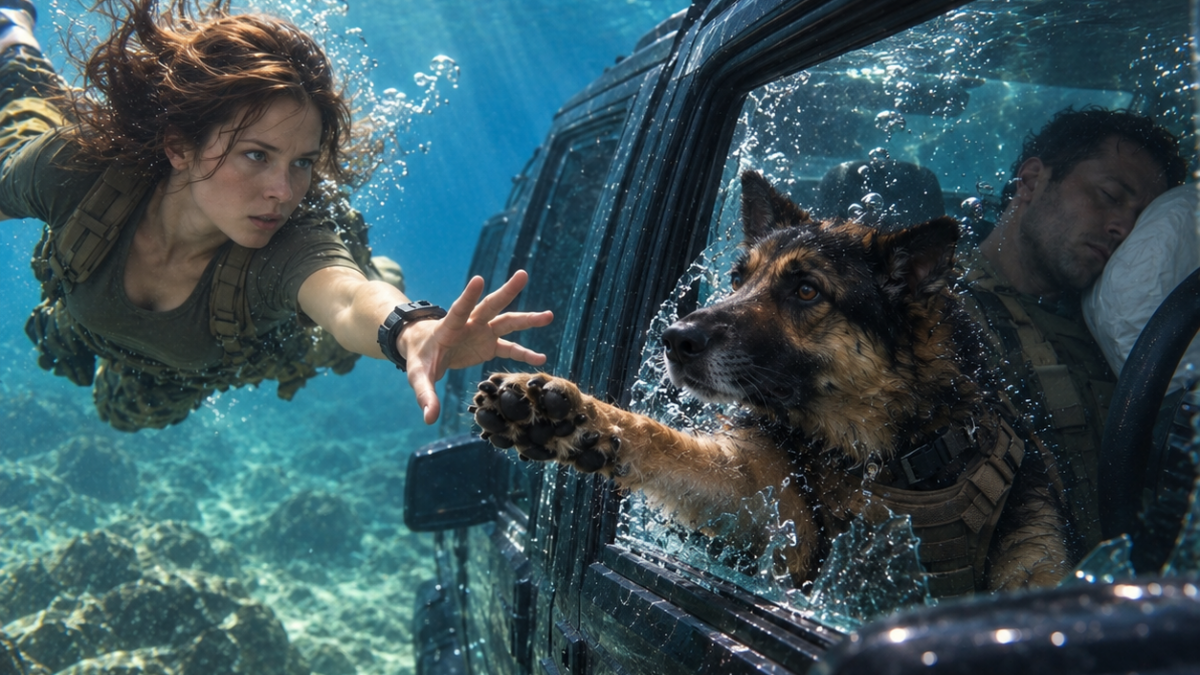
Then phones across the terminal screamed with the same emergency alert. A reported chlorine leak in downtown Silver Wake ordered residents to avoid the center and assemble at the East Marina for evacuation by water.
Rowan stared at the map. The East Marina sat below the auxiliary spillway.
Outside, Harbor Lights banners snapped above streets already crowded with vendors and early visitors. Police sirens began guiding families away from downtown exactly as the false order instructed.
Caleb had taken the safest original element of his plan, the evacuation, and reversed it. Instead of clearing the blast zone, he was filling it.
Witcom called the state command post through the encrypted radio.
She ordered officers to reject every municipal instruction, but the town’s public address network was already repeating the false warning.
A church bus turned toward the Eastern Shore. Parents pulled children after it, trusting the orange vested volunteers waving them onward. Laya found one last active file on the drive, a maintenance interface Owen had copied.
Six status lights changed from amber to red. A timer appeared beneath them, 28 minutes. The original fraud had depended upon an empty structure, controlled damage, and a believable accident.
Caleb no longer had an accident left to sell. He had evidence to bury and witnesses who could name him. Somewhere beneath the lake, six real charges had armed while thousands of people were being directed toward the water.
Wickham handed command to the state incident chief and ran for the doors.
Rowan followed with Keel, hearing the false announcement roll across Silver Wake in Caleb’s reassuring recorded voice.
The man once trusted to lead the town out of danger was now using that trust to gather it at the edge of destruction. State Police Captain Elena Ruiz assumed incident command in the parking lot of the ferry terminal.
She was a broad-shouldered woman in her 40s with closecropped dark hair and a voice that carried without shouting.
Whitams surrendered authority without hesitation, then became the captain’s local guide.
There was no time for wounded pride. Because Caleb controlled the municipal network, Ruiz built an evacuation system from older pieces. Patrol cars broadcast instructions through roof speakers.
Volunteer firefighters carried hand sirens. The churches rang their bells in the emergency pattern used before the town installed digital alerts.
Amateur radio operators relayed routes to boat captains. The new order sent people west and uphill away from both downtown and the auxiliary spillway. The correction moved through Silver Wake unevenly.
A bakery owner unlocked her rear gate so families could cut toward higher ground.
Fishing guides brought their boats ashore rather than obey Caleb’s order to report east.
At one intersection, volunteers in orange vests argued over two competing instructions until Witcom arrived, removed the municipal barricade herself, and showed them the state command authorization. The crowd began turning west. It was slow, imperfect progress, but every person who changed direction widened the distance between the marina and a mass casualty scene.
Rowan called Elias from the command vehicle. His words came slowly around exhaustion.
He could not remember the final placement of the charges, but he remembered the six cases in Owen’s maintenance shed.
Each had been packed with bright blue desicant powder. A mooring line used to lower them had lain across the open cases and carried the same sharp industrial odor afterward.
“Don’t ask Keel to find something underwater,” Elias whispered.
“Give him the line.
He knows that line.”
At the Eastern Service Compound, troopers cleared each building while Rowan kept Keel on a short lead. A state bomb technician located a coil of wet moing rope behind the pump house. Blue dust remained inside its braided fibers.
Keel sampled it once, breathed away from it, then moved with deliberate training rather than excitement. He indicated a pair of neoprene gloves beneath a workbench. Their scent trail continued to a louvered ventilation housing at the rear of the auxiliary control building.
Keel could not tell them where explosives lay below the lake. He could tell them where the people who handled the contaminated equipment had walked. The ventilation fan rattled to a stop.
In the sudden quiet, three dull knocks came from behind the steel wall. Everyone froze.
Another knock followed, weaker than the first. The pause lasted barely a heartbeat, but Rowan felt it open beneath her like deep water. Troopers breached the locked service room.
Owen Pike lay bound to a pipe, his beard matted with sweat and one eye swollen shut. He was gaunt, dehydrated, and furious enough to remain conscious. A medic cut him free while Wickham knelt beside him.
Caleb kept asking where the copy was. Owen rasped.
Said they’d leave me at the gate after the blast.
the extremist who died finishing his own work. Ruiz showed him the copied spillway diagram.
Owen traced the pressure balancing conduit with a trembling finger. The six charges had originally been arranged around it, not on the gate hinges shown in the public maintenance plan.
Destroying the conduit at peak pressure could make the gate fail like neglected metal fatigue. Caleb alone had supervised the final wiring.
A state EOD truck arrived, but its underwater team was still 40 minutes away. The active timer showed 19. Sergeant Noah Bell, the bomb technician on scene, was a spare, weathered man with gray at his temples and the patient eyes of someone who distrusted hurried heroics.
He could direct an underwater assessment, but he needed a qualified diver familiar with the approach channel. Rowan held current rescue and military dive certifications. She had entered that same water to reach Elias.
A county public safety diver, Tessa Monroe, would follow as safety and EOD support. Tessa was 35, athletic, and quiet with years of recovery dives in cold inland lakes.
Neither woman would cut, move, or disconnect a device without Belle’s order.
Belle also made the limit of their mission explicit. They were to identify the array, inspect the access points, and transmit images.
If the configuration offered no safe engineering option, they would surface. Rowan disliked hearing that retreat might be required, yet repeating the boundary steadied her. The decision would belong to a team reading the same evidence, not to one frightened diver trying to redeem an old loss.
Ruiz approved the dive because waiting guaranteed detonation before the specialist team arrived. Surface crews rigged independent air, hardline communications, and tether tenders.
Belle reviewed abort signals. Rowan repeated each instruction back to prove she understood.
Keel remained with Witcom behind the secure line. When Rowan pulled on her hood, he leaned forward but obeyed her stay command.
She touched the top of his head once.
“I come back,” she told him.
Beyond the barricade, an emergency skiff engine caught. Caleb had crossed through the marina in an orange response jacket, using the uniform to pass volunteers who still believed he belonged there.
Keel’s head snapped toward the fuel dock.
The same burnt fabric odor that had clung to Elias’s watchstrap rode the wind from Caleb’s sleeve.
Keel barked once, hard and directional. Witkim turned in time to see Caleb cast off.
His hand moved inside his jacket, and troopers spread toward cover. Keel stayed beside Witkim, barking but never charging, stripping Caleb of the surprise he needed. Rowan could not chase him.
She stepped from the dive platform and sank into green water with Tessa behind her. The spillway wall emerged through silt like the side of a sunken building.
They followed the conduit down while Belle watched their helmet feed. At 30 ft, Rowan saw the first red indicator, then a second.
Four more came alive along the concrete curve until six points burned through the merc.
Owen’s system description had been right.
The wiring had not. Caleb had rerouted the trigger leads through an anti-teamper junction fixed above the balancing valve. Any attempt to remove a charge could close the circuit immediately.
Hands off, Belle ordered through the line. Document the array. Rowan held her light steady while Tessa moved the camera.
The timer showed 12 minutes. A current breathed through the narrow conduit, stirring blue grains from a cable clamp.
Above them, Keel barked again as Caleb raised a weapon near the fleeing skiff.
Below, the six red lights reflected across Rowan’s mask.
She had returned to the kind of confined water that lived inside her worst memory. This time, she was tethered to a team, listening to experts, and refusing to confuse courage with acting alone.
Bel studied the live camera image while the timer fell through 11 minutes. The charges were linked to a sealed anti-tamper relay. Cutting any visible wire could complete the firing circuit.
Removing the relay could do the same. Rowan and Tessa hovered beside the balancing conduit, their safety lines trembling in the current. No contact with the array.
Belle said, “We changed the environment around it.”
Owen, wrapped in a medic’s blanket on shore, examined an enlarged maintenance diagram.
His finger found a manual equalization valve upstream from the relay. Opening it would flood the dry communications pocket and reduce the pressure differential across the auxiliary gate. If water disabled the wireless repeater before detonation, the main charges might never receive their synchronized signal.
Even if one fired, equalized pressure would limit structural failure. Ruiz ordered engineers to clear the downstream channel and move the last surface crews behind concrete cover.
At Bell’s request, the power utility isolated the gate motors so an automated correction could not close the bypass against the divers.
Each safeguard consumed seconds, but skipping one could have trapped Rowan and Tessa between machinery and current. Witcom relayed confirmation from the evacuation teams. The eastern dock was finally empty except for police, medics, and the dive crew.
It was not disarming a bomb. It was giving the spillway a chance to survive it.
The valve wheel lay inside a concrete throat barely wide enough for two divers. As Rowan entered, her tank scraped the ceiling. The sound traveled through her bones.
For one terrible instant, the lake became the training tank where a young marine named Danny Kesler had stopped answering her hand signals. She saw again the slack tether, the bubbles thinning, the clock she had obeyed, while every instinct told her to move faster. Her breathing accelerated.
The regulator seemed unable to give enough air.
Then Tessa’s gloved hand closed around her forearm, not pulling, only present.
Belle’s voice came through the hard line.
Hail, report what you see. Rowan named the wheel, the locking bar, the corrosion on the lower spindle.
Facts gave the darkness edges. She did not have to prove that she felt no fear.
She had to complete one verified action at a time. Tessa stabilized the relay housing without touching its leads.
At Belle’s direction, Rowan released the safety latch, fitted a manual lever to the wheel, and waited for confirmation.
Owen verified the flow direction. Belle ordered one quarter turn. Metal shrieked underwater.
Nothing detonated. The next half turn opened the bypass.
Water punched through the conduit with far more force than the diagram predicted.
Rowan’s shoulder struck concrete.

