“Free Water for the Dog, But You? Marry Me,” She Told the Former Navy SEAL – Part 2
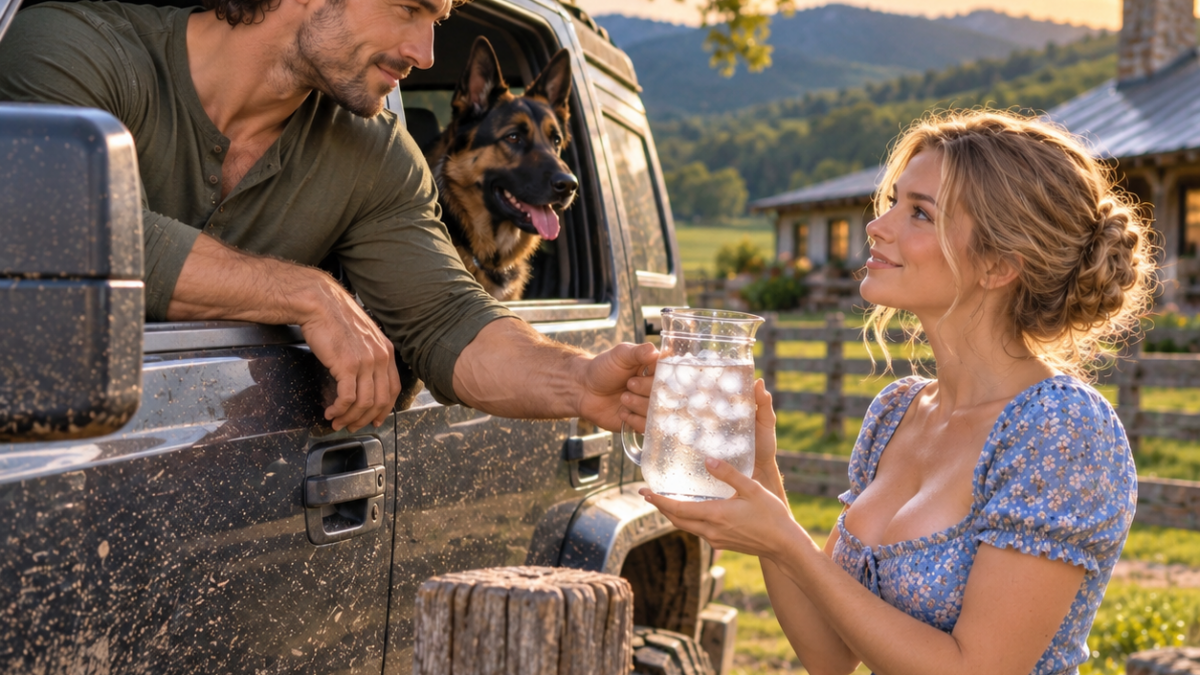
That sounds hard to prove. Arlo looked from Maggie to Wesley, then back to the bacon. Maggie lowered her voice.
He seems underfed. He had breakfast. He says otherwise.
He has no credibility in bacon related matters. Maggie looked down at the dog.
I think you’re living under a dictatorship.
Arlo exhaled through his nose and lowered his head to his paws. Maggie laughed.
Wesley kept washing his hands, though the corner of his mouth gave him away. They ate without much conversation.
The day had work waiting. Near midm morning, a dusty Chevrolet came slowly up the drive. The man who climbed out was lean, gray-haired, and probably close to 70, though he moved like someone who disliked being reminded of it.
He wore faded work pants, a short-sleeve plaid shirt, and a cap carrying the logo of a feed store that had probably closed years ago. Maggie wiped her hands on her jeans.
“Morning, Ray.”
Ray Mercer looked first at the damaged pump house, then at Wesley, then at Arlo beneath the shed.
“Well,” he said.
Storm bring you a dog, too. Maggie glanced toward Wesley.
“Dog came first.”
Ry nodded as though that explained enough. He had driven over to check the place after clearing limbs from his own driveway. His west fence had lost two posts, and one of his smaller sheds had picked up enough wind to move several inches off its blocks.
Nothing catastrophic. Several ranches farther south had taken similar damage.
The conversation stayed mostly practical. Ry knew which county road was passable and which low crossing still held too much water. He had already heard that repair crews were getting backed up.
When Maggie mentioned the pump system, his attention sharpened. Henry would have hated seeing that pump house leaned over like Ray stopped.
Not dramatically, just enough. Maggie looked toward the damaged roof instead of at him.
He hated seeing anything out of square. Ry cleared his throat.
That he did. Wesley noticed the old rocking chair on the porch. Then he had seen it the previous night without giving it much thought.
In daylight, its age showed more clearly. The oak had faded from years of sun. Two brass screws sat slightly crooked through the left armrest where someone had repaired it long ago.
A pale coffee ring remained near the front edge. Nobody had sat in it since Wesley arrived. He kept the observation to himself.
Rey changed the subject and asked whether Maggie still needed him to pick up feed later in the week. She told him no.
then reminded him that she had already finished the bookkeeping for his last month and left the envelope in his mailbox. Rey looked mildly offended.
You didn’t have to do that.
You say that every month. You keep doing it. So do you.
There was affection in the argument, though neither treated it like one. Only after Ry drove away did Wesley understand something the previous day had not shown him.
Maggie’s isolation was not the same thing as being without people.
She belonged here. that mattered.
By late morning, she had called three repair companies. One could not send anyone until the following week. Another did not service that particular well system.
The third, Harker Recovery and Roofing, said they already had a crew in Chase County and could stop by that afternoon. They arrived shortly after 2.
The truck was newer than Wesley’s and considerably cleaner.
The man who stepped out introduced himself as Doug Harker. Another worker remained near the truck while Doug walked around the pump house, took photographs, measured portions of the structure, and asked Maggie a series of questions.
At first, everything sounded ordinary. Then, the estimate began growing.
Doug said most of the pump house framing should be replaced. The roof would have to come off entirely. He talked about moisture, hidden stress, and the possibility that the pressure system itself had been compromised.
Some of those concerns might have been reasonable. What Wesley noticed was the confidence with which Doug treated every uncertainty as a certainty.
What Maggie noticed was that by the third question, Doug had begun answering Wesley instead of her. She asked about salvaging the front framing.
Doug looked at Wesley.
Once something like this twists, you really don’t want to gamble.
Maggie asked whether the pressure tank had been tested. Doug looked at Wesley again.
I’d replace the whole setup while you’re already into it.
Wesley kept his hands in his pockets. He had met men who mistook silence for agreement.
Doug eventually gave Maggie a number large enough to make her eyebrows rise. Not outrageously impossible, just high enough to deserve suspicion.
He said the company could begin as soon as she signed and placed a substantial deposit. Maggie looked at the paperwork.
Wesley finally spoke. Can you leave an itemized estimate? Doug paused.
Sure. Materials and labor separated.
Another pause. We can do that.
Wesley nodded. Nothing more.
Doug left 15 minutes later with no signature. Maggie waited until the truck disappeared down the road before turning toward Wesley. You were very helpful.
I asked one question. Exactly. She held up the estimate.
What do you think? Wesley looked back at the pump house.
If it were my money, I’d get another estimate.
Maggie folded the paperwork once. Then she took out her phone. She called Flint Hills Pump and Farm Supply in Emporia.
The conversation took less than 10 minutes. Maggie described the symptoms, sent a few photographs, and arranged for a technician to look at the system when someone became available.
Based on what they could see remotely, the structure probably did not need to be demolished. Some framing could be repaired.
The pressure issue might be tied to a damaged control component, but no one would know until it was tested. The problem was timing. Storm calls had piled up across the area, even if the diagnosis proved straightforward.
A replacement component and several specific fittings might take days to arrive. Maggie thanked them and ended the call.
She did not look pleased, but she looked better than she had while holding Harker’s estimate.
The rest of the afternoon settled back into physical work. They straightened the lighter fence damage, secured roofing temporarily over the shed, and moved enough water manually to keep the stock tanks from falling behind, while the pump remained unreliable. Arlo spent most of that time beneath the shade, occasionally rising when Wesley changed locations and returning to his place when told.
The dog was useful by being predictable. That was enough. By late afternoon, the sunlight had dried the upper layer of soil, though deeper patches still took a bootprint easily.
Maggie dragged a long hose across the yard toward one of the tanks. Wesley followed with another length coiled over his shoulder.
If that part takes a week, he said, “What are you going to do?”
Maggie kept walking. Same thing I did before you got here. He waited.
She reached the coupling, dropped the hose beside it, and wiped her forehead with the back of her wrist, which is She looked at him as though the answer ought to be obvious. Figure it out. No complaint, no invitation, no attempt to make the problem his.
Wesley looked across the yard toward the leaning pump house, then toward the porch where the old oak rocking chair sat empty in the late light. He said nothing. He pulled his gloves back on.
3 days after the storm, the county road had dried enough that Wesley no longer needed weather as an excuse to stay. The low places still held muddy water, and the grass along the ditches bent in the direction the wind had driven it, but traffic had begun moving normally again. A delivery truck passed Cedar Draw before breakfast.
Later, a utility pickup went by without slowing. The world beyond the ranch had opened back up.
Wesley noticed he simply did not leave. The pump house remained braced and usable only in part. The technician from Flint Hills Pump and Farm Supply had confirmed what Maggie had hoped.
Most of the structure could be repaired, and the pressure problem did not require replacing the entire system. The less convenient news was that one control component was not in stock, and several fittings had to come from a supplier farther east. They could make do in the meantime.
Making do became the shape of the next few days. Maggie woke early and made coffee strong enough to strip paint from farm equipment.
Wesley stopped pretending he liked it after the second morning, but he drank it anyway. She fed cattle while he handled sections of framing around the pump house that did not require a licensed technician. They moved temporary hoses, reinforced a section of shed roof, and spent an entire afternoon arguing with a warped piece of lumber that had apparently decided the storm was not finished, causing trouble.
Arlo developed his own routine. At first, every movement in the house had brought his head up.
When Maggie crossed the kitchen, he watched. When she opened the back door, he stood.
If Wesley picked up keys, the dog was ready before the sound had finished. By the third evening, Arlo had chosen a place near the kitchen door where cool air moved across the floor. Maggie stepped around him without thinking.
He no longer moved. That small change was easier to notice than either of them would have admitted.
So were Wesley’s habits.
Nothing he owned stayed unpacked longer than necessary. His clothes were folded into compact bundles and returned to the duffel as soon as they were clean. A toothbrush appeared beside the bathroom sink in the morning and disappeared before noon.
His shaving kit never remained open. Even the charger for his phone was wrapped and put away when he was not using it. The guest room showed almost no evidence that anyone had slept there.
Maggie noticed because she had spent years living in a house where objects accumulated meaning simply by remaining in place. Wesley seemed to believe permanence began with something as small as leaving a shirt on the back of a chair.
She did not ask him about it. He did not ask why the rocking chair on the porch was always empty.
They worked around each other’s silences.
On the fourth morning, Wesley came into the kitchen already dressed to leave. Maggie was standing at the counter with a cup of coffee in one hand and a list of feed orders in the other.
Arlo waited near the back door. Wesley had checked the pump supply order before breakfast. The replacement component had arrived in Emporia earlier than expected along with most of the fittings they needed.
There were also a few pieces of lumber, hardware, and sealant he wanted to pick up while he was in town.
I’m heading down to Emporia.
Maggie looked up for the parts and a few other things. She nodded.
Nothing about the answer was strange. Then she followed him outside.
The morning was already warming, but a breeze still moved across the pasture. Wesley opened the truck, lifted his duffel into the rear cab, then set the backpack beside it. Maggie stopped walking.
He did not notice. To Wesley, packing before driving somewhere was no different from checking the fuel gauge or making sure Arlo had water.
The movement had become automatic long before cedar draw. Arlo waited for the command, then climbed into the truck. Maggie watched the dog settle behind the passenger seat.
Everything Wesley owned that mattered had gone with him. Again, she looked toward the pump house.
The temporary braces were still in place. The loose roofing had been secured.
Nothing urgent required him that morning except the trip itself. He closed the truck door.
Should be back before dark. Maggie heard the words.
Some part of her did not trust them. She raised one hand. Drive safe.
Wesley pulled out of the yard and turned toward the county road. The diesel engine faded slowly.
Maggie remained where she was until the truck disappeared behind the rise. Then she went back to work.
There was nothing else to do. By 9, she had moved two hose lines and checked the north pasture.
At 10:00, she answered an email from the feed supplier. Before noon, she carried a load of towels from the laundry room and found herself standing in the guest room doorway. The bed was made.
The dresser was empty. The water glass from the night before was gone.
Nothing had been left behind by accident. She crossed the hall and went into the kitchen.
Arlo’s bowl was not beside the door.
Wesley’s coffee mug sat upside down on the drying rack.
The house did not feel newly empty. That was worse. It felt familiar.
Maggie took the mug from the rack, dried it with a towel that did not need to be used, then put it in the cabinet. The motion irritated her.
So did the quiet. She went outside.
The old oak rocking chair sat where it always did, near the far end of the porch, angled slightly toward the pasture. The two brass screws in the left arm caught sunlight.
The coffee ring on the armrest had faded further, but had never disappeared. Her father had sat there most mornings for almost 30 years. Henry Ellison had not been a man who filled a room with conversation.
He listened to farm reports on the radio, complained about machinery, and drank his coffee too hot. When Maggie was younger, she sometimes thought he could spend an entire morning with another person and say six words.
Later, she understood that he considered presence a language of its own. Before he got sick, Maggie had been close to leaving Cedar Draw.
There had been a man then, Evan. He had not been cruel, and that somehow made the end harder to resent. He had a good job in Kansas City, a small house under contract, and a reasonable idea of what their future could look like.
His plan had only required one thing. Cedar Draw had to become something they visited instead of somewhere they lived. At first, Maggie had tried to imagine it.
She imagined selling the cattle, hiring someone to lease the ground, driving back on weekends.
Then, Henry’s health began to fail.
The decision stopped being theoretical. Evan never told her she had to choose between him and her father.
He did not need to. Each conversation carried the same quiet arithmetic. His job was in the city.
Her life was not. Maggie stayed.
Evan eventually stopped asking when she would come. Neither of them became a villain.
They simply reached the part where love was no longer enough to make two different lives occupy the same place. After that, Henry required more help than more. The years narrowed.
Dates were cancelled because a heer was sick. Because a storm had taken down fencing.
Because her father had an appointment in Emporia. Because some days leaving the ranch for dinner felt like one more obligation than she could carry.
Eventually, people stopped asking. Someone in Cottonwood Falls once joked that Maggie had married Cedar Draw instead.
She laughed. People kept using the line. It became convenient, much easier than explaining that being needed and being chosen were not always the same thing.
Maggie looked at her father’s chair.
She did not sit.
By early afternoon, she had convinced herself Wesley’s absence meant nothing.
He had said he was going to Emporia. He had said he would be back before dark. The problem was not what Wesley had done.

