“Just a Nurse,” They Said — Then a Marine General Exposed the Hero They Ignored – Part 5
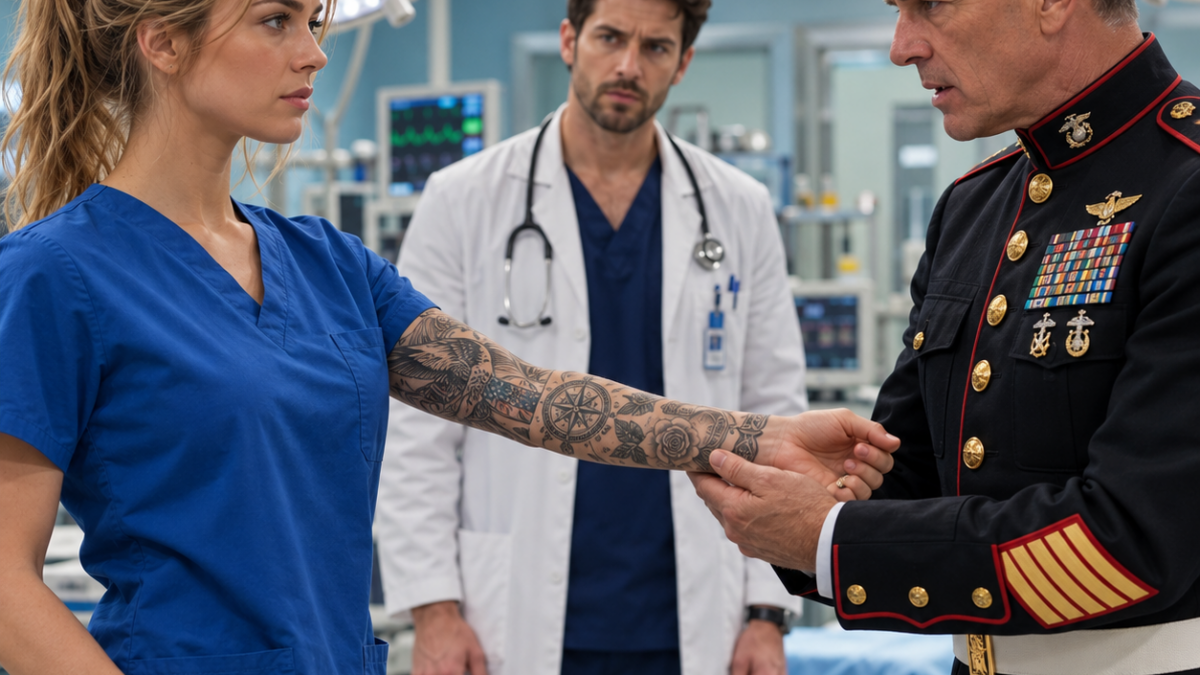
That evening, Sarah stood in the emergency department she now oversaw, watching the organized chaos of a Friday night shift. Ambulances arriving, nurses triaging patients, residents managing cases under her supervision.
Martinez found her there.
“Conel wanted me to give you this,” he said, handing her an envelope.
“Inside was a handwritten letter on military stationery.”
Sarah read it twice, her throat tight.
“Sergeant Bennett, you saved my life, but more importantly, you reminded me why we serve, not for glory or recognition, but because some things matter more than our own comfort or safety.
” The research I was doing, the protocols you helped protect will save countless lives in combat zones around the world.
You didn’t just save one colonel.
You saved every soldier who will benefit from that work.
I’m recommending you for additional recognition at the Pentagon.
I’m also making sure your story reaches the people who train our combat medics so they understand what it means to have moral courage under fire.
You left the military, but the military will never leave you. You carry it in every decision you make, every stand you take.
That’s not a burden.
It’s a superpower.
Thank you for your service. All of it. Colonel James Mitchell.
Sarah folded the letter carefully and slipped it into her pocket. Through the emergency department windows, she could see Crescent Falls at night. City lights stretching toward the horizon.
Lives being lived in homes and streets and buildings. All of them potential patients who might one day need this hospital. Her hospital now.
Her responsibility. Her chance to build something better. Amy appeared at her elbow.
Director Bennett, we’ve got a multi-vehicle collision coming in.
ETA, 2 minutes. You want to take lead? Sarah felt the familiar surge of adrenaline, the sharpening of focus that came before controlled chaos.
But this time, when she walked toward the trauma bay, she wasn’t the invisible nurse hoping to stay unnoticed.
She was the director, the leader, the person who’d fought her way from the bottom to the top and refused to become what she’d defeated.
Let’s show them how it’s done, Sarah said.
The ambulances arrived right on schedule. Sarah directed her team with calm authority, coordinating care across multiple patients, making decisions that saved lives and prevented complications. The residents watched her work with respect.
The nurses followed her lead without hesitation. Even the attending physicians deferred to her judgment on complex trauma cases.
everything she’d fought for, everything she’d almost lost, everything she’d proven she deserved.
But as the last patient was stabilized and transferred to surgery, as Sarah was stripping off bloodied gloves and documenting the cases, her phone buzzed with a message from an unknown number. She almost ignored it, almost deleted it without reading. But something made her open it.
Something made the message was brief. Congratulations on your promotion, Director Bennett. The colonel survived.
The conspiracy was exposed. and you won.
But did you ever wonder why Patricia was so easy to catch? Why the evidence was so convenient?
Why everything wrapped up so neatly? Some of us are still watching. Some of us are still waiting.
And the next move is going to be much harder to see coming.
Sarah’s blood turned to ice as she read it again.
Then again, she immediately called Morse, but it went to voicemail. She tried Martinez. Same result.
The number that sent the message was already disconnected when she tried to call back. Sarah stood alone in the trauma bay, metal still pinned to her collar, director title freshly minted, surrounded by the evidence of her victory.
And for the first time since this whole nightmare started, she wondered if she’d actually won anything at all, or if she’d just survived the opening move in a much longer game.
Sarah stared at the threatening message for exactly 10 seconds before her training overrode her fear.
She screenshotted it, forwarded it to Mors’ secure email, then locked her phone, and walked directly to hospital security.
I need the surveillance footage from the emergency department for the last 2 hours, she told the head of security, a former cop named Davis.
And I need every phone that accessed the hospital’s internal network during my ceremony.
Someone sent me a threat and they’re either inside this building or they’ve breached our systems.
Davis didn’t question her authority.
Within 20 minutes, Sarah was reviewing footage alongside federal agents who’d been stationed at the hospital.
They tracked every person who’d entered the building, cross-referenced phone signals, analyzed network access logs.
The trace led to a burner phone that had connected briefly to the hospital’s guest Wi-Fi, sending one message before disconnecting permanently.
But the physical location data pointed to somewhere inside Riverside Memorial during the transmission.
“Whoever sent this was here,” Morse said when he arrived 30 minutes later, his expression grim.
watching you, testing to see if you’d panic.
“I’m not panicking,” Sarah said.
“I’m hunting.”
They found the answer in security footage from the conference room where the ceremony had taken place.
A figure in maintenance coveralls had entered during the event, ostensibly to check the air conditioning, but the angle of their body, the way they’d positioned themselves near the door.
They’d been watching, listening.
The maintenance worker had signed in as Jay Torres, but when security checked the actual maintenance roster, no one by that name was scheduled for that shift. They wanted you to know, Martinez said, reviewing the footage.
Wanted you to understand this isn’t over.
It’s psychological warfare.
Sarah thought about Patricia, about the convenient evidence, about how neatly everything had wrapped up. They sacrificed Patricia and the others, used them as decoys while the real operation stayed hidden.
That’s the theory we’re working on now.
Morse confirmed, “The pharmaceutical companies we arrested were small players.
The real money, the real power, we haven’t found it yet.
And whoever’s running this operation knows you’re the one person who can’t be bought or scared into silence.”
So what do they want? Morse met her eyes. They want you to make a mistake, to get paranoid, to overreach, to give them a reason to discredit you.
They couldn’t destroy you through hallway, couldn’t kill you through direct attack.
So now they’re trying to make you destroy yourself.
Sarah felt something click into place.
The message wasn’t just a threat, it was bait.
They wanted her afraid. Wanted her looking over her shoulder.
Wanted her to become the paranoid conspiracy theorist instead of the credible director who’d exposed corruption.
Then I won’t give them what they want,” she said.
Over the next week, Sarah did exactly what the messages author didn’t expect.
She ignored the threat and focused on her actual job. She implemented new trauma protocols. She held staff meetings where nurses and residents could voice concerns without fear.
She worked with the hospital board to create independent oversight committees. And she waited. The break came from an unexpected source.
Holloway, now teaching residents about clinical humility and collaborative care, noticed something odd in the hospital’s supply chain records.
Certain medications were being ordered in quantities that didn’t match usage patterns.
“I almost missed it,” he told Sarah when he brought her the data.
“But when you spend years micromanaging every aspect of a department, you notice when numbers don’t add up.”
Sarah reviewed the records and saw what Holloway had found. Someone was systematically diverting controlled substances. Not enough to trigger automatic alerts, but consistent enough to indicate organized theft.
She brought the evidence to Morse, who brought in the DEA. Within 48 hours, they traced the diversion to a network that connected back to the same pharmaceutical interest that had targeted Colonel Mitchell. The scheme was elegant and massive.
steal medications from hospitals, create artificial shortages, drive up prices, and profit from the chaos.
Patricia’s involvement had been real, but minor.
The assassination attempt on the colonel had been about silencing his research that could have exposed the broader fraud. And the person coordinating it all from inside Riverside Memorial was someone Sarah had never suspected. Dr.
Sandra Michaels, the board chair who’d apologized so eloquently, who’d offered Sarah the directorship, who’d positioned herself as the champion of reform.
“She played us perfectly,” Moore said during the arrest briefing.
Sacrificed her subordinates, positioned herself as the solution, and used the investigation to consolidate power while we were looking elsewhere. Sarah felt sick.
She’d trusted Michaels, had believed the apology, the commitment to change.
The message you received, Morse continued, we traced it to her personal phone.
She sent it to gauge your reaction to see if you’d become unstable enough to discredit.
When you didn’t take the bait, she probably realized you were more dangerous than she’d calculated.
The arrest happened publicly in the hospital lobby during morning rounds. Federal agents walked Sandra Michaels out in handcuffs while staff and patients watched in stunned silence.
The evidence was overwhelming. communication records, financial transfers, testimony from co-conspirators trying to reduce their sentences.
The board chair who’d promised accountability was led away facing charges that would mean life in prison.
Sarah watched from the emergency department entrance, feeling not triumph, but exhaustion. How many layers did corruption have?
How many times would she have to fight the same battle? You okay?
Amy asked, appearing at her side.
I don’t know, Sarah admitted.
I thought we’d won.
Thought the ceremony and the reforms meant something. Now I find out the person who gave me this job was using me as cover for continued criminal activity.
Amy was quiet for a moment.
Then she said, “But we did win.
Look around.”
Sarah looked. She saw nurses confidently voicing concerns about patient care.
Saw residents asking questions instead of blindly following orders. Saw a culture that had begun shifting toward transparency and collaboration.
Michaels gave you the directorship to control you,” Amy continued.
“But you actually did the job.
You made real changes.
You built something she couldn’t manipulate or destroy.
That’s what matters.”
The hospital board, now down to emergency leadership, met with Sarah that afternoon. The interim chair was Dr.
Robert Hayes, a surgeon who’d been vocal about supporting reforms.
“Miss Bennett, we owe you another apology,” he began.
Stop apologizing and start fixing the system,” Sarah interrupted.
“I don’t want apologies.
I want structural changes that make it impossible for one person to have the kind of power Michael’s had.
I want transparency, oversight, and consequences for people who abuse their positions.”
Hayes nodded slowly.
“Then help us build that.
Your directorship stands.
In fact, we’d like to expand it.
Director of quality and safety for the entire hospital, not just trauma.
you’d have authority to investigate any concerns anywhere in the institution.
Sarah thought about accepting another promotion from a board that had failed twice to protect its patients. Thought about walking away from all of it, finding somewhere quieter, somewhere safer.
But she also thought about the message Amy had shown her that morning, a thank you note from the young woman who’d survived the mass casualty event because Sarah had pushed for the FAST exam.
The patient Holloway had almost killed through stubbornness and pride. That woman was alive because Sarah had refused to stay quiet.
How many others could benefit from someone who wouldn’t back down?
I’ll take the position, Sarah said.
On one condition, every decision I make, every change I implement gets published in monthly public reports. No more closed door deals, no more hidden corruption, complete transparency.
Agreed, Hayes said.
3 months later, Sarah stood in the same conference room where she’d received her medal.
But this time, the gathering was different. Hospital staff from every department filled the space.
Nurses, physicians, technicians, administrators, even housekeeping and cafeteria workers.
“We’re here to launch the Riverside Accountability Initiative,” Sarah said, addressing the crowd.
“Every employee, regardless of position, will have direct access to report safety concerns without fear of retaliation.
Every complaint will be investigated by an independent committee.
Every outcome will be published publicly.”
She paused, looking at the faces in front of her. Some skeptical, some hopeful, all of them watching to see if this would be real change or just another empty promise.
I know trust has to be earned, Sarah continued.
I know words are easy and action is hard, but I also know what it feels like to be silenced, to be dismissed, to be told you don’t matter.
I will not let that happen to anyone else in this hospital.
That’s not a promise.
It’s a commitment I’m making in front of all of you, and you have the power to hold me to it.”
After the meeting, Sarah found Holloway waiting in the hallway. He looked healthier now, the color back in his face, though he still moved carefully.
“That was a good speech,” he said.
“It wasn’t a speech.
It was a declaration.”
Holloway smiled. Not the arrogant smirk she remembered, but something more genuine.
“I’m teaching a session next week on the danger of medical hierarchy and ego.
I’d like you to co-present.
Show the residents what collaborative care actually looks like. Sarah considered refusing, then realized this was exactly the kind of partnership that could change the culture. A nurse and a doctor, former enemies, modeling mutual respect.
I’ll be there, she said.
That evening, Sarah received one final message, this time from Colonel Mitchell.
Heard about Michael’s?
You caught another one. When are you going to run out of conspiracies to expose?
She typed back, “Hopefully soon.
I’d like to just practice medicine for a while.”
The response came immediately.
You’re doing more than practicing medicine.
You’re showing people what integrity looks like under pressure.
That matters more than you know.
Sarah set her phone down and looked around her office, the director’s office, that she’d earned through skill and courage, not politics or connections.
On her desk sat the metal Mitchell had given her.
On the wall hung a framed copy of Amy’s petition with all 43 signatures.
And in her email inbox was a message from a nursing student who’d heard her story and wanted to know how to stand up to authority without losing her career.
Sarah began typing a response. And as she wrote, she realized something.
The fight wasn’t over.
It would probably never be over. There would always be people who prioritized profit over patience, ego over expertise, power over principle. But there would also always be people willing to stand against them.
People like Amy, like Martinez, like the 43 who’d signed their names to demand better.
Like Holloway, learning to be more than his worst impulses.
Like every nurse who’d ever been told to stay in their lane and had the courage to step out of it anyway.
Sarah had spent years trying to be invisible, trying to escape her past, trying to avoid conflict. And in the end, it was visibility, the willingness to be seen, to be challenged, to be targeted, that had given her real power.
Not the power to hide, the power to change things. She finished the email to the student and hit send.
Then she packed up her things and headed home, walking through Riverside Memorial’s hallways with her head up and her shoulders back.
The hospital was different now. Not perfect. It would never be perfect, but better, safer, more honest.
And if threats came, if conspiracies emerged, if someone tried to drag her back into the shadows, well, she’d already proven she knew how to fight in the light.
Sarah Bennett had been underestimated her entire career, had been dismissed, silenced, nearly destroyed.
But she’d also been forged in places where weakness meant death, and strength meant keeping someone alive for one more minute, one more hour, one more day.
They’d never see her coming again.
And that was exactly how she wanted