“Show Me, Then”—They Mocked the Quiet Auditor Until Her One Shot Exposed Harlan’s Lie – Part 4
That was a separate matter from Harlland’s misconduct.
It did not cancel Harlland’s misconduct, but it was also not nothing.
You understand I have to include this in the record.
Clare said, “I know it will complicate the formal finding.
I know that too.
Harlland’s legal team is going to use it.
They’re going to argue that the audit was itself the product of data manipulation and that everything downstream is tainted by the circumstances of how it was initiated.
Mara nodded. She had clearly thought about this.
The steadiness with which she accepted it suggested she’d been thinking about it for some time.
Can they make that argument stick? She asked.
Not easily, Clare said.
Okafor’s forensic analysis is independent of the audit trigger.
The evidence he documented would exist whether or not the audit was legitimately initiated, but it will slow things down and it gives Harlland’s attorneys something to work with.
She paused.
It also means you’re going to face a formal review.
I know, Mara said for the third time. And then, was I wrong?
Clare thought about the honest answer. used a method that created a complication. She said the goal was right.
The method was technically a violation.
Those two things are both true simultaneously, and I can’t make either of them not true.
That’s not an answer.
I know. Clare stood up.
I need you to write down exactly what you did, when, and why. tonight in full before Okafor files in the morning.
If it’s in the record from your own account rather than discovered later, it’s a disclosure rather than a concealment that matters.
Mara was already reaching for a keyboard. One more thing, Clare said from the doorway. The photograph.
Your mother, did she ever go back to competition? Mara shook her head.
She said the joy had gone out of it. Clare looked at the photograph for a moment. at the medal, at the woman holding it with the uncomplicated pride of someone who had earned something real and knew it.
That’s the part that should be on Harland’s record, she said.
Not just the numbers, he changed. She crossed back to the administrative building through air that had turned properly cold.
The desert finally releasing the day’s heat, wind flags she couldn’t see, still moving in the dark above the range.
Okafor filed the referral at 6:17 the following morning. By 8:00 a. m.
, Harlon had been formally notified of his administrative suspension. His system access was revoked. His instructor credentials were placed under review.
He was required to remain on site pending an initial IG interviews, a condition he apparently tested immediately by attempting to leave in his truck, which resulted in a brief conversation with a federal officer who had arrived with Okafor’s team and had very politely returned him to his quarters.
Clare was not present for any of this.
She was in the administrative building writing the final section of her audit report, which was the cleanest document she had produced in years narrow, precise, supported entirely by physical records and forensic analysis with her supplemental statement attached as an addendum and Mara’s voluntary disclosure filed as a separate exhibit.
She included Mara’s disclosure without characterizing it as exculpatory or condemning.
She described what Mara had done, why Mara had stated she’d done it, and noted that the underlying evidence chain had been independently verified without reliance on the manipulated inventory entry.
The legal determination of what Mara’s action constituted was not Claire’s to make.
Her job was to describe what had happened accurately. Evan Torres appeared in her doorway at 9:15 with his notebook under his arm and the careful expression of someone who has slept badly and is processing a great deal.
They’re interviewing Haron now, he said.
I know. Callaway is sitting in also expected.
He came in and sat down. He did not appear to know exactly what he wanted to say, which was fine because Clare was in the middle of a paragraph and gave him time to find it.
Mara, he said eventually, “Yes, she’s the one who started all of this.
She identified a problem and found an imperfect way to get outside attention on it.”
Clare said, “Whether that decision was right or wrong isn’t simple.
It produced a result that was right.
The method had a cost.”
She looked at him.
People do complicated things when institutions fail to police themselves and they don’t see a clean alternative.
Evan turned his notebook over in his hands. Is that what you did when you left competition instead of fighting? He was not asking it to wound her.
He was asking because he was a 23-year-old who was trying to understand how people navigate situations where none of the available choices are uncomplicated. And he thought she might have a useful answer. What I did was choose the option that felt like integrity in the moment and turned out to be mostly self-p protection.
Clare said, “I told myself walking away from a corrupted record was the principled thing.
Part of it was, but part of it was also that fighting publicly was going to be humiliating and painful and uncertain, and disappearing was none of those things.
And now, now I’m sitting in a federal facility writing a report under both my names,” she said.
So he almost smiled.
“Not quite.
What happens to Mara?”
he said.
That’s above my authority to determine.
She’ll face a review.
The voluntary disclosure helps.
The fact that she didn’t benefit personally helps.
The fact that the underlying evidence is independently valid helps considerably. Clare paused.
I don’t know how it ends for her.
I know she did something that needed doing and used a tool that created complications and that the institution she was trying to protect is better off because she did it. Whether the institution recognizes that is a separate question.
Evan was quiet for a moment. That seems like a bad system.
It’s the system.
Clare said, “The alternative is waiting for bad actors to police themselves, which historically has a poor success rate.”
She went back to the paragraph. The IG interview team requested Clare at 11:00 a. m.
in the main conference room, which had been converted into something resembling a formal proceeding with a recording device, two senior investigators, a legal representative from the contracting authority, and Callaway sitting to one side with the expression of a man who has decided that cooperation is his only viable posture and is finding it uncomfortable. Harlon was not present. His interview had been completed earlier.
Clare did not know what he had said and did not ask. She answered every question completely and in the order the investigators asked them.
She did not volunteer interpretations. She did not editorialize.
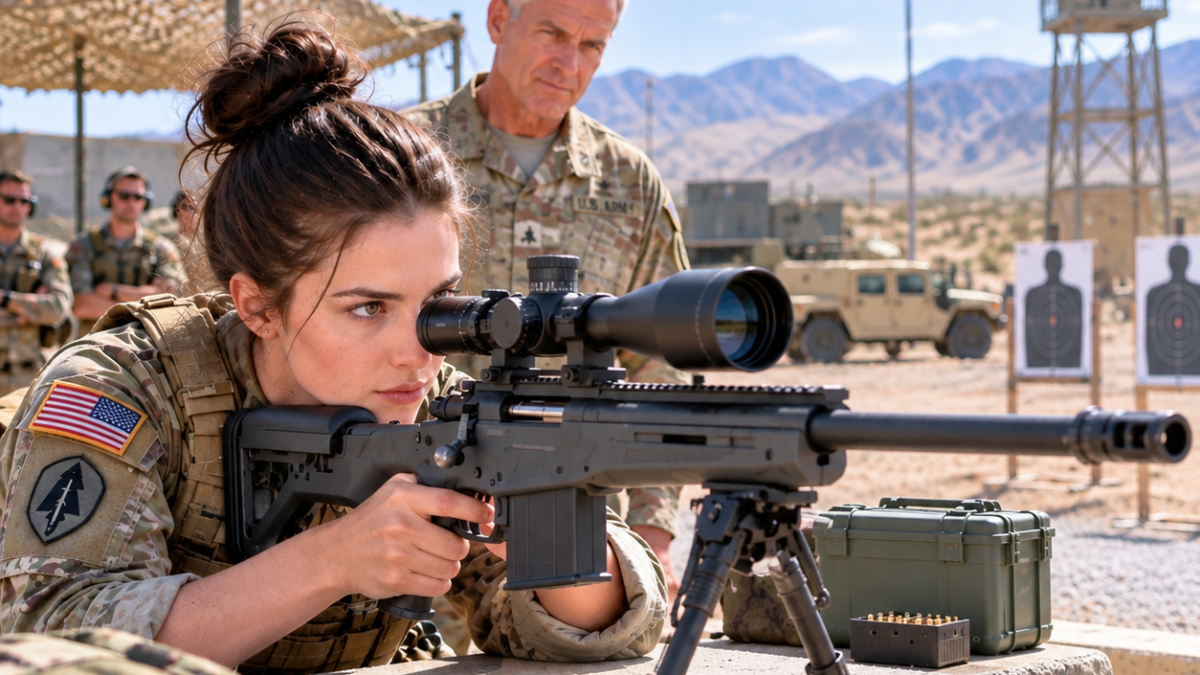
When they asked about the witness plate demonstration, she explained the technical basis for it without framing it as exceptional. It was a reference shot, she said, designed to produce a physical record of wind behavior across the range corridor under documented conditions. When they asked about her professional background, she confirmed both names, the competition history, the record surrender, and the reason for her departure from competitive shooting.
And she answered these questions with the same factual register she applied to the sensor data. One of the investigators, a woman in her 40s named Salace, who had been taking notes throughout with a focused economy that suggested she had heard a great deal of testimony and developed efficient instincts about which parts mattered looked up from her notes at this point. You chose not to disclose your background when you arrived at the facility, Solace said.
Correct. Why?
My background wasn’t relevant to an inventory audit.
Once it became relevance, I had taken the demonstration shot. I disclosed it fully in a supplemental statement filed before I was asked.
You anticipated you’d need to disclose it.
I anticipated Harlon would discover it. I wanted the disclosure to be mine rather than his.
Salah made a note. Do you believe your prior experience influenced your conduct of the audit in ways that exceeded your formal authority?
Clare considered this. It was the question she had been waiting for because it was the honest question.
Yes, she said, “I recognize the the technical anomaly in the demonstration because of knowledge I wouldn’t have had without my prior background.
A standard inventory auditor probably would not have looked at the wind flags during Harlland’s demonstration.”
I did, and that changed the direction of the investigation. She paused.
I don’t believe it invalidates the findings.
The forensic evidence stands independently of how it was initiated, but I think it’s accurate to say that who I was before affected what I was able to see here.”
Solace nodded once, wrote something, and moved on. The interview lasted 2 hours and 14 minutes.
When it ended, Clare walked out into the facility courtyard and stood in the October sun for a moment, letting the warmth do what warmth does after too long in air conditioned rooms. The range was quiet.
The long-distance flags were visible from where she stood, moving in their slow telling patterns, and she watched them the way she always watched them, not consciously reading them so much as letting the information register at the level where it had always registered most naturally. The IG team spent the remainder of the day interviewing facility staff.
Harlland’s access remained revoked.
By afternoon, three of the certifications connected to his most recent demonstration scores had been placed under formal review, which meant students who had been certified based on those scores had been notified that their credentials were under secondary verification. That was the part that was going to be complicated and slow and not particularly satisfying.
43 active professionals whose credentials trace back through Harlland’s instruction.
Some of them had earned everything on their records and would be verified quickly. Some would not. That process would take months and would affect people who had nothing to do with what Harlon had done.
And there was no way to make that clean. Clare had put that in her report, the systemic cost.
Not as an argument against accountability. Accountability was what the systemic cost existed to prevent from compounding, but as an accurate description of what happens when one person in a position of institutional. Authority substitutes performance for truth long enough.
Evan found her at the range fence at 4:30. He stood beside her without speaking for a moment, looking at the long distance firing positions. They cleared me formally, he said, an hour ago.
Signed paperwork. Apology from Callaway. The whole thing.
Good. It felt smaller than I expected.
It usually does. She looked at him.
The clearing isn’t the thing.
The clearing just removes what shouldn’t have been there.
He thought about this.
What’s the thing then?
What you do next? He was quiet. Then you said I should leave the facility.
Find somewhere that didn’t form its first opinion of me in the middle of this.
I said that. Are you going to stay?
Clare looked at the flags. It was a question she had not answered yet, even to herself. Callaway had indicated carefully in the way institutional leaders indicate things they cannot formally offer, that the contracting authorities review of Red Mesa would include an assessment of its training programs future direction.
that Mara Vance’s position, despite the review she was facing, was likely to evolve into something with more formal oversight authority, that there might be a role, consultative or otherwise, for someone with specific expertise in ballistic verification and environmental
reading.
She had not said yes. She had not said no.
I’m going to finish the report, she said.
Then I’m going to drive to Tucson and sleep in a hotel that has a real bed.
Then I’m going to figure out what comes next.
Evan nodded. He looked at the flags for a moment longer. The winds shifted, he said, coming more from the south than it was this morning.
Clare looked at the far markers. He was right. 3 to 4° shift in the dominant direction.
The near flag reading consistent. The far flag showing a slight lag that would create a stack at distance.
Yes, she said.
I’ve been watching them all week, he said.
like you said, not waiting until I’m at the firing line.
Clare looked at him for a moment. She has almost said something about his future, about what she could see in him, the quality of attention, the willingness to be wrong in service of being accurate, the particular combination of technical obsession and observational patience that produced the best long-range shooters and more rarely people who could teach others to become them.
She did not say it because he didn’t need to hear it yet and because she was still figuring out whether she was qualified to offer it.
She just said good. She walked back toward the administrative building. The report was almost done.
One section remained, the formal summary recommendation which she had been drafting in pieces throughout the day and which needed to be a single coherent statement that would survive legal challenge institutional resistance. and the particular kind of erosion that happens when findings get translated through multiple layers of bureaucratic interpretation.
She sat down, opened the document, read the last three paragraphs. Her phone lit up. The message was from Okaphor and it was short.
IG team found something during Harlland’s device review.
His personal laptop emails going back 2 years. You need to see these before you finalize the summary recommendation.
come to the conference room. Clare saved the document without closing it.
She stood, straightened her jacket, and walked down the corridor toward the conference room with the same steady pace she had maintained throughout the last 4 days. Not fast, not slow. The pace of someone who has learned that urgency and haste are not the same thing, and that the most important things usually require you to arrive at them clear-headed.
Okafor was standing outside the conference room door when she reached it.
He was holding a printed page and his expression had done something she hadn’t seen from him before moved out of forensic neutrality into something that was not quite discomfort but was adjacent to it.
He handed her the page without preamble. It was an email chain 2 years old, 43 messages long. The participants were Harlon and a name Clare did not immediately recognize, a regional director at the Federal Training Authorities Certification Oversight Division, whose name appeared on the formal contract renewal documents she had reviewed on her first day.
She read the first message, then the 10th, then the last. The regional director had known about the ammunition substitution before it happened, not after, before. He had not flagged it.
He had not reported it. He had, in the 14th message of the chain, sent Harlon a three-word reply to the question of whether the audit authority had any visibility into individual facility demonstration records.
Not at that level. The investigation she had just completed, the one she thought had been about one man at one facility falsifying one record, was not that. It was the bottom of something considerably larger.
And somewhere above it, two levels up in the contracting chain, someone with the authority to approve the very audit that had sent Clare to Red Mesa had known this was coming and had made a calculation about what it was worth to let it continue. The email chain was 43 messages long, and Clare read all of them standing in the hallway outside the conference room because she did not trust herself to sit down yet.
Regional director Paul Stetner had known about Harlland’s ammunition substitution before the demonstration happened.
Not suspected known, message 14 confirmed it with the three-word reply about audit visibility. Message 22 went further. Ster had actively advised Harland on which demonstration format would minim minimize the likelihood of environmental sensor review.
Message 31 sent 8 days before the demonstration contained a single line that was the clearest thing in the entire chain. The contract renewal goes to committee in November. Make it count.
Make it count. Harlon had falsified a ballistic record to protect his professional reputation.
But the reason the falsification had mattered enough to protect the reason, one disputed score at one Arizona facility had generated three data modification events and a forward threat and a deliberate attempt to frame a federal auditor was that the score had been cited four times in the contract renewal proposal that Stener’s office was preparing for November committee review.
Red Mesa’s federal training contract was worth.
Clare now recalled from the first day’s documents approximately $4.
3 million annually. The renewal proposal included an enhanced scope that would have increased that figure by nearly 60%.
Harlon had not just been protecting his ego.
He had been protecting Stener’s budget justification.
And Stener, who sat two levels above the audit authority that had sent Clare here, had known the foundation of that justification was fabricated and had done nothing about it because the fabrication was useful. Clare handed the printed page back to Okafor.
How many people on the IG team have seen this?
She said, “Myself, Solace, and the lead investigator.
We pulled it approximately 40 minutes ago during the device review. Has anyone contacted Stener?
Not yet. That determination is above my authority.
Above mine, too, Clare said. But my summary recommendation needs to reflect that the certification irregularities at this facility are connected to a contract renewal process that involves a federal official with oversight authority over the audit that investigated those irregularities. She looked at Okafor.
I can’t write a clean recommendation that stops at Harland.
No, Okaffor agreed.
You can’t.
She went back to the borrowed office and opened the document and deleted the summary recommendation section she had spent the day drafting. She sat in front of the blank space for approximately 4 minutes, which was longer than she usually needed.
And then she began writing a different version. This one was longer. It named Stetner by title and by the specific content of his correspondence.
It described the connection between the falsified demonstration record and the contract renewal proposal.
It noted that the audit authority which had assigned Clare to Red Mesa sat within Stetner’s organizational chain and that this created a structural question about whether the audit itself had been anticipated and if so whether any aspect of Clare’s assignment had been shaped to produce a particular outcome.
She did
not know the answer to that last question. She said so explicitly in the report.
Because honest uncertainty is not a weakness in a formal finding, and pretending to know things you don’t know is how these situations compound.
What she did know and said clearly was that the evidence chain was intact, independently verified, and did not depend on any single witness whose credibility was vulnerable to challenge.
The forensic record existed whether Stener fell or survived, whether Harland cooperated or fought, whether Mara’s disclosure complicated things or resolved them cleanly.
The evidence was the thing that couldn’t be made to disappear.
She submitted the revised summary recommendation to Okapor’s team at 11:40 p.
m. Then she closed the laptop and drove to Tucson and slept in a hotel bed for 7 hours without dreaming about anything she could remember.
The next 3 weeks happened the way institutional consequences usually happen, not with dramatic swiftness, but with the grinding, unglamorous momentum of formal processes that move slowly and land hard.
Stener was placed on administrative leave within 48 hours of the IG team’s preliminary report reaching the inspector general’s office.
The speed of it surprised people who expected these things to take months.
What they didn’t know and what Clare learned from her contracting supervisor in a brief phone call was that the email chain had not been a surprise to everyone.
Two other investigators had been building a separate case involving Stener’s office and three other facility contracts, and Clare’s finding had provided the specific documentary evidence that connected a pattern of behavior to a specific act.
She had not walked into a contained situation. She had found the end of a thread that other people had been pulling from a different direction.
That was the thing about evidence.
It didn’t respect the boundaries of the investigation that discovered it.
Harlland’s administrative suspension converted to termination 14 days after the IG referral.
The certification review that followed was extensive, careful, and as Clare had predicted to Evan Slow. 41 of the 43 flagged certifications ultimately survived secondary verification.
Two did not. Those two individuals were notified, their credentials suspended pending re-evaluation, and both of them appealed.
One appeal was resolved within six weeks. The other was still pending at the point where Clare stopped tracking it because tracking it was no longer her job.
Mara Vance’s formal review concluded with a finding that her modification of the inventory record had constituted unauthorized access to a federal system, a finding that carried a formal reprimand and a 60-day suspension without pay.
The same finding noted that her voluntary disclosure, the quality of her cooperation with the investigation, and the fact that her action had produced no personal benefit were significant mitigating factors. Her employment at Red Mesa was retained.