Ten Experts Failed The Billionaire’s 1968 GTO—Then A Broke Single Dad Fixed It With Scrap Metal – Part 5
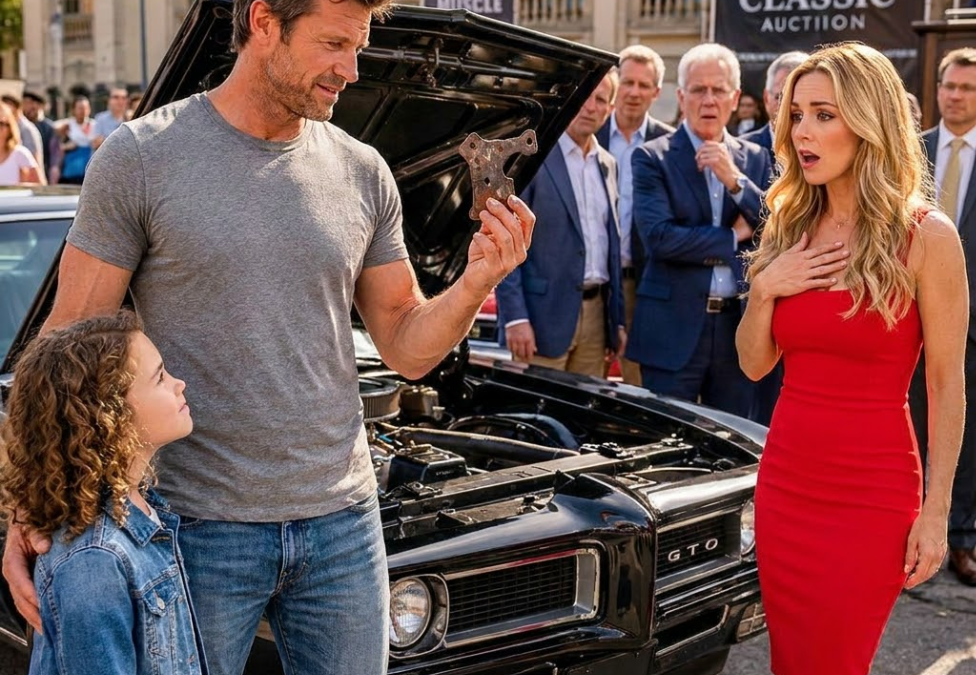
She thought about what it had taken for him to walk through the gate of this property with a battered toolbox and $12 in scrap metal, knowing what he knew about himself and what the world had been told about him and ask for 20 minutes. She thought was not a small thing. That was in fact a very large thing and it deserved to be recognized as such.
She opened her laptop and started drafting a formal letter of support for the engineering board review. The review took 73 days.
During those 73 days, the restoration division’s new building was completed and fitted out.
Mason hired four people, two junior technicians, one experienced restoration specialist named Diane, who had 20 years in the field and had heard about the position through Paulo, who had joined the testing division, and one administrative coordinator who turned out to be the most organizationally effective person Natalie had seen in a
professional context since her father’s old office manager.
The independent testing protocols that Mason designed were reviewed by Sharon’s team for procedural integrity and approved by three external specialists.
The first three vehicles came in for testing in the second week of November. The Callaway contract work began in earnest in December. Regginald Callaway turned out to be a demanding client in the ways that were productive and not in the ways that were destructive.
He had specific standards and communicated them clearly and did not change them arbitrarily, which was in Natalie’s experience the difference between a difficult client and a bad one.
His project manager made the trip to the facility twice in the first month and spent both visits in the testing bay with Mason going through the protocols with the thoroughess of someone who had been burned by inadequate certification before and intended not to be again.
your guy,” the project manager said to Natalie on his second visit, standing at the edge of the bay, watching Mason walk two of the junior technicians through a fuel system integrity check.
“He’s the real thing.”
“I know,” she said.
“Where did you find him?”
He drove past the building and heard an engine. The project manager looked at her to see if she was joking.
She wasn’t.
He turned back to the bay.
“Huh?”
he said. Uh, the letter from the engineering board arrived on a Thursday afternoon in January.
Mason was under a 1971 Chevel when Diane brought it to the workshop. He came out from under the car, wiped his hands, and read it standing at the bench.
Diane and the two junior technicians had the careful awareness of people who understand something significant is happening and have collectively decided to find other things to look at. He read it twice.
Then he set it on the bench and went back under the chvel and finished what he’d been doing, which took about 20 minutes.
When he came back out, he picked up the letter and went to find Natalie. She was in the showroom in the middle of a conversation with a private collector about a potential intake.
She read Mason’s face when he appeared in the doorway, the particular quality of stillness that meant something had resolved, and said to the collector, “Excuse me for one moment.”
and came to the door. He handed her the letter. She read it.
The review had found based on new evidence that the original complaint against Mason Carter had been filed in bad faith and contained materially false statements. The complaint was formally expuned from his record. His engineering license was reinstated with full standing retroactive to the date of the original suspension.
She looked up. He was not crying. He was doing the thing he did that controlled stillness, but his jaw was set in a way that told her what the stillness was costing.
6 years Riley had been one year old.
He’d been building something and it had been taken.
And he’d spent 6 years working at whatever level he could reach, supporting his daughter, borrowing a bay from a tire shop, driving past buildings where engines spoke to him through walls.
“Congratulations,” she said.
And then because it was true and he deserved to hear it, this was always yours. They just gave it back.
He took the letter back. He nodded once.
He said, “I’m going to call Riley’s school and let her teacher know.
Riley’s been He stopped.
Started again.
She’s been worried.
She’s seven and she understands more than 7-year-olds are supposed to understand.
Go call,” Natalie said.
“Take as long as you need.”
He went outside. She watched through the showroom window as he stood in the parking lot with his phone to his ear and she saw the moment the teacher must have put Riley on. Something changed in his posture.
A fractional shift.
The particular way a person’s body changes when they’re talking to the person they love most.
She turned back to the collector who had the good grace to be looking at a brochure. The plaque went up on a Friday in February.
It had been Natalie’s idea and she’d expected Mason to resist it.
He had the specific discomfort of someone who had spent a long time being invisible and had not fully recalibrated to a world in which being seen was not also being exposed.
But when she showed him the text, he’d read it and been quiet for a moment and then said, “Okay.”
And that was that.
They mounted it on the wall of the showroom beside the GTO’s display space.
Simple brushed steel, the lettering clean and without ornamentation. 1.
94 million or in failed repairs, $12 in scrap metal. One single father who chose to listen.
The GTO stood beneath it in morning light carousel red deepened by the careful cleaning and the compound work Greg had done on the paint in his spare hours.
Not a restoration to showroom new, they’d all agreed on that, but a preservation of what it actually was.
The chrome still had its pitting. The paint still had 58 years in it. The car looked like time, like use, like something that had been through things and was still here, and that seemed more honest than making it look like it had just left the factory.
The first time Riley saw the plaque, she stood in front of it for a long time. Mason stood behind her with his hands in his pockets, watching her read it.
“That’s about you,” she said.
“Yeah.”
“The $12?”
She turned around to look at him.
“That was the scrap metal you brought?”
“Yeah.”
She looked at the plaque again, then at the car.
She was 7 and a half now, and she had the quality of attention that some kids have where they’re thinking about more than they’re saying.
“Was it scary?”
she said.
“Going in there when you didn’t know if they’d let you.”
Mason thought about it a little, he said.
“Yeah, but you went anyway.”
“I knew what was wrong with the car,” he said.
“That seemed more important than being scared.”
Riley considered this with the seriousness it deserved.
Then she nodded like someone filing something away for later and went to look at the car up close, pressing her face near the driver’s window to see inside.
Natalie was across the showroom and had heard all of this without intending to. She looked at the plaque, then at the car, then at Mason watching his daughter. She thought about what her father had written.
I always thought that was a metaphor for something, but I could never work out for what. She thought she understood it now.
Not completely.
She wasn’t sure it was the kind of thing you ever understood completely, but enough to work with.
You listen to something not because it’s convenient or because the timing is right or because someone has handed you a diagnostic report that tells you where to look.
You listen because the thing in front of you is real and it deserves that much from you and because the truth of what’s wrong with it has been there the whole time, available to anyone willing to be quiet enough to hear it.
The money doesn’t buy you that.
The credentials don’t buy you that.
What buys you that is just willingness. The decision to actually pay attention. It sounds simple.
It isn’t simple.
There are thousand pressures at any given moment pushing you toward assumption, toward precedent, toward the comfort of what you already know. Fighting those pressures is not natural.
It costs something every time. Most people faced with that cost often enough stop paying it.
They replace listening with telling and they call it expertise. And in a lot of cases, nobody notices the difference until the car that was supposed to run has been failing for 11 months and $2 million.
And the solution turns out to be something so fundamental it embarrasses everyone. Mason Carter had never stopped paying that cost.
He’d paid it when it earned him nothing and when it cost him everything, and when the person standing across from him was laughing.
That was the thing Natalie had seen in him from the first morning. Not talent, not cleverness, not the particular brand of competence that performs well under observation.
Something harder to name and harder to fake.
A quality of honesty so deep it extended to the way he heard a sick engine from a block away and couldn’t pretend he hadn’t.
She thought about her father writing those words in a letter he didn’t know if she’d ever read.
She thought about the recording, his voice measured and slightly horsearo, saying, “The car will run when someone is willing to listen to it.
” It had taken 58 years and $2 million and a man with $12 in scrap metal.
But he’d been right.
In March, the restoration division took in its eighth vehicle, a 1969 Dodge Charger that arrived on a flatbed from a collector in Colorado non-running with a history of failed restoration attempts that felt to everyone in the workshop pleasantly familiar. Mason walked around it twice the way he did, stood at the front and listened to it not running, which had stopped being strange to the junior technicians by the third week. Then he put his hand flat on the hood and left it there for a moment.
Diane, watching from the bay entrance, said to one of the technicians quietly, “He’s reading it.
” “Reading what?”
She thought about how to explain it.
“Whatever it has to say,” she said finally and went back to her workbench.
Mason lifted his hand from the hood. He looked at the charger for another moment, and something in his face had the quality of a conversation that had just begun.
Then he turned to his team, Diane and the two technicians and Paulo, who had come over from the testing bay for the intake, and said, “Okay, let’s pull the engine documentation and see what we’ve got.
” They went to work.
In the showroom, visible through the open bay door, the GTO sat under its plaque with its engine quiet and its problems resolved.
58 years of history in its paint and its chrome, and the small, dense component in its ignition system that bore, in the precise tolerances of its machine surfaces, the particular signature of a father’s unfinished work, and a stranger’s willingness to finish it.
The morning light moved across the showroom floor and touched the red of the car and kept moving the way light does indifferent to everything it illuminates and illuminating it anyway. Outside spring was making its way toward the city in the slow unannounced way that seasons always do. Not arriving so much as accumulating degree by degree until one morning you go out to your truck and the air is different and you realize the change has already happened while you were paying attention to other things.
Mason Carter had been paying attention to other things his whole life. That was, depending on how you looked at it, either the reason his life had gone the way it had or the reason he was here. He had decided it was the reason he was here.
He picked up his clipboard and went to find out what the Charger had to say.