The Nurse Was Called a “Relic” — Then Navy SEALs Arrived Calling Her “Captain” – Part 1
The Nurse Was Called a “Relic” — Then Navy SEALs Arrived Calling Her “Captain”
The parking lot went black before anyone understood what was happening.
Seven tactical SUVs cut their headlights simultaneously, rolling to a stop in a coordinated arc around the emergency entrance of Harrow Creek General. Silent, deliberate, like something out of a classified operation. Doors opened.
Men in uniform stepped onto the wet asphalt. Not police, not federal agents. United States Navy.
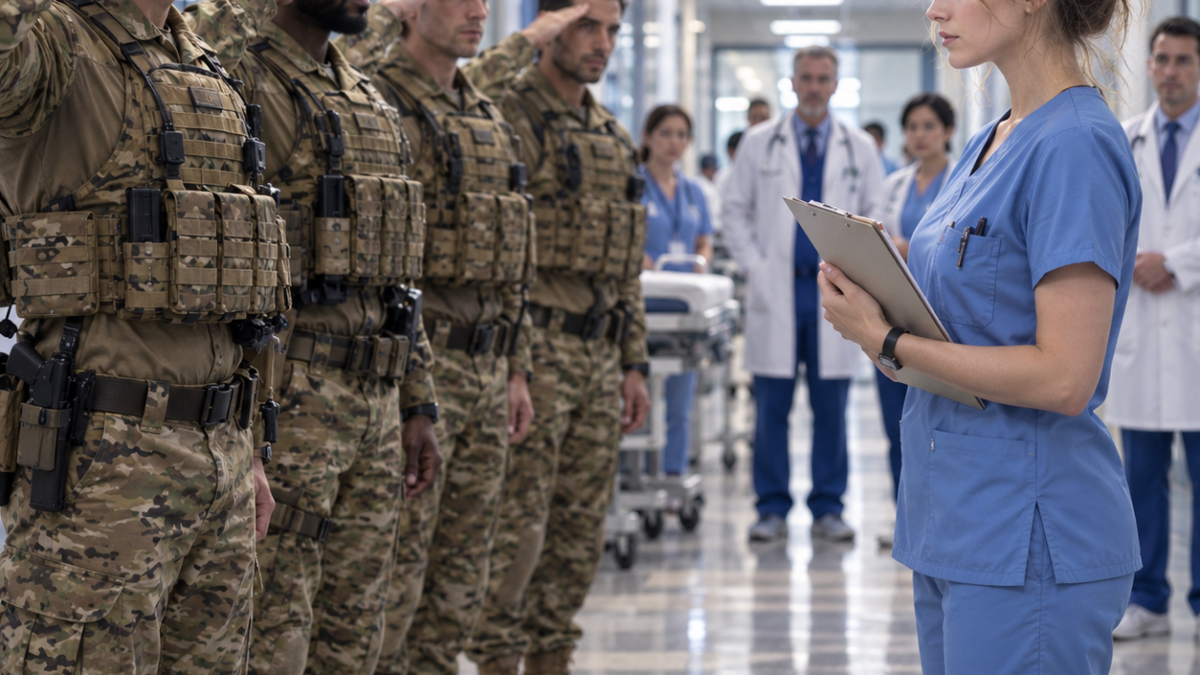
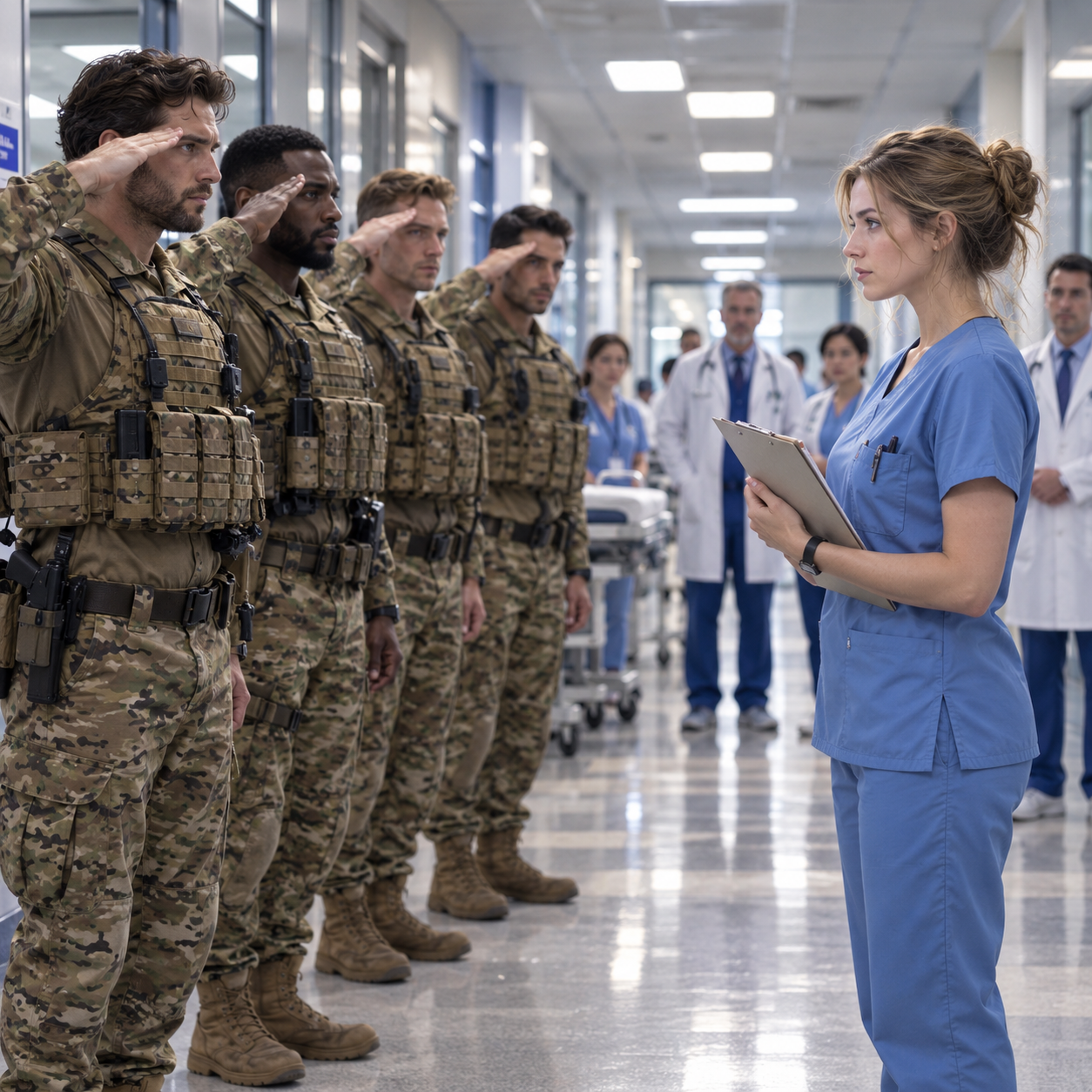
Full dress. And at the front of that formation, a decorated commander with 30 years on his face, walked straight past the automatic doors, past the stunned receptionist, past the charge nurse, reaching for a phone, and stopped in front of a 54year-old woman in faded blue scrubs holding a clipboard.
He raised his hand to his brow.
“Captain,” he said quietly, “we’ve been looking for you for a long time.
The first thing people noticed about Margaret Oay was that she was always early. Not the kind of early that announces itself.
Not the nurse who sweeps in with a travel mug and makes a performance of her punctuality. Margaret arrived before the shift change like the building itself expected her.
Coat on a hook, bag in the same bottom locker, hands washed before anyone had finished logging out of the previous night. She moved quietly through the pre-dawn corridors of Harrow Creek General.
The way water moves through familiar pipes without friction, without fuss, without drawing attention. She had worked in the trauma unit for 6 years.
She was 54. Her hair had gone mostly silver at the temples, cut short in a way that was practical rather than styled. Her badge said Margaret Oay, RN, trauma, and below that the unit number and nothing else.
No certifications listed, no honors, just the name and the role. Same as everyone else. The younger staff had their own names for her.
Nothing vicious, just the quiet, dismissive taxonomy that forms in any workplace when someone doesn’t fit the mold.
Old school. The dinosaur.
One of the third-year residents, a fast-talking kid named Dr.
Priya Anand, who had graduated top of her class and knew it, had taken to calling her the relic when Margaret wasn’t in earshot.
It wasn’t cruel.
Exactly. It was the kind of careless label that sticks when no one bothers to look closely. Margaret had heard it.
She’d heard all of them.
She didn’t say anything.
What she did was work methodically, precisely, without complaint. When a trauma bay filled up and three nurses were scrambling to manage two critical patients simultaneously, Margaret moved to the place she was needed before anyone asked.
When a new resident froze on a hemorrhaging patient at 2:00 in the morning, Margaret put her hand on the resident’s shoulder and said very calmly, “Look at me.
You’ve got this.
Talk me through what you’re seeing.”
Not because she was required to, because the patient needed it.
She’d been doing this a long time, longer than most people in that building knew.
The administrator who made her life difficult arrived in March. Dr. Dr.
Conrad Voss was 41 years old, the new chief of medical operations, and he had come to Harrow Creek General from a hospital system in the Northeast with a mandate to modernize. That was the word he used constantly, modernize. In his first week, he sat in on three trauma cases and spent more time watching Margaret than watching the patients.
Afterward, he called her into his office and told her that her technique was inconsistent with current best practices and that he’d be monitoring her performance closely.
Margaret sat across the desk from him and listened without expression.
“Do you have any questions?”
he asked.
“No,” she said.
“Do you understand the concerns I’ve outlined?”
“I understand what you’ve said.”
“Yes.”
He waited for her to push back.
She didn’t.
She stood, nodded once, and returned to the floor. That bothered him more than an argument would have.
Over the following weeks, Voss found reasons to pull her aside after every major case. A notation in a patient chart that he characterized as incomplete.
A triage decision he claimed fell outside her scope.
The way she’d improvised a pressure management technique during a bad thoracic trauma that he said hadn’t been cleared through proper channels.
Each time Margaret listened, acknowledged, and said very little.
Each time Voss left the conversation with the vague, nagging sense that he hadn’t won anything.
What he didn’t understand, what none of them understood was that Margaret Oay was not a woman who needed to win arguments.
She’d fought enough of them in places where the stakes were considerably higher than a hospital administrator’s opinion.
The case that changed everything started with a rainstorm. It had been building all afternoon. The sky over Harrow Creek pressing lower and lower until it opened up just after 8:00 in the evening.
By 9:15, the roads south of town were underwater in three places, and the pileup on Route 9 involved 11 vehicles, two jacknifed freight trucks, and a school transport van that had gone sideways into a guardrail. 42 people in varying states of injury.
The first ambulances arrived at Harrow Creek General at 9:42. The trauma unit went from quiet to catastrophic in under 4 minutes. Margaret was already pulling a second gurnie into bay 3 when the charge nurse started calling the all hands.
She had heard the radio traffic in the breakroom and had known from the way the dispatcher’s voice had tightened on certain words that this was not going to be a manageable night.
She had also noted without registering it fully until much later that two of the incoming patients were described as military contractors returning from a training exercise at a facility north of the city. That detail settled somewhere in the back of her mind and stayed there. The first hour of a mass casualty event at a midsized regional hospital is controlled chaos.
There are people who train for it, people who freeze in it, and people who seem to become most themselves precisely when it happens. Margaret was the third kind.
She moved between bays with an economy of motion that looked to the untrained eye almost slow, but nothing she did was slow. Every step had a destination. Every decision was already made by the time her hands were moving.
At 10:12, Bayour received a 38-year-old male with blunt abdominal trauma, a closed head injury, an internal hemorrhaging that wasn’t showing on the initial scan the way it should have.
The attendant on the case was Dr. Anand, who was excellent under ordinary pressure, and was visibly struggling under this kind.
The patients pressure was dropping faster than the medication was compensating, and Anand was staring at the monitor with the particular stillness of someone doing rapid math that wasn’t adding up.
Margaret came in behind her and looked at the patient. Not the monitor, the patient for about 3 seconds. His left flank, she said, look at the discoloration just below the rib line.
That’s not presenting on the scan because the bleed is slow tracking.
He needs an exploratory lap and he needs it in the next 18 minutes or you’re losing him.
Anan looked at the flank. The discoloration was there, subtle, easily missed at speed.
How did you get the O on the line?
Margaret said, “I’ll prep him.
” Anand hesitated for exactly 1 second, then moved.
She got the O on the line. The surgery happened. The patient lived.
40 minutes later, Voss appeared in the trauma bay looking for Margaret. She was working a secondary patient, a woman from the van, broken clavicle, possible internal bruising, and did not look up when he came in. Mrs.
Oay. He only ever called her that when he was in administrator mode.
Never her title.
I’m with a patient, she said.
I understand that.
I need a word when you’re finished.
I’ll be finished in about 10 minutes.
He waited. I was not good at waiting, and his impatience gave off a specific kind of heat that Margaret had learned to identify in people who were accustomed to rooms organizing themselves around their presence.
When she handed the patient off to a junior nurse and turned to face him, he didn’t bother with softening the procedure in bay 4, he said.
Dr.
Anan’s case, what about it?
You directed that patient toward surgery based on a visual assessment.
That’s not within your scope as a floor nurse, and you know that.
I offered a clinical observation to the attending physician. Margaret said she made the call.
That’s not what Dr.
Anan described. Anan Margaret noted was not in the room to speak for herself.
I suggested she look at the patients flank. Margaret said the rest was Dr.
Anan’s decision.
The patient was prepped before the attendant had formally ordered the O.
The patient would have died if we’d waited for the formal order.
Voss’s jaw tightened.
That’s not your determination to make.
Apparently, it was. It came out flatter than she intended, and she saw it land on him like a lit match.
“Mrs.
Oay,” he said, dropping his voice in the way that administrators do when they want the conversation to feel like a warning.
“I’ve been watching this pattern since I arrived.
You override your colleagues. You act outside your designated role.
You create liability exposure for this hospital and dress it up as intuition.
I’ve been patient with you because your tenure here warranted it.
But tonight, he stopped, recalibrated.
Tonight confirms what I’ve been seeing.
I’m recommending a formal performance review and a temporary reassignment off the trauma unit pending that review.
Margaret looked at him for a long moment, not angry. Not hurt.
Something quieter and more contained than either. The patient in bay 4, she said.
Do you know his name yet? Voss blinked.
That’s not the his name is on the intake sheet.
you might want to look at it before you file your recommendation. She walked back to the floor.
She didn’t explain herself.
She never did. That had always been both her greatest professional liability and the thing that kept her sane.
The refusal to justify herself to people who had already decided what she was.
What she hadn’t said because it wasn’t the right time and also because she had spent 6 years carefully not saying it.
She had seen that specific presentation of a slow tracking splenic bleed 11 times in her life.
Not in textbooks, not in simulations, in field conditions, in places that didn’t have scanners or attending physicians or O teams on standby.
In conditions where the discoloration below the rib line was the only data point you had, and you either read it correctly or the person in front of you went into irreversible shock while you were still deciding. She had read it correctly every time.
11 for 11 in location she was not permitted to disclose. The suspension letter landed in her personnel file at 11:40.
She was informed by the charge nurse, embarrassed, apologetic, that she was being reassigned to the administrative floor pending review effective the following Monday.
The charge nurse, a good woman named Deshawn, who had worked alongside Margaret for 4 years, couldn’t quite meet her eyes.
“I’m sorry,” Deshawn said.
“I pushed back for what it’s worth.”
“I know you did,” Margaret said.
“Don’t worry about it.”
She finished her shift. She charted every patient, completed every handoff, updated every file.
She did not leave a single thing undone. At 217 in the morning, with the rain still hammering the roof, and the trauma bay quieter now, just the hum of equipment and the occasional voice from the nurses station, Margaret sat in the breakroom with a cup of coffee that had gone cold and read through the suspension notice once.
Her expression didn’t change.
She had been dismissed before. She had been underestimated, questioned, redirected, and removed from situations she was more qualified to handle than anyone else in the room.
This was not the first time.
It wasn’t even close to the worst time.
She put the letter in her bag, finished the cold coffee, and was about to stand when Deshawn appeared in the doorway with a look on her face that Margaret recognized immediately as the look of someone delivering information they didn’t understand yet.
“There’s
something happening out front,” Desawn said.
“What kind of something?”
military. A lot of it. Deshaawn paused.
They asked for you by name, not your employee name. They used a different name.
Margaret set down the cup very carefully. What name did they use?
Deshawn looked at the paper in her hand as if she needed to confirm she’d read it correctly.
Captain, she said. They asked for Captain Margaret Oay. The breakroom was quiet.
The rain hit the window in irregular bursts. Margaret stood up slowly, smoothed the front of her scrubs, and walked out of the room.
The lobby of Harrow Creek General was not a large space.
A regional hospital serving a midsize city didn’t require grand architecture, but it felt smaller than usual.
And it felt smaller because seven men in Navy dress uniform were standing in it, taking up the particular kind of space that comes not from physical size, but from absolute stillness.
They weren’t at parade rest.
They weren’t performing anything.
They were simply present in the way that people are present when they’ve come somewhere with a clear purpose.
The man at the front had the face of someone who had made difficult decisions in difficult places and had learned to live with every one of them. He was perhaps 60, broad- shouldered with the kind of posture that military service installs in a person so deeply it never fully leaves.
When he saw Margaret come through the internal doors, he straightened an almost imperceptible shift and raised his right hand to his brow.
“Captain Oay,” he said.
The lobby was quiet enough that everyone within 20 ft heard it clearly. Behind the reception desk, the night shift administrator had stopped typing.
Desawn, who had followed Margaret out, made a sound that wasn’t quite a word.
Margaret stopped 3 ft in front of the commander and looked at him steadily. Commander Ashby, she said.
It’s been a while.
Yes. She glanced at the men behind him, reading faces quickly the way she had always read everything quickly. How bad is it?
Petty Officer Trann is in surgery right now. Bay 4. He went in about an hour ago.
Ashby paused. He was the one you flagged for the exploratory lap. The silence that followed that sentence had a particular texture.
He came around briefly in transport, Ashb continued. enough to say one thing to the corman.
He said, “Find her.”
He gave your name, “The name we knew you by.”
Something moved in the commander’s expression.
Not quite a smile, not quite grief. Something between them.
Took us 40 minutes to cross reference that with the civilian records.
“Your cover’s thorough, Captain, but his was a very specific request.”
Margaret said nothing for a moment.
“How do you know it’s the same person?”
she asked, though she already knew the answer. Ashby reached into the breast pocket of his jacket and produced a photograph. He held it out to her.
She took it, looked at it. It was her, younger, not by a small margin.
In the photograph, she was wearing field gear, not scrubs, standing outside a forward medical station somewhere with a landscape that had no reference points a civilian would recognize.
Beside her was a young man, 19, maybe 20, looking at the camera with the particular expression of someone who has just survived something and hasn’t fully processed it yet.
She remembered that day. She remembered exactly what had happened that day.
He kept this,” she said.
Apparently, she handed the photograph back. behind her.
She was aware that the lobby had acquired additional observers, the night supervisor, two nurses who’d been heading home, the janitor who cleaned the corridors between 2:00 and 4:00 in the morning, and who had stopped his cart near the hallway entrance and was watching with open curiosity, and Conrad Voss, who had appeared from somewhere, possibly still in the building finalizing his recommendation, and was
standing near the corridor to the administrative wing with an expression she couldn’t fully read from this distance, but which contained the particular quality of a man encountering something that doesn’t fit the framework he’s been operating inside.
She turned back to Ashb.
He’s going to be all right, she said.
The surgery is straightforward. The attendant on the case is Dr.
Anand, and she’s excellent.
I know. Ashby nodded.
We’re not here for the surgery, Captain.
Then why are you here? He looked at her directly. Because the record needs to be set straight and because Marcus Tran asked us to be.
She studied his face for a moment.
That’s not your call to make, she said carefully.
And it’s certainly not mine.
No, Ashb agreed.
But it’s his, and he made it before he went under.
He glanced briefly at the corridor behind her, in the direction of Voss, she realized, and then back to her.
We’re not leaving until we’ve said what needs to be said.
The lobby of Harrow Creek General at 2:30 in the morning had the particular quality of a space holding its breath. Margaret Oay stood in the middle of it in her faded blue scrubs with her employee badge that listed only her name and unit number and nothing else and looked at the row of men in dress uniform who had driven through a storm to find her.
She had spent 6 years making herself small in this building. 6 years letting the bosses of the world file their reports and schedule their reviews and use their institutional authority as a blunt instrument against competence. They were too insecure to properly evaluate.
She had done it because she’d wanted the quiet life.
She had earned the right to the quiet life.
She had paid for it in ways that didn’t fit neatly into any personnel file.
But Marcus Trann was in bay 4, 19 years old the first time she’d seen him.
38 now apparently, which meant time had continued passing while she wasn’t watching it, and he had gone into surgery with enough consciousness left to ask for her.
She exhaled slowly.
“All right,” she said.
“Not in the lobby.
There’s a family consultation room on the second floor that’s empty at this hour.
We can talk there. She turned toward the elevator without looking at Voss.
She didn’t need to.
She could feel the shift in the room. The way the air changes when a story that was going one direction suddenly goes another. She had felt it before in smaller rooms, in darker places.
The moment when the version of events that the powerful people have agreed upon starts to develop cracks too large to paper over. She pressed the elevator button.
The door opened, and somewhere above her, in a surgical bay that smelled of antiseptic and warmed saline, a man who had trusted her with his life twice, was breathing steadily under general anesthesia, not knowing yet what she had already done for him tonight, or what the men downstairs were about to do for
her, not knowing yet what she had already done for him tonight, or what the men downstairs were about to do for her. The elevator opened on the second floor to a corridor that smelled of floor cleaner and recycled air.
The overhead lights dimmed to the nighttime setting that gave everything a slightly underwater quality. Margaret walked ahead of the group without looking back to confirm they were following. She knew they were.
She could hear the particular cadence of military footfall, even in a carpeted hospital hallway, even in dress shoes rather than boots.
There was a rhythm to it that she recognized the way other people recognized music they’d grown up hearing.
The family consultation room was at the end of the hall, past the cardiac ward, and a small waiting area with chairs arranged around a television that was cycling through a muted weather broadcast. She pushed the door open, hit the light switch, and stood aside while Commander Ashb and two of his men entered. The others remained in the corridor, a decision Ashb made with a single hand gesture that the men obeyed without question or discussion.
The room was not designed for this kind of meeting. It was designed for delivering bad news to people who were already in shock. Soft chairs, a box of tissues on the side table, a painting of a lake on the wall that was meant to be calming and mostly just looked like it had been chosen by someone who had never experienced actual grief.
Margaret pulled one of the chairs out from the low table and sat in it the way she sat in most chairs. Forward, not back. Weight on the front edge, occupying as little space as possible.
Ashb sat across from her. His two men stood near the door. He put a folder on the table.
He didn’t open it immediately.
How long have you been here? He asked. Arrow Creek.
6 years. Before that?
St.
Augustine’s in the valley.
2 years. Before that, I took some time.
How much time? About a year, she paused. I needed a year.
He nodded slowly, and in that nod was an acknowledgement of something that didn’t need to be stated directly, that the kind of work she’d done before the civilian life had a cost that was specific and non-transferable, and that a year was not very long to pay it.
Marcus wasn’t the only one who kept track of you, Ashb said.
You should know that.
I’d rather not know it, actually.
I understand, but it’s true.
He leaned forward slightly. There are nine men and four women still active who completed their advanced trauma training under your instruction in the 12 months before you separated. Every one of them has at some point in the last 6 years asked where you went and and what did you tell them?
That you’d made a choice and that the choice deserved to be respected.
He paused.
That held for a while until Marcus got hurt tonight and decided it didn’t hold anymore.
Margaret looked at the folder on the table.
What’s in that?
Some of it, you know, some of it might surprise you. He tapped the cover.
We’ll get to it.
First, I need to know what happened tonight before we arrived. The full version.
She almost said, “The full version isn’t your business.”
But she didn’t because Marcus Tran was lying in a surgical bay one floor below them, and the man sitting across from her had driven through a rainstorm with six other people because a soldier who trusted her had asked him to, and that deserved something more than deflection.
So, she told him.
She told him about Voss, about the pattern of it, the slow erosion, the way institutional authority operates when it’s wielded by someone who is more threatened by competence than interested in it.
She kept it factual, stripped of editorial.
She told him about Bayour, about Anand, about the call she’d made on the bleed and what it had cost her within the hour.
She told him about the suspension letter in her bag, which she hadn’t read again since the breakroom and didn’t intend to until she was ready to deal with it in the morning.
Ashb listened without interrupting. One of his men near the door had produced a small notepad at some point and was writing things down.
She noticed it and didn’t object.
When she finished, Ashb was quiet for a moment.
The patient in Bay 4, he said, “Before you knew who he was.
You made the same call you would have made for anyone.”
“Yes, because you read the presentation.
Because I’ve seen it before and I knew what it meant.”
11 times, Ashb said. She looked at him. I read your field reports, he said simply.
All of them years ago when you were still active. 11 splenic presentations in austere environments.
11 correct calls. No imaging, no O, no attending on backup. He let that sit.
And tonight, in a fully equipped regional trauma center, your administrator filed a performance review because you use the same skill set to save the same kind of injury.
It’s more complicated than that.
It always is. He opened the folder, which is why this needs to stop being your problem alone.
What was inside the folder was not what she expected. She had assumed in the elevator that this was going to be a record retrieval.
The Navy producing documentation of her service history to validate her clinical background in the face of Voss’s review, a professional credential play, clean, procedural, the kind of institutional machinery she understood.
It wasn’t that.
The top sheet was a formal complaint already filed with the state medical board bearing a case number and a timestamp from earlier that evening before the accident on Route 9 before any of tonight’s events.
The complaint was against Harrow Creek General’s chief of medical operations and it contained a detailed account of clinical interference, scope manipulation, and documented patient endangerment across 17 cases over the past 8 months.
Margaret read the first page, then the second.
This isn’t about me, she said.
No, Ashb said. Not entirely. Who filed this?
The families of three patients who died in cases where the clinical record doesn’t match the care provided and two nurses who were terminated in the last 4 months.
He paused. One of them is a former corman. She reached out to us 3 weeks ago because she recognized something in the incident reports.
The way certain decisions were being attributed, the way documentation was being revised after the fact.
It’s a pattern she’d seen before in a different context.
Margaret set the pages down on the table.
You’ve been watching this hospital, she said.
It wasn’t an accusation.
It was a realization.
We’ve been watching Conrad Voss, Ashby said since before he came to Harrow Creek.
His previous posting had similar irregularities. Nothing that rose to a criminal threshold on its own. But the pattern across institutions, he shook his head.
The board complaint is the formal piece.
There’s also an inquiry from the state health authority and as of 6 hours ago, an interest from the federal health oversight division because two of the patient files involved individuals who were receiving care under military health coverage.
Margaret sat back in the chair for the first time. She looked at the ceiling, the drop tiles, the fluorescent panel, the generic institutional nothing of it, and breathed out slowly through her nose.
He was going to move me to administrative, she said, off the floor. Yes. which would have removed me from any cases where I might observe what he was doing.
That’s the working theory.
And Marcus Tran coming in tonight changes the timeline, Ashby said, because now there are questions being asked about who flagged the injury correctly and why the person who flagged it was simultaneously being suspended
for overstepping her role. He looked at her steadily.
The performance review Voss filed creates a paper trail he didn’t intend to create.
It puts your clinical judgment in documented opposition to his administrative authority at the exact moment a federal patient is being treated.
That’s not a favorable position for him to be in right now.
The consultation room was very quiet.
Margaret thought about Deshaawn’s face when she delivered the suspension notice, the embarrassment in it, the apology.
Deshawn had been watching Voss operate for 8 months and had not had the framework to name what she was seeing.
She thought about Anand, who was excellent and ambitious, and who had, Margaret now realized, been navigating Voss’s management style by making herself smaller and faster and more differential than her training warranted.
She thought about the two nurses who had been terminated.
She didn’t know their names.
That felt wrong. The nurses who were let go, she said.
What are their names? Ashby checked the folder. Patterson and Reeves.
I don’t recognize Patterson.
Reeves? Is that Sandra Reeves? Dark hair, about my height, worked the overnight trauma rotation.
That’s her.
Margaret remembered Sandra Reeves. Capable, direct, occasionally impatient in the way that competent people become impatient when surrounded by process that serves administration rather than patients. She had left in November, and the official reason had been restructuring of overnight staffing, and no one on the floor had believed it, but no one had said anything loud enough to matter.
She needs to be part of whatever comes next.
Margaret said she’s already been contacted.
Ashb said she’s cooperating with the inquiry.
There was a knock at the consultation room door.
One of the men near the wall opened it and a young officer stepped in and leaned close to Ashby’s ear.
Ashb nodded twice, then looked at Margaret.
Surgery’s finished, he said after Dr.
Anan’s closing.
Marcus is stable.
Something she’d been holding in her chest without realizing it released.
Good. she said.
It came out quieter than she meant it to.
He’s going to want to see you, Ashby said.
When he’s out of recovery.
That’s his choice.
I know.
I’m telling you so you’re not caught off guard.
She looked at him.
I’ve been caught off guard twice in the last 4 hours, commander.
I think I’ve met my quota.
It was the first thing she’d said all night that had any warmth in it, and it surprised both of them slightly.
Ashb almost smiled. Almost.
There’s one more thing,” he said, and reached into the folder again.
This time, what he produced was a single sheet. Not official, not a form, not stamped or case numbered. It was handwritten.
The handwriting was uneven, pressured in places, the kind of writing that happens when someone is working against a physical limitation and is determined to get the words down. Anyway, he held it out.
She took it. It was addressed to her, not to Captain Oay, not to the nurse in bay 4, just to Margaret, in the way that people who know you well enough dispense with titles entirely. She read it without moving.
The room was quiet enough that the building’s ventilation system was audible, a low, consistent push of recycled air through the vents near the ceiling.
When she finished, she folded the paper once and held it in both hands with a steadiness that was not effortless, but was practiced.
“He wrote this in the ambulance?”
she asked. He dictated it to the corman. The corman wrote it down.
Ashby paused. He had to stop twice, but he finished it.
She didn’t ask what the stopping was about.
She understood what kind of physical state Marcus Tran had been in during that ambulance ride, and she understood what it cost a person to push through that state to finish a sentence they decided needed finishing. She put the letter in the pocket of her scrubs against her chest.
“All right,” she said, and stood.
Ashb stood as well.
“What happens now isn’t your burden to carry alone,” he said.
“I want you to understand that clearly.”
“I’ve been carrying things alone for a long time,” she said.
“Old habit.
” “I know, but this one has more people attached to it than you’re aware of.”
She picked up her badge from where it had slipped to the table’s edge, clipped it back to her scrub top, and moved toward the door.
In the corridor, the other four men were exactly where they’d been, unhurried, present, patient in the particular way of people who understand that some things take the time they take, and rushing them doesn’t change the outcome.
She walked back toward the elevator without any clear plan about what she was going to do when she reached the ground floor. She knew Voss was still in the building.
The suspension notice had been filed digitally, which meant he was likely in his office or near the administrative wing, doing the kind of paperwork that people do when they want a paper trail that validates their version of events before any other version can gain traction.
She knew that what was in Ashby’s folder changed the weight of that paperwork significantly.
She also knew that institutional machinery moves slowly and that a federal inquiry and a state board complaint, however serious, did not mean that Conrad Voss would walk out of Harrow Creek General tomorrow morning having lost anything. He had lawyers.
He had the board’s procedural difference.
He had 8 months of maneuvering that had been careful enough to survive this long. The elevator opened on the ground floor. The lobby was different than it had been 40 minutes ago.
The receptionist at the night desk had been joined by the hospital’s weekend manager, a man named Gary Ostrouski, who was technically on call, but who Margaret had never seen actually called at 2:00 in the morning before.
Ostrouski was talking to one of Ashby’s men near the main entrance with the expression of someone doing extremely rapid calculations about institutional liability.
Two of the nurses who had been heading home were still there, standing near the vending al cove, not pretending to have a reason to stay, but not leaving either.
Deshawn was at the nurse’s station.
She looked up when Margaret came off the elevator and her face did something complicated.
“He’s stable,” Margaret said before Deshawn could ask.
“Thank God.”
She paused, caught herself.
“That’s I’m really glad.”
“So am I.”
Desawn looked past her at the men in uniform filtering out of the elevator behind her, then back to Margaret.
“What’s happening?”
“I’m not entirely sure yet,” Margaret said.
But I think you should document every interaction you’ve had with Voss in the last 8 months formally in writing starting tonight.
Deshawn’s eyes sharpened.
Is this about the Patterson thing and Sandra? It might be connected.
Yes.
I’ve been thinking about that for months.
I didn’t think she stopped.
I know. Margaret said document it anyway. Time stamp it.
Don’t edit.
She moved toward the trauma unit. Not because she was back on shift.
She wasn’t.
Technically, she was suspended, but because there were still patients in those bays who had come in tonight and whose care she understood better than anyone currently on the floor, and because the suspension notice in her bag had not yet been formally processed, which meant she was still technically on hospital grounds in a professional capacity, and she was
going to be useful for exactly as long as that technicality held. She pushed through the trauma unit doors. The bay that had been Marcus trans was empty now, cleaned and reset.
The gurnie stripped and remade with the speed that hospital support staff develop when efficiency is the only option. Bay 3 held a teenager with a broken femur who was sleeping through a morphine drip.
Bay 2 had an older man, the driver of one of the freight trucks, she’d learned earlier, who had come through the windshield and was concussed and lacerated across the scalp, but otherwise intact in ways that were frankly improbable.
Bay 1 was empty.
She moved to the central station and pulled up the active chart on the truck driver, reviewing the overnight notes with the automatic attention of someone for whom other people’s charting is a readable language.
The resident at the station, a secondyear named Tobias, who looked like he hadn’t slept since Thursday, glanced at her and then back at his screen with the look of someone choosing not to ask questions.
“Anything I should know about 14B?”
she asked, not looking up from the chart.
“Pressure’s been consistent since 11,” Tobias said.
He’s been asking for his dog.
His dog is presumably not in the hospital.
No, his wife’s been called.
She’s about 2 hours out.
A pause. He keeps asking anyway.
Noted in the chart, it matters. Does it?
When people wake up disoriented after head trauma and they have a fixation on something, a person, an animal, a specific object, that fixation is usually the thing closest to the core of who they are.
If he’s asking for the dog, the dog is what’s going to stabilize him when he surfaces properly.
Note it. Tell the wife when she arrives. She handed the tablet back.
It matters. Tobias wrote it down. She moved through the rest of the bay, checking monitors, adjusting a drip rate on the teenager that was slightly high for her weight, noting a respiratory irregularity on the truck driver that could be managed conservatively or could be the early edge of something that would need intervention in the next 2 to 3 hours.
She flagged it in the chart with a note detailed enough that whoever came on after her would have everything they needed to make the call. She did not think about Voss.
She did not think about the folder Ashby had laid on the consultation room table. She did not think about the letter folded against her chest or about what Marcus Trann had dictated to a corman in an ambulance while bleeding internally at a rate that should by clinical probability have made coherent speech impossible. She thought about the patients in front of her and what they needed next.
That was the work. That had always been the work. At 4 in the morning, she became aware that she was not alone.
She had been aware of the lobby’s changed energy for some time, the sound levels, the movement at the periphery, but she had been focused and had not tracked it closely.
Now, stepping out of bay 3 after checking the teenager’s vitals, she looked toward the internal corridor and saw that there were people in the hallway who were not hospital staff.
Not the Navy men, different people. A man and a woman in civilian clothes with the specific posture of people who are working, not waiting, working.
The woman was on a phone. The man was reviewing something on a tablet.
They were not visible to the administrative wing from this angle, which Margaret suspected was not accidental.
Behind them, further down the corridor, she could see Gary Ostraki in conversation with a person she didn’t recognize at all.
younger with a lanyard that wasn’t the hospital’s standard issue, and a carry bag that looked more like a document case than anything medical.
She looked at all of this for about 4 seconds. Then, Commander Ashby appeared at her left elbow, which she had not heard him approach, and which told her she was more tired than she had assessed.
“State health investigator,” he said quietly, nodding toward the woman on the phone.
“The man with the tablet is from the federal oversight office.
They were already on route when we got here. The inquiry had already been escalated before tonight. Marcus being admitted here just he paused accelerated the timeline.
How much of this was already in motion? She asked more than you know.
That’s not an answer.
It’s the honest one.
He glanced at the corridor. Voss is still in his office.
He hasn’t been informed yet that the investigators are here.
When? Probably within the hour.
She processed this. The hour.
Voss sitting at his desk, filing his paperwork, building his version of tonight’s events, unaware that the version was becoming irrelevant in real time.
That the machinery he’d been operating inside had developed a fracture he couldn’t paper over because the fracture had been documented from the outside by people with authority he couldn’t reassign or suspend.
She felt something that was not satisfaction.
She didn’t have the energy for satisfaction, and she wasn’t sure she’d have had it anyway.
It was more like recognition. The specific feeling of watching a system correct itself after a long misalignment. Not clean, not simple, but directionally right.
There’s something else.
Ashby said. She looked at him.
The board member who approved Voss’s original appointment, he said.
We have documentation that suggests the appointment bypassed two qualified internal candidates and that Voss’s references were not independently verified the way the process required.
He stopped.
One of the bypassed candidates was a woman who’d been with the hospital for 11 years.
She left the field entirely after she didn’t get the role.
Her name was Dolores Web.
Margaret didn’t know that name, but she knew the shape of what Ashb was describing.
She had seen it before in smaller forms. The quiet structuring of systems to produce specific outcomes while maintaining the appearance of process. The genius of it was that it looked procedural.
It looked like institutional rigor until you pulled one thread and the whole weave came apart. Is Webb part of the inquiry? She asked.
She will be. Someone should call her. Someone already has.
She turned back toward the bay. She was going to keep working.
That was the only thing that made sense to her right now.
to keep working until someone formally told her she couldn’t or until the morning shift arrived or until whatever was building in the corridors of this hospital at 4 in the morning reached whatever conclusion it was building toward.
She had taken three steps when the trauma unit doors opened from the corridor side and Dr. Priya Anand walked in.
Anand was still in surgical gear, hadn’t changed, probably hadn’t stopped moving since bay 4.
She looked like someone who had been running on adrenaline for 3 hours and was now becoming acquainted with what existed on the other side of adrenaline. She spotted Margaret and crossed the bay without hesitation.
“He’s in recovery,” she said.
“I heard.”
“Thank you.”
Unun stopped, she looked at Margaret with an expression that had several things in it that she was clearly working out how to say.
“And this was not a woman who typically struggled to say things.
” “The call you made,” she said finally.
on the flank. You made the call, Margaret said.
I offered an observation.
Don’t, Anunan’s voice was short.
Not angry. Something more effortful than anger. The sound of someone insisting on accuracy.
I’ve been practicing medicine for 9 years, and I missed that presentation.
You saw it in about 3 seconds, and you knew exactly what it was. She paused.
Where did you? She stopped herself. looked at the door where Ashb was visible in the corridor beyond.
Looked back. He kept saying your name in preop.
He was barely conscious and he kept saying it. He was a former patient.
Margaret said from here. No, from before. Anand absorbed this.
She looked at Margaret the way she had probably looked at texts in medical school that contained more information than the surface reading suggested. Turning it over, looking for the full weight of it. The military records, she said carefully.
Ashby said something about military records when I passed him in the hall. He said your clinical expertise had been documented in environments that she paused.
He said austere environments. That was the phrase.
It was how austere Priya. It was the first time Margaret had used her first name and it landed with a quietness that Anand clearly registered.
There’s going to be a process formal.
You’ll hear what you need to hear through that tonight.
She looked at the bay around them, the monitors, the two sleeping patients, the resident still at the station trying not to appear like he was listening. Tonight, I need you to do something for me.
What? Write up the Bayour case exactly as it happened. Your own words, your own recollection, timestamped before you sleep on it, and before anyone from administration suggests how to frame it.
The full account. Anan stared at her.
Is something happening with Voss? just document the case, Margaret said accurately tonight.
The look that crossed Anan’s face was complicated.
Something between understanding and alarm and the particular expression of a person who had been half aware of a problem for a long time and was now confronting the possibility that their half awareness had been a form of complicity.
“Okay,” she said quietly.
“Okay.”
She left through the trauma unit doors and her footsteps in the corridor were quick and purposeful. Heading back toward the surgical wing, Margaret stood in the bay for a moment in the particular stillness of a night that had gone far past what any reasonable person would call a shift.
She was suspended. She was operating on somewhere between 2 and 3 hours of sleep from the night before.
There were federal investigators in the corridor, military personnel in her lobby, a state inquiry gathering momentum in the administrative wing, and a man in the recovery room one floor up who had found her name in his memory at the moment when the cost of keeping things inside had become higher than the cost of saying them out loud. And in his office at the end of the administrative corridor, Conrad Voss was still writing his report. The door to the trauma unit opened from the corridor.
Not a nurse, not a physician.
Conrad Voss stepped into the trauma bay in his administrator’s jacket, and he looked around the room with the sharp scanning quality of a man who has arrived somewhere and is rapidly assessing how much of what he expected to find is actually present.
He found Margaret. His expression went through three things in quick succession.
Surprise, recalibration, and something harder that settled into place with the deliberate quality of a decision being made in real time. Mrs.
Oay, he said, you’re not on the schedule.
No, she said the suspension notice was filed 4 hours ago.
I’m aware.
Then I don’t understand why you’re standing in my trauma unit at 4 in the morning.
The bay was very quiet. The monitors hummed.
The teenager in bay 3 breathed steadily through her morphine.
The truck driver shifted in his sleep and said something that wasn’t quite a word.
Margaret looked at Voss and thought about the folder on the consultation table upstairs. She thought about this woman on the phone in the corridor. She thought about Sandra Reeves and Dolores Web and the names of three patients whose families had filed complaints before tonight.
She thought about all of the things that were moving in this building right now quietly with the specific efficiency of institutional processes that have gathered enough evidence to act. She thought about saying none of this to Conrad Voss. She said something else instead.
Your investigators are here, she said. Not mine, the States. Voss went very still.
They’re in the corridor outside administrative.
She said they’ve been here for about 20 minutes.
I’d estimate you have another 30 before someone formally notifies you, but that’s a guess.
The color in Voss’s face shifted in a way she had seen before.
And people who have built something carefully over time and have just heard the specific sound of it beginning to come down. What investigators, he said, and his voice was nearly steady.
Nearly. You should go find out, Margaret said.
I have patience to monitor. She turned back to the bay. Behind her, she heard the trauma unit doors open and then close and then the particular sound of footsteps moving fast down a corridor.
Not running, not quite, but close in the direction of the administrative wing. She exhaled. The monitors kept humming.
In the recovery room, Marcus Tran’s blood pressure held steady at numbers that said he was going to make it through the night and through the weeks after that and probably quite a few years beyond that.
Though no one in the building knew yet what those years were going to look like or what the morning was going to look like or what was going to happen when the sun came up over Harrow Creek and the administrative wing opened its doors to people who were holding a great deal of carefully assembled paperwork and the authority to use it. Margaret knew one thing. She was done being small.
She didn’t announce it.
She didn’t say it out loud to anyone in the room.
She just stood in the trauma bay with her badge and her faded scrubs, monitoring two patients who needed her, and let the knowledge settle into her the way certainties do when they’ve been true for a long time and have finally run out of reasons to hide.

